

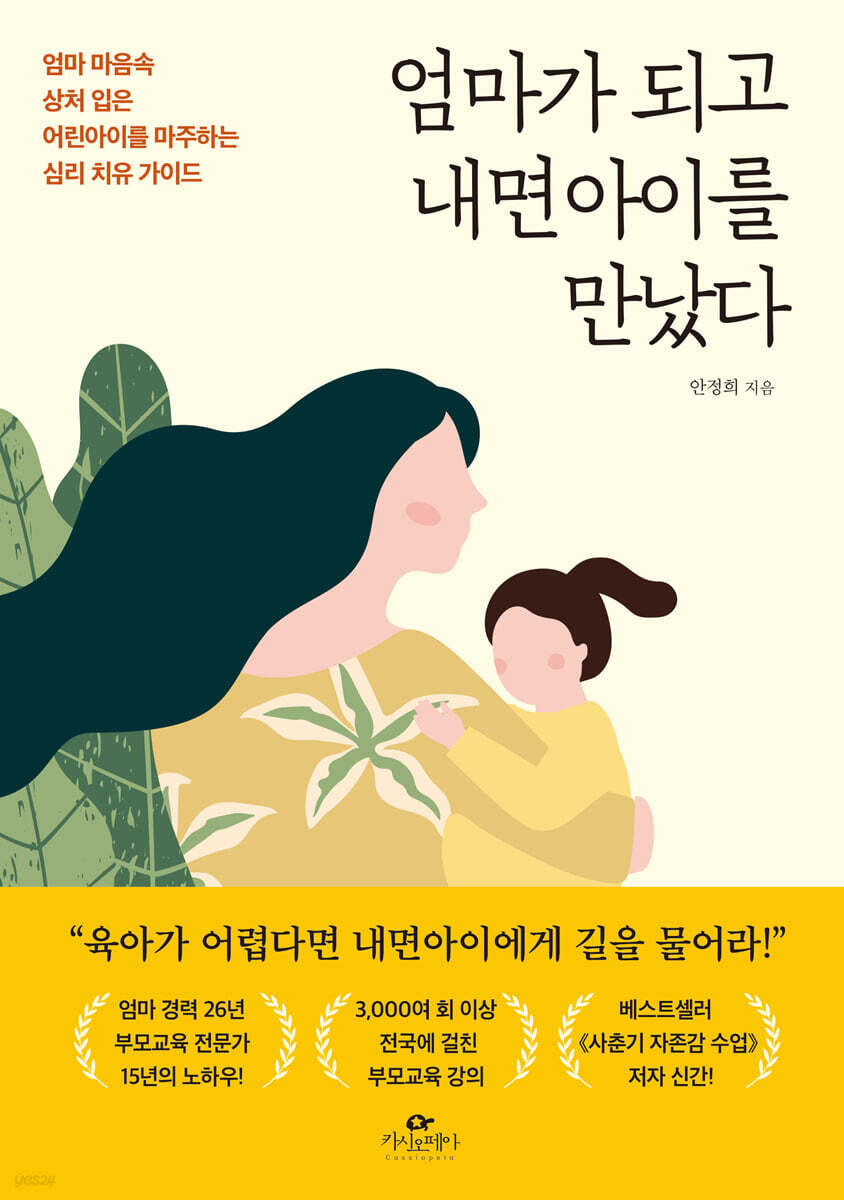
Becoming a mother and meeting my inner child
 |
Description
Book Introduction
“If parenting is difficult, you should ask your inner child for guidance!”
For mothers whose bodies have grown but whose hearts have not yet fully matured
A warm message of healing and growth from a parenting education expert with 15 years of experience.
Parenting is often said to be 'the wondrous experience of living childhood twice.'
Also, it is clear that to a mother, a child is a precious being that she cannot bear to hurt even if she puts it in her eye.
But for some mothers, parenting can be painful and full of regrets.
When you see yourself acting and feeling differently from the "good parenting" methods that countless media and books teach, you may feel confused and even guilty.
So, does the difficulty of raising children stem solely from a lack of motherly ability? Or is it simply a lack of parenting experience? According to "Becoming a Mother and Meeting My Inner Child," that's absolutely not the case.
The author, a parenting expert with 15 years of experience and a mother herself with 26 years of experience, diagnoses that the reason mothers struggle with raising their children is because their psychological growth has stopped at a certain stage of development due to the deficiencies and wounds they experienced during their childhood.
The reason parenting is difficult is not in the 'here and now'.
The problem is the 'inner child' within the mother.
The inner child is literally the "child trapped inside," a being that lives hidden away in the place where our psychological growth has stalled, exerting great influence throughout our lives.
Especially during the parenting process, the inner child tries to exert a strong influence.
But I must not let my immature inner child raise my child.
Otherwise, the wounds and deficiencies within the mother are passed down to the child and repeated.
"Becoming a Mother and Meeting My Inner Child" begins with meeting the wounded child within a mother and then offers step-by-step, concrete suggestions on how to care for and nurture that being.
To this end, we actively utilize proven theories and tools, such as Erik Erikson's stages of psychosocial development and Jeffrey Young's 11 Traps of Life.
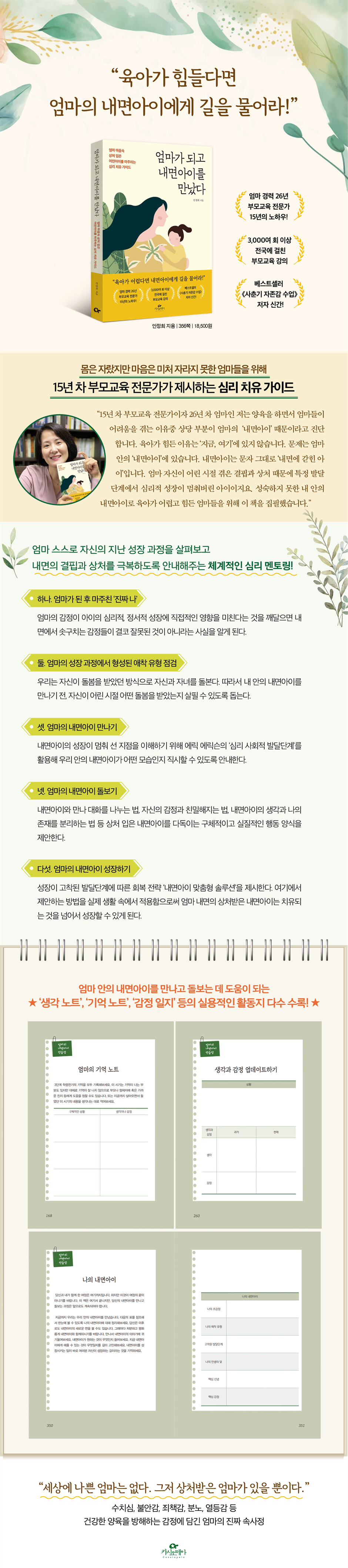
Additionally, we have included a number of colorful and practical activity sheets (aka 'Mom's Inner Child Practice Sheets') so that mothers can sufficiently meet and practice caring for their inner child on their own.
By following the author's systematic and practical advice and repeatedly practicing reflecting on and nurturing your inner child in your daily life, you will not only overcome the wounds and deficiencies of childhood, but also achieve a deeper understanding of yourself.
Through this, you will be able to fulfill your role as a mother well, and at the same time, you will gain the strength to live a cool and proud life as a human being.
For mothers whose bodies have grown but whose hearts have not yet fully matured
A warm message of healing and growth from a parenting education expert with 15 years of experience.
Parenting is often said to be 'the wondrous experience of living childhood twice.'
Also, it is clear that to a mother, a child is a precious being that she cannot bear to hurt even if she puts it in her eye.
But for some mothers, parenting can be painful and full of regrets.
When you see yourself acting and feeling differently from the "good parenting" methods that countless media and books teach, you may feel confused and even guilty.
So, does the difficulty of raising children stem solely from a lack of motherly ability? Or is it simply a lack of parenting experience? According to "Becoming a Mother and Meeting My Inner Child," that's absolutely not the case.
The author, a parenting expert with 15 years of experience and a mother herself with 26 years of experience, diagnoses that the reason mothers struggle with raising their children is because their psychological growth has stopped at a certain stage of development due to the deficiencies and wounds they experienced during their childhood.
The reason parenting is difficult is not in the 'here and now'.
The problem is the 'inner child' within the mother.
The inner child is literally the "child trapped inside," a being that lives hidden away in the place where our psychological growth has stalled, exerting great influence throughout our lives.
Especially during the parenting process, the inner child tries to exert a strong influence.
But I must not let my immature inner child raise my child.
Otherwise, the wounds and deficiencies within the mother are passed down to the child and repeated.
"Becoming a Mother and Meeting My Inner Child" begins with meeting the wounded child within a mother and then offers step-by-step, concrete suggestions on how to care for and nurture that being.
To this end, we actively utilize proven theories and tools, such as Erik Erikson's stages of psychosocial development and Jeffrey Young's 11 Traps of Life.
Additionally, we have included a number of colorful and practical activity sheets (aka 'Mom's Inner Child Practice Sheets') so that mothers can sufficiently meet and practice caring for their inner child on their own.
By following the author's systematic and practical advice and repeatedly practicing reflecting on and nurturing your inner child in your daily life, you will not only overcome the wounds and deficiencies of childhood, but also achieve a deeper understanding of yourself.
Through this, you will be able to fulfill your role as a mother well, and at the same time, you will gain the strength to live a cool and proud life as a human being.
- You can preview some of the book's contents.
Preview
index
Prologue: The reason parenting is difficult isn't in the "here and now."
Chapter 1: The Real Me I Faced After Becoming a Mother
A child grows up feeding on his mother's emotions.
Mom's old feelings, shame
Angry Mom and Angry Mom
The heaviest emotion in the world: maternal guilt
A mother's super emotions that only she doesn't know
[Mom's Inner Child Workbook] Flower Diary
Chapter 2: Attachment: Words I Can't Say Because I've Never Heard Them
There is no problem mom
Mother is a safe haven for her child
Mother's attachment is ongoing
[Mom's Inner Child Workbook] Mom's Thought Notebook
Chapter 3: Meeting Your Inner Child
In Search of Mother's Inner Child: Psychosocial Development Stages and Life's Traps
A mother who wants to resign right now
[Mom's Inner Child Workbook] Mom's Thought Notebook
Stage 1: Infancy: A mother who is still unfamiliar with the world and anxious.
[Mom's Inner Child Workbook] Mom's Memory Notebook
Stage 2 Toddlerhood: The Mother Who Swings Between Shame and Anger
[Mom's Inner Child Workbook] Mom's Memory Notebook
Stage 3: Preschoolers: The Mom Who Pushes Them Too Hard
[Mom's Inner Child Workbook] Mom's Memory Notebook
Stage 4: School-Age: Moms with Low Self-Esteem
[Mom's Inner Child Workbook] Mom's Memory Notebook
Stage 5: Adolescence: The Mother Who Lost Herself
[Mom's Inner Child Workbook] Mom's Memory Notebook
Different coping strategies for each inner child
[Mom's Inner Child Workbook] Organizing Memories
Chapter 4: Caring for a Mother's Inner Child
Step 1: Talk to Your Inner Child
Step 2: Becoming Intimate with Your Emotions
Step 3: Set boundaries for your thoughts
[Mom's Inner Child Workbook] Updating Your Thoughts and Emotions
The best tool for inner observation: the emotional journal
[Mom's Inner Child Workbook] Emotion Journal & ABCC Emotion Strategies
Chapter 5: Growing a Mother's Inner Child
Stage 1: Infancy: Choosing to Love Myself
[Mom's Inner Child Workbook] Writing Therapy
Stage 2: Toddlerhood: Expressing and asserting oneself freely
[Mom's Inner Child Workbook] Writing a Letter You Won't Send
Stage 3: Preschool: Taking Responsibility for Your Actions and Choices
[Mom's Inner Child Practice Book] Building My Fence
Stage 4: School Age: I Have the Right to Fail
[Mom's Inner Child Workbook] Redesigning Failure
Stage 5: Adolescence: Designing Mom's Future
[Mom's Inner Child Workbook] My Future Diary, Written in Advance
[Mom's Inner Child Workbook] My Inner Child
Epilogue: Supporting the growth and healing of all mothers in the world
Chapter 1: The Real Me I Faced After Becoming a Mother
A child grows up feeding on his mother's emotions.
Mom's old feelings, shame
Angry Mom and Angry Mom
The heaviest emotion in the world: maternal guilt
A mother's super emotions that only she doesn't know
[Mom's Inner Child Workbook] Flower Diary
Chapter 2: Attachment: Words I Can't Say Because I've Never Heard Them
There is no problem mom
Mother is a safe haven for her child
Mother's attachment is ongoing
[Mom's Inner Child Workbook] Mom's Thought Notebook
Chapter 3: Meeting Your Inner Child
In Search of Mother's Inner Child: Psychosocial Development Stages and Life's Traps
A mother who wants to resign right now
[Mom's Inner Child Workbook] Mom's Thought Notebook
Stage 1: Infancy: A mother who is still unfamiliar with the world and anxious.
[Mom's Inner Child Workbook] Mom's Memory Notebook
Stage 2 Toddlerhood: The Mother Who Swings Between Shame and Anger
[Mom's Inner Child Workbook] Mom's Memory Notebook
Stage 3: Preschoolers: The Mom Who Pushes Them Too Hard
[Mom's Inner Child Workbook] Mom's Memory Notebook
Stage 4: School-Age: Moms with Low Self-Esteem
[Mom's Inner Child Workbook] Mom's Memory Notebook
Stage 5: Adolescence: The Mother Who Lost Herself
[Mom's Inner Child Workbook] Mom's Memory Notebook
Different coping strategies for each inner child
[Mom's Inner Child Workbook] Organizing Memories
Chapter 4: Caring for a Mother's Inner Child
Step 1: Talk to Your Inner Child
Step 2: Becoming Intimate with Your Emotions
Step 3: Set boundaries for your thoughts
[Mom's Inner Child Workbook] Updating Your Thoughts and Emotions
The best tool for inner observation: the emotional journal
[Mom's Inner Child Workbook] Emotion Journal & ABCC Emotion Strategies
Chapter 5: Growing a Mother's Inner Child
Stage 1: Infancy: Choosing to Love Myself
[Mom's Inner Child Workbook] Writing Therapy
Stage 2: Toddlerhood: Expressing and asserting oneself freely
[Mom's Inner Child Workbook] Writing a Letter You Won't Send
Stage 3: Preschool: Taking Responsibility for Your Actions and Choices
[Mom's Inner Child Practice Book] Building My Fence
Stage 4: School Age: I Have the Right to Fail
[Mom's Inner Child Workbook] Redesigning Failure
Stage 5: Adolescence: Designing Mom's Future
[Mom's Inner Child Workbook] My Future Diary, Written in Advance
[Mom's Inner Child Workbook] My Inner Child
Epilogue: Supporting the growth and healing of all mothers in the world
Detailed image
Into the book
Now that we are mothers, we must properly understand the emotions that arise within us.
Perhaps our emotions reveal us more clearly than our faces.
You can put on makeup on your face, but it's almost impossible to dress up your emotions.
Although we may not know it ourselves, we feed our children a spoonful of our emotions every day.
A child grows up eating more of his mother's emotions than food.
We learn how to process emotions from our mothers and in this way emotions are passed down.
It's like sowing beans and getting beans, and sowing red beans and getting red beans.
---From "A child grows by feeding on his mother's emotions"
There is no reason to be criticized as being immature or bad just because you are angry.
In that sense, the angry mother is not at fault.
Rather, anger is a sign of heartache.
It could be that the unresolved wounds within the mother are bursting out.
The child may have touched the mother's most painful spot without even knowing it.
In fact, it is no exaggeration to say that the most common secondary emotion a mother experiences is anger.
But getting angry is on a different level.
There is a difference between being angry and getting angry.
There is a responsibility involved when I express my anger outwardly.
At least as an adult, you must be able to take responsibility for your actions when angry.
Before that, I need to properly understand the anger rising within me.
---From "Angry Mom and Angry Mom"
When a mother's psychological and emotional energy is focused entirely on herself, her children become alienated and neglected.
If a child's very existence is not noticed by the mother and there is no place to live in peace, then healthy growth is not expected.
Problems arise when mothers do not fully understand this fact, that is, when they do not look within themselves.
They end up nagging the child, asking why he can't do better by 'transferring' his own wounds and vulnerabilities onto the child.
They see children as a burden and unwelcome presence.
The child who should be loved and cared for becomes a victim again, and the wounds are repeated.
We not only care for ourselves the way we were cared for, but we also care for our children the same way.
So, now that we have become mothers, we need to look back on our relationships with our parents during our childhood.
---From "There Are No Problem Moms"
There is no such thing as a perfect environment.
Everyone is bound to suffer wounds, big or small, as they grow up.
We call a child who cannot grow and is trapped inside the mind a 'wounded inner child.'
Our inner child lives there, where our psychological growth has stopped for whatever reason.
The inner child is created when we are not yet fully capable of responding emotionally.
In other words, the inner child is the part of us that was emotionally neglected and suffered by our parents.
---From "In Search of Mother's Inner Child"
To understand someone deeply, conversation is essential above all else.
Through conversation, we connect with each other.
Inside of us, there are children who have not yet grown up, such as children who are seriously upset and have fallen, children who are tired of crying, and children who scream and swear.
So now we need to comfort our wounded inner child.
We must listen to our inner child and comfort his or her heart.
We must help children discover their inner sense of awe and rediscover their creativity and spontaneity.
In this way, we must take care of not only the child in front of us, but also the inner child within us.
---From "Talking to Your Inner Child"
Change begins with recognizing old patterns.
Therefore, it is important to be aware of the core emotions and core beliefs that have been ingrained within us over a long period of time.
But it is equally important to properly understand the internal reality that is happening right now.
The act of noticing our own thoughts, feelings, and behavioral patterns as they arise in real time is an act of identifying our real-world problems and vulnerabilities.
If I understand this properly, I can clearly see where and how to start solving the problem I am currently facing.
Perhaps our emotions reveal us more clearly than our faces.
You can put on makeup on your face, but it's almost impossible to dress up your emotions.
Although we may not know it ourselves, we feed our children a spoonful of our emotions every day.
A child grows up eating more of his mother's emotions than food.
We learn how to process emotions from our mothers and in this way emotions are passed down.
It's like sowing beans and getting beans, and sowing red beans and getting red beans.
---From "A child grows by feeding on his mother's emotions"
There is no reason to be criticized as being immature or bad just because you are angry.
In that sense, the angry mother is not at fault.
Rather, anger is a sign of heartache.
It could be that the unresolved wounds within the mother are bursting out.
The child may have touched the mother's most painful spot without even knowing it.
In fact, it is no exaggeration to say that the most common secondary emotion a mother experiences is anger.
But getting angry is on a different level.
There is a difference between being angry and getting angry.
There is a responsibility involved when I express my anger outwardly.
At least as an adult, you must be able to take responsibility for your actions when angry.
Before that, I need to properly understand the anger rising within me.
---From "Angry Mom and Angry Mom"
When a mother's psychological and emotional energy is focused entirely on herself, her children become alienated and neglected.
If a child's very existence is not noticed by the mother and there is no place to live in peace, then healthy growth is not expected.
Problems arise when mothers do not fully understand this fact, that is, when they do not look within themselves.
They end up nagging the child, asking why he can't do better by 'transferring' his own wounds and vulnerabilities onto the child.
They see children as a burden and unwelcome presence.
The child who should be loved and cared for becomes a victim again, and the wounds are repeated.
We not only care for ourselves the way we were cared for, but we also care for our children the same way.
So, now that we have become mothers, we need to look back on our relationships with our parents during our childhood.
---From "There Are No Problem Moms"
There is no such thing as a perfect environment.
Everyone is bound to suffer wounds, big or small, as they grow up.
We call a child who cannot grow and is trapped inside the mind a 'wounded inner child.'
Our inner child lives there, where our psychological growth has stopped for whatever reason.
The inner child is created when we are not yet fully capable of responding emotionally.
In other words, the inner child is the part of us that was emotionally neglected and suffered by our parents.
---From "In Search of Mother's Inner Child"
To understand someone deeply, conversation is essential above all else.
Through conversation, we connect with each other.
Inside of us, there are children who have not yet grown up, such as children who are seriously upset and have fallen, children who are tired of crying, and children who scream and swear.
So now we need to comfort our wounded inner child.
We must listen to our inner child and comfort his or her heart.
We must help children discover their inner sense of awe and rediscover their creativity and spontaneity.
In this way, we must take care of not only the child in front of us, but also the inner child within us.
---From "Talking to Your Inner Child"
Change begins with recognizing old patterns.
Therefore, it is important to be aware of the core emotions and core beliefs that have been ingrained within us over a long period of time.
But it is equally important to properly understand the internal reality that is happening right now.
The act of noticing our own thoughts, feelings, and behavioral patterns as they arise in real time is an act of identifying our real-world problems and vulnerabilities.
If I understand this properly, I can clearly see where and how to start solving the problem I am currently facing.
---From "The Best Tool for Inner Observation, the Emotion Journal"
Publisher's Review
“There are no bad mothers in the world.
“There is just a hurt mother.”
Shame, anxiety, guilt, anger, inferiority complex, etc.
The True Story of a Mother's Emotions That Interfere with Healthy Parenting
These days, as parents only have one or two children, there are a lot more parents who are interested in parenting methods that can help them raise their children well.
In response to this atmosphere, various organizations are planning parent education programs to provide parents with quality information.
Broadcast programs featuring experts offering parenting solutions are also very popular.
However, knowing a lot about parenting methods does not necessarily make parenting in reality easier.
When anger and resentment toward their child surge up, contrary to what they know in their heads, and they are unable to control their emotions, the mother is not only confused, but also suffers even more emotionally because she wonders, "Am I really a bad parent? Am I unworthy of being a parent?"
Sometimes, we don't even have the energy to get angry, so we just watch the situation helplessly.
So, is it simply because many mothers lack the ability as mothers that they are overwhelmed by negative emotions such as anger, anxiety, guilt, inferiority complex, and shame during the parenting process and thus experience problems in parenting in general?
The author of “Becoming a Mother and Meeting My Inner Child” says that this is absolutely not the case.
The author, a mother of 26 years and a parenting expert of 15 years, diagnoses that the reason mothers have difficulties raising their children is because their psychological growth has stopped at a certain stage of development due to the deficiencies and wounds they experienced while growing up.
This is the existence that remains hidden in a place where psychological growth has stopped and influences our entire lives, which is called the 'inner child'.
The inner child is literally a child trapped inside.
The inner child has nothing to do with physical growth.
The inner child remains within us even after we become adults and exerts influence over our entire lives.
In particular, they try to stand at the forefront of parenting and take the lead.
While raising a child, a mother often encounters situations that overlap with her own childhood, and each time, the deficiencies and wounds of her inner child are unconsciously stimulated.
However, the main subject of parenting must be adults.
I must not let my immature inner child raise my child.
Otherwise, the mother's wounds and deficiencies will be passed down to her precious children.
Based on Erik Erikson's 'Stages of Psychosocial Development'
Mom looks back on her own past growth process
Systematic psychological mentoring to help you overcome inner deficiencies and wounds!
The author is a veteran parenting education provider who has conducted over 3,000 on-site education and counseling sessions over the past 15 years, meeting tens of thousands of mothers in education and counseling settings across the country.
After each lecture, a barrage of questions filled with the mothers' desperation and earnest desires poured in.
But time was limited, and some questions were too complex to answer simply; they required a deep dive into the mother's inner self.
“Becoming a Mother and Meeting My Inner Child” was planned and written to help mothers calmly meet their inner child without being bound by time.
I wanted to make sure that mothers could use this book as a tool to meet and care for their inner child without any obstacles, and that the entire process was described in detail, systematically, and specifically.
The text consists of a total of five chapters. Chapters 1-3 are organized so that you can practice how to meet your inner child, and Chapters 4-5 are organized so that you can practice how to care for your inner child.
In Chapter 1, we learn about the 'real me' I encountered after becoming a mother.
Through the contents of Chapter 1, readers will realize that a mother's emotions have a direct impact on her child's psychological and emotional growth, and will be comforted by the fact that the emotions that well up within them are by no means wrong.
In Chapter 2, we examine the types of attachment that are formed during the mother's growth process.
We care for ourselves and our children the way we were cared for.
Therefore, before meeting the inner child within us, it is very important to examine what kind of care we received as children.
In Chapter 3, the journey to meet our inner child begins in earnest.
The author uses the "stages of psychosocial development" of Erik Erikson, an American psychologist and psychoanalyst, as a tool to understand where the inner child's growth stops.
In addition, by comprehensively examining the "11 Traps of Life" presented by Jeffrey Young and learning three strategies to deal with these traps, it guides mothers to face the inner child within them.
If you have discovered the wounds and deficiencies within yourself based on the contents up to Chapter 3, it is time to move on to healing.
Chapter 4 suggests specific and practical ways to heal a wounded inner child, including how to meet and talk to the inner child, how to become intimate with one's own emotions, and how to separate the inner child's thoughts from one's own existence.
Finally, Chapter 5 goes beyond caring for your inner child and teaches you how to fill in what you lack.
The wounds of the inner child are different for each mother.
Chapter 5 presents recovery strategies tailored to each developmental stage in which growth is fixed.
This is truly a ‘tailored solution for your inner child.’
By applying the methods suggested in Chapter 5 to real life, the wounded inner child within the mother can not only be healed but also grow.
Helps mothers meet and care for their inner child
Includes a variety of practical activity sheets, including 'Thought Notes', 'Memory Notes', and 'Emotion Journals'!
"Becoming a Mother and Meeting My Inner Child" differs from other books on the inner child in that it focuses on the "mother's inner child."
In particular, the greatest utility and strength of this book is that it comprehensively examines the entire process of human development and guides a person to reflect on his or her own growth process.
Another point to note is that the center of parenting has shifted from the child to the mother.
Most books on parenting or discipline often tell parents how to react to their children's behavior.
On the other hand, “Becoming a Mother and Meeting My Inner Child” helps us understand the root cause of why the caregiver’s reaction (here, mostly negative reaction) to the child’s behavior occurs.
Through this, we help mothers understand the fundamental reasons for difficulties in parenting and develop the inner strength to resolve parenting troubles.
And that power ultimately serves as a driving force for mothers to move beyond their role as 'nurturers' and become independent and grow as human beings.
《Becoming a Mother and Meeting Your Inner Child》 contains a variety of colorful and practical activity sheets that will help you meet your inner child and practice caring for it.
These include 'Mom's Memory Note' and 'Mom's Thought Note', which allow you to recall your childhood and write down your thoughts and feelings from that time, and 'Emotion Diary', which helps you look at the situations you have experienced from a deeper and broader perspective.
This book collectively names these activity sheets “Mom’s Inner Child Workbook.”
The author says, "Meeting and caring for your inner child is ultimately the process of filling up your inner child's workbook."
There is no safer way to process your emotions in this world than writing.
If you keep recording your past and present as honestly and faithfully as possible and keep going through the process of looking back on those records, at some point you will discover that the little inner child within you has grown a little.
I highly recommend "Becoming a Mother and Meeting My Inner Child" to mothers who love their children but are also struggling with the emotional turmoil of not knowing what to do with themselves, and to mothers who want to do well as mothers but also live a wonderful and proud life as themselves.
“There is just a hurt mother.”
Shame, anxiety, guilt, anger, inferiority complex, etc.
The True Story of a Mother's Emotions That Interfere with Healthy Parenting
These days, as parents only have one or two children, there are a lot more parents who are interested in parenting methods that can help them raise their children well.
In response to this atmosphere, various organizations are planning parent education programs to provide parents with quality information.
Broadcast programs featuring experts offering parenting solutions are also very popular.
However, knowing a lot about parenting methods does not necessarily make parenting in reality easier.
When anger and resentment toward their child surge up, contrary to what they know in their heads, and they are unable to control their emotions, the mother is not only confused, but also suffers even more emotionally because she wonders, "Am I really a bad parent? Am I unworthy of being a parent?"
Sometimes, we don't even have the energy to get angry, so we just watch the situation helplessly.
So, is it simply because many mothers lack the ability as mothers that they are overwhelmed by negative emotions such as anger, anxiety, guilt, inferiority complex, and shame during the parenting process and thus experience problems in parenting in general?
The author of “Becoming a Mother and Meeting My Inner Child” says that this is absolutely not the case.
The author, a mother of 26 years and a parenting expert of 15 years, diagnoses that the reason mothers have difficulties raising their children is because their psychological growth has stopped at a certain stage of development due to the deficiencies and wounds they experienced while growing up.
This is the existence that remains hidden in a place where psychological growth has stopped and influences our entire lives, which is called the 'inner child'.
The inner child is literally a child trapped inside.
The inner child has nothing to do with physical growth.
The inner child remains within us even after we become adults and exerts influence over our entire lives.
In particular, they try to stand at the forefront of parenting and take the lead.
While raising a child, a mother often encounters situations that overlap with her own childhood, and each time, the deficiencies and wounds of her inner child are unconsciously stimulated.
However, the main subject of parenting must be adults.
I must not let my immature inner child raise my child.
Otherwise, the mother's wounds and deficiencies will be passed down to her precious children.
Based on Erik Erikson's 'Stages of Psychosocial Development'
Mom looks back on her own past growth process
Systematic psychological mentoring to help you overcome inner deficiencies and wounds!
The author is a veteran parenting education provider who has conducted over 3,000 on-site education and counseling sessions over the past 15 years, meeting tens of thousands of mothers in education and counseling settings across the country.
After each lecture, a barrage of questions filled with the mothers' desperation and earnest desires poured in.
But time was limited, and some questions were too complex to answer simply; they required a deep dive into the mother's inner self.
“Becoming a Mother and Meeting My Inner Child” was planned and written to help mothers calmly meet their inner child without being bound by time.
I wanted to make sure that mothers could use this book as a tool to meet and care for their inner child without any obstacles, and that the entire process was described in detail, systematically, and specifically.
The text consists of a total of five chapters. Chapters 1-3 are organized so that you can practice how to meet your inner child, and Chapters 4-5 are organized so that you can practice how to care for your inner child.
In Chapter 1, we learn about the 'real me' I encountered after becoming a mother.
Through the contents of Chapter 1, readers will realize that a mother's emotions have a direct impact on her child's psychological and emotional growth, and will be comforted by the fact that the emotions that well up within them are by no means wrong.
In Chapter 2, we examine the types of attachment that are formed during the mother's growth process.
We care for ourselves and our children the way we were cared for.
Therefore, before meeting the inner child within us, it is very important to examine what kind of care we received as children.
In Chapter 3, the journey to meet our inner child begins in earnest.
The author uses the "stages of psychosocial development" of Erik Erikson, an American psychologist and psychoanalyst, as a tool to understand where the inner child's growth stops.
In addition, by comprehensively examining the "11 Traps of Life" presented by Jeffrey Young and learning three strategies to deal with these traps, it guides mothers to face the inner child within them.
If you have discovered the wounds and deficiencies within yourself based on the contents up to Chapter 3, it is time to move on to healing.
Chapter 4 suggests specific and practical ways to heal a wounded inner child, including how to meet and talk to the inner child, how to become intimate with one's own emotions, and how to separate the inner child's thoughts from one's own existence.
Finally, Chapter 5 goes beyond caring for your inner child and teaches you how to fill in what you lack.
The wounds of the inner child are different for each mother.
Chapter 5 presents recovery strategies tailored to each developmental stage in which growth is fixed.
This is truly a ‘tailored solution for your inner child.’
By applying the methods suggested in Chapter 5 to real life, the wounded inner child within the mother can not only be healed but also grow.
Helps mothers meet and care for their inner child
Includes a variety of practical activity sheets, including 'Thought Notes', 'Memory Notes', and 'Emotion Journals'!
"Becoming a Mother and Meeting My Inner Child" differs from other books on the inner child in that it focuses on the "mother's inner child."
In particular, the greatest utility and strength of this book is that it comprehensively examines the entire process of human development and guides a person to reflect on his or her own growth process.
Another point to note is that the center of parenting has shifted from the child to the mother.
Most books on parenting or discipline often tell parents how to react to their children's behavior.
On the other hand, “Becoming a Mother and Meeting My Inner Child” helps us understand the root cause of why the caregiver’s reaction (here, mostly negative reaction) to the child’s behavior occurs.
Through this, we help mothers understand the fundamental reasons for difficulties in parenting and develop the inner strength to resolve parenting troubles.
And that power ultimately serves as a driving force for mothers to move beyond their role as 'nurturers' and become independent and grow as human beings.
《Becoming a Mother and Meeting Your Inner Child》 contains a variety of colorful and practical activity sheets that will help you meet your inner child and practice caring for it.
These include 'Mom's Memory Note' and 'Mom's Thought Note', which allow you to recall your childhood and write down your thoughts and feelings from that time, and 'Emotion Diary', which helps you look at the situations you have experienced from a deeper and broader perspective.
This book collectively names these activity sheets “Mom’s Inner Child Workbook.”
The author says, "Meeting and caring for your inner child is ultimately the process of filling up your inner child's workbook."
There is no safer way to process your emotions in this world than writing.
If you keep recording your past and present as honestly and faithfully as possible and keep going through the process of looking back on those records, at some point you will discover that the little inner child within you has grown a little.
I highly recommend "Becoming a Mother and Meeting My Inner Child" to mothers who love their children but are also struggling with the emotional turmoil of not knowing what to do with themselves, and to mothers who want to do well as mothers but also live a wonderful and proud life as themselves.
GOODS SPECIFICS
- Date of issue: June 27, 2023
- Page count, weight, size: 356 pages | 390g | 148*210*18mm
- ISBN13: 9791168271258
- ISBN10: 1168271258
You may also like
카테고리
korean


korean

![GQ KOREA Mark (Monthly): December [2025]](http://librairie.coreenne.fr/cdn/shop/files/8ef265dbbfbf186523ed75ba7319009d.jpg?v=1765340328&width=3840)


