

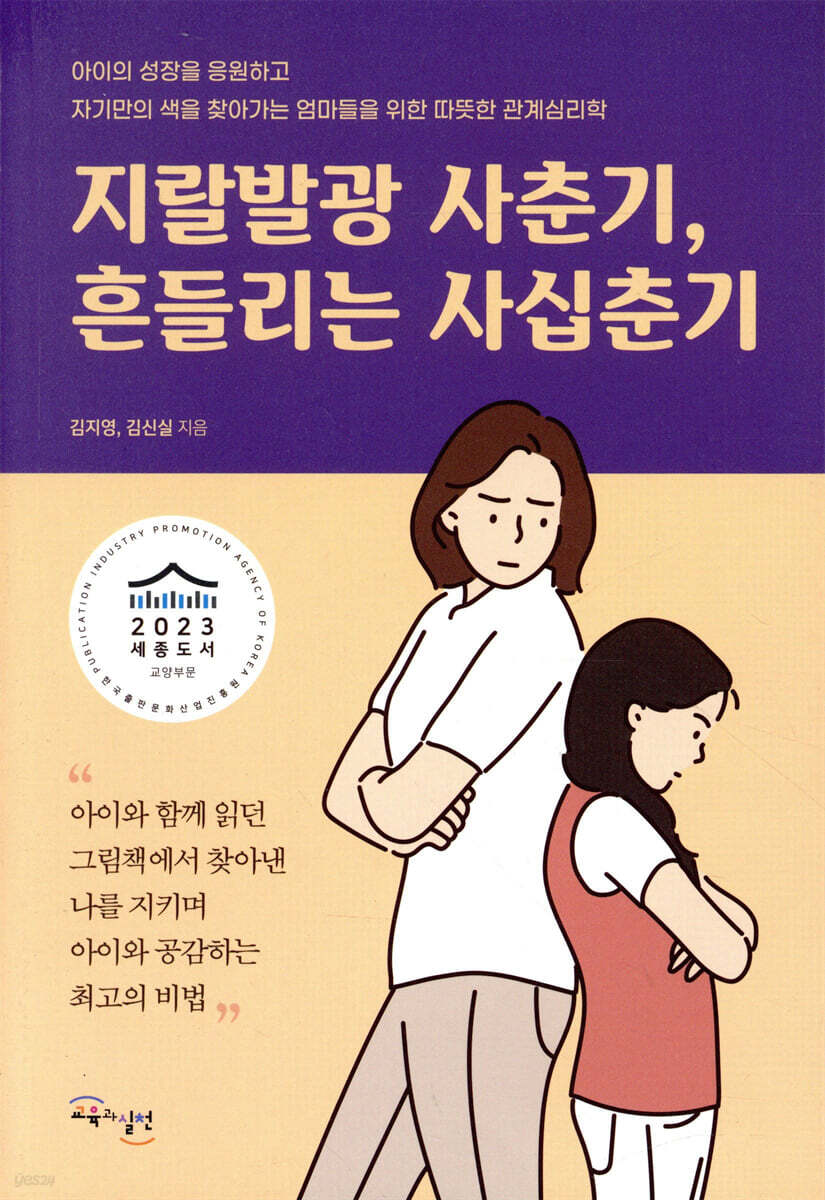
Crazy adolescence, shaky forties
 |
Description
Book Introduction
I feel like I'm drifting further and further away from my child, who rebels at first, as if it were my mother's words. Is it okay for this to continue? I never imagined my relationship with my child, who had always looked at me with loving eyes, as if I were an omnipotent giant, would end up like this.
I don't understand why he's acting like that, let alone how I raised him, and I feel betrayed.
Even when I try to understand, I end up yelling at my child without realizing it and immediately regret it.
'I should have held on one more time.' I never knew that I, a good mother and a good person, would end up like this.
In this seemingly dilemma, is there even a solution? With the intention of answering these mothers' concerns and encouraging themselves, the authors, both mothers raising adolescents and professional counselors, have memorized the character "忍" (patience) dozens, hundreds of times each day. In "Crazy Puberty, Shaken Puberty," they offer guidance for mothers enduring their children's adolescence together.
This book is about a mother in her forties who is going through her first puberty and is shaking up the atmosphere, and it is about the characteristics of her child who is going through the crazy puberty that no one knows where it will go, and it is a warm and easy way to find solutions to the relationship between parents and children, using picture books that I used to read with my child.
I don't understand why he's acting like that, let alone how I raised him, and I feel betrayed.
Even when I try to understand, I end up yelling at my child without realizing it and immediately regret it.
'I should have held on one more time.' I never knew that I, a good mother and a good person, would end up like this.
In this seemingly dilemma, is there even a solution? With the intention of answering these mothers' concerns and encouraging themselves, the authors, both mothers raising adolescents and professional counselors, have memorized the character "忍" (patience) dozens, hundreds of times each day. In "Crazy Puberty, Shaken Puberty," they offer guidance for mothers enduring their children's adolescence together.
This book is about a mother in her forties who is going through her first puberty and is shaking up the atmosphere, and it is about the characteristics of her child who is going through the crazy puberty that no one knows where it will go, and it is a warm and easy way to find solutions to the relationship between parents and children, using picture books that I used to read with my child.
- You can preview some of the book's contents.
Preview
index
Prologue | I didn't know I could do that.
And I really didn't know you'd do that, "I love you, I love you, I love you."
Part 1 Puberty: My Crazy Baby
Episode 1: Who Am I? Into the Endless Question: "Is This Really Me?"
Episode 2: Who am I, the blue, red, and transparent me? "The Blue, Red, and Transparent Me"
Episode 3: I Want to Do What I Want in My Own Kingdom: "I Won't Tell You for a Million Years"
Episode 4: How Do Others See Me? "I Got Stripes"
Episode 5: My Mom and Dad Look Different "Mom's Appearance"
Episode 6: You are so important to me.
The name 'Friend' 'Let's Play Together'
Episode 7: Adolescent Love and Deepening Relationships with the Opposite Sex: "Accept My Love"
Episode 8: A Heart That Sways Like the Swirling Waves "On the Day I Want to Leave"
Episode 9: A Teenager Building a House for Sadness "The House Built for Sadness"
Part 2: The Forties: A Shaken Mother
Episode 1: The Key to Relationships with Your Adolescent: Attachment "To You on Your Journey"
Episode 2: My Mother, Me, and My Child: "Crocodile Mother"
Episode 3: "We'll Always Meet Again" - To You Who Are Good Enough
Episode 4: "Are You Lonely Too?" for You Who Feels Lonely and Emptiness
Episode 5: "I Like Being Alone" for You Who Like Being Alone
Episode 6: "That's How Trees Grow" for Those Who Are Confused About Their Relationships
Episode 7: For You Who Can't Tolerate Your Child's Frustration: "Medusa's Mother" and "Hand, Devil"
Part 3 You and Me: And Yet… , Connected Again
Episode 1: My Heart Needs Comfort, Too: "A Dog on a Spring Day," "Sometimes I"
Episode 2: I Had No Choice: "Swimming in the Heart" and "The Happy Fox"
Episode 3: A Mother Who Embraces and Supports Her Teenage Child: "I Will Always Love You," "My Bicycle"
Episode 4: Now, Let's Keep Our Distance: "Beyond the Fence", "An Appropriate Distance"
Episode 5: A Mother Quietly Approaches Her Adolescent's Heart: "I Listened Quietly"
Episode 6: Focusing on the Emotions and Desires Behind Children's Behaviors: "The Thorn Boy" and "Please Listen to Me"
Episode 7: A Mother's Praise for Creating a Happy Child: "The Happy Sloth"
Episode 8: The Power to See Both Light and Shadow "It's Okay to Be a Little Lacking", "I'm Not Shy, I'm Thinking!"
Epilogue | For a Mother Who's Just Okay: "Why Won't You Come Home, Mom?"
And I really didn't know you'd do that, "I love you, I love you, I love you."
Part 1 Puberty: My Crazy Baby
Episode 1: Who Am I? Into the Endless Question: "Is This Really Me?"
Episode 2: Who am I, the blue, red, and transparent me? "The Blue, Red, and Transparent Me"
Episode 3: I Want to Do What I Want in My Own Kingdom: "I Won't Tell You for a Million Years"
Episode 4: How Do Others See Me? "I Got Stripes"
Episode 5: My Mom and Dad Look Different "Mom's Appearance"
Episode 6: You are so important to me.
The name 'Friend' 'Let's Play Together'
Episode 7: Adolescent Love and Deepening Relationships with the Opposite Sex: "Accept My Love"
Episode 8: A Heart That Sways Like the Swirling Waves "On the Day I Want to Leave"
Episode 9: A Teenager Building a House for Sadness "The House Built for Sadness"
Part 2: The Forties: A Shaken Mother
Episode 1: The Key to Relationships with Your Adolescent: Attachment "To You on Your Journey"
Episode 2: My Mother, Me, and My Child: "Crocodile Mother"
Episode 3: "We'll Always Meet Again" - To You Who Are Good Enough
Episode 4: "Are You Lonely Too?" for You Who Feels Lonely and Emptiness
Episode 5: "I Like Being Alone" for You Who Like Being Alone
Episode 6: "That's How Trees Grow" for Those Who Are Confused About Their Relationships
Episode 7: For You Who Can't Tolerate Your Child's Frustration: "Medusa's Mother" and "Hand, Devil"
Part 3 You and Me: And Yet… , Connected Again
Episode 1: My Heart Needs Comfort, Too: "A Dog on a Spring Day," "Sometimes I"
Episode 2: I Had No Choice: "Swimming in the Heart" and "The Happy Fox"
Episode 3: A Mother Who Embraces and Supports Her Teenage Child: "I Will Always Love You," "My Bicycle"
Episode 4: Now, Let's Keep Our Distance: "Beyond the Fence", "An Appropriate Distance"
Episode 5: A Mother Quietly Approaches Her Adolescent's Heart: "I Listened Quietly"
Episode 6: Focusing on the Emotions and Desires Behind Children's Behaviors: "The Thorn Boy" and "Please Listen to Me"
Episode 7: A Mother's Praise for Creating a Happy Child: "The Happy Sloth"
Episode 8: The Power to See Both Light and Shadow "It's Okay to Be a Little Lacking", "I'm Not Shy, I'm Thinking!"
Epilogue | For a Mother Who's Just Okay: "Why Won't You Come Home, Mom?"
Into the book
If you are a mother who has had to put aside your studies and work to give birth and spend time with your child, you will feel even more sad.
The child who used to look only at me like a sunflower is now moving away from me.
I thought I raised them with love and care, but they don't seem to like me.
I feel upset and disappointed that no one understands or comforts my struggling mother.
I find myself yelling at that child without realizing it.
Suddenly, I am startled by my reflection in the mirror.
I really didn't know I would end up like this.
--- p.
11
It is about looking realistically at the great and perfect mother and father and properly integrating the objects.
I realized that parents not only have the ideal image I dreamed of and hoped for, but also have a weak and struggling image.
I will come to realize that everyone I meet is a being with both greatness and weakness.
You will come to realize that not all relationships in the world are 100% good or 100% bad.
Remember.
The child is now going through the process of recognizing his mother and father as realistic beings rather than as insignificant beings who were idealized.
And this process is something that all teenagers must go through naturally.
The child is meeting us as a good enough parent by mixing the good and bad parts of the parents.
--- pp.
66~67
Based on the quality of our early relationship experiences with our mothers and our attachment experiences, we draw a map of the world we live in.
For some, this map provides a path to becoming comfortable with others, while for others, it shows a path to building walls and entering a world of their own.
This map is very strong, formed before language acquisition, and unconsciously has a strong influence on the life I lead.
--- pp.
141~142
Children who develop avoidant attachments are indifferent to their own feelings and suppress their emotions.
They don't even pay attention to the heart.
Because they have no positive expectations of others, they build walls and gradually withdraw into their own world, eventually becoming socially isolated.
…What kind of parenting did people with avoidant attachment, who find their own space comfortable, receive from their parents? Their mothers, who are their caregivers, are likely to be dismissive and avoidant toward their children.
…because avoidant attachment is more emotionally vulnerable than any other attachment style.
Any situation where even the slightest negative emotion is revealed is so scary and frightening.
I feel like I'm going to collapse.
So I struggle and try really hard not to feel any emotions.
--- pp.
180~182
If you feel that past hurts are having a powerful negative impact on your relationship with your children, now is the time to seek counseling.
Through counseling, I need to meet my younger self who was crying and hug me who was trembling because I couldn't do anything.
Even if your attachment style is not secure, if you develop the ability to reflect on your past and present through counseling, you will increase the possibility of forming a secure attachment with your child.
The ability to reflect can mitigate the negative impact of difficult childhoods and reduce the likelihood that insecure attachments will be transmitted across generations.
--- p.
200
I am slowly organizing my mind, which is full of confusing doodles, and looking calmly at my past self and my present child.
Instead of hitting and physically punishing your beloved child, how about disciplining them with explanations and alternatives? When your child's anger reaches its peak, instead of yelling and getting angry, how about waiting until their emotions subside? Your child may have grown as tall and physically as you, but they're still in the early stages of puberty.
He is still a child who is not good at handling his own mind and thoughts.
I pray that the warm spring sun will come to you, who has endured the harsh winter and become a mother.
--- p.
201
Amidst the countless turbulent midlife crises, don't I try to pretend I'm okay? The weight of the title "mother" grows heavier and heavier, yet I pretend not to care, don't I? Like in the book, aren't I accustomed to lying and claiming I'm not in pain even when I'm actually feeling it? Because I'm a "mother," I often confine myself to the stereotype that mothers should never show their struggles and must be strong.
There will be many days when you will just endure it because you have been taught that you must sacrifice for your children, your husband, and your family.
…I may be spending so much energy trying to keep my mind off things that I may not have the energy to connect with my adolescent child.
Ultimately, taking care of my own heart is paramount in maintaining a good relationship with my adolescent child.
Just as a car needs fuel to run, we must never forget that the fuel of strong comfort and encouragement within us gives us the strength to do anything for our children.
--- pp.
223~226
Are only young children in need of self-objects? No.
The self-object is something we need throughout our lives.
When you achieve something, who do you want to talk to first? When you're hurt, who do you want to run to for comfort? When you're feeling down and frustrated, who do you want to embrace? The person who comes to mind in these moments is your self-object.
The person who shares my happiness and acknowledges it, the person who shares my sorrow and comforts me, the person who I feel is on my side no matter what happens is my self-object.
Who is your ego object? Think about them and think about how you've been comforted and empathized with them.
--- p.
250
During adolescence.
Even though I was cruel and naughty, my mother's love endured it, and that's how I became a mother.
This love that I am letting go will continue to lead to other lives.
Just because your relationship with your teenager is falling apart now, it doesn't mean the 10+ years you've built up to that point will disappear.
And it all passes.
The crazy teenage years are definitely coming to an end.
--- p.
253
We all know that empathy is important, but it's not as easy as it sounds.
It's very difficult to put down my glasses for a moment and put on that person's glasses.
It's never easy to set aside my own thoughts and experiences and accept that person's experience as it is.
However, this does not mean that we should abandon our own existence and become one with that person's heart.
I, who observe the other person's mind, must still be maintained.
That way, my feelings and that person's feelings won't get mixed up.
In the same situation, I may feel sad, but that person may feel angry.
When we become a fairy tale, we often fail to empathize because we cannot see the other person's emotions and only assume our own.
--- pp.
271~272
All emotions we experience in life, whether positive or negative, are valid.
We must recognize that there are no good or bad emotions, that all emotions are natural and beneficial.
…when faced with negative emotions, rather than suppressing them, blaming them, or running away from them, we must approach them with an open mind and curiosity.
As you let yourself drift along, as if surfing the waves of emotion, your emotions will become clearer and calmer, and your true intentions and desires will be revealed.
Any intention is good and valid, and every emotion has a reason.
Simply examining your heart can be comforting and empower you to move forward toward more positive relationships.
And most importantly, you will gain the strength to feel and empathize with the needs and emotions behind your child's behavior.
--- pp.
286~287
Everyone is a multi-dimensional and integrated being, with some things they are good at and some things they are not.
…Adolescents who are still developing cognitively and psychologically have a narrow field of vision.
When you focus on one thing, it's hard to see other things.
If I feel like something is lacking in me, I just focus on that.
Then I would be reduced to a completely inadequate person.
More than anyone else, adolescent children need adults who can view them from an integrated and holistic perspective.
Any aspect of your child that you feel is lacking must be seen from both sides.
--- pp.
303~304
Many people seek the perfect parents for their beloved children.
I agree with you a hundred times, as I too have been shaken by that feeling countless times.
But being a perfect mother is not only impossible, it's not always good for your child.
In object relations theory, the image of an anxious mother who tries not to give her child a single frustration is called the "plight of the perfect mother."
Isn't it a good thing that a mother tries not to frustrate her child? Why is it called "sad"? Because the more we strive for perfection, the more guilt follows.
The more I try to do the impossible, the more my limitations as a mother become apparent.
The child who used to look only at me like a sunflower is now moving away from me.
I thought I raised them with love and care, but they don't seem to like me.
I feel upset and disappointed that no one understands or comforts my struggling mother.
I find myself yelling at that child without realizing it.
Suddenly, I am startled by my reflection in the mirror.
I really didn't know I would end up like this.
--- p.
11
It is about looking realistically at the great and perfect mother and father and properly integrating the objects.
I realized that parents not only have the ideal image I dreamed of and hoped for, but also have a weak and struggling image.
I will come to realize that everyone I meet is a being with both greatness and weakness.
You will come to realize that not all relationships in the world are 100% good or 100% bad.
Remember.
The child is now going through the process of recognizing his mother and father as realistic beings rather than as insignificant beings who were idealized.
And this process is something that all teenagers must go through naturally.
The child is meeting us as a good enough parent by mixing the good and bad parts of the parents.
--- pp.
66~67
Based on the quality of our early relationship experiences with our mothers and our attachment experiences, we draw a map of the world we live in.
For some, this map provides a path to becoming comfortable with others, while for others, it shows a path to building walls and entering a world of their own.
This map is very strong, formed before language acquisition, and unconsciously has a strong influence on the life I lead.
--- pp.
141~142
Children who develop avoidant attachments are indifferent to their own feelings and suppress their emotions.
They don't even pay attention to the heart.
Because they have no positive expectations of others, they build walls and gradually withdraw into their own world, eventually becoming socially isolated.
…What kind of parenting did people with avoidant attachment, who find their own space comfortable, receive from their parents? Their mothers, who are their caregivers, are likely to be dismissive and avoidant toward their children.
…because avoidant attachment is more emotionally vulnerable than any other attachment style.
Any situation where even the slightest negative emotion is revealed is so scary and frightening.
I feel like I'm going to collapse.
So I struggle and try really hard not to feel any emotions.
--- pp.
180~182
If you feel that past hurts are having a powerful negative impact on your relationship with your children, now is the time to seek counseling.
Through counseling, I need to meet my younger self who was crying and hug me who was trembling because I couldn't do anything.
Even if your attachment style is not secure, if you develop the ability to reflect on your past and present through counseling, you will increase the possibility of forming a secure attachment with your child.
The ability to reflect can mitigate the negative impact of difficult childhoods and reduce the likelihood that insecure attachments will be transmitted across generations.
--- p.
200
I am slowly organizing my mind, which is full of confusing doodles, and looking calmly at my past self and my present child.
Instead of hitting and physically punishing your beloved child, how about disciplining them with explanations and alternatives? When your child's anger reaches its peak, instead of yelling and getting angry, how about waiting until their emotions subside? Your child may have grown as tall and physically as you, but they're still in the early stages of puberty.
He is still a child who is not good at handling his own mind and thoughts.
I pray that the warm spring sun will come to you, who has endured the harsh winter and become a mother.
--- p.
201
Amidst the countless turbulent midlife crises, don't I try to pretend I'm okay? The weight of the title "mother" grows heavier and heavier, yet I pretend not to care, don't I? Like in the book, aren't I accustomed to lying and claiming I'm not in pain even when I'm actually feeling it? Because I'm a "mother," I often confine myself to the stereotype that mothers should never show their struggles and must be strong.
There will be many days when you will just endure it because you have been taught that you must sacrifice for your children, your husband, and your family.
…I may be spending so much energy trying to keep my mind off things that I may not have the energy to connect with my adolescent child.
Ultimately, taking care of my own heart is paramount in maintaining a good relationship with my adolescent child.
Just as a car needs fuel to run, we must never forget that the fuel of strong comfort and encouragement within us gives us the strength to do anything for our children.
--- pp.
223~226
Are only young children in need of self-objects? No.
The self-object is something we need throughout our lives.
When you achieve something, who do you want to talk to first? When you're hurt, who do you want to run to for comfort? When you're feeling down and frustrated, who do you want to embrace? The person who comes to mind in these moments is your self-object.
The person who shares my happiness and acknowledges it, the person who shares my sorrow and comforts me, the person who I feel is on my side no matter what happens is my self-object.
Who is your ego object? Think about them and think about how you've been comforted and empathized with them.
--- p.
250
During adolescence.
Even though I was cruel and naughty, my mother's love endured it, and that's how I became a mother.
This love that I am letting go will continue to lead to other lives.
Just because your relationship with your teenager is falling apart now, it doesn't mean the 10+ years you've built up to that point will disappear.
And it all passes.
The crazy teenage years are definitely coming to an end.
--- p.
253
We all know that empathy is important, but it's not as easy as it sounds.
It's very difficult to put down my glasses for a moment and put on that person's glasses.
It's never easy to set aside my own thoughts and experiences and accept that person's experience as it is.
However, this does not mean that we should abandon our own existence and become one with that person's heart.
I, who observe the other person's mind, must still be maintained.
That way, my feelings and that person's feelings won't get mixed up.
In the same situation, I may feel sad, but that person may feel angry.
When we become a fairy tale, we often fail to empathize because we cannot see the other person's emotions and only assume our own.
--- pp.
271~272
All emotions we experience in life, whether positive or negative, are valid.
We must recognize that there are no good or bad emotions, that all emotions are natural and beneficial.
…when faced with negative emotions, rather than suppressing them, blaming them, or running away from them, we must approach them with an open mind and curiosity.
As you let yourself drift along, as if surfing the waves of emotion, your emotions will become clearer and calmer, and your true intentions and desires will be revealed.
Any intention is good and valid, and every emotion has a reason.
Simply examining your heart can be comforting and empower you to move forward toward more positive relationships.
And most importantly, you will gain the strength to feel and empathize with the needs and emotions behind your child's behavior.
--- pp.
286~287
Everyone is a multi-dimensional and integrated being, with some things they are good at and some things they are not.
…Adolescents who are still developing cognitively and psychologically have a narrow field of vision.
When you focus on one thing, it's hard to see other things.
If I feel like something is lacking in me, I just focus on that.
Then I would be reduced to a completely inadequate person.
More than anyone else, adolescent children need adults who can view them from an integrated and holistic perspective.
Any aspect of your child that you feel is lacking must be seen from both sides.
--- pp.
303~304
Many people seek the perfect parents for their beloved children.
I agree with you a hundred times, as I too have been shaken by that feeling countless times.
But being a perfect mother is not only impossible, it's not always good for your child.
In object relations theory, the image of an anxious mother who tries not to give her child a single frustration is called the "plight of the perfect mother."
Isn't it a good thing that a mother tries not to frustrate her child? Why is it called "sad"? Because the more we strive for perfection, the more guilt follows.
The more I try to do the impossible, the more my limitations as a mother become apparent.
--- p.
314
314
Publisher's Review
A simple yet powerful insight and message conveyed through picture books read with children.
Even the authors, who are counseling experts with over a decade of experience counseling middle school students, parenting experts who have met hundreds and thousands of parents, and relationship experts who counsel using object relations theory, confess that they sometimes waver in front of their adolescent children.
There is a picture book that came to mind at a time when I had no idea about the specialized knowledge I had studied for a long time and my clinical experience.
As I recall books I read with my child when he or she was young but had forgotten about, I reflect on myself once again and gain the wisdom to wisely overcome this period of 'separate yet together'.
How powerful can a single painting be? Paintings can convey a wide range of feelings and thoughts, depending on the viewer's state of mind and state of mind.
Now, I reread picture books that felt like memories, and find solace and comfort in them.
Puberty vs.
forties
Puberty, also known as the second birth, is a period of rapid physical, emotional, and cognitive change in children.
However, this period is also a time of significant change for mothers.
Mothers in their forties, who usually experience this period, are also helpless in the face of the emotional and physical changes they face as mothers and as human beings.
Just as puberty is new to many mothers, the forties are also new to many mothers, and they complain of difficulties due to conflicts and relationship difficulties with their children.
I try all sorts of things to overcome this, but it always seems like I'm at a standstill.
This book argues that the starting point for solving all problems is to 'intervene for the relationship itself' rather than learning any technique to deal with the flood and turmoil of anxious and confused emotions.
The bottom line is you, you're good enough
Even if there are trials and errors, what matters is that the mother continues to run to her child, whether it is late or not.
Even if a mother makes mistakes, makes bad choices, misses important things due to ignorance, or unintentionally hurts her child, a mother who is always there for her child acknowledges that she is a good enough mother for her child.
They may not be able to listen quietly and may start yelling or, out of frustration, start harassing rather than praising.
Let's acknowledge that a mother who tries to empathize even when she fails to empathize is already a good enough mother, even if she is not a perfect mother.
If you're reading this book, you're a good enough mom.
Even the authors, who are counseling experts with over a decade of experience counseling middle school students, parenting experts who have met hundreds and thousands of parents, and relationship experts who counsel using object relations theory, confess that they sometimes waver in front of their adolescent children.
There is a picture book that came to mind at a time when I had no idea about the specialized knowledge I had studied for a long time and my clinical experience.
As I recall books I read with my child when he or she was young but had forgotten about, I reflect on myself once again and gain the wisdom to wisely overcome this period of 'separate yet together'.
How powerful can a single painting be? Paintings can convey a wide range of feelings and thoughts, depending on the viewer's state of mind and state of mind.
Now, I reread picture books that felt like memories, and find solace and comfort in them.
Puberty vs.
forties
Puberty, also known as the second birth, is a period of rapid physical, emotional, and cognitive change in children.
However, this period is also a time of significant change for mothers.
Mothers in their forties, who usually experience this period, are also helpless in the face of the emotional and physical changes they face as mothers and as human beings.
Just as puberty is new to many mothers, the forties are also new to many mothers, and they complain of difficulties due to conflicts and relationship difficulties with their children.
I try all sorts of things to overcome this, but it always seems like I'm at a standstill.
This book argues that the starting point for solving all problems is to 'intervene for the relationship itself' rather than learning any technique to deal with the flood and turmoil of anxious and confused emotions.
The bottom line is you, you're good enough
Even if there are trials and errors, what matters is that the mother continues to run to her child, whether it is late or not.
Even if a mother makes mistakes, makes bad choices, misses important things due to ignorance, or unintentionally hurts her child, a mother who is always there for her child acknowledges that she is a good enough mother for her child.
They may not be able to listen quietly and may start yelling or, out of frustration, start harassing rather than praising.
Let's acknowledge that a mother who tries to empathize even when she fails to empathize is already a good enough mother, even if she is not a perfect mother.
If you're reading this book, you're a good enough mom.
GOODS SPECIFICS
- Date of issue: May 13, 2022
- Page count, weight, size: 324 pages | 478g | 140*205*20mm
- ISBN13: 9791190113199
- ISBN10: 1190113198
You may also like
카테고리
korean


korean

![ELLE 엘르 스페셜 에디션 A형 : 12월 [2025]](http://librairie.coreenne.fr/cdn/shop/files/b8e27a3de6c9538896439686c6b0e8fb.jpg?v=1766436872&width=3840)


