

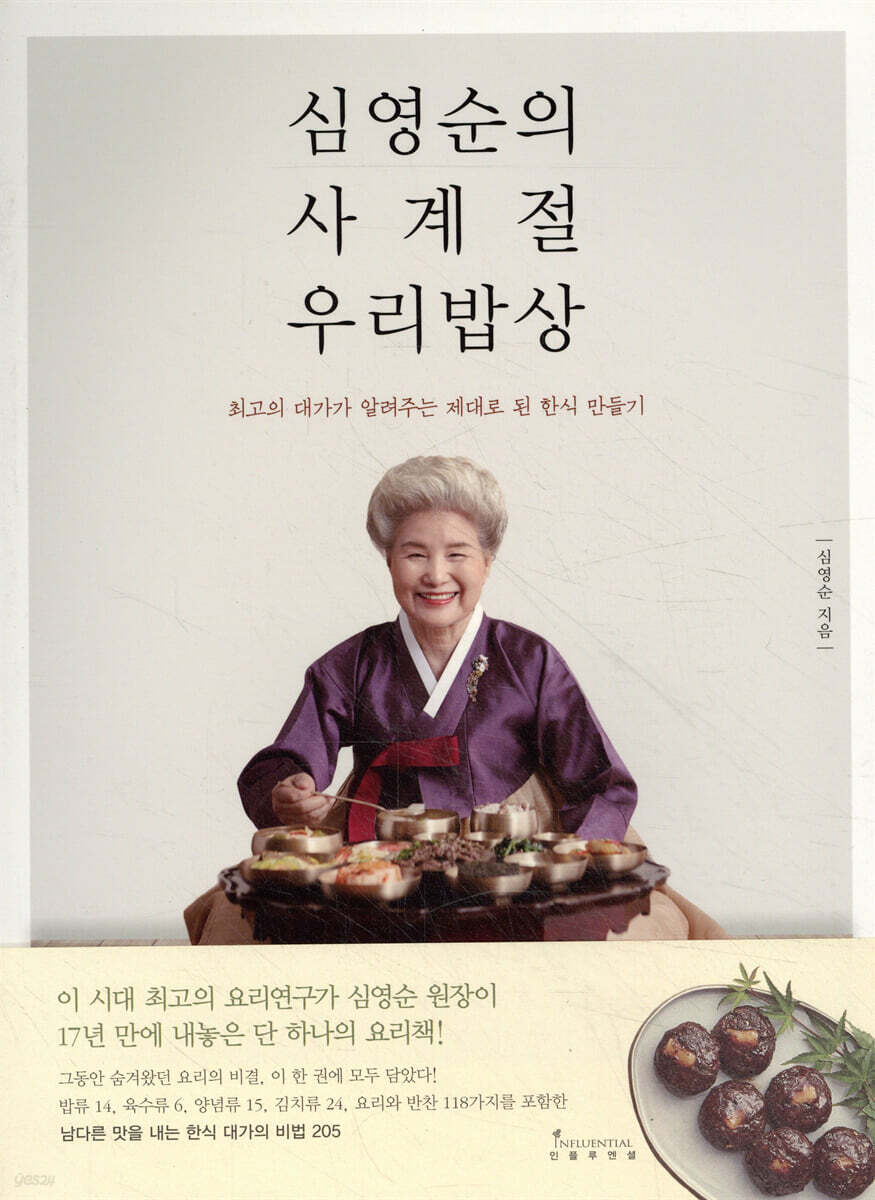
Sim Young-sun's Four Seasons Korean Table
 |
Description
Book Introduction
Director Shim Young-sun, the best culinary researcher of this era
The only cookbook published in 17 years!
The amazing cooking of 'Mr. Oksudong' that I only saw on TV and heard about through word of mouth.
The secret to a deep, rich flavor you'll want to emulate is all here! 205 recipes from master Korean chefs that create extraordinary flavors, including 14 rice dishes, 6 broths, 15 seasonings, 24 kimchi dishes, and 118 side dishes.
Sim Young-sun, who has fully demonstrated her Korean cooking skills through appearances on EBS's "Best Cooking Secrets," Korea's leading cooking show, as well as Olive TV's "Korean Food Battle" and "Oksu-dong Master Chef," has returned as a cookbook author after 17 years.
『Sim Young-sun's Four Seasons Korean Table』 is Director Sim Young-sun's one and only cookbook containing her 50 years of cooking secrets.
This book breaks the stereotype that making Korean food is difficult, and meticulously organizes basic dishes that preserve the uniqueness of Korean food while also bringing out Sim Young-sun's unique, deep, and profound flavors.
Above all, the table setting that suits the four seasons stands out.
Because there is nothing better for learning Korean cooking than preparing a table to suit each season.
A total of 40 basic table settings are presented, including 7 basic table settings and 3 special table settings using seasonal ingredients for each season.
It covers everything from basic rice cooking, which is the basis of the four seasons' table, to the secret recipes of Mr. Ok Su-dong's taste, including how to make spice juice and spice paste, and even how to make soy sauce and kimchi.
Let's meet the secret recipes of Master Oksudong that you will want to steal, learn, and try in 『Sim Young-sun's Four Seasons Korean Table』.
The only cookbook published in 17 years!
The amazing cooking of 'Mr. Oksudong' that I only saw on TV and heard about through word of mouth.
The secret to a deep, rich flavor you'll want to emulate is all here! 205 recipes from master Korean chefs that create extraordinary flavors, including 14 rice dishes, 6 broths, 15 seasonings, 24 kimchi dishes, and 118 side dishes.
Sim Young-sun, who has fully demonstrated her Korean cooking skills through appearances on EBS's "Best Cooking Secrets," Korea's leading cooking show, as well as Olive TV's "Korean Food Battle" and "Oksu-dong Master Chef," has returned as a cookbook author after 17 years.
『Sim Young-sun's Four Seasons Korean Table』 is Director Sim Young-sun's one and only cookbook containing her 50 years of cooking secrets.
This book breaks the stereotype that making Korean food is difficult, and meticulously organizes basic dishes that preserve the uniqueness of Korean food while also bringing out Sim Young-sun's unique, deep, and profound flavors.
Above all, the table setting that suits the four seasons stands out.
Because there is nothing better for learning Korean cooking than preparing a table to suit each season.
A total of 40 basic table settings are presented, including 7 basic table settings and 3 special table settings using seasonal ingredients for each season.
It covers everything from basic rice cooking, which is the basis of the four seasons' table, to the secret recipes of Mr. Ok Su-dong's taste, including how to make spice juice and spice paste, and even how to make soy sauce and kimchi.
Let's meet the secret recipes of Master Oksudong that you will want to steal, learn, and try in 『Sim Young-sun's Four Seasons Korean Table』.
- You can preview some of the book's contents.
Preview
index
In publishing this book
Recommendations from Oksu-dong students who first encountered this book
Starting to cook
― Part 1: The Basics of a Master You Want to Steal
Chapter 1: The Basics of Korean Cuisine: Cooking Rice
Basics of Cooking Rice / Cooking Rice by Container / Cooking Rice by Grain
Chapter 2: Taste-enhancing broth and natural seasonings that guarantee the best flavor in your dishes
Taste guaranteed broth / salt seasoning / soy sauce seasoning / natural seasoning / red pepper powder seasoning / seasoning that is good to know more about / base ingredients that are good to know more about
Chapter 3: How to Prepare Ingredients to Speed Up Cooking
Basic cutting and use for cooking / How to prepare ingredients for each dish
― Part 2: Our Four Seasons Table I Want to Share
Chapter 1: A Spring Table to Wake Up Your Body
Seafood mugwort soup and grilled deodeok and red pepper paste table (yam and seafood mugwort soup | grilled deodeok and red pepper paste | seasoned water parsley | soybean paste) / Stir-fried octopus and beef seaweed soup table (beef seaweed soup | stir-fried octopus | steamed egg | seasoned wild chives and deodeok) / Clam mugwort soup and grilled pork table (grilled pork | clam mugwort soup | stir-fried wild chives and perilla) / Wild chives and beef soybean paste stew table (braised beef | braised tuna | wild chives | seasoned perilla leaves) / Bangpungnamul and beef bulgogi table (tofu and bean sprout soup | beef bulgogi | seasoned Bangpungnamul | lettuce wraps and egg ssamjang) / Pickled spring vegetables and cheonggukjang table (cheonggukjang stew | seasoned wild chives) / Healthy steamed carp table (steamed carp) / Spring delicacy bibimbap Table setting (bibimbap, aukguk, hwajeon) / Spring delicacy banquet noodle table setting (banquet noodle table setting, soybean paste stew) / Spring delicacy seafood and spring vegetable stew table setting (seafood and spring vegetable stew)
Chapter 2: A Lively Summer Table
Perilla leaf sprouts and pumpkin pancakes (pumpkin pancakes | bean sprout kimchi soup | perilla leaf sprouts | radish greens) / radish kimchi and cold chicken salad (chicken salad | cabbage soup | stir-fried anchovies | spicy red pepper paste) / braised beef and chili peppers (braised beef and chili peppers | mushroom soup | seasoned whole eggplant) / steamed tofu and mackerel kimchi stew (steamed tofu | mackerel kimchi stew | crown daisy | seasoned boiled pollack roe) / shrimp and pumpkin soup and seasoned eel stew (shrimp and pumpkin soup | seasoned eel stew | braised lotus root | bellflower root salad) / buckwheat noodles and chogyetang (chogyetang) / kimchi mung bean pancakes and acorn jelly rice (acorn jelly rice | kimchi mung bean pancake) / summer delicacy, cold noodles with seeds Table setting (seed cold noodles) / Summer delicacy galbitang table setting (galbitang) / Summer delicacy gyeban table setting (gyeban | fruit salad | aloe shake)
Chapter 3: A Bountiful Autumn Table
Yukjeon and Ugeojijjigae table (Ugeojijjigae | Yukjeon | Stir-fried pumpkin and shrimp) / Potato stew and tteokgalbi table (Tteokgalbi | Potato stew | Cucumber kimchi) / Mussel kimchi and healthy loach soup table (Boyang loach soup | Mussel kimchi | Seasoned seaweed and green onion) / Beef and green onion soup and braised tofu table (Braised tofu | Beef and green onion soup | Stir-fried wild parsley) / Spinach and soybean paste soup and pork and kimchi stew table (Bamboo shoot rice | Steamed pork and kimchi | Spinach and soybean paste soup | Stir-fried red shrimp | Braised garlic shoots) / Tri-color vegetables and braised short ribs table (Braised short ribs | Beef radish soup | Tri-color vegetables | Songpyeon) / Red steamed sea bream and raw fish table (Red steamed sea bream and raw fish) / Pumpkin porridge table, a fall delicacy (Pumpkin porridge | Thick rice cakes) / Gondre rice, a fall delicacy Table (Gondre rice | Grilled mackerel | Zucchini greens) Table (Gungjung tteokbokki | Assorted stews)
Chapter 4: A Winter Table for the Body
Clear pumpkin tofu soup and grilled shrimp table (grilled shrimp | clear pumpkin tofu soup | grilled mackerel) / Grilled oyster and bean sprout rice table (bean sprout rice | grilled oyster | potato soup) / Shrimp pancake and yukgaejang table (yukgaejang | shrimp pancake | braised burdock) / Hwangtae soup and marinated cockle table (jangjorim | hwangtae soup | marinated cockle) / Soft tofu stew and boiled pork and perilla leaf wrap table (Blanched pork and perilla leaf wrap | bean sprouts | soft tofu stew) / Aged vegetables and five-grain rice table (Aged vegetables | braised walnuts and nuts) / Meat and bean ssamjang and tofu and cabbage wrap table (Tofu and cabbage wrap | Meat and bean ssamjang) / Winter delicacy kimchi rice table (kimchi rice) / Winter delicacy jujube and chestnut porridge table (jujube and chestnut porridge) / Winter delicacy red bean porridge Table (red bean porridge | mung bean brown rice nut rice cake)
Chapter 5: A Table for Special Occasions
Children's Birthday Meal (Egg Roll Rice | Braised Chicken) / Parents' Day Meal (Stir-fried Eggplant | Grilled Hairtail Braised in Radish) / Christmas Buffet (Cold Shrimp Salad | Japchae | Grilled Beef with Glutinous Rice and Pickled Cucumber | Assorted Moon Vegetables) / Picnic Lunchbox
― Part 3: A Little More Intense About Our Healthy Fermented Foods
Chapter 1: Kimchi, the natural lactic acid bacteria on the table
Geotjeori (Cabbage Geotjeori | Radish Geotjeori) / Kimchi (Cabbage Kimchi | Young Radish Kimchi | Godeulppaegi Kimchi | Chive Kimchi | Bachelor Kimchi | Kkakdugi | Ikkakdugi | Mixed Kimchi | Mustard Leaf Kimchi | Cucumber Kimchi | Eggplant Sobagi) / Water Kimchi (Yeolmu Mulkimchi | White Kimchi | Cucumber Sobagi Mulkimchi | Bachelor Radish Mulkimchi | Easy Dongchimi | Clear Red and White Kimchi | Nabak Kimchi | Gochu Mulkimchi) / Other Various Kimchi (Jang Kimchi | Watermelon Kimchi | Baek Bossam Kimchi)
Chapter 2 Appetizing Pickled Vegetables and Salted Seafood
Jangajji (sesame leaf pickle | garlic pickle | aralia elata pickle | wild chive pickle | plum pickle) / Jeotgal (raw shrimp pickle | clam pickle | sea squirt pickle)
Chapter 3: Adding Health to Your Table
Homemade soy sauce | soybean paste | pumpkin paste | simple fish sauce | gochujang | deodeok gochujang
Appendix
The secret to planning a meal plan that takes care of both your health and your time.
2 Sim Young-sun's Four Seasons Korean Table Setting
3 Sim Young-sun's Favorite Cooking Tools & Cooking Seasonings
Search
Recommendations from Oksu-dong students who first encountered this book
Starting to cook
― Part 1: The Basics of a Master You Want to Steal
Chapter 1: The Basics of Korean Cuisine: Cooking Rice
Basics of Cooking Rice / Cooking Rice by Container / Cooking Rice by Grain
Chapter 2: Taste-enhancing broth and natural seasonings that guarantee the best flavor in your dishes
Taste guaranteed broth / salt seasoning / soy sauce seasoning / natural seasoning / red pepper powder seasoning / seasoning that is good to know more about / base ingredients that are good to know more about
Chapter 3: How to Prepare Ingredients to Speed Up Cooking
Basic cutting and use for cooking / How to prepare ingredients for each dish
― Part 2: Our Four Seasons Table I Want to Share
Chapter 1: A Spring Table to Wake Up Your Body
Seafood mugwort soup and grilled deodeok and red pepper paste table (yam and seafood mugwort soup | grilled deodeok and red pepper paste | seasoned water parsley | soybean paste) / Stir-fried octopus and beef seaweed soup table (beef seaweed soup | stir-fried octopus | steamed egg | seasoned wild chives and deodeok) / Clam mugwort soup and grilled pork table (grilled pork | clam mugwort soup | stir-fried wild chives and perilla) / Wild chives and beef soybean paste stew table (braised beef | braised tuna | wild chives | seasoned perilla leaves) / Bangpungnamul and beef bulgogi table (tofu and bean sprout soup | beef bulgogi | seasoned Bangpungnamul | lettuce wraps and egg ssamjang) / Pickled spring vegetables and cheonggukjang table (cheonggukjang stew | seasoned wild chives) / Healthy steamed carp table (steamed carp) / Spring delicacy bibimbap Table setting (bibimbap, aukguk, hwajeon) / Spring delicacy banquet noodle table setting (banquet noodle table setting, soybean paste stew) / Spring delicacy seafood and spring vegetable stew table setting (seafood and spring vegetable stew)
Chapter 2: A Lively Summer Table
Perilla leaf sprouts and pumpkin pancakes (pumpkin pancakes | bean sprout kimchi soup | perilla leaf sprouts | radish greens) / radish kimchi and cold chicken salad (chicken salad | cabbage soup | stir-fried anchovies | spicy red pepper paste) / braised beef and chili peppers (braised beef and chili peppers | mushroom soup | seasoned whole eggplant) / steamed tofu and mackerel kimchi stew (steamed tofu | mackerel kimchi stew | crown daisy | seasoned boiled pollack roe) / shrimp and pumpkin soup and seasoned eel stew (shrimp and pumpkin soup | seasoned eel stew | braised lotus root | bellflower root salad) / buckwheat noodles and chogyetang (chogyetang) / kimchi mung bean pancakes and acorn jelly rice (acorn jelly rice | kimchi mung bean pancake) / summer delicacy, cold noodles with seeds Table setting (seed cold noodles) / Summer delicacy galbitang table setting (galbitang) / Summer delicacy gyeban table setting (gyeban | fruit salad | aloe shake)
Chapter 3: A Bountiful Autumn Table
Yukjeon and Ugeojijjigae table (Ugeojijjigae | Yukjeon | Stir-fried pumpkin and shrimp) / Potato stew and tteokgalbi table (Tteokgalbi | Potato stew | Cucumber kimchi) / Mussel kimchi and healthy loach soup table (Boyang loach soup | Mussel kimchi | Seasoned seaweed and green onion) / Beef and green onion soup and braised tofu table (Braised tofu | Beef and green onion soup | Stir-fried wild parsley) / Spinach and soybean paste soup and pork and kimchi stew table (Bamboo shoot rice | Steamed pork and kimchi | Spinach and soybean paste soup | Stir-fried red shrimp | Braised garlic shoots) / Tri-color vegetables and braised short ribs table (Braised short ribs | Beef radish soup | Tri-color vegetables | Songpyeon) / Red steamed sea bream and raw fish table (Red steamed sea bream and raw fish) / Pumpkin porridge table, a fall delicacy (Pumpkin porridge | Thick rice cakes) / Gondre rice, a fall delicacy Table (Gondre rice | Grilled mackerel | Zucchini greens) Table (Gungjung tteokbokki | Assorted stews)
Chapter 4: A Winter Table for the Body
Clear pumpkin tofu soup and grilled shrimp table (grilled shrimp | clear pumpkin tofu soup | grilled mackerel) / Grilled oyster and bean sprout rice table (bean sprout rice | grilled oyster | potato soup) / Shrimp pancake and yukgaejang table (yukgaejang | shrimp pancake | braised burdock) / Hwangtae soup and marinated cockle table (jangjorim | hwangtae soup | marinated cockle) / Soft tofu stew and boiled pork and perilla leaf wrap table (Blanched pork and perilla leaf wrap | bean sprouts | soft tofu stew) / Aged vegetables and five-grain rice table (Aged vegetables | braised walnuts and nuts) / Meat and bean ssamjang and tofu and cabbage wrap table (Tofu and cabbage wrap | Meat and bean ssamjang) / Winter delicacy kimchi rice table (kimchi rice) / Winter delicacy jujube and chestnut porridge table (jujube and chestnut porridge) / Winter delicacy red bean porridge Table (red bean porridge | mung bean brown rice nut rice cake)
Chapter 5: A Table for Special Occasions
Children's Birthday Meal (Egg Roll Rice | Braised Chicken) / Parents' Day Meal (Stir-fried Eggplant | Grilled Hairtail Braised in Radish) / Christmas Buffet (Cold Shrimp Salad | Japchae | Grilled Beef with Glutinous Rice and Pickled Cucumber | Assorted Moon Vegetables) / Picnic Lunchbox
― Part 3: A Little More Intense About Our Healthy Fermented Foods
Chapter 1: Kimchi, the natural lactic acid bacteria on the table
Geotjeori (Cabbage Geotjeori | Radish Geotjeori) / Kimchi (Cabbage Kimchi | Young Radish Kimchi | Godeulppaegi Kimchi | Chive Kimchi | Bachelor Kimchi | Kkakdugi | Ikkakdugi | Mixed Kimchi | Mustard Leaf Kimchi | Cucumber Kimchi | Eggplant Sobagi) / Water Kimchi (Yeolmu Mulkimchi | White Kimchi | Cucumber Sobagi Mulkimchi | Bachelor Radish Mulkimchi | Easy Dongchimi | Clear Red and White Kimchi | Nabak Kimchi | Gochu Mulkimchi) / Other Various Kimchi (Jang Kimchi | Watermelon Kimchi | Baek Bossam Kimchi)
Chapter 2 Appetizing Pickled Vegetables and Salted Seafood
Jangajji (sesame leaf pickle | garlic pickle | aralia elata pickle | wild chive pickle | plum pickle) / Jeotgal (raw shrimp pickle | clam pickle | sea squirt pickle)
Chapter 3: Adding Health to Your Table
Homemade soy sauce | soybean paste | pumpkin paste | simple fish sauce | gochujang | deodeok gochujang
Appendix
The secret to planning a meal plan that takes care of both your health and your time.
2 Sim Young-sun's Four Seasons Korean Table Setting
3 Sim Young-sun's Favorite Cooking Tools & Cooking Seasonings
Search
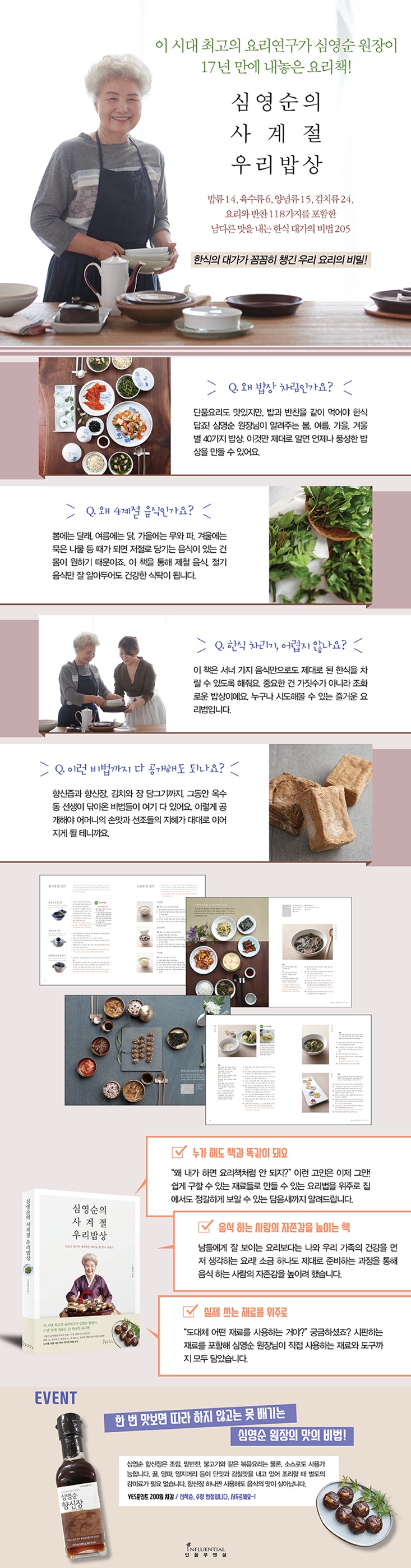
Detailed image
Publisher's Review
■ Take cooking classes from ‘Mr. Oksudong’ at home!
_The only cookbook released after 17 years, containing 50 years of experience
"What should I do with that dish? I want to try it too!"
When MC Shin Dong-yup told the story of eating rice (gye-ban) made with native chicken on “Wednesday Food Talk,” many people watching the show swallowed their saliva.
And that's not all.
The broth-free bulgogi and chogyetang from “Oksudong Master” and the watermelon kimchi noodles introduced on “Happy Together” also stimulated many people’s salivary glands.
The person who makes us think, “I wish I could try this at least once” when he appears on TV and presents every dish is none other than Korean food researcher Shim Young-sun, known as “Teacher Ok-su-dong.”
Sim Young-sun, who has fully demonstrated her Korean cooking skills through appearances on EBS's "Best Cooking Secrets," Korea's leading cooking show, as well as Olive TV's "Korean Food Battle" and "Oksu-dong Master Chef," has returned as a cookbook author after 17 years.
“Sim Young-soon’s Four Seasons Korean Table” is a book that was born from the enthusiastic support of those who “wanted to see his cookbook.”
To answer the requests, “How do you make that dish?”, “Your spice juice and spice paste are really unique. Is there a way to make it at home?”, and “I want to learn the secret to cooking rice that was introduced on TV”, at a time when the desire for a ‘well-prepared meal’ is higher than ever, Sim Yeong-sun has published this book, filled with 50 years of experience, to teach you the recipes for finding the right taste.
Breaking the stereotype that making Korean food is difficult, we have meticulously organized and packed Sim Young-sun's secrets to Korean cooking so that you can enjoy her deep and rich flavors at home.
He even covered the basic cooking skills that he considered important in his cooking classes held in Oksu-dong.
Let's meet the secret recipes of Master Oksudong that you want to steal, learn, and try in "Sim Young-soon's Four Seasons Our Table."
■ Why is the table set like this?
_Easy and fun Korean table setting for those who find it difficult to prepare various dishes.
Recently, there has been an increase in the number of people eating only single items due to being busy, but this can cause nutritional problems.
Korean food is basically served with rice and side dishes.
It's a great way to enjoy a variety of flavors while also getting a balanced diet.
In Korean cuisine, where various foods are served together, the 'compatibility' between the foods is important.
Depending on how you arrange the food, the food served together can have a synergistic effect or it can actually be detrimental to your health.
Korean food is designed to be eaten with other dishes to ensure a balanced diet and taste, so it is best to eat it at the table.
Therefore, this book is a suggestion for ‘setting the table.’
That doesn't mean you have to think about it too hard or feel burdened by the number of options.
Because there are ways to eat a variety of foods that are rich and healthy, even with a small amount.
In "Sim Young-soon's Four Seasons Korean Table," a table with fewer ingredients is proposed so that anyone can follow and imitate it.
It was designed so that you can add just one or two dishes to the deliciously cooked rice and kimchi that is always on the table.
■ Why is it a food for all four seasons?
Dishes that make your mouth, eyes, nose, and mind happy and healthy
We have foods that we have eaten during each season since ancient times, such as red bean porridge for winter solstice, mugwort for summer solstice, and chicken for summer solstice.
This takes into account the physical balance that changes with each season.
In the spring, we ate healthy seasonal food using ingredients that were in season to replenish the vitamins we lacked in the winter, in the summer to beat the heat, in the fall to replenish our lost energy, and in the winter to replenish the nutrients we lacked and prepare for the cold.
Even though we can get ingredients all year round, there are definitely times when it tastes better.
Therefore, there is no better way to understand Korean cuisine than to prepare a seasonal table using seasonal ingredients.
《Sim Young-soon's Four Seasons Korean Table》 presents a total of 40 seasonal tables, including 7 basic tables and 3 special tables for spring, summer, fall, and winter.
If you master just these 40 dishes, you can cook a whopping 118 dishes.
And that's not all.
We also meticulously covered the basics of Korean cuisine, 'cooking rice', as well as the various side dishes that are served on our tables every day, such as fermented foods like kimchi and soy sauce.
By preparing and serving seasonal dishes made with fresh seasonal ingredients over warm rice, and following Sim Young-soon's unique fermented food that is healthy and deeply flavorful, you will not only acquire the basics of Korean cuisine, but also experience cooking becoming easier and faster.
■ Sim Young-sun's Korean cooking secrets that you'll want to steal, learn, and try!
_The secret recipe for the deep, rich flavor you've always wanted to know and imitate is revealed.
This book is largely divided into three parts.
First, it is ‘the basic skills of a master that you want to steal.’
Here, we introduce the basics of Korean cooking, including how to cook rice, how to make broth and seasonings to add flavor, and how to prepare ingredients to speed up cooking.
Anyone who wants to know the secrets of Sim Yeong-sun's secret seasonings, such as spice juice and spice paste that add flavor to dishes, must pay attention.
Next is ‘the table setting you want to prepare.’
Here, we introduce seasonal table settings and recipes to complement them. If you've ever wondered about dishes like gyeban (stir-fried chicken), boyang galbijjim (braised short ribs), and bulgogi (beef skewers) you've seen on TV, open your eyes wide.
You can taste Sim Young-sun's delicious-looking Korean cuisine at our house.
Seasonal delicacies such as spring vegetable stew, chicken soup, pumpkin porridge, and kimchi rice are a bonus.
In addition, we have increased the usability by introducing home party recipes that can be prepared at home for special occasions such as children's birthdays, Parents' Day, and Christmas.
Lastly, ‘Our fermented food that we want to try.’
Fermented foods like kimchi and soy sauce are a staple on our table, but they are also one of the most difficult to make.
Here, Master Ok Soo-dong explains the process step by step, making it easy to make. If you've ever wondered what the watermelon kimchi noodles you saw on TV taste like, take a close look at this watermelon kimchi recipe.
You can also taste water kimchi made with cucumber and bachelor radish.
The more you look at it, the more you will want to try it, and your home table will become more abundant.
_The only cookbook released after 17 years, containing 50 years of experience
"What should I do with that dish? I want to try it too!"
When MC Shin Dong-yup told the story of eating rice (gye-ban) made with native chicken on “Wednesday Food Talk,” many people watching the show swallowed their saliva.
And that's not all.
The broth-free bulgogi and chogyetang from “Oksudong Master” and the watermelon kimchi noodles introduced on “Happy Together” also stimulated many people’s salivary glands.
The person who makes us think, “I wish I could try this at least once” when he appears on TV and presents every dish is none other than Korean food researcher Shim Young-sun, known as “Teacher Ok-su-dong.”
Sim Young-sun, who has fully demonstrated her Korean cooking skills through appearances on EBS's "Best Cooking Secrets," Korea's leading cooking show, as well as Olive TV's "Korean Food Battle" and "Oksu-dong Master Chef," has returned as a cookbook author after 17 years.
“Sim Young-soon’s Four Seasons Korean Table” is a book that was born from the enthusiastic support of those who “wanted to see his cookbook.”
To answer the requests, “How do you make that dish?”, “Your spice juice and spice paste are really unique. Is there a way to make it at home?”, and “I want to learn the secret to cooking rice that was introduced on TV”, at a time when the desire for a ‘well-prepared meal’ is higher than ever, Sim Yeong-sun has published this book, filled with 50 years of experience, to teach you the recipes for finding the right taste.
Breaking the stereotype that making Korean food is difficult, we have meticulously organized and packed Sim Young-sun's secrets to Korean cooking so that you can enjoy her deep and rich flavors at home.
He even covered the basic cooking skills that he considered important in his cooking classes held in Oksu-dong.
Let's meet the secret recipes of Master Oksudong that you want to steal, learn, and try in "Sim Young-soon's Four Seasons Our Table."
■ Why is the table set like this?
_Easy and fun Korean table setting for those who find it difficult to prepare various dishes.
Recently, there has been an increase in the number of people eating only single items due to being busy, but this can cause nutritional problems.
Korean food is basically served with rice and side dishes.
It's a great way to enjoy a variety of flavors while also getting a balanced diet.
In Korean cuisine, where various foods are served together, the 'compatibility' between the foods is important.
Depending on how you arrange the food, the food served together can have a synergistic effect or it can actually be detrimental to your health.
Korean food is designed to be eaten with other dishes to ensure a balanced diet and taste, so it is best to eat it at the table.
Therefore, this book is a suggestion for ‘setting the table.’
That doesn't mean you have to think about it too hard or feel burdened by the number of options.
Because there are ways to eat a variety of foods that are rich and healthy, even with a small amount.
In "Sim Young-soon's Four Seasons Korean Table," a table with fewer ingredients is proposed so that anyone can follow and imitate it.
It was designed so that you can add just one or two dishes to the deliciously cooked rice and kimchi that is always on the table.
■ Why is it a food for all four seasons?
Dishes that make your mouth, eyes, nose, and mind happy and healthy
We have foods that we have eaten during each season since ancient times, such as red bean porridge for winter solstice, mugwort for summer solstice, and chicken for summer solstice.
This takes into account the physical balance that changes with each season.
In the spring, we ate healthy seasonal food using ingredients that were in season to replenish the vitamins we lacked in the winter, in the summer to beat the heat, in the fall to replenish our lost energy, and in the winter to replenish the nutrients we lacked and prepare for the cold.
Even though we can get ingredients all year round, there are definitely times when it tastes better.
Therefore, there is no better way to understand Korean cuisine than to prepare a seasonal table using seasonal ingredients.
《Sim Young-soon's Four Seasons Korean Table》 presents a total of 40 seasonal tables, including 7 basic tables and 3 special tables for spring, summer, fall, and winter.
If you master just these 40 dishes, you can cook a whopping 118 dishes.
And that's not all.
We also meticulously covered the basics of Korean cuisine, 'cooking rice', as well as the various side dishes that are served on our tables every day, such as fermented foods like kimchi and soy sauce.
By preparing and serving seasonal dishes made with fresh seasonal ingredients over warm rice, and following Sim Young-soon's unique fermented food that is healthy and deeply flavorful, you will not only acquire the basics of Korean cuisine, but also experience cooking becoming easier and faster.
■ Sim Young-sun's Korean cooking secrets that you'll want to steal, learn, and try!
_The secret recipe for the deep, rich flavor you've always wanted to know and imitate is revealed.
This book is largely divided into three parts.
First, it is ‘the basic skills of a master that you want to steal.’
Here, we introduce the basics of Korean cooking, including how to cook rice, how to make broth and seasonings to add flavor, and how to prepare ingredients to speed up cooking.
Anyone who wants to know the secrets of Sim Yeong-sun's secret seasonings, such as spice juice and spice paste that add flavor to dishes, must pay attention.
Next is ‘the table setting you want to prepare.’
Here, we introduce seasonal table settings and recipes to complement them. If you've ever wondered about dishes like gyeban (stir-fried chicken), boyang galbijjim (braised short ribs), and bulgogi (beef skewers) you've seen on TV, open your eyes wide.
You can taste Sim Young-sun's delicious-looking Korean cuisine at our house.
Seasonal delicacies such as spring vegetable stew, chicken soup, pumpkin porridge, and kimchi rice are a bonus.
In addition, we have increased the usability by introducing home party recipes that can be prepared at home for special occasions such as children's birthdays, Parents' Day, and Christmas.
Lastly, ‘Our fermented food that we want to try.’
Fermented foods like kimchi and soy sauce are a staple on our table, but they are also one of the most difficult to make.
Here, Master Ok Soo-dong explains the process step by step, making it easy to make. If you've ever wondered what the watermelon kimchi noodles you saw on TV taste like, take a close look at this watermelon kimchi recipe.
You can also taste water kimchi made with cucumber and bachelor radish.
The more you look at it, the more you will want to try it, and your home table will become more abundant.
GOODS SPECIFICS
- Date of issue: February 20, 2018
- Page count, weight, size: 292 pages | 954g | 195*260*21mm
- ISBN13: 9791186560631
- ISBN10: 1186560630
You may also like
카테고리
korean


korean

![GQ KOREA Mark (Monthly): December [2025]](http://librairie.coreenne.fr/cdn/shop/files/8ef265dbbfbf186523ed75ba7319009d.jpg?v=1765340328&width=3840)


