

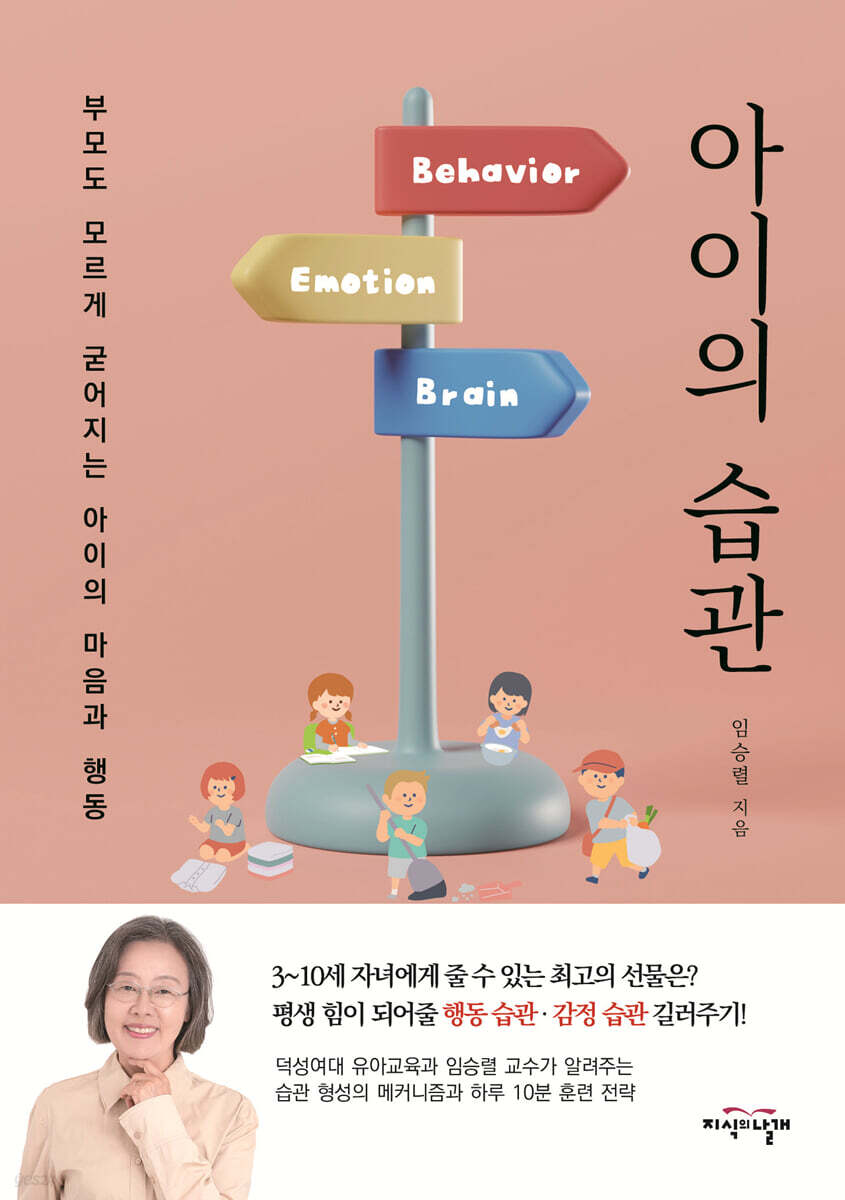
Child's habits
 |
Description
Book Introduction
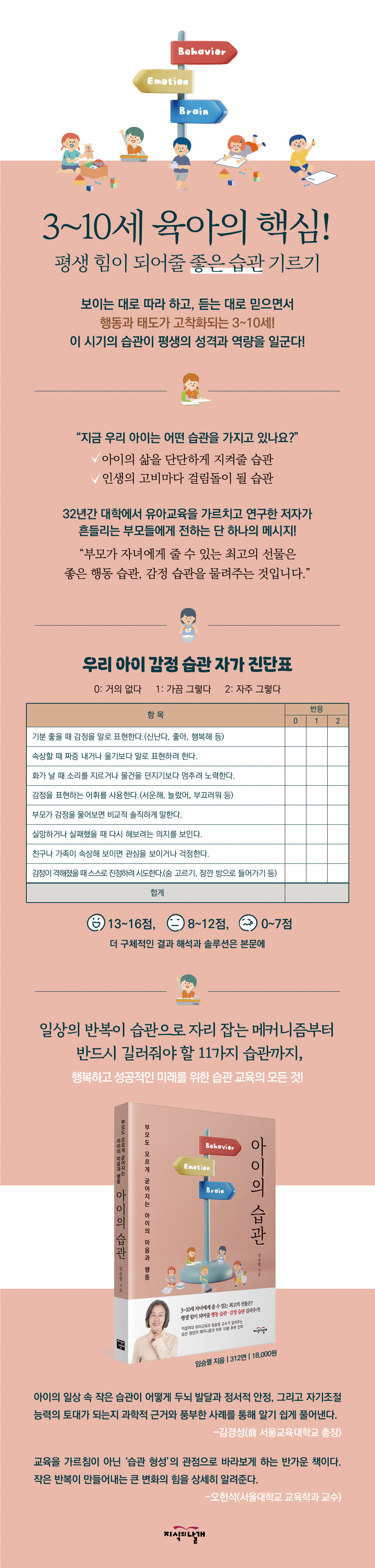
How are children's habits formed and solidified?
From the impact of small repetitions in daily life on a child's brain development,
11 habits you must develop between the ages of 3 and 10
Habits are so powerful that they are sometimes called “second nature,” but forming good habits is not always easy.
Because bad habits always take over your body and mind one step ahead.
So, good habits should be developed at a young age, even if it is only one year old.
Ages 3 to 10 are the golden age for habit formation.
Children at this age follow what they see, believe what they hear, and repeat their daily routine.
Repeated experiences are stored in the brain, creating an 'auto-execution circuit', which is automatically executed without conscious effort when a similar situation arises.
This is a habit, and this process affects the child's cognitive development, emotional stability, and self-regulation skills.
This book explains how the small repetitions of daily life between parents and children become habits through neuroscientific mechanisms, and introduces effective parenting strategies based on this.
In particular, he emphasizes that not only outward behavior but also emotions are considered to be a realm of habits, and that children should be trained to control their minds from a young age.
Professor Seungryeol Lim, who has trained early childhood education experts at universities for over 30 years and now provides counseling, mentoring, and lectures to parents of young children, reaches out to the public in an easy-to-understand and clear writing style.
From the impact of small repetitions in daily life on a child's brain development,
11 habits you must develop between the ages of 3 and 10
Habits are so powerful that they are sometimes called “second nature,” but forming good habits is not always easy.
Because bad habits always take over your body and mind one step ahead.
So, good habits should be developed at a young age, even if it is only one year old.
Ages 3 to 10 are the golden age for habit formation.
Children at this age follow what they see, believe what they hear, and repeat their daily routine.
Repeated experiences are stored in the brain, creating an 'auto-execution circuit', which is automatically executed without conscious effort when a similar situation arises.
This is a habit, and this process affects the child's cognitive development, emotional stability, and self-regulation skills.
This book explains how the small repetitions of daily life between parents and children become habits through neuroscientific mechanisms, and introduces effective parenting strategies based on this.
In particular, he emphasizes that not only outward behavior but also emotions are considered to be a realm of habits, and that children should be trained to control their minds from a young age.
Professor Seungryeol Lim, who has trained early childhood education experts at universities for over 30 years and now provides counseling, mentoring, and lectures to parents of young children, reaches out to the public in an easy-to-understand and clear writing style.
- You can preview some of the book's contents.
Preview
index
preface
Habits: The Magic Spell That Changes Your Child's Future
Chapter 1
Habits Change Your Child's Brain_The Neuroscience of Habits
-Why do they say habits shape the brain?
Daily routines increase the brain's predictability and stability.
Good habits develop the frontal lobe and control impulses.
Why bad habits are so easily entrenched
* Parental behavior that hinders the formation of children's habits
Chapter 2
Small Repetitions Make Big Changes_The Mechanism of Habit Formation
-The three elements of a habit: cue, behavior, and reward
How do children learn habits?
-Start small and easy
-Even if it seems trivial, action comes first
-The power of repeating small things every day
-Even habit formation requires steps.
-Let's be conscious of our unconscious choices.
* Routine Automation Tips for Busy Parents
Chapter 3
Emotions are also habits_ Cultivating emotional expression and control skills
-Why do we need to cultivate emotions?
-A child's emotional expression is determined by the parent's response.
Repeated reactions create emotional habits.
-Emotional habits begin in our relationships with our parents.
-If you suppress your emotions, they will grow bigger.
-Emotional habits are the foundation for developing social skills.
-Parents' emotional habits are transmitted to their children.
-The power to express emotions in words
-Emotions also need to be practiced to improve.
-How to develop the habit of managing emotions
-Parents' speech that interferes with their children's proper emotional habits
* Our Child's Emotional Habits Self-Diagnosis Table
Chapter 4
A habit becomes sustainable - A reset strategy that starts over even if you fail
-Goal setting: What specifically and why?
-Give the gift of a sense of 'can do' with small, easy goals
-The action plan clearly states ‘when’ and ‘where’
- Create a reset routine so you can start over if you fail.
-Visible checklists and visualization strategies
Encouragement and feedback build persistence, not praise.
-Parents must also be present so that they do not give up.
-Respecting the child's autonomy
- Maintain consistency
- Create clear and flexible rules
* 10 Strategies to Build Resilience in Your Child
Chapter 5
11 Habits That Shape Your Future - Daily Habits That Will Give You Lifetime Strength
-Daily routines help children grow.
-Basic living habits are the foundation of all learning.
-Social skills and consideration habits
- Self-regulating media usage habits
-Organizing is the beginning of organizing emotions.
-Reading habits are a training ground for concentration.
-The habit of expressing emotions in words
-The habit of setting goals and putting them into practice
-The habit of asking questions and thinking
-Time management habits
-The habit of accepting and overcoming failure
* Our Home Routine Checklist
Chapter 6
Parental Emotions Shape Children's Habits_Parenting Mental Coaching
Parents' emotional ups and downs affect their children's habits.
Nagging feeds on parents' anxiety.
Parents also need emotional recovery routines.
-When it comes to children's problems, let's first look at my reaction.
Waiting builds habits better than hasty discipline.
-Parental consistency creates children's habits.
* Creating an emotional routine for parents
References
Habits: The Magic Spell That Changes Your Child's Future
Chapter 1
Habits Change Your Child's Brain_The Neuroscience of Habits
-Why do they say habits shape the brain?
Daily routines increase the brain's predictability and stability.
Good habits develop the frontal lobe and control impulses.
Why bad habits are so easily entrenched
* Parental behavior that hinders the formation of children's habits
Chapter 2
Small Repetitions Make Big Changes_The Mechanism of Habit Formation
-The three elements of a habit: cue, behavior, and reward
How do children learn habits?
-Start small and easy
-Even if it seems trivial, action comes first
-The power of repeating small things every day
-Even habit formation requires steps.
-Let's be conscious of our unconscious choices.
* Routine Automation Tips for Busy Parents
Chapter 3
Emotions are also habits_ Cultivating emotional expression and control skills
-Why do we need to cultivate emotions?
-A child's emotional expression is determined by the parent's response.
Repeated reactions create emotional habits.
-Emotional habits begin in our relationships with our parents.
-If you suppress your emotions, they will grow bigger.
-Emotional habits are the foundation for developing social skills.
-Parents' emotional habits are transmitted to their children.
-The power to express emotions in words
-Emotions also need to be practiced to improve.
-How to develop the habit of managing emotions
-Parents' speech that interferes with their children's proper emotional habits
* Our Child's Emotional Habits Self-Diagnosis Table
Chapter 4
A habit becomes sustainable - A reset strategy that starts over even if you fail
-Goal setting: What specifically and why?
-Give the gift of a sense of 'can do' with small, easy goals
-The action plan clearly states ‘when’ and ‘where’
- Create a reset routine so you can start over if you fail.
-Visible checklists and visualization strategies
Encouragement and feedback build persistence, not praise.
-Parents must also be present so that they do not give up.
-Respecting the child's autonomy
- Maintain consistency
- Create clear and flexible rules
* 10 Strategies to Build Resilience in Your Child
Chapter 5
11 Habits That Shape Your Future - Daily Habits That Will Give You Lifetime Strength
-Daily routines help children grow.
-Basic living habits are the foundation of all learning.
-Social skills and consideration habits
- Self-regulating media usage habits
-Organizing is the beginning of organizing emotions.
-Reading habits are a training ground for concentration.
-The habit of expressing emotions in words
-The habit of setting goals and putting them into practice
-The habit of asking questions and thinking
-Time management habits
-The habit of accepting and overcoming failure
* Our Home Routine Checklist
Chapter 6
Parental Emotions Shape Children's Habits_Parenting Mental Coaching
Parents' emotional ups and downs affect their children's habits.
Nagging feeds on parents' anxiety.
Parents also need emotional recovery routines.
-When it comes to children's problems, let's first look at my reaction.
Waiting builds habits better than hasty discipline.
-Parental consistency creates children's habits.
* Creating an emotional routine for parents
References
Detailed image
Into the book
The important thing here is that the brain doesn't judge these automations as 'good' or 'bad'.
Even if it is a harmful habit for a child, if it is repeated, the brain will accept it in an efficient way and strengthen the circuit.
This is why bad habits become ingrained quickly and are difficult to break.
---pp.37-38
Emotions are not just momentary feelings or sensations, but rather 'expressive skills' essential for building relationships, managing conflicts, and taking care of ourselves.
The habit of expressing one's feelings in words and the habit of empathizing with others' feelings are not developed overnight.
Expressing emotions takes practice, and when parents demonstrate healthy ways of handling emotions, children can learn to use their own emotions.
Therefore, emotions, like language, must be taught and trained in daily routines.
---pp.99-100
The biggest worry for parents trying to teach their children habits is, “They do well at first, but eventually give up.”
Even if you try to establish good habits like 'reading a book every day', 'organizing', or 'writing a gratitude journal', they often end up fading away after a few days.
But here I want to ask an important question.
"Is my child a failure? Or is the habit poorly designed?" To develop sustainable habits in children, you need to teach them how to start over after a failure, not how to prevent it.
In other words, habit formation is not a matter of simple repetition, but rather a flexible strategy that includes failure.
---p.148
Also, after setting the standard, it is important that parents do not say different things in front of the child.
If parents show different reactions in front of the child, they should say, “Mom and Dad will talk about that later and get back to you,” and then convey to the child the position they reached through discussion.
If you explain something like, "Mom and Dad talked about it, and we think this way would be better for our family," your child will learn that he or she can trust you and that rules are agreed-upon promises.
---p.194
Learning attitude is not simply a tendency or habit, but the result of accumulated lifestyle habits.
A regular routine helps your brain naturally distinguish between times to focus and times to rest, which provides the foundation for using cognitive energy effectively.
Therefore, if your child is easily distracted or has difficulty completing tasks, it is important to first examine their basic lifestyle habits before blaming their intellectual ability or personality.
A child's concentration isn't just built on the desk.
It is something that is nurtured in the flow of life throughout the day.
---pp.212-213
Yura's room was always messy, but she never cleaned it up herself.
One day, my mom started to consistently say, “I feel better now that things are organized!” while cleaning up the toys scattered all over the living room.
A few days later, the child who had been looking gloomy for some reason began to gather his blocks and put them in a box without saying anything.
After finishing cleaning, Yura said with a bright expression as if she was relieved, “I feel refreshed after cleaning up the blocks!” and Yura’s mother laughed.
Yura learned the 'power of emotional management' contained in organizing by imitating her mother's actions and emotions.
---pp.232-233
Seven-year-old Minho's mother is the type who takes care of Minho every moment and nags him.
“I have to do my homework now, I have to shower now, I have to sleep now.” At first, Minho followed his mother’s orders well, but gradually he began to show an attitude of not wanting to do anything unless he was told to.
One night, when Minho hadn't finished any of his homework until late at night, his mother was shocked and asked him why.
Minho calmly replied, “Mom didn’t tell me to do that.”
Minho has already lost the power to lead his own life.
---pp.278
The belief that parents must change first is not mere hope.
Parents' language, attitude, and way of responding have the greatest influence on their children's emotions and behavior.
This is because children learn and imitate their parents.
Additionally, the belief that “if I change, my child will change too” gives parents hope and motivation.
Instead of constantly trying to change your child, focusing on the changes you can make first will reduce the burden and give you peace of mind.
---pp.294-295
‘Waiting’ is a very important virtue in the process of a child’s growth and habit formation.
A parent's patience can easily waver when their child doesn't grow at the desired pace or when they make repeated mistakes.
At this time, the 'power to wait' is not simply patience, but comes from the parents' ability to control their own emotions.
Only when you can manage your emotions well can you truly wait for and support your child.
Even if it is a harmful habit for a child, if it is repeated, the brain will accept it in an efficient way and strengthen the circuit.
This is why bad habits become ingrained quickly and are difficult to break.
---pp.37-38
Emotions are not just momentary feelings or sensations, but rather 'expressive skills' essential for building relationships, managing conflicts, and taking care of ourselves.
The habit of expressing one's feelings in words and the habit of empathizing with others' feelings are not developed overnight.
Expressing emotions takes practice, and when parents demonstrate healthy ways of handling emotions, children can learn to use their own emotions.
Therefore, emotions, like language, must be taught and trained in daily routines.
---pp.99-100
The biggest worry for parents trying to teach their children habits is, “They do well at first, but eventually give up.”
Even if you try to establish good habits like 'reading a book every day', 'organizing', or 'writing a gratitude journal', they often end up fading away after a few days.
But here I want to ask an important question.
"Is my child a failure? Or is the habit poorly designed?" To develop sustainable habits in children, you need to teach them how to start over after a failure, not how to prevent it.
In other words, habit formation is not a matter of simple repetition, but rather a flexible strategy that includes failure.
---p.148
Also, after setting the standard, it is important that parents do not say different things in front of the child.
If parents show different reactions in front of the child, they should say, “Mom and Dad will talk about that later and get back to you,” and then convey to the child the position they reached through discussion.
If you explain something like, "Mom and Dad talked about it, and we think this way would be better for our family," your child will learn that he or she can trust you and that rules are agreed-upon promises.
---p.194
Learning attitude is not simply a tendency or habit, but the result of accumulated lifestyle habits.
A regular routine helps your brain naturally distinguish between times to focus and times to rest, which provides the foundation for using cognitive energy effectively.
Therefore, if your child is easily distracted or has difficulty completing tasks, it is important to first examine their basic lifestyle habits before blaming their intellectual ability or personality.
A child's concentration isn't just built on the desk.
It is something that is nurtured in the flow of life throughout the day.
---pp.212-213
Yura's room was always messy, but she never cleaned it up herself.
One day, my mom started to consistently say, “I feel better now that things are organized!” while cleaning up the toys scattered all over the living room.
A few days later, the child who had been looking gloomy for some reason began to gather his blocks and put them in a box without saying anything.
After finishing cleaning, Yura said with a bright expression as if she was relieved, “I feel refreshed after cleaning up the blocks!” and Yura’s mother laughed.
Yura learned the 'power of emotional management' contained in organizing by imitating her mother's actions and emotions.
---pp.232-233
Seven-year-old Minho's mother is the type who takes care of Minho every moment and nags him.
“I have to do my homework now, I have to shower now, I have to sleep now.” At first, Minho followed his mother’s orders well, but gradually he began to show an attitude of not wanting to do anything unless he was told to.
One night, when Minho hadn't finished any of his homework until late at night, his mother was shocked and asked him why.
Minho calmly replied, “Mom didn’t tell me to do that.”
Minho has already lost the power to lead his own life.
---pp.278
The belief that parents must change first is not mere hope.
Parents' language, attitude, and way of responding have the greatest influence on their children's emotions and behavior.
This is because children learn and imitate their parents.
Additionally, the belief that “if I change, my child will change too” gives parents hope and motivation.
Instead of constantly trying to change your child, focusing on the changes you can make first will reduce the burden and give you peace of mind.
---pp.294-295
‘Waiting’ is a very important virtue in the process of a child’s growth and habit formation.
A parent's patience can easily waver when their child doesn't grow at the desired pace or when they make repeated mistakes.
At this time, the 'power to wait' is not simply patience, but comes from the parents' ability to control their own emotions.
Only when you can manage your emotions well can you truly wait for and support your child.
---p.301
GOODS SPECIFICS
- Date of issue: November 5, 2025
- Page count, weight, size: 312 pages | 436g | 148*210*15mm
- ISBN13: 9788920054655
- ISBN10: 8920054657
You may also like
카테고리
korean


korean

![ELLE 엘르 스페셜 에디션 A형 : 12월 [2025]](http://librairie.coreenne.fr/cdn/shop/files/b8e27a3de6c9538896439686c6b0e8fb.jpg?v=1766436872&width=3840)


