

Elementary math is just like this
 |
Description
Book Introduction
“Is math a matter of brain or hard work?” “Is math memorization?” “When should I start going to a math academy?”
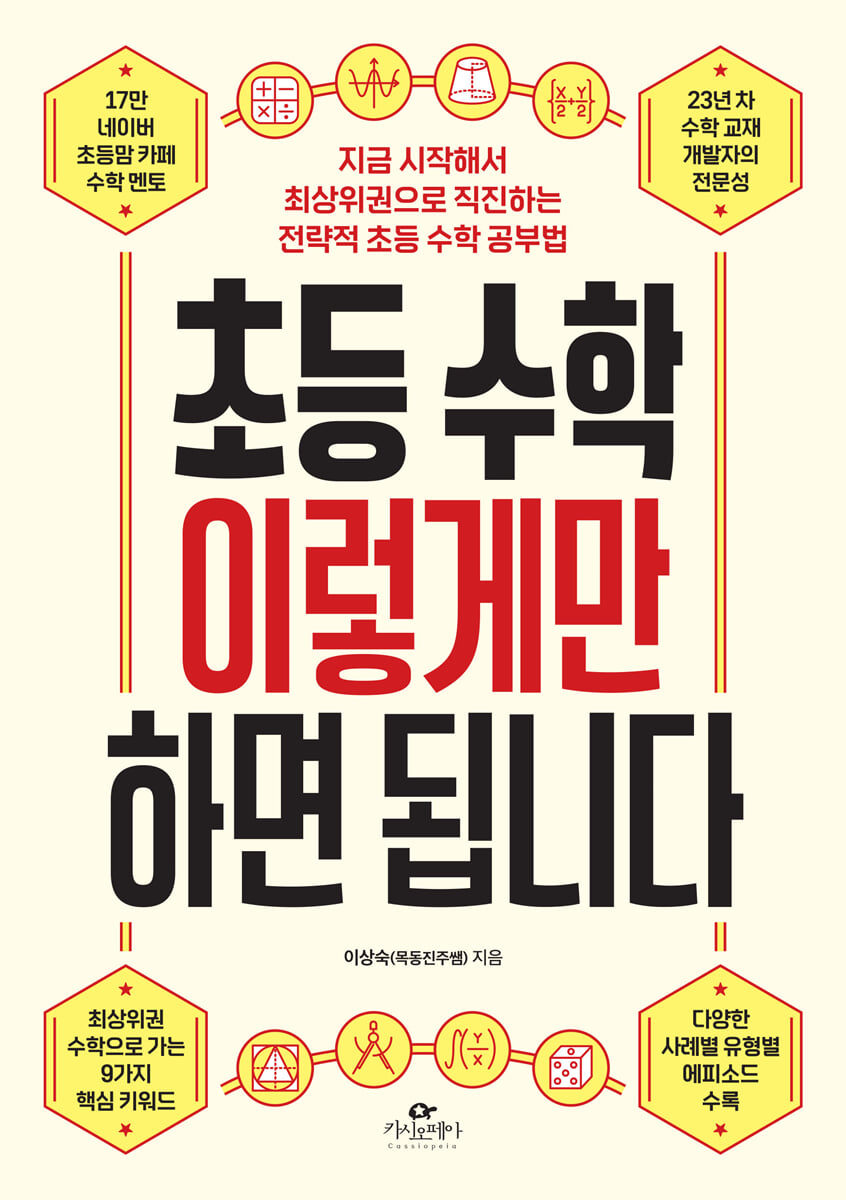
The best study strategies from a math textbook developer with 23 years of experience and a math mentor for 170,000 Naver elementary school moms.
9 key keywords for top-tier math, featuring episodes by case and type.
The term '7-year-old exam' is said to be trendy, referring to the entrance exam taken by children just before entering elementary school to enter prestigious academies.
In these times, parents feel more anxious about the subject of 'math'.
At a time when parents who are wavering and impatient in front of their children's 'math' need to find their balance, the book "Elementary Math: Just Do It This Way" has been published to help parents of elementary school children set the right direction for their children's math learning.
The author, who has been developing elementary school math textbooks for a long time and has taught math directly to children in Mokdong, says in this book that if you establish the right direction and habits for studying elementary school math, you can become a top math student in middle and high school.
The book explains the core of elementary school math study methods through nine keywords: 'concept', 'mathematical literacy', 'operation', 'thinking skills', 'curriculum math workbook', 'preliminary', 'advanced', 'academy', and 'attitude', and specifically addresses the issues that parents are most curious about.
Above all, as a developer of mathematics textbooks, the author meticulously covers the 'basics' and 'concepts' that should not be missed in elementary mathematics.
In particular, it sharply points out the content that parents who do 'Mom's Math' at home often overlook, and sometimes even the parts that even academy teachers overlook, and explains the key points in an easy-to-understand way.
It also contains a wealth of practical information tailored to your child, including advice on choosing specific textbooks.
This book will serve as the first step on a roadmap that elementary school students must follow step by step to achieve top-tier math learning and college entrance success.
The best study strategies from a math textbook developer with 23 years of experience and a math mentor for 170,000 Naver elementary school moms.
9 key keywords for top-tier math, featuring episodes by case and type.
The term '7-year-old exam' is said to be trendy, referring to the entrance exam taken by children just before entering elementary school to enter prestigious academies.
In these times, parents feel more anxious about the subject of 'math'.
At a time when parents who are wavering and impatient in front of their children's 'math' need to find their balance, the book "Elementary Math: Just Do It This Way" has been published to help parents of elementary school children set the right direction for their children's math learning.
The author, who has been developing elementary school math textbooks for a long time and has taught math directly to children in Mokdong, says in this book that if you establish the right direction and habits for studying elementary school math, you can become a top math student in middle and high school.
The book explains the core of elementary school math study methods through nine keywords: 'concept', 'mathematical literacy', 'operation', 'thinking skills', 'curriculum math workbook', 'preliminary', 'advanced', 'academy', and 'attitude', and specifically addresses the issues that parents are most curious about.
Above all, as a developer of mathematics textbooks, the author meticulously covers the 'basics' and 'concepts' that should not be missed in elementary mathematics.
In particular, it sharply points out the content that parents who do 'Mom's Math' at home often overlook, and sometimes even the parts that even academy teachers overlook, and explains the key points in an easy-to-understand way.
It also contains a wealth of practical information tailored to your child, including advice on choosing specific textbooks.
This book will serve as the first step on a roadmap that elementary school students must follow step by step to achieve top-tier math learning and college entrance success.
- You can preview some of the book's contents.
Preview
index
prolog
[Chapter 1] Concepts: The First Step to Top-Level Elementary Math
▶ The key to studying math is 'concepts'
▶ Math is memorization! vs. Is math memorization?
▶ Textbooks are stronger than any concept book.
▶ The beginning of studying concepts is terminology: 'Seeming to know' and 'knowing exactly' are different.
▶ How to learn concepts correctly using math textbooks
▶ The magic of 'Because...'
▶ If you can't explain it in words, you don't understand it correctly.
[Chapter 2] Children who excel at math have a distinct "math literacy"
▶ Will reading a lot of books make me good at math?
▶ Do you know all the mathematical terms and symbols that appear in your math textbook?
▶ Mathematical terms that are different from everyday terms
▶ Reasons why lower- and middle-ranking students make mistakes on word problems and solutions
▶ Reasons why top-ranking friends make mistakes on sentence problems and solutions
▶ Habit of reading while analyzing math problems ① Reading the problem backwards
▶ Habits of Reading and Analyzing Math Problems ② Understanding the Questioner's Intentions
▶ Why doesn't my child want to use the solution process?
[Chapter 3] My Child's Math Learning, Unwavering to the Next Door Mom
▶ Stop being swayed by the advice of the mom next door!
▶ Are you really good at division?
▶ Don't think of addition and subtraction as easy!
▶ The harm of mechanical calculations
▶ Correct way to learn operations ① First, develop your sense of numbers!
▶ Correct method of learning operations ② You must master operations at your grade level.
▶ The Right Way to Learn Arithmetic ③ Finding a Learning Method That Fits Your Child's Aptitude and Level
▶ Recommended operation textbooks for each situation
[Chapter 4] The right time for elementary school students to practice 'thinking math'
▶ Things that even parents who knew a bit about math in their old days don't know
▶ Math Study Method for Thinking: 'Why' Beats 'How'!
▶ Teaching aids to help students learn critical thinking skills in mathematics
▶ The best time to study critical thinking math is in the early grades!
▶ How should I choose a math textbook that develops critical thinking skills?
[Chapter 5] Choosing the Right Math Workbook for Your Child's Level
▶ What math workbook do you like?
▶ Introduction to Math Workbooks by Difficulty and Publisher
▶ The elementary math roadmap is divided into subjects by level.
▶ How to make the most of the commentary
▶ Don't trust the achievement rates in workbooks
[Chapter 6] Direction Matters More Than Speed: How to Properly Build a Roadmap
▶ A child who is good at math vs. a child who seems to be good at math
▶ "Isn't that how it's supposed to be done?" The Reality of Wrongful Good Deeds
▶ The real loss is losing the opportunity to solve advanced problems!
▶ There are children who need good deeds.
▶ Speed is meaningless if the direction is wrong!
▶ A Peek into the Math Study Roadmap for Children in the School District
▶ Things to keep in mind when doing secondary prerequisites
▶ Recommended textbooks for each level of secondary mathematics
[Chapter 7] Don't Miss Out on Advanced Math, Which Is More Important Than Preliminary Math
▶ Deepening rather than prioritizing
▶ They say there won't be any killer problems, so do I need advanced math?
▶ What is the right in-depth math learning program for my child?
▶ The right way to study in-depth: Is it okay to skip the most difficult level problems and solve them?
▶ If you are having trouble with advanced problems, start with ‘this’!
▶ Are math competitions medicine or poison?
▶ Characteristics and preparation methods for each type of math competition
▶ Things to know when taking a math test!
[Chapter 8] Elementary Math: When You Need a Private Academy
▶ When should I start attending a math academy?
▶ The moment you feel you need an academy!
▶ If I go to an academy, isn't that self-directed learning?
▶ Find an academy that suits your child's personality
▶ Don't send your child to an academy like this.
▶ Even if you leave it to an academy, management is still necessary.
▶ The most important thing in academy classes is 'questions'
[Chapter 9] Children in different school districts have different 'attitudes' toward studying math.
▶ The greatest strength of children in the school district
▶ Confidence is half the battle in math!
▶ Praise and encouragement should be given for attitude, not grades.
▶ Is math ability a matter of brains or effort?
▶ Mistakes are also skills!
[Chapter 1] Concepts: The First Step to Top-Level Elementary Math
▶ The key to studying math is 'concepts'
▶ Math is memorization! vs. Is math memorization?
▶ Textbooks are stronger than any concept book.
▶ The beginning of studying concepts is terminology: 'Seeming to know' and 'knowing exactly' are different.
▶ How to learn concepts correctly using math textbooks
▶ The magic of 'Because...'
▶ If you can't explain it in words, you don't understand it correctly.
[Chapter 2] Children who excel at math have a distinct "math literacy"
▶ Will reading a lot of books make me good at math?
▶ Do you know all the mathematical terms and symbols that appear in your math textbook?
▶ Mathematical terms that are different from everyday terms
▶ Reasons why lower- and middle-ranking students make mistakes on word problems and solutions
▶ Reasons why top-ranking friends make mistakes on sentence problems and solutions
▶ Habit of reading while analyzing math problems ① Reading the problem backwards
▶ Habits of Reading and Analyzing Math Problems ② Understanding the Questioner's Intentions
▶ Why doesn't my child want to use the solution process?
[Chapter 3] My Child's Math Learning, Unwavering to the Next Door Mom
▶ Stop being swayed by the advice of the mom next door!
▶ Are you really good at division?
▶ Don't think of addition and subtraction as easy!
▶ The harm of mechanical calculations
▶ Correct way to learn operations ① First, develop your sense of numbers!
▶ Correct method of learning operations ② You must master operations at your grade level.
▶ The Right Way to Learn Arithmetic ③ Finding a Learning Method That Fits Your Child's Aptitude and Level
▶ Recommended operation textbooks for each situation
[Chapter 4] The right time for elementary school students to practice 'thinking math'
▶ Things that even parents who knew a bit about math in their old days don't know
▶ Math Study Method for Thinking: 'Why' Beats 'How'!
▶ Teaching aids to help students learn critical thinking skills in mathematics
▶ The best time to study critical thinking math is in the early grades!
▶ How should I choose a math textbook that develops critical thinking skills?
[Chapter 5] Choosing the Right Math Workbook for Your Child's Level
▶ What math workbook do you like?
▶ Introduction to Math Workbooks by Difficulty and Publisher
▶ The elementary math roadmap is divided into subjects by level.
▶ How to make the most of the commentary
▶ Don't trust the achievement rates in workbooks
[Chapter 6] Direction Matters More Than Speed: How to Properly Build a Roadmap
▶ A child who is good at math vs. a child who seems to be good at math
▶ "Isn't that how it's supposed to be done?" The Reality of Wrongful Good Deeds
▶ The real loss is losing the opportunity to solve advanced problems!
▶ There are children who need good deeds.
▶ Speed is meaningless if the direction is wrong!
▶ A Peek into the Math Study Roadmap for Children in the School District
▶ Things to keep in mind when doing secondary prerequisites
▶ Recommended textbooks for each level of secondary mathematics
[Chapter 7] Don't Miss Out on Advanced Math, Which Is More Important Than Preliminary Math
▶ Deepening rather than prioritizing
▶ They say there won't be any killer problems, so do I need advanced math?
▶ What is the right in-depth math learning program for my child?
▶ The right way to study in-depth: Is it okay to skip the most difficult level problems and solve them?
▶ If you are having trouble with advanced problems, start with ‘this’!
▶ Are math competitions medicine or poison?
▶ Characteristics and preparation methods for each type of math competition
▶ Things to know when taking a math test!
[Chapter 8] Elementary Math: When You Need a Private Academy
▶ When should I start attending a math academy?
▶ The moment you feel you need an academy!
▶ If I go to an academy, isn't that self-directed learning?
▶ Find an academy that suits your child's personality
▶ Don't send your child to an academy like this.
▶ Even if you leave it to an academy, management is still necessary.
▶ The most important thing in academy classes is 'questions'
[Chapter 9] Children in different school districts have different 'attitudes' toward studying math.
▶ The greatest strength of children in the school district
▶ Confidence is half the battle in math!
▶ Praise and encouragement should be given for attitude, not grades.
▶ Is math ability a matter of brains or effort?
▶ Mistakes are also skills!
Detailed image

Into the book
Top math students understand the importance of math concepts all too well.
I actually spend a lot of time studying math concepts, and I consider studying math concepts to include understanding how the concepts I've learned apply to problems and how certain concepts are used in the problems I've solved.
For these children, math problems are a way to 'check if I've really understood the concepts I've learned.'
So these kids often say, “Math is a very easy subject; you don’t have to memorize words like English words, as long as you understand the concepts.”
On the other hand, children who have difficulty with math and are not good at it tend to skim over the concepts and try to solve problems right away when studying math.
I spend more time solving problems than studying concepts.
This is because people think that math is all about solving problems and getting the right answers.
---From "The Core of Studying Mathematics is Concepts"
When creating a math textbook, many math-specialized editors gather together to research, hold meetings, review, and spend a long time organizing the content and creating problems.
At this time, the absolute standard that math editors use is the math textbook.
When I meet parents at my lectures, they often ask me what the best textbook is for teaching math concepts.
Every time, I answer, “The best teaching material for children to learn correct concepts is a math textbook.”
---From "Textbooks are stronger than any concept book"
The best way to ensure that children understand the math concepts they are learning is to have them explain them verbally.
Having a solid understanding of a mathematical concept means being able to organize it in your head and explain and express it in your own words.
Through this process, children think they 'know' something, but when they try to explain it to a friend, teacher, or mother, they realize that it is not well organized in their head, and they come to understand the concept on their own, making it difficult to explain it to someone else.
Also, from a teaching perspective, listening to a child explain a concept verbally can help you determine where the child may not have fully understood the concept or may be misunderstanding a concept.
---From "If you can't explain it in words, you don't understand it correctly"
People often say, “You have to read a lot to be good at math.”
When I give lectures to parents, I hear, “Teacher, my child has read a lot of books since he was little, but he has difficulty with math.
I often hear questions like, “I have a hard time with sentence structures. Why is that?”
But does reading a lot really make you good at math? To that question, I answer with a resounding "no."
This is because the way we read books and the way we read math sentences are different.
---From "Will Reading a Lot Make You Good at Math?"
When friends in the upper ranks make mistakes on word problems, it is rare for them to make mistakes because they do not understand the problem itself, unlike friends in the middle and lower ranks.
The reason these friends make mistakes is that, having encountered many similar problems, they quickly solve the problem without reading it thoroughly and assume that it is the same type of problem they have solved before, and end up not finding the correct answer required by the problem.
What you are missing is that the given conditions and the answers to be found are slightly different for each problem.
---From "Reasons why top-ranking friends make mistakes on sentence problems and solutions"
But why do children find it so difficult to write out the solution process? There are two main reasons why children avoid writing out the solution process or formulas when solving math problems.
First, many children think that they just need to solve math problems and get the right answer.
(…) Secondly, when solving a math problem, the process of solving it is not organized in the child’s mind or the ability to organize it is lacking.
---From "Why doesn't my child want to use the solution process?"
When I meet parents of younger students at external lectures, the question I hear most often, along with questions about computational learning methods, is about "thinking math."
Among them, the most common question is about the necessity of critical thinking mathematics, such as “Do I really need to take critical thinking mathematics?”
The more confidently parents say, “I was good at math back in the day,” the more likely they are to say, “When we were kids, we didn’t need to do anything special like critical thinking math, because we were good at math.”
I often see people say, “All thinking math is just a trick.”
(…) I think that what is most necessary in learning mathematics for preschool and lower grade children is real-life mathematics or thinking mathematics.
---From "Things that even parents who did some math in their old days don't know"
Whenever I'm asked if prior learning is necessary, I always say, "Just give it a try."
However, I will add the caveat, “It must be a proper prior learning.”
There's no way to know how talented your child is at math learning until you try it.
I don't think there's anything wrong with progressing quickly, as long as it's within the child's capabilities.
Of course, there are cases where you have to set a specific goal and make a certain amount of progress quickly within a set period of time, such as for entrance exams to gifted high schools or science high schools.
Even if that is not the case, I think it is better to progress at a pace that is appropriate for the child's ability rather than unnecessary repetition, so that the child can spend enough time on areas where he or she is stuck or has difficulty while learning math in the future.
---From "There Are Children Who Need Good Deeds"
When the Ministry of Education first announced that it would no longer include "killer" math problems on the CSAT, I saw many people thinking, "Now math will be easier," and saying they should ease up on math and focus on other subjects.
And then, when the actual college entrance exam questions were released, many people were confused by the math problems that seemed to have become more difficult.
(…) In fact, if you look at the briefings from the Korea Institute for Curriculum and Evaluation and the Ministry of Education after the CSAT, you can see that they did not mean to unconditionally exclude difficult killer problems.
The Korea Institute for Curriculum and Evaluation (KIEC) stated that the purpose of the exam was to exclude killer questions that would be advantageous to children who had already acquired problem-solving skills through private education, and the Ministry of Education also stated that the purpose of the exam was to exclude killer questions so that children who had learned problem-solving skills through private education in areas not covered in public education would not be at an advantage.
Furthermore, the importance of in-depth learning has grown, as it means that going forward, we will be presenting problems that require as much in-depth thinking as possible within the scope provided by public education.
---From "They say there won't be any killer problems, so do I need advanced math?"
When people think of math competitions, they often think of very difficult math tests taken by top students.
For that reason, many people have negative thoughts, such as, "Is it really necessary to make young elementary school students study difficult math that has little to do with their school life?"
However, I think it is a good idea to experience external tests such as math competitions during elementary school.
The benefits of participating in math competitions in elementary school include:
First, it is the experience of taking the test.
(…) Second, it is an experience that gives you confidence and a sense of accomplishment.
(…) Third, it is possible to check the achievement rate for the semester or grade studied and to confirm objective indicators of learning ability.
---From "Is the Math Competition Medicine or Poison?"
The moment when one feels the need for an academy varies greatly from child to child and from each family's situation and atmosphere.
However, I would like to recommend two main cases.
First, it is a moment when the relationship between mother and child is shaken.
(…) If conflicts arise between mother and child while learning math, or if the relationship between mother and child begins to waver, I recommend that mothers boldly withdraw from their children’s learning and send them to an academy.
(…) Second, it is a moment when it is no longer possible to answer the child’s questions in a correct way.
(…) There are ways to teach at home using textbook commentary or online lectures that fit the curriculum, but as the child advances in grade level, this process can become more difficult and you may not be confident that your answers will be helpful to the child’s questions.
This is exactly when you need a math academy.
---From "The Moment You Feel the Need for an Academy"
From now on, I will explain the four main types of academies to avoid.
First, it is an academy that emphasizes good deeds or creates anxiety by comparing the progress of other children in the academy.
(…) Second, it is an academy that does not administer exams.
This is a case where the academy only moves forward with the same textbook and class without checking the children's achievement rate or understanding, that is, without giving them tests.
(…) Third, it is an academy with excessively long class hours.
(…) If the class time is too long, there is a high possibility that the teacher will be solving many problems one by one.
(…) Lastly, it is an academy without feedback.
It's best to choose an academy that regularly communicates with parents about how their child is adjusting to classes and how they are doing with their homework.
---From "Don't send your child to this kind of academy"
Many of the parents I meet at the lecture are considering moving to a school district and asking about the advantages of the school district.
At such times, I talk about the school district's greatest strength as 'the children's attitude toward learning.'
(…) So, if you want to foster a child's positive attitude toward learning, do you really need to move to a school district? And will simply moving to a school district automatically change your child's attitude toward learning? Just because a school district is located doesn't mean every child will study hard and take studying for granted.
In fact, what is more important than the surrounding environment is the study atmosphere at home.
The study environment at home, the perception of studying, and the attitude toward studying must be corrected first, and then the surrounding environment will also be affected.
I actually spend a lot of time studying math concepts, and I consider studying math concepts to include understanding how the concepts I've learned apply to problems and how certain concepts are used in the problems I've solved.
For these children, math problems are a way to 'check if I've really understood the concepts I've learned.'
So these kids often say, “Math is a very easy subject; you don’t have to memorize words like English words, as long as you understand the concepts.”
On the other hand, children who have difficulty with math and are not good at it tend to skim over the concepts and try to solve problems right away when studying math.
I spend more time solving problems than studying concepts.
This is because people think that math is all about solving problems and getting the right answers.
---From "The Core of Studying Mathematics is Concepts"
When creating a math textbook, many math-specialized editors gather together to research, hold meetings, review, and spend a long time organizing the content and creating problems.
At this time, the absolute standard that math editors use is the math textbook.
When I meet parents at my lectures, they often ask me what the best textbook is for teaching math concepts.
Every time, I answer, “The best teaching material for children to learn correct concepts is a math textbook.”
---From "Textbooks are stronger than any concept book"
The best way to ensure that children understand the math concepts they are learning is to have them explain them verbally.
Having a solid understanding of a mathematical concept means being able to organize it in your head and explain and express it in your own words.
Through this process, children think they 'know' something, but when they try to explain it to a friend, teacher, or mother, they realize that it is not well organized in their head, and they come to understand the concept on their own, making it difficult to explain it to someone else.
Also, from a teaching perspective, listening to a child explain a concept verbally can help you determine where the child may not have fully understood the concept or may be misunderstanding a concept.
---From "If you can't explain it in words, you don't understand it correctly"
People often say, “You have to read a lot to be good at math.”
When I give lectures to parents, I hear, “Teacher, my child has read a lot of books since he was little, but he has difficulty with math.
I often hear questions like, “I have a hard time with sentence structures. Why is that?”
But does reading a lot really make you good at math? To that question, I answer with a resounding "no."
This is because the way we read books and the way we read math sentences are different.
---From "Will Reading a Lot Make You Good at Math?"
When friends in the upper ranks make mistakes on word problems, it is rare for them to make mistakes because they do not understand the problem itself, unlike friends in the middle and lower ranks.
The reason these friends make mistakes is that, having encountered many similar problems, they quickly solve the problem without reading it thoroughly and assume that it is the same type of problem they have solved before, and end up not finding the correct answer required by the problem.
What you are missing is that the given conditions and the answers to be found are slightly different for each problem.
---From "Reasons why top-ranking friends make mistakes on sentence problems and solutions"
But why do children find it so difficult to write out the solution process? There are two main reasons why children avoid writing out the solution process or formulas when solving math problems.
First, many children think that they just need to solve math problems and get the right answer.
(…) Secondly, when solving a math problem, the process of solving it is not organized in the child’s mind or the ability to organize it is lacking.
---From "Why doesn't my child want to use the solution process?"
When I meet parents of younger students at external lectures, the question I hear most often, along with questions about computational learning methods, is about "thinking math."
Among them, the most common question is about the necessity of critical thinking mathematics, such as “Do I really need to take critical thinking mathematics?”
The more confidently parents say, “I was good at math back in the day,” the more likely they are to say, “When we were kids, we didn’t need to do anything special like critical thinking math, because we were good at math.”
I often see people say, “All thinking math is just a trick.”
(…) I think that what is most necessary in learning mathematics for preschool and lower grade children is real-life mathematics or thinking mathematics.
---From "Things that even parents who did some math in their old days don't know"
Whenever I'm asked if prior learning is necessary, I always say, "Just give it a try."
However, I will add the caveat, “It must be a proper prior learning.”
There's no way to know how talented your child is at math learning until you try it.
I don't think there's anything wrong with progressing quickly, as long as it's within the child's capabilities.
Of course, there are cases where you have to set a specific goal and make a certain amount of progress quickly within a set period of time, such as for entrance exams to gifted high schools or science high schools.
Even if that is not the case, I think it is better to progress at a pace that is appropriate for the child's ability rather than unnecessary repetition, so that the child can spend enough time on areas where he or she is stuck or has difficulty while learning math in the future.
---From "There Are Children Who Need Good Deeds"
When the Ministry of Education first announced that it would no longer include "killer" math problems on the CSAT, I saw many people thinking, "Now math will be easier," and saying they should ease up on math and focus on other subjects.
And then, when the actual college entrance exam questions were released, many people were confused by the math problems that seemed to have become more difficult.
(…) In fact, if you look at the briefings from the Korea Institute for Curriculum and Evaluation and the Ministry of Education after the CSAT, you can see that they did not mean to unconditionally exclude difficult killer problems.
The Korea Institute for Curriculum and Evaluation (KIEC) stated that the purpose of the exam was to exclude killer questions that would be advantageous to children who had already acquired problem-solving skills through private education, and the Ministry of Education also stated that the purpose of the exam was to exclude killer questions so that children who had learned problem-solving skills through private education in areas not covered in public education would not be at an advantage.
Furthermore, the importance of in-depth learning has grown, as it means that going forward, we will be presenting problems that require as much in-depth thinking as possible within the scope provided by public education.
---From "They say there won't be any killer problems, so do I need advanced math?"
When people think of math competitions, they often think of very difficult math tests taken by top students.
For that reason, many people have negative thoughts, such as, "Is it really necessary to make young elementary school students study difficult math that has little to do with their school life?"
However, I think it is a good idea to experience external tests such as math competitions during elementary school.
The benefits of participating in math competitions in elementary school include:
First, it is the experience of taking the test.
(…) Second, it is an experience that gives you confidence and a sense of accomplishment.
(…) Third, it is possible to check the achievement rate for the semester or grade studied and to confirm objective indicators of learning ability.
---From "Is the Math Competition Medicine or Poison?"
The moment when one feels the need for an academy varies greatly from child to child and from each family's situation and atmosphere.
However, I would like to recommend two main cases.
First, it is a moment when the relationship between mother and child is shaken.
(…) If conflicts arise between mother and child while learning math, or if the relationship between mother and child begins to waver, I recommend that mothers boldly withdraw from their children’s learning and send them to an academy.
(…) Second, it is a moment when it is no longer possible to answer the child’s questions in a correct way.
(…) There are ways to teach at home using textbook commentary or online lectures that fit the curriculum, but as the child advances in grade level, this process can become more difficult and you may not be confident that your answers will be helpful to the child’s questions.
This is exactly when you need a math academy.
---From "The Moment You Feel the Need for an Academy"
From now on, I will explain the four main types of academies to avoid.
First, it is an academy that emphasizes good deeds or creates anxiety by comparing the progress of other children in the academy.
(…) Second, it is an academy that does not administer exams.
This is a case where the academy only moves forward with the same textbook and class without checking the children's achievement rate or understanding, that is, without giving them tests.
(…) Third, it is an academy with excessively long class hours.
(…) If the class time is too long, there is a high possibility that the teacher will be solving many problems one by one.
(…) Lastly, it is an academy without feedback.
It's best to choose an academy that regularly communicates with parents about how their child is adjusting to classes and how they are doing with their homework.
---From "Don't send your child to this kind of academy"
Many of the parents I meet at the lecture are considering moving to a school district and asking about the advantages of the school district.
At such times, I talk about the school district's greatest strength as 'the children's attitude toward learning.'
(…) So, if you want to foster a child's positive attitude toward learning, do you really need to move to a school district? And will simply moving to a school district automatically change your child's attitude toward learning? Just because a school district is located doesn't mean every child will study hard and take studying for granted.
In fact, what is more important than the surrounding environment is the study atmosphere at home.
The study environment at home, the perception of studying, and the attitude toward studying must be corrected first, and then the surrounding environment will also be affected.
---From "The Greatest Strengths of School District Children"
Publisher's Review
“There’s a civil service exam for 7-year-olds?” “Shouldn’t we start taking it sooner for our child too?”
“Is it possible that my child is bad at math because I am bad at math?”
Parents' anxiety and impatience when faced with math ruins their children's math skills.
They say the term '7-year-old exam' is trendy.
This refers to the test taken by 5-6 year old children who are about to enter elementary school to enter a famous academy.
Parents' anxiety is growing in this era.
Especially when it comes to 'math', I get anxious for no reason.
“Shouldn’t I be getting my child to do it sooner?” “Isn’t it because I’m a math churn that my child can’t do math?” Such anxiety and guilt often lead to impatience, which often makes things even harder for the child.
At a time when parents, who are more anxious and unstable than ever before when it comes to math, need to find their balance, this book, "Elementary Math: Just Do It This Way," helps parents of elementary school children set the right direction for their children's math learning and provides customized, practical information for their children.
The editor, who has developed elementary math textbooks for a long time and the author, who has taught math directly to children in Mokdong, clearly outlines the direction of elementary math study based on the know-how acquired through long experience, and provides specific study methods and various tips.
Concepts, mathematical literacy, operations, thinking skills, prior knowledge, advanced knowledge, textbook mathematics workbooks, academies, attitudes, etc.
We'll teach you the essentials of math study methods with nine key keywords that will help you reach the top of your math skills.
This book explains the core of elementary school math study methods using nine keywords and provides specific answers to questions parents have.
Chapter 1 discusses the 'method of learning math concepts,' which is the first step in the secret to advancing to the top level of math.
Chapter 2 provides a detailed explanation of 'mathematical literacy', which parents often overlook and teachers at private academies often fail to properly address.
Chapters 3 and 4 discuss 'operational learning methods' and 'thinking mathematics', which are especially important and easily misunderstood in elementary school, and Chapter 5 provides information on how to select a 'curriculum mathematics workbook' that is appropriate for the child's level, which many parents are curious about.
Chapters 6 and 7 also address the never-ending concerns of parents regarding ‘math pre-study’ and ‘advanced learning.’
Chapter 8 discusses how to wisely choose a math academy, and Chapter 9 discusses the importance of one's "attitude" toward studying math.
In this way, elementary mathematics learning and teaching methods are covered step by step over nine chapters.
Mokdong Jinju, a math textbook developer with 23 years of experience and a math mentor at the Naver Elementary School Moms Cafe with 170,000 subscribers
Includes specific study methods that can be applied to your child and vivid case studies and episodes for each type.
Above all, this book is deeply imbued with the author's long-term practical experience as an editor who has developed elementary school mathematics textbooks and taught mathematics directly to children in Mokdong.
The author emphasizes the importance of learning the right concepts, the first step in mathematics, and provides various training methods and practical tips for this.
Additionally, the author shares his unique know-how on how to improve mathematical literacy, saying that simply reading a lot of books does not improve mathematical literacy.
It also points out the harm of learning operations by force, swayed by the advice of the mother next door, or by mechanically prioritizing operations, and introduces the correct method of learning operations, which varies depending on the level and tendency of each child.
The author particularly emphasizes the importance of critical thinking in mathematics, saying that critical thinking is not about solving difficult problems, but rather learning the process of asking 'why' in a problem.
Regarding advanced learning, which many parents are curious about, the book explains that direction is more important than speed when doing advanced learning, and explains how to properly create a roadmap, from a glimpse into the math study roadmap for children in the school district to things to keep in mind when doing advanced learning in middle school and recommended textbooks for each stage of advanced learning.
This book is the first to teach the study direction and habits that elementary school students should follow step by step to achieve "math learning" that will lead to top-tier students and successful college entrance exams. It is a great guidebook for parents of elementary school children.
“Is it possible that my child is bad at math because I am bad at math?”
Parents' anxiety and impatience when faced with math ruins their children's math skills.
They say the term '7-year-old exam' is trendy.
This refers to the test taken by 5-6 year old children who are about to enter elementary school to enter a famous academy.
Parents' anxiety is growing in this era.
Especially when it comes to 'math', I get anxious for no reason.
“Shouldn’t I be getting my child to do it sooner?” “Isn’t it because I’m a math churn that my child can’t do math?” Such anxiety and guilt often lead to impatience, which often makes things even harder for the child.
At a time when parents, who are more anxious and unstable than ever before when it comes to math, need to find their balance, this book, "Elementary Math: Just Do It This Way," helps parents of elementary school children set the right direction for their children's math learning and provides customized, practical information for their children.
The editor, who has developed elementary math textbooks for a long time and the author, who has taught math directly to children in Mokdong, clearly outlines the direction of elementary math study based on the know-how acquired through long experience, and provides specific study methods and various tips.
Concepts, mathematical literacy, operations, thinking skills, prior knowledge, advanced knowledge, textbook mathematics workbooks, academies, attitudes, etc.
We'll teach you the essentials of math study methods with nine key keywords that will help you reach the top of your math skills.
This book explains the core of elementary school math study methods using nine keywords and provides specific answers to questions parents have.
Chapter 1 discusses the 'method of learning math concepts,' which is the first step in the secret to advancing to the top level of math.
Chapter 2 provides a detailed explanation of 'mathematical literacy', which parents often overlook and teachers at private academies often fail to properly address.
Chapters 3 and 4 discuss 'operational learning methods' and 'thinking mathematics', which are especially important and easily misunderstood in elementary school, and Chapter 5 provides information on how to select a 'curriculum mathematics workbook' that is appropriate for the child's level, which many parents are curious about.
Chapters 6 and 7 also address the never-ending concerns of parents regarding ‘math pre-study’ and ‘advanced learning.’
Chapter 8 discusses how to wisely choose a math academy, and Chapter 9 discusses the importance of one's "attitude" toward studying math.
In this way, elementary mathematics learning and teaching methods are covered step by step over nine chapters.
Mokdong Jinju, a math textbook developer with 23 years of experience and a math mentor at the Naver Elementary School Moms Cafe with 170,000 subscribers
Includes specific study methods that can be applied to your child and vivid case studies and episodes for each type.
Above all, this book is deeply imbued with the author's long-term practical experience as an editor who has developed elementary school mathematics textbooks and taught mathematics directly to children in Mokdong.
The author emphasizes the importance of learning the right concepts, the first step in mathematics, and provides various training methods and practical tips for this.
Additionally, the author shares his unique know-how on how to improve mathematical literacy, saying that simply reading a lot of books does not improve mathematical literacy.
It also points out the harm of learning operations by force, swayed by the advice of the mother next door, or by mechanically prioritizing operations, and introduces the correct method of learning operations, which varies depending on the level and tendency of each child.
The author particularly emphasizes the importance of critical thinking in mathematics, saying that critical thinking is not about solving difficult problems, but rather learning the process of asking 'why' in a problem.
Regarding advanced learning, which many parents are curious about, the book explains that direction is more important than speed when doing advanced learning, and explains how to properly create a roadmap, from a glimpse into the math study roadmap for children in the school district to things to keep in mind when doing advanced learning in middle school and recommended textbooks for each stage of advanced learning.
This book is the first to teach the study direction and habits that elementary school students should follow step by step to achieve "math learning" that will lead to top-tier students and successful college entrance exams. It is a great guidebook for parents of elementary school children.
GOODS SPECIFICS
- Date of issue: March 25, 2025
- Page count, weight, size: 272 pages | 390g | 148*210*20mm
- ISBN13: 9791168272828
- ISBN10: 1168272823
You may also like
카테고리
korean


korean

![GQ KOREA Mark (Monthly): December [2025]](http://librairie.coreenne.fr/cdn/shop/files/8ef265dbbfbf186523ed75ba7319009d.jpg?v=1765340328&width=3840)


