

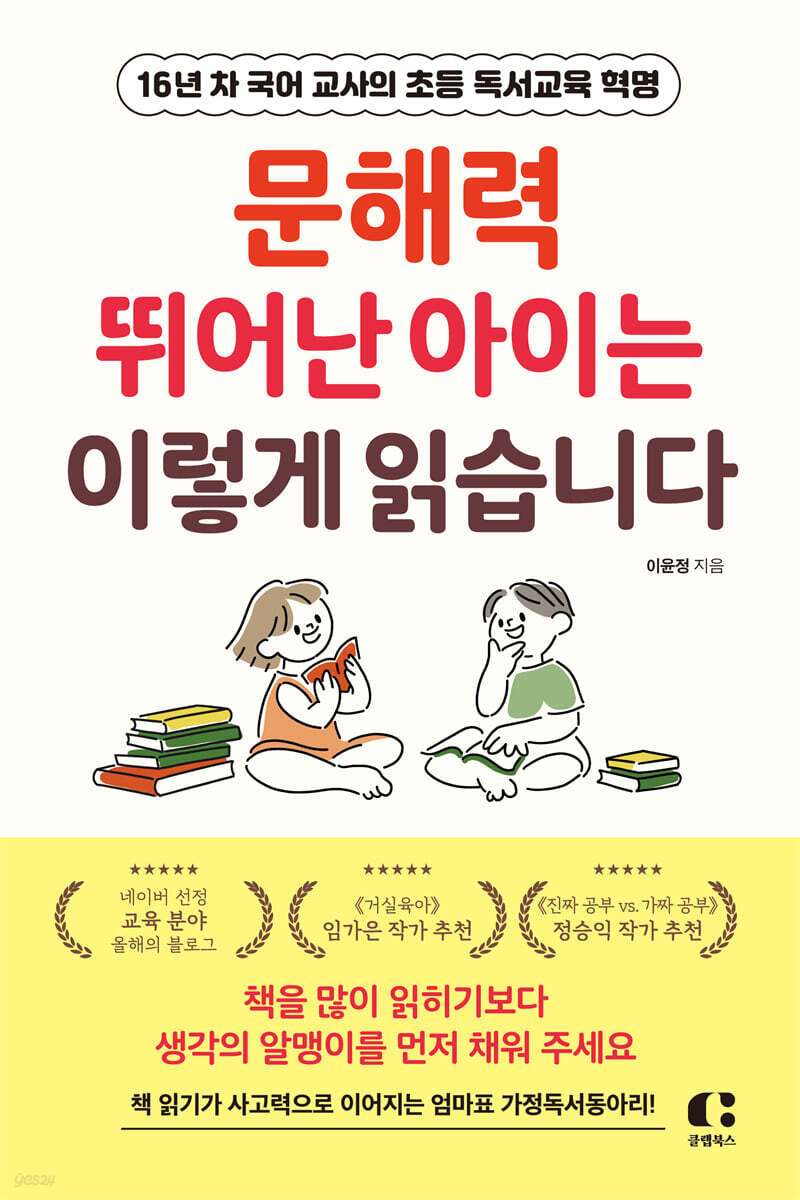
This is how a child with high literacy reads
 |
Description
Book Introduction
“Elementary literacy determines your life!” Everything about the elementary school home reading club that eventually became popular in high school * 5th stage of literacy foundation construction for a 16-year Korean language teacher * Naver Education Blog of the Year: "Teacher Yoon Jeong's I Like Korean" * EBS Suneung English instructor Jeong Seung-ik strongly recommends "Living Room Parenting" author Im Ga-eun. There are no subjects for which ‘mother-style education’ is as effective as Korean and reading. This is because the competitiveness of reading, discussion, and writing academies lies in their curriculum, which consists of high-quality books such as "World Classics" and "Required Readings for Prestigious Universities," and thus cannot properly target my child's level and interests. If you send your child to an academy, they will be exposed to difficult books and will be able to acquire 'skills' such as reading in a short period of time, writing short essays, and using manuscript paper, but it will be difficult to fill them with the 'essence of thought' of actively asking questions and imagining while reading. In other words, reading a lot of books and raising the quality of books does not necessarily improve a child's abilities. In particular, literacy becomes a unique ability when it is nurtured at home rather than in an academy. Literacy grows when we read books and make their contents 'our own.' However, as children advance in grade level, they become more distant from active reading due to the pressure of school classes and college entrance exams. Literacy is necessary for Korean, English, science, and even mathematics, but there is not enough time to develop it. This is why we must not miss out on reading education during elementary school. No matter what subject a child studies or what social life he or she experiences, there is no area that does not require literacy, so elementary literacy skills inevitably influence a child's entire life. The author, a high school Korean language teacher with 16 years of experience, created a home reading club by combining the 'Korean language education know-how' she acquired through her long career as a teacher with the 'mom's way of education' she experienced firsthand as a mother of sons in second and fourth grades. Children who have experienced a home reading club become children who like reading books more than using smartphones, children who do not have much difficulty with Korean even when they are in high school, and children who enjoy reading books throughout their lives. This book not only provides a list of books that children should read, but also provides detailed instructions on how to start and run a home reading club, even for non-experts. In particular, '5 Steps to Building a Solid and Unwavering Literacy Foundation' can be said to be the core of elementary reading education, which the author has selected through three years of trial and error to retain only the most effective activities. With just this one book, even ordinary parents without any specialized knowledge can become experts in their child's reading education. |
- You can preview some of the book's contents.
Preview
index
Do you know the relationship between CSAT English and reading? _Jeong Seung-ik (EBS CSAT English instructor)
A Foundation for Children to Live as 'Lifelong Readers' _ Lim Ga-eun (Educational Environment Specialist)
Beginning with elementary literacy, it shapes your life.
-Part 1: Where Our Children's Literacy Begins-
Chapter 1: Children with High Literacy Read at Home
A mother who is passionate about reading is getting anxious as her child approaches elementary school.
Filling in the nucleus of thoughts that essay academies cannot
A mother's reading education is a lifelong legacy for her children.
Reasons why it's enough for a mother to run a home reading club on her own
PLUS TIP.
How do I get a reading instructor certification?
Discover the power of reading together, something you can't achieve alone.
Embracing our differences as "diversity" instead of "uniqueness."
Chapter 2: How to Start a Home Reading Club
Just deciding to start is half the battle.
PLUS TIP.
I don't know if I'm leading well.
Setting clear goals for unwavering sailing
Looking for dependable crew members to join us on our long journey.
Making mothers the hidden helpers and children the protagonists.
A few preventive shots that are safe to get in advance
Part 2: The Secret to Improving Literacy: A Practical Guide to Home Reading Clubs
Chapter 3: 5 Steps to Building a Solid and Unwavering Literacy Foundation
[Step 1] Warm-up with an attendance mission: Writing and simultaneous transcription
[Step 2] Motivational Activities to Make You Want to Read: "Creating a Title"
[Step 3] Reading Strategy for Deeper Immersion in a Book: Repeating "Read, Write, and Read"
[Step 4] Done Reading? Make It Yours: 7 Post-Reading Strategies
└ The basics of post-reading activities: 'Understand, think, and write'
└ Strategy 1.
Expand your vocabulary with idioms and proverbs related to the book's content.
└ Strategy 2.
Developing delicate expressiveness using the "Emotion and Personality Bookends"
└ Strategy 3.
Develop academic skills through curriculum-related activities
└ Strategy 4.
Deepening Literacy by Reading Elementary Newspapers
└ Strategy 5.
Identify problems yourself by presenting your own writing.
└ Strategy 6.
Develop speaking skills by watching presentation videos directly.
└ Strategy 7.
Develop listening skills by listening to your friends' presentations.
[Step 5] Ending the Reading Fun: Special Quarterly Activities
└ Beginner 1.
Reading Newspaper: Imprinting the Book's Contents in Your Mind
└ Beginner 2.
Reading Quiz Contest: Review the Books You've Read Carefully
└ Intermediate 1.
Reading Board Game: Have Fun Reviewing Book Content
└ Intermediate 2.
Create a Reading Quiz: Develop Logical Thinking and Creativity
└ Advanced 1.
Participate in the Book Review Contest: Raise the Level of Your Book Reviews
└ Advanced 2.
Presenting: Develop Your Presentation Skills
PLUS TIP.
The spelling is a mess. Should I fix it one by one?
Chapter 4: Know-how for Running a Home Reading Club to Create an Environment for Improving Literacy
Three Ways to Choose Good Books to Read with Your Kids
PLUS TIP.
Do we have to buy all the books needed for each activity?
Formula for creating 'reading activity sheets' tailored to children's levels
Everything You Need to Know About Preparing Snacks, the Source of Concentration
PLUS TIP.
My child is slow during activities. How long should I wait?
Preparing a "Space" Optimized for Home Reading Clubs
PLUS TIP.
I feel burdened by providing my house as a club venue.
Useful 'auxiliary tools' to have on hand
PLUS TIP.
Who purchases the supplies needed for the activity and how?
Chapter 5: Expanding Your Child's World through In-Depth Home Reading Club Activities
Feedback on Home Reading Club Activities
PLUS TIP.
Should parents be notified if their child is having trouble concentrating or falling behind?
Creating a home reading club activity booklet for each semester
Immerse yourself in a sea of books during your vacation! All-day reading day
Family Camping: A Home Reading Club That Boosts Solidarity and Achievement
Appendix: Monthly Recommended Book Lists Related to School Events
A Foundation for Children to Live as 'Lifelong Readers' _ Lim Ga-eun (Educational Environment Specialist)
Beginning with elementary literacy, it shapes your life.
-Part 1: Where Our Children's Literacy Begins-
Chapter 1: Children with High Literacy Read at Home
A mother who is passionate about reading is getting anxious as her child approaches elementary school.
Filling in the nucleus of thoughts that essay academies cannot
A mother's reading education is a lifelong legacy for her children.
Reasons why it's enough for a mother to run a home reading club on her own
PLUS TIP.
How do I get a reading instructor certification?
Discover the power of reading together, something you can't achieve alone.
Embracing our differences as "diversity" instead of "uniqueness."
Chapter 2: How to Start a Home Reading Club
Just deciding to start is half the battle.
PLUS TIP.
I don't know if I'm leading well.
Setting clear goals for unwavering sailing
Looking for dependable crew members to join us on our long journey.
Making mothers the hidden helpers and children the protagonists.
A few preventive shots that are safe to get in advance
Part 2: The Secret to Improving Literacy: A Practical Guide to Home Reading Clubs
Chapter 3: 5 Steps to Building a Solid and Unwavering Literacy Foundation
[Step 1] Warm-up with an attendance mission: Writing and simultaneous transcription
[Step 2] Motivational Activities to Make You Want to Read: "Creating a Title"
[Step 3] Reading Strategy for Deeper Immersion in a Book: Repeating "Read, Write, and Read"
[Step 4] Done Reading? Make It Yours: 7 Post-Reading Strategies
└ The basics of post-reading activities: 'Understand, think, and write'
└ Strategy 1.
Expand your vocabulary with idioms and proverbs related to the book's content.
└ Strategy 2.
Developing delicate expressiveness using the "Emotion and Personality Bookends"
└ Strategy 3.
Develop academic skills through curriculum-related activities
└ Strategy 4.
Deepening Literacy by Reading Elementary Newspapers
└ Strategy 5.
Identify problems yourself by presenting your own writing.
└ Strategy 6.
Develop speaking skills by watching presentation videos directly.
└ Strategy 7.
Develop listening skills by listening to your friends' presentations.
[Step 5] Ending the Reading Fun: Special Quarterly Activities
└ Beginner 1.
Reading Newspaper: Imprinting the Book's Contents in Your Mind
└ Beginner 2.
Reading Quiz Contest: Review the Books You've Read Carefully
└ Intermediate 1.
Reading Board Game: Have Fun Reviewing Book Content
└ Intermediate 2.
Create a Reading Quiz: Develop Logical Thinking and Creativity
└ Advanced 1.
Participate in the Book Review Contest: Raise the Level of Your Book Reviews
└ Advanced 2.
Presenting: Develop Your Presentation Skills
PLUS TIP.
The spelling is a mess. Should I fix it one by one?
Chapter 4: Know-how for Running a Home Reading Club to Create an Environment for Improving Literacy
Three Ways to Choose Good Books to Read with Your Kids
PLUS TIP.
Do we have to buy all the books needed for each activity?
Formula for creating 'reading activity sheets' tailored to children's levels
Everything You Need to Know About Preparing Snacks, the Source of Concentration
PLUS TIP.
My child is slow during activities. How long should I wait?
Preparing a "Space" Optimized for Home Reading Clubs
PLUS TIP.
I feel burdened by providing my house as a club venue.
Useful 'auxiliary tools' to have on hand
PLUS TIP.
Who purchases the supplies needed for the activity and how?
Chapter 5: Expanding Your Child's World through In-Depth Home Reading Club Activities
Feedback on Home Reading Club Activities
PLUS TIP.
Should parents be notified if their child is having trouble concentrating or falling behind?
Creating a home reading club activity booklet for each semester
Immerse yourself in a sea of books during your vacation! All-day reading day
Family Camping: A Home Reading Club That Boosts Solidarity and Achievement
Appendix: Monthly Recommended Book Lists Related to School Events
Detailed image

Into the book
Reading a lot of books doesn't automatically develop your thinking skills or guarantee good grades.
So I started thinking about how to connect reading and thinking skills.
And I came to the conclusion that we need a process of checking whether we have read the book properly, a process of conversation that deepens our understanding, and a process of writing ourselves and organizing it by linking it to our own thoughts.
---From “Elementary Literacy Affects Your Life”
The book contains an endless variety of situations, not only those you have already experienced, but also those you have yet to experience.
It's a very optimized tool for understanding complex situations on your own and examining how you can act and express yourself in those situations.
However, it is difficult to fully reap the positive effects of reading a book by simply reading it for fun and finishing it.
It may be fun, like watching a drama, but it may leave you with nothing left.
Of course, reading books for fun is meaningful in itself, but reading books to develop 'communication skills' is different.
---From "A mother who is serious about reading becomes anxious about her child entering elementary school"
More important than the fact that you read a book is that you practice understanding the meaning contained in the book through the reading process and are able to connect what you understand to your own life.
To achieve this, we need a child-centered curriculum that moves beyond a fixed curriculum and adapts to the child's level and pace. This is where a home reading club can play a role.
---From "Filling the Core of Thoughts That Essay Academy Can't Do"
Like other mothers, I want my child to live the life he or she wants, in a stable and happy way.
In a competitive world, there is also a desire to have a special competitive edge that sets you apart from others.
I thought that reading was the way to help me achieve that kind of life.
If you can always open a book that helps you gain wisdom for life and grow into a person who actively seeks answers, it will definitely help you live the life you want.
---From "A mother's reading education is a lifelong legacy for her children."
The larger the board, the larger the area where the child can run around and play with the book.
So what happens then? The world where children can roam freely expands.
Running a home reading club with my child, I discover the power of reading together every moment.
This also strengthens my belief that my child will be able to further expand his or her world.
---From "Discovering the 'Power of Reading Together' That Cannot Be Obtained When Reading Alone"
Children who know that being different from others is not a bad thing are more willing to express and actively discuss opinions that differ from their peers.
Because I have confidence that my friends will listen to my opinions, and I know that even if I receive criticism during the discussion, it will not be an attack on me.
---From "Embracing Differences as 'Diversity' Instead of 'Uniqueness'"
A child's life doesn't end with college entrance.
We must go out into the wider world, gain diverse experiences, and continue to learn endlessly.
We must continue to grow within it.
In a world overflowing with knowledge and information, we must live as people who are willing to learn and actively lead our own lives without being left behind.
A child who enjoys books and can communicate through them, a child who finds his or her own answers in books that contain all the wisdom and knowledge of life.
This is what I want my child to be like.
---From “Setting Clear Goals for Unwavering Sailing”
Why do students who adapt to the difficulty of math struggle to adapt to the difficulty of poetry? It's because they've lost "continuity."
I study math without stopping until the day of the CSAT.
But poetry isn't like that.
Are there elementary school students around you who consistently read poetry collections, or middle and high school students who consistently read poetry collections?
---From "Warming Up with Attendance Missions: Writing and Simultaneous Transcription"
Knowing a diverse vocabulary of emotions and personality traits helps children perceive the world around them more clearly.
It's not just about figuring out the personality and emotions of the characters in a text and answering the test questions correctly.
When children learn to clearly express their feelings as they navigate the world, it also helps them develop a sense of self.
In addition, it allows you to understand other people's emotions and respond appropriately in certain situations, which allows you to form smooth social relationships.
---From "Finished Reading? Make It Yours: 7 Post-Reading Strategies"
Children's attention span is lower than that of adults.
Because their attention control ability is not yet developed, they react sensitively to every stimuli around them, making it difficult to maintain concentration for a long time.
Therefore, in the space where the home reading club is held, things that could take away children's concentration and interfere with reading activities should be minimized.
So I started thinking about how to connect reading and thinking skills.
And I came to the conclusion that we need a process of checking whether we have read the book properly, a process of conversation that deepens our understanding, and a process of writing ourselves and organizing it by linking it to our own thoughts.
---From “Elementary Literacy Affects Your Life”
The book contains an endless variety of situations, not only those you have already experienced, but also those you have yet to experience.
It's a very optimized tool for understanding complex situations on your own and examining how you can act and express yourself in those situations.
However, it is difficult to fully reap the positive effects of reading a book by simply reading it for fun and finishing it.
It may be fun, like watching a drama, but it may leave you with nothing left.
Of course, reading books for fun is meaningful in itself, but reading books to develop 'communication skills' is different.
---From "A mother who is serious about reading becomes anxious about her child entering elementary school"
More important than the fact that you read a book is that you practice understanding the meaning contained in the book through the reading process and are able to connect what you understand to your own life.
To achieve this, we need a child-centered curriculum that moves beyond a fixed curriculum and adapts to the child's level and pace. This is where a home reading club can play a role.
---From "Filling the Core of Thoughts That Essay Academy Can't Do"
Like other mothers, I want my child to live the life he or she wants, in a stable and happy way.
In a competitive world, there is also a desire to have a special competitive edge that sets you apart from others.
I thought that reading was the way to help me achieve that kind of life.
If you can always open a book that helps you gain wisdom for life and grow into a person who actively seeks answers, it will definitely help you live the life you want.
---From "A mother's reading education is a lifelong legacy for her children."
The larger the board, the larger the area where the child can run around and play with the book.
So what happens then? The world where children can roam freely expands.
Running a home reading club with my child, I discover the power of reading together every moment.
This also strengthens my belief that my child will be able to further expand his or her world.
---From "Discovering the 'Power of Reading Together' That Cannot Be Obtained When Reading Alone"
Children who know that being different from others is not a bad thing are more willing to express and actively discuss opinions that differ from their peers.
Because I have confidence that my friends will listen to my opinions, and I know that even if I receive criticism during the discussion, it will not be an attack on me.
---From "Embracing Differences as 'Diversity' Instead of 'Uniqueness'"
A child's life doesn't end with college entrance.
We must go out into the wider world, gain diverse experiences, and continue to learn endlessly.
We must continue to grow within it.
In a world overflowing with knowledge and information, we must live as people who are willing to learn and actively lead our own lives without being left behind.
A child who enjoys books and can communicate through them, a child who finds his or her own answers in books that contain all the wisdom and knowledge of life.
This is what I want my child to be like.
---From “Setting Clear Goals for Unwavering Sailing”
Why do students who adapt to the difficulty of math struggle to adapt to the difficulty of poetry? It's because they've lost "continuity."
I study math without stopping until the day of the CSAT.
But poetry isn't like that.
Are there elementary school students around you who consistently read poetry collections, or middle and high school students who consistently read poetry collections?
---From "Warming Up with Attendance Missions: Writing and Simultaneous Transcription"
Knowing a diverse vocabulary of emotions and personality traits helps children perceive the world around them more clearly.
It's not just about figuring out the personality and emotions of the characters in a text and answering the test questions correctly.
When children learn to clearly express their feelings as they navigate the world, it also helps them develop a sense of self.
In addition, it allows you to understand other people's emotions and respond appropriately in certain situations, which allows you to form smooth social relationships.
---From "Finished Reading? Make It Yours: 7 Post-Reading Strategies"
Children's attention span is lower than that of adults.
Because their attention control ability is not yet developed, they react sensitively to every stimuli around them, making it difficult to maintain concentration for a long time.
Therefore, in the space where the home reading club is held, things that could take away children's concentration and interfere with reading activities should be minimized.
---From "Preparing a 'Space' Optimized for a Home Reading Club"
Publisher's Review
The Impact of Elementary Literacy on Children's Lives
“I sent my child to an essay academy, but when I see the book reports they write, I sigh...” Is it because the mother has high expectations, or is it because the child’s education is lacking?
Parents raising children cannot avoid the process of ‘paternity confirmation.’
It's okay for other children to fall behind, but it makes me anxious when my child seems to be falling behind.
We know that patience is a virtue, but if you send your child to an academy with a lot of money and the results fall short of your expectations, you can't help but sigh.
As the importance of literacy begins to be emphasized, literacy-related workbooks are flooding the market.
Mothers buy these workbooks for their children to solve, and they order and stock their bookshelves with hundreds of world classics and recommended books.
However, the ironic reality is that when the cost of private academies exceeding hundreds of thousands of won per subject becomes a burden, the first thing to give up is Korean language education such as 'essay academies' and 'reading studies'.
Korean language education is as important as English and math.
Any learning is bound to be ineffective if literacy is not supported.
This is because even if you study for the same amount of time, the amount of knowledge you absorb will vary.
The English passages in the college entrance exam cover a wide range of topics, including philosophy, literature, and science, and require a literacy level equivalent to that of a first-year American college student to read them.
Likewise, in other subjects such as math and science, you must be able to quickly understand the intent and conditions of the test within a given time limit in order to solve the problem.
So, if there are holes in your ability to read and interpret, the cost-effectiveness of studying is bound to decrease.
Ultimately, literacy affects tests, performance assessments, and ultimately a child's entire life, including their social life.
After going through the trial and error of ‘paternity confirmation’
With the best ‘Mom’s Education’
How can we cultivate such crucial literacy skills? Workbooks and essay writing academies are far from sufficient to develop reading skills through mastering a single book.
Because progress doesn't stop even if my child doesn't understand.
If this happens, the child may lose the joy of reading.
So what we need is ‘Mom’s Reading Education.’
Compared to other subjects, reading education has an overwhelming number of advantages when conducted by mothers.
Because reading is not simply a field where you have to memorize knowledge and get the right answers.
The author, a high school Korean language teacher, initially planned to send his first child to a reading academy.
Because there were already many children around me going to academies.
However, considering that the books on the academy's reading list did not match the child's developmental stage and did not reflect the child's interests and level, I decided to provide my own reading education.
Ultimately, it is about having students practice actively thinking, asking questions, and finding answers in order to develop writing and reading skills that will be useful in high school.
However, if the education is conducted at home with only the child and the parents, there may be a conflict process called 'paternity confirmation' between the child and the parents, and there is also the disadvantage that it may be left unfinished because there is no set framework like in an academy.
To make up for that, the author gathered the child's friends and created an 'Elementary Home Reading Club.'
As a current teacher and mother of two sons, I have researched practical mother-style teaching methods that can help anyone become a teacher.
This home reading club is run at a level that anyone can participate in, even if they are not a Korean language teacher or have a reading instructor certificate.
All you need is the will to start reading education with your own mother and a space in front of a desk where children's thoughts can run freely.
The five-stage activities of the Home Reading Club are tailored to the level of elementary school children.
You can find free reading activity sheets available at online bookstores, various educational and learning blogs, or those created by the authors themselves.
All participating families are responsible for providing the necessary supplies and snacks for the activity.
Because the difficulty of the activities is divided into beginner, intermediate, and advanced levels, they can be flexibly applied even if each child's level is different or each family's circumstances are different.
“Children with excellent literacy skills read in home reading clubs.”
Children who freely express their thoughts through home reading clubs grow into children who can absorb new knowledge like a sponge, children who read to expand their world, and children who can make books their lifelong companions.
In particular, elementary literacy skills grow rapidly when children read with their mothers rather than alone, and when they read with friends rather than only with their mothers.
So, children who have experienced a home reading club discover the 'power of reading together' that they cannot obtain when reading alone.
This is thanks to the early experience of understanding that others may have different opinions and expanding my interests into various fields.
Through the home reading club, mothers have more time to talk with their children and learn more about them.
You can see and hear the child's school life that you cannot see with your own eyes, as well as the thoughts that the child usually only has in his or her mind.
Additionally, it has the advantage of being able to check the child's learning level in real time, so any deficiencies can be immediately addressed.
Sending your child to an academy will allow you to see with your own eyes the child's true abilities that you were not aware of before.
Literacy doesn't develop automatically just by going to school.
It's not an area where you can grow short and thick.
Memorizing grammar and word meanings and writing disjointed fragments is not enough.
By starting a home reading club where you can deeply understand the content of a book and look at a story from various perspectives, you can solidify your child's communication skills, problem-solving skills, and even literacy, which will serve them well throughout their lives.
“I sent my child to an essay academy, but when I see the book reports they write, I sigh...” Is it because the mother has high expectations, or is it because the child’s education is lacking?
Parents raising children cannot avoid the process of ‘paternity confirmation.’
It's okay for other children to fall behind, but it makes me anxious when my child seems to be falling behind.
We know that patience is a virtue, but if you send your child to an academy with a lot of money and the results fall short of your expectations, you can't help but sigh.
As the importance of literacy begins to be emphasized, literacy-related workbooks are flooding the market.
Mothers buy these workbooks for their children to solve, and they order and stock their bookshelves with hundreds of world classics and recommended books.
However, the ironic reality is that when the cost of private academies exceeding hundreds of thousands of won per subject becomes a burden, the first thing to give up is Korean language education such as 'essay academies' and 'reading studies'.
Korean language education is as important as English and math.
Any learning is bound to be ineffective if literacy is not supported.
This is because even if you study for the same amount of time, the amount of knowledge you absorb will vary.
The English passages in the college entrance exam cover a wide range of topics, including philosophy, literature, and science, and require a literacy level equivalent to that of a first-year American college student to read them.
Likewise, in other subjects such as math and science, you must be able to quickly understand the intent and conditions of the test within a given time limit in order to solve the problem.
So, if there are holes in your ability to read and interpret, the cost-effectiveness of studying is bound to decrease.
Ultimately, literacy affects tests, performance assessments, and ultimately a child's entire life, including their social life.
After going through the trial and error of ‘paternity confirmation’
With the best ‘Mom’s Education’
How can we cultivate such crucial literacy skills? Workbooks and essay writing academies are far from sufficient to develop reading skills through mastering a single book.
Because progress doesn't stop even if my child doesn't understand.
If this happens, the child may lose the joy of reading.
So what we need is ‘Mom’s Reading Education.’
Compared to other subjects, reading education has an overwhelming number of advantages when conducted by mothers.
Because reading is not simply a field where you have to memorize knowledge and get the right answers.
The author, a high school Korean language teacher, initially planned to send his first child to a reading academy.
Because there were already many children around me going to academies.
However, considering that the books on the academy's reading list did not match the child's developmental stage and did not reflect the child's interests and level, I decided to provide my own reading education.
Ultimately, it is about having students practice actively thinking, asking questions, and finding answers in order to develop writing and reading skills that will be useful in high school.
However, if the education is conducted at home with only the child and the parents, there may be a conflict process called 'paternity confirmation' between the child and the parents, and there is also the disadvantage that it may be left unfinished because there is no set framework like in an academy.
To make up for that, the author gathered the child's friends and created an 'Elementary Home Reading Club.'
As a current teacher and mother of two sons, I have researched practical mother-style teaching methods that can help anyone become a teacher.
This home reading club is run at a level that anyone can participate in, even if they are not a Korean language teacher or have a reading instructor certificate.
All you need is the will to start reading education with your own mother and a space in front of a desk where children's thoughts can run freely.
The five-stage activities of the Home Reading Club are tailored to the level of elementary school children.
You can find free reading activity sheets available at online bookstores, various educational and learning blogs, or those created by the authors themselves.
All participating families are responsible for providing the necessary supplies and snacks for the activity.
Because the difficulty of the activities is divided into beginner, intermediate, and advanced levels, they can be flexibly applied even if each child's level is different or each family's circumstances are different.
“Children with excellent literacy skills read in home reading clubs.”
Children who freely express their thoughts through home reading clubs grow into children who can absorb new knowledge like a sponge, children who read to expand their world, and children who can make books their lifelong companions.
In particular, elementary literacy skills grow rapidly when children read with their mothers rather than alone, and when they read with friends rather than only with their mothers.
So, children who have experienced a home reading club discover the 'power of reading together' that they cannot obtain when reading alone.
This is thanks to the early experience of understanding that others may have different opinions and expanding my interests into various fields.
Through the home reading club, mothers have more time to talk with their children and learn more about them.
You can see and hear the child's school life that you cannot see with your own eyes, as well as the thoughts that the child usually only has in his or her mind.
Additionally, it has the advantage of being able to check the child's learning level in real time, so any deficiencies can be immediately addressed.
Sending your child to an academy will allow you to see with your own eyes the child's true abilities that you were not aware of before.
Literacy doesn't develop automatically just by going to school.
It's not an area where you can grow short and thick.
Memorizing grammar and word meanings and writing disjointed fragments is not enough.
By starting a home reading club where you can deeply understand the content of a book and look at a story from various perspectives, you can solidify your child's communication skills, problem-solving skills, and even literacy, which will serve them well throughout their lives.
GOODS SPECIFICS
- Date of issue: December 9, 2024
- Page count, weight, size: 288 pages | 494g | 150*225*17mm
- ISBN13: 9791193941249
You may also like
카테고리
korean


korean

![GQ KOREA Mark (Monthly): December [2025]](http://librairie.coreenne.fr/cdn/shop/files/8ef265dbbfbf186523ed75ba7319009d.jpg?v=1765340328&width=3840)


