

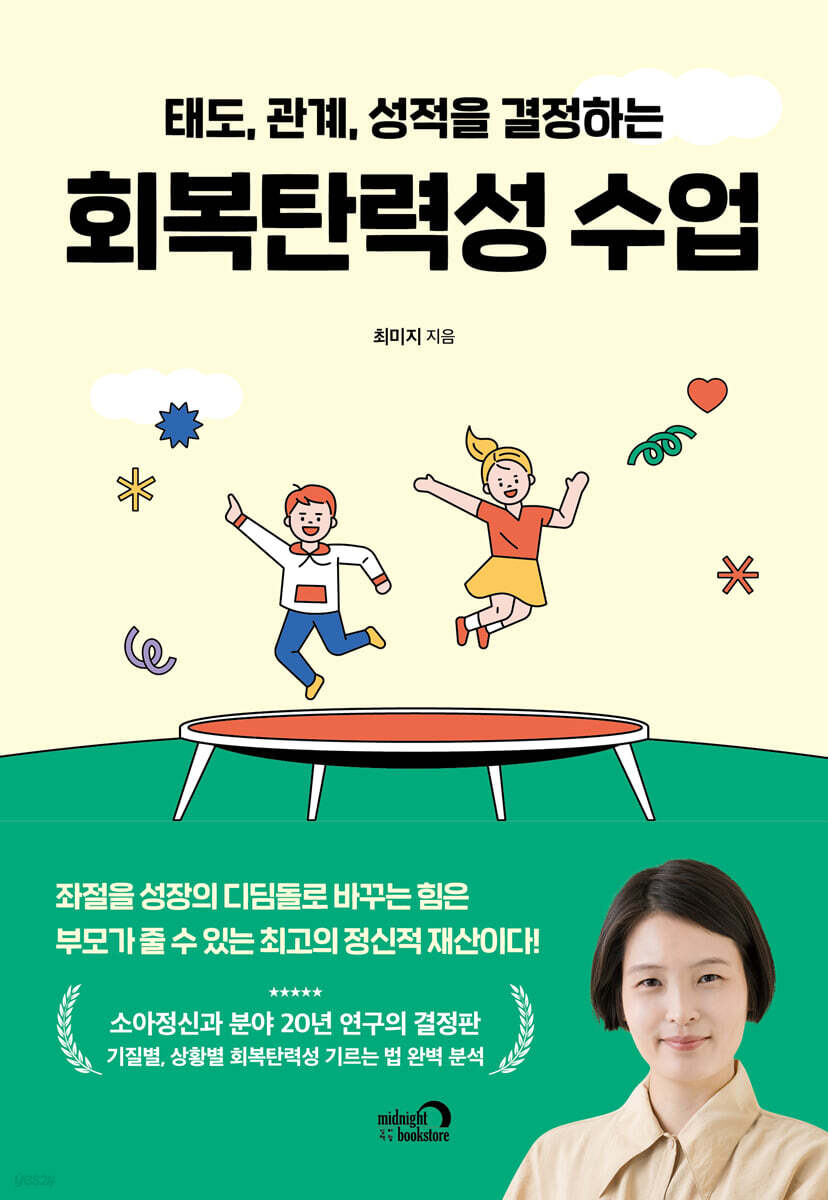
Resilience classes that determine attitudes, relationships, and grades
 |
Description
Book Introduction
The culmination of 20 years of research in child psychiatry
“Resilience is something that parents can create.
“It is the greatest spiritual wealth!”
Discovered by a child and adolescent psychiatrist
The Secret of Children Who Flexibly Ride the Waves of Life
Child psychiatrists often encounter children who are frustrated and disappointed for various reasons, emotionally hurt, and unable to heal their wounds on their own, leading to worsening conditions.
And at the same time, through the treatment process, the child's thoughts and feelings, self-image and worldview, attitudes and behaviors gradually change, and the wounds are healed, and we observe the child turning the crisis into an opportunity.
Author Choi Mi-ji says that while there are many reasons why children get emotionally hurt, there are common factors that contribute to the changes and healing that occur as they get better.
And I have compiled the results of my direct observations and research into the critical conditions that children who emerge from crisis and adversity have in common into a single book.
The strength of this book is that it explains that two pillars—emotional resources and cognitive resources—are necessary to foster resilience in children, and it provides easy and specific ways to build these resources, using vivid examples and tailored to each age, situation, and temperament.
The reason why both of these pillars are necessary is that if a child has only 'emotional resources', he is likely to be stable, positive, and content, whereas if he has only 'cognitive resources', he may be successful but anxious and unhappy.
These two pillars must be built together at a young age to develop the ability to overcome setbacks and take on new challenges.
As a child grows, he or she will encounter waves both big and small.
Resilience, the ability to navigate countless waves and see things through to the end, is the greatest mental asset a parent can leave their child.
This property, once created, is a treasure that is kept forever within the child and cannot be taken away by anyone.
Through this book, learn key methods to foster resilience in your child and apply them to your daily life.
Resilience, deeply rooted in a child's heart, will empower them to overcome any challenge in life.
“Resilience is something that parents can create.
“It is the greatest spiritual wealth!”
Discovered by a child and adolescent psychiatrist
The Secret of Children Who Flexibly Ride the Waves of Life
Child psychiatrists often encounter children who are frustrated and disappointed for various reasons, emotionally hurt, and unable to heal their wounds on their own, leading to worsening conditions.
And at the same time, through the treatment process, the child's thoughts and feelings, self-image and worldview, attitudes and behaviors gradually change, and the wounds are healed, and we observe the child turning the crisis into an opportunity.
Author Choi Mi-ji says that while there are many reasons why children get emotionally hurt, there are common factors that contribute to the changes and healing that occur as they get better.
And I have compiled the results of my direct observations and research into the critical conditions that children who emerge from crisis and adversity have in common into a single book.
The strength of this book is that it explains that two pillars—emotional resources and cognitive resources—are necessary to foster resilience in children, and it provides easy and specific ways to build these resources, using vivid examples and tailored to each age, situation, and temperament.
The reason why both of these pillars are necessary is that if a child has only 'emotional resources', he is likely to be stable, positive, and content, whereas if he has only 'cognitive resources', he may be successful but anxious and unhappy.
These two pillars must be built together at a young age to develop the ability to overcome setbacks and take on new challenges.
As a child grows, he or she will encounter waves both big and small.
Resilience, the ability to navigate countless waves and see things through to the end, is the greatest mental asset a parent can leave their child.
This property, once created, is a treasure that is kept forever within the child and cannot be taken away by anyone.
Through this book, learn key methods to foster resilience in your child and apply them to your daily life.
Resilience, deeply rooted in a child's heart, will empower them to overcome any challenge in life.
- You can preview some of the book's contents.
Preview
index
prolog
A Resilience Roadmap at a Glance
Step 1: Understanding the Secrets of Resilience Through Brain Science
Chapter 1 The Trap of Positivity
The more you try to think positively, the slower your recovery may be | Why my pain feels greater than someone else's | What is 'emotional resilience'?
Chapter 2 The Self-Regulating Rhythm of Our Body and Mind
Survival Mode vs.
Relaxation Mode | Survival Mode and Relaxation Mode for Children During a Transition | Why Developing Resilience in Childhood Is Important
Chapter 3: Digesting Negative Emotions
Emotional Digestion Recipe | The Process of Digesting Negative Emotions
Chapter 4: Resilience as a Roadmap
The Two Pillars of Resilience: Emotion and Cognition | Emotional Pillar: The Power of Warm Memories | Cognitive Pillar: A Child's Self-Esteem Found in Challenges and Failures
Step 2: Developing emotional resources that determine a child's emotional regulation skills
Chapter 5: 9 Ways to Build Secure Attachment and Trust
The Importance of Unconditional Love and Trust | Overcoming Attachment Crises | The 80 Percent Consistency Principle | Why Parents Fail to Regulate Their Emotions | Appropriate Limits and Discipline Make Children Feel Safe | Misconceptions About Discipline | When to Accept and When to Stop? | Tips for Limiting Children at Different Developmental Stages | Don't Punish Your Child for Anger
Chapter 6: A Safe Base in the Heart Creates Emotional Control
What makes a parent embrace? | Support and acceptance at each stage of a child's development.
Chapter 7: How to develop your child's emotional digestion skills
Observe and respond to your child | Communicate with emotions through internal probing questions | Be willing to engage and wait
Step 3: Developing Cognitive Resources to Develop Your Child's Perseverance and Perseverance
Chapter 8 Cognitive Flexibility Solves Problems
Socratic Dialogue | Answering Children's Questions Sincerely | Metacognitive Practice | Creating Diverse Contexts Through Experience
Chapter 9 The Power to See You Through to the End
Finding Values That Ignite Your Child's Heart | A Shortcut to the Life You Want | The Value of Small Successes
Step 4: Building Resilience Based on Your Child's Temperament
Chapter 10 Interest-seeking type
To make your child achieve with perseverance | If other children can do it but your child can't | To develop social skills | To develop empathy
Chapter 11 Risk Averse
If you're anxious about trying new things | If you ruminate on mistakes or failures | If you can't form relationships | If you're afraid of rejection
Chapter 12 Optimistic Type
If you are not disappointed | If your achievement level is low compared to your ability | If you are too naive
Chapter 13 Relationship-centered
If you are swept away by a friend | If you are trying to avoid conflict
Chapter 14 Rigid
If you reject and avoid new things | If you have low cognitive flexibility
A Resilience Roadmap at a Glance
Step 1: Understanding the Secrets of Resilience Through Brain Science
Chapter 1 The Trap of Positivity
The more you try to think positively, the slower your recovery may be | Why my pain feels greater than someone else's | What is 'emotional resilience'?
Chapter 2 The Self-Regulating Rhythm of Our Body and Mind
Survival Mode vs.
Relaxation Mode | Survival Mode and Relaxation Mode for Children During a Transition | Why Developing Resilience in Childhood Is Important
Chapter 3: Digesting Negative Emotions
Emotional Digestion Recipe | The Process of Digesting Negative Emotions
Chapter 4: Resilience as a Roadmap
The Two Pillars of Resilience: Emotion and Cognition | Emotional Pillar: The Power of Warm Memories | Cognitive Pillar: A Child's Self-Esteem Found in Challenges and Failures
Step 2: Developing emotional resources that determine a child's emotional regulation skills
Chapter 5: 9 Ways to Build Secure Attachment and Trust
The Importance of Unconditional Love and Trust | Overcoming Attachment Crises | The 80 Percent Consistency Principle | Why Parents Fail to Regulate Their Emotions | Appropriate Limits and Discipline Make Children Feel Safe | Misconceptions About Discipline | When to Accept and When to Stop? | Tips for Limiting Children at Different Developmental Stages | Don't Punish Your Child for Anger
Chapter 6: A Safe Base in the Heart Creates Emotional Control
What makes a parent embrace? | Support and acceptance at each stage of a child's development.
Chapter 7: How to develop your child's emotional digestion skills
Observe and respond to your child | Communicate with emotions through internal probing questions | Be willing to engage and wait
Step 3: Developing Cognitive Resources to Develop Your Child's Perseverance and Perseverance
Chapter 8 Cognitive Flexibility Solves Problems
Socratic Dialogue | Answering Children's Questions Sincerely | Metacognitive Practice | Creating Diverse Contexts Through Experience
Chapter 9 The Power to See You Through to the End
Finding Values That Ignite Your Child's Heart | A Shortcut to the Life You Want | The Value of Small Successes
Step 4: Building Resilience Based on Your Child's Temperament
Chapter 10 Interest-seeking type
To make your child achieve with perseverance | If other children can do it but your child can't | To develop social skills | To develop empathy
Chapter 11 Risk Averse
If you're anxious about trying new things | If you ruminate on mistakes or failures | If you can't form relationships | If you're afraid of rejection
Chapter 12 Optimistic Type
If you are not disappointed | If your achievement level is low compared to your ability | If you are too naive
Chapter 13 Relationship-centered
If you are swept away by a friend | If you are trying to avoid conflict
Chapter 14 Rigid
If you reject and avoid new things | If you have low cognitive flexibility
Detailed image

Into the book
Cooking ingredients can be tricky to master due to an individual's innate emotional makeup, but some are wonderful, while others are easy to handle, convenient, and versatile.
At first, the child learns emotional cooking techniques from his parents as an assistant cook.
Only after going through a long training period of nearly 20 years can one become a chef who can cook one's own emotions.
The beginning of this emotional cooking education begins with the comfort of parents who come to Ai, an assistant chef, and hug her when she is first born and starts crying.
In other words, the first step in developing emotional digestion is forming an attachment between parents and children.
---From "Step 1 Chapter 3 Digesting Negative Emotions"
All parents need to do to build resilience in a child who has failed a level test and is discouraged is to do so in 'relaxation mode.'
Instead of struggling with anxiety alongside their children, parents should step back from their own emotions and calmly observe their children's facial expressions, behavior, and tone of voice to see how they react and feel in difficult situations. They should wait and help their children share and digest those emotions with their parents.
Rather than just looking at your smartphone screen or talking to other parents, you need to look at your child's face and listen to what they say to truly help them.
Parents who are in sync with their children and feel anxious together can increase their ability to take action and send their children to a better academy right away.
However, parents who quietly listen to their children's emotions may not be able to find another academy, but they can help their children develop the fundamental ability to challenge themselves with courage without feeling inferior or defeated, or losing self-esteem even after repeated failures.
---From "Step 2 Chapter 5 9 Ways to Create Stable Attachment and Trust"
Parents can foster cognitive flexibility by having children repeatedly practice using metacognition to put their experiences into context when talking to them.
This will help children better understand not only their own behavior, but also the behaviors, emotions, and thoughts of others, thereby developing emotional control and empathy skills.
Usually, we tend to move past things, especially bad ones, and not think about them again, but even if it is something that has already happened, if there is a need to go over the feelings or thoughts the child felt at the time, it is better for parents to bring it back to the present and deal with it persistently, even if the child avoids or resists.
---From "Step 3 Chapter 8 Cognitive Flexibility Solves Problems"
Preschool children are often not ready to imagine other people's feelings.
So, if your child is teasing a friend, instead of saying, “How do you think your friend felt when you teased him?” say, “Stop teasing your friend.
It is better to discipline by simply and clearly saying, “That is bad behavior.”
Instead, in situations where the child's emotions are highlighted, try to comfort the child by saying, "I'm sorry you were upset when you got scolded by Mom," and help the child recognize his or her feelings and emotions specifically by giving them a label.
As children begin to recognize and express their own emotions, they are ready to recognize the emotions of others.
Starting in the early elementary school years, you can help your child imagine the feelings, thoughts, and intentions of others by asking questions using the conditional mood, such as, “What do you think that friend felt when you teased him or her?”
It takes a lot of imagination to be able to guess how someone else might feel in a given situation.
At first, the child learns emotional cooking techniques from his parents as an assistant cook.
Only after going through a long training period of nearly 20 years can one become a chef who can cook one's own emotions.
The beginning of this emotional cooking education begins with the comfort of parents who come to Ai, an assistant chef, and hug her when she is first born and starts crying.
In other words, the first step in developing emotional digestion is forming an attachment between parents and children.
---From "Step 1 Chapter 3 Digesting Negative Emotions"
All parents need to do to build resilience in a child who has failed a level test and is discouraged is to do so in 'relaxation mode.'
Instead of struggling with anxiety alongside their children, parents should step back from their own emotions and calmly observe their children's facial expressions, behavior, and tone of voice to see how they react and feel in difficult situations. They should wait and help their children share and digest those emotions with their parents.
Rather than just looking at your smartphone screen or talking to other parents, you need to look at your child's face and listen to what they say to truly help them.
Parents who are in sync with their children and feel anxious together can increase their ability to take action and send their children to a better academy right away.
However, parents who quietly listen to their children's emotions may not be able to find another academy, but they can help their children develop the fundamental ability to challenge themselves with courage without feeling inferior or defeated, or losing self-esteem even after repeated failures.
---From "Step 2 Chapter 5 9 Ways to Create Stable Attachment and Trust"
Parents can foster cognitive flexibility by having children repeatedly practice using metacognition to put their experiences into context when talking to them.
This will help children better understand not only their own behavior, but also the behaviors, emotions, and thoughts of others, thereby developing emotional control and empathy skills.
Usually, we tend to move past things, especially bad ones, and not think about them again, but even if it is something that has already happened, if there is a need to go over the feelings or thoughts the child felt at the time, it is better for parents to bring it back to the present and deal with it persistently, even if the child avoids or resists.
---From "Step 3 Chapter 8 Cognitive Flexibility Solves Problems"
Preschool children are often not ready to imagine other people's feelings.
So, if your child is teasing a friend, instead of saying, “How do you think your friend felt when you teased him?” say, “Stop teasing your friend.
It is better to discipline by simply and clearly saying, “That is bad behavior.”
Instead, in situations where the child's emotions are highlighted, try to comfort the child by saying, "I'm sorry you were upset when you got scolded by Mom," and help the child recognize his or her feelings and emotions specifically by giving them a label.
As children begin to recognize and express their own emotions, they are ready to recognize the emotions of others.
Starting in the early elementary school years, you can help your child imagine the feelings, thoughts, and intentions of others by asking questions using the conditional mood, such as, “What do you think that friend felt when you teased him or her?”
It takes a lot of imagination to be able to guess how someone else might feel in a given situation.
---From "Step 4 Chapter 10 Interest-seeking Type"
Publisher's Review
It's not a lack of effort, it's a lack of resilience.
Discover the common traits of children who turn crises into opportunities!
What's the crucial difference between a "child who gives up easily" and a "child who perseveres through to the end"? We tend to think of the difference simply as a difference in "effort."
But this is not simply a difference in will and effort.
Without resilience, it is difficult to overcome failure and frustration, even if you have the will.
The key is to build resilience so you can get back up again.
The author argues that 'children must develop the ability to relax appropriately in stressful situations.'
This is because the abilities developed at this time become the basis for resilience that allows one to properly relax and run for a long time in competitive situations such as college entrance exams, employment, marriage, promotion, and home ownership that one experiences during adolescence and adulthood.
Transferring schools during school days is a relatively minor example, but even as adults, changes such as forming relationships with new people and adapting to new spaces continue.
Perhaps this kind of change and adaptation is our life itself.
The important thing is that the abilities we develop in responding to change and stress in childhood continue to be the same in adulthood.
Resilience not only empowers children to thrive, but also plays a crucial role in overcoming the challenges and difficulties they face as they grow.
When children experience failure and frustration in their daily lives, such as when they have conflicts with friends, receive lower-than-expected grades, get scolded by their teacher, or make mistakes due to nervousness during a presentation or performance, if they have resilience, they will overcome these failures and strive to improve on their own shortcomings to achieve better results.
Furthermore, it gives us the strength to live a happy and healthy life without getting lost between work and rest, struggle and enjoyment, tension and peace even as adults.
“How can I help my child develop a mentality that won’t break easily?”
Parents' wisdom to help them overcome limitations
The essence of solutions for each age, situation, and temperament!
When we experience failure or disappointment, we take time to rest, take care of ourselves, or seek comfort from someone we can trust.
Sometimes I relax in a quiet, comfortable place with a cup of hot cocoa, or I meet my mom or a friend to vent my frustrations.
However, comfort from external sources alone may not be sufficient for emotional recovery.
After experiencing failure, a child must be able to process the negative emotions that follow in order to change his or her thinking.
Furthermore, in order to not become complacent after digesting emotions, you must be able to flexibly change your thinking and solve problems.
Both 'emotional digestion' and 'cognitive flexibility' must be present, that is, a child must have 'self-regulation' to overcome failure and disappointment and take on new challenges.
This book introduces various methods to create emotional resources that determine a child's 'emotional regulation ability' and cognitive resources that foster a child's 'patience and perseverance.'
It teaches you how to create a safe base in your heart and give your child a solid emotional foundation, and it also explains 'Why parents fail to control their emotions, misconceptions and truths about discipline, and the 80 percent consistency principle', so you can let go of the idea of wanting to be a perfect parent and learn how to do well again with a relaxed mind, so that your own example can become a good example of resilience for your child.
Additionally, the 'Socratic method of questioning and answering and metacognitive practice' that makes the mind and thoughts flexible helps children develop the ability to look at problems from various perspectives and solve them on their own.
This book is not simply a theoretical book.
It is a practical guide for parents and children to grow together and a starting point for amazing change.
Maybe there is only one thing a child needs in life.
Even if they fall, they can get back up on their own! In the process, children will forge their own path and learn how to achieve success.
Discover the common traits of children who turn crises into opportunities!
What's the crucial difference between a "child who gives up easily" and a "child who perseveres through to the end"? We tend to think of the difference simply as a difference in "effort."
But this is not simply a difference in will and effort.
Without resilience, it is difficult to overcome failure and frustration, even if you have the will.
The key is to build resilience so you can get back up again.
The author argues that 'children must develop the ability to relax appropriately in stressful situations.'
This is because the abilities developed at this time become the basis for resilience that allows one to properly relax and run for a long time in competitive situations such as college entrance exams, employment, marriage, promotion, and home ownership that one experiences during adolescence and adulthood.
Transferring schools during school days is a relatively minor example, but even as adults, changes such as forming relationships with new people and adapting to new spaces continue.
Perhaps this kind of change and adaptation is our life itself.
The important thing is that the abilities we develop in responding to change and stress in childhood continue to be the same in adulthood.
Resilience not only empowers children to thrive, but also plays a crucial role in overcoming the challenges and difficulties they face as they grow.
When children experience failure and frustration in their daily lives, such as when they have conflicts with friends, receive lower-than-expected grades, get scolded by their teacher, or make mistakes due to nervousness during a presentation or performance, if they have resilience, they will overcome these failures and strive to improve on their own shortcomings to achieve better results.
Furthermore, it gives us the strength to live a happy and healthy life without getting lost between work and rest, struggle and enjoyment, tension and peace even as adults.
“How can I help my child develop a mentality that won’t break easily?”
Parents' wisdom to help them overcome limitations
The essence of solutions for each age, situation, and temperament!
When we experience failure or disappointment, we take time to rest, take care of ourselves, or seek comfort from someone we can trust.
Sometimes I relax in a quiet, comfortable place with a cup of hot cocoa, or I meet my mom or a friend to vent my frustrations.
However, comfort from external sources alone may not be sufficient for emotional recovery.
After experiencing failure, a child must be able to process the negative emotions that follow in order to change his or her thinking.
Furthermore, in order to not become complacent after digesting emotions, you must be able to flexibly change your thinking and solve problems.
Both 'emotional digestion' and 'cognitive flexibility' must be present, that is, a child must have 'self-regulation' to overcome failure and disappointment and take on new challenges.
This book introduces various methods to create emotional resources that determine a child's 'emotional regulation ability' and cognitive resources that foster a child's 'patience and perseverance.'
It teaches you how to create a safe base in your heart and give your child a solid emotional foundation, and it also explains 'Why parents fail to control their emotions, misconceptions and truths about discipline, and the 80 percent consistency principle', so you can let go of the idea of wanting to be a perfect parent and learn how to do well again with a relaxed mind, so that your own example can become a good example of resilience for your child.
Additionally, the 'Socratic method of questioning and answering and metacognitive practice' that makes the mind and thoughts flexible helps children develop the ability to look at problems from various perspectives and solve them on their own.
This book is not simply a theoretical book.
It is a practical guide for parents and children to grow together and a starting point for amazing change.
Maybe there is only one thing a child needs in life.
Even if they fall, they can get back up on their own! In the process, children will forge their own path and learn how to achieve success.
GOODS SPECIFICS
- Date of issue: July 15, 2024
- Page count, weight, size: 284 pages | 452g | 145*210*20mm
- ISBN13: 9791158733100
- ISBN10: 1158733100
You may also like
카테고리
korean


korean

![ELLE 엘르 스페셜 에디션 A형 : 12월 [2025]](http://librairie.coreenne.fr/cdn/shop/files/b8e27a3de6c9538896439686c6b0e8fb.jpg?v=1766436872&width=3840)


