

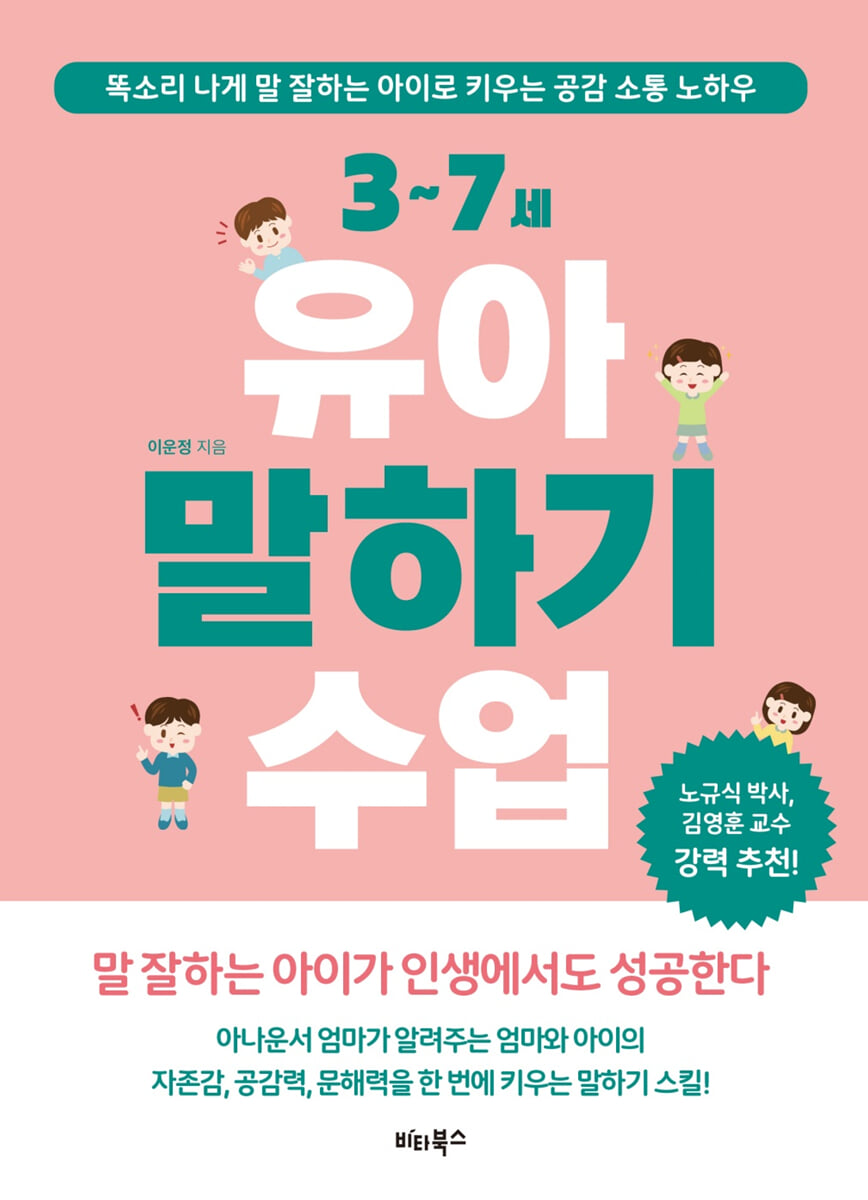
Speaking classes for children ages 3-7
 |
Description
Book Introduction
"Children who speak well will succeed in life." A practical guide to clear, articulate speech from an announcer mom who has taught over 12,000 children for 15 years! What are the most essential skills in our rapidly changing world? Empathy and communication skills. AI gathers vast amounts of information and uses this information to suggest solutions.
In contrast, humans can persuade others and move their hearts by adding emotions and experiences to their knowledge. This is a human strength that AI lacks, and the more children possess these communication and empathy skills, the more successful they are at school, academics, and even college entrance interviews. If we go further and add literacy skills that allow us to understand the context of conversations and texts, our children will be able to become talented individuals who can shine in any situation. 『Speaking Class for Children Aged 3-7』 is a speaking guide for preschool children from when they begin to speak until they enter elementary school. It is no exaggeration to say that communication and rapport practice with children begins in the mother's womb, but it is especially important before entering school age. If you practice speech homeschooling with your child at home as presented in this book and refer to the tips for improving communication and empathy every time you talk, your child will grow up to be a healthy child with both intelligence and character who is loved by many. |
- You can preview some of the book's contents.
Preview
index
Recommendation
prolog
Part 1.
Why You Should Raise Your Child to Be a Good Communicator
In the age of AI and chat GPT, why is speaking important?
Reading well is more important than reading a lot.
The Secret to a Well-Spoken Child: Empathy and Communication Skills
Things Seen Differently When You Develop Empathy
Key Points to Increase Empathy: Conversation Skills
Empathetic Conversation ① Listen carefully when the other person speaks.
Empathetic Conversation ② Look into the other person's eyes, open your ears, and focus on what they are saying.
Empathy Conversation ③ When requesting something, first ask if it is possible.
Empathy Conversation ④ Consider the other person's level of knowledge and topics of interest before speaking.
Empathy Dialogue ⑤ Leading everyone into conversation without leaving anyone out of the meeting
Improving Literacy in Children Who Have Short Thinking Skills
Part 2.
The Beginning of Empathy: Understanding Your Child's Type
What kind of child will our child be?
Using the MBTI as a basic personality type test
① Direction of energy - extroversion and introversion
② Information gathering and perception process - sensory and intuitive types
③ Judgment and decision-making - Thinking and feeling types
④ Behavior and Coping Styles - Judging and Perceiving
A new tool for receiving information: the brain type
Part 3.
Customized Speech Homeschooling for Toddlers
When is the best time to learn a language?
Basic Speaking for Infants 0-24 Months
Basic Speaking for 24-48 Month Olds
Speaking for 5-7 year olds ① 10 basic speech games
5-step voice volume adjustment | Sound ball throwing | Twenty questions with Korean alphabet cards | Making a belly button | Belly mountain going up and down | Ga-na-da-ra Little Star Song | Making a sound mountain of store-goo (up and down voice) | Matching various facial expressions | Mouth opening exercise | Matching nursery rhymes spoken through gestures
Speaking for 5-7 year olds ② Seasonal speech play
Speaking for 5-7 year olds ③ Lifestyle Habits Speech Play
Speaking for Children Ages 5-7 ④ Storytelling Speech to Foster Creativity
Speaking for 5-7 year olds ⑤ Play that makes discussion fun
Epilogue
prolog
Part 1.
Why You Should Raise Your Child to Be a Good Communicator
In the age of AI and chat GPT, why is speaking important?
Reading well is more important than reading a lot.
The Secret to a Well-Spoken Child: Empathy and Communication Skills
Things Seen Differently When You Develop Empathy
Key Points to Increase Empathy: Conversation Skills
Empathetic Conversation ① Listen carefully when the other person speaks.
Empathetic Conversation ② Look into the other person's eyes, open your ears, and focus on what they are saying.
Empathy Conversation ③ When requesting something, first ask if it is possible.
Empathy Conversation ④ Consider the other person's level of knowledge and topics of interest before speaking.
Empathy Dialogue ⑤ Leading everyone into conversation without leaving anyone out of the meeting
Improving Literacy in Children Who Have Short Thinking Skills
Part 2.
The Beginning of Empathy: Understanding Your Child's Type
What kind of child will our child be?
Using the MBTI as a basic personality type test
① Direction of energy - extroversion and introversion
② Information gathering and perception process - sensory and intuitive types
③ Judgment and decision-making - Thinking and feeling types
④ Behavior and Coping Styles - Judging and Perceiving
A new tool for receiving information: the brain type
Part 3.
Customized Speech Homeschooling for Toddlers
When is the best time to learn a language?
Basic Speaking for Infants 0-24 Months
Basic Speaking for 24-48 Month Olds
Speaking for 5-7 year olds ① 10 basic speech games
5-step voice volume adjustment | Sound ball throwing | Twenty questions with Korean alphabet cards | Making a belly button | Belly mountain going up and down | Ga-na-da-ra Little Star Song | Making a sound mountain of store-goo (up and down voice) | Matching various facial expressions | Mouth opening exercise | Matching nursery rhymes spoken through gestures
Speaking for 5-7 year olds ② Seasonal speech play
Speaking for 5-7 year olds ③ Lifestyle Habits Speech Play
Speaking for Children Ages 5-7 ④ Storytelling Speech to Foster Creativity
Speaking for 5-7 year olds ⑤ Play that makes discussion fun
Epilogue
Detailed image

Publisher's Review
The know-how of Korea's leading speech experts is concentrated
Speaking skills that boost your child's confidence and social skills!
When a child enters elementary school, parents have more worries than before.
As we begin our full-fledged social life, one of the things we must consider is whether we can get along well with our teachers and friends.
Children who enter elementary school develop a wider range of relationships than they did in kindergarten and grow into respectable members of society.
This is why smooth communication skills, empathy, and self-esteem become important from this point on.
Director Lee Woon-jung, author of “Speech Classes for Children Aged 3-7,” is a speech expert and former announcer who has taught over 12,000 students while running a speech academy in Daechi and Bundang for 15 years.
In this book, the author emphasizes 'empathy and literacy' as the most important skills for communication.
Empathy is not a mechanical response to what someone else says, but a complex process of accurately understanding what they are trying to say, emotionally sympathizing with it, and thinking together to solve the problem.
To achieve this, parents must have many conversations with their children at home and provide them with practical speech education.
This book presents customized speech solutions tailored to each child's characteristics, including gender, age, and personality type.
A child is a mirror of his parents.
The way parents talk to each other and the environment in which they talk to their children form the foundation for their children's speaking habits.
The author states that through the contents of this book, children can learn to speak properly, thereby increasing their confidence, social skills, and literacy, and further developing good study and lifestyle habits.
Parenting is a happy thing for both parents and children through the tool of speaking.
He said he hopes the answer will be 'talking is fun communication'.
From basic speeches to discussions that add empathy and creativity,
Everything You Need to Know About Toddler Speech, Tailored to Age and Personality Type
This book is divided into three parts.
Part 1 looks at how to improve empathy, the foundation of communication.
We will examine five characteristics of people with high empathy one by one and point out areas in which children with high empathy can excel.
He also emphasizes that 'empathy can only be felt by those who have received empathy' and says that only when parents treat their children with an open mind can their children grow up to be people who understand others.
Part 2 presents personality type tests such as MBTI and brain types as tools for parents to understand their children.
Understanding others begins with accepting their unique qualities as they are.
To do this, we take the time to understand our children through the MBTI, the most frequently used personality type test, and the five brain types that can help us understand how children receive and express information.
Finally, in Part 3, we will practice speaking using various games to improve pronunciation, voice volume, and confidence.
This type of training can be done from 48 months onwards and can be expanded in various ways as the child grows, such as going beyond play to becoming a reporter or having a simple discussion.
Over the past several decades, the world has been developing at a rapid pace, and that pace is expected to accelerate even further in the future.
In the future, our children may have to live in a society where they compete not only with people but also with AI.
More important than being able to solve math problems or speak English fluently right now are speaking and empathy.
British philosopher Wittgenstein famously said, “The limits of my language mean the limits of my world.”
What our children say will determine the world they will grow up in.
If you want your child to get along well with others and grow into a healthy member of society, 『Speaking Class for Children Ages 3-7』 will be the perfect guide.
Speaking skills that boost your child's confidence and social skills!
When a child enters elementary school, parents have more worries than before.
As we begin our full-fledged social life, one of the things we must consider is whether we can get along well with our teachers and friends.
Children who enter elementary school develop a wider range of relationships than they did in kindergarten and grow into respectable members of society.
This is why smooth communication skills, empathy, and self-esteem become important from this point on.
Director Lee Woon-jung, author of “Speech Classes for Children Aged 3-7,” is a speech expert and former announcer who has taught over 12,000 students while running a speech academy in Daechi and Bundang for 15 years.
In this book, the author emphasizes 'empathy and literacy' as the most important skills for communication.
Empathy is not a mechanical response to what someone else says, but a complex process of accurately understanding what they are trying to say, emotionally sympathizing with it, and thinking together to solve the problem.
To achieve this, parents must have many conversations with their children at home and provide them with practical speech education.
This book presents customized speech solutions tailored to each child's characteristics, including gender, age, and personality type.
A child is a mirror of his parents.
The way parents talk to each other and the environment in which they talk to their children form the foundation for their children's speaking habits.
The author states that through the contents of this book, children can learn to speak properly, thereby increasing their confidence, social skills, and literacy, and further developing good study and lifestyle habits.
Parenting is a happy thing for both parents and children through the tool of speaking.
He said he hopes the answer will be 'talking is fun communication'.
From basic speeches to discussions that add empathy and creativity,
Everything You Need to Know About Toddler Speech, Tailored to Age and Personality Type
This book is divided into three parts.
Part 1 looks at how to improve empathy, the foundation of communication.
We will examine five characteristics of people with high empathy one by one and point out areas in which children with high empathy can excel.
He also emphasizes that 'empathy can only be felt by those who have received empathy' and says that only when parents treat their children with an open mind can their children grow up to be people who understand others.
Part 2 presents personality type tests such as MBTI and brain types as tools for parents to understand their children.
Understanding others begins with accepting their unique qualities as they are.
To do this, we take the time to understand our children through the MBTI, the most frequently used personality type test, and the five brain types that can help us understand how children receive and express information.
Finally, in Part 3, we will practice speaking using various games to improve pronunciation, voice volume, and confidence.
This type of training can be done from 48 months onwards and can be expanded in various ways as the child grows, such as going beyond play to becoming a reporter or having a simple discussion.
Over the past several decades, the world has been developing at a rapid pace, and that pace is expected to accelerate even further in the future.
In the future, our children may have to live in a society where they compete not only with people but also with AI.
More important than being able to solve math problems or speak English fluently right now are speaking and empathy.
British philosopher Wittgenstein famously said, “The limits of my language mean the limits of my world.”
What our children say will determine the world they will grow up in.
If you want your child to get along well with others and grow into a healthy member of society, 『Speaking Class for Children Ages 3-7』 will be the perfect guide.
GOODS SPECIFICS
- Date of issue: March 5, 2024
- Page count, weight, size: 228 pages | 392g | 152*210*13mm
- ISBN13: 9791158464127
- ISBN10: 1158464126
You may also like
카테고리
korean


korean

![ELLE 엘르 스페셜 에디션 A형 : 12월 [2025]](http://librairie.coreenne.fr/cdn/shop/files/b8e27a3de6c9538896439686c6b0e8fb.jpg?v=1766436872&width=3840)


