

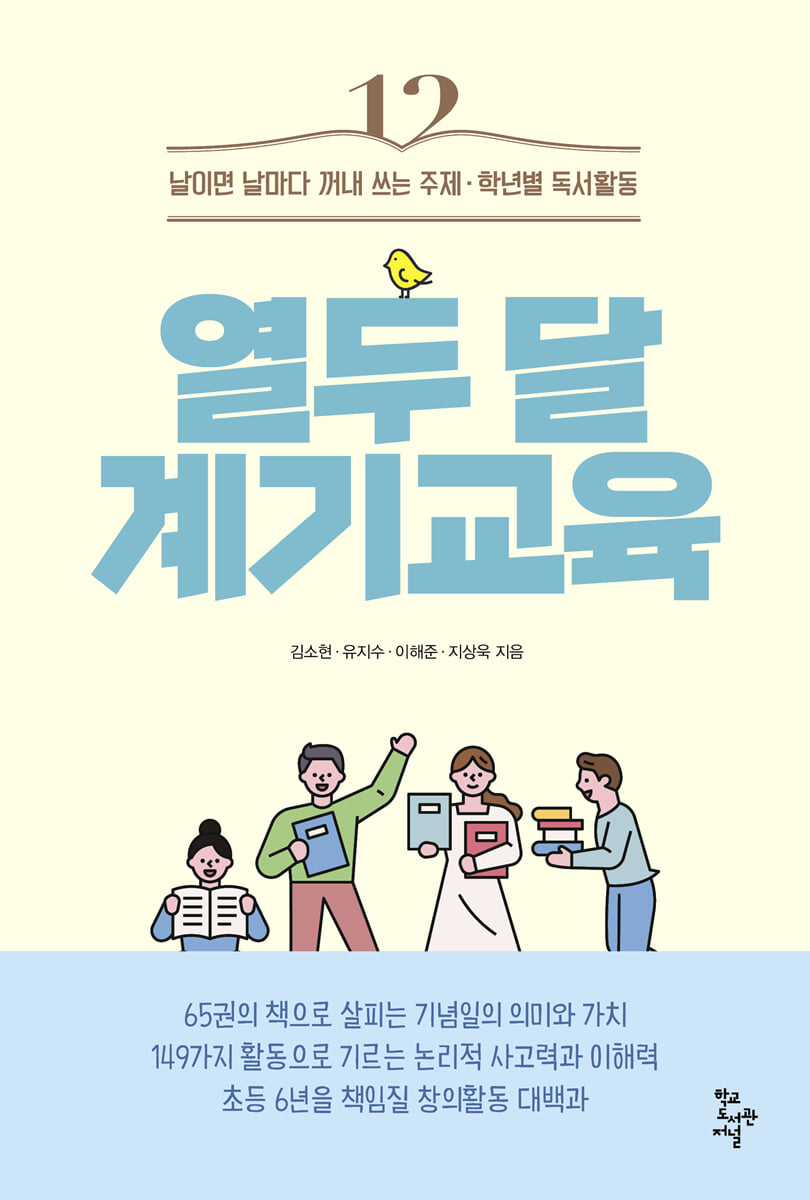
Twelve-month instrumental education
 |
Description
Book Introduction
Four current librarians have compiled Korea's first guide to instrumental education using children's books.
Although not covered in detail in the official curriculum, instrumental education refers to education conducted on topics that students must know according to the needs of teachers and schools. Although the necessity of such education is clear, it is often limited to formal and one-way classes.
This book addresses this regret by focusing on how to convey the meaning and value of these annual anniversaries in an easy and fun way.
The books and reading activities, carefully selected by season and theme to match the classroom management throughout the year, and categorized by grade level according to reading level, provide specific and useful guidance to teachers who feel overwhelmed by the challenges of curricular education.
"Twelve Months of Education" is an encyclopedia of creative activities that helps students independently and three-dimensionally learn the themes and values of each anniversary that cannot be learned through textbooks alone.
Although not covered in detail in the official curriculum, instrumental education refers to education conducted on topics that students must know according to the needs of teachers and schools. Although the necessity of such education is clear, it is often limited to formal and one-way classes.
This book addresses this regret by focusing on how to convey the meaning and value of these annual anniversaries in an easy and fun way.
The books and reading activities, carefully selected by season and theme to match the classroom management throughout the year, and categorized by grade level according to reading level, provide specific and useful guidance to teachers who feel overwhelmed by the challenges of curricular education.
"Twelve Months of Education" is an encyclopedia of creative activities that helps students independently and three-dimensionally learn the themes and values of each anniversary that cannot be learned through textbooks alone.
- You can preview some of the book's contents.
Preview
index
· Opening remarks
· What is instrumental education?
· The necessity of book-based instrumental education
· Recommended Book Selection Criteria
· Twelve-Month Instrumental Education Guide
Spring
· 3.
Verse 1
『Taegeukgi Day』 │ 『March 1st Movement Road』 │ 『Protect the Spark of the March 1st Movement, the Declaration of Independence!』
· Women's Day
Mary Wears What She Wants to Wear | Hello? My Pink Blue | My Grandmother is a Feminist
· Cybercrime Prevention Day
13-Day Group Chat │ The War on Digital Sex Crimes
· Arbor Day
"The Tree Remembers the Forest" │ "We Eat Sunlight for Breakfast!"
· National Safety Day
『The Book of Safety』 │ 『Worry, Worry』 │ 『Safety, How to Protect Myself』
· Day of Persons with Disabilities
"Mr. Giraffe, Come Ride!" │ "A Child Who Is Neither Strange nor Sick" │ "A Noisy and Cheerful Sign Language"
World Book and Copyright Day
"What is a Book?" │ "The Unreading Family and the Book Restaurant" │ "How Far Do You Know About Books?"
Food Safety Day
"I Eat Rice Every Day" │ "Everyone's Good Table Research Institute"
· World Family Day
"Want to Meet My Family?" │ "We Are Family: Who Are My Family?" │ "How Are We Family?"
Summer
· Environment Day
The Strange Vacation Brought About by Global Warming | Recycling: How to Reuse Waste
"If you eat ramen, the forest disappears."
· June 25th War Day
The Old Wish of the Big Tiled House │ That June
· Constitution Day
"A Law Banning Noodles?" │ "Raccoon Judge Pong Pong"
"Congresswoman Seo Min-ju, busy, busy!"
· Memorial Day for Victims of Japanese Military Comfort Women
The Park Flower Has Blossomed │ The Girls Who Became Butterflies
· Liberation Day
『Gaedongi's 1945』 │ 『Long Live Korean Independence, Regained』
· Character education
Cake for Everyone │ Kindness: The Power to Change the World │ Respect: Is It a Given Thing for Everyone?
Autumn
· Intellectual Property Day
Gusteau, Inventing │ Plagiarism Classroom │ Children's Copyright Classroom
· Senior Citizen's Day
"Grandma Wasn't a Grandma From Birth" │ "Master of Dialect Conversation" │ "Okchundang"
World Animal Day
Tomorrow's Zoo │ Wootan in Sneakers │ Animal Rights
· Hangeul Day
Thank You, Hangul │ King Sejong's Hangul Research Institute
· Dokdo Day
Letters from Our Dokdo │ Those Who Protect Dokdo
· Financial Day
"Going to the Mart Again Was a Mistake!" │ "Our Class's Debt Relationship" │ "Kids Who Pay Taxes"
· School violence prevention education
"I Don't Want to!" │ "A Week of Bullying" │ "The Debt Repayment Project"
●Winter
· Child Abuse Prevention Day
"That's How Trees Grow" │ "Convenience Store"
· World Human Rights Day
"Mr. Shiran, Who Doesn't Use an Umbrella" │ "Human Rights Stories Found in the Library"
· Human relationships (friendship)
『The Legend of Friends』 │ 『The Kids Who Stick to the Chalkboard』 │ 『That's Right, Sister's Counseling Center』
· Books used in instrument education
· What is instrumental education?
· The necessity of book-based instrumental education
· Recommended Book Selection Criteria
· Twelve-Month Instrumental Education Guide
Spring
· 3.
Verse 1
『Taegeukgi Day』 │ 『March 1st Movement Road』 │ 『Protect the Spark of the March 1st Movement, the Declaration of Independence!』
· Women's Day
Mary Wears What She Wants to Wear | Hello? My Pink Blue | My Grandmother is a Feminist
· Cybercrime Prevention Day
13-Day Group Chat │ The War on Digital Sex Crimes
· Arbor Day
"The Tree Remembers the Forest" │ "We Eat Sunlight for Breakfast!"
· National Safety Day
『The Book of Safety』 │ 『Worry, Worry』 │ 『Safety, How to Protect Myself』
· Day of Persons with Disabilities
"Mr. Giraffe, Come Ride!" │ "A Child Who Is Neither Strange nor Sick" │ "A Noisy and Cheerful Sign Language"
World Book and Copyright Day
"What is a Book?" │ "The Unreading Family and the Book Restaurant" │ "How Far Do You Know About Books?"
Food Safety Day
"I Eat Rice Every Day" │ "Everyone's Good Table Research Institute"
· World Family Day
"Want to Meet My Family?" │ "We Are Family: Who Are My Family?" │ "How Are We Family?"
Summer
· Environment Day
The Strange Vacation Brought About by Global Warming | Recycling: How to Reuse Waste
"If you eat ramen, the forest disappears."
· June 25th War Day
The Old Wish of the Big Tiled House │ That June
· Constitution Day
"A Law Banning Noodles?" │ "Raccoon Judge Pong Pong"
"Congresswoman Seo Min-ju, busy, busy!"
· Memorial Day for Victims of Japanese Military Comfort Women
The Park Flower Has Blossomed │ The Girls Who Became Butterflies
· Liberation Day
『Gaedongi's 1945』 │ 『Long Live Korean Independence, Regained』
· Character education
Cake for Everyone │ Kindness: The Power to Change the World │ Respect: Is It a Given Thing for Everyone?
Autumn
· Intellectual Property Day
Gusteau, Inventing │ Plagiarism Classroom │ Children's Copyright Classroom
· Senior Citizen's Day
"Grandma Wasn't a Grandma From Birth" │ "Master of Dialect Conversation" │ "Okchundang"
World Animal Day
Tomorrow's Zoo │ Wootan in Sneakers │ Animal Rights
· Hangeul Day
Thank You, Hangul │ King Sejong's Hangul Research Institute
· Dokdo Day
Letters from Our Dokdo │ Those Who Protect Dokdo
· Financial Day
"Going to the Mart Again Was a Mistake!" │ "Our Class's Debt Relationship" │ "Kids Who Pay Taxes"
· School violence prevention education
"I Don't Want to!" │ "A Week of Bullying" │ "The Debt Repayment Project"
●Winter
· Child Abuse Prevention Day
"That's How Trees Grow" │ "Convenience Store"
· World Human Rights Day
"Mr. Shiran, Who Doesn't Use an Umbrella" │ "Human Rights Stories Found in the Library"
· Human relationships (friendship)
『The Legend of Friends』 │ 『The Kids Who Stick to the Chalkboard』 │ 『That's Right, Sister's Counseling Center』
· Books used in instrument education
Detailed image

Into the book
Instrumental education refers to education on topics that students must know, based on the needs of teachers and the needs of the school, but are not covered in detail in the official curriculum.
Occasional education, which covers a variety of topics such as seasons, holidays, and social events, imparts social values such as community awareness and historical awareness to students both within and outside the framework of the curriculum, and greatly contributes to the development of students as whole individuals.
Furthermore, instrumental education serves as the foundation for lifelong education, helping students develop the attitudes and character necessary for life in general.
--- p.11
The need for instrumental education is clear, but teachers in the field are limited to providing formal, one-sided education due to a lack of educational materials and preparation time.
However, school libraries already have a wealth of instrumental education materials.
As of 2022, the average number of books in school libraries nationwide reached 16,686, covering a wide range of topics, from 000 general titles to 900 historical books.
By utilizing the books available in the school library to provide meaningful learning, we can kill two birds with one stone: provide substantive instruction and enhance students' reading experience.
Occasional education, which covers a variety of topics such as seasons, holidays, and social events, imparts social values such as community awareness and historical awareness to students both within and outside the framework of the curriculum, and greatly contributes to the development of students as whole individuals.
Furthermore, instrumental education serves as the foundation for lifelong education, helping students develop the attitudes and character necessary for life in general.
--- p.11
The need for instrumental education is clear, but teachers in the field are limited to providing formal, one-sided education due to a lack of educational materials and preparation time.
However, school libraries already have a wealth of instrumental education materials.
As of 2022, the average number of books in school libraries nationwide reached 16,686, covering a wide range of topics, from 000 general titles to 900 historical books.
By utilizing the books available in the school library to provide meaningful learning, we can kill two birds with one stone: provide substantive instruction and enhance students' reading experience.
--- p.14
Publisher's Review
■ Why you should start with books for instrument education
Recently, voices calling for the need for instrumental education are growing louder in the educational field.
This is because instrumental education provides opportunities for diverse experiences that cannot be obtained through textbook learning alone, and by examining recent social events and issues, it contributes to fostering desirable values and a self-directed and exploratory learning attitude.
However, for students, instrumental education often approaches them as a rigid and boring class that only emphasizes the meaning.
Four librarians, who had been struggling to create enjoyable class times, found the answer in a book.
There are three main advantages of book-based learning.
First, students who are vulnerable to unreliable information on the Internet can acquire quality information through books.
Second, by reading a book while empathizing with the characters' emotions, you can develop an attitude that recognizes diversity.
Third, by encountering topics you haven't encountered before, such as history, human rights, and social issues, through books, you can reflect on your own life and develop your humanistic knowledge.
The authors argue that by leveraging these strengths and implementing instrumental education using books from various fields available in school libraries, they can kill two birds with one stone: provide substantive instruction and enhance students' reading experience.
This book guides teachers and students, tired of predictable instrumental education, to create a fun classroom through mutual interaction, and helps students expand their learning horizons based on 25 diverse instrumental education topics.
■ By subject and grade according to the date
A configuration that only takes out the necessary parts
In keeping with its subtitle, “Reading activities you can do every day,” this book introduces each anniversary by season and theme.
We examine four national holidays and 18 commemorative days established by law, as well as topics that students really need in real-world schools, such as character education, school violence prevention education, and human relationships.
Furthermore, within each topic, books and reading activities are detailed by grade level, allowing teachers to select and utilize books and activities individually as needed.
The books used in the instrument classes were carefully selected with a wide range of considerations, including topical relevance, up-to-dateness, reading level of the grade group, political correctness, and reader diversity to avoid hurting or alienating any particular students.
Through reading activities that involve reading together, sharing thoughts, and putting them into practice, students will be able to acquire the meaning and value of each anniversary more easily and enjoyably.
■ Three steps for systematic reading activities
The instrument education reading activity is largely divided into three stages.
In 'Introduction', we have included introductory activities that can awaken students' awareness of the book's theme before reading and arouse their interest.
The teacher's introduction and students' vivid answers have been included as is so that it can be used effectively in actual classroom settings.
'Activities' contains two or three optional reading activities that can be used in class.
Rather than simply conveying the meaning of the anniversary, we prioritized its connection to the content of the book.
Above all, the authors have provided activity sheets that they have created through years of trial and error, making them a useful resource for everyone, from novice teachers just starting out with instrumental education to veteran teachers exploring more unique teaching methods.
Lastly, in 'Conclusion', after finishing the activity, the theme of the instrumental education was emphasized once again so that students could look back on the meaning of the anniversary they learned that day.
We hope to make the lesson more engaging by completing quizzes or brief additional activities.
Additionally, if you refer to the list of "Good Books to Read Together" that decorates the last page of each anniversary, you will be able to continue the instrumental education steadily and in-depth as a voluntary and three-dimensional learning method, rather than simply ending the class as a one-time experience.
In the case of instrumental education, textbooks are often not used, so there is always a shortage of materials to refer to in class, such as concepts about the topic, historical facts, and activities to do with students.
It's difficult to explain the reasons and origins of instrumental education, and I'm also worried about what to do as class activities.
To alleviate this regret, four like-minded librarians came together to prepare a class by systematically connecting opportunity education, books, and post-reading activities.
I've spent years reviewing countless children's books and devising follow-up activities to select books that are not only fun to read but also have a strong connection to the subject matter.
And while actually teaching, I went through the process of revision and supplementation again.
I hope this book will provide a clue to teachers and parents who are struggling to open a window of new direction for their students.
I hope you all have a safe and enjoyable class.
_Opening remarks
Recently, voices calling for the need for instrumental education are growing louder in the educational field.
This is because instrumental education provides opportunities for diverse experiences that cannot be obtained through textbook learning alone, and by examining recent social events and issues, it contributes to fostering desirable values and a self-directed and exploratory learning attitude.
However, for students, instrumental education often approaches them as a rigid and boring class that only emphasizes the meaning.
Four librarians, who had been struggling to create enjoyable class times, found the answer in a book.
There are three main advantages of book-based learning.
First, students who are vulnerable to unreliable information on the Internet can acquire quality information through books.
Second, by reading a book while empathizing with the characters' emotions, you can develop an attitude that recognizes diversity.
Third, by encountering topics you haven't encountered before, such as history, human rights, and social issues, through books, you can reflect on your own life and develop your humanistic knowledge.
The authors argue that by leveraging these strengths and implementing instrumental education using books from various fields available in school libraries, they can kill two birds with one stone: provide substantive instruction and enhance students' reading experience.
This book guides teachers and students, tired of predictable instrumental education, to create a fun classroom through mutual interaction, and helps students expand their learning horizons based on 25 diverse instrumental education topics.
■ By subject and grade according to the date
A configuration that only takes out the necessary parts
In keeping with its subtitle, “Reading activities you can do every day,” this book introduces each anniversary by season and theme.
We examine four national holidays and 18 commemorative days established by law, as well as topics that students really need in real-world schools, such as character education, school violence prevention education, and human relationships.
Furthermore, within each topic, books and reading activities are detailed by grade level, allowing teachers to select and utilize books and activities individually as needed.
The books used in the instrument classes were carefully selected with a wide range of considerations, including topical relevance, up-to-dateness, reading level of the grade group, political correctness, and reader diversity to avoid hurting or alienating any particular students.
Through reading activities that involve reading together, sharing thoughts, and putting them into practice, students will be able to acquire the meaning and value of each anniversary more easily and enjoyably.
■ Three steps for systematic reading activities
The instrument education reading activity is largely divided into three stages.
In 'Introduction', we have included introductory activities that can awaken students' awareness of the book's theme before reading and arouse their interest.
The teacher's introduction and students' vivid answers have been included as is so that it can be used effectively in actual classroom settings.
'Activities' contains two or three optional reading activities that can be used in class.
Rather than simply conveying the meaning of the anniversary, we prioritized its connection to the content of the book.
Above all, the authors have provided activity sheets that they have created through years of trial and error, making them a useful resource for everyone, from novice teachers just starting out with instrumental education to veteran teachers exploring more unique teaching methods.
Lastly, in 'Conclusion', after finishing the activity, the theme of the instrumental education was emphasized once again so that students could look back on the meaning of the anniversary they learned that day.
We hope to make the lesson more engaging by completing quizzes or brief additional activities.
Additionally, if you refer to the list of "Good Books to Read Together" that decorates the last page of each anniversary, you will be able to continue the instrumental education steadily and in-depth as a voluntary and three-dimensional learning method, rather than simply ending the class as a one-time experience.
In the case of instrumental education, textbooks are often not used, so there is always a shortage of materials to refer to in class, such as concepts about the topic, historical facts, and activities to do with students.
It's difficult to explain the reasons and origins of instrumental education, and I'm also worried about what to do as class activities.
To alleviate this regret, four like-minded librarians came together to prepare a class by systematically connecting opportunity education, books, and post-reading activities.
I've spent years reviewing countless children's books and devising follow-up activities to select books that are not only fun to read but also have a strong connection to the subject matter.
And while actually teaching, I went through the process of revision and supplementation again.
I hope this book will provide a clue to teachers and parents who are struggling to open a window of new direction for their students.
I hope you all have a safe and enjoyable class.
_Opening remarks
GOODS SPECIFICS
- Date of issue: April 15, 2023
- Page count, weight, size: 396 pages | 698g | 152*225*24mm
- ISBN13: 9788969151438
- ISBN10: 8969151435
You may also like
카테고리
korean


korean

![ELLE 엘르 스페셜 에디션 A형 : 12월 [2025]](http://librairie.coreenne.fr/cdn/shop/files/b8e27a3de6c9538896439686c6b0e8fb.jpg?v=1766436872&width=3840)


