

How to improve concentration in distractible children
 |
Description
Book Introduction
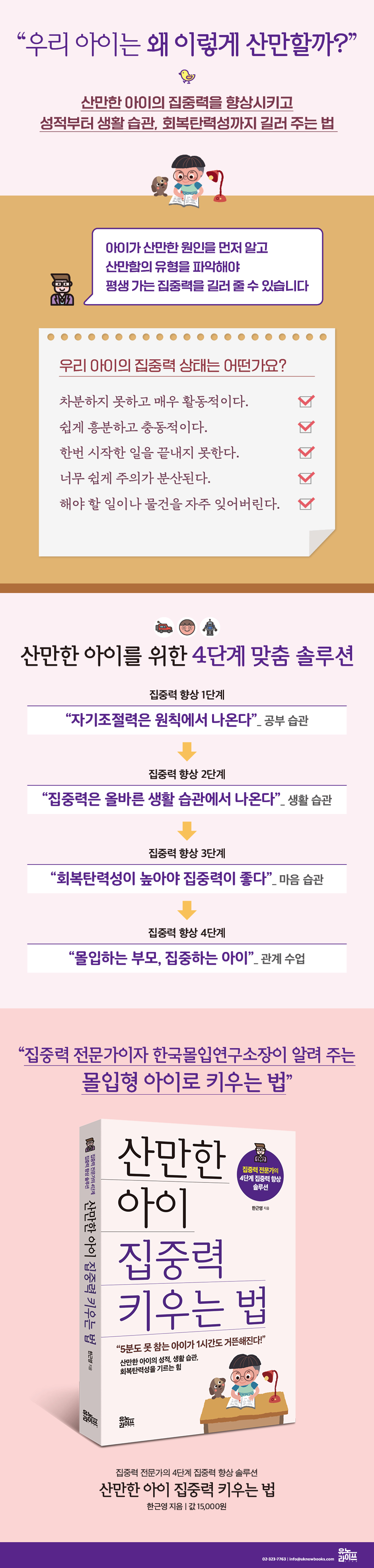
"Concentration determines a child's future." A 4-step customized strategy for distracted children How to Build Sexuality, Lifestyle, and Resilience There are children who are hyperactive, easily excited and impulsive, children who often forget their homework or supplies, and children who cannot sit down at their desks for even a moment. Additionally, if you give up on something easily, have trouble understanding what is being said, or only focus on things you like, this could be a sign that you have trouble concentrating. Concentration doesn't just grow as you advance in grades. Even if a child is distracted now, the way the parents raise them will determine whether or not they will develop their innate ability to concentrate. Concentration is not only necessary when studying. It has a significant impact on the ability to maintain a healthy daily life, as well as the ability to manage time and maintain good interpersonal relationships in social life, and overall happiness in life. If your child is so distracted that you suspect he or she may have ADHD, or if he or she is having trouble adjusting to elementary school, it may be time to help him or her improve concentration. The author, director of the Korea Immersion Research Institute and a concentration expert, has met with many parents and children who come to the counseling center concerned about their children's distractibility. I've encountered various cases of lack of concentration, such as children who can't sit still for even 5 minutes while studying, children who are so addicted to their smartphones that they have trouble with daily life, and children who have difficulty adjusting to school life. This book is based on various cases like this and the 'Learning Fusion Test (LFT)' actually used at the Korea Immersion Research Institute. The appendix includes the 'Learning Immersion Test' actually used by the Korea Immersion Research Institute, which allows you to check your child's current concentration level. Concentration is an essential skill for academic ability, self-esteem development, career planning, and social skills development. Not all children are born with the ability to focus, but it can be developed through parenting. This requires a more systematic and professional solution. Through this book, I hope to help you understand the causes and types of distraction in your child and learn ways to develop concentration tailored to your child. |
- You can preview some of the book's contents.
Preview
index
Prologue: How can we improve the concentration of our absent-minded children?
Lesson 1: "How is my child's concentration right now?" - Understanding Distraction
I feel like I've become more distracted since I started elementary school.
How do you tell the difference between a child with ADHD and one with inattentiveness?
I can't hear you when you call while playing a game
I never try to do anything I hate.
I suddenly started avoiding subjects I liked.
Lecture 2: "Concentration must be developed in elementary school" - Immersion Types
Don't miss out on the elementary school years
A child who is smart but has trouble concentrating
Concentration, a prerequisite for a happy life
How to maximize concentration while riding
3-Lesson Focus Improvement Step 1: "Concentration Strategies for Better Grades!"_ Study Habits
The first step to focusing is organizing your learning environment.
Prioritizing Subjects That Are Right for Your Child
Catch up on the concentration that slips away during class
Note-taking trains your brain
If you often forget your homework or supplies
Step 2: Improving Concentration: "Concentration comes from good lifestyle habits." - Lifestyle Habits
Sleep management is the foundation of concentration.
Time management skills to live a focused life
Develop the habit of focusing on subjects you dislike
Reading every day improves concentration.
How to Develop Lifelong Habits
Step 3: Improving Concentration: "High resilience leads to better concentration" - Mental Habits
The foundation of self-regulation: resilience
Anxiety and focus, that love-hate relationship
My child hates unfamiliar things so much.
The freedom of children to choose what they want to do
Parents' words should 'usually' be heeded.
The power to stay focused and not give up
Lesson 6: Improving Concentration: Step 4: "Immersive Parents, Focused Children" - Relationship Lesson
Clear communication keeps children engaged.
Developing Concentration Through Expressions of Love
Give them a variety of choices and let them choose for themselves.
Parents' reactions challenge children.
Praise is medicine when used well, poison when used poorly.
How to Fight Well with Your Child and Reconcile Properly
Parents grow together with their children.
supplement
Lesson 1: "How is my child's concentration right now?" - Understanding Distraction
I feel like I've become more distracted since I started elementary school.
How do you tell the difference between a child with ADHD and one with inattentiveness?
I can't hear you when you call while playing a game
I never try to do anything I hate.
I suddenly started avoiding subjects I liked.
Lecture 2: "Concentration must be developed in elementary school" - Immersion Types
Don't miss out on the elementary school years
A child who is smart but has trouble concentrating
Concentration, a prerequisite for a happy life
How to maximize concentration while riding
3-Lesson Focus Improvement Step 1: "Concentration Strategies for Better Grades!"_ Study Habits
The first step to focusing is organizing your learning environment.
Prioritizing Subjects That Are Right for Your Child
Catch up on the concentration that slips away during class
Note-taking trains your brain
If you often forget your homework or supplies
Step 2: Improving Concentration: "Concentration comes from good lifestyle habits." - Lifestyle Habits
Sleep management is the foundation of concentration.
Time management skills to live a focused life
Develop the habit of focusing on subjects you dislike
Reading every day improves concentration.
How to Develop Lifelong Habits
Step 3: Improving Concentration: "High resilience leads to better concentration" - Mental Habits
The foundation of self-regulation: resilience
Anxiety and focus, that love-hate relationship
My child hates unfamiliar things so much.
The freedom of children to choose what they want to do
Parents' words should 'usually' be heeded.
The power to stay focused and not give up
Lesson 6: Improving Concentration: Step 4: "Immersive Parents, Focused Children" - Relationship Lesson
Clear communication keeps children engaged.
Developing Concentration Through Expressions of Love
Give them a variety of choices and let them choose for themselves.
Parents' reactions challenge children.
Praise is medicine when used well, poison when used poorly.
How to Fight Well with Your Child and Reconcile Properly
Parents grow together with their children.
supplement
Detailed image
Into the book
It is very important to find out why your child is distracted or inattentive.
It is important to determine whether the child's distractibility or inattention is due to impaired attention or inefficient cognitive function.
---p.22
Some children who show signs of distraction after entering elementary school are not diagnosed with ADHD.
If a child exhibits emotional symptoms such as anxiety or depression, or behavioral problems such as inattentiveness, distraction, or refusal to go to school within three months of entering school or within three months of changing grades, the possibility of an 'adjustment disorder' should also be considered.
---p.26
Here are some things to consider when children become selectively involved in games or certain behaviors.
First, consider whether your child is doing the behavior because he or she really enjoys it or is doing it to avoid something he or she needs to do.
For example, if you play a game because you enjoy it so much, and you add the reason to avoid school or studying, it becomes more difficult to stop.
---p.39
To develop a child's ability to focus, parents must match their internal expectations to the child's abilities, potential, and tendencies, and provide assistance in a way that fits those expectations.
This means that parents should not raise their children to meet their standards, but rather match their expectations to the child's current level.
---p.56
Studies on memory show that events imbued with emotion are better remembered.
Pleasant emotions are generally remembered better than unpleasant emotions.
When we examine memories formed through positive emotions, we find that they contain more contextual details, which helps us remember them better.
---p.111
To become a person who can concentrate well and be immersed in something, you need to have less mental burden (emotional difficulties, anxiety, depression, anger, etc.) that can distract you from your energy.
Children need to be able to accurately identify what they want and develop that motivation in a way that is appropriate for their developmental stage.
To do that, you need the wisdom to distinguish between what you want and what you don't.
It is important to determine whether the child's distractibility or inattention is due to impaired attention or inefficient cognitive function.
---p.22
Some children who show signs of distraction after entering elementary school are not diagnosed with ADHD.
If a child exhibits emotional symptoms such as anxiety or depression, or behavioral problems such as inattentiveness, distraction, or refusal to go to school within three months of entering school or within three months of changing grades, the possibility of an 'adjustment disorder' should also be considered.
---p.26
Here are some things to consider when children become selectively involved in games or certain behaviors.
First, consider whether your child is doing the behavior because he or she really enjoys it or is doing it to avoid something he or she needs to do.
For example, if you play a game because you enjoy it so much, and you add the reason to avoid school or studying, it becomes more difficult to stop.
---p.39
To develop a child's ability to focus, parents must match their internal expectations to the child's abilities, potential, and tendencies, and provide assistance in a way that fits those expectations.
This means that parents should not raise their children to meet their standards, but rather match their expectations to the child's current level.
---p.56
Studies on memory show that events imbued with emotion are better remembered.
Pleasant emotions are generally remembered better than unpleasant emotions.
When we examine memories formed through positive emotions, we find that they contain more contextual details, which helps us remember them better.
---p.111
To become a person who can concentrate well and be immersed in something, you need to have less mental burden (emotional difficulties, anxiety, depression, anger, etc.) that can distract you from your energy.
Children need to be able to accurately identify what they want and develop that motivation in a way that is appropriate for their developmental stage.
To do that, you need the wisdom to distinguish between what you want and what you don't.
---p.172
Publisher's Review
“Why is my child so distracted?”
We must properly understand and know the causes of distraction.
You can help your child develop lifelong concentration skills!
What's the most effective way to improve a child's grades? It's to focus properly during class.
It's difficult to study well if you waste time in class, which accounts for 60 percent, or even 80 percent, of your total study time.
Children with good concentration are bound to get good grades because they focus on class time and use it to review.
In addition, concentration affects the ability to maintain regular lifestyle habits.
So, children with good concentration can develop time management skills, which is the most difficult area of self-management.
To help children with high concentration develop, a tailored strategy for children with high concentration is needed.
The author, a concentration expert and director of the Korea Immersion Research Institute, says it's important to first understand the causes and types of distraction in children.
The book contains a four-step solution to fostering children's concentration, including understanding distractions, learning strategies tailored to your child, lifestyle habits, mental habits, and even parent-child relationships.
# Does my quiet and calm child have ADHD?
Fortunately, if your child's distractibility becomes apparent, you can quickly recognize the problem.
Some children may appear quiet and calm on the outside, but actually have trouble concentrating or are "quiet ADHD."
If you don't realize it, you may live as an adult without even knowing that you have ADHD.
This is because symptoms of frequent forgetting or making mistakes are often mistaken as a personal characteristic.
A child's distractibility requires close attention from parents, and the earlier it is noticed, the better.
If learning difficulties accumulate due to lack of concentration, it is very difficult to catch up with the learning gap that has developed in middle and high school.
This is why parents need to understand their children's distractibility and learn professional and accurate methods to help them develop concentration.
# A child who can't hear no matter how much you call while playing a game
There are times when a child is so absorbed in a game that he or she breaks the promised time and does not listen when called.
Sometimes I get confused as to whether they really can't hear or are just pretending not to hear.
If excessive gaming worsens a child's concentration problems, it can even worsen the relationship between parent and child.
In such cases, efforts must first be made to restore the relationship in order to improve the child's concentration.
Here are some ways to avoid hurting each other's feelings when your child doesn't keep promises or doesn't answer when you call them.
1) Call only once when the promised time has arrived.
After that, approach them and try to get their attention through physical contact.
2) Do not call more than three times and do not shout.
3) If you get angry at your child, it is your responsibility to make efforts to improve the relationship.
First, check whether the child is in a situation where he or she can talk.
4) Check whether the experiences formed during my childhood are affecting my current relationship with my child.
5) Think back to how your parents treated you in similar conflict situations and how you felt at that time.
# A child who is glued to his smartphone all night long
When conflicts with children escalate due to excessive smartphone use, confiscating the smartphone may be the last resort.
However, from a child's perspective, if their smartphone is taken away, they may feel like everything about themselves is being taken away.
Here are some things to check first to resolve smartphone issues.
1) Our child has been exposed to media stimuli since he was 7 years old.
2) Excluding smartphones, I am experiencing a variety of enjoyable daily activities.
3) Set a time for the appointment with your parents and keep it.
4) The relationship with the child is good.
5) It is a physically and psychologically simple environment.
In order to develop a child's concentration, it is important to know how the parent and child have interacted fundamentally.
A good relationship with your child is the most basic prerequisite for developing concentration.
Happy parenting where children develop concentration and parents grow too.
Concentration is an important ability that affects not only academic performance but also overall happiness in life.
Concentration is key to everything from the resilience to positively overcome failure, to the time management skills essential for a successful social life, to the right lifestyle habits to maintain a healthy daily life.
Use this book to learn how to communicate clearly so your child can focus, how to get a child who hates reading to read, and how to manage learning materials effectively and study efficiently.
Clear parenting strategies for distractible children allow children to feel loved and secure by their parents.
I hope this book will help your child grow into an engaged child who completes his or her assigned tasks and lives a successful life.
We must properly understand and know the causes of distraction.
You can help your child develop lifelong concentration skills!
What's the most effective way to improve a child's grades? It's to focus properly during class.
It's difficult to study well if you waste time in class, which accounts for 60 percent, or even 80 percent, of your total study time.
Children with good concentration are bound to get good grades because they focus on class time and use it to review.
In addition, concentration affects the ability to maintain regular lifestyle habits.
So, children with good concentration can develop time management skills, which is the most difficult area of self-management.
To help children with high concentration develop, a tailored strategy for children with high concentration is needed.
The author, a concentration expert and director of the Korea Immersion Research Institute, says it's important to first understand the causes and types of distraction in children.
The book contains a four-step solution to fostering children's concentration, including understanding distractions, learning strategies tailored to your child, lifestyle habits, mental habits, and even parent-child relationships.
# Does my quiet and calm child have ADHD?
Fortunately, if your child's distractibility becomes apparent, you can quickly recognize the problem.
Some children may appear quiet and calm on the outside, but actually have trouble concentrating or are "quiet ADHD."
If you don't realize it, you may live as an adult without even knowing that you have ADHD.
This is because symptoms of frequent forgetting or making mistakes are often mistaken as a personal characteristic.
A child's distractibility requires close attention from parents, and the earlier it is noticed, the better.
If learning difficulties accumulate due to lack of concentration, it is very difficult to catch up with the learning gap that has developed in middle and high school.
This is why parents need to understand their children's distractibility and learn professional and accurate methods to help them develop concentration.
# A child who can't hear no matter how much you call while playing a game
There are times when a child is so absorbed in a game that he or she breaks the promised time and does not listen when called.
Sometimes I get confused as to whether they really can't hear or are just pretending not to hear.
If excessive gaming worsens a child's concentration problems, it can even worsen the relationship between parent and child.
In such cases, efforts must first be made to restore the relationship in order to improve the child's concentration.
Here are some ways to avoid hurting each other's feelings when your child doesn't keep promises or doesn't answer when you call them.
1) Call only once when the promised time has arrived.
After that, approach them and try to get their attention through physical contact.
2) Do not call more than three times and do not shout.
3) If you get angry at your child, it is your responsibility to make efforts to improve the relationship.
First, check whether the child is in a situation where he or she can talk.
4) Check whether the experiences formed during my childhood are affecting my current relationship with my child.
5) Think back to how your parents treated you in similar conflict situations and how you felt at that time.
# A child who is glued to his smartphone all night long
When conflicts with children escalate due to excessive smartphone use, confiscating the smartphone may be the last resort.
However, from a child's perspective, if their smartphone is taken away, they may feel like everything about themselves is being taken away.
Here are some things to check first to resolve smartphone issues.
1) Our child has been exposed to media stimuli since he was 7 years old.
2) Excluding smartphones, I am experiencing a variety of enjoyable daily activities.
3) Set a time for the appointment with your parents and keep it.
4) The relationship with the child is good.
5) It is a physically and psychologically simple environment.
In order to develop a child's concentration, it is important to know how the parent and child have interacted fundamentally.
A good relationship with your child is the most basic prerequisite for developing concentration.
Happy parenting where children develop concentration and parents grow too.
Concentration is an important ability that affects not only academic performance but also overall happiness in life.
Concentration is key to everything from the resilience to positively overcome failure, to the time management skills essential for a successful social life, to the right lifestyle habits to maintain a healthy daily life.
Use this book to learn how to communicate clearly so your child can focus, how to get a child who hates reading to read, and how to manage learning materials effectively and study efficiently.
Clear parenting strategies for distractible children allow children to feel loved and secure by their parents.
I hope this book will help your child grow into an engaged child who completes his or her assigned tasks and lives a successful life.
GOODS SPECIFICS
- Publication date: August 24, 2022
- Page count, weight, size: 248 pages | 338g | 142*210*15mm
- ISBN13: 9791191104462
- ISBN10: 119110446X
You may also like
카테고리
korean


korean

![ELLE 엘르 스페셜 에디션 A형 : 12월 [2025]](http://librairie.coreenne.fr/cdn/shop/files/b8e27a3de6c9538896439686c6b0e8fb.jpg?v=1766436872&width=3840)


