

Child Code
 |
Description
Book Introduction
★★★ Includes a test to understand parent and child temperament
★★★ Customized coaching for three representative temperament traits
★★★ "There is no more important period than 4 to 7 years old," highly recommended by author Im Sook Lee
"Successful parenting strategies lie in a child's genetic code."
A personalized parenting prescription from a world authority on genetics.
Why is my child acting this way? Why do countless parenting books and advice from friends fail to work? Why is parenting so difficult? The answer is simple.
Many parents who harbor these concerns overlook one crucial factor that has a decisive influence on every aspect of their child's personality, behavior, and attitude toward life.
It is 'genes'.
Danielle Dick, a world authority on genetics and mother of two, emphasizes that each child is 'coded' with a unique genetic makeup.
Therefore, when we understand the temperament inherent in our child's genes and practice parenting methods that suit them, we can save energy in actual parenting and fully bring out our child's innate potential.
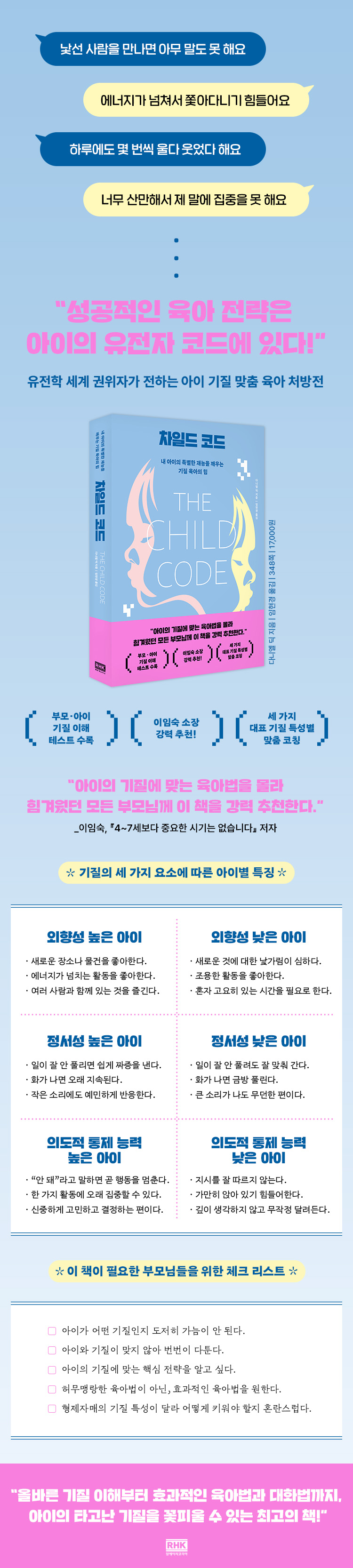
Based on in-depth genetic research and a wealth of case studies, "The Child Code" offers clear and practical parenting strategies tailored to each child's unique genetic code, such as those with high or low extroversion, high emotionality, and low intentional control.
In addition, the author's 'Temporary Understanding Test for Children and Parents' is included, which allows parents to understand their child's temperament in detail, as well as their own tendencies, which can be of great help in real-life parenting.
From parents who want to properly understand their child's temperament, to parents who constantly argue with their child due to different temperaments, to parents raising siblings with different temperaments, this book will be the best parenting prescription for parents who are looking for effective parenting methods that suit their child's temperament.
★★★ Customized coaching for three representative temperament traits
★★★ "There is no more important period than 4 to 7 years old," highly recommended by author Im Sook Lee
"Successful parenting strategies lie in a child's genetic code."
A personalized parenting prescription from a world authority on genetics.
Why is my child acting this way? Why do countless parenting books and advice from friends fail to work? Why is parenting so difficult? The answer is simple.
Many parents who harbor these concerns overlook one crucial factor that has a decisive influence on every aspect of their child's personality, behavior, and attitude toward life.
It is 'genes'.
Danielle Dick, a world authority on genetics and mother of two, emphasizes that each child is 'coded' with a unique genetic makeup.
Therefore, when we understand the temperament inherent in our child's genes and practice parenting methods that suit them, we can save energy in actual parenting and fully bring out our child's innate potential.
Based on in-depth genetic research and a wealth of case studies, "The Child Code" offers clear and practical parenting strategies tailored to each child's unique genetic code, such as those with high or low extroversion, high emotionality, and low intentional control.
In addition, the author's 'Temporary Understanding Test for Children and Parents' is included, which allows parents to understand their child's temperament in detail, as well as their own tendencies, which can be of great help in real-life parenting.
From parents who want to properly understand their child's temperament, to parents who constantly argue with their child due to different temperaments, to parents raising siblings with different temperaments, this book will be the best parenting prescription for parents who are looking for effective parenting methods that suit their child's temperament.
- You can preview some of the book's contents.
Preview
index
Author's Note
I need to know the genetic code to see my child.
The Illusion of Perfect Parenting | Every Child Is Different | Parents Who Forget the Importance of Genes | Parenting That Unleashes Innate Temperament | How to Use This Book | [Key Summary]
Chapter 1: Scientifically Examining Genetics and the Environment
Traditional Family Studies and Their Limitations | The Influence of Genes and Environment ① Adoption Studies | The Influence of Genes and Environment ② Twin Studies | Parents Still Play a Crucial Role | [Key Summary]
Chapter 2: Genes Influence Our Lives in Complex Ways
Three Ways Genes and Environment Interact | The Feedback Loop Genes Create in Life | The Role of Good Parenting: Shaping Temperament | [Key Summary]
Chapter 3: How to Understand Your Child's Temperament
Three Key Elements of Temperament | Five Things to Consider When Understanding Your Child's Temperament | Temperament Exists on a Continuum | Harmonious Fit: A Key Element of Happy Parenting | Why Parents Should Consider Their Temperament, Too | Temperament Is Unchangeable? | A Test to Understand Temperament in Children and Parents | [Key Summary]
Chapter 4 Representative Temperament Elements I.
extroversion
Highly Extroverted Children | Lowly Extroverted Children | The Difference Between Low Extroversion and Shyness | 'Conversation' to Develop Your Child's Social Skills | Parenting Strategies for Different Extroverted Levels | If Your Child is Agreeable (Medium Extroverted) | Preparation is Key | How Parental Extroversion Affects Parenting | When Siblings Have Different Extroversion Levels | The Greatest Gift Parents Can Give | [Key Summary]
Chapter 5 Representative Temperament Elements II.
emotionality
Punishment Doesn't Work | Four Basic Principles for Proper Reward | Proper Reward Strategy ① Using a Reward Table | Proper Reward Strategy ② Accepting the Consequences of Behavior | When Previous Parenting Strategies Haven't Worked | Parenting Strategies for Emotionally Sensitive Children | Good Parents Know How to Take Care of Themselves | Measure Your Emotional Temperature | When Siblings Have Different Emotional Levels | [Key Summary]
Chapter 6 Representative Temperament Elements III.
intentional control
The Brain Science of Intentional Control | Understanding the Various Aspects of Intentional Control | Parenting Strategies for Children with Low Intentional Control | Some Insights into Intentional Control | Your Child's Brain Is Still Growing | [Key Summary]
Chapter 7: What We Can Do Together for Better Parenting
Finding Your Way to Co-Parenting | Preparing for School Success | It Takes a Village | [Key Summary]
Chapter 8: What Should I Do If My Child Is Different?
Internalized Disorders: Problems Inside Your Mind | Externalized Disorders: Problems Outward | Disorders and Temperament: The Difference Between | How to Seek Help | The Sooner You Seek Help, the Better | [Key Summary]
Chapter 9: Parenting: Walking Together at Your Child's Code
[Key Summary]
Acknowledgments | References and Recommended Reading | Notes
I need to know the genetic code to see my child.
The Illusion of Perfect Parenting | Every Child Is Different | Parents Who Forget the Importance of Genes | Parenting That Unleashes Innate Temperament | How to Use This Book | [Key Summary]
Chapter 1: Scientifically Examining Genetics and the Environment
Traditional Family Studies and Their Limitations | The Influence of Genes and Environment ① Adoption Studies | The Influence of Genes and Environment ② Twin Studies | Parents Still Play a Crucial Role | [Key Summary]
Chapter 2: Genes Influence Our Lives in Complex Ways
Three Ways Genes and Environment Interact | The Feedback Loop Genes Create in Life | The Role of Good Parenting: Shaping Temperament | [Key Summary]
Chapter 3: How to Understand Your Child's Temperament
Three Key Elements of Temperament | Five Things to Consider When Understanding Your Child's Temperament | Temperament Exists on a Continuum | Harmonious Fit: A Key Element of Happy Parenting | Why Parents Should Consider Their Temperament, Too | Temperament Is Unchangeable? | A Test to Understand Temperament in Children and Parents | [Key Summary]
Chapter 4 Representative Temperament Elements I.
extroversion
Highly Extroverted Children | Lowly Extroverted Children | The Difference Between Low Extroversion and Shyness | 'Conversation' to Develop Your Child's Social Skills | Parenting Strategies for Different Extroverted Levels | If Your Child is Agreeable (Medium Extroverted) | Preparation is Key | How Parental Extroversion Affects Parenting | When Siblings Have Different Extroversion Levels | The Greatest Gift Parents Can Give | [Key Summary]
Chapter 5 Representative Temperament Elements II.
emotionality
Punishment Doesn't Work | Four Basic Principles for Proper Reward | Proper Reward Strategy ① Using a Reward Table | Proper Reward Strategy ② Accepting the Consequences of Behavior | When Previous Parenting Strategies Haven't Worked | Parenting Strategies for Emotionally Sensitive Children | Good Parents Know How to Take Care of Themselves | Measure Your Emotional Temperature | When Siblings Have Different Emotional Levels | [Key Summary]
Chapter 6 Representative Temperament Elements III.
intentional control
The Brain Science of Intentional Control | Understanding the Various Aspects of Intentional Control | Parenting Strategies for Children with Low Intentional Control | Some Insights into Intentional Control | Your Child's Brain Is Still Growing | [Key Summary]
Chapter 7: What We Can Do Together for Better Parenting
Finding Your Way to Co-Parenting | Preparing for School Success | It Takes a Village | [Key Summary]
Chapter 8: What Should I Do If My Child Is Different?
Internalized Disorders: Problems Inside Your Mind | Externalized Disorders: Problems Outward | Disorders and Temperament: The Difference Between | How to Seek Help | The Sooner You Seek Help, the Better | [Key Summary]
Chapter 9: Parenting: Walking Together at Your Child's Code
[Key Summary]
Acknowledgments | References and Recommended Reading | Notes
Detailed image
Into the book
Why is it so difficult to raise children who we imagined?
There is certainly a wealth of advice for parents.
A variety of parenting classes, blogs and podcasts, magazines and parenting books for parents, workshops… … .
Your mother-in-law nags you about discipline, and your friend gives you advice on sleep training.
The sheer volume of information is overwhelming, but the bigger problem is that all that information conflicts! Humanity has been raising children for thousands of years.
But how come we still haven't found the answer? The most important question for parents is figuring out what's best among the conflicting advice.
---p.11
To summarize, it is as follows.
There is no such thing as a 'good' or a 'bad' temperament.
The temperaments influenced by genes are simply distinct, and all temperaments have strengths and weaknesses.
How much each temperament makes parenting easier or more difficult can also vary depending on the developmental stage.
A child whose stubbornness made his parents pull their hair out can make his parents proud by using that stubbornness to confront any potential injustices in early adulthood.
---p.19
So where does the role of parents begin?
Genes lay the foundation for temperament, and that foundation influences how we experience the world, but genes do not determine our children's fate.
Parents can help their children develop their natural potential and control temperamental factors that may cause problems by understanding their genetic makeup.
In other words, the environment can influence how genetic predispositions are expressed.
This is called gene-environment interaction.
---pp.75-76
Dweck points out that parents' dreams and hopes for their children can easily become distorted into a fixed mindset.
It means that parents are fixated on the mold they want their children to fit into, whether it's a bright student, a talented artist, the star of the school play, or a Harvard graduate.
This means that I hope my child will be a child who likes to spend time quietly without making a fuss in the library, or a child who enjoys playing sports with his parents.
When a child's innate temperament doesn't align with the parent's perspective, the parent may be sending the message that they are inadvertently judging the child for who they are (or aren't).
Not only will children naturally experience frustration, but if you are too quick to worry that it will negatively impact your child's future, that is a fixed mindset.
Thoughts like, "If I can't even sit still and concentrate right now, how am I ever going to graduate from college and get a job?" send the message to children that their parents don't believe in their potential.
---pp.104-105
The best parenting isn't about raising your child to be the best person possible.
You can't feed a child born with short genes a lot of food and make them grow to be 180 centimeters tall.
Conversely, it can prevent them from growing as large as they could by not providing them with enough nutrients.
However, if the environment is not too prominent, most children will grow up to be the most authentic person they can be, based on the unique combination of genes they were born with.
The role of parents is to provide good parenting and provide opportunities for children to blossom.
---pp.329-330
As parents, we can watch our children grow and provide support and encouragement.
As children grow, the decisions they must make will become more difficult and the consequences more serious, so it's important to start practicing from a young age.
Parents cannot and should not always be there for their children as much as they love them.
The greatest gift a parent can give their child is to watch them grow into their best selves, to let their innate genetic code allow them to sing at their best, to realize that that singing may not be the same as their parents', and to enjoy a concert that wasn't what they wanted to see.
There is certainly a wealth of advice for parents.
A variety of parenting classes, blogs and podcasts, magazines and parenting books for parents, workshops… … .
Your mother-in-law nags you about discipline, and your friend gives you advice on sleep training.
The sheer volume of information is overwhelming, but the bigger problem is that all that information conflicts! Humanity has been raising children for thousands of years.
But how come we still haven't found the answer? The most important question for parents is figuring out what's best among the conflicting advice.
---p.11
To summarize, it is as follows.
There is no such thing as a 'good' or a 'bad' temperament.
The temperaments influenced by genes are simply distinct, and all temperaments have strengths and weaknesses.
How much each temperament makes parenting easier or more difficult can also vary depending on the developmental stage.
A child whose stubbornness made his parents pull their hair out can make his parents proud by using that stubbornness to confront any potential injustices in early adulthood.
---p.19
So where does the role of parents begin?
Genes lay the foundation for temperament, and that foundation influences how we experience the world, but genes do not determine our children's fate.
Parents can help their children develop their natural potential and control temperamental factors that may cause problems by understanding their genetic makeup.
In other words, the environment can influence how genetic predispositions are expressed.
This is called gene-environment interaction.
---pp.75-76
Dweck points out that parents' dreams and hopes for their children can easily become distorted into a fixed mindset.
It means that parents are fixated on the mold they want their children to fit into, whether it's a bright student, a talented artist, the star of the school play, or a Harvard graduate.
This means that I hope my child will be a child who likes to spend time quietly without making a fuss in the library, or a child who enjoys playing sports with his parents.
When a child's innate temperament doesn't align with the parent's perspective, the parent may be sending the message that they are inadvertently judging the child for who they are (or aren't).
Not only will children naturally experience frustration, but if you are too quick to worry that it will negatively impact your child's future, that is a fixed mindset.
Thoughts like, "If I can't even sit still and concentrate right now, how am I ever going to graduate from college and get a job?" send the message to children that their parents don't believe in their potential.
---pp.104-105
The best parenting isn't about raising your child to be the best person possible.
You can't feed a child born with short genes a lot of food and make them grow to be 180 centimeters tall.
Conversely, it can prevent them from growing as large as they could by not providing them with enough nutrients.
However, if the environment is not too prominent, most children will grow up to be the most authentic person they can be, based on the unique combination of genes they were born with.
The role of parents is to provide good parenting and provide opportunities for children to blossom.
---pp.329-330
As parents, we can watch our children grow and provide support and encouragement.
As children grow, the decisions they must make will become more difficult and the consequences more serious, so it's important to start practicing from a young age.
Parents cannot and should not always be there for their children as much as they love them.
The greatest gift a parent can give their child is to watch them grow into their best selves, to let their innate genetic code allow them to sing at their best, to realize that that singing may not be the same as their parents', and to enjoy a concert that wasn't what they wanted to see.
---p.334
Publisher's Review
“There is a different parenting style that suits my child.”
In an age where all kinds of parenting advice are rampant,
Why We Need to Focus on Temperament Parenting Again Now
“My child is very shy, so I’m worried about his social life.”, “He has mood swings so much that he cries and laughs several times a day, so it’s hard to adjust to him.”, “He’s so distracted, I don’t know if he’ll be able to study properly.” Behind these concerns, which many parents can relate to, are these underlying thoughts.
"How on earth should I raise my child, who I know but don't know?" Parenting books are plentiful and offer all sorts of advice, but often, it's not suitable for my child.
What's the most important thing to remember in this seemingly daunting journey of parenting? It's understanding temperament.
Only when parenting is tailored to the child's temperament can both parents and children achieve a happy parenting experience.
Daniel Dick, a world authority in the field of genetics, has intensively studied the three major temperament components that have consistently emerged in studies on children's temperament: extraversion, emotionality, and effortful control, and has included his findings in this book.
Extraversion is a temperament trait associated with positive emotions, activity levels, and exploratory behavior, while emotionality is a trait associated with frustration, fear, and anger.
Deliberative control is the ability to control one's emotions and behavior, often referred to as self-control.
In this regard, we provide practical parenting strategies for each child by specifically analyzing the strengths and potential future difficulties that each child may face according to the degree of each characteristic, such as high or low extroversion, high emotionality, and low intentional control ability.
The author, a mother of two, uses different parenting techniques for her son, who is low in extroversion and high in emotionality, and her daughter, who is low in extroversion and low in emotionality.
In terms of extroversion, it was the same in that when exposed to a large stimulus, such as meeting a lot of people, it gave me time to be alone and quiet.
However, in terms of emotional well-being, I helped my son manage his volatile emotions by making a list of things that trigger his psychological stimuli and working together to solve problems.
Parenting methods that suit this temperament not only allow parents and children to form a healthy relationship, but also provide opportunities for them to grow together.
“Good parenting is not about worrying about what to add,
“It’s about walking together according to the child’s unique temperament.”
The power of temperament parenting that fully brings out a child's innate potential.
Immediately after the child is born, parents carefully observe the child's facial expressions and behavior to figure out what the child wants.
Then, as the child grows up, they try to make the child into what they want.
This relationship between parents and children can never be peaceful.
The problem arises when parents try to change their children.
The author advises parents:
"The best parenting isn't about raising a child to be the person you want them to be, but about nurturing them into their own unique selves, allowing their innate temperament to flourish." In the long marathon of parenting, shouldn't parents be like coaches, nurturing their children into top athletes, but like solid running mates, helping them grow into their best selves? Parents should continually observe their children to determine which approach best suits them, and walk alongside them in a way that suits their unique temperament.
In order to move in this direction of good parenting, it is important to understand the correct temperament.
The Child Code suggests five things to keep in mind when trying to understand your child's temperament.
First, you need to find a consistent, frequent appearance, not a temporary one.
Second, we must think about the appearance that does not change over time.
Third, because the characteristics revealed differ depending on the developmental stage, the temperament must be identified by considering the child's age.
Fourth, parents must be careful not to look at their children with prejudice due to their innate temperament.
This also ties into the last point: by facing your child as they are, without being swayed by the opinions of those around them, you can more clearly understand their temperament and find the most appropriate parenting method.
By accurately understanding temperament, parents can avoid repeating the frustrating experiences of ineffective parenting methods, and children can objectively recognize their strengths and weaknesses and develop a strong self-esteem to navigate the world.
If you ever feel lost in your parenting, or find yourself wondering what parenting method is best for your child, I encourage you to carefully read the author's suggested parenting methods, conversation techniques, and parental mindset.
You will find the most clear and useful answers to help you hold the hands of lost and wandering parents.
Now, let's realize the power of temperamental parenting that makes both parents and children comfortable through this book.
In an age where all kinds of parenting advice are rampant,
Why We Need to Focus on Temperament Parenting Again Now
“My child is very shy, so I’m worried about his social life.”, “He has mood swings so much that he cries and laughs several times a day, so it’s hard to adjust to him.”, “He’s so distracted, I don’t know if he’ll be able to study properly.” Behind these concerns, which many parents can relate to, are these underlying thoughts.
"How on earth should I raise my child, who I know but don't know?" Parenting books are plentiful and offer all sorts of advice, but often, it's not suitable for my child.
What's the most important thing to remember in this seemingly daunting journey of parenting? It's understanding temperament.
Only when parenting is tailored to the child's temperament can both parents and children achieve a happy parenting experience.
Daniel Dick, a world authority in the field of genetics, has intensively studied the three major temperament components that have consistently emerged in studies on children's temperament: extraversion, emotionality, and effortful control, and has included his findings in this book.
Extraversion is a temperament trait associated with positive emotions, activity levels, and exploratory behavior, while emotionality is a trait associated with frustration, fear, and anger.
Deliberative control is the ability to control one's emotions and behavior, often referred to as self-control.
In this regard, we provide practical parenting strategies for each child by specifically analyzing the strengths and potential future difficulties that each child may face according to the degree of each characteristic, such as high or low extroversion, high emotionality, and low intentional control ability.
The author, a mother of two, uses different parenting techniques for her son, who is low in extroversion and high in emotionality, and her daughter, who is low in extroversion and low in emotionality.
In terms of extroversion, it was the same in that when exposed to a large stimulus, such as meeting a lot of people, it gave me time to be alone and quiet.
However, in terms of emotional well-being, I helped my son manage his volatile emotions by making a list of things that trigger his psychological stimuli and working together to solve problems.
Parenting methods that suit this temperament not only allow parents and children to form a healthy relationship, but also provide opportunities for them to grow together.
“Good parenting is not about worrying about what to add,
“It’s about walking together according to the child’s unique temperament.”
The power of temperament parenting that fully brings out a child's innate potential.
Immediately after the child is born, parents carefully observe the child's facial expressions and behavior to figure out what the child wants.
Then, as the child grows up, they try to make the child into what they want.
This relationship between parents and children can never be peaceful.
The problem arises when parents try to change their children.
The author advises parents:
"The best parenting isn't about raising a child to be the person you want them to be, but about nurturing them into their own unique selves, allowing their innate temperament to flourish." In the long marathon of parenting, shouldn't parents be like coaches, nurturing their children into top athletes, but like solid running mates, helping them grow into their best selves? Parents should continually observe their children to determine which approach best suits them, and walk alongside them in a way that suits their unique temperament.
In order to move in this direction of good parenting, it is important to understand the correct temperament.
The Child Code suggests five things to keep in mind when trying to understand your child's temperament.
First, you need to find a consistent, frequent appearance, not a temporary one.
Second, we must think about the appearance that does not change over time.
Third, because the characteristics revealed differ depending on the developmental stage, the temperament must be identified by considering the child's age.
Fourth, parents must be careful not to look at their children with prejudice due to their innate temperament.
This also ties into the last point: by facing your child as they are, without being swayed by the opinions of those around them, you can more clearly understand their temperament and find the most appropriate parenting method.
By accurately understanding temperament, parents can avoid repeating the frustrating experiences of ineffective parenting methods, and children can objectively recognize their strengths and weaknesses and develop a strong self-esteem to navigate the world.
If you ever feel lost in your parenting, or find yourself wondering what parenting method is best for your child, I encourage you to carefully read the author's suggested parenting methods, conversation techniques, and parental mindset.
You will find the most clear and useful answers to help you hold the hands of lost and wandering parents.
Now, let's realize the power of temperamental parenting that makes both parents and children comfortable through this book.
GOODS SPECIFICS
- Date of issue: August 17, 2022
- Page count, weight, size: 348 pages | 580g | 148*210*21mm
- ISBN13: 9788925577722
- ISBN10: 8925577720
You may also like
카테고리
korean


korean

![ELLE 엘르 스페셜 에디션 A형 : 12월 [2025]](http://librairie.coreenne.fr/cdn/shop/files/b8e27a3de6c9538896439686c6b0e8fb.jpg?v=1766436872&width=3840)


