

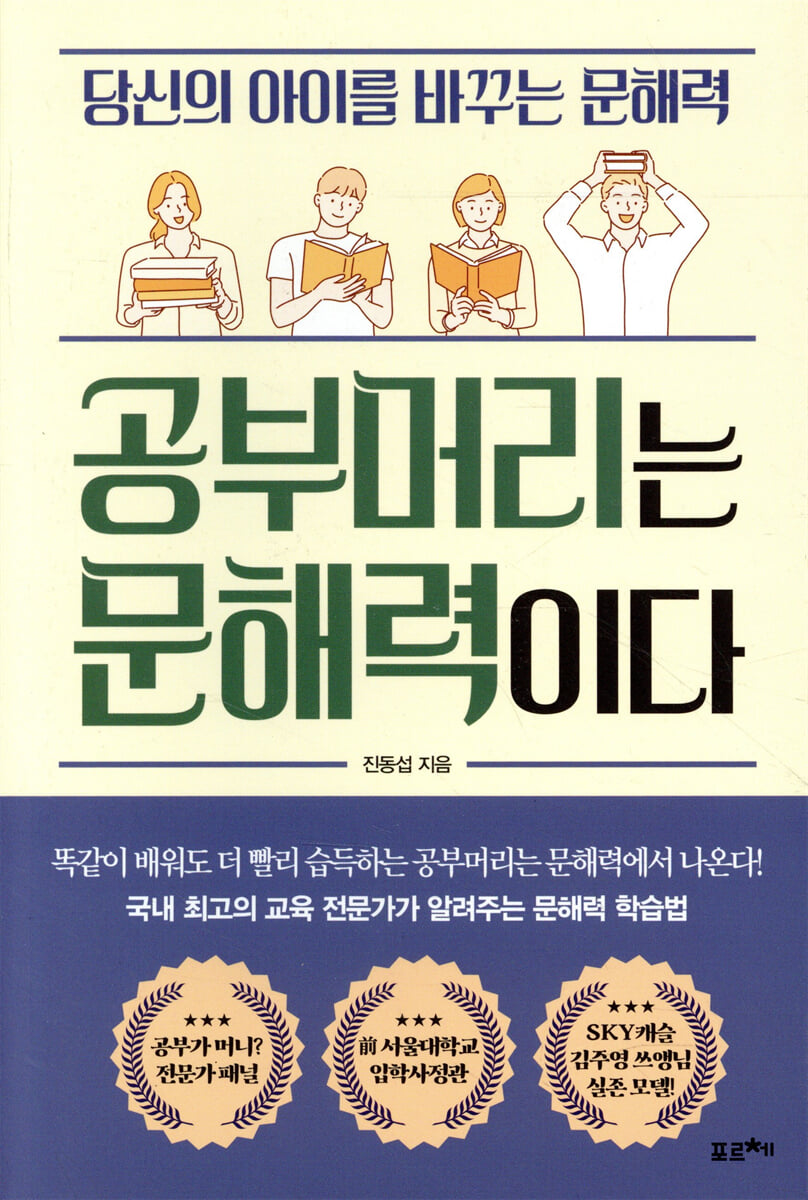
The ability to study is literacy.
 |
Description
Book Introduction
- A word from MD
- A literacy learning method that fosters a keen eye for study! Why do students find studying more difficult as they advance in grade level? The ability to learn faster, even when learning the same subjects, stems from literacy.
Develop literacy, a core skill for successful students! A one-book guide to literacy development for your child, presented by an admissions expert with 30 years of experience as a Korean language teacher and former Seoul National University admissions officer.
- Kim Hyun-joo, MD of Home Living
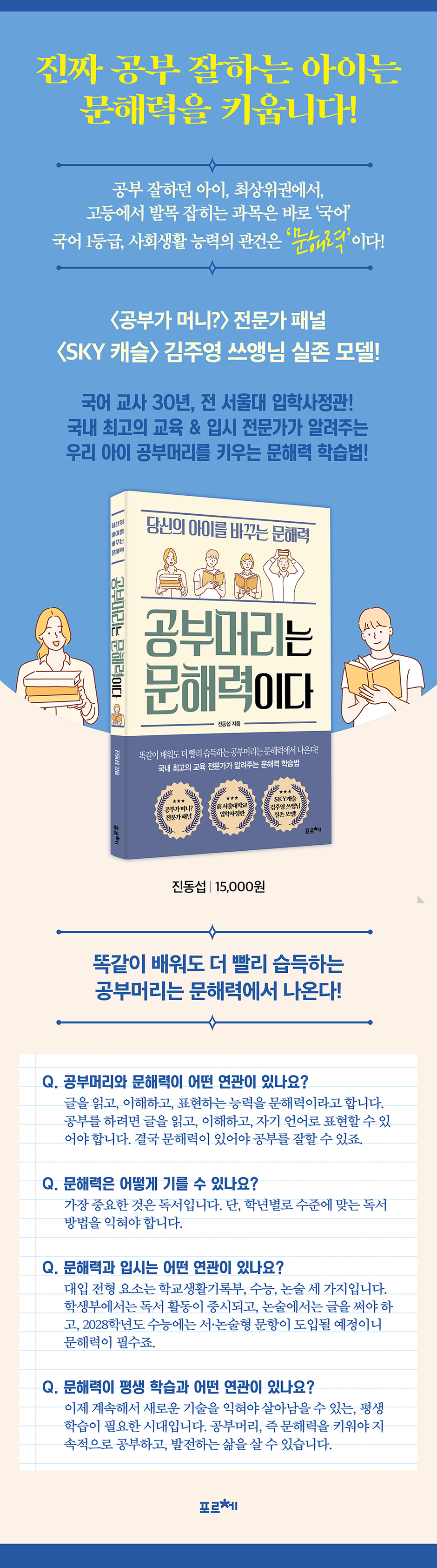
The ability to learn faster than others even when learning the same thing comes from literacy!
Develop literacy, a core skill for successful students.
Why do children struggle with schoolwork? It's because they lack literacy.
Korean language texts are becoming longer and questions in all subjects are presented in increasingly longer texts.
Top-tier children who did quite well in elementary school all say the same thing when they reach middle and high school.
“I can’t solve the problem because I can’t read it.” The author says that one must have Korean language skills, especially literacy, which is the ability to read, understand, and express oneself, in order to read a given text and study well.
This is not limited to the Korean language subject.
The same goes for math, English, social studies, science, and history.
If you don't understand the vocabulary and content in the textbook for each subject, you will inevitably have difficulty studying.
This book explains why literacy is necessary to foster a child's academic aptitude, how to develop literacy, and how to guide children at home to develop their Korean language skills.
Fostering literacy from an early age makes studying fun and improves children's grades and self-esteem.
This book, which contains 'How to Raise Children's Literacy' by author Jin Dong-seop, a former Seoul National University admissions officer and high school Korean language teacher with over 30 years of experience, will be a good guide to killing two birds with one stone: raising children's self-esteem and academic performance.
Develop literacy, a core skill for successful students.
Why do children struggle with schoolwork? It's because they lack literacy.
Korean language texts are becoming longer and questions in all subjects are presented in increasingly longer texts.
Top-tier children who did quite well in elementary school all say the same thing when they reach middle and high school.
“I can’t solve the problem because I can’t read it.” The author says that one must have Korean language skills, especially literacy, which is the ability to read, understand, and express oneself, in order to read a given text and study well.
This is not limited to the Korean language subject.
The same goes for math, English, social studies, science, and history.
If you don't understand the vocabulary and content in the textbook for each subject, you will inevitably have difficulty studying.
This book explains why literacy is necessary to foster a child's academic aptitude, how to develop literacy, and how to guide children at home to develop their Korean language skills.
Fostering literacy from an early age makes studying fun and improves children's grades and self-esteem.
This book, which contains 'How to Raise Children's Literacy' by author Jin Dong-seop, a former Seoul National University admissions officer and high school Korean language teacher with over 30 years of experience, will be a good guide to killing two birds with one stone: raising children's self-esteem and academic performance.
- You can preview some of the book's contents.
Preview
index
Prologue: Literacy that Develops a Study Mind
Chapter 1: Literacy for Developing Elementary School Aptitude
4th grader Yujun's study method
Why should elementary school students develop literacy skills?
How to develop literacy skills in first and second graders
How to develop literacy skills in 3rd and 4th graders
How to develop literacy skills in 5th and 6th graders
This is a must: How to study elementary literacy
TIP Habits that Develop Study Aptitude and Literacy
Chapter 2: The Answer to Improving Grades Lies in Literacy
Let's gradually build literacy skills and develop a study mindset.
Literacy can be developed through writing.
Why We Need to Develop Literacy, According to the OECD
Let's remember the destination of literacy.
Chapter 3: Literacy Learning Methods by Age
Literacy that develops kindergarten students' study skills
Literacy that develops the study skills of middle school students
Literacy that cultivates high school students' academic aptitude
Chapter 4: Literacy Develops a Study Aptitude for College Entrance Exams
Literacy and college admissions are inseparable.
Will Seoul National University's 100 Recommended Books Help with College Admissions?
Books that will help you prepare for college entrance exams, as mentioned by Seoul National University's webzine, Arori
What kind of books can help you develop a study mindset?
Reading habits that cultivate study skills
Studying to develop literacy creates mathematical skills.
How to get a good evaluation in the student-centered admissions process
What role will literacy studies play in the essay-based CSAT?
Studying to develop literacy skills is the core of the Korean language section of the CSAT.
Studying to improve literacy leads to high scores on the CSAT.
Chapter 5: Do different high schools require different types of study skills?
What kind of studies will be conducted at a gifted school?
Even in science high schools, literacy skills must be nurtured.
Literacy skills required for autonomous private high schools, foreign language high schools, and international high schools
Epilogue: You must study consistently.
Chapter 1: Literacy for Developing Elementary School Aptitude
4th grader Yujun's study method
Why should elementary school students develop literacy skills?
How to develop literacy skills in first and second graders
How to develop literacy skills in 3rd and 4th graders
How to develop literacy skills in 5th and 6th graders
This is a must: How to study elementary literacy
TIP Habits that Develop Study Aptitude and Literacy
Chapter 2: The Answer to Improving Grades Lies in Literacy
Let's gradually build literacy skills and develop a study mindset.
Literacy can be developed through writing.
Why We Need to Develop Literacy, According to the OECD
Let's remember the destination of literacy.
Chapter 3: Literacy Learning Methods by Age
Literacy that develops kindergarten students' study skills
Literacy that develops the study skills of middle school students
Literacy that cultivates high school students' academic aptitude
Chapter 4: Literacy Develops a Study Aptitude for College Entrance Exams
Literacy and college admissions are inseparable.
Will Seoul National University's 100 Recommended Books Help with College Admissions?
Books that will help you prepare for college entrance exams, as mentioned by Seoul National University's webzine, Arori
What kind of books can help you develop a study mindset?
Reading habits that cultivate study skills
Studying to develop literacy creates mathematical skills.
How to get a good evaluation in the student-centered admissions process
What role will literacy studies play in the essay-based CSAT?
Studying to develop literacy skills is the core of the Korean language section of the CSAT.
Studying to improve literacy leads to high scores on the CSAT.
Chapter 5: Do different high schools require different types of study skills?
What kind of studies will be conducted at a gifted school?
Even in science high schools, literacy skills must be nurtured.
Literacy skills required for autonomous private high schools, foreign language high schools, and international high schools
Epilogue: You must study consistently.
Detailed image
Into the book
Literacy refers to the ability to use written text freely.
Literacy is the ability to quickly read and understand everything written, express your thoughts well both verbally and in writing, create good documents, write a one-page proposal to close a deal, and present this document as a presentation. Being able to demonstrate your abilities in all aspects of written communication is what it means to have literacy.
Literacy is an essential skill in almost all occupations and entrepreneurship fields.
Literacy not only serves as a passport to college admissions, but is also an important skill for social life.
Therefore, literacy is considered the most important value to be cultivated during elementary, middle, and high school.
---p.9
The most basic skill in studying Korean is literacy.
So every semester begins with reading instruction.
We teach book selection strategies, book reading strategies, and post-reading activity strategies appropriate to each grade level.
The reason why reading is necessary is self-evident, and this ability is developed in the Korean language.
In other words, Korean is the foundation of all subjects, so if you can't learn Korean, you can't study other subjects.
Furthermore, studying the Korean language does not stop at simply reading letters and accepting the content, but rather helps students successfully navigate social life through training in using the language critically and creatively.
---p.33
There is one thing you must remember when developing literacy.
Science and social studies textbooks contain many concepts, and you must memorize all the vocabulary for those concepts.
Science books are filled with a balanced mix of basic knowledge in physics, life science, chemistry, and earth science, and are filled with words that represent that knowledge and words that describe new things.
However, if you only focus on Korean, English, and math during this period, your child will begin to lose background knowledge.
The opposite situation is also problematic.
If you neglect Korean, English, and math, you will have a lot of common sense, but you will not be able to adapt to more difficult situations, so you will have a hard time as you move on to higher grades.
---p.47
To study, you need to be able to read a book of about 500 pages and summarize its contents.
This is the goal.
You also need to read a book that has consistent content on one topic.
The phrase 'I have to read' may give the impression of being forced to read out of a sense of duty, but it should be understood more as meaning that you are challenging yourself to read and master it.
---p.61
Literacy is the ability to communicate through writing and speaking.
So, not only information input and judgment, but also output is important.
Output is speaking and writing.
Speaking, from the speaker's perspective, is divided into one-to-one speaking and one-to-many speaking.
However, in ordinary conversations, not lectures, deviations from the topic often occur.
(…) However, since writing is generally focused on the topic, the story is more complete.
During school days, there are various writing events and awards.
Don't Use Awards to Advance to Higher Schools While many competitions are disappearing, there are still plenty of writing contests where students can participate and gain recognition for their writing skills.
Even if there is no award-winning contest, a single word of praise for demonstrating excellent writing skills can help students maintain and develop their writing habits.
Praise makes whales dance.
---pp.73-74
The factors that universities determine to select students are called admissions factors.
The college entrance exam elements are three: school records, the CSAT, and the essay.
The CSAT will remain in its current form until the 2027 college entrance exam, and essay-type questions may be introduced starting from the 2028 college entrance exam.
In terms of writing, there will be attempts to select students for the writing section in some way.
Now, whether it is the CSAT or the essay-based admissions process, you cannot get good grades without literacy skills.
---p.123
In the future, we will become a lifelong learning society, so we may have to study again at university at age forty, once more at age sixty, and perhaps even again at age eighty.
To further study, literacy is necessary, but without literacy, one cannot achieve the goal of 'continuously developing one's life and completing the second and third acts of life'.
I cannot be happy if I am the only one living in the past due to lack of literacy while others live in the present.
Nowadays, even people living in the mountains can post on social media to express themselves and obtain various information online.
No one knows how much the world will change.
Literacy is essential to living in this present world.
Literacy is the ability to quickly read and understand everything written, express your thoughts well both verbally and in writing, create good documents, write a one-page proposal to close a deal, and present this document as a presentation. Being able to demonstrate your abilities in all aspects of written communication is what it means to have literacy.
Literacy is an essential skill in almost all occupations and entrepreneurship fields.
Literacy not only serves as a passport to college admissions, but is also an important skill for social life.
Therefore, literacy is considered the most important value to be cultivated during elementary, middle, and high school.
---p.9
The most basic skill in studying Korean is literacy.
So every semester begins with reading instruction.
We teach book selection strategies, book reading strategies, and post-reading activity strategies appropriate to each grade level.
The reason why reading is necessary is self-evident, and this ability is developed in the Korean language.
In other words, Korean is the foundation of all subjects, so if you can't learn Korean, you can't study other subjects.
Furthermore, studying the Korean language does not stop at simply reading letters and accepting the content, but rather helps students successfully navigate social life through training in using the language critically and creatively.
---p.33
There is one thing you must remember when developing literacy.
Science and social studies textbooks contain many concepts, and you must memorize all the vocabulary for those concepts.
Science books are filled with a balanced mix of basic knowledge in physics, life science, chemistry, and earth science, and are filled with words that represent that knowledge and words that describe new things.
However, if you only focus on Korean, English, and math during this period, your child will begin to lose background knowledge.
The opposite situation is also problematic.
If you neglect Korean, English, and math, you will have a lot of common sense, but you will not be able to adapt to more difficult situations, so you will have a hard time as you move on to higher grades.
---p.47
To study, you need to be able to read a book of about 500 pages and summarize its contents.
This is the goal.
You also need to read a book that has consistent content on one topic.
The phrase 'I have to read' may give the impression of being forced to read out of a sense of duty, but it should be understood more as meaning that you are challenging yourself to read and master it.
---p.61
Literacy is the ability to communicate through writing and speaking.
So, not only information input and judgment, but also output is important.
Output is speaking and writing.
Speaking, from the speaker's perspective, is divided into one-to-one speaking and one-to-many speaking.
However, in ordinary conversations, not lectures, deviations from the topic often occur.
(…) However, since writing is generally focused on the topic, the story is more complete.
During school days, there are various writing events and awards.
Don't Use Awards to Advance to Higher Schools While many competitions are disappearing, there are still plenty of writing contests where students can participate and gain recognition for their writing skills.
Even if there is no award-winning contest, a single word of praise for demonstrating excellent writing skills can help students maintain and develop their writing habits.
Praise makes whales dance.
---pp.73-74
The factors that universities determine to select students are called admissions factors.
The college entrance exam elements are three: school records, the CSAT, and the essay.
The CSAT will remain in its current form until the 2027 college entrance exam, and essay-type questions may be introduced starting from the 2028 college entrance exam.
In terms of writing, there will be attempts to select students for the writing section in some way.
Now, whether it is the CSAT or the essay-based admissions process, you cannot get good grades without literacy skills.
---p.123
In the future, we will become a lifelong learning society, so we may have to study again at university at age forty, once more at age sixty, and perhaps even again at age eighty.
To further study, literacy is necessary, but without literacy, one cannot achieve the goal of 'continuously developing one's life and completing the second and third acts of life'.
I cannot be happy if I am the only one living in the past due to lack of literacy while others live in the present.
Nowadays, even people living in the mountains can post on social media to express themselves and obtain various information online.
No one knows how much the world will change.
Literacy is essential to living in this present world.
---p.149
Publisher's Review
Seoul National University Admissions Officer, the real-life model for Kim Joo-young from "SKY Castle"!
〈Studying is Money?〉 Teacher Jin Dong-seop explains
Literacy Learning Methods to Develop Your Child's Aptitude for Studying
In order to develop a keen mind for studying, one must build literacy skills from elementary school.
So how can we develop literacy? The author says the most effective way to develop literacy is through reading.
This book presents literacy goals and teaches learning methods for each age group.
In kindergarten, the role of parents in fostering reading habits is emphasized, and in 1st and 2nd grades, 3rd and 4th grades, and 5th and 6th grades, the method of selecting books, how to develop reading habits, and what studies must be done are pointed out.
Next, it tells middle and high school students what level of books they should read, what the correct reading method is, and what activities they should do after reading.
Finally, the author advises parents that academic aptitude cannot be developed overnight, and that literacy must be developed step by step.
Literacy and college entrance exams are inseparable!
Literate children perform better on college entrance exams.
The college entrance exam elements are essay, CSAT, and academic transcript.
Since the essay is a writing test, it is difficult to get a good score without literacy skills.
The College Scholastic Ability Test (CSAT) is expected to introduce essay-type questions starting in the 2020 school year.
In other words, you need to have literacy skills to get a high score on the CSAT.
Literacy is also important in the student-centered admissions process, which accounts for the largest portion of the rolling admissions process.
In particular, in the comprehensive selection process, the thing that admissions officers focus on is 'reading activities'. They mainly evaluate what prompted the student to read the book, what the student felt from the book, and how the student organized his thoughts after reading the book.
This is something that can be easily filled in if you have gone through the process of learning literacy.
Literacy is also important in the academic achievement-based student selection process, which focuses on school grades.
Performance assessments that count toward course grades require students to submit assignments or make presentations, and literacy skills are essential for organizing data and thoughts.
Therefore, the author says that all students, regardless of school type, such as general high schools, autonomous private high schools, foreign language high schools, or science high schools, should develop literacy skills.
Literacy makes college and social life easier.
How to develop your child's academic aptitude for elementary, middle, and high school, and even into social life!
Literacy is important in college life and even in social life.
You need to be able to read thick textbooks to be able to take exams and submit assignments.
To get a job, you need to be literate, write a self-introduction letter, and prepare for a descriptive exam.
When writing business plans, contracts, and performance reports after getting a job, it is easier to do so if you have literacy skills.
Moreover, these days, it is difficult to make a living with just one skill.
To be a lifelong learner, you must study by reading texts and accepting new ideas.
Ultimately, this is a world where Korean language skills determine one's starting point and even future development potential.
This book emphasizes that literacy is not just a means to an end, but a skill for the future, and explains the importance of literacy study methods for lifelong learning.
〈Studying is Money?〉 Teacher Jin Dong-seop explains
Literacy Learning Methods to Develop Your Child's Aptitude for Studying
In order to develop a keen mind for studying, one must build literacy skills from elementary school.
So how can we develop literacy? The author says the most effective way to develop literacy is through reading.
This book presents literacy goals and teaches learning methods for each age group.
In kindergarten, the role of parents in fostering reading habits is emphasized, and in 1st and 2nd grades, 3rd and 4th grades, and 5th and 6th grades, the method of selecting books, how to develop reading habits, and what studies must be done are pointed out.
Next, it tells middle and high school students what level of books they should read, what the correct reading method is, and what activities they should do after reading.
Finally, the author advises parents that academic aptitude cannot be developed overnight, and that literacy must be developed step by step.
Literacy and college entrance exams are inseparable!
Literate children perform better on college entrance exams.
The college entrance exam elements are essay, CSAT, and academic transcript.
Since the essay is a writing test, it is difficult to get a good score without literacy skills.
The College Scholastic Ability Test (CSAT) is expected to introduce essay-type questions starting in the 2020 school year.
In other words, you need to have literacy skills to get a high score on the CSAT.
Literacy is also important in the student-centered admissions process, which accounts for the largest portion of the rolling admissions process.
In particular, in the comprehensive selection process, the thing that admissions officers focus on is 'reading activities'. They mainly evaluate what prompted the student to read the book, what the student felt from the book, and how the student organized his thoughts after reading the book.
This is something that can be easily filled in if you have gone through the process of learning literacy.
Literacy is also important in the academic achievement-based student selection process, which focuses on school grades.
Performance assessments that count toward course grades require students to submit assignments or make presentations, and literacy skills are essential for organizing data and thoughts.
Therefore, the author says that all students, regardless of school type, such as general high schools, autonomous private high schools, foreign language high schools, or science high schools, should develop literacy skills.
Literacy makes college and social life easier.
How to develop your child's academic aptitude for elementary, middle, and high school, and even into social life!
Literacy is important in college life and even in social life.
You need to be able to read thick textbooks to be able to take exams and submit assignments.
To get a job, you need to be literate, write a self-introduction letter, and prepare for a descriptive exam.
When writing business plans, contracts, and performance reports after getting a job, it is easier to do so if you have literacy skills.
Moreover, these days, it is difficult to make a living with just one skill.
To be a lifelong learner, you must study by reading texts and accepting new ideas.
Ultimately, this is a world where Korean language skills determine one's starting point and even future development potential.
This book emphasizes that literacy is not just a means to an end, but a skill for the future, and explains the importance of literacy study methods for lifelong learning.
GOODS SPECIFICS
- Date of issue: July 1, 2021
- Page count, weight, size: 184 pages | 330g | 150*223*11mm
- ISBN13: 9791191393200
- ISBN10: 1191393208
You may also like
카테고리
korean


korean

![GQ KOREA Mark (Monthly): December [2025]](http://librairie.coreenne.fr/cdn/shop/files/8ef265dbbfbf186523ed75ba7319009d.jpg?v=1765340328&width=3840)


