

Asperger syndrome
 |
Description
Book Introduction
Autism challenges the common belief that it affects four times more males than females.
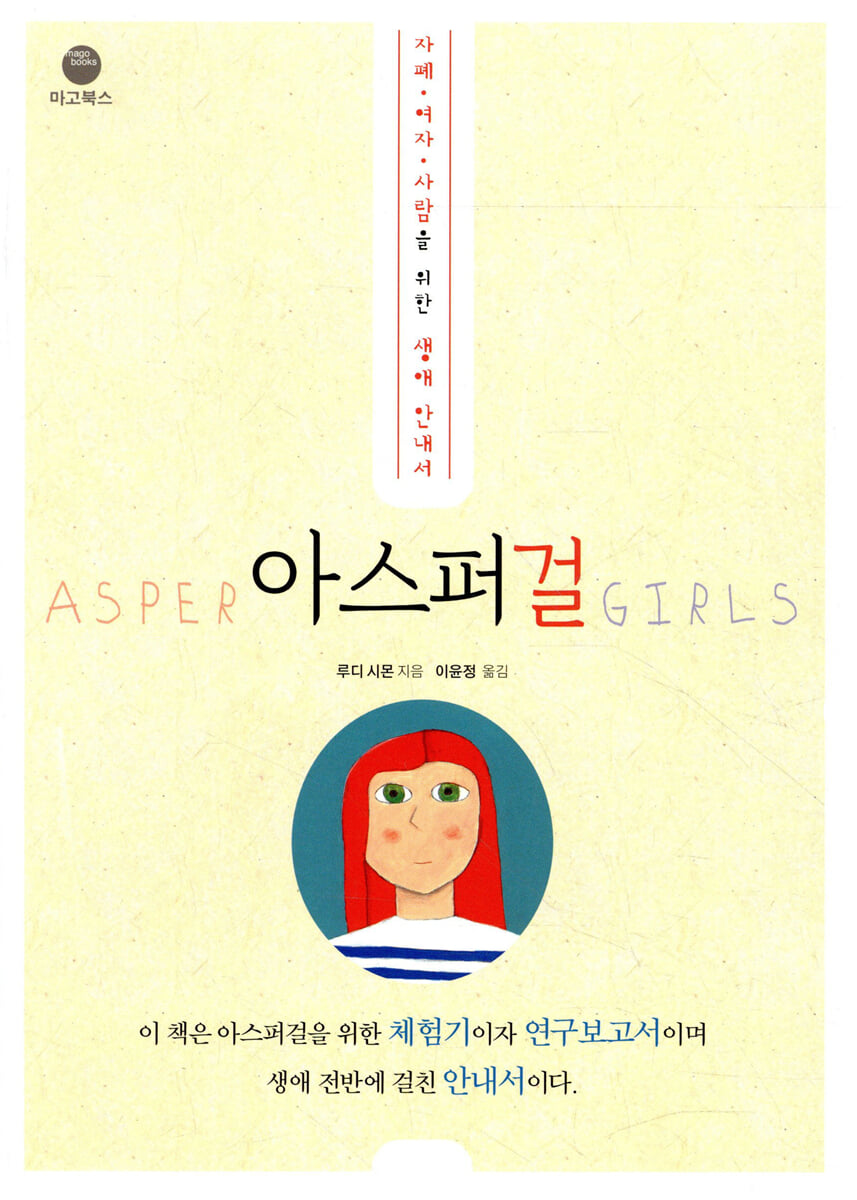
A book that illuminates the hidden world of women with autism according to their life cycle.
Based on the experiences of 35 women with autism, including the author herself, as well as their parents and spouses, this book provides guidance on life for Asperger's.
2011 IPPY Awards (The Independent Publisher Book Awards)
Gold Medal-Winning Book in the Sexuality Category
A Guide Written by Aspergers for Aspergers
Until now, autism spectrum disorder has been considered to be overwhelmingly male, and female autism has been overlooked.
However, it has recently been discovered that autism in women presents differently from that in men, and that women require different diagnosis and support than men with autism.
This book is written to help women with autism (including undiagnosed women) understand themselves and navigate their daily lives, as well as to help those around them, such as their parents, friends, and spouses, understand and support them.
This is also the first book on female autism to be introduced in Korea.
This book is also a guide written by an Asperger for other Aspergers.
Rudy Simon, who discovered her Asperger's syndrome late in life, offers guidance for Aspergers through all aspects of life, from growing up and schooling, love and marriage, friendship, guilt, savant talent, career and finances, depression, parenting, diagnosis and misdiagnosis, seizures and the pain of not being understood by those around her, and growing old with autism.
This book, woven with the author's own story as the warp and interviews with over 30 women diagnosed with autism spectrum disorder as the warp, and the experiences of their spouses and parents as the warp, reads very three-dimensionally and realistically.
A book that illuminates the hidden world of women with autism according to their life cycle.
Based on the experiences of 35 women with autism, including the author herself, as well as their parents and spouses, this book provides guidance on life for Asperger's.
2011 IPPY Awards (The Independent Publisher Book Awards)
Gold Medal-Winning Book in the Sexuality Category
A Guide Written by Aspergers for Aspergers
Until now, autism spectrum disorder has been considered to be overwhelmingly male, and female autism has been overlooked.
However, it has recently been discovered that autism in women presents differently from that in men, and that women require different diagnosis and support than men with autism.
This book is written to help women with autism (including undiagnosed women) understand themselves and navigate their daily lives, as well as to help those around them, such as their parents, friends, and spouses, understand and support them.
This is also the first book on female autism to be introduced in Korea.
This book is also a guide written by an Asperger for other Aspergers.
Rudy Simon, who discovered her Asperger's syndrome late in life, offers guidance for Aspergers through all aspects of life, from growing up and schooling, love and marriage, friendship, guilt, savant talent, career and finances, depression, parenting, diagnosis and misdiagnosis, seizures and the pain of not being understood by those around her, and growing old with autism.
This book, woven with the author's own story as the warp and interviews with over 30 women diagnosed with autism spectrum disorder as the warp, and the experiences of their spouses and parents as the warp, reads very three-dimensionally and realistically.
- You can preview some of the book's contents.
Preview
index
1.
Imagination, self-learning, servant talent, unusual interests
2.
Why Smart Girls Hate School
3.
sensory overload
4.
Stereotyped behavior and behavior when happy
5.
Blame and internalized guilt
6.
Gender Roles and Identity
7.
Puberty and Mutism
8.
attraction, dating, sex, relationships
9.
Friendship and social interactions
10.
higher education
11.
Employment and work life
12.
Marriage, living with someone
13.
Child rearing
14.
Rituals and routines, logical and rigid thinking, direct speech, empathy, and misunderstandings among people.
15.
Diagnosis, Misdiagnosis, and Drug Therapy
16.
More information about depressive meltdowns, post-traumatic stress disorder (PTSD), and medications
17.
Anger meltdown
18.
Breaking ties
19.
Gastrointestinal problems and autism
20.
Growing Old with Autism
21.
Is Asperger's Syndrome a Disability or a Talent?
Additional resources for parents
22.
Give your Asperger daughter faith, acceptance, love, affection, and support.
23.
Thoughts and Advice from Parents of Asperger's Children
supplement
List of characteristics of female Asperger syndrome
Summary of some key differences between men and women
References and Websites
After moving - Resonating with the pain of Aspergers
Imagination, self-learning, servant talent, unusual interests
2.
Why Smart Girls Hate School
3.
sensory overload
4.
Stereotyped behavior and behavior when happy
5.
Blame and internalized guilt
6.
Gender Roles and Identity
7.
Puberty and Mutism
8.
attraction, dating, sex, relationships
9.
Friendship and social interactions
10.
higher education
11.
Employment and work life
12.
Marriage, living with someone
13.
Child rearing
14.
Rituals and routines, logical and rigid thinking, direct speech, empathy, and misunderstandings among people.
15.
Diagnosis, Misdiagnosis, and Drug Therapy
16.
More information about depressive meltdowns, post-traumatic stress disorder (PTSD), and medications
17.
Anger meltdown
18.
Breaking ties
19.
Gastrointestinal problems and autism
20.
Growing Old with Autism
21.
Is Asperger's Syndrome a Disability or a Talent?
Additional resources for parents
22.
Give your Asperger daughter faith, acceptance, love, affection, and support.
23.
Thoughts and Advice from Parents of Asperger's Children
supplement
List of characteristics of female Asperger syndrome
Summary of some key differences between men and women
References and Websites
After moving - Resonating with the pain of Aspergers
Into the book
It is well known that people with Asperger's syndrome are very fond of information.
But why is that?
Information is the mental anchor of our thoughts and something we can control.
We don't have to charm them, take them to lunch, or look good.
Information can be handled as we wish.
Asperger's has what could be called a voracious appetite for information.
You don't have to wait until you go to kindergarten and learn to read to read.
Also, don't wait until you have lessons to learn how to play an instrument at home.
There are many cases where this is not necessary.
I learned how to read from a series of records called Sing Along with Mitch Miller.
One day, I picked up 'The Cat in the Hat' from one of those records and I could read the lyrics.
It just suddenly made sense._(Withers)
In my case, I learned reading logically and quickly.
I remember asking my mother to show me the alphabet.
And I learned the pronunciation of letters, such as “A is for apple, B is for boy.”
A few minutes later, when my mother had finished reading the alphabet, I picked up a book and left.
Most of the Aspergers I interviewed learned to read on their own, and many had similar experiences in math, music, and design.
I am a servant of spatial dynamics.
It becomes CAD (computer-aided design) in your head.
You can assemble electronics and machines from scratch without any prior knowledge._ (Andy)
These talents level off as we age.
This superior reading ability (hyperlexia) compared to that of their peers in childhood gives some Aspergers an air of intellectual maturity, which can lead people to mistakenly believe that they are also emotionally mature.
This also masks the shortcomings of Asperger's syndrome, making autism less apparent.
Of course, some Asperger's are not so language-focused, and some have learning disabilities such as dyslexia.
But whether verbal or visual, with or without learning disabilities, throughout their lives, our Aspergers self-taught most of what they wanted to know.
It's the same even if you go to college.
We love to teach ourselves anything that interests us, partly because we can't stand the process of learning from others, and partly because we have our own way of acquiring and understanding knowledge.
We tend to receive information in our own way because we can miss other people's instructions, especially verbal instructions.
Almost everything I know is self-taught.
Although he was a very fast learner in school, he was expelled because his dyslexia caused his test scores to be low.
I taught myself statistics, chemistry, sewing, embroidery, and welding.
(fountain)
(y)
I'm not saying we're all incredibly smart.
If you don't have the passion or servant talent to devote yourself to something, you're not alone, because there are others who don't.
What really bothers me is when Asperger's activists, caught up in the myth that all Asperger's people are geniuses at math or science, some kind of leading species, insist on "leave Asperger's people alone."
When I hear things like that, I feel like a double failure as someone with Asperger's who doesn't have that talent.
He is a failure who is neither normal nor has Asperger's.
(Poly)
However, there may be many reasons why people fall into the category of learning delay.
It could be due to sensory integration issues, or it could be due to stress or people around you paralyzing your thinking.
A bright girl can be misunderstood because of dyslexia, dyspraxia, and selective mutism.
--- p.22~26, from “Chapter 1 Imagination, Self-Learning, Servant Talent, and Unique Interests”
Even if you're not bullied at school, you may still feel very lonely. Many adults with AS prefer to be alone simply because they've been accustomed to it since childhood.
We all know that Aspergers exhibit a "fight or flight" response to others, but even if they exhibit this response at a very young age, I believe it is an acquired response.
I was allowed to leave class early to avoid crowds and didn't have to eat lunch in the cafeteria.
I wish I had friends.
Someone who understands me.
(Megan)
School experiences, especially elementary school, vary from person to person with Asperger's and from school to school.
The character of a school is shaped by its people.
We are all unique individuals and there is no one-size-fits-all solution to these situations.
Some Aspergers did well before they received diagnosis, observation, individualized instruction, and special education, partly because people left them alone, and partly because they lived in an environment where bullying was not tolerated.
At the time, Catholic elementary schools were like paradise for children with Asperger's syndrome.
The training was rigorous, well-structured, and predictable.
I've been doing well.
Children were expected to study hard, follow rules, and be kind to each other.
(Pokegran)
Aspergers do not thrive under even the slightest hint of hostility.
If we receive unfriendly, scary, or threatening looks, whether from our peers or teachers, we become discouraged.
When alone, he is talented, elegant, witty and intelligent, but in such an environment, he becomes crouched like a hedgehog.
We are as sensitive emotionally as we are physically, and this sensitivity creates a vicious cycle of bullying.
That is, when the perpetrators realize the extent of their influence, they become more enthusiastic about it (they find it more fun because the bully reacts sensitively).
Some of us are pushed into a corner, pushed out of the parking lot, and then pushed all the way out.
In other words, it's like dropping out of school.
Some adults with Asperger's were gifted students as children but dropped out of high school or college.
Due to post-traumatic stress disorder, he only received a high school diploma instead of a doctorate.
It's better to drop out of school than to die from bullying.
We feel empowered when we get out of a bad situation because it means we are in control of the situation, and that is very important to people with Asperger's.
But the problem arises later.
When we turn 42 and realize that we didn't get that degree back then, or that we wish we had gotten that higher education degree.
The feeling of victory is temporary, but problems will continue to arise in the future.
--- p.41~43, from “Chapter 2 Why Smart Girls Hate School”
One day when I was little, my mom saw me shaking my head in the kitchen and said, "What the hell are you doing, you idiot?"
After that, I started jumping on the step attached to the bunk bed stairs, driving my sister crazy who was in the bunk below.
It was a total mess in public places.
I fiddled with the hairs I couldn't see, kept scraping the dirt under my fingernails, and fiddled with everything I was wearing.
I learned to smoke when I was twenty and I'm having a hard time quitting.
(Bramble)
Our emotions are pure, immature, and childlike.
It is most evident when we are excited and happy.
I asked Asperger girls whether they exhibited similar behaviors when they were happy or excited, and I got the following list in response:
This list is very similar to the behaviors we engage in when we're anxious, but in this case, they're driven by an overflow of positive emotions.
Dancing with joy, laughing loudly, waving both hands or arms, saying “wow” and “yahoo” like a child, jumping up and down, shaking fists, clapping, laughing non-stop, pacing back and forth at full speed, jumping up and down, singing, speaking in a high-pitched voice.
A lot of my obsessions tend to be based on popular media (e.g., certain TV shows or movies).
So when a scene I particularly like comes up, I pause the screen, quickly jump in and then come back to continue watching.
(Poly)
Many Aspergers report laughing, squeaking, or speaking in a childlike voice when they are happy.
In my opinion, this kind of lively appearance is more closely related to women and is relatively more socially acceptable than men.
So in some ways we are lucky.
Social acceptability varies depending on the situation and the mindset of the people we are with.
When everyone is feeling silly, it doesn't seem like anyone is really pointing out my quirks.
(Dame Kev)
People don't seem to care, and some people seem to enjoy it more because I'm really excited about it.
(Andy)
Some parents take their Asperger's daughters to dance or other classes to channel that energy into more constructive or socially acceptable activities.
My mom told me that I should use all my energy to do something productive.
The solution was dance, martial arts, tennis, fencing, or any type of sport that would allow me to channel that energy.
Doing such activities also helps me avoid suddenly rushing into a physical fight with someone.
(Dame Kev)
Others have not found an acceptable outlet.
So, after being teased or criticized so often, I learned to suppress my 'happy behavior' or replace it with something less noticeable.
--- p.66~68, from “Chapter 4 Similar Behaviors and Behaviors When Happy”
We have an amazing ability to think deeply and continuously about things for long periods of time.
When these characteristics appear in a hobby, it is called passion.
At work or school, this is called concentration.
But in our private lives, we call it obsession.
All of these are Asperger's traits.
It's okay to be fixated on inanimate objects or information, but it's dangerous to be fixated on people, especially those with whom you don't have a mutual interest.
We, as well as our doctors and parents, need to understand that we are prone to clinginess and that this may be something to be wary of in our relationships.
It is true that some Aspergers have no interest in dating at all.
However, we are emotionally naive, highly sensory-oriented, lack understanding of gender roles, and have a fight-or-flight response to others.
So, if we are interested in a relationship, we might end up chasing after a guy, lost in a dreamy fantasy about a relationship, while not actually being able to maintain a relationship with him.
I never had a good time with the guys I had a crush on.
In the end, I ended up looking like a stalker.
I learned that I shouldn't call the guy I like 12 times a night to see if he's home and try to talk to him every night, but I still don't know how much is too much.
(Elfinia)
When I was 12, I had an obsession with one of the coolest and most handsome boys in the neighborhood.
He was 17 years old.
I was so drawn into his senses that I couldn't stop looking at his hair and eyes.
One day we were all watching a movie, and he was sitting on the couch behind me and I was sitting on the floor in front of the TV.
I turned my head 180 degrees every few seconds to look at him.
He avoided my gaze and just forced a smile.
I'm sure there were a lot of jokes about the Exorcist after I left (a reference to the terrifying scene in The Exorcist where Megan's head is twisted when she's possessed - translator's note).
I remember clearly that I couldn't stop doing that at that time.
I also remember thinking that no one would notice my actions, but of course they did.
How could I not know? I was sitting in front of everyone.
However, I have a theory of mind (the ability to understand one's own mind and the minds of others).
If this ability is not properly developed, it is said that one may not be able to recognize that other people's thoughts and feelings may be different from one's own - the translator's ability was lacking.
In other words, I thought, 'If I can't see myself, how can other people see me?'
I also believed that since I loved him, he must love me too.
After months of obsessively pursuing him, he finally lashed out at me in an angry, almost frightened voice.
“You are not a woman.
“I don’t even know what you are.” That was the first time I realized that there was something about me that might scare people, but I still couldn’t figure out what I had done wrong.
Girls are expected to be pushy, but Asperger girls don't flirt.
Besides not understanding gender roles and demands, we are logical and direct beings.
“I want to date him.
So you might think, “I should ask him out on a date,” and invite ridicule and rejection.
The whole dating process and what to do and how to do it is beyond most of our capabilities.
We fail by acting in a way that tries to attract a date.
Whether in high school or as adults, we can often be rejected for inappropriate behavior.
As a result, you may become extremely afraid of rejection and avoid anything related to relationships.
Your lifelong love affair with loneliness may begin here.
--- p.112~114, from “Chapter 8 Attraction, Love, Sex, and Relationships between Men and Women”
As I describe in my book on employment, most people with Asperger's want to go to work, work, and leave.
But it's not that simple.
When we go through something, it is people who create the atmosphere.
That's why many Aspergers try to avoid working with other people by working from home or working with animals.
I am unemployed.
I'm homeschooling my son.
I just can't deal with people for long periods of time.
(Niki)
I would love to work as a dog groomer.
I feel a close bond with my dog and the dogs I groom.
Like Mother Wolf, I feel like I am a part of their world.
(Elfinia)
We've talked a lot about intellectual challenge and achievement, but of course not all Aspergers are creative geniuses.
Some people like simple, repetitive tasks.
When I was 13, I decided to become a dental hygienist.
I love the repetitive task of removing tartar from my teeth.
The hard part is working with people who have those teeth and all sorts of personality issues that come up.
(Jen)
People with Asperger's can develop and lose interest in hobbies and careers very quickly, so it's best to pursue a career that you're passionate about.
This way, you can maintain your interest and focus for a long time and even make money doing something you enjoy.
If you can't find a job in your field of interest, you'll become unfocused, bored, and depressed.
You may even feel sick.
We need obsessive immersion.
It serves as our mental anchor and provides a crucial ritualistic and routine framework for our thinking.
Without immersion, our thoughts would just float away in the wind like balloons with nowhere to go.
That state of not being able to go anywhere is like never having truly taken off.
I get very stressed out from being around people all day and not being able to pursue my interests.
So I stay up until dawn doing my hobbies and barely get any sleep.
(Withers)
Temple Grandin once said to people on the autism spectrum, “Sell your accomplishments, not yourself,” and she’s right.
But how can this be, in a culture where character is valued and where psychological and personality tests are commonly required for job placement? These so-called personality tests can expose our social and cognitive differences (different, not necessarily defects) and potentially cost people with Asperger's syndrome jobs before they even have a chance to demonstrate who they are.
Increasing job satisfaction and reducing the number of people with autism who are unemployed or underemployed ultimately comes down to recognizing our talents, embracing our flaws, and leveraging our strengths.
--- p.175~177, from “Chapter 11 Employment and Work Life”
Many women don't know they have Asperger's syndrome or have never even heard of it.
They only find out about it when their child (usually a son) is diagnosed and doctors look into the parents to find a genetic cause.
I have been misdiagnosed several times.
The content was about mental disorders, ADHD, and bipolar disorder (based on meltdowns and a dazed state like going crazy).
Then, at the age of thirteen, he was diagnosed with Tourette's syndrome (a condition in which tics persist for more than a year, and motor and vocal tics appear together).
Although the cause is unknown, it is thought to be due to neurological rather than psychiatric causes - translator) and was diagnosed with hand flapping, mumbling and repeating words twice, being unable to look people in the face for a long time, and occasionally making noises.
It wasn't until my two sons were diagnosed with autism that I was diagnosed with AS.
(Dame Kev)
It wasn't until our third child was diagnosed that my husband and I began to realize the similarities between our children and ourselves.
I always knew I was different, and I was relieved to get the diagnosis.
(Jen)
I've had so many misdiagnoses that I can't even list them all.
Doctors tried many different medications, but I had a bad reaction to them all.
When one of my teachers at school told me that the two youngest of my children were autistic, I said, “That’s ridiculous.
I thought, “Kids are just like me.”
So I read all the relevant books.
I was trying to prove that teacher wrong, but instead I realized that most of my family was on the spectrum.
The diagnosis proved that he had autism.
(Pokegran)
When people, myself included, first stumbled upon the term Asperger's, they were trying to figure out the root cause of their partner's strange habits.
Then we realized that we also had similar characteristics.
But the first books I found that suggested I might be on the spectrum were mostly about men, with only a little bit about women.
Mozart and the Whale (2005), a fictionalized version of the true story of Mary Newport, is an American film directed by Petter Næss and tells the love story of a couple with Asperger's syndrome.
Josh Hartnett and Radha Mitchell played the lead couple - the description of the female protagonist Isabel in (translator's note) gave me confidence in the spectrum.
It took me several times to realize - Isabelle is so much like me.
From then on, I thoroughly dug into everything I could find.
For those of us who don't have children with Asperger's, doctors often use the method of elimination, eliminating suspected conditions as they continue testing until they find the correct diagnosis.
Who can afford that without free or really good health insurance? Self-diagnosis is sometimes the only economical and practical alternative, and it's usually accurate.
Some women first self-diagnose, then contact insurance companies, decide on coverage, and negotiate a contract before receiving an official diagnosis.
--- p.235~237, from “Chapter 15 Diagnosis, Misdiagnosis, and Drug Therapy”
Whether your daughter is young or old, if she's having a tantrum in the supermarket or a big box store, she's experiencing sensory overload.
With the music, pedestrians, and chatter, her mind is overwhelmed with information to process.
When you first take your daughter to a new store, tell her you'll only be turning two corners.
Let your daughter find her favorite food in that corner.
That will be a landmark, and the next time she goes there she will feel more comfortable in that corner.
She may already be there, clutching the peanut butter jar in triumph.
Next time you go, add two more corners.
This method doesn't work in big stores, so don't do it then.
When you have the time, teach your daughter the tricks.
If your child is very young, give them a nice pair of sunglasses to block out the glare from the store's bright lights, and bring their favorite soft toy.
If your daughter were having temper tantrums toward you, you would of course look for possible causes, such as sensory issues, hunger, etc.
Then ask yourself what you think is upsetting your child.
Are you blaming or provoking your child? Are you scolding her for something she didn't do, making her feel guilty about what she actually is? Take a step back and remember to always use positive reinforcement with your daughter.
Of course, I'm not suggesting that you cater to your child's whims and let them manipulate you with their tantrums.
She needs to learn that there are consequences for losing her temper, and she will learn that if you take away her privileges when she has a temper tantrum.
But this needs to start when the child is young.
Even if you don't show her the SpongeBob series, it's not really a threat if she's in her 20s.
And because the child is younger, they are more receptive and their personality is still forming.
I once heard an English grandmother say, “Manners are the grease that makes society run smoothly.”
It's a golden rule for anyone, autistic or not, but the visual aspect of its expression is especially helpful for us to understand.
As with depressive meltdowns and stereotyped behaviors, a quiet environment that allows her to release energy when she needs it and to calm her down is essential.
Drugs are a last resort.
But why is that?
Information is the mental anchor of our thoughts and something we can control.
We don't have to charm them, take them to lunch, or look good.
Information can be handled as we wish.
Asperger's has what could be called a voracious appetite for information.
You don't have to wait until you go to kindergarten and learn to read to read.
Also, don't wait until you have lessons to learn how to play an instrument at home.
There are many cases where this is not necessary.
I learned how to read from a series of records called Sing Along with Mitch Miller.
One day, I picked up 'The Cat in the Hat' from one of those records and I could read the lyrics.
It just suddenly made sense._(Withers)
In my case, I learned reading logically and quickly.
I remember asking my mother to show me the alphabet.
And I learned the pronunciation of letters, such as “A is for apple, B is for boy.”
A few minutes later, when my mother had finished reading the alphabet, I picked up a book and left.
Most of the Aspergers I interviewed learned to read on their own, and many had similar experiences in math, music, and design.
I am a servant of spatial dynamics.
It becomes CAD (computer-aided design) in your head.
You can assemble electronics and machines from scratch without any prior knowledge._ (Andy)
These talents level off as we age.
This superior reading ability (hyperlexia) compared to that of their peers in childhood gives some Aspergers an air of intellectual maturity, which can lead people to mistakenly believe that they are also emotionally mature.
This also masks the shortcomings of Asperger's syndrome, making autism less apparent.
Of course, some Asperger's are not so language-focused, and some have learning disabilities such as dyslexia.
But whether verbal or visual, with or without learning disabilities, throughout their lives, our Aspergers self-taught most of what they wanted to know.
It's the same even if you go to college.
We love to teach ourselves anything that interests us, partly because we can't stand the process of learning from others, and partly because we have our own way of acquiring and understanding knowledge.
We tend to receive information in our own way because we can miss other people's instructions, especially verbal instructions.
Almost everything I know is self-taught.
Although he was a very fast learner in school, he was expelled because his dyslexia caused his test scores to be low.
I taught myself statistics, chemistry, sewing, embroidery, and welding.
(fountain)
(y)
I'm not saying we're all incredibly smart.
If you don't have the passion or servant talent to devote yourself to something, you're not alone, because there are others who don't.
What really bothers me is when Asperger's activists, caught up in the myth that all Asperger's people are geniuses at math or science, some kind of leading species, insist on "leave Asperger's people alone."
When I hear things like that, I feel like a double failure as someone with Asperger's who doesn't have that talent.
He is a failure who is neither normal nor has Asperger's.
(Poly)
However, there may be many reasons why people fall into the category of learning delay.
It could be due to sensory integration issues, or it could be due to stress or people around you paralyzing your thinking.
A bright girl can be misunderstood because of dyslexia, dyspraxia, and selective mutism.
--- p.22~26, from “Chapter 1 Imagination, Self-Learning, Servant Talent, and Unique Interests”
Even if you're not bullied at school, you may still feel very lonely. Many adults with AS prefer to be alone simply because they've been accustomed to it since childhood.
We all know that Aspergers exhibit a "fight or flight" response to others, but even if they exhibit this response at a very young age, I believe it is an acquired response.
I was allowed to leave class early to avoid crowds and didn't have to eat lunch in the cafeteria.
I wish I had friends.
Someone who understands me.
(Megan)
School experiences, especially elementary school, vary from person to person with Asperger's and from school to school.
The character of a school is shaped by its people.
We are all unique individuals and there is no one-size-fits-all solution to these situations.
Some Aspergers did well before they received diagnosis, observation, individualized instruction, and special education, partly because people left them alone, and partly because they lived in an environment where bullying was not tolerated.
At the time, Catholic elementary schools were like paradise for children with Asperger's syndrome.
The training was rigorous, well-structured, and predictable.
I've been doing well.
Children were expected to study hard, follow rules, and be kind to each other.
(Pokegran)
Aspergers do not thrive under even the slightest hint of hostility.
If we receive unfriendly, scary, or threatening looks, whether from our peers or teachers, we become discouraged.
When alone, he is talented, elegant, witty and intelligent, but in such an environment, he becomes crouched like a hedgehog.
We are as sensitive emotionally as we are physically, and this sensitivity creates a vicious cycle of bullying.
That is, when the perpetrators realize the extent of their influence, they become more enthusiastic about it (they find it more fun because the bully reacts sensitively).
Some of us are pushed into a corner, pushed out of the parking lot, and then pushed all the way out.
In other words, it's like dropping out of school.
Some adults with Asperger's were gifted students as children but dropped out of high school or college.
Due to post-traumatic stress disorder, he only received a high school diploma instead of a doctorate.
It's better to drop out of school than to die from bullying.
We feel empowered when we get out of a bad situation because it means we are in control of the situation, and that is very important to people with Asperger's.
But the problem arises later.
When we turn 42 and realize that we didn't get that degree back then, or that we wish we had gotten that higher education degree.
The feeling of victory is temporary, but problems will continue to arise in the future.
--- p.41~43, from “Chapter 2 Why Smart Girls Hate School”
One day when I was little, my mom saw me shaking my head in the kitchen and said, "What the hell are you doing, you idiot?"
After that, I started jumping on the step attached to the bunk bed stairs, driving my sister crazy who was in the bunk below.
It was a total mess in public places.
I fiddled with the hairs I couldn't see, kept scraping the dirt under my fingernails, and fiddled with everything I was wearing.
I learned to smoke when I was twenty and I'm having a hard time quitting.
(Bramble)
Our emotions are pure, immature, and childlike.
It is most evident when we are excited and happy.
I asked Asperger girls whether they exhibited similar behaviors when they were happy or excited, and I got the following list in response:
This list is very similar to the behaviors we engage in when we're anxious, but in this case, they're driven by an overflow of positive emotions.
Dancing with joy, laughing loudly, waving both hands or arms, saying “wow” and “yahoo” like a child, jumping up and down, shaking fists, clapping, laughing non-stop, pacing back and forth at full speed, jumping up and down, singing, speaking in a high-pitched voice.
A lot of my obsessions tend to be based on popular media (e.g., certain TV shows or movies).
So when a scene I particularly like comes up, I pause the screen, quickly jump in and then come back to continue watching.
(Poly)
Many Aspergers report laughing, squeaking, or speaking in a childlike voice when they are happy.
In my opinion, this kind of lively appearance is more closely related to women and is relatively more socially acceptable than men.
So in some ways we are lucky.
Social acceptability varies depending on the situation and the mindset of the people we are with.
When everyone is feeling silly, it doesn't seem like anyone is really pointing out my quirks.
(Dame Kev)
People don't seem to care, and some people seem to enjoy it more because I'm really excited about it.
(Andy)
Some parents take their Asperger's daughters to dance or other classes to channel that energy into more constructive or socially acceptable activities.
My mom told me that I should use all my energy to do something productive.
The solution was dance, martial arts, tennis, fencing, or any type of sport that would allow me to channel that energy.
Doing such activities also helps me avoid suddenly rushing into a physical fight with someone.
(Dame Kev)
Others have not found an acceptable outlet.
So, after being teased or criticized so often, I learned to suppress my 'happy behavior' or replace it with something less noticeable.
--- p.66~68, from “Chapter 4 Similar Behaviors and Behaviors When Happy”
We have an amazing ability to think deeply and continuously about things for long periods of time.
When these characteristics appear in a hobby, it is called passion.
At work or school, this is called concentration.
But in our private lives, we call it obsession.
All of these are Asperger's traits.
It's okay to be fixated on inanimate objects or information, but it's dangerous to be fixated on people, especially those with whom you don't have a mutual interest.
We, as well as our doctors and parents, need to understand that we are prone to clinginess and that this may be something to be wary of in our relationships.
It is true that some Aspergers have no interest in dating at all.
However, we are emotionally naive, highly sensory-oriented, lack understanding of gender roles, and have a fight-or-flight response to others.
So, if we are interested in a relationship, we might end up chasing after a guy, lost in a dreamy fantasy about a relationship, while not actually being able to maintain a relationship with him.
I never had a good time with the guys I had a crush on.
In the end, I ended up looking like a stalker.
I learned that I shouldn't call the guy I like 12 times a night to see if he's home and try to talk to him every night, but I still don't know how much is too much.
(Elfinia)
When I was 12, I had an obsession with one of the coolest and most handsome boys in the neighborhood.
He was 17 years old.
I was so drawn into his senses that I couldn't stop looking at his hair and eyes.
One day we were all watching a movie, and he was sitting on the couch behind me and I was sitting on the floor in front of the TV.
I turned my head 180 degrees every few seconds to look at him.
He avoided my gaze and just forced a smile.
I'm sure there were a lot of jokes about the Exorcist after I left (a reference to the terrifying scene in The Exorcist where Megan's head is twisted when she's possessed - translator's note).
I remember clearly that I couldn't stop doing that at that time.
I also remember thinking that no one would notice my actions, but of course they did.
How could I not know? I was sitting in front of everyone.
However, I have a theory of mind (the ability to understand one's own mind and the minds of others).
If this ability is not properly developed, it is said that one may not be able to recognize that other people's thoughts and feelings may be different from one's own - the translator's ability was lacking.
In other words, I thought, 'If I can't see myself, how can other people see me?'
I also believed that since I loved him, he must love me too.
After months of obsessively pursuing him, he finally lashed out at me in an angry, almost frightened voice.
“You are not a woman.
“I don’t even know what you are.” That was the first time I realized that there was something about me that might scare people, but I still couldn’t figure out what I had done wrong.
Girls are expected to be pushy, but Asperger girls don't flirt.
Besides not understanding gender roles and demands, we are logical and direct beings.
“I want to date him.
So you might think, “I should ask him out on a date,” and invite ridicule and rejection.
The whole dating process and what to do and how to do it is beyond most of our capabilities.
We fail by acting in a way that tries to attract a date.
Whether in high school or as adults, we can often be rejected for inappropriate behavior.
As a result, you may become extremely afraid of rejection and avoid anything related to relationships.
Your lifelong love affair with loneliness may begin here.
--- p.112~114, from “Chapter 8 Attraction, Love, Sex, and Relationships between Men and Women”
As I describe in my book on employment, most people with Asperger's want to go to work, work, and leave.
But it's not that simple.
When we go through something, it is people who create the atmosphere.
That's why many Aspergers try to avoid working with other people by working from home or working with animals.
I am unemployed.
I'm homeschooling my son.
I just can't deal with people for long periods of time.
(Niki)
I would love to work as a dog groomer.
I feel a close bond with my dog and the dogs I groom.
Like Mother Wolf, I feel like I am a part of their world.
(Elfinia)
We've talked a lot about intellectual challenge and achievement, but of course not all Aspergers are creative geniuses.
Some people like simple, repetitive tasks.
When I was 13, I decided to become a dental hygienist.
I love the repetitive task of removing tartar from my teeth.
The hard part is working with people who have those teeth and all sorts of personality issues that come up.
(Jen)
People with Asperger's can develop and lose interest in hobbies and careers very quickly, so it's best to pursue a career that you're passionate about.
This way, you can maintain your interest and focus for a long time and even make money doing something you enjoy.
If you can't find a job in your field of interest, you'll become unfocused, bored, and depressed.
You may even feel sick.
We need obsessive immersion.
It serves as our mental anchor and provides a crucial ritualistic and routine framework for our thinking.
Without immersion, our thoughts would just float away in the wind like balloons with nowhere to go.
That state of not being able to go anywhere is like never having truly taken off.
I get very stressed out from being around people all day and not being able to pursue my interests.
So I stay up until dawn doing my hobbies and barely get any sleep.
(Withers)
Temple Grandin once said to people on the autism spectrum, “Sell your accomplishments, not yourself,” and she’s right.
But how can this be, in a culture where character is valued and where psychological and personality tests are commonly required for job placement? These so-called personality tests can expose our social and cognitive differences (different, not necessarily defects) and potentially cost people with Asperger's syndrome jobs before they even have a chance to demonstrate who they are.
Increasing job satisfaction and reducing the number of people with autism who are unemployed or underemployed ultimately comes down to recognizing our talents, embracing our flaws, and leveraging our strengths.
--- p.175~177, from “Chapter 11 Employment and Work Life”
Many women don't know they have Asperger's syndrome or have never even heard of it.
They only find out about it when their child (usually a son) is diagnosed and doctors look into the parents to find a genetic cause.
I have been misdiagnosed several times.
The content was about mental disorders, ADHD, and bipolar disorder (based on meltdowns and a dazed state like going crazy).
Then, at the age of thirteen, he was diagnosed with Tourette's syndrome (a condition in which tics persist for more than a year, and motor and vocal tics appear together).
Although the cause is unknown, it is thought to be due to neurological rather than psychiatric causes - translator) and was diagnosed with hand flapping, mumbling and repeating words twice, being unable to look people in the face for a long time, and occasionally making noises.
It wasn't until my two sons were diagnosed with autism that I was diagnosed with AS.
(Dame Kev)
It wasn't until our third child was diagnosed that my husband and I began to realize the similarities between our children and ourselves.
I always knew I was different, and I was relieved to get the diagnosis.
(Jen)
I've had so many misdiagnoses that I can't even list them all.
Doctors tried many different medications, but I had a bad reaction to them all.
When one of my teachers at school told me that the two youngest of my children were autistic, I said, “That’s ridiculous.
I thought, “Kids are just like me.”
So I read all the relevant books.
I was trying to prove that teacher wrong, but instead I realized that most of my family was on the spectrum.
The diagnosis proved that he had autism.
(Pokegran)
When people, myself included, first stumbled upon the term Asperger's, they were trying to figure out the root cause of their partner's strange habits.
Then we realized that we also had similar characteristics.
But the first books I found that suggested I might be on the spectrum were mostly about men, with only a little bit about women.
Mozart and the Whale (2005), a fictionalized version of the true story of Mary Newport, is an American film directed by Petter Næss and tells the love story of a couple with Asperger's syndrome.
Josh Hartnett and Radha Mitchell played the lead couple - the description of the female protagonist Isabel in (translator's note) gave me confidence in the spectrum.
It took me several times to realize - Isabelle is so much like me.
From then on, I thoroughly dug into everything I could find.
For those of us who don't have children with Asperger's, doctors often use the method of elimination, eliminating suspected conditions as they continue testing until they find the correct diagnosis.
Who can afford that without free or really good health insurance? Self-diagnosis is sometimes the only economical and practical alternative, and it's usually accurate.
Some women first self-diagnose, then contact insurance companies, decide on coverage, and negotiate a contract before receiving an official diagnosis.
--- p.235~237, from “Chapter 15 Diagnosis, Misdiagnosis, and Drug Therapy”
Whether your daughter is young or old, if she's having a tantrum in the supermarket or a big box store, she's experiencing sensory overload.
With the music, pedestrians, and chatter, her mind is overwhelmed with information to process.
When you first take your daughter to a new store, tell her you'll only be turning two corners.
Let your daughter find her favorite food in that corner.
That will be a landmark, and the next time she goes there she will feel more comfortable in that corner.
She may already be there, clutching the peanut butter jar in triumph.
Next time you go, add two more corners.
This method doesn't work in big stores, so don't do it then.
When you have the time, teach your daughter the tricks.
If your child is very young, give them a nice pair of sunglasses to block out the glare from the store's bright lights, and bring their favorite soft toy.
If your daughter were having temper tantrums toward you, you would of course look for possible causes, such as sensory issues, hunger, etc.
Then ask yourself what you think is upsetting your child.
Are you blaming or provoking your child? Are you scolding her for something she didn't do, making her feel guilty about what she actually is? Take a step back and remember to always use positive reinforcement with your daughter.
Of course, I'm not suggesting that you cater to your child's whims and let them manipulate you with their tantrums.
She needs to learn that there are consequences for losing her temper, and she will learn that if you take away her privileges when she has a temper tantrum.
But this needs to start when the child is young.
Even if you don't show her the SpongeBob series, it's not really a threat if she's in her 20s.
And because the child is younger, they are more receptive and their personality is still forming.
I once heard an English grandmother say, “Manners are the grease that makes society run smoothly.”
It's a golden rule for anyone, autistic or not, but the visual aspect of its expression is especially helpful for us to understand.
As with depressive meltdowns and stereotyped behaviors, a quiet environment that allows her to release energy when she needs it and to calm her down is essential.
Drugs are a last resort.
--- p.274~276, from “Chapter 17 Anger Meltdown”
GOODS SPECIFICS
- Publication date: November 30, 2020
- Page count, weight, size: 352 pages | 150*210*30mm
- ISBN13: 9791187282044
- ISBN10: 1187282049
You may also like
카테고리
korean


korean

![ELLE 엘르 스페셜 에디션 A형 : 12월 [2025]](http://librairie.coreenne.fr/cdn/shop/files/b8e27a3de6c9538896439686c6b0e8fb.jpg?v=1766436872&width=3840)


