

Warm and firm discipline
 |
Description
Book Introduction
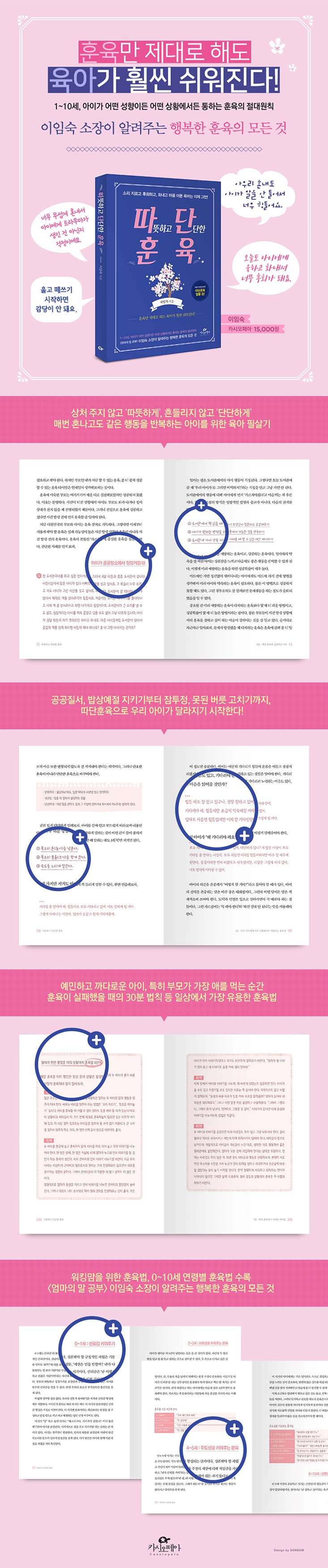
“Parenting becomes much easier if you discipline properly!”
Ages 1-10: Absolute principles of discipline that apply to any child, regardless of their temperament or situation.
Everything You Need to Know About Happy Discipline, as Rev. Im Sook Lee of "Mom's Words" explains.
“It’s so hard when my child doesn’t listen no matter how much I scold them.” “I can’t handle it when they start crying and throwing tantrums.” “I’m worried that my child has become traumatized because I scolded them so harshly.” These are the complaints of mothers who say that discipline is too difficult.
There is so much to teach at each stage of growth, but there are even more things to worry about.
Stern and harsh discipline is like a double-edged sword; it not only hurts the child, but also the mother who wields it.
This book teaches absolute principles of discipline that apply to any child, regardless of their temperament or situation.
Now let's practice some warm and solid 'Ttadan Discipline'.
You will experience the miracle of your family, once a battlefield of crying and frustration, returning to a peaceful daily life.
The author, who has healed the hearts of parents and children for over 20,000 hours over 15 years, has learned through numerous consultations that most mothers struggle with parenting because they do not know proper discipline methods.
The reason why you end up scolding your child while trying to properly teach him or her, and end up getting angry and yelling without realizing it, and end up hurting yourself more, is because your discipline is not suitable for your child.
This book examines the reasons why mothers' discipline efforts inevitably fail and suggests principles for successful discipline.
It kindly provides parents with ways to appropriately discipline their children at the moments in their daily lives when they have the most difficulty, such as when their child whines in public, has trouble sleeping, becomes increasingly aggressive, cries and acts aggressively, cannot sit still in a restaurant, wants to play all the time, or only looks at their smartphone.
It goes beyond simple situational discipline and contains methods for parents and children to communicate and create a happy relationship.
Ages 1-10: Absolute principles of discipline that apply to any child, regardless of their temperament or situation.
Everything You Need to Know About Happy Discipline, as Rev. Im Sook Lee of "Mom's Words" explains.
“It’s so hard when my child doesn’t listen no matter how much I scold them.” “I can’t handle it when they start crying and throwing tantrums.” “I’m worried that my child has become traumatized because I scolded them so harshly.” These are the complaints of mothers who say that discipline is too difficult.
There is so much to teach at each stage of growth, but there are even more things to worry about.
Stern and harsh discipline is like a double-edged sword; it not only hurts the child, but also the mother who wields it.
This book teaches absolute principles of discipline that apply to any child, regardless of their temperament or situation.
Now let's practice some warm and solid 'Ttadan Discipline'.
You will experience the miracle of your family, once a battlefield of crying and frustration, returning to a peaceful daily life.
The author, who has healed the hearts of parents and children for over 20,000 hours over 15 years, has learned through numerous consultations that most mothers struggle with parenting because they do not know proper discipline methods.
The reason why you end up scolding your child while trying to properly teach him or her, and end up getting angry and yelling without realizing it, and end up hurting yourself more, is because your discipline is not suitable for your child.
This book examines the reasons why mothers' discipline efforts inevitably fail and suggests principles for successful discipline.
It kindly provides parents with ways to appropriately discipline their children at the moments in their daily lives when they have the most difficulty, such as when their child whines in public, has trouble sleeping, becomes increasingly aggressive, cries and acts aggressively, cannot sit still in a restaurant, wants to play all the time, or only looks at their smartphone.
It goes beyond simple situational discipline and contains methods for parents and children to communicate and create a happy relationship.
- You can preview some of the book's contents.
Preview
index
Header
Chapter 1.
Why Discipline Fails Every Time
01.
Both children and parents suffer from disciplinary wounds.
02.
Isn't discipline supposed to be firm and strict?
---- It wasn't strict, it was cold and indifferent
03.
My child started acting strange after I tried to ignore him.
---- A child who neither cries nor smiles
04.
It's hard to time discipline
---- When a child whines in a public place
Chapter 2.
What is proper discipline?
01.
Misconceptions and Truths about Discipline
02.
Parents who can't read their children's minds
03.
Children who want to be properly disciplined
04.
Two types of discipline, choose first
05.
Discipline: At what age should you start?
Chapter 3.
Discipline that applies to all children, in all situations
01.
A Look Inside a Successful Discipline Process
02.
Was it warm? Did the child say thank you?
03.
The First Rule of Successful Discipline: Warm Discipline
04.
The Second Principle of Successful Discipline: Firm Discipline
---- A child with severe sleep apnea 1.
A child who must be held and put to sleep while standing
---- A child with severe sleep deprivation 2 A child who makes many demands
05.
The Third Principle of Successful Discipline: Aware Discipline
---- A child whose behavior is becoming increasingly aggressive
---- A child who hates his unborn younger sibling
Chapter 4.
Practical Discipline for My Child
01.
4 Steps to Warm-Up Training That's Easy Once You Know It
02.
How to Discipline a Child Who Can't Sit Still in a Restaurant
03.
When it's hard to control your child, try the 'back hug discipline method'
--- When crying loudly and acting aggressively
Chapter 5.
When discipline succeeds, when it fails
01.
Evidence that discipline is successful
02.
Side effects of lack of firmness
03.
For the 'ignore discipline' to be successful,
04.
The "30-Minute Rule After Yelling" You Must Know
Chapter 6.
Discipline that requires no discipline
01.
Find positive intentions and discipline becomes unnecessary.
--- Finding positive intentions in your child's heart
02.
Telling your child their strengths will change their mind.
--- A child who breaks promises often
03.
Storytelling Disciplines to Develop Imagination
--- A child who just wants to keep playing
--- A child who only does what he wants to do
04.
Questioning Discipline to Raise Insightful Children
--- Questions that reveal something you didn't know
--- Questions that make you think concretely
--- Questions that change perspectives
Chapter 7.
Children who are especially difficult to discipline
01.
A sensitive and picky child
02.
A kid who only wants to win
03.
Children with severe sibling conflict
04.
A child obsessed with his smartphone
05.
Working Mom's Worry #1: My Child Throws a Tantrum Because He Doesn't Want to Be Left with Me
06.
Working Mom's Worries 2: My Child Says She Hates Me
07.
Working Mom's Worry #3: My Child Always Says "No!"
Chapter 8.
Training methods for each growth stage
01.
The Wisdom of Discipline from Vygotsky
02.
The Wisdom of Discipline from Erikson
--- 0~1 years: Building trust
--- 2~3 years old: Discipline that fosters autonomy
--- Ages 4-5: Discipline that fosters initiative
--- Ages 6-10: Discipline that fosters diligence
Chapter 1.
Why Discipline Fails Every Time
01.
Both children and parents suffer from disciplinary wounds.
02.
Isn't discipline supposed to be firm and strict?
---- It wasn't strict, it was cold and indifferent
03.
My child started acting strange after I tried to ignore him.
---- A child who neither cries nor smiles
04.
It's hard to time discipline
---- When a child whines in a public place
Chapter 2.
What is proper discipline?
01.
Misconceptions and Truths about Discipline
02.
Parents who can't read their children's minds
03.
Children who want to be properly disciplined
04.
Two types of discipline, choose first
05.
Discipline: At what age should you start?
Chapter 3.
Discipline that applies to all children, in all situations
01.
A Look Inside a Successful Discipline Process
02.
Was it warm? Did the child say thank you?
03.
The First Rule of Successful Discipline: Warm Discipline
04.
The Second Principle of Successful Discipline: Firm Discipline
---- A child with severe sleep apnea 1.
A child who must be held and put to sleep while standing
---- A child with severe sleep deprivation 2 A child who makes many demands
05.
The Third Principle of Successful Discipline: Aware Discipline
---- A child whose behavior is becoming increasingly aggressive
---- A child who hates his unborn younger sibling
Chapter 4.
Practical Discipline for My Child
01.
4 Steps to Warm-Up Training That's Easy Once You Know It
02.
How to Discipline a Child Who Can't Sit Still in a Restaurant
03.
When it's hard to control your child, try the 'back hug discipline method'
--- When crying loudly and acting aggressively
Chapter 5.
When discipline succeeds, when it fails
01.
Evidence that discipline is successful
02.
Side effects of lack of firmness
03.
For the 'ignore discipline' to be successful,
04.
The "30-Minute Rule After Yelling" You Must Know
Chapter 6.
Discipline that requires no discipline
01.
Find positive intentions and discipline becomes unnecessary.
--- Finding positive intentions in your child's heart
02.
Telling your child their strengths will change their mind.
--- A child who breaks promises often
03.
Storytelling Disciplines to Develop Imagination
--- A child who just wants to keep playing
--- A child who only does what he wants to do
04.
Questioning Discipline to Raise Insightful Children
--- Questions that reveal something you didn't know
--- Questions that make you think concretely
--- Questions that change perspectives
Chapter 7.
Children who are especially difficult to discipline
01.
A sensitive and picky child
02.
A kid who only wants to win
03.
Children with severe sibling conflict
04.
A child obsessed with his smartphone
05.
Working Mom's Worry #1: My Child Throws a Tantrum Because He Doesn't Want to Be Left with Me
06.
Working Mom's Worries 2: My Child Says She Hates Me
07.
Working Mom's Worry #3: My Child Always Says "No!"
Chapter 8.
Training methods for each growth stage
01.
The Wisdom of Discipline from Vygotsky
02.
The Wisdom of Discipline from Erikson
--- 0~1 years: Building trust
--- 2~3 years old: Discipline that fosters autonomy
--- Ages 4-5: Discipline that fosters initiative
--- Ages 6-10: Discipline that fosters diligence
Detailed image
Into the book
One of the biggest concerns for parents of children between the ages of 1 and 10 is discipline.
As children grow, they exhibit a variety of problem behaviors.
Discipline is used to stop the behavior and teach the correct behavior, but rather than being effective, it can actually make the problem behavior worse.
Why are my discipline efforts so diligently ineffective or producing negative side effects? This could mean the discipline methods I know and am diligently implementing aren't working for my child.
When effective discipline is delivered at the right time, we can see changes in children from those with severe behavioral problems to those with naturally distractible temperaments.
Successful discipline is teaching with warmth and firmness so that children learn to recognize what is important on their own.
--- p.17
When is discipline effective? One of the biggest concerns parents have about discipline is the timing of discipline.
It's hard to decide whether to do it when the problem occurs, to gradually address it after it's over, or to endure it several times and then do it all at once.
It seems like the most common time for parents to discipline their children is when they throw a tantrum.
There are two main timings for discipline.
‘Before the incident occurred’ and ‘after the incident occurred’.
If discipline has been difficult up until now, think about when discipline was difficult.
And if you really want to discipline well, think about when discipline will be most effective.
--- p.37
We need to go over the posture when disciplining.
When I first started talking, I started by holding the child's hands in front of me, but when the child started to cry and resist, I went behind the child and started hugging him from behind.
I sat behind Junseo and hugged him and comforted him.
Disciplinary action using the back hug position helps parents maintain a sense of stability and has the advantage of conveying the warmth of the parent when holding and comforting the child.
So, even though Junseo resisted for over thirty minutes, he did not show any explosive behavior.
--- p.62
It's one thing to ask a child's opinion and then decide, and another thing entirely to teach them what to follow.
It is a given that we must wait in line when riding the subway, playing at the playground, or eating lunch.
So, let's not pretend to empathize with a child who is lining up to ride the swing by saying things like, "Can you wait?" or "Don't you want to wait?"
It is enough to understand how difficult it is.
--- p.102
Let's speak firmly and authoritatively.
All you have to do is hold the child in your arms, look at them gently, and convey the message firmly.
If you're not sure what it means to speak with authority and firmness, there's a very easy way.
You just need to follow the '3 principles of attitude when disciplining'.
① Lower your voice tone (pitch).
② Reduce the voice volume (size).
③ Speak slowly.
If you just follow these three things, you can speak in a way that your child can easily understand.
Let's practice it once.
As children grow, they exhibit a variety of problem behaviors.
Discipline is used to stop the behavior and teach the correct behavior, but rather than being effective, it can actually make the problem behavior worse.
Why are my discipline efforts so diligently ineffective or producing negative side effects? This could mean the discipline methods I know and am diligently implementing aren't working for my child.
When effective discipline is delivered at the right time, we can see changes in children from those with severe behavioral problems to those with naturally distractible temperaments.
Successful discipline is teaching with warmth and firmness so that children learn to recognize what is important on their own.
--- p.17
When is discipline effective? One of the biggest concerns parents have about discipline is the timing of discipline.
It's hard to decide whether to do it when the problem occurs, to gradually address it after it's over, or to endure it several times and then do it all at once.
It seems like the most common time for parents to discipline their children is when they throw a tantrum.
There are two main timings for discipline.
‘Before the incident occurred’ and ‘after the incident occurred’.
If discipline has been difficult up until now, think about when discipline was difficult.
And if you really want to discipline well, think about when discipline will be most effective.
--- p.37
We need to go over the posture when disciplining.
When I first started talking, I started by holding the child's hands in front of me, but when the child started to cry and resist, I went behind the child and started hugging him from behind.
I sat behind Junseo and hugged him and comforted him.
Disciplinary action using the back hug position helps parents maintain a sense of stability and has the advantage of conveying the warmth of the parent when holding and comforting the child.
So, even though Junseo resisted for over thirty minutes, he did not show any explosive behavior.
--- p.62
It's one thing to ask a child's opinion and then decide, and another thing entirely to teach them what to follow.
It is a given that we must wait in line when riding the subway, playing at the playground, or eating lunch.
So, let's not pretend to empathize with a child who is lining up to ride the swing by saying things like, "Can you wait?" or "Don't you want to wait?"
It is enough to understand how difficult it is.
--- p.102
Let's speak firmly and authoritatively.
All you have to do is hold the child in your arms, look at them gently, and convey the message firmly.
If you're not sure what it means to speak with authority and firmness, there's a very easy way.
You just need to follow the '3 principles of attitude when disciplining'.
① Lower your voice tone (pitch).
② Reduce the voice volume (size).
③ Speak slowly.
If you just follow these three things, you can speak in a way that your child can easily understand.
Let's practice it once.
--- p.104
Publisher's Review
'Warmly' without hurting, 'firmly' without shaking
Parenting Tips for Children Who Repeat the Same Behavior Despite Being Scolded Every Time
The meaning of discipline is 'to teach and nurture character or morality.'
Discipline is teaching proper morality to develop good character.
While teaching a child by holding them and calming them down when they explode is part of discipline, teaching them before they explode is better discipline.
If your child doesn't change even after you discipline them, it may be because you don't know how to discipline them properly or how to teach them properly.
By examining what truly successful discipline looks like and discovering the "timeless principles of discipline" embedded within it, we can discover effective discipline techniques that work for all children.
One of the biggest concerns for parents of children between the ages of 1 and 10 is discipline.
As children grow, they exhibit a variety of problem behaviors.
Discipline is needed to stop that behavior and teach proper behavior.
Successful discipline is teaching with warmth and firmness so that the child learns what is important on his own.
When effective discipline is delivered at the right time, we can see changes in children from those with severe behavioral problems to those who are naturally distractible.
‘Warm and firm discipline’ will bring about change in the home.
“From maintaining public order and table manners to preventing sleepwalking and correcting bad habits,
Our children begin to change through gentle discipline!
The various rules and manners that adult parents naturally teach their children.
For example, following rules in shared spaces, table manners, bedtime routines, managing emotions in relationships with others, consideration and manners, and issues related to character have now become activities of controlling and glaring at children who throw tantrums in the name of discipline.
This book divides discipline into 'preventive discipline before an accident occurs' and 'discipline to deal with an accident after an accident occurs', and puts forward 'warm and firm discipline' as the principle that underlies all of this discipline.
Director Im-Sook Lee, who has become a mentor to mothers through "Mom's Word Study," teaches a discipline method that works for all children in any situation, through "Ttadan Discipline," which warmly embraces children but sets firm boundaries and allows children to come to their own realizations.
Most parents tend to discipline their children firmly and strictly when they cry, fuss, and make a fuss.
The author disputes this and recommends a rethinking of discipline.
The principle of discipline should be 'warm and firm discipline that is understood.'
Rather than unconditionally strict and firm discipline, we help you find the right discipline method just for your child that will help them grow in a variety of ways and with sensitivity.
We closely examine cases that require delicate techniques, such as temperament-based discipline methods for particularly sensitive and susceptible children and problem-based discipline methods that are encountered several times a day, and we also provide a separate guide for working moms who do not have much time.
In addition, by increasing understanding of a child's growth through discipline according to the growth stage, we have taken care to seek out discipline that understands the child's appearance rather than unnecessary discipline.
Parenting Tips for Children Who Repeat the Same Behavior Despite Being Scolded Every Time
The meaning of discipline is 'to teach and nurture character or morality.'
Discipline is teaching proper morality to develop good character.
While teaching a child by holding them and calming them down when they explode is part of discipline, teaching them before they explode is better discipline.
If your child doesn't change even after you discipline them, it may be because you don't know how to discipline them properly or how to teach them properly.
By examining what truly successful discipline looks like and discovering the "timeless principles of discipline" embedded within it, we can discover effective discipline techniques that work for all children.
One of the biggest concerns for parents of children between the ages of 1 and 10 is discipline.
As children grow, they exhibit a variety of problem behaviors.
Discipline is needed to stop that behavior and teach proper behavior.
Successful discipline is teaching with warmth and firmness so that the child learns what is important on his own.
When effective discipline is delivered at the right time, we can see changes in children from those with severe behavioral problems to those who are naturally distractible.
‘Warm and firm discipline’ will bring about change in the home.
“From maintaining public order and table manners to preventing sleepwalking and correcting bad habits,
Our children begin to change through gentle discipline!
The various rules and manners that adult parents naturally teach their children.
For example, following rules in shared spaces, table manners, bedtime routines, managing emotions in relationships with others, consideration and manners, and issues related to character have now become activities of controlling and glaring at children who throw tantrums in the name of discipline.
This book divides discipline into 'preventive discipline before an accident occurs' and 'discipline to deal with an accident after an accident occurs', and puts forward 'warm and firm discipline' as the principle that underlies all of this discipline.
Director Im-Sook Lee, who has become a mentor to mothers through "Mom's Word Study," teaches a discipline method that works for all children in any situation, through "Ttadan Discipline," which warmly embraces children but sets firm boundaries and allows children to come to their own realizations.
Most parents tend to discipline their children firmly and strictly when they cry, fuss, and make a fuss.
The author disputes this and recommends a rethinking of discipline.
The principle of discipline should be 'warm and firm discipline that is understood.'
Rather than unconditionally strict and firm discipline, we help you find the right discipline method just for your child that will help them grow in a variety of ways and with sensitivity.
We closely examine cases that require delicate techniques, such as temperament-based discipline methods for particularly sensitive and susceptible children and problem-based discipline methods that are encountered several times a day, and we also provide a separate guide for working moms who do not have much time.
In addition, by increasing understanding of a child's growth through discipline according to the growth stage, we have taken care to seek out discipline that understands the child's appearance rather than unnecessary discipline.
GOODS SPECIFICS
- Date of publication: June 12, 2017
- Page count, weight, size: 280 pages | 454g | 152*210*17mm
- ISBN13: 9791185952826
- ISBN10: 1185952829
You may also like
카테고리
korean


korean

![ELLE 엘르 스페셜 에디션 A형 : 12월 [2025]](http://librairie.coreenne.fr/cdn/shop/files/b8e27a3de6c9538896439686c6b0e8fb.jpg?v=1766436872&width=3840)


