

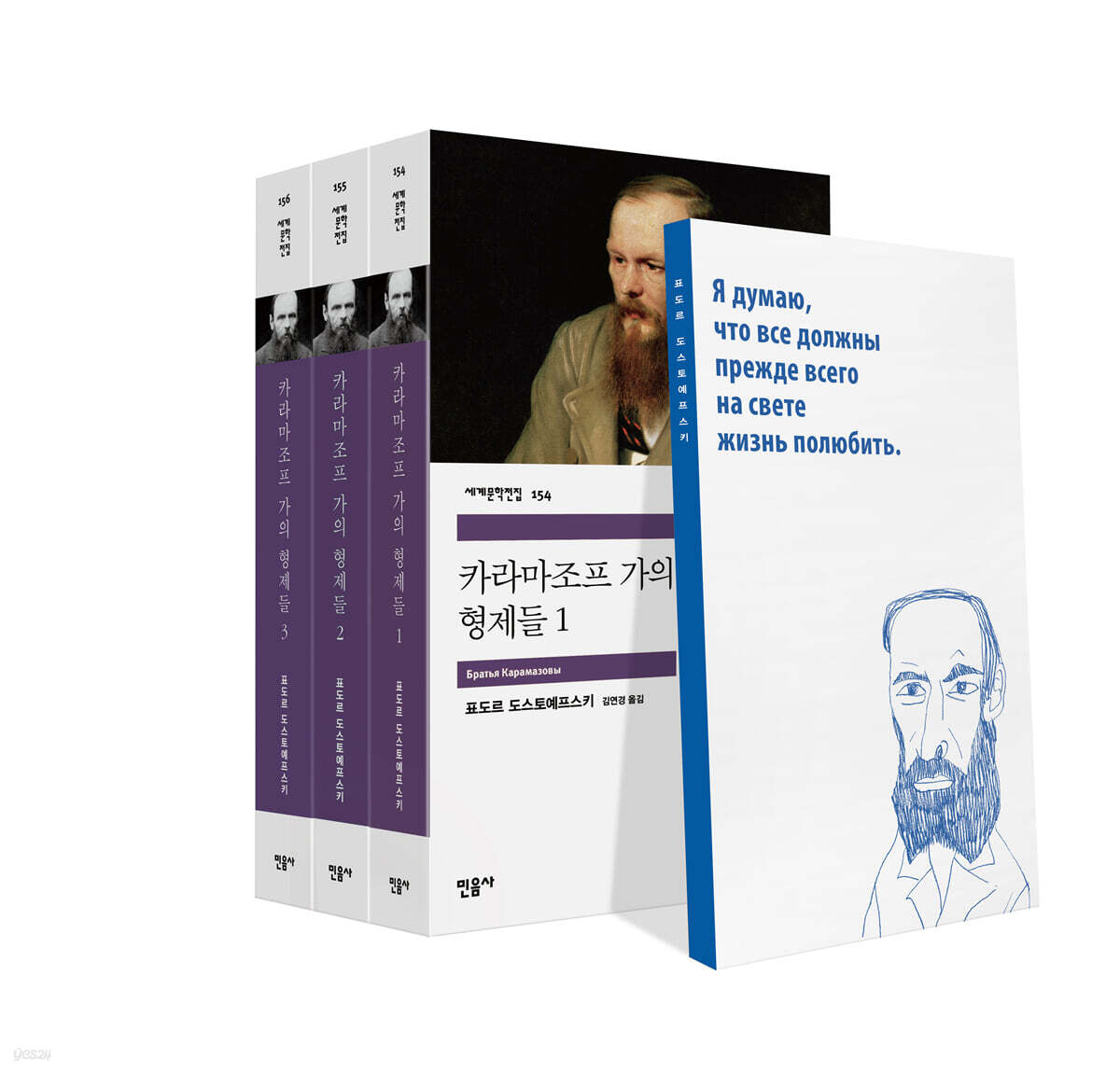
The Brothers Karamazov set
 |
Description
Book Introduction
"The Brothers Karamazov" is not only a vast work in terms of its profound ideas and diverse themes, but also in its sheer volume. But despite this, the extreme subject matter and tense plot make it a must-read once you pick it up. This work, which is written in the style of a crime novel or detective novel and contains a rather sensational subject matter of a dispute between rich people over property, a conflict surrounding a woman, and ultimately the murder of a father resulting from this feud, is more readable than any of Dostoevsky's other works. Here, the story unfolds around characters with unique personalities, making the stimulating events unfold in a more interesting way. Through tragic events brought about by characters with unique personalities and ideologies, Dostoevsky addresses fundamental issues of human existence, such as life and death, love and desire, but the most central theme can be seen as that of God and faith. Fyodor's question, "Is there a God or not?" and Ivan and Alexei's contrasting answers are a major theme that runs through the entire work. A consistent theme that Dostoevsky consistently explored throughout his works was the contradictory principles of God and man, good and evil. By highlighting the dark side of humanity, the meaning of divinity was further enhanced, and religious concepts such as salvation and resurrection were concretized in the realm of life. For this purpose, Dostoevsky often used criminal incidents such as murder. However, by focusing on the thoughts and actions of the people surrounding these events rather than the events themselves, it raised questions about human nature. In 『The Brothers Karamazov』, the subject of patricide was used, and attention was paid to the psychological conflict experienced by the people around the murdered Fyodor before and after the incident. Even now, over 100 years after its publication, this work is still considered a classic, perhaps because it addresses fundamental questions of human existence that transcend the limitations of literature. The Brothers Karamazov, which deals with topics that are still relevant not only to late 19th-century Russia but also to modern people living in the 21st century, still resonates with many readers. *This book is a set (3 volumes) The Brothers Karamazov 1-3 |
- You can preview some of the book's contents.
Preview
Publisher's Review
Dostoevsky, the great writer who changed the landscape of 20th-century literature, philosophy, and psychology
His last and greatest novel, the pinnacle of Dostoevsky's literature, the "cruel genius"
The Brothers Karamazov, a 21st-century reimagining of the novel, brought to life with a fresh and youthful sensibility.
▶ He created unforgettable scenes.
The secret of his genius lies in what people call madness. —James Joyce
▶ The greatest novel ever written. - Freud
▶ Dostoevsky's portraits, which depict the story like Rembrandt, are both intense and perfect.
He is the greatest of all novelists. —André Gide
▶ Everything you need to know about life is in The Brothers Karamazov. —Kurt Vonnegut
The translation closest to Dostoevsky's style
A complete translation of The Brothers Karamazov by the great Russian author Dostoevsky has been published in Minumsa's World Literature Collection.
Dostoevsky, a 19th-century writer, had such a great influence that it can be said to have changed the course of 20th-century intellectual history.
The works he left behind, such as 『Crime and Punishment』, 『The Idiot』, 『The Demons』, 『The Poor Folk』, and 『Notes from the Underground』, are masterpieces that need no further description.
Among them, "The Brothers Karamazov" is a masterpiece that contains all of his literary concerns about the fundamental questions of human existence that he has pondered throughout his life, and is widely regarded as an outstanding work that encompasses not only literature but also philosophy, psychology, and religion.
Dostoevsky's writing is sometimes so long that even Russian readers find it lengthy, but he is also known for his flowing and logical sentences.
In existing translations, sentences were often cut arbitrarily or paragraphs were divided, ignoring his individuality simply because the sentences themselves were long.
However, Minumsa's translation of "The Brothers Karamazov" preserves Dostoevsky's unique style, thereby conveying his rhythm and pace to Korean readers.
Russian is a language in which honorifics are clearly expressed through personal pronouns, but in the past, honorifics were expressed based on hierarchical relationships or male-female relationships, regardless of the level of intimacy between characters or the author's intention.
However, in this Minumsa translation, we tried to preserve as much of the intimacy or, conversely, the distance between the characters that Dostoevsky wanted to express as possible, as far as cultural common sense allows.
Translator Kim Yeon-kyung is a young scholar who received her doctorate in Dostoevsky studies from Seoul National University and Moscow State Pedagogical University.
He is also a novelist who debuted at the age of 21 and published works such as “Everything About My Wife,” “So How Can I Forgive Myself,” “Minor,” and “A Novel of, by, and for Cats.”
A young scholar and novelist, he has retranslated The Brothers Karamazov with a sensibility suited to today's generation.
In addition, the most reliable version of the Dostoevsky complete works published in Russia, the 'Nauka edition', was used as the translation script, and in addition, English and French versions were referenced to minimize translation errors.
As a result, Minumsa's 『The Brothers Karamazov』 was able to be born as a new and youthful translation, completely different from the existing ones.
Company A: “Fyodor Pavlovich married a second time immediately after abandoning his four-year-old son, Mitya.”
Minumsa “Fyodor Pavlovich married a second time as quickly as he could after throwing his four-year-old son, Mitya, out of his arms.”
Company A: “One day, they even broke up a drinking party and forcibly drove out the gathered workers.”
Company B: “Once, we had to use brute force to chase away the prostitutes who were causing a ruckus at our house.”
Minumsa “One day, he even used force to drive out a group of dirty women who had gathered like a pack of dogs and were having a wild drinking party.”
The greatest work of the tragic genius Dostoevsky
In 1878, Dostoevsky began writing what would become his greatest work, The Brothers Karamazov.
The novel was completed three years later, but he died three months later.
He originally conceived this work as a two-part series, and as he revealed in “From the Author,” he planned to write the sequel with the period set 20 years after “The Brothers Karamazov.”
He had confidently expressed his ambition, saying, “I will live for another 20 years and continue to write.”
Unfortunately, he never achieved this plan, and The Brothers Karamazov remained his last and greatest work.
Dostoevsky published his first novel, Poor Folk, in 1846 at the age of 25, and gained attention as a darling of the Russian literary world at the time.
However, three years later, he was sentenced to death for attending the Petrashevsky gathering, which had socialist tendencies.
Eventually, the death penalty is canceled just before execution and he is released from prison.
The only book Dostoevsky, a promising new writer, could read during his eight years of exile in prison and the military was the Bible.
When he returned to the world as a free man, he had become a true extreme right-wing conservative.
And 'God' or 'religion', which were rarely seen in the early works, begin to appear as topics in the novel.
Social awareness has moved beyond the psychological and philosophical dimensions to the ethical and religious dimensions.
In "The Brothers Karamazov," all the problems of human existence that Dostoevsky explored throughout his life are intertwined.
It is also very interesting that a story he heard while exiled in Siberia for eight years in his youth became the motif for his last work, The Brothers Karamazov.
In the prison in Omsk he learned about a man of noble birth who was the 'father-killer'.
It was said that he lived a dissolute life and eventually murdered his father in order to inherit his inheritance.
However, Dostoevsky later learns that the man was innocent and that the crime was actually the work of his brother, who was in love with the man's fiancée.
Dostoevsky meticulously compiled his notes on this event, and finally completed it as a novel nearly 30 years later.
Therefore, it would not be an exaggeration to say that The Brothers Karamazov was a grand project that spanned his entire literary life.
An epic poem exploring the issues of God and religion, life and death, love and desire, and human nature.
"The Brothers Karamazov" is not only a vast work in terms of its profound ideas and diverse themes, but also in its sheer volume.
But despite this, the extreme subject matter and tense plot make it a must-read once you pick it up.
This work, which is written in the style of a crime novel or detective novel and contains a rather sensational subject matter of a dispute between rich people over property, a conflict surrounding a woman, and ultimately the murder of a father resulting from this feud, is more readable than any of Dostoevsky's other works.
Here, the story unfolds around characters with unique personalities, making the stimulating events unfold in a more interesting way.
Skotprigonievsk, a small Russian town in the 1860s.
Fyodor Karamazov, a former businessman and local landowner, is a conglomerate of egoism and greed, a lecher who has lived his entire life in debauchery, chasing his passions.
He abandoned the three sons born to him by his two wives, and also had an illegitimate child with an ignorant woman in the village.
His sons come to visit his house after 20 years.
The eldest son, Dmitry, came to settle the matter of property with his father.
Despite having a fiancée, he falls in love with Grushenka, a woman his father has chosen for him.
He came into conflict with his father not only over money but also over women.
Dmitry is a character with Karamazov's characteristic passion and zest for life.
On the other hand, the second son, Ivan, is the most educated of the sons and an intellectual who writes for newspapers, but is an atheist who denies God and religion.
While trying to help him at his brother's request, he falls in love with his fiancée, Katerina.
The third son, Alexei, is a devout and virtuous young man who walks the path of true faith in the monastery.
Alexei watches his father and brothers with pity.
The conflict in the Karamazov family grows, and Dmitry and Ivan cannot suppress their anger and hatred towards their father.
Dmitry tries to get his share of the money from his father and marry Grushenka, but Fyodor, as if mocking him, announces that he will give the money to Grushenka if she comes to him.
Dmitry openly threatens to kill his father, and Ivan, in turn, grows to hate his father, instilling in Smerdyakov the idea that "everything is permitted."
Finally, one night, when his greed and anger reach their peak, Dmitry searches for Grushenka, and Fyodor is found murdered.
Dmitry, who finally confesses his love to Grushenka, is arrested for the murder of his father.
Through the tragic events brought about by these characters, each representing a unique personality and ideology, Dostoevsky addresses fundamental issues of human existence, such as life and death, love and desire, but the most central theme can be seen as that of God and faith.
Fyodor's question, "Is there a God or not?" and Ivan and Alexei's contrasting answers are a major theme that runs through the entire work.
“Is there a God or not?”
“There is no God.” (Ivan)
“Alyoshka, is there a God?”
“There is a God.”
“Ivan, then, what about immortality?”
“There is no immortality.”
“Alyoshka, is there immortality?”
"there is.
“There is immortality in God.”
“Ivan, then, is there a devil?”
“No, there is no devil.”
A consistent theme that Dostoevsky consistently explored throughout his works was the contradictory principles of God and man, good and evil.
By highlighting the dark side of humanity, the meaning of divinity was further enhanced, and religious concepts such as salvation and resurrection were concretized in the realm of life.
For this purpose, Dostoevsky often used criminal incidents such as murder.
However, by focusing on the thoughts and actions of the people surrounding these events rather than the events themselves, it raised questions about human nature.
In 『The Brothers Karamazov』, the subject of patricide was used, and attention was paid to the psychological conflict experienced by the people around the murdered Fyodor before and after the incident.
Even now, over 100 years after its publication, this work is still considered a classic, perhaps because it addresses fundamental questions of human existence that transcend the limitations of literature.
The Brothers Karamazov, which deals with topics that are still relevant not only to Russia in the late 19th century but also to modern people living in the 21st century, still resonates with many readers.
A work within a work, the epic poem "The Grand Inquisitor" about the salvation of the human soul
The fifth chapter of The Brothers Karamazov, consisting of 12 chapters in 4 parts, is "Pro and Contra," which Dostoevsky himself called the peak of the novel.
It includes Ivan's epic entitled "The Grand Inquisitor."
Ivan confesses to his younger brother Alexei that "it is not that I will not accept God, but that I will not accept the world God created." This logic is expressed poetically in "The Grand Inquisitor," and the content is as follows.
Christ appears in 16th century Spain, when Roman Catholic corruption was at its peak and Inquisition trials were held daily.
The Grand Inquisitor imprisons him and tells him about his earthly paradise.
He gave bread to people who did not deserve freedom and received freedom in return, thus turning them into docile sheep.
When the Grand Inquisitor's long story was over, Christ silently kissed his pale lips.
Since its publication, numerous critics and philosophers have commented on and analyzed "The Grand Inquisitor."
This part alone was published as a separate book.
Armed with sharp originality and brilliant logic, "The Grand Inquisitor" could be considered the crown jewel of "The Brothers Karamazov."
In addition, as a counterargument to this, the 6th sermon of the monk Zosima, "The Russian Monk," continues and leads to a discussion of the ideal divinity that Dostoevsky had in mind.
A 19th-century master, a writer who changed the course of 20th-century intellect
The Brothers Karamazov is known to have been the book that was at Tolstoy's bedside when he was dying.
Tolstoy said, “All the books in the world, especially literary books, can be burned, including my own.
However, Dostoevsky's works are an exception.
“His work should be preserved,” he said.
Dostoevsky and Tolstoy never met, and their works differed greatly, but they shared the commonality of being contemporary Russian writers who had a great influence on Russia and, by extension, the entire world.
Not only Tolstoy, but also countless writers, philosophers, and psychologists of the 20th century expressed boundless respect for Dostoevsky.
Dostoevsky's influence on the 20th century was truly enormous, not only for writers like Camus, Kafka, Joyce, Virginia Woolf, Proust, Hemingway, Hesse, André Gide, Marquez, and Orhan Pamuk, but also for philosophers and psychologists like Nietzsche and Freud.
In particular, his ideas on pursuing existence within the context of human existence are known to have had a great influence on French existentialism.
His last and greatest novel, the pinnacle of Dostoevsky's literature, the "cruel genius"
The Brothers Karamazov, a 21st-century reimagining of the novel, brought to life with a fresh and youthful sensibility.
▶ He created unforgettable scenes.
The secret of his genius lies in what people call madness. —James Joyce
▶ The greatest novel ever written. - Freud
▶ Dostoevsky's portraits, which depict the story like Rembrandt, are both intense and perfect.
He is the greatest of all novelists. —André Gide
▶ Everything you need to know about life is in The Brothers Karamazov. —Kurt Vonnegut
The translation closest to Dostoevsky's style
A complete translation of The Brothers Karamazov by the great Russian author Dostoevsky has been published in Minumsa's World Literature Collection.
Dostoevsky, a 19th-century writer, had such a great influence that it can be said to have changed the course of 20th-century intellectual history.
The works he left behind, such as 『Crime and Punishment』, 『The Idiot』, 『The Demons』, 『The Poor Folk』, and 『Notes from the Underground』, are masterpieces that need no further description.
Among them, "The Brothers Karamazov" is a masterpiece that contains all of his literary concerns about the fundamental questions of human existence that he has pondered throughout his life, and is widely regarded as an outstanding work that encompasses not only literature but also philosophy, psychology, and religion.
Dostoevsky's writing is sometimes so long that even Russian readers find it lengthy, but he is also known for his flowing and logical sentences.
In existing translations, sentences were often cut arbitrarily or paragraphs were divided, ignoring his individuality simply because the sentences themselves were long.
However, Minumsa's translation of "The Brothers Karamazov" preserves Dostoevsky's unique style, thereby conveying his rhythm and pace to Korean readers.
Russian is a language in which honorifics are clearly expressed through personal pronouns, but in the past, honorifics were expressed based on hierarchical relationships or male-female relationships, regardless of the level of intimacy between characters or the author's intention.
However, in this Minumsa translation, we tried to preserve as much of the intimacy or, conversely, the distance between the characters that Dostoevsky wanted to express as possible, as far as cultural common sense allows.
Translator Kim Yeon-kyung is a young scholar who received her doctorate in Dostoevsky studies from Seoul National University and Moscow State Pedagogical University.
He is also a novelist who debuted at the age of 21 and published works such as “Everything About My Wife,” “So How Can I Forgive Myself,” “Minor,” and “A Novel of, by, and for Cats.”
A young scholar and novelist, he has retranslated The Brothers Karamazov with a sensibility suited to today's generation.
In addition, the most reliable version of the Dostoevsky complete works published in Russia, the 'Nauka edition', was used as the translation script, and in addition, English and French versions were referenced to minimize translation errors.
As a result, Minumsa's 『The Brothers Karamazov』 was able to be born as a new and youthful translation, completely different from the existing ones.
Company A: “Fyodor Pavlovich married a second time immediately after abandoning his four-year-old son, Mitya.”
Minumsa “Fyodor Pavlovich married a second time as quickly as he could after throwing his four-year-old son, Mitya, out of his arms.”
Company A: “One day, they even broke up a drinking party and forcibly drove out the gathered workers.”
Company B: “Once, we had to use brute force to chase away the prostitutes who were causing a ruckus at our house.”
Minumsa “One day, he even used force to drive out a group of dirty women who had gathered like a pack of dogs and were having a wild drinking party.”
The greatest work of the tragic genius Dostoevsky
In 1878, Dostoevsky began writing what would become his greatest work, The Brothers Karamazov.
The novel was completed three years later, but he died three months later.
He originally conceived this work as a two-part series, and as he revealed in “From the Author,” he planned to write the sequel with the period set 20 years after “The Brothers Karamazov.”
He had confidently expressed his ambition, saying, “I will live for another 20 years and continue to write.”
Unfortunately, he never achieved this plan, and The Brothers Karamazov remained his last and greatest work.
Dostoevsky published his first novel, Poor Folk, in 1846 at the age of 25, and gained attention as a darling of the Russian literary world at the time.
However, three years later, he was sentenced to death for attending the Petrashevsky gathering, which had socialist tendencies.
Eventually, the death penalty is canceled just before execution and he is released from prison.
The only book Dostoevsky, a promising new writer, could read during his eight years of exile in prison and the military was the Bible.
When he returned to the world as a free man, he had become a true extreme right-wing conservative.
And 'God' or 'religion', which were rarely seen in the early works, begin to appear as topics in the novel.
Social awareness has moved beyond the psychological and philosophical dimensions to the ethical and religious dimensions.
In "The Brothers Karamazov," all the problems of human existence that Dostoevsky explored throughout his life are intertwined.
It is also very interesting that a story he heard while exiled in Siberia for eight years in his youth became the motif for his last work, The Brothers Karamazov.
In the prison in Omsk he learned about a man of noble birth who was the 'father-killer'.
It was said that he lived a dissolute life and eventually murdered his father in order to inherit his inheritance.
However, Dostoevsky later learns that the man was innocent and that the crime was actually the work of his brother, who was in love with the man's fiancée.
Dostoevsky meticulously compiled his notes on this event, and finally completed it as a novel nearly 30 years later.
Therefore, it would not be an exaggeration to say that The Brothers Karamazov was a grand project that spanned his entire literary life.
An epic poem exploring the issues of God and religion, life and death, love and desire, and human nature.
"The Brothers Karamazov" is not only a vast work in terms of its profound ideas and diverse themes, but also in its sheer volume.
But despite this, the extreme subject matter and tense plot make it a must-read once you pick it up.
This work, which is written in the style of a crime novel or detective novel and contains a rather sensational subject matter of a dispute between rich people over property, a conflict surrounding a woman, and ultimately the murder of a father resulting from this feud, is more readable than any of Dostoevsky's other works.
Here, the story unfolds around characters with unique personalities, making the stimulating events unfold in a more interesting way.
Skotprigonievsk, a small Russian town in the 1860s.
Fyodor Karamazov, a former businessman and local landowner, is a conglomerate of egoism and greed, a lecher who has lived his entire life in debauchery, chasing his passions.
He abandoned the three sons born to him by his two wives, and also had an illegitimate child with an ignorant woman in the village.
His sons come to visit his house after 20 years.
The eldest son, Dmitry, came to settle the matter of property with his father.
Despite having a fiancée, he falls in love with Grushenka, a woman his father has chosen for him.
He came into conflict with his father not only over money but also over women.
Dmitry is a character with Karamazov's characteristic passion and zest for life.
On the other hand, the second son, Ivan, is the most educated of the sons and an intellectual who writes for newspapers, but is an atheist who denies God and religion.
While trying to help him at his brother's request, he falls in love with his fiancée, Katerina.
The third son, Alexei, is a devout and virtuous young man who walks the path of true faith in the monastery.
Alexei watches his father and brothers with pity.
The conflict in the Karamazov family grows, and Dmitry and Ivan cannot suppress their anger and hatred towards their father.
Dmitry tries to get his share of the money from his father and marry Grushenka, but Fyodor, as if mocking him, announces that he will give the money to Grushenka if she comes to him.
Dmitry openly threatens to kill his father, and Ivan, in turn, grows to hate his father, instilling in Smerdyakov the idea that "everything is permitted."
Finally, one night, when his greed and anger reach their peak, Dmitry searches for Grushenka, and Fyodor is found murdered.
Dmitry, who finally confesses his love to Grushenka, is arrested for the murder of his father.
Through the tragic events brought about by these characters, each representing a unique personality and ideology, Dostoevsky addresses fundamental issues of human existence, such as life and death, love and desire, but the most central theme can be seen as that of God and faith.
Fyodor's question, "Is there a God or not?" and Ivan and Alexei's contrasting answers are a major theme that runs through the entire work.
“Is there a God or not?”
“There is no God.” (Ivan)
“Alyoshka, is there a God?”
“There is a God.”
“Ivan, then, what about immortality?”
“There is no immortality.”
“Alyoshka, is there immortality?”
"there is.
“There is immortality in God.”
“Ivan, then, is there a devil?”
“No, there is no devil.”
A consistent theme that Dostoevsky consistently explored throughout his works was the contradictory principles of God and man, good and evil.
By highlighting the dark side of humanity, the meaning of divinity was further enhanced, and religious concepts such as salvation and resurrection were concretized in the realm of life.
For this purpose, Dostoevsky often used criminal incidents such as murder.
However, by focusing on the thoughts and actions of the people surrounding these events rather than the events themselves, it raised questions about human nature.
In 『The Brothers Karamazov』, the subject of patricide was used, and attention was paid to the psychological conflict experienced by the people around the murdered Fyodor before and after the incident.
Even now, over 100 years after its publication, this work is still considered a classic, perhaps because it addresses fundamental questions of human existence that transcend the limitations of literature.
The Brothers Karamazov, which deals with topics that are still relevant not only to Russia in the late 19th century but also to modern people living in the 21st century, still resonates with many readers.
A work within a work, the epic poem "The Grand Inquisitor" about the salvation of the human soul
The fifth chapter of The Brothers Karamazov, consisting of 12 chapters in 4 parts, is "Pro and Contra," which Dostoevsky himself called the peak of the novel.
It includes Ivan's epic entitled "The Grand Inquisitor."
Ivan confesses to his younger brother Alexei that "it is not that I will not accept God, but that I will not accept the world God created." This logic is expressed poetically in "The Grand Inquisitor," and the content is as follows.
Christ appears in 16th century Spain, when Roman Catholic corruption was at its peak and Inquisition trials were held daily.
The Grand Inquisitor imprisons him and tells him about his earthly paradise.
He gave bread to people who did not deserve freedom and received freedom in return, thus turning them into docile sheep.
When the Grand Inquisitor's long story was over, Christ silently kissed his pale lips.
Since its publication, numerous critics and philosophers have commented on and analyzed "The Grand Inquisitor."
This part alone was published as a separate book.
Armed with sharp originality and brilliant logic, "The Grand Inquisitor" could be considered the crown jewel of "The Brothers Karamazov."
In addition, as a counterargument to this, the 6th sermon of the monk Zosima, "The Russian Monk," continues and leads to a discussion of the ideal divinity that Dostoevsky had in mind.
A 19th-century master, a writer who changed the course of 20th-century intellect
The Brothers Karamazov is known to have been the book that was at Tolstoy's bedside when he was dying.
Tolstoy said, “All the books in the world, especially literary books, can be burned, including my own.
However, Dostoevsky's works are an exception.
“His work should be preserved,” he said.
Dostoevsky and Tolstoy never met, and their works differed greatly, but they shared the commonality of being contemporary Russian writers who had a great influence on Russia and, by extension, the entire world.
Not only Tolstoy, but also countless writers, philosophers, and psychologists of the 20th century expressed boundless respect for Dostoevsky.
Dostoevsky's influence on the 20th century was truly enormous, not only for writers like Camus, Kafka, Joyce, Virginia Woolf, Proust, Hemingway, Hesse, André Gide, Marquez, and Orhan Pamuk, but also for philosophers and psychologists like Nietzsche and Freud.
In particular, his ideas on pursuing existence within the context of human existence are known to have had a great influence on French existentialism.
GOODS SPECIFICS
- Date of publication: November 6, 2012
- Page count, weight, size: 2,000 pages | 2,100g | 132*225*80mm
- ISBN13: 9788937486067
- ISBN10: 8937486067
You may also like
카테고리
korean


korean

![GQ KOREA Mark (Monthly): December [2025]](http://librairie.coreenne.fr/cdn/shop/files/8ef265dbbfbf186523ed75ba7319009d.jpg?v=1765340328&width=3840)


