

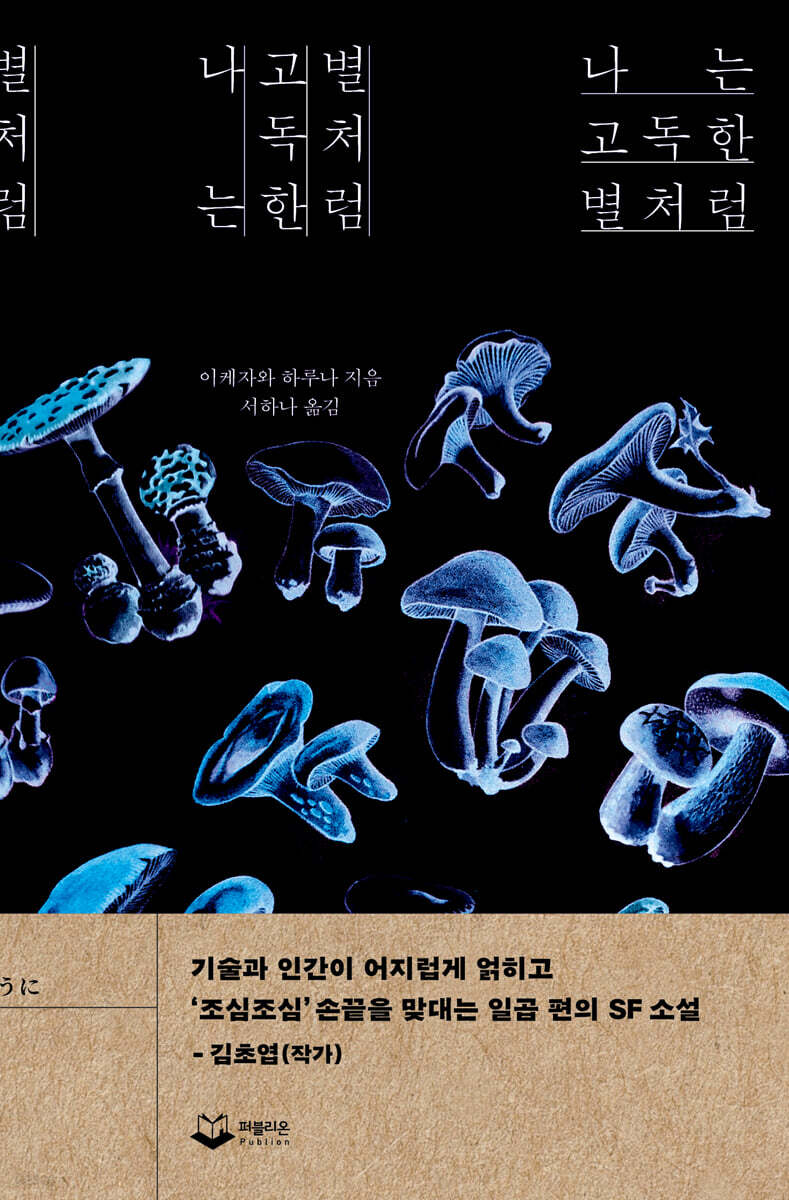
I am like a lonely star
 |
Description
Book Introduction
Technology and humans are entangled in a messy way.
Seven science fiction novels that will have you feeling your fingertips together.
- Kim Cho-yeop (writer)
“Someday, soon, surely”
The future I vaguely pictured as an adult when I was a child.
In that way, we often imagine a future that has not yet arrived but will surely arrive someday.
This book, "I Am Like a Lonely Star," is the first science fiction novel collection by Haruna Ikezawa, a voice actor and writer who served as president of the Japan Science Fiction Writers' Club. It transports us to seven different imaginary worlds that we have already visited.
The title work, "I Am Like a Lonely Star," which won the Ito Yasu Award for the 6th Genron SF Newcomer Award, tells the story of death, loss, and the hopes of those left behind through two women who embark on a journey to mourn their aunt who passed away in a dying colony. In "It's Actually Red, It's Actually White," the hopes, fears, and love of empathy, which involves reading the minds of others by planting mushroom fungi in one's body, are delicately portrayed through the eyes of two girls in their adolescence.
"Grandmother's Cradle" allows us to reconsider life and death, as well as gender, childbirth, and childcare, through the ambiguous figure of "Grandmother," who appears as a giant jellyfish floating in the sea and could be either male or female.
Also, "A Universe Full of Fat" and "Shouting I at the Center of the Universe" are two intertwined stories about dieting, and are a comedy SF that sounds an alarm to humanity that is not satisfied with its own appearance.
From "If It Rains on Pieces Someday," which makes you think about whether it would be a blessing to have eternal life, where you neither age nor die and remain in your current state, to "Yours is the Earth and everything that's in it," which asks the question of how AI and humans should relate to each other in a world where AI implanted in the body as soon as one is born supports all thoughts and actions.
The seven stories in this book evoke countless emotions deep within us through the lives of those living in a world where technology and humanity are already intertwined, and constantly lead us to ask ourselves what kind of future we desire.
Seven science fiction novels that will have you feeling your fingertips together.
- Kim Cho-yeop (writer)
“Someday, soon, surely”
The future I vaguely pictured as an adult when I was a child.
In that way, we often imagine a future that has not yet arrived but will surely arrive someday.
This book, "I Am Like a Lonely Star," is the first science fiction novel collection by Haruna Ikezawa, a voice actor and writer who served as president of the Japan Science Fiction Writers' Club. It transports us to seven different imaginary worlds that we have already visited.
The title work, "I Am Like a Lonely Star," which won the Ito Yasu Award for the 6th Genron SF Newcomer Award, tells the story of death, loss, and the hopes of those left behind through two women who embark on a journey to mourn their aunt who passed away in a dying colony. In "It's Actually Red, It's Actually White," the hopes, fears, and love of empathy, which involves reading the minds of others by planting mushroom fungi in one's body, are delicately portrayed through the eyes of two girls in their adolescence.
"Grandmother's Cradle" allows us to reconsider life and death, as well as gender, childbirth, and childcare, through the ambiguous figure of "Grandmother," who appears as a giant jellyfish floating in the sea and could be either male or female.
Also, "A Universe Full of Fat" and "Shouting I at the Center of the Universe" are two intertwined stories about dieting, and are a comedy SF that sounds an alarm to humanity that is not satisfied with its own appearance.
From "If It Rains on Pieces Someday," which makes you think about whether it would be a blessing to have eternal life, where you neither age nor die and remain in your current state, to "Yours is the Earth and everything that's in it," which asks the question of how AI and humans should relate to each other in a world where AI implanted in the body as soon as one is born supports all thoughts and actions.
The seven stories in this book evoke countless emotions deep within us through the lives of those living in a world where technology and humanity are already intertwined, and constantly lead us to ask ourselves what kind of future we desire.
- You can preview some of the book's contents.
Preview
index
The thread is red, the thread is white
Grandmother's Cradle
Maybe a universe full of fat
If it rains on the tomb someday
Yours is the Earth and everything that's in it
Shouting I at the center of the universe
I am like a lonely star
Grandmother's Cradle
Maybe a universe full of fat
If it rains on the tomb someday
Yours is the Earth and everything that's in it
Shouting I at the center of the universe
I am like a lonely star
Detailed image

Into the book
What would it feel like to have someone who understands you unconditionally, someone you can connect with without having to say anything?
--- p.13 From “The Thread is Red, the Thread is White”
The spores flowed away, sparkling.
The mycelia in the shape of a person in front of me overflowed, incomparable to my empty self.
I will follow you soon.
We can share our thoughts and feelings and transcend language to say, “I love you.”
--- pp.63-64 From "The Thread is Red, the Thread is White"
Humans did not give names to each of the Miyos.
Perhaps it was because of the guilt of making humans into such completely different beings that he tried to pass the baton on to the next generation.
Even so.
Even so, I want to see it.
I see these children walking on the ground.
Ichikado, Nikido, Miyodo, and countless other children of the sea who will be born next, all feeling the wind under the sun and treading on the grass.
So I found a cherry tree that survived somewhere and played under its light red petals.
--- p.96 From “Grandmother’s Cradle”
“I think I’ve gained some weight.”
These words were the beginning of everything.
--- p.101 From "Perhaps a Universe Full of Fat"
There are probably not many people who are completely satisfied with their current self.
Everyone began to show signs of impatience as they realized that the fact that things were not changing any more was actually a very serious matter.
What shocked people the most was that the children were no longer growing in their current state.
--- p.131 From "Perhaps a Universe Full of Fat"
“The world stops at this very moment.
Even if that happens… … .”
Moon Chen stopped talking.
Beyond the steering wheel, a white, heated road stretched on endlessly.
“Even so, do you still think this is the gospel?”
--- p.166 From "If It Rains on the Pieces Someday"
Can you be happy if you have an ID?
Would I be unhappy if I didn't have an ID?
Az couldn't figure it out.
But here, Az is connected to people.
Connecting the inside and outside through a transparent cocoon.
Whether or not there is an ID, society and people, and people to people, can definitely be connected.
Az believes that there is value in the choices we clumsily discover through communication, rather than in the answers presented before we even ask for them.
--- p.199 From “Yours is the Earth and everything that’s in it”
This chair is yours.
This is the place for you.
Without you, this chair wouldn't look this great.
Because I want to hear things like this.
We all want to be 'special' - to be told we are essential, to believe that there are things only we can do, and to be irreplaceable by anyone else.
--- p.225 From “Shouting I at the Center of the Universe”
Maybe I'm at a loss right now.
I'm at a loss as to what to do with my aunt's absence and this silence.
I know how it feels to be annoyed or dissatisfied with someone around you.
But I can't believe that something like this happens when someone isn't around.
--- p.244 From "I am like a lonely star"
"Why did you have to come all the way here? You could have just thrown away a hand mirror anywhere."
Leirita was quietly looking out the window from the side.
“I think your aunt wanted to be the North Star.”
--- p.13 From “The Thread is Red, the Thread is White”
The spores flowed away, sparkling.
The mycelia in the shape of a person in front of me overflowed, incomparable to my empty self.
I will follow you soon.
We can share our thoughts and feelings and transcend language to say, “I love you.”
--- pp.63-64 From "The Thread is Red, the Thread is White"
Humans did not give names to each of the Miyos.
Perhaps it was because of the guilt of making humans into such completely different beings that he tried to pass the baton on to the next generation.
Even so.
Even so, I want to see it.
I see these children walking on the ground.
Ichikado, Nikido, Miyodo, and countless other children of the sea who will be born next, all feeling the wind under the sun and treading on the grass.
So I found a cherry tree that survived somewhere and played under its light red petals.
--- p.96 From “Grandmother’s Cradle”
“I think I’ve gained some weight.”
These words were the beginning of everything.
--- p.101 From "Perhaps a Universe Full of Fat"
There are probably not many people who are completely satisfied with their current self.
Everyone began to show signs of impatience as they realized that the fact that things were not changing any more was actually a very serious matter.
What shocked people the most was that the children were no longer growing in their current state.
--- p.131 From "Perhaps a Universe Full of Fat"
“The world stops at this very moment.
Even if that happens… … .”
Moon Chen stopped talking.
Beyond the steering wheel, a white, heated road stretched on endlessly.
“Even so, do you still think this is the gospel?”
--- p.166 From "If It Rains on the Pieces Someday"
Can you be happy if you have an ID?
Would I be unhappy if I didn't have an ID?
Az couldn't figure it out.
But here, Az is connected to people.
Connecting the inside and outside through a transparent cocoon.
Whether or not there is an ID, society and people, and people to people, can definitely be connected.
Az believes that there is value in the choices we clumsily discover through communication, rather than in the answers presented before we even ask for them.
--- p.199 From “Yours is the Earth and everything that’s in it”
This chair is yours.
This is the place for you.
Without you, this chair wouldn't look this great.
Because I want to hear things like this.
We all want to be 'special' - to be told we are essential, to believe that there are things only we can do, and to be irreplaceable by anyone else.
--- p.225 From “Shouting I at the Center of the Universe”
Maybe I'm at a loss right now.
I'm at a loss as to what to do with my aunt's absence and this silence.
I know how it feels to be annoyed or dissatisfied with someone around you.
But I can't believe that something like this happens when someone isn't around.
--- p.244 From "I am like a lonely star"
"Why did you have to come all the way here? You could have just thrown away a hand mirror anywhere."
Leirita was quietly looking out the window from the side.
“I think your aunt wanted to be the North Star.”
--- p.268 From "I am like a lonely star"
Publisher's Review
“I finally found it.
I found you.
The joy of becoming one, the happiness of harmonizing with one another.
Spores are scattered, hyphae are connected, burst and spread
Fill every nook and cranny to the brim.
“You are me, I am you.”
A strange world suddenly appeared
Even in that, we still
The seven short stories in "I Am a Lonely Star" suddenly present us with stories of people who inoculate their heads with fungi during the period of secondary sexual characteristics, people who find it difficult to live on land raise children of the sea to continue the human race, and people living in colonies where death is commemorated by dropping artificial stars.
The reason why the world in such novels doesn't feel unfamiliar at all is because, along with the unfamiliarity that science fiction novels provide, the characters and their daily lives that could exist around us unfold in a familiar way, and the story contains a future that may one day come.
Even in a world where nature has been destroyed, even in a world headed toward destruction, they worry about eating, going to school and work, and making a living just like we do today.
And they love, break up, and experience loss, hoping to want each other and be connected.
We often imagine that a future world dependent on AI and machines rather than our own will will be unhappy.
Yet, the future depicted in this book never feels entirely bleak, because it nonetheless reflects our lives as humans. Even if AI peers over our shoulders and suggests a better path, even if we face a moment of immortality, even if we communicate with aliens through voice, the choice lies solely with humans, resting on our will. Even in a changed world, we are still born, face death, love, part, and live as one. This is what it means to be human, to be us.
“Can you be happy if you have an ID?
“Will I be unhappy if I don’t have an ID?”
And yet we
I dream of continuing
Haruna Ikezawa says that she tries to write something that transcends humanity, but always ends up being human.
Her writing may seem cheerful at first glance, but it is also tinged with a gentle sense of loneliness and solitude.
Perhaps that's why so many marginalized people appear in this book.
Neo, who is always left behind because he can't keep up with his classmates; Jomo, who takes care of 300,000 children underwater; Az, who cannot adapt to his AI ID and chooses to live with the elderly in a seaside village; Yennie, who suffers from dyslexia and lives in a dying colony. Even in a world where AI allows us to make the best choices and civilization advances to fully read others' minds, striving for perfection, and even on a planet that has already been ruined beyond repair, there are those who belong nowhere or do not want to belong, as if trapped in an invisible cocoon.
This book, "I Am Like a Lonely Star," poses the question of how humans and technology, and humans and technology, should relate to each other and move forward together in the world that has already arrived and will come.
Even though the reality facing each of us is harsh and the future is uncertain, we all look together at the beautiful fireworks, dream of cherry blossoms blooming somewhere, and look forward to a world where people and society, not technology, are connected.
I found you.
The joy of becoming one, the happiness of harmonizing with one another.
Spores are scattered, hyphae are connected, burst and spread
Fill every nook and cranny to the brim.
“You are me, I am you.”
A strange world suddenly appeared
Even in that, we still
The seven short stories in "I Am a Lonely Star" suddenly present us with stories of people who inoculate their heads with fungi during the period of secondary sexual characteristics, people who find it difficult to live on land raise children of the sea to continue the human race, and people living in colonies where death is commemorated by dropping artificial stars.
The reason why the world in such novels doesn't feel unfamiliar at all is because, along with the unfamiliarity that science fiction novels provide, the characters and their daily lives that could exist around us unfold in a familiar way, and the story contains a future that may one day come.
Even in a world where nature has been destroyed, even in a world headed toward destruction, they worry about eating, going to school and work, and making a living just like we do today.
And they love, break up, and experience loss, hoping to want each other and be connected.
We often imagine that a future world dependent on AI and machines rather than our own will will be unhappy.
Yet, the future depicted in this book never feels entirely bleak, because it nonetheless reflects our lives as humans. Even if AI peers over our shoulders and suggests a better path, even if we face a moment of immortality, even if we communicate with aliens through voice, the choice lies solely with humans, resting on our will. Even in a changed world, we are still born, face death, love, part, and live as one. This is what it means to be human, to be us.
“Can you be happy if you have an ID?
“Will I be unhappy if I don’t have an ID?”
And yet we
I dream of continuing
Haruna Ikezawa says that she tries to write something that transcends humanity, but always ends up being human.
Her writing may seem cheerful at first glance, but it is also tinged with a gentle sense of loneliness and solitude.
Perhaps that's why so many marginalized people appear in this book.
Neo, who is always left behind because he can't keep up with his classmates; Jomo, who takes care of 300,000 children underwater; Az, who cannot adapt to his AI ID and chooses to live with the elderly in a seaside village; Yennie, who suffers from dyslexia and lives in a dying colony. Even in a world where AI allows us to make the best choices and civilization advances to fully read others' minds, striving for perfection, and even on a planet that has already been ruined beyond repair, there are those who belong nowhere or do not want to belong, as if trapped in an invisible cocoon.
This book, "I Am Like a Lonely Star," poses the question of how humans and technology, and humans and technology, should relate to each other and move forward together in the world that has already arrived and will come.
Even though the reality facing each of us is harsh and the future is uncertain, we all look together at the beautiful fireworks, dream of cherry blossoms blooming somewhere, and look forward to a world where people and society, not technology, are connected.
GOODS SPECIFICS
- Date of issue: November 25, 2025
- Page count, weight, size: 276 pages | 360g | 125*190*17mm
- ISBN13: 9791191587821
- ISBN10: 1191587827
You may also like
카테고리
korean


korean

![GQ KOREA Mark (Monthly): December [2025]](http://librairie.coreenne.fr/cdn/shop/files/8ef265dbbfbf186523ed75ba7319009d.jpg?v=1765340328&width=3840)


