

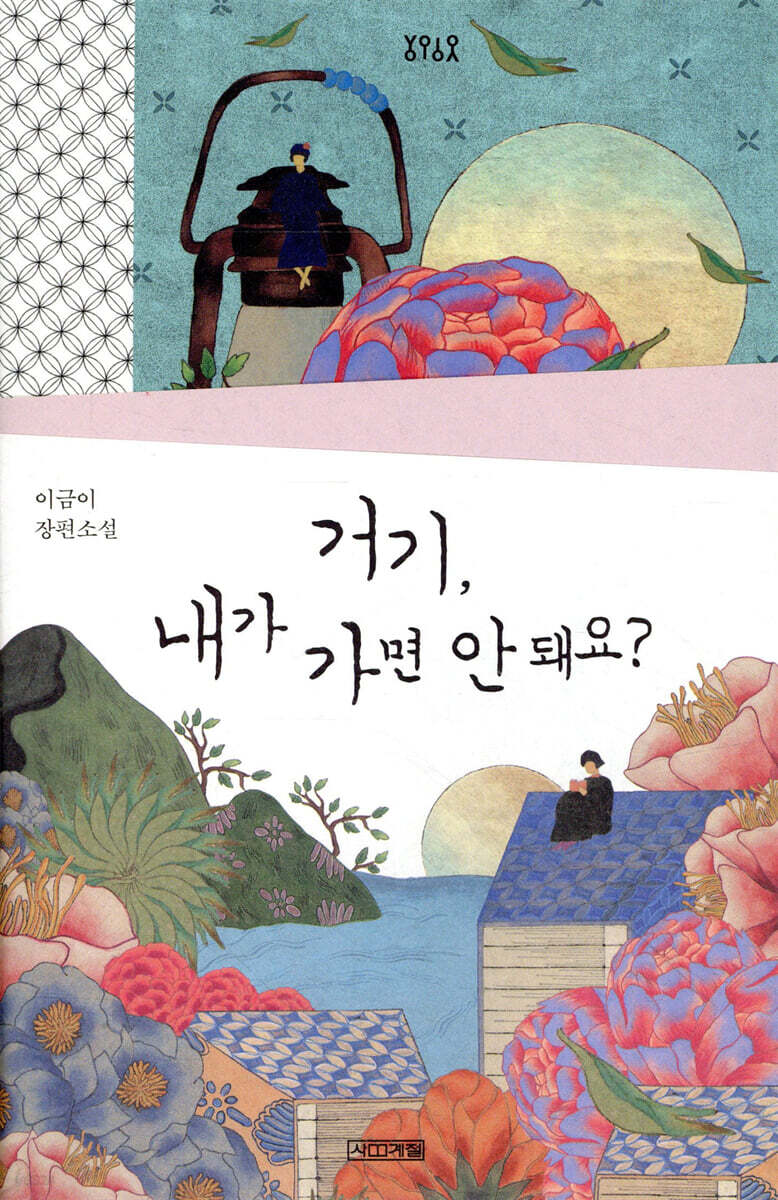
Can I go there?
 |
Description
Book Introduction
Nominations for the 2024 and 2026 Hans Christian Andersen Award for Writing
This novel marks the beginning of author Lee Geum-i's trilogy on the female diaspora during the Japanese colonial period!
A human drama about two women who jumped into the whirlwind of fate and lived their lives with dignity.
“Can I go there?” With just these words, there was a person who lived a life that no one could have dreamed of at the time.
Sunam, a seven-year-old girl from a rural village, is sold to a farmer as a birthday present for the Count's daughter and brought to Gyeongseong.
Chae-ryeong, the daughter of a viscount who was given a son as an eighth birthday present, lives a life without the envy of others, but experiences a difficult journey in life.
The two protagonists, who are of similar age, overcome all the obstacles that life throws at them like waves, such as class, gender, education, culture, ethnicity, and race, and forge their own destinies.
The story of two women's growth, set against the backdrop of the turbulent times of Japanese colonial rule and liberation, begins by crossing the border and reaching the other side of the globe, encompassing a vast space.
"Can't I Go There?" is the author's first historical novel, and marks a new turning point in his literary world.
This work, which has been praised for portraying human nature, which cannot help but waver in the face of personal desires and interests in a chaotic era, through enterprising and open-minded characters, offers readers a new understanding of the meaning of history as encountered through literature.
This novel marks the beginning of author Lee Geum-i's trilogy on the female diaspora during the Japanese colonial period!
A human drama about two women who jumped into the whirlwind of fate and lived their lives with dignity.
“Can I go there?” With just these words, there was a person who lived a life that no one could have dreamed of at the time.
Sunam, a seven-year-old girl from a rural village, is sold to a farmer as a birthday present for the Count's daughter and brought to Gyeongseong.
Chae-ryeong, the daughter of a viscount who was given a son as an eighth birthday present, lives a life without the envy of others, but experiences a difficult journey in life.
The two protagonists, who are of similar age, overcome all the obstacles that life throws at them like waves, such as class, gender, education, culture, ethnicity, and race, and forge their own destinies.
The story of two women's growth, set against the backdrop of the turbulent times of Japanese colonial rule and liberation, begins by crossing the border and reaching the other side of the globe, encompassing a vast space.
"Can't I Go There?" is the author's first historical novel, and marks a new turning point in his literary world.
This work, which has been praised for portraying human nature, which cannot help but waver in the face of personal desires and interests in a chaotic era, through enterprising and open-minded characters, offers readers a new understanding of the meaning of history as encountered through literature.
- You can preview some of the book's contents.
Preview
index
Prologue: A story that hasn't ended yet
Part 1: People Leaving (1920–1939)
Gahoe-dong mansion
birthday present
eighth child
Envy and contempt
Their dreams
People Leaving 1
People Leaving 2
From spring to summer
From fall to winter
Terao Hikari
The Viscount's daughter
A rippling morning
Part 2: The Time That Never Sets (1939–1954)
A dream that cannot be broken
San Francisco
Crossing into life
Life in the Fog
bright night
treeless orchard
New York
The Cursed House
From here to there
Time That Never Sets 1
Time That Never Sets 2
Epilogue: A new story begins
Author's Note
References
Part 1: People Leaving (1920–1939)
Gahoe-dong mansion
birthday present
eighth child
Envy and contempt
Their dreams
People Leaving 1
People Leaving 2
From spring to summer
From fall to winter
Terao Hikari
The Viscount's daughter
A rippling morning
Part 2: The Time That Never Sets (1939–1954)
A dream that cannot be broken
San Francisco
Crossing into life
Life in the Fog
bright night
treeless orchard
New York
The Cursed House
From here to there
Time That Never Sets 1
Time That Never Sets 2
Epilogue: A new story begins
Author's Note
References
Detailed image

Into the book
Sunam's father was dumbfounded when he said he would buy his daughter, who would not take him home even if he offered her money, from the field.
I tried to recall if there was any special omen when Sunam was born, but since he had ten children, including the dead ones, I couldn't tell which memory was Sunam's.
The only person in the house who remembered the time when Gunam was born was Sunam himself.
--- p.65
He says that he is loved by a woman who speaks Japanese more fluently than Korean, a woman who does not know the suffering of the colonized people, a woman who does not even try to know, a woman who lacks nothing.
As if it were a habit, he says he would risk his life for love.
The very fact that she had grown up so unfazed in these dark times was repulsive, but Chae-ryeong's brightness, like a pinhole in a dark curtain, came across as brilliant.
--- p.228
“If you mix a new thread with this one and weave it, you won’t be able to tell that it’s an old thread at all.”
Suzuki smiled brightly as he wound the thread.
(…)
But now that I've left the Gahoe-dong mansion and experienced another world, I feel like there must be a way to change my destiny somewhere in the world.
There must be something like hot steam that turns old thread into new thread in the human world.
--- p.232
“When it was bright inside, I couldn’t see outside at all, but when I turned off the lights, I could see outside.”
Sunam's mumbling words made Kang-Hwi think a lot.
(…)
When I see people who think that minor mistakes are acceptable when doing something as big as the independence movement, or people who talk about freedom and equality but discriminate against others and treat them rudely in real life, or people who fight for positions and engage in secret struggles, I lose the desire to stay in that organization.
Above all, Kang Hui had no conviction or desire to reclaim his country.
--- pp.426-427
Looking back, Sunam has lived with discrimination since birth.
Because I was a daughter, because I was poor, because I was of low social status, because I was uneducated, because I was a Joseon person… … .
All this time, Sunam never thought that it was unfair.
It was taken for granted that women were ignored and discriminated against by men, the poor by the rich, the lowly by the high, the ignorant by the educated, and the Koreans by the Japanese.
--- p.459
It occurred to me that 'here', which I had previously thought of as Harbin, might not simply mean a region.
Wasn't he referring to things I couldn't believe I'd accomplished, things that seemed impossible on my own? If so, then remaining in New York and living on my own would also fall under this category.
Only then was Sunam able to make up his mind.
--- p.462
“Hey, can I go there?”
This is what Sunam said when he saw his daughter, who was trying to make Chae-ryeong her servant, crying and saying she didn't want to.
I also remembered Marum's words.
Where is that?
The scenery and circumstances of that time were vague, but those words remained vivid in my memory.
At that time, Sunam was only seven years old.
A young girl who had never even left her village decided to leave her parents and home.
--- p.515
“No matter what happens to you, you are Kim Soo-nam, the one I love.
Just as you accepted everything about me, so do I.
“No matter what happens, that fact won’t change.”
Sunam buried his face in Kang-hui's arms.
The medicine that cures all worries, fears, and anxieties was Kang-Hwi.
Any worries or pains disappeared when I was with Kang-Hwi.
I tried to recall if there was any special omen when Sunam was born, but since he had ten children, including the dead ones, I couldn't tell which memory was Sunam's.
The only person in the house who remembered the time when Gunam was born was Sunam himself.
--- p.65
He says that he is loved by a woman who speaks Japanese more fluently than Korean, a woman who does not know the suffering of the colonized people, a woman who does not even try to know, a woman who lacks nothing.
As if it were a habit, he says he would risk his life for love.
The very fact that she had grown up so unfazed in these dark times was repulsive, but Chae-ryeong's brightness, like a pinhole in a dark curtain, came across as brilliant.
--- p.228
“If you mix a new thread with this one and weave it, you won’t be able to tell that it’s an old thread at all.”
Suzuki smiled brightly as he wound the thread.
(…)
But now that I've left the Gahoe-dong mansion and experienced another world, I feel like there must be a way to change my destiny somewhere in the world.
There must be something like hot steam that turns old thread into new thread in the human world.
--- p.232
“When it was bright inside, I couldn’t see outside at all, but when I turned off the lights, I could see outside.”
Sunam's mumbling words made Kang-Hwi think a lot.
(…)
When I see people who think that minor mistakes are acceptable when doing something as big as the independence movement, or people who talk about freedom and equality but discriminate against others and treat them rudely in real life, or people who fight for positions and engage in secret struggles, I lose the desire to stay in that organization.
Above all, Kang Hui had no conviction or desire to reclaim his country.
--- pp.426-427
Looking back, Sunam has lived with discrimination since birth.
Because I was a daughter, because I was poor, because I was of low social status, because I was uneducated, because I was a Joseon person… … .
All this time, Sunam never thought that it was unfair.
It was taken for granted that women were ignored and discriminated against by men, the poor by the rich, the lowly by the high, the ignorant by the educated, and the Koreans by the Japanese.
--- p.459
It occurred to me that 'here', which I had previously thought of as Harbin, might not simply mean a region.
Wasn't he referring to things I couldn't believe I'd accomplished, things that seemed impossible on my own? If so, then remaining in New York and living on my own would also fall under this category.
Only then was Sunam able to make up his mind.
--- p.462
“Hey, can I go there?”
This is what Sunam said when he saw his daughter, who was trying to make Chae-ryeong her servant, crying and saying she didn't want to.
I also remembered Marum's words.
Where is that?
The scenery and circumstances of that time were vague, but those words remained vivid in my memory.
At that time, Sunam was only seven years old.
A young girl who had never even left her village decided to leave her parents and home.
--- p.515
“No matter what happens to you, you are Kim Soo-nam, the one I love.
Just as you accepted everything about me, so do I.
“No matter what happens, that fact won’t change.”
Sunam buried his face in Kang-hui's arms.
The medicine that cures all worries, fears, and anxieties was Kang-Hwi.
Any worries or pains disappeared when I was with Kang-Hwi.
--- p.561
Publisher's Review
We have been with children and adolescents for over 40 years.
Lee Geum-i's first historical novel published
This author's works consistently portray our lives truthfully, and are widely loved by readers.
"Can't I Go There?" is a period piece that the author has never attempted before, and it marks a new turning point for the author.
Covering the period from the Japanese colonial period to liberation and the Korean War, this work does not put historical events at the forefront, but rather meticulously establishes them as a background, naturally drawing readers into the history of the time.
This novel was conceived in 2004, the first draft was completed in 2014, and after a year and a half of repeated revisions, it was finally completed.
This is a time when the author's efforts to pay attention to the lives of each and every character over a long period of time are fully conveyed.
The characters come to the reader in vivid ways, to the point that the author himself said, “It was a time for me to learn about life from those who lived before me.”
Regardless of the era, the book depicts human nature, which cannot help but be swayed by one's own desires or interests, in a three-dimensional way without confining it to a historical framework, and contains content that many people can relate to even in modern times.
The main characters, Sunam and Chaeryeong, their partners Kang-hwi and Jun-pei, Viscount Yun Hyeong-man and Mrs. Kwak of the Gahoe-dong mansion, and Chaeryeong's nanny, Sul-ine, etc., although they have small roles, show the true nature of humanity in their respective situations and play an accurate role in the novel, leaving a strong impression on the reader.
The author breathed life into the characters and historical space and time by visiting Higashikujo, the first Korean town in Kyoto that served as the setting for the work; Yokohama, the site of the Great Kanto Earthquake; the Trans-Siberian Railway and Lake Baikal; Ellis Island in New York, the gateway to the eastern United States; and Angel Island in San Francisco, the gateway to the west.
Sunam, a man who set out from the southern tip of the Korean peninsula over 70 years ago, crossed borders, traversed continents, crossed the ocean, reached the other side of the globe, and returned.
The life of a person who went on a journey that could be called an explorer at the time is interesting enough in its own story.
The fate of two girls who were intertwined during the Japanese colonial period
What truth is revealed as we trace that life?
I, a broadcast writer who has not given up on my dream of becoming a novelist, become interested in the life of Dr. Chae-ryeong Yoon, who was born as the daughter of a baron during the Japanese colonial period and became the godmother of Korean education.
The story of Dr. Yoon, now in his mid-90s, who shed the label of being the son of a pro-Japanese collaborator and devoted his life to educational activities, was produced as a special documentary commemorating the 70th anniversary of liberation, “The Viscount’s Daughter,” which received a great response.
However, the novel begins in earnest when another person appears claiming to be 'Yoon Chae-ryeong'.
“I am that Yun Chae-ryeong.”
“What on earth are you talking about?
Dr. Yoon Chae-ryeong passed away not long ago… … .”
I couldn't finish what I was saying.
Because I knew why it looked familiar.
The old man resembled Dr. Yoon Chae-ryeong.
A lot.
Could they be sisters? No, since they're the same age, maybe twins? But Dr. Yoon had no female siblings.
“That guy is fake.” (Page 12)
Sunam, a seven-year-old girl, comes from a rural village to the Gyeongseong mansion as a birthday present for Chae-ryeong, the daughter of Count Yun Hyeong-man, at the end of the story.
Sunam, who followed Chae-ryeong to see the Joseon Expo, is unable to read the word "Gojang" (Gojang) at the water fountain because he is thirsty, and from then on, he opens his eyes to the world of letters.
He learns Korean from Taesul, the son of Sul, and Japanese from Junpei, the Japanese manager of Mugeuk Yanghaeng, run by Jajak Yoon, and studies in his spare time.
When she was seventeen, she followed Chae-ryeong on her way to study abroad in Kyoto and learned English from a British woman named Mrs. Bradley.
On the other hand, Chae-ryeong, who was more focused on love than on her studies, is accused of participating in the independence movement and faces a serious crisis.
Thanks to the efforts of her resourceful brother, Chae-ryeong has a fake marriage with Junpei and goes to America using the name of a dead Japanese woman.
Sunam becomes the daughter of the count, Yun Chae-ryeong, and joins the Imperial Women's Comfort Corps instead of Chae-ryeong, who is in danger of going to prison.
The Imperial Women's Comfort Corps' claim to be nurses was just a pretext, and in reality they were comfort women for the Japanese military.
The girls, who had been filled with high hopes, are shocked to find themselves reduced to military comfort women.
Sunam barely escapes the crisis and escapes from the military base, and with the help of the old man and his wife, he recovers from his injuries.
However, the shadow of Bun-i, the girl he met again as a comfort woman, follows Sunam.
For Chae-ryeong, who has to send her beloved lover to prison and live under someone else's name in a foreign land, trials begin in earnest.
Junpei is able to enter the country safely thanks to his uncle Jiro, but Chae-ryeong is denied entry into the United States and is imprisoned in the Angel Island Immigration Detention Center in San Francisco.
After many twists and turns, Chae-ryeong becomes an immigrant to the United States, but faces the harsh realities of poverty, racial discrimination, and the language barrier.
Meanwhile, Sunam, under the guise of Chae-ryeong, gets a job as a housekeeper at the home of Mark Jones, a secretary at the American consulate.
And there he reunites with Kang-Hwi.
To Sunam, Kang-Hwi was a light that he had trusted and relied on in his heart since the day he first came to the Gahoe-dong mansion.
Sunam had never thought about patriotism or independence.
He thought that he just had to do what his master told him to do and not starve.
However, seeing Kang-Hwi working as a poor night school teacher, contrary to what he had heard in Gyeongseong, Sunam also looks at his future life in a new light.
Kang-Hwi had always been concerned about Sunam, who had been carrying the loneliness he had experienced, so he was happy and respectful to see her appear as such a respectable young lady.
Chae-ryeong, who was overwhelmed by the fact that she was nothing in America, begins to open her heart to Junpei, who is devoted to her.
However, after the outbreak of World War II, Japanese people living in the western United States were forcibly interned in the Manzanar Camp in the interior of California due to the Japanese attack on Pearl Harbor, Hawaii.
Junpei, whose business and love were at their peak, lives a life like slaves in a prison camp, where Chae-ryeong suffers from severe morning sickness and gives birth to a baby.
Around the same time, Sunam, who had no idea that Chae-ryeong was in the US, followed the Joneses to New York and went to college in Chae-ryeong's name.
Sunam endures all kinds of hardships, but through persistent work and study, he gradually comes to understand the reality of his country and sets out to find work that can help liberate it.
After graduating from college, Sunam crosses the North Atlantic and goes to the Chongqing Provisional Government where Kang Hui, who has become a member of the Korean Liberation Army, is located.
With liberation, Viscount Yun, believing that his daughter Chae-ryeong was taken to the Imperial Women's Comfort Corps because of him, kills Mrs. Kwak, who is living like a corpse, and then takes her own life.
The tangled lives of Sunam and Chae-ryeong take a new turn when Chae-ryeong starts a new life with a degree in her name.
Going back to the beginning of the novel, Dr. Yoon Chae-ryeong appears in the documentary to explain Hyung-man's pro-Japanese activities.
Sunam, who was officially uneducated, is shocked when he sees the broadcast while living in a nursing home on basic livelihood security.
Without hesitation in front of history, one's own life
Stories of independent women who discovered their selves
"Can't I Go There?" is a historical novel and a human drama about two women.
Sunam confesses her love to Kang-hui at Lake Baikal, and studies hard on her own to graduate from college.
And he actively helps his country achieve independence to the extent that he can.
The author portrays a life in which he constantly bumps into walls and overcomes limitations with his whole body, featuring the enterprising and proactive character, Sunam.
The story of Sunam, who discovered his true self from a servant who unconditionally obeyed his master, dreaming of a bigger world and living a life of practical dedication to liberating his country is not just a story in a novel.
“I wish I could change people’s fates just like I could make new thread from old thread,” thought Sunam. His life was not smooth in the end, but this too is a reality in our history.
Chae-ryeong's life depicted in the documentary was Sunam's, but Sunam confesses his truth, which was that he wanted to steal her status as the daughter of a viscount, her wealth, her family, and her father's love, even if it was fake.
Chae-ryeong, who has always lived at the center of the world, realizes that she is insignificant in an unfamiliar world, and grows through harsh trials.
Chae-ryeong realizes that she has never tried to understand her mother, Mrs. Kwak's life, as a daughter or as a woman herself.
She later realizes that her mother, who had always treated her coldly, had lived a life locked up in layers of wounds and loneliness, and that her father, who had loved her so much, had only treated his daughter like a bird in a cage, never trusting or accepting her.
This work, which contains various domestic and international situations and events from the Japanese colonial period to liberation and the Korean War, makes us more interested in the historical situation at that time.
In particular, the comfort women issue, the Provisional Government of the Republic of Korea, the Korean Liberation Army, and the story of Baekbeom Kim Gu are connected to the main events of the work, leading us into history.
Sunam goes to the Chongqing Provisional Government alone to find Kang Hui, and also meets Baekbeom Kim Gu.
Kang Hui also feels skeptical about the reality of those who fight for independence and wanders around, but decides to devote himself to the independence movement again for Sunam and goes to see Baekbeom Kim Gu.
Additionally, the novel easily includes references to the American anti-Japanese immigration law, white supremacy, and the Japanese Ukiyo-e paintings and tea gardens that were popular in the United States at the time.
This writer, Lee Geum-i, suggests the path forward for our society through history as encountered in literature.
It shows that steps can start from small, everyday moments rather than big, grand resolutions.
Starting with this novel, the author published “The Gap of Sorrow,” which depicts the lives of Sakhalin Koreans, in time for the 80th anniversary of liberation in 2025, completing the “Korean Women’s Diaspora Trilogy during the Japanese Colonial Period” in nine years.
Lee Geum-i's first historical novel published
This author's works consistently portray our lives truthfully, and are widely loved by readers.
"Can't I Go There?" is a period piece that the author has never attempted before, and it marks a new turning point for the author.
Covering the period from the Japanese colonial period to liberation and the Korean War, this work does not put historical events at the forefront, but rather meticulously establishes them as a background, naturally drawing readers into the history of the time.
This novel was conceived in 2004, the first draft was completed in 2014, and after a year and a half of repeated revisions, it was finally completed.
This is a time when the author's efforts to pay attention to the lives of each and every character over a long period of time are fully conveyed.
The characters come to the reader in vivid ways, to the point that the author himself said, “It was a time for me to learn about life from those who lived before me.”
Regardless of the era, the book depicts human nature, which cannot help but be swayed by one's own desires or interests, in a three-dimensional way without confining it to a historical framework, and contains content that many people can relate to even in modern times.
The main characters, Sunam and Chaeryeong, their partners Kang-hwi and Jun-pei, Viscount Yun Hyeong-man and Mrs. Kwak of the Gahoe-dong mansion, and Chaeryeong's nanny, Sul-ine, etc., although they have small roles, show the true nature of humanity in their respective situations and play an accurate role in the novel, leaving a strong impression on the reader.
The author breathed life into the characters and historical space and time by visiting Higashikujo, the first Korean town in Kyoto that served as the setting for the work; Yokohama, the site of the Great Kanto Earthquake; the Trans-Siberian Railway and Lake Baikal; Ellis Island in New York, the gateway to the eastern United States; and Angel Island in San Francisco, the gateway to the west.
Sunam, a man who set out from the southern tip of the Korean peninsula over 70 years ago, crossed borders, traversed continents, crossed the ocean, reached the other side of the globe, and returned.
The life of a person who went on a journey that could be called an explorer at the time is interesting enough in its own story.
The fate of two girls who were intertwined during the Japanese colonial period
What truth is revealed as we trace that life?
I, a broadcast writer who has not given up on my dream of becoming a novelist, become interested in the life of Dr. Chae-ryeong Yoon, who was born as the daughter of a baron during the Japanese colonial period and became the godmother of Korean education.
The story of Dr. Yoon, now in his mid-90s, who shed the label of being the son of a pro-Japanese collaborator and devoted his life to educational activities, was produced as a special documentary commemorating the 70th anniversary of liberation, “The Viscount’s Daughter,” which received a great response.
However, the novel begins in earnest when another person appears claiming to be 'Yoon Chae-ryeong'.
“I am that Yun Chae-ryeong.”
“What on earth are you talking about?
Dr. Yoon Chae-ryeong passed away not long ago… … .”
I couldn't finish what I was saying.
Because I knew why it looked familiar.
The old man resembled Dr. Yoon Chae-ryeong.
A lot.
Could they be sisters? No, since they're the same age, maybe twins? But Dr. Yoon had no female siblings.
“That guy is fake.” (Page 12)
Sunam, a seven-year-old girl, comes from a rural village to the Gyeongseong mansion as a birthday present for Chae-ryeong, the daughter of Count Yun Hyeong-man, at the end of the story.
Sunam, who followed Chae-ryeong to see the Joseon Expo, is unable to read the word "Gojang" (Gojang) at the water fountain because he is thirsty, and from then on, he opens his eyes to the world of letters.
He learns Korean from Taesul, the son of Sul, and Japanese from Junpei, the Japanese manager of Mugeuk Yanghaeng, run by Jajak Yoon, and studies in his spare time.
When she was seventeen, she followed Chae-ryeong on her way to study abroad in Kyoto and learned English from a British woman named Mrs. Bradley.
On the other hand, Chae-ryeong, who was more focused on love than on her studies, is accused of participating in the independence movement and faces a serious crisis.
Thanks to the efforts of her resourceful brother, Chae-ryeong has a fake marriage with Junpei and goes to America using the name of a dead Japanese woman.
Sunam becomes the daughter of the count, Yun Chae-ryeong, and joins the Imperial Women's Comfort Corps instead of Chae-ryeong, who is in danger of going to prison.
The Imperial Women's Comfort Corps' claim to be nurses was just a pretext, and in reality they were comfort women for the Japanese military.
The girls, who had been filled with high hopes, are shocked to find themselves reduced to military comfort women.
Sunam barely escapes the crisis and escapes from the military base, and with the help of the old man and his wife, he recovers from his injuries.
However, the shadow of Bun-i, the girl he met again as a comfort woman, follows Sunam.
For Chae-ryeong, who has to send her beloved lover to prison and live under someone else's name in a foreign land, trials begin in earnest.
Junpei is able to enter the country safely thanks to his uncle Jiro, but Chae-ryeong is denied entry into the United States and is imprisoned in the Angel Island Immigration Detention Center in San Francisco.
After many twists and turns, Chae-ryeong becomes an immigrant to the United States, but faces the harsh realities of poverty, racial discrimination, and the language barrier.
Meanwhile, Sunam, under the guise of Chae-ryeong, gets a job as a housekeeper at the home of Mark Jones, a secretary at the American consulate.
And there he reunites with Kang-Hwi.
To Sunam, Kang-Hwi was a light that he had trusted and relied on in his heart since the day he first came to the Gahoe-dong mansion.
Sunam had never thought about patriotism or independence.
He thought that he just had to do what his master told him to do and not starve.
However, seeing Kang-Hwi working as a poor night school teacher, contrary to what he had heard in Gyeongseong, Sunam also looks at his future life in a new light.
Kang-Hwi had always been concerned about Sunam, who had been carrying the loneliness he had experienced, so he was happy and respectful to see her appear as such a respectable young lady.
Chae-ryeong, who was overwhelmed by the fact that she was nothing in America, begins to open her heart to Junpei, who is devoted to her.
However, after the outbreak of World War II, Japanese people living in the western United States were forcibly interned in the Manzanar Camp in the interior of California due to the Japanese attack on Pearl Harbor, Hawaii.
Junpei, whose business and love were at their peak, lives a life like slaves in a prison camp, where Chae-ryeong suffers from severe morning sickness and gives birth to a baby.
Around the same time, Sunam, who had no idea that Chae-ryeong was in the US, followed the Joneses to New York and went to college in Chae-ryeong's name.
Sunam endures all kinds of hardships, but through persistent work and study, he gradually comes to understand the reality of his country and sets out to find work that can help liberate it.
After graduating from college, Sunam crosses the North Atlantic and goes to the Chongqing Provisional Government where Kang Hui, who has become a member of the Korean Liberation Army, is located.
With liberation, Viscount Yun, believing that his daughter Chae-ryeong was taken to the Imperial Women's Comfort Corps because of him, kills Mrs. Kwak, who is living like a corpse, and then takes her own life.
The tangled lives of Sunam and Chae-ryeong take a new turn when Chae-ryeong starts a new life with a degree in her name.
Going back to the beginning of the novel, Dr. Yoon Chae-ryeong appears in the documentary to explain Hyung-man's pro-Japanese activities.
Sunam, who was officially uneducated, is shocked when he sees the broadcast while living in a nursing home on basic livelihood security.
Without hesitation in front of history, one's own life
Stories of independent women who discovered their selves
"Can't I Go There?" is a historical novel and a human drama about two women.
Sunam confesses her love to Kang-hui at Lake Baikal, and studies hard on her own to graduate from college.
And he actively helps his country achieve independence to the extent that he can.
The author portrays a life in which he constantly bumps into walls and overcomes limitations with his whole body, featuring the enterprising and proactive character, Sunam.
The story of Sunam, who discovered his true self from a servant who unconditionally obeyed his master, dreaming of a bigger world and living a life of practical dedication to liberating his country is not just a story in a novel.
“I wish I could change people’s fates just like I could make new thread from old thread,” thought Sunam. His life was not smooth in the end, but this too is a reality in our history.
Chae-ryeong's life depicted in the documentary was Sunam's, but Sunam confesses his truth, which was that he wanted to steal her status as the daughter of a viscount, her wealth, her family, and her father's love, even if it was fake.
Chae-ryeong, who has always lived at the center of the world, realizes that she is insignificant in an unfamiliar world, and grows through harsh trials.
Chae-ryeong realizes that she has never tried to understand her mother, Mrs. Kwak's life, as a daughter or as a woman herself.
She later realizes that her mother, who had always treated her coldly, had lived a life locked up in layers of wounds and loneliness, and that her father, who had loved her so much, had only treated his daughter like a bird in a cage, never trusting or accepting her.
This work, which contains various domestic and international situations and events from the Japanese colonial period to liberation and the Korean War, makes us more interested in the historical situation at that time.
In particular, the comfort women issue, the Provisional Government of the Republic of Korea, the Korean Liberation Army, and the story of Baekbeom Kim Gu are connected to the main events of the work, leading us into history.
Sunam goes to the Chongqing Provisional Government alone to find Kang Hui, and also meets Baekbeom Kim Gu.
Kang Hui also feels skeptical about the reality of those who fight for independence and wanders around, but decides to devote himself to the independence movement again for Sunam and goes to see Baekbeom Kim Gu.
Additionally, the novel easily includes references to the American anti-Japanese immigration law, white supremacy, and the Japanese Ukiyo-e paintings and tea gardens that were popular in the United States at the time.
This writer, Lee Geum-i, suggests the path forward for our society through history as encountered in literature.
It shows that steps can start from small, everyday moments rather than big, grand resolutions.
Starting with this novel, the author published “The Gap of Sorrow,” which depicts the lives of Sakhalin Koreans, in time for the 80th anniversary of liberation in 2025, completing the “Korean Women’s Diaspora Trilogy during the Japanese Colonial Period” in nine years.
GOODS SPECIFICS
- Date of publication: July 3, 2017
- Page count, weight, size: 612 pages | 548g | 123*188*35mm
- ISBN13: 9791160940602
- ISBN10: 1160940606
You may also like
카테고리
korean


korean

![GQ KOREA Mark (Monthly): December [2025]](http://librairie.coreenne.fr/cdn/shop/files/8ef265dbbfbf186523ed75ba7319009d.jpg?v=1765340328&width=3840)


