

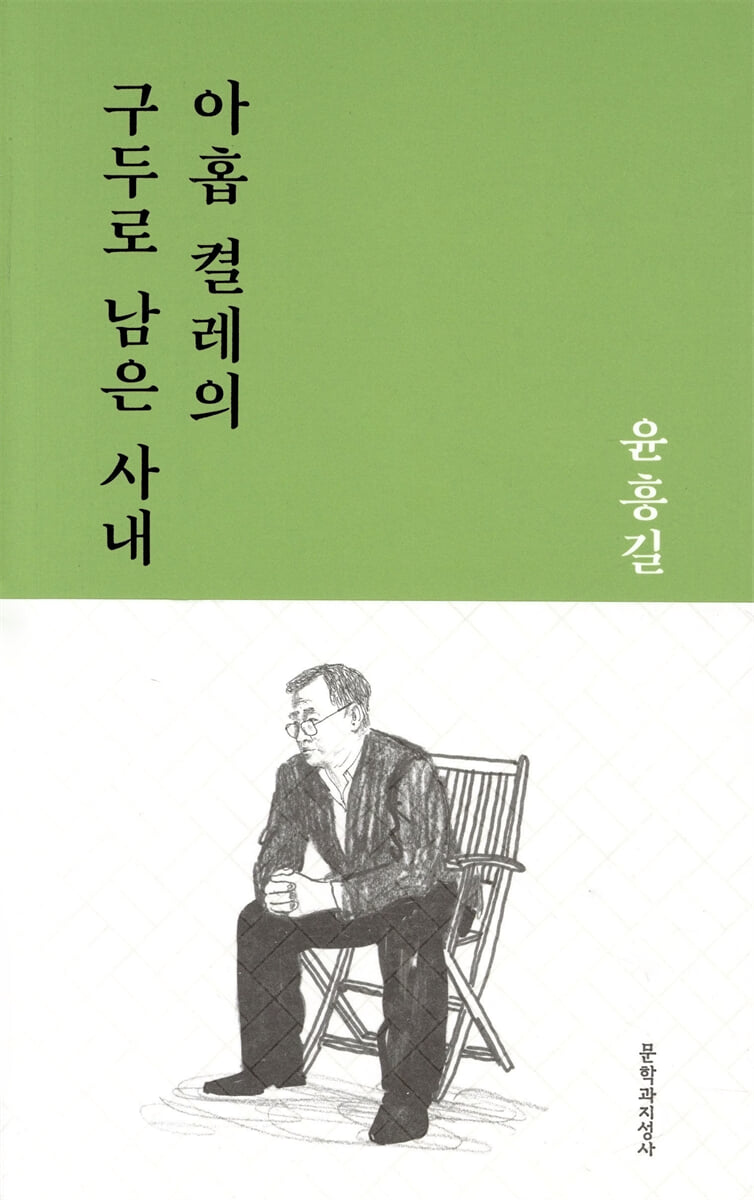
The man left with nine pairs of shoes
 |
Description
Book Introduction
Writing that confronts the changing reality
Yun Heung-gil's short story collection, "The Man Left Behind with Nine Pairs of Shoes"
After "The Season of the Gray Crown" was selected for the 1968 Hankook Ilbo New Year's Literary Contest, Yun Heung-gil's "The Man Who Remained with Nine Pairs of Shoes", which marks the 51st anniversary of his literary debut, was published as the fifth book in the Munji Writers' Series.
The second collection of short stories with the same work as the title was published in 1977, and novelist Lee Mun-gu said the following year, “1977 was the year of novelist Yun Heung-gil.” The series “The Man Left with Nine Pairs of Shoes,” which continues with “Straight Lines and Curves,” “Pale Middle Age,” and “Wings or Handcuffs,” is evaluated as a monumental masterpiece of Korean literature in the late 1970s and a pioneering work that opened a new horizon for Korean literature in the 1980s. (Seong Min-yeop, “The Current Meaning of the Series “The Man Left with Nine Pairs of Shoes,” Commentary on the New Edition of “The Man Left with Nine Pairs of Shoes,” 1997) This time, “The Man Left with Nine Pairs of Shoes,” which has been re-collected as a Munji writer’s collection, includes “The House of Twilight” (1970) and “House” (1972), which show the characteristics of Yun Heung-gil’s early novels, and “The House” (1972), which show the two directions of literature of division. Nine short stories, including “When Does the Rainbow Rises” (1978) and the novella “Rice” (1993), which mark important points in the world of Yun Heung-gil’s novels spanning half a century, are included.
Yun Heung-gil's short story collection, "The Man Left Behind with Nine Pairs of Shoes"
After "The Season of the Gray Crown" was selected for the 1968 Hankook Ilbo New Year's Literary Contest, Yun Heung-gil's "The Man Who Remained with Nine Pairs of Shoes", which marks the 51st anniversary of his literary debut, was published as the fifth book in the Munji Writers' Series.
The second collection of short stories with the same work as the title was published in 1977, and novelist Lee Mun-gu said the following year, “1977 was the year of novelist Yun Heung-gil.” The series “The Man Left with Nine Pairs of Shoes,” which continues with “Straight Lines and Curves,” “Pale Middle Age,” and “Wings or Handcuffs,” is evaluated as a monumental masterpiece of Korean literature in the late 1970s and a pioneering work that opened a new horizon for Korean literature in the 1980s. (Seong Min-yeop, “The Current Meaning of the Series “The Man Left with Nine Pairs of Shoes,” Commentary on the New Edition of “The Man Left with Nine Pairs of Shoes,” 1997) This time, “The Man Left with Nine Pairs of Shoes,” which has been re-collected as a Munji writer’s collection, includes “The House of Twilight” (1970) and “House” (1972), which show the characteristics of Yun Heung-gil’s early novels, and “The House” (1972), which show the two directions of literature of division. Nine short stories, including “When Does the Rainbow Rises” (1978) and the novella “Rice” (1993), which mark important points in the world of Yun Heung-gil’s novels spanning half a century, are included.
- You can preview some of the book's contents.
Preview
index
The House of Twilight | Home | The Dead of Winter | The Man Left with Nine Pairs of Shoes | Firewood | When Will the Rainbow Appear | Today's Fortune | A Very Handsome Umbrella | Rice
Into the book
Every three or four days, sometimes for several days straight, the red sunlight, as if it were going to burn the house, would begin to flash across the inn window, and the old woman would look up at the sky and cry in despair.
The cries, which began with a long, shrill cry like a fox's, and continued endlessly, sounded like a deliberate attempt to get help, or a harsh rebuke of someone's fault, or one of those terrifying screams that naturally escape a person's lips when he is complaining of some unbearable pain to anyone.
Whenever I heard that cry, I couldn't stand it because one of my worm-eaten molars would ache.
For the first time, I thought that the reason my grandmother's face was always red was because she was always drinking alcohol.
But little by little I came to believe that it was because the slanting sunlight and the sunset glinting on the windowpane were stuck on my face and never erased.
--- p.20
“Oh, teacher, I am a college graduate.”
That was it.
Like a parent shoving a note into my pocket, he shyly said those words and walked down the hill.
He appeared to me as a man with a short, lanky frame that didn't even sway much, who kept staggering forward, cursing the earth and the sky with every step he took.
As he turned the mountain peak and disappeared behind the bare yellow hill, I felt the urge to run and call out to him.
Just like Mr. Kwon, who witnessed a crowd rushing onto an overturned tricycle while throwing stones and then biting into a melon, I had the feeling that this was a complete nude painting.
--- p.165
Oh, I don't know.
It's truly incomprehensible.
I have no way of knowing whether my father-in-law's pathological obsession with rice stems from his ancestral belief in the spirit of the Tao or whether it is based on his Christian faith.
I have no idea whether my mother-in-law's chronic back pain can truly be cured, as my wife says, by feeding her stale, fake North Korean rice for 10 years, pretending it was the hometown of the two old men, just like my grandmother did in the old days.
If the day of unification is miserably delayed, if that day never comes, if the rest of my mother-in-law's life lasts as long as the delayed day of unification, if shocking incidents like the repatriation of Lee In-mo or Lee In-mo continue to occur frequently in the future, how much more will my mother-in-law have to suffer from homesickness, and how much more will she have to rely on the grace of Almighty Jehovah God or the supernatural power of the spirit dwelling in the rice from the North?
However, one thing I do know for sure is that while rice is nothing more than a simple food that some people just shove into their mouths to fill their stomachs, for others it can be very desolately accepted as something other than rice, something more than rice, something miraculous, a supernatural being that has amazing powers that seep into every corner of the human soul, sometimes curing illness, sometimes soothing sorrow, and ultimately making salvation possible.
The cries, which began with a long, shrill cry like a fox's, and continued endlessly, sounded like a deliberate attempt to get help, or a harsh rebuke of someone's fault, or one of those terrifying screams that naturally escape a person's lips when he is complaining of some unbearable pain to anyone.
Whenever I heard that cry, I couldn't stand it because one of my worm-eaten molars would ache.
For the first time, I thought that the reason my grandmother's face was always red was because she was always drinking alcohol.
But little by little I came to believe that it was because the slanting sunlight and the sunset glinting on the windowpane were stuck on my face and never erased.
--- p.20
“Oh, teacher, I am a college graduate.”
That was it.
Like a parent shoving a note into my pocket, he shyly said those words and walked down the hill.
He appeared to me as a man with a short, lanky frame that didn't even sway much, who kept staggering forward, cursing the earth and the sky with every step he took.
As he turned the mountain peak and disappeared behind the bare yellow hill, I felt the urge to run and call out to him.
Just like Mr. Kwon, who witnessed a crowd rushing onto an overturned tricycle while throwing stones and then biting into a melon, I had the feeling that this was a complete nude painting.
--- p.165
Oh, I don't know.
It's truly incomprehensible.
I have no way of knowing whether my father-in-law's pathological obsession with rice stems from his ancestral belief in the spirit of the Tao or whether it is based on his Christian faith.
I have no idea whether my mother-in-law's chronic back pain can truly be cured, as my wife says, by feeding her stale, fake North Korean rice for 10 years, pretending it was the hometown of the two old men, just like my grandmother did in the old days.
If the day of unification is miserably delayed, if that day never comes, if the rest of my mother-in-law's life lasts as long as the delayed day of unification, if shocking incidents like the repatriation of Lee In-mo or Lee In-mo continue to occur frequently in the future, how much more will my mother-in-law have to suffer from homesickness, and how much more will she have to rely on the grace of Almighty Jehovah God or the supernatural power of the spirit dwelling in the rice from the North?
However, one thing I do know for sure is that while rice is nothing more than a simple food that some people just shove into their mouths to fill their stomachs, for others it can be very desolately accepted as something other than rice, something more than rice, something miraculous, a supernatural being that has amazing powers that seep into every corner of the human soul, sometimes curing illness, sometimes soothing sorrow, and ultimately making salvation possible.
--- p.452~453
Publisher's Review
Munhak-kwa-Jiseongsa's new novel series, "Munji Writer's Selection"
Rereading yesterday's literature through today's eyes, the "Munji Writer's Selection" took its first steps last July.
In 2019, the year that marks the end of another decade, Munhak-kwa-Jiseongsa has decided that it is time to compile a list of authors and their works that have left a profound mark on Korean literary history and, by extension, modern Korean history, highlighting their literary value and imbuing them with new meaning.
We aim to select writers who have engaged in serious literary exploration, while also enjoying the support of a broad readership and continuing meaningful creative activities as the backbone of Korean literature. We then present their works to readers through a critically selected selection.
We also plan to add commentary by literary critics responsible for editing each volume, providing a detailed look into the literary and historical significance of each author and their work.
The starting point of the "Munji Writers' Selection" is the "4?19 Generation" writers who, during a period of political upheaval in an oppressed era, expressed criticism and resistance against power and society through literary language.
In addition to Choi In-hun's short story collection, "The Moon and the Boy Soldier," which was specially published first to coincide with the first anniversary of his passing, we are publishing the first installment of Kim Seung-ok's short story collection, "Seoul, Winter 1964," Seo Jeong-in's short story collection, "Tangerine," Lee Cheong-jun's short story collection, "The Face of the Perpetrator," and Yun Heung-gil's short story collection, "The Man Left Behind with Nine Pairs of Shoes."
Next, the second installment will feature a selection of short stories by Oh Jeong-hee and Park Wan-seo, the originators of modern Korean women's fiction, in January of next year.
Writing that confronts the changing reality
Yun Heung-gil's short story collection, "The Man Left Behind with Nine Pairs of Shoes"
After "The Season of the Gray Crown" was selected for the 1968 Hankook Ilbo New Year's Literary Contest, Yun Heung-gil's "The Man Who Remained with Nine Pairs of Shoes", which marks the 51st anniversary of his literary debut, was published as the fifth book in the Munji Writers' Series.
The second collection of short stories with the same work as the title was published in 1977, and novelist Lee Mun-gu said the following year, “1977 was the year of novelist Yun Heung-gil.” The series “The Man Left with Nine Pairs of Shoes,” which continues with “Straight Lines and Curves,” “Pale Middle Age,” and “Wings or Handcuffs,” is evaluated as a monumental masterpiece of Korean literature in the late 1970s and a pioneering work that opened a new horizon for Korean literature in the 1980s. (Seong Min-yeop, “The Current Meaning of the Series “The Man Left with Nine Pairs of Shoes,” Commentary on the New Edition of “The Man Left with Nine Pairs of Shoes,” 1997) This time, “The Man Left with Nine Pairs of Shoes,” which has been re-collected as a Munji writer’s collection, includes “The House of Twilight” (1970) and “House” (1972), which show the characteristics of Yun Heung-gil’s early novels, and “The House” (1972), which show the two directions of literature of division. Nine short stories, including “When Does the Rainbow Rises” (1978) and the novella “Rice” (1993), which mark important points in the world of Yun Heung-gil’s novels spanning half a century, are included.
In the introduction, literary critic Son Jeong-su, who was in charge of editing this book, argues that the “significance as a novelistic response to contemporary challenges,” such as the evaluation that “Yoon Heung-gil’s novels captured the problems of Korean society that arose due to division and industrialization and aesthetically presented a direction to overcome them,” “can now be said to have been historicized” due to the changing times, and that “nevertheless, his novels still produce problems by giving rise to new interpretations in many aspects.”
This book emphasizes once again that the nine short stories included are not just the fruits of the past, but still powerful works.
“The House at Dusk” and “The House,” which unfold from the perspective of a child, are works that allow us to glimpse “the unique personality of Yun Heung-gil’s early novels, which do not stop at realistic representation while recalling childhood immediately after the war.”
And the story of these characters with childhood memories growing up and entering reality continues in “Early Winter” (1975) and “The Man Left with Nine Pairs of Shoes.”
These two works, set in Seongnam, also feature a 'house' as the body of the novel, but there is something in particular that deserves attention in a context different from that of these early novels.
It is a change in the way we resolve the gap between ourselves and others.
As we move from “The Cold Winter” to “The Man Left with Nine Pairs of Shoes,” we see “the object that arouses desire in the subject” moving “step by step from the presence of sexual temptation to the presence of human compassion and hierarchical solidarity,” which is a very meaningful change.
Additionally, in representative novels about division, such as “When Does the Rainbow Rises” and “Rice,” we can see a change in the way division is dealt with.
The former takes the approach of “symbolic processing,” which is not unfamiliar in Yun Heung-gil’s novels, while the latter shows how to overcome the division issue by “facing the contradiction itself.”
The process of reading to confirm these changes will not only provide the pleasure of encountering works representing the world of author Yun Heung-gil, who has led the novelistic trend of our time by continuously writing in the face of changing reality, but will also allow you to feel the power of his works to always acquire new, contemporary meaning as time passes.
Rereading yesterday's literature through today's eyes, the "Munji Writer's Selection" took its first steps last July.
In 2019, the year that marks the end of another decade, Munhak-kwa-Jiseongsa has decided that it is time to compile a list of authors and their works that have left a profound mark on Korean literary history and, by extension, modern Korean history, highlighting their literary value and imbuing them with new meaning.
We aim to select writers who have engaged in serious literary exploration, while also enjoying the support of a broad readership and continuing meaningful creative activities as the backbone of Korean literature. We then present their works to readers through a critically selected selection.
We also plan to add commentary by literary critics responsible for editing each volume, providing a detailed look into the literary and historical significance of each author and their work.
The starting point of the "Munji Writers' Selection" is the "4?19 Generation" writers who, during a period of political upheaval in an oppressed era, expressed criticism and resistance against power and society through literary language.
In addition to Choi In-hun's short story collection, "The Moon and the Boy Soldier," which was specially published first to coincide with the first anniversary of his passing, we are publishing the first installment of Kim Seung-ok's short story collection, "Seoul, Winter 1964," Seo Jeong-in's short story collection, "Tangerine," Lee Cheong-jun's short story collection, "The Face of the Perpetrator," and Yun Heung-gil's short story collection, "The Man Left Behind with Nine Pairs of Shoes."
Next, the second installment will feature a selection of short stories by Oh Jeong-hee and Park Wan-seo, the originators of modern Korean women's fiction, in January of next year.
Writing that confronts the changing reality
Yun Heung-gil's short story collection, "The Man Left Behind with Nine Pairs of Shoes"
After "The Season of the Gray Crown" was selected for the 1968 Hankook Ilbo New Year's Literary Contest, Yun Heung-gil's "The Man Who Remained with Nine Pairs of Shoes", which marks the 51st anniversary of his literary debut, was published as the fifth book in the Munji Writers' Series.
The second collection of short stories with the same work as the title was published in 1977, and novelist Lee Mun-gu said the following year, “1977 was the year of novelist Yun Heung-gil.” The series “The Man Left with Nine Pairs of Shoes,” which continues with “Straight Lines and Curves,” “Pale Middle Age,” and “Wings or Handcuffs,” is evaluated as a monumental masterpiece of Korean literature in the late 1970s and a pioneering work that opened a new horizon for Korean literature in the 1980s. (Seong Min-yeop, “The Current Meaning of the Series “The Man Left with Nine Pairs of Shoes,” Commentary on the New Edition of “The Man Left with Nine Pairs of Shoes,” 1997) This time, “The Man Left with Nine Pairs of Shoes,” which has been re-collected as a Munji writer’s collection, includes “The House of Twilight” (1970) and “House” (1972), which show the characteristics of Yun Heung-gil’s early novels, and “The House” (1972), which show the two directions of literature of division. Nine short stories, including “When Does the Rainbow Rises” (1978) and the novella “Rice” (1993), which mark important points in the world of Yun Heung-gil’s novels spanning half a century, are included.
In the introduction, literary critic Son Jeong-su, who was in charge of editing this book, argues that the “significance as a novelistic response to contemporary challenges,” such as the evaluation that “Yoon Heung-gil’s novels captured the problems of Korean society that arose due to division and industrialization and aesthetically presented a direction to overcome them,” “can now be said to have been historicized” due to the changing times, and that “nevertheless, his novels still produce problems by giving rise to new interpretations in many aspects.”
This book emphasizes once again that the nine short stories included are not just the fruits of the past, but still powerful works.
“The House at Dusk” and “The House,” which unfold from the perspective of a child, are works that allow us to glimpse “the unique personality of Yun Heung-gil’s early novels, which do not stop at realistic representation while recalling childhood immediately after the war.”
And the story of these characters with childhood memories growing up and entering reality continues in “Early Winter” (1975) and “The Man Left with Nine Pairs of Shoes.”
These two works, set in Seongnam, also feature a 'house' as the body of the novel, but there is something in particular that deserves attention in a context different from that of these early novels.
It is a change in the way we resolve the gap between ourselves and others.
As we move from “The Cold Winter” to “The Man Left with Nine Pairs of Shoes,” we see “the object that arouses desire in the subject” moving “step by step from the presence of sexual temptation to the presence of human compassion and hierarchical solidarity,” which is a very meaningful change.
Additionally, in representative novels about division, such as “When Does the Rainbow Rises” and “Rice,” we can see a change in the way division is dealt with.
The former takes the approach of “symbolic processing,” which is not unfamiliar in Yun Heung-gil’s novels, while the latter shows how to overcome the division issue by “facing the contradiction itself.”
The process of reading to confirm these changes will not only provide the pleasure of encountering works representing the world of author Yun Heung-gil, who has led the novelistic trend of our time by continuously writing in the face of changing reality, but will also allow you to feel the power of his works to always acquire new, contemporary meaning as time passes.
GOODS SPECIFICS
- Date of issue: September 20, 2019
- Page count, weight, size: 496 pages | 570g | 130*207*25mm
- ISBN13: 9788932035710
- ISBN10: 8932035717
You may also like
카테고리
korean


korean

![GQ KOREA Mark (Monthly): December [2025]](http://librairie.coreenne.fr/cdn/shop/files/8ef265dbbfbf186523ed75ba7319009d.jpg?v=1765340328&width=3840)


