

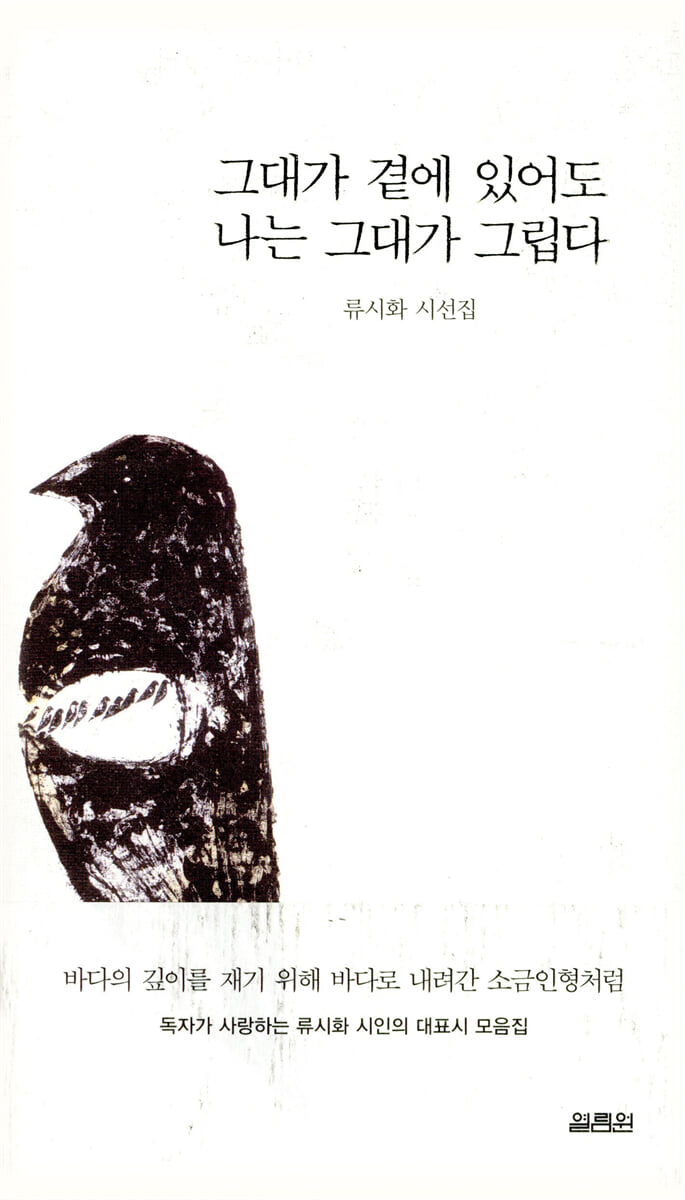
Even though you are by my side, I miss you
 |
Description
Book Introduction
“Like a salt doll who went down to the sea to measure its depth.”
A collection of representative poems by poet Ryu Si-hwa, beloved by readers.
A poet is someone who writes poetry through life.
He has written countless poems throughout his life, and like harvesting well-ripened grains of rice, he selects only the best of his poems and compiles them into a poetry collection.
Poet Ryu Si-hwa published his first poetry collection, 『Even When You Are By My Side』, 10 years after his debut, his second poetry collection, 『The Love of a One-Eyed Fish』, 5 years later, and his third poetry collection, 『My Wounds Are Stones, Your Wounds Are Flowers』, 15 years later. These collections of representative poems loved by readers and selected by the poet have been compiled into one volume.
'I like a love that doesn't stop even at a red light / I like the poet who said that if you go into the darkness with light, you won't know the darkness / I like poems that haven't been written yet more than all the poems he's written so far... ...' Among the poems the poet published after his debut, this book includes 98 representative poems, including [Thoughts on the Road], [Salt Doll], [Birds and Trees], [Two Days in September], [Birds Don't Look Back as They Fly], [The Love of a One-Eyed Fish], [Ong-i], [Stars in the Stone], [Somen], and [The Death of a Gnat].
The enlightenment and openness to life gained while walking the path of enlightenment become the language of poetry, making the eyes and hearts of readers tremble.
Ryu Si-hwa's poetry is not an invention, but a 'discovery'.
What runs through his poetry is love for the subject and a transparent gaze.
That poetic intuition gives birth to a unique world of poetry in which ‘things want to speak through the poet.’
Not only objects, but also readers of poetry will have their own intimate stories to tell through the poet.
The poems in this representative collection, published for the first time in 35 years since his debut, sing of a world where subject and object become one, with his unique linguistic sense, outstanding lyricism, and simple language that has acquired depth.
A collection of representative poems by poet Ryu Si-hwa, beloved by readers.
A poet is someone who writes poetry through life.
He has written countless poems throughout his life, and like harvesting well-ripened grains of rice, he selects only the best of his poems and compiles them into a poetry collection.
Poet Ryu Si-hwa published his first poetry collection, 『Even When You Are By My Side』, 10 years after his debut, his second poetry collection, 『The Love of a One-Eyed Fish』, 5 years later, and his third poetry collection, 『My Wounds Are Stones, Your Wounds Are Flowers』, 15 years later. These collections of representative poems loved by readers and selected by the poet have been compiled into one volume.
'I like a love that doesn't stop even at a red light / I like the poet who said that if you go into the darkness with light, you won't know the darkness / I like poems that haven't been written yet more than all the poems he's written so far... ...' Among the poems the poet published after his debut, this book includes 98 representative poems, including [Thoughts on the Road], [Salt Doll], [Birds and Trees], [Two Days in September], [Birds Don't Look Back as They Fly], [The Love of a One-Eyed Fish], [Ong-i], [Stars in the Stone], [Somen], and [The Death of a Gnat].
The enlightenment and openness to life gained while walking the path of enlightenment become the language of poetry, making the eyes and hearts of readers tremble.
Ryu Si-hwa's poetry is not an invention, but a 'discovery'.
What runs through his poetry is love for the subject and a transparent gaze.
That poetic intuition gives birth to a unique world of poetry in which ‘things want to speak through the poet.’
Not only objects, but also readers of poetry will have their own intimate stories to tell through the poet.
The poems in this representative collection, published for the first time in 35 years since his debut, sing of a world where subject and object become one, with his unique linguistic sense, outstanding lyricism, and simple language that has acquired depth.
- You can preview some of the book's contents.
Preview
index
Part 1 1980-1991
Thoughts on the Road 12 / Dandelion 13 / Even When You Are By My Side, I Miss You 14 / Magnolia 15 / Salt Doll 16 / Red Leaves 17 / October Dawn 18 / Mountain Fog 22 / Birds and Trees 23 / Two Days in September 24 / Birds Don't Look Back as They Fly 27 / Trees 28 / I Saw Many Snows 30 / Winter Clouds 32 / The Old Garden 35 / We Met Through Two Droplets of Water 36 / The Star of the Bug 39 / Some Snow 40 / November, Five Lines of Poem 42 / Sleeves Stained with Blood 43 / So Much Rain 44 / Walking in the Spring Rain 47 / Something of His Own 48 / Asking Regards to Sorrow 52 / Spider 54 / A Resume Dedicated to the Sun 56 / Poem Written on the Snow 58
Part 2 1992-1996
Salt 60 / Now is the time to close the shutters of longing 61 / Butterfly 62 / The love of a one-eyed fish 64 / Bread 65 / I plucked a mysterious flower 66 / Dianthus 68 / Nailing a star 69 / Plantain 70 / The tree 72 / Flower lamp 74 / For a moment on earth, it was called Ryu Si-hwa 75 / Birds come to our house and die 76 / A prologue for a traveler 78 / Water fog 81 / A song for sweet potatoes 82 / A poem about trees 85 / First love 86 / A short song 88 / Salt star 89 / To the flowers of the evening 90 / A prologue 91 / The bird of the Himalayas 92 / The hill on the other side 94 / That is not the wind 95 / Teaching a water rat to speak 96 / Write with blood 99 / Autumn will 100 / The memory of love is fading 102 / The phone To the Man Who Walks and Says Nothing 104 / A Winter's Tale 106
Part 3 1996-2012
At the Teahouse of the Wind 110 / Ongi 112 / Star in the Stone 113 / Somen 114 / Wintering in Saha Village 117 / Fireflies 122 / The Life of a Camel 124 / Blood-Stained Sleeves 43 / Mother 126 / Still in the Old Notebook 128 / The Icy Pond 131 / If the Poet Made a Dictionary 132 / Peony's Romance 134 / A Month in the Countryside 136 / Perfect Love 139 / The Death of the Gnat 140 / Letter from Darjeeling 143 / The River of First Love 144 / Barley 146 / Spring Opens and Closes Flowers 149 / Self-Portrait 150 / Being Alive Hurts 153 / Meditation on a Water Stone 154 / In the Most Beautiful Mood for Love 156 / When Spring Water Rises at the Edge of the Frozen Pond 158 / He A Good Person 160 / If I Do Laundry with Allen Ginsberg 162 / I Tracing the Place Where Flowers Bloomed 165 / Black Tea 166 / Like Taking Out the Flower I Had Locked Up Inside Me 169 / A Bear's Visit 170 / One Joy, a Thousand Sorrows 172 / I Think of a Flock of Blackbirds 174 / Seeing That I Wrote These Poems, I Must Have Loved Someone Back Then 176 / At the Age of Forty 178 / What the Moon Gae-bi Whispers to the Stars' Ears 180 / Courtesy to Those Who Have Stepped Away 182 / Poems That Readers Must Continue to Write 184 / Remembering with a Reindeer 187 / Turning Over, I Pour Out the Stars in My Ears 188
Commentary on the work | Poetry that makes you write poetry (Lee Moon-jae)
Into the book
Thoughts on the Road
Those who have no home long for home.
Those who have a home long for the wind in the empty fields.
I left home and stood on the road, thinking
Nothing is lost or gained in life.
Everything is like the wind in an empty field
As time passed, we just drifted apart
Some people long for the days when they can laugh while crying
Those who laugh also fear the tears that will follow the laughter.
I ask the grass blooming on the roadside
What did I live for?
And what else did you not live for?
The living fear death.
The dying regret that they cannot live any longer.
Those who are not free long for freedom.
Some travelers, weary of freedom, collapse on the road.
Salt doll
To measure the depth of the sea
went down to the sea
Like a salt doll
To measure your depth
Into your blood
jumped in
I am
Like a salt doll
Without a trace
It melted
knag
Don't call it a scar
This too was once a flower
Even though it bloomed and withered quickly
Don't call it a wound
Once upon a time, the flowers pushed up dazzlingly
Even though I lost with tears
If I wasn't going to die, I wouldn't have lived.
If you weren't going to leave, I wouldn't have held on.
If I wasn't going to be silent, I wouldn't have said anything.
If it won't break, if it won't hate
I didn't even love you
Don't call me Ong
The hardest part
At one time, this was also delicate
But passion is too much and it only hurts once
Because it never bloomed again
Star in the Stone
Those who believe that the inside of a stone is dark
A person who has never hit a stone
A person who does not know that a star is trapped in a stone
Those who think that stones cannot sing
The song of the stones sung by the river current at dusk
I've never heard of him before
I'm a person who has never cried while listening to that song.
To enter the stone, you must become water.
I don't know the person yet
Whoever says the stone is cold
A person who has never cried out from a stone
A person who has forgotten that coolness was once fire.
People who ignore stones because they are expressionless
A person who has never looked at the face of a stone
A person who does not understand the ripples swirling inside.
That expressionless oxymoron
The death of the magpie
Today I think about humans
What is a human being?
For example, the child with Down syndrome living next door is a human being.
What are the disqualifications?
That day was the coldest day of the year.
It was winter
I went outside after hearing a knock on the door.
The child was standing
Holding a dead bird in my hand
Where does a child who is always stuck at home go?
I don't know if they found a direct hit
The bird was already stiff and frozen.
The child asked in a dull voice.
Ask them to bury the bird in the yard.
There is no place like that in my house.
And the child left stiff
Leaving the bird and me behind like a monologue
It's snowing
Even the smallest bird can touch the frozen ground
Breaking the white frost was not an easy task.
It was dug deep into the ground
Even when the hoe struck the stone, no sparks came out.
It was then that the child returned.
There was a knock on the door again.
The child said, holding out one shoe.
Put the bird in there and bury it so it doesn't get cold.
With only one shoe on
With bare feet and no socks on
The snow piled up before I could even bury the bird.
What is a human being?
Do you love because you understand?
Do you understand because you love?
Intensity trapped in a blank expression
Perfection in Imperfection
I've been using it for so long that it's become my real face
mask
Or, they can't fly because they have arms instead of wings.
Can hug
--- From the text
Publisher's Review
Introducing a collection of poems
As I compiled the poems from my three collections into one volume, I realized that the signals that flicker in my poetry are 'despair and hope,' or, as Pablo Neruda and Wisława Szymborska put it, 'questions that answer questions.'
Just as overlapping coincidences come together to form destiny, overlapping words come together to determine the fate of my poetry.
Life is wonderful, lonely, and hopelessly hopeless.
Meanwhile, the flowers are fading away, and the rain is putting us to sleep.
In the face of that paradox, each human being is a poet.
When asked by a reporter when he decided to become a poet, he replied, “Everyone born into this world is a poet.
The words of a poet who answered, “But we must ask each person when he stopped doing it,” are true.
It is a gift of this mysterious world that shakes and thrills language.
I wrote, 'Birds don't look back as they fly,' but I ended up looking back like this.
The title of every poet's last poem should be 'Goodbye Now'.
The meaning of a poem only comes to you after you read the last word.
Just as one realizes the meaning of the paths taken only after the journey is over.
The pain passes and a poem remains.
Until then, finding words is what it means to live as a poet.
My poetry may not offer solace in despair or answers to questions, but I am publishing a collection of poems after 35 years as a poet.
Reading poetry is synonymous with 'reading poetry'.
My poetry, which sometimes tries to use poetic techniques with noble words, has only the eyes and heart of the reader who 'reads the poetry' to rely on.
-Fall 2015, Ryu Si-hwa
Poetry that makes you write poetry
Poet Ryu Si-hwa is not prolific.
He published his first poetry collection more than 10 years after his debut, and his third poetry collection was published 15 years after his second.
For a poet with over 30 years of experience, he has published very few books of poetry.
If you follow the custom of publishing one book of poetry every three to four years, you should have around ten books of poetry.
If we agree that the three elements of creation are reading extensively, writing extensively, and producing extensively, then we can say that poet Ryu is lacking in one element.
But that's just talking without knowing much.
From what I have observed as a friend since the late 1970s, poet Ryu has several times more poems than he has published.
And those poems are not on paper, they are in his head.
He doesn't just write poetry on paper.
It is used in the wind and also placed on the clouds.
Because I spend more time on the road than at home.
He has “spent half his life on the road” since his late twenties ([In the Windy Teahouse]), and he has memorized all the poems he wrote on the road.
The poems written on the road were naturally stored in memory cells through the process of rewriting them countless times on the road.
So, Ryu Si-hwa's complete poetry collection has been growing in his mind for the past 30 years.
I don't know when that enormous collection of poems in my head will come out.
The process of editing an anthology is painful for the poet himself, but the anthology thus created is a blessing to the readers.
A poet writes 'one poem' throughout his life.
At this time, a poem is not a numerical concept.
A complete collection of poems, or anthology, can be a single poem.
A poem can be said to represent the values, meaning, or world that a poet pursues throughout his life.
However, although the poet himself may assert that one poem, the readers do not accept it as is.
A poem that encapsulates a poet's life and spiritual world is determined by the reader.
And the poem will be different for each reader, and the poem will also have new meaning each time the reader reads it.
That kind of poetry is good poetry.
A good poem is one that is renewed each time by the reader, one that is completed anew each time through an intimate conversation between the reader and the poem.
Here is the 'Poem of Poems'.
There are poems that have more readers than poets who have created them.
No, there is a poem that turns all readers into poets.
-From poet Lee Moon-jae's commentary
As I compiled the poems from my three collections into one volume, I realized that the signals that flicker in my poetry are 'despair and hope,' or, as Pablo Neruda and Wisława Szymborska put it, 'questions that answer questions.'
Just as overlapping coincidences come together to form destiny, overlapping words come together to determine the fate of my poetry.
Life is wonderful, lonely, and hopelessly hopeless.
Meanwhile, the flowers are fading away, and the rain is putting us to sleep.
In the face of that paradox, each human being is a poet.
When asked by a reporter when he decided to become a poet, he replied, “Everyone born into this world is a poet.
The words of a poet who answered, “But we must ask each person when he stopped doing it,” are true.
It is a gift of this mysterious world that shakes and thrills language.
I wrote, 'Birds don't look back as they fly,' but I ended up looking back like this.
The title of every poet's last poem should be 'Goodbye Now'.
The meaning of a poem only comes to you after you read the last word.
Just as one realizes the meaning of the paths taken only after the journey is over.
The pain passes and a poem remains.
Until then, finding words is what it means to live as a poet.
My poetry may not offer solace in despair or answers to questions, but I am publishing a collection of poems after 35 years as a poet.
Reading poetry is synonymous with 'reading poetry'.
My poetry, which sometimes tries to use poetic techniques with noble words, has only the eyes and heart of the reader who 'reads the poetry' to rely on.
-Fall 2015, Ryu Si-hwa
Poetry that makes you write poetry
Poet Ryu Si-hwa is not prolific.
He published his first poetry collection more than 10 years after his debut, and his third poetry collection was published 15 years after his second.
For a poet with over 30 years of experience, he has published very few books of poetry.
If you follow the custom of publishing one book of poetry every three to four years, you should have around ten books of poetry.
If we agree that the three elements of creation are reading extensively, writing extensively, and producing extensively, then we can say that poet Ryu is lacking in one element.
But that's just talking without knowing much.
From what I have observed as a friend since the late 1970s, poet Ryu has several times more poems than he has published.
And those poems are not on paper, they are in his head.
He doesn't just write poetry on paper.
It is used in the wind and also placed on the clouds.
Because I spend more time on the road than at home.
He has “spent half his life on the road” since his late twenties ([In the Windy Teahouse]), and he has memorized all the poems he wrote on the road.
The poems written on the road were naturally stored in memory cells through the process of rewriting them countless times on the road.
So, Ryu Si-hwa's complete poetry collection has been growing in his mind for the past 30 years.
I don't know when that enormous collection of poems in my head will come out.
The process of editing an anthology is painful for the poet himself, but the anthology thus created is a blessing to the readers.
A poet writes 'one poem' throughout his life.
At this time, a poem is not a numerical concept.
A complete collection of poems, or anthology, can be a single poem.
A poem can be said to represent the values, meaning, or world that a poet pursues throughout his life.
However, although the poet himself may assert that one poem, the readers do not accept it as is.
A poem that encapsulates a poet's life and spiritual world is determined by the reader.
And the poem will be different for each reader, and the poem will also have new meaning each time the reader reads it.
That kind of poetry is good poetry.
A good poem is one that is renewed each time by the reader, one that is completed anew each time through an intimate conversation between the reader and the poem.
Here is the 'Poem of Poems'.
There are poems that have more readers than poets who have created them.
No, there is a poem that turns all readers into poets.
-From poet Lee Moon-jae's commentary
GOODS SPECIFICS
- Date of issue: September 25, 2015
- Format: Hardcover book binding method guide
- Page count, weight, size: 208 pages | 330g | 125*210*20mm
- ISBN13: 9788970639475
- ISBN10: 8970639470
You may also like
카테고리
korean


korean

![GQ KOREA Mark (Monthly): December [2025]](http://librairie.coreenne.fr/cdn/shop/files/8ef265dbbfbf186523ed75ba7319009d.jpg?v=1765340328&width=3840)


