

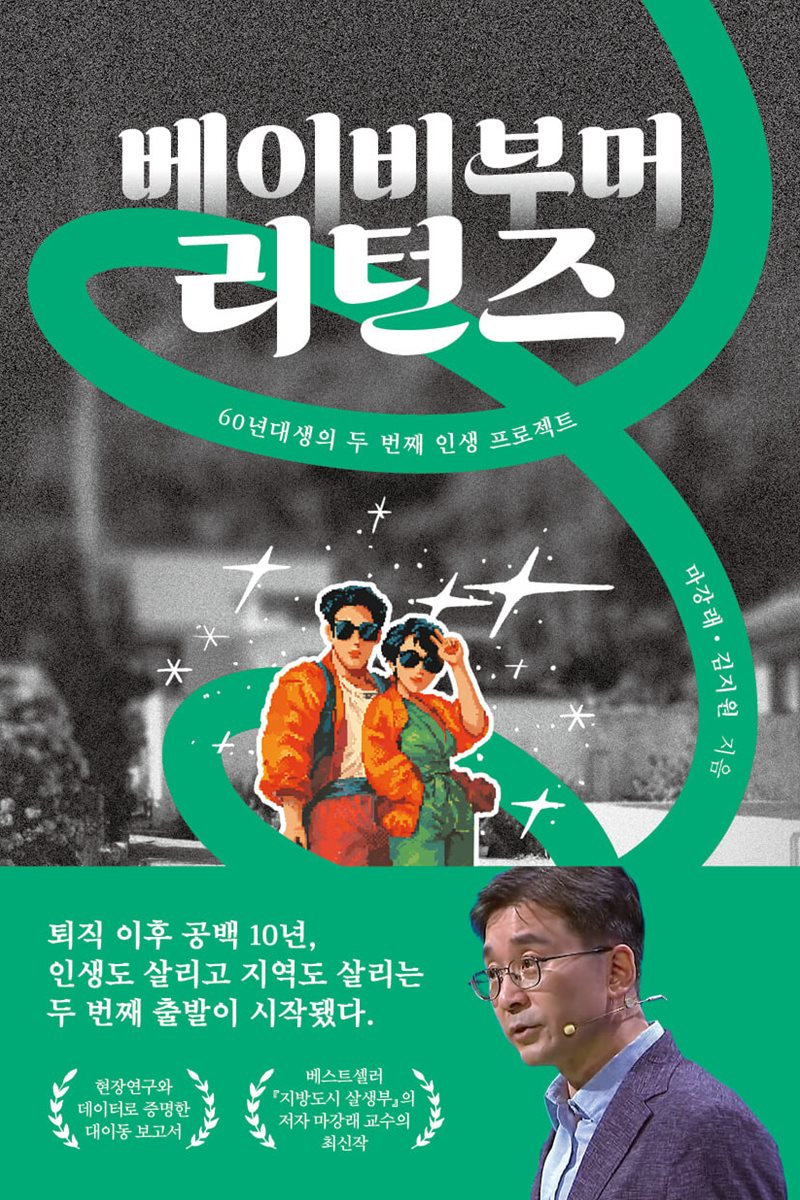
Baby Boomer Returns
 |
Description
Book Introduction
"How to fill the 10-year gap between retirement and pension?" The Great Migration of the 1960s Generation: Unleashing Urban Density and Unleashing the Potential of Regional Cities
Korea is aging rapidly now.
Birth rates are falling and urban populations have peaked.
But in the midst of it all, there is a generation that moves quietly.
They are the baby boomers, born in the 60s.
This book captures the trend of people leaving the city for the countryside in search of a place to live again after facing a '10-year income gap' between retirement and pension receipt.
The author, Professor Ma Kang-rae (Chung-Ang University), interprets this not as a simple phenomenon of returning to farming or rural life, but as a signal of a 'golden time' for the survival of Korean society.
The book proposes a "three-way alliance model" where baby boomers with experience (Mr. Experience), local governments facing extinction (Mr. Local), and small and medium-sized enterprises (Mr. Enterprise) suffering from a labor shortage come together, and proves its feasibility through vivid field cases from Hamyang County.
This book is not a romantic guide to country life.
This is the most realistic policy proposal and future strategy book, designed to simultaneously plan the second act of an individual's life and the balanced development of the nation, based on specific data on housing, jobs, and healthcare.
Korea is aging rapidly now.
Birth rates are falling and urban populations have peaked.
But in the midst of it all, there is a generation that moves quietly.
They are the baby boomers, born in the 60s.
This book captures the trend of people leaving the city for the countryside in search of a place to live again after facing a '10-year income gap' between retirement and pension receipt.
The author, Professor Ma Kang-rae (Chung-Ang University), interprets this not as a simple phenomenon of returning to farming or rural life, but as a signal of a 'golden time' for the survival of Korean society.
The book proposes a "three-way alliance model" where baby boomers with experience (Mr. Experience), local governments facing extinction (Mr. Local), and small and medium-sized enterprises (Mr. Enterprise) suffering from a labor shortage come together, and proves its feasibility through vivid field cases from Hamyang County.
This book is not a romantic guide to country life.
This is the most realistic policy proposal and future strategy book, designed to simultaneously plan the second act of an individual's life and the balanced development of the nation, based on specific data on housing, jobs, and healthcare.
- You can preview some of the book's contents.
Preview
index
Prologue: Kim Sang-cheol's Second Life Story
Note
Chapter 1.
The 10-Year Income Gap for Young Baby Boomers
ㆍThe country with the fastest population decline in the world
ㆍThe country with the longest life expectancy in the world
Declining working-age population and the emergence of the "single-parent generation"
Retirement in your mid-50s: Can you handle it?
Why are demands for continued employment growing?
ㆍWill continued employment really take away jobs from young people?
Chapter 2.
Surplus or Resource?
Why were these three resources relegated to "surplus" status? Those born in the 1960s, small and medium-sized cities, and small and medium-sized businesses
Resource 1: Experienced? Active-level human capital
Resource 2: Local Seeds? A Space of Opportunity in the Face of Extinction
Resource 3: Mr. Enterprise? A Report on Job Creation
ㆍThe whole is much greater than the sum of its parts
Chapter 3.
Signs of a great migration
ㆍMr. Experience wants a second life.
Life's Second Curve: Where You Live Determines Your Happiness
The population migration has already begun.
A mass exodus of baby boomers is also occurring overseas.
ㆍThe power of people aged around 55 to return to the countryside!
People who come to endangered areas on their own
Why Now Is the Golden Time for the Rural Relocation Policy
ㆍFor the rural migration trend to become explosively strong…
Chapter 4.
Eliminating the Three Major Concerns of Returning to the Countryside
ㆍThe first gateway to the three-party alliance model is home
ㆍComplex-type housing that reduces both loneliness and seclusion
ㆍHouses are starting to rotate? An innovative housing circular model.
ㆍReturning to the countryside is completed not by a house but by work.
ㆍDoes the company really hire people with experience?
Misunderstandings and Truths about 'Byeongse Kwon'
ㆍEmergency Golden Time? Criteria for Choosing a Place to Live
ㆍBonus wages received upon returning to the countryside
Chapter 5.
Hamyang faces a three-way alliance model.
Why Hamyang?
ㆍHamyangpan 3-party alliance
ㆍWill Hamyang residents welcome outsiders?
ㆍIt's such a great place, why are there so few people?
The second act of life that began with 'Let's live once'
ㆍI want to live, but will I be able to live?
ㆍFrom a farmer to a craftsman
Surprised by the public employment model proposed by a returning rural person
Chapter 6.
Hamyang's small and medium-sized businesses speak to the reality.
ㆍAsk Hamyang's Enterprise, "Insanga"
ㆍA picture of coexistence between regions and businesses
ㆍReal stories from on-site interviews
How do small and medium-sized enterprises view the three-party alliance?
ㆍAgricultural and Industrial Complex, Can I Work Here?
Why is the "time" for local small and medium-sized enterprises (SMEs) so short?
Opportunities in the food processing industry
ㆍThere is a job here
ㆍThe urgent need for workers on the ground
ㆍLocal communities and small and medium-sized enterprises share a common destiny.
Chapter 7.
A three-party alliance to save the country
The paradox of youth leaving and rising "youth standards"
Local governments' "One Thing" for returning people
ㆍPossibility confirmed.
Now to execution
ㆍA three-party alliance to save the country
Appendix 1.
The 'local people' mentioned in this book
Appendix 2.
How can the central government support a tripartite merger?
Appendix 3.
Life Expectancy Table (19-64 years old)
Appendix 4.
Is a three-way alliance model really possible? Q&A
Americas
Note
Chapter 1.
The 10-Year Income Gap for Young Baby Boomers
ㆍThe country with the fastest population decline in the world
ㆍThe country with the longest life expectancy in the world
Declining working-age population and the emergence of the "single-parent generation"
Retirement in your mid-50s: Can you handle it?
Why are demands for continued employment growing?
ㆍWill continued employment really take away jobs from young people?
Chapter 2.
Surplus or Resource?
Why were these three resources relegated to "surplus" status? Those born in the 1960s, small and medium-sized cities, and small and medium-sized businesses
Resource 1: Experienced? Active-level human capital
Resource 2: Local Seeds? A Space of Opportunity in the Face of Extinction
Resource 3: Mr. Enterprise? A Report on Job Creation
ㆍThe whole is much greater than the sum of its parts
Chapter 3.
Signs of a great migration
ㆍMr. Experience wants a second life.
Life's Second Curve: Where You Live Determines Your Happiness
The population migration has already begun.
A mass exodus of baby boomers is also occurring overseas.
ㆍThe power of people aged around 55 to return to the countryside!
People who come to endangered areas on their own
Why Now Is the Golden Time for the Rural Relocation Policy
ㆍFor the rural migration trend to become explosively strong…
Chapter 4.
Eliminating the Three Major Concerns of Returning to the Countryside
ㆍThe first gateway to the three-party alliance model is home
ㆍComplex-type housing that reduces both loneliness and seclusion
ㆍHouses are starting to rotate? An innovative housing circular model.
ㆍReturning to the countryside is completed not by a house but by work.
ㆍDoes the company really hire people with experience?
Misunderstandings and Truths about 'Byeongse Kwon'
ㆍEmergency Golden Time? Criteria for Choosing a Place to Live
ㆍBonus wages received upon returning to the countryside
Chapter 5.
Hamyang faces a three-way alliance model.
Why Hamyang?
ㆍHamyangpan 3-party alliance
ㆍWill Hamyang residents welcome outsiders?
ㆍIt's such a great place, why are there so few people?
The second act of life that began with 'Let's live once'
ㆍI want to live, but will I be able to live?
ㆍFrom a farmer to a craftsman
Surprised by the public employment model proposed by a returning rural person
Chapter 6.
Hamyang's small and medium-sized businesses speak to the reality.
ㆍAsk Hamyang's Enterprise, "Insanga"
ㆍA picture of coexistence between regions and businesses
ㆍReal stories from on-site interviews
How do small and medium-sized enterprises view the three-party alliance?
ㆍAgricultural and Industrial Complex, Can I Work Here?
Why is the "time" for local small and medium-sized enterprises (SMEs) so short?
Opportunities in the food processing industry
ㆍThere is a job here
ㆍThe urgent need for workers on the ground
ㆍLocal communities and small and medium-sized enterprises share a common destiny.
Chapter 7.
A three-party alliance to save the country
The paradox of youth leaving and rising "youth standards"
Local governments' "One Thing" for returning people
ㆍPossibility confirmed.
Now to execution
ㆍA three-party alliance to save the country
Appendix 1.
The 'local people' mentioned in this book
Appendix 2.
How can the central government support a tripartite merger?
Appendix 3.
Life Expectancy Table (19-64 years old)
Appendix 4.
Is a three-way alliance model really possible? Q&A
Americas
Detailed image

Into the book
The common belief that middle-aged people with relatively more assets and achievements would be happier was surprisingly not true.
When controlling for various factors and looking purely at the 'age effect', happiness took a U-shape.
A U-shaped curve where you are happy when you are young, your happiness hits rock bottom around the age of 50, and then gradually recovers.
The problem is that society is turning a blind eye to those going through this unfortunate time.
--- p.3
10 Years After Retirement, The Weight of Money Let's say you retire at age 55 and live off the bare minimum for 10 years without any income.
Just a simple calculation reveals that it is a little over 300 million won.
There are very few households in our country that can survive for 10 years without a pension and spend this amount without any burden.
(…) you have to be prepared to lose more than half of your assets.
--- p.50
Our society doesn't pay much attention to those who are considered to be at the end of their lives.
But within the three-party alliance model, they are no longer 'surplus'.
During the day, I work hard at a local business, in the evening, I learn at a lifelong learning center, and on weekends, I tend my garden and share laughter with my neighbors.
In this way, they grow not just as 'people enduring old age', but as members of the community and as independent individuals.
--- p.17
If an area more than seven times the size of Seoul can be considered as an 'emergency medical care zone,' it is difficult to conclude that access to emergency medical care in local areas has 'collapsed.'
(…) Moving to the countryside is not just about moving house.
It's a matter of completely relocating your job, relationships, and even the foundation of your life.
Therefore, the housing policy that the region should truly strive for should not be for show, but should be a 'foundation for settlement' for those returning to the countryside.
--- p.185
The only good sign is that young baby boomers are returning.
But the local government is full of youth policies.
(…) I want to say this.
While policies to retain those who are leaving are important, aren't policies to welcome those who are coming in even more necessary?
It is much easier and more effective to welcome those who come in on their own than to hold back those who are leaving.
When controlling for various factors and looking purely at the 'age effect', happiness took a U-shape.
A U-shaped curve where you are happy when you are young, your happiness hits rock bottom around the age of 50, and then gradually recovers.
The problem is that society is turning a blind eye to those going through this unfortunate time.
--- p.3
10 Years After Retirement, The Weight of Money Let's say you retire at age 55 and live off the bare minimum for 10 years without any income.
Just a simple calculation reveals that it is a little over 300 million won.
There are very few households in our country that can survive for 10 years without a pension and spend this amount without any burden.
(…) you have to be prepared to lose more than half of your assets.
--- p.50
Our society doesn't pay much attention to those who are considered to be at the end of their lives.
But within the three-party alliance model, they are no longer 'surplus'.
During the day, I work hard at a local business, in the evening, I learn at a lifelong learning center, and on weekends, I tend my garden and share laughter with my neighbors.
In this way, they grow not just as 'people enduring old age', but as members of the community and as independent individuals.
--- p.17
If an area more than seven times the size of Seoul can be considered as an 'emergency medical care zone,' it is difficult to conclude that access to emergency medical care in local areas has 'collapsed.'
(…) Moving to the countryside is not just about moving house.
It's a matter of completely relocating your job, relationships, and even the foundation of your life.
Therefore, the housing policy that the region should truly strive for should not be for show, but should be a 'foundation for settlement' for those returning to the countryside.
--- p.185
The only good sign is that young baby boomers are returning.
But the local government is full of youth policies.
(…) I want to say this.
While policies to retain those who are leaving are important, aren't policies to welcome those who are coming in even more necessary?
It is much easier and more effective to welcome those who come in on their own than to hold back those who are leaving.
--- p.296
Publisher's Review
"Where Will You Be in the Ten Years Between Retirement and Pension?" A Last Golden Time Proposal for Anxious Individuals and Dying Local Communities
We live in an age where everyone worries about retirement, but no one has a clear answer.
A time when you have to survive without pension income after retiring in your mid-50s.
This 'decade of income gap' represents a survival crisis for individuals, and for the nation, a rapid exodus of the working-age population.
Professor Ma Kang-rae and researcher Kim Ji-won's book, "Baby Boomer Returns," proposes a counter-intuitive approach to turning this crisis into an opportunity.
This is not a vague fantasy of returning to the countryside.
Through thorough data and field verification, we provide clear answers to "the questions that readers are most curious about and anxious about."
Q.
Are baby boomers really moving to the countryside?
A.
Already on the way.
In the past five years, the number of people aged 45 to 69 who have moved into the province has reached 200,000, of which over 100,000 are aged 55 to 64.
Under the water, the great migration has already begun.
Q.
Will the provinces welcome the 5060 generation?
A.
It is a huge welcome.
In a region where the average age is well over 60, people in their mid-50s are practically young people.
Rather than simply being a population, they are treated as a ‘core force’ that will lead the region.
Q.
Are there really places to work in the countryside?
A.
Small and medium-sized businesses are on the verge of closing down due to lack of employees.
Half of the workers at local small and medium-sized enterprises are already over 50 years old.
What the field wants is not just labor.
We are desperately looking for 'baby boomer middle managers' with experience and know-how in managing organizations.
Q.
What should I do if I get sick? The hospital is far away.
A.
It's not 'distance' that matters, it's 'time'.
Even if we only select the 'Byeongse-gwon' area, which is within 5km of emergency facilities, the area is more than seven times the size of Seoul.
Rather than simply moving to the countryside, it is possible to strategically choose a place with secure medical access, a 'smart return to the countryside' approach.
Q.
Won't it be difficult because of the tax?
A.
That's why we need a 'simple-type rural village'.
Designs for urban dwellers and indigenous people to coexist have already begun.
This book goes beyond the individual's return to the countryside and proves how the three-way alliance of baby boomers (experience) × local areas (space) × small and medium-sized enterprises (jobs) can save each other.
Moving after retirement is no longer a personal escape.
It is a social solution that relieves urban density and fills the potential of local areas.
This is a must-read for both baby boomers contemplating the second act of their lives and policymakers tasked with preventing the disappearance of rural areas. It is the most essential guidebook for South Korea today.
We live in an age where everyone worries about retirement, but no one has a clear answer.
A time when you have to survive without pension income after retiring in your mid-50s.
This 'decade of income gap' represents a survival crisis for individuals, and for the nation, a rapid exodus of the working-age population.
Professor Ma Kang-rae and researcher Kim Ji-won's book, "Baby Boomer Returns," proposes a counter-intuitive approach to turning this crisis into an opportunity.
This is not a vague fantasy of returning to the countryside.
Through thorough data and field verification, we provide clear answers to "the questions that readers are most curious about and anxious about."
Q.
Are baby boomers really moving to the countryside?
A.
Already on the way.
In the past five years, the number of people aged 45 to 69 who have moved into the province has reached 200,000, of which over 100,000 are aged 55 to 64.
Under the water, the great migration has already begun.
Q.
Will the provinces welcome the 5060 generation?
A.
It is a huge welcome.
In a region where the average age is well over 60, people in their mid-50s are practically young people.
Rather than simply being a population, they are treated as a ‘core force’ that will lead the region.
Q.
Are there really places to work in the countryside?
A.
Small and medium-sized businesses are on the verge of closing down due to lack of employees.
Half of the workers at local small and medium-sized enterprises are already over 50 years old.
What the field wants is not just labor.
We are desperately looking for 'baby boomer middle managers' with experience and know-how in managing organizations.
Q.
What should I do if I get sick? The hospital is far away.
A.
It's not 'distance' that matters, it's 'time'.
Even if we only select the 'Byeongse-gwon' area, which is within 5km of emergency facilities, the area is more than seven times the size of Seoul.
Rather than simply moving to the countryside, it is possible to strategically choose a place with secure medical access, a 'smart return to the countryside' approach.
Q.
Won't it be difficult because of the tax?
A.
That's why we need a 'simple-type rural village'.
Designs for urban dwellers and indigenous people to coexist have already begun.
This book goes beyond the individual's return to the countryside and proves how the three-way alliance of baby boomers (experience) × local areas (space) × small and medium-sized enterprises (jobs) can save each other.
Moving after retirement is no longer a personal escape.
It is a social solution that relieves urban density and fills the potential of local areas.
This is a must-read for both baby boomers contemplating the second act of their lives and policymakers tasked with preventing the disappearance of rural areas. It is the most essential guidebook for South Korea today.
GOODS SPECIFICS
- Date of issue: December 1, 2025
- Page count, weight, size: 344 pages | 140*210*22mm
- ISBN13: 9791199573505
You may also like
카테고리
korean


korean

![GQ KOREA Mark (Monthly): December [2025]](http://librairie.coreenne.fr/cdn/shop/files/8ef265dbbfbf186523ed75ba7319009d.jpg?v=1765340328&width=3840)


