

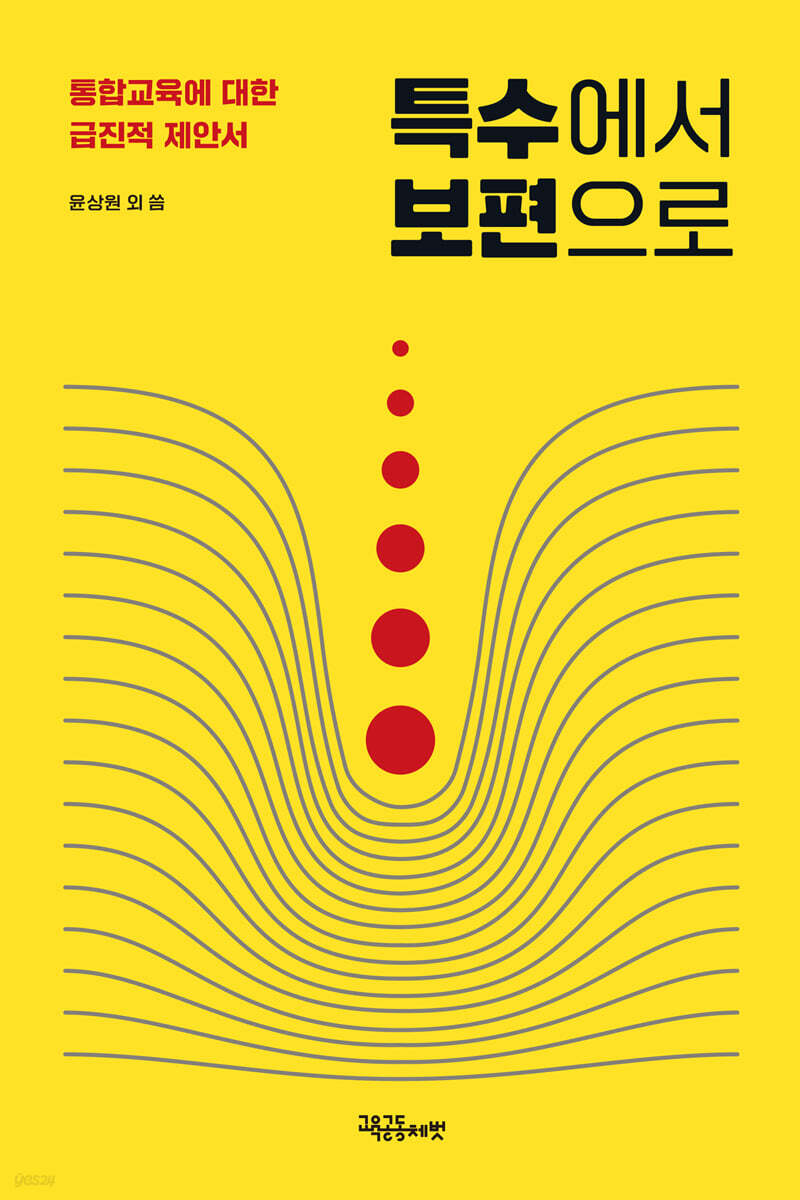
From special to universal
 |
Description
Book Introduction
Thinking about inclusive education as a universal educational discourse, beyond the "special"
Broadening the scope to the disability movement, there is a history and accumulated capacity to change social systems and perceptions by proposing major social agendas such as the right to mobility, deinstitutionalization, labor, self-reliance, and housing. However, integrated education for the disabled and non-disabled is still an unexplored area with many challenges to be solved.
On the surface, schools aim for inclusive education, but they have justified discrimination and exclusion by dichotomously distinguishing between 'universal' and 'special', 'normal' and 'abnormal', 'disabled' and 'non-disabled', and 'general education' and 'special education'.
The common belief that inclusive education is “an issue that only special education teachers should worry about” and “education only for students with disabilities” has also been a major obstacle to the spread of inclusive education.
This book goes beyond the "special" category and considers inclusive education as a universal educational discourse, proposing inclusive education as a radical form of education that transforms schools.
Broadening the scope to the disability movement, there is a history and accumulated capacity to change social systems and perceptions by proposing major social agendas such as the right to mobility, deinstitutionalization, labor, self-reliance, and housing. However, integrated education for the disabled and non-disabled is still an unexplored area with many challenges to be solved.
On the surface, schools aim for inclusive education, but they have justified discrimination and exclusion by dichotomously distinguishing between 'universal' and 'special', 'normal' and 'abnormal', 'disabled' and 'non-disabled', and 'general education' and 'special education'.
The common belief that inclusive education is “an issue that only special education teachers should worry about” and “education only for students with disabilities” has also been a major obstacle to the spread of inclusive education.
This book goes beyond the "special" category and considers inclusive education as a universal educational discourse, proposing inclusive education as a radical form of education that transforms schools.
- You can preview some of the book's contents.
Preview
index
At the publication of the book / Sangwon Yoon
prolog/
Inclusive Education, the "Pandora's Box" Disability Studies Offers to Schools - The Coexistence of Disability Studies Changing Society and Schools Protecting Society / Ku Yun-suk
Part 1: Revisiting the "Special"
The uniqueness of every individual is universal - Self-theory of injury and development / Sangwon Yoon
The Identity of Special Education: The Encounter of Universality and Particularity / Kim Byeong-ha
Reimagining Education from a "Disabled" Perspective - Why Is Disability Radical? / Lee Myung-hoon
Part 2: What Schools Are Like for People with Disabilities
Don't Exclude Us from the Classroom / Park Kyung-in, Kim Dae-beom
The Joys and Sorrows of Inclusive Education - There Are Students with Disabilities in Schools / Kyungmi Cho
A Reflection from a Guardian of a Special Education Student - Reflecting on Participation in School (Special) Education Activities as a Guardian / Jeong Ye-hyeon
Part 3: There is no such thing as equal segregation in education.
The Dilemma of Special Education Teachers Working in Special Schools: Between Obstacles and Stepping Stones to Inclusive Education / Gong Jin-ha
Three Tragedies in the Border Space: The Failure of Inclusive Education in Our Education System / Kim Heon-yong
Radical Special Education Leads to Successful Inclusive Education for All - Beyond Inclusive Education for Students with Disabilities Only / Ryu Kyung-won
Part 4: Inclusive Education for Non-Special Teachers
Integrated Education: Clumsily Brilliant and Clumsily Beautiful - Our Struggles for Integrated Classrooms / Koo Yun-suk
Inclusive Education, a Microcosm of a Coexisting Society - Inclusive Secondary Education for Students with and Without Disabilities / Lee Su-hyeon
Participatory Classes and Assessments for All - From 'Special' Education to Education for All / Kim Min-jin
Epilogue/
A Proposal for Inclusive Education as a Radical Educational Approach - A Look Back at Seongmisan School's Inclusive Education / Choi Kyung-mi
supplement/
All for One, One School for All Movement - Norway's Special Needs Education for Inclusive Education / Sangwon Yoon
People who participated in the writing of this book
prolog/
Inclusive Education, the "Pandora's Box" Disability Studies Offers to Schools - The Coexistence of Disability Studies Changing Society and Schools Protecting Society / Ku Yun-suk
Part 1: Revisiting the "Special"
The uniqueness of every individual is universal - Self-theory of injury and development / Sangwon Yoon
The Identity of Special Education: The Encounter of Universality and Particularity / Kim Byeong-ha
Reimagining Education from a "Disabled" Perspective - Why Is Disability Radical? / Lee Myung-hoon
Part 2: What Schools Are Like for People with Disabilities
Don't Exclude Us from the Classroom / Park Kyung-in, Kim Dae-beom
The Joys and Sorrows of Inclusive Education - There Are Students with Disabilities in Schools / Kyungmi Cho
A Reflection from a Guardian of a Special Education Student - Reflecting on Participation in School (Special) Education Activities as a Guardian / Jeong Ye-hyeon
Part 3: There is no such thing as equal segregation in education.
The Dilemma of Special Education Teachers Working in Special Schools: Between Obstacles and Stepping Stones to Inclusive Education / Gong Jin-ha
Three Tragedies in the Border Space: The Failure of Inclusive Education in Our Education System / Kim Heon-yong
Radical Special Education Leads to Successful Inclusive Education for All - Beyond Inclusive Education for Students with Disabilities Only / Ryu Kyung-won
Part 4: Inclusive Education for Non-Special Teachers
Integrated Education: Clumsily Brilliant and Clumsily Beautiful - Our Struggles for Integrated Classrooms / Koo Yun-suk
Inclusive Education, a Microcosm of a Coexisting Society - Inclusive Secondary Education for Students with and Without Disabilities / Lee Su-hyeon
Participatory Classes and Assessments for All - From 'Special' Education to Education for All / Kim Min-jin
Epilogue/
A Proposal for Inclusive Education as a Radical Educational Approach - A Look Back at Seongmisan School's Inclusive Education / Choi Kyung-mi
supplement/
All for One, One School for All Movement - Norway's Special Needs Education for Inclusive Education / Sangwon Yoon
People who participated in the writing of this book
Into the book
In a meritocratic society that reveres the capable, the physical characteristics of an individual are disconnected from the universality of the social origins of human development, and that particularity is forced to be recognized as an individual attribute.
In this way, the separation of students with disabilities who are labeled as having physical differences under the name of 'special' becomes natural, and they are placed at the forefront of discrimination and exclusion as incompetent beings in a meritocratic society.
(……) This book is an effort to understand particularity from the perspective of human universality, rather than confining it to individual students.
Rather than confining the 'special' to the individual by separating it from universality, it is also an imperfect attempt to understand and empathize with a universal perspective on humanity and education.
These attempts do not provide a stable foundation.
Rather, it warns that the stability of the existing special education-led integrated education discourse has led to injustice in the reality of integrated education.
This book rejects the common sense and normative assumption that only certain physical characteristics are normal, and proposes a radical proposal that the space for theory and practice in inclusive education must be constantly reconstructed and dismantled.
--- From "Yoon Sang-won, Publishing a Book"
Disability studies seeks to break the established social order and reestablish the position of people with disabilities, while schools seek to cultivate the human resources needed by society and maintain national order.
If disability studies is a spear that pierces the absurdity of established society, then schools are a shield that protects the entire society (including the absurdity).
In this way, the department of disability studies and schools are fundamentally different.
From the perspective of a conservative state institution, schools would be in a difficult position if disability studies, which have different orientations, actively intervened in the issue of inclusive education.
Of course, the difficulties are not due to the integrated students.
Some of this is due to trial and error caused by starting unprepared, while others are due to the many problems that schools already had in the integrated education environment being revealed.
--- From "Gu Yun-suk, "Integrated Education, the 'Pandora's Box' that Disability Studies Presented to Schools"
In a meritocratic society, the presence of outsiders causes discomfort, which leads to discrimination, exclusion, and even hatred and violence.
It's as if by isolating students with disabilities into special schools (grades), we are defining students outside of those schools as 'normal learners.'
Even in the phrase, “If you do that, you’ll have to go to a special unit!”, this logic of exclusion is hidden.
Ultimately, when special education functions as a device of isolation, whether intentional or not, students labeled as disabled are pushed out of the general education category, and society justifies discrimination and hatred toward them.
--- From "Yoon Sang-won, 'The Particularity of Every Individual is Universal'"
The reason why special education should not be special can be found in breaking away from the dualistic structure that takes for granted that special education exists as a subordinate variable (separate education) to general education for all children, while it is for children with disabilities.
Special education was originally established as a boarding school for children with disabilities who could not study with non-disabled children in the public education system.
In the case of schools for the deaf and blind, a separate special school system was inevitable from the beginning, given the special nature of sensory impairments.
However, in the case of children with intellectual disabilities, it was established from the beginning as a means to isolate children who would seriously hinder the public education of children without disabilities.
For this purpose, intelligence measurement tools were developed, and finally, an era of 'omnipotence in measurement' was brought about in the name of science.
--- From "Kim Byeong-ha, The Identity of Special Education"
Making education accessible to the disabled is making education accessible to everyone.
Just as the effects of health-centered and able-centered approaches, and the resulting restrictions on access to physical, institutional, cultural, economic, and intellectual resources, are not limited to those with illness or disabilities, the effects of disabling education are not limited to those with illness or disabilities.
The meritocratic 'self-development subjects' who individually strive to acquire abilities and achievements recognized by society and school, and the 'depressed subjects' who feel exhausted and incompetent because that competitive life does not suit their body/mind, and who blame themselves, are all victims of a society and education that privileges a specific body/mind, and are thus crippled.
Therefore, crippling education means imagining and providing education that is accessible to all those who are left out when we think of productive bodies and minds capable of long, intense work and study, bodies and minds desirable for ourselves and our descendants, and therefore bodies and minds we want and need to reproduce in the future.
This is an education for those who move at different speeds, work for different periods of time, use different equipment, occupy different volumes and places, who have different developmental tasks and expectations of health and lifespan, who frequently slip from normative identities, labor, relationships, emotions, and attitudes, and who nevertheless perceive and interdepend in unique ways, free from the time and space dictated by capitalism for productivity, independence, and efficiency.
--- From Lee Myeong-hun's "Reimagining Education from the Perspective of the 'Disabled'"
A teacher's job is not just to support learning at school.
When a developmentally disabled person behaves in a certain way, we must not ignore it or separate the student to another place.
I would like the teacher to explain to the student's classmates what the student's behavior means.
Then, rather than seeing it as a problem behavior that people easily criticize and fear, they will understand it as 'how students speak.'
To do that, we need to also spend time with non-disabled people.
Because people with developmental disabilities must live in society like non-disabled people.
If we start separating them from school, the behavior of people with developmental disabilities will be seen as strange and they will be seen as different from us and should be kept separate.
In this way, special education classes end up becoming isolated spaces that are no different from residential facilities that prevent people with disabilities from living in the community.
So, it would be good to have inclusive education that does not exclude or segregate people with disabilities from school.
And when I'm having trouble hanging out with friends and problems arise, and I feel like I don't know how to work things out together, it would be nice to have someone I can turn to for help.
--- From "Park Kyung-in, "Don't Exclude Us from the Classroom"
We hear from teachers who are working hard on universal learning design, including instructional modifications, in the field.
I am truly grateful to the teachers who strive to create classes where all students participate and no one is left out.
However, it is not easy for parents to talk to all teachers about the importance and necessity of universal design for learning for students with disabilities by citing examples like this.
This is because the current school environment places all responsibility for the classroom on a single teacher.
Beyond the efforts of individual teachers, school culture must be supportive of inclusive education, and more teachers and support staff must be deployed.
--- From "Jo Kyung-mi, The Joy and Sorrow of Integrated Education"
Although I am still cautious and timid, I want to go one step further.
It is fearless cooperation.
I won't be left wondering on my own what support my child needs to make their school life a little more engaging.
Instead of asking, "Why aren't you doing this?" I want teachers, children, and parents to put their heads together to figure out how to make even the smallest thing possible.
I know full well that I can't do as well as my friends, but I still find challenges and strive to be recognized. Seeing this child, I know I can't change this complex reality all at once, but I want to build up small successes one by one.
(……)
Through countless trials and errors, failures become a stimulus, successes become fertilizer, and when the day comes to leave school, I hope that my child will be able to vaguely imagine himself as someone who can do whatever the environment allows, rather than someone who is "incapable" as society has defined him to be.
And then, as a guardian of a special education student, I was able to grow into a slightly better democratic citizen during the 12 years I attended school with him, and I can go around testifying that school is a place where valuable educational activities take place not only for the students but also for their guardians.
--- From "Jeong Ye-Hyeon, "Reflections of a Guardian of a Special Education Student"
Contrary to my inner desire that special education should be integrated education, I have ended up working in special schools for over 30 years.
(……) In the past, the educational conditions for students with multiple disabilities were so poor that I thought the country should speak out more, but considering the special education situation these days, it is difficult to do so.
I find myself wondering if the voices telling me to 'go to a special school!' are because of me.
As soon as I introduced myself as a special education teacher, I often met regular teachers who asked me about the school's facilities and teaching methods.
Then comes the statement, "I'm sorry I don't know much about it so I can't help you (with special education students)," followed by the question, "Do you have any vacancies at your school?"
I wanted to continue the conversation, hoping to give the teacher some clues to understand the student I was meeting in the classroom, but as the conversation went on, the teacher's expression seemed to say, "That student was not the one I was supposed to teach," and I started to feel uncomfortable.
--- From "Gong Jin-ha, "The Dilemma of a Special Education Teacher Working in a Special School"
Special education classes in elementary schools are where the contradictions of our country's education system are most acutely revealed.
This is the boundary where the two worlds of special education and general education meet, an awkward middle ground between complete segregation and complete integration.
Although the law and system define this space as a core base for integrated education, in reality it functions as a space where separation and exclusion are the norm.
The duality of the space called special education class is found on several levels.
First, on a physical level, special classes exist as separate spaces from regular classrooms.
Although they are installed under the guise of being spaces for students with 'special' educational needs, in many cases they actually act as a boundary separating students with disabilities from general students.
The reality that students who exhibit 'problematic behavior' in integrated classes are 'isolated' here clearly demonstrates the segregation function of this space.
--- From "Kim Heon-yong, 'Three Tragedies that Happened in the Space of the Border'"
“I wish only students with disabilities who are ready for inclusion and capable of inclusive education could come to regular schools.” I often hear this.
We also hear about the effectiveness of inclusive education for students with and without disabilities.
However, I don't think that integrated education requires preparation, nor is it something that is done because it is effective.
We do integrated education for students with disabilities because we have to do it.
We don't all live our lives prepared.
You don't live life prepared, but rather, you make the necessary preparations for life as you live.
I think the same goes for students with disabilities and people with disabilities.
--- From "Ryu Kyung-won, 'Radical Special Education Leads to the Success of Inclusive Education for All'"
Inclusive education is difficult.
This is also true for me, who has a special education teacher certification and extensive experience in inclusive education.
But there is no choice.
As an elementary school teacher, I have to enter an integrated classroom by chance or necessity.
So, we must do our best to create a good integrated classroom.
Then, a unique joy comes to you that shatters the common sense you have held until now.
Teachers in the field will know that there are paradoxical moments like this that can only be felt in integrated education.
These moments are sometimes created by special needs students or by other children in the classroom.
Joy is stronger than duty or responsibility.
We must remember the moments of joy.
Inclusive education is not noble.
Wiping spit, calming a child who is having an outburst, trying to persuade classmates who don't understand, and dealing with parents who are complaining can be a time-consuming process.
It is rare to meet a gifted child with a learning disability like the one in the book.
Of course, there is no magic time or amazing technology that can transform a special needs student in an instant.
Teachers will not be heroes who save special students.
But if you look, there are definitely teachers who have found ways, big and small.
If you're a teacher reading this and experiencing the frustration and challenges I've experienced, I pray that you'll seek out the achievements of your colleagues and experience the joy that can only be found through inclusive education.
--- From "Gu Yun-suk, "Integrated Education, Clumsily Brilliant and Clumsily Beautiful"
After observing my child's inclusive education for a year, I became convinced of the importance and value of inclusive education.
As I watched the children, who were filled with fear of the unfamiliar, change, I became convinced that segregated education had fostered hatred and fear of disabilities.
Also, seeing the numerous 'worries' that my child had as a result of 'existing' in the educational field made me think that I made the right decision to send him to school.
If it had not existed, neither the teachers, the students, the school, the board of education, nor even this society would have had to worry about it.
It was worth the fear and pain of pushing my child into an environment he or she wasn't prepared for.
The existence of my child has led to a society that begins to ponder in everyday life how to live with people with disabilities.
I felt like school was a microcosm of the society we live in together.
--- From "Lee Su-hyeon, "Integrated Education, a Microcosm of a Society Living Together"
In the past, since students with special needs were admitted to high school regardless of their grades, it was taken for granted that the evaluation process would provide a “floor cushion” for non-disabled students who had difficulty advancing to high school.
This atmosphere made it impossible for anyone to question the fact that special education students should be assessed on performance assessments for things they had not learned, and as always, special education students simply wrote their names on the performance assessment forms and received the lowest or next lowest grade.
However, recently, many teachers have begun to express concerns about this method.
Is it okay to evaluate students you didn't teach in class? Is it right to evaluate something you didn't teach? Even teachers felt it was unfair, and the burden of not being able to defend themselves against potential complaints or fairness disputes led to adjustments in the performance assessments of students with special needs.
Regardless of the sentiment, special education students can now be evaluated on what they have learned in a way that best allows them to express it, at least through performance assessments, and such assessments are now routinely implemented in many subjects.
--- From "Kim Min-jin, 〈Participatory Classes and Evaluation for All〉"
Inclusive education makes us question what kind of society we have been trying to reproduce through schools.
At the same time, it presents a new paradigm for thinking about why and how we care for one another and what kind of society we want to live in.
Inclusive education goes beyond simply placing people with and without disabilities in the same space; it makes us think about the direction in which education should move forward.
If we differentiate between abilities through competition and pursue achievement-oriented education focused on entrance exams, integrated education will be impossible.
So, when we consider integrated education, we inevitably face what we are failing at in education.
In this way, the separation of students with disabilities who are labeled as having physical differences under the name of 'special' becomes natural, and they are placed at the forefront of discrimination and exclusion as incompetent beings in a meritocratic society.
(……) This book is an effort to understand particularity from the perspective of human universality, rather than confining it to individual students.
Rather than confining the 'special' to the individual by separating it from universality, it is also an imperfect attempt to understand and empathize with a universal perspective on humanity and education.
These attempts do not provide a stable foundation.
Rather, it warns that the stability of the existing special education-led integrated education discourse has led to injustice in the reality of integrated education.
This book rejects the common sense and normative assumption that only certain physical characteristics are normal, and proposes a radical proposal that the space for theory and practice in inclusive education must be constantly reconstructed and dismantled.
--- From "Yoon Sang-won, Publishing a Book"
Disability studies seeks to break the established social order and reestablish the position of people with disabilities, while schools seek to cultivate the human resources needed by society and maintain national order.
If disability studies is a spear that pierces the absurdity of established society, then schools are a shield that protects the entire society (including the absurdity).
In this way, the department of disability studies and schools are fundamentally different.
From the perspective of a conservative state institution, schools would be in a difficult position if disability studies, which have different orientations, actively intervened in the issue of inclusive education.
Of course, the difficulties are not due to the integrated students.
Some of this is due to trial and error caused by starting unprepared, while others are due to the many problems that schools already had in the integrated education environment being revealed.
--- From "Gu Yun-suk, "Integrated Education, the 'Pandora's Box' that Disability Studies Presented to Schools"
In a meritocratic society, the presence of outsiders causes discomfort, which leads to discrimination, exclusion, and even hatred and violence.
It's as if by isolating students with disabilities into special schools (grades), we are defining students outside of those schools as 'normal learners.'
Even in the phrase, “If you do that, you’ll have to go to a special unit!”, this logic of exclusion is hidden.
Ultimately, when special education functions as a device of isolation, whether intentional or not, students labeled as disabled are pushed out of the general education category, and society justifies discrimination and hatred toward them.
--- From "Yoon Sang-won, 'The Particularity of Every Individual is Universal'"
The reason why special education should not be special can be found in breaking away from the dualistic structure that takes for granted that special education exists as a subordinate variable (separate education) to general education for all children, while it is for children with disabilities.
Special education was originally established as a boarding school for children with disabilities who could not study with non-disabled children in the public education system.
In the case of schools for the deaf and blind, a separate special school system was inevitable from the beginning, given the special nature of sensory impairments.
However, in the case of children with intellectual disabilities, it was established from the beginning as a means to isolate children who would seriously hinder the public education of children without disabilities.
For this purpose, intelligence measurement tools were developed, and finally, an era of 'omnipotence in measurement' was brought about in the name of science.
--- From "Kim Byeong-ha, The Identity of Special Education"
Making education accessible to the disabled is making education accessible to everyone.
Just as the effects of health-centered and able-centered approaches, and the resulting restrictions on access to physical, institutional, cultural, economic, and intellectual resources, are not limited to those with illness or disabilities, the effects of disabling education are not limited to those with illness or disabilities.
The meritocratic 'self-development subjects' who individually strive to acquire abilities and achievements recognized by society and school, and the 'depressed subjects' who feel exhausted and incompetent because that competitive life does not suit their body/mind, and who blame themselves, are all victims of a society and education that privileges a specific body/mind, and are thus crippled.
Therefore, crippling education means imagining and providing education that is accessible to all those who are left out when we think of productive bodies and minds capable of long, intense work and study, bodies and minds desirable for ourselves and our descendants, and therefore bodies and minds we want and need to reproduce in the future.
This is an education for those who move at different speeds, work for different periods of time, use different equipment, occupy different volumes and places, who have different developmental tasks and expectations of health and lifespan, who frequently slip from normative identities, labor, relationships, emotions, and attitudes, and who nevertheless perceive and interdepend in unique ways, free from the time and space dictated by capitalism for productivity, independence, and efficiency.
--- From Lee Myeong-hun's "Reimagining Education from the Perspective of the 'Disabled'"
A teacher's job is not just to support learning at school.
When a developmentally disabled person behaves in a certain way, we must not ignore it or separate the student to another place.
I would like the teacher to explain to the student's classmates what the student's behavior means.
Then, rather than seeing it as a problem behavior that people easily criticize and fear, they will understand it as 'how students speak.'
To do that, we need to also spend time with non-disabled people.
Because people with developmental disabilities must live in society like non-disabled people.
If we start separating them from school, the behavior of people with developmental disabilities will be seen as strange and they will be seen as different from us and should be kept separate.
In this way, special education classes end up becoming isolated spaces that are no different from residential facilities that prevent people with disabilities from living in the community.
So, it would be good to have inclusive education that does not exclude or segregate people with disabilities from school.
And when I'm having trouble hanging out with friends and problems arise, and I feel like I don't know how to work things out together, it would be nice to have someone I can turn to for help.
--- From "Park Kyung-in, "Don't Exclude Us from the Classroom"
We hear from teachers who are working hard on universal learning design, including instructional modifications, in the field.
I am truly grateful to the teachers who strive to create classes where all students participate and no one is left out.
However, it is not easy for parents to talk to all teachers about the importance and necessity of universal design for learning for students with disabilities by citing examples like this.
This is because the current school environment places all responsibility for the classroom on a single teacher.
Beyond the efforts of individual teachers, school culture must be supportive of inclusive education, and more teachers and support staff must be deployed.
--- From "Jo Kyung-mi, The Joy and Sorrow of Integrated Education"
Although I am still cautious and timid, I want to go one step further.
It is fearless cooperation.
I won't be left wondering on my own what support my child needs to make their school life a little more engaging.
Instead of asking, "Why aren't you doing this?" I want teachers, children, and parents to put their heads together to figure out how to make even the smallest thing possible.
I know full well that I can't do as well as my friends, but I still find challenges and strive to be recognized. Seeing this child, I know I can't change this complex reality all at once, but I want to build up small successes one by one.
(……)
Through countless trials and errors, failures become a stimulus, successes become fertilizer, and when the day comes to leave school, I hope that my child will be able to vaguely imagine himself as someone who can do whatever the environment allows, rather than someone who is "incapable" as society has defined him to be.
And then, as a guardian of a special education student, I was able to grow into a slightly better democratic citizen during the 12 years I attended school with him, and I can go around testifying that school is a place where valuable educational activities take place not only for the students but also for their guardians.
--- From "Jeong Ye-Hyeon, "Reflections of a Guardian of a Special Education Student"
Contrary to my inner desire that special education should be integrated education, I have ended up working in special schools for over 30 years.
(……) In the past, the educational conditions for students with multiple disabilities were so poor that I thought the country should speak out more, but considering the special education situation these days, it is difficult to do so.
I find myself wondering if the voices telling me to 'go to a special school!' are because of me.
As soon as I introduced myself as a special education teacher, I often met regular teachers who asked me about the school's facilities and teaching methods.
Then comes the statement, "I'm sorry I don't know much about it so I can't help you (with special education students)," followed by the question, "Do you have any vacancies at your school?"
I wanted to continue the conversation, hoping to give the teacher some clues to understand the student I was meeting in the classroom, but as the conversation went on, the teacher's expression seemed to say, "That student was not the one I was supposed to teach," and I started to feel uncomfortable.
--- From "Gong Jin-ha, "The Dilemma of a Special Education Teacher Working in a Special School"
Special education classes in elementary schools are where the contradictions of our country's education system are most acutely revealed.
This is the boundary where the two worlds of special education and general education meet, an awkward middle ground between complete segregation and complete integration.
Although the law and system define this space as a core base for integrated education, in reality it functions as a space where separation and exclusion are the norm.
The duality of the space called special education class is found on several levels.
First, on a physical level, special classes exist as separate spaces from regular classrooms.
Although they are installed under the guise of being spaces for students with 'special' educational needs, in many cases they actually act as a boundary separating students with disabilities from general students.
The reality that students who exhibit 'problematic behavior' in integrated classes are 'isolated' here clearly demonstrates the segregation function of this space.
--- From "Kim Heon-yong, 'Three Tragedies that Happened in the Space of the Border'"
“I wish only students with disabilities who are ready for inclusion and capable of inclusive education could come to regular schools.” I often hear this.
We also hear about the effectiveness of inclusive education for students with and without disabilities.
However, I don't think that integrated education requires preparation, nor is it something that is done because it is effective.
We do integrated education for students with disabilities because we have to do it.
We don't all live our lives prepared.
You don't live life prepared, but rather, you make the necessary preparations for life as you live.
I think the same goes for students with disabilities and people with disabilities.
--- From "Ryu Kyung-won, 'Radical Special Education Leads to the Success of Inclusive Education for All'"
Inclusive education is difficult.
This is also true for me, who has a special education teacher certification and extensive experience in inclusive education.
But there is no choice.
As an elementary school teacher, I have to enter an integrated classroom by chance or necessity.
So, we must do our best to create a good integrated classroom.
Then, a unique joy comes to you that shatters the common sense you have held until now.
Teachers in the field will know that there are paradoxical moments like this that can only be felt in integrated education.
These moments are sometimes created by special needs students or by other children in the classroom.
Joy is stronger than duty or responsibility.
We must remember the moments of joy.
Inclusive education is not noble.
Wiping spit, calming a child who is having an outburst, trying to persuade classmates who don't understand, and dealing with parents who are complaining can be a time-consuming process.
It is rare to meet a gifted child with a learning disability like the one in the book.
Of course, there is no magic time or amazing technology that can transform a special needs student in an instant.
Teachers will not be heroes who save special students.
But if you look, there are definitely teachers who have found ways, big and small.
If you're a teacher reading this and experiencing the frustration and challenges I've experienced, I pray that you'll seek out the achievements of your colleagues and experience the joy that can only be found through inclusive education.
--- From "Gu Yun-suk, "Integrated Education, Clumsily Brilliant and Clumsily Beautiful"
After observing my child's inclusive education for a year, I became convinced of the importance and value of inclusive education.
As I watched the children, who were filled with fear of the unfamiliar, change, I became convinced that segregated education had fostered hatred and fear of disabilities.
Also, seeing the numerous 'worries' that my child had as a result of 'existing' in the educational field made me think that I made the right decision to send him to school.
If it had not existed, neither the teachers, the students, the school, the board of education, nor even this society would have had to worry about it.
It was worth the fear and pain of pushing my child into an environment he or she wasn't prepared for.
The existence of my child has led to a society that begins to ponder in everyday life how to live with people with disabilities.
I felt like school was a microcosm of the society we live in together.
--- From "Lee Su-hyeon, "Integrated Education, a Microcosm of a Society Living Together"
In the past, since students with special needs were admitted to high school regardless of their grades, it was taken for granted that the evaluation process would provide a “floor cushion” for non-disabled students who had difficulty advancing to high school.
This atmosphere made it impossible for anyone to question the fact that special education students should be assessed on performance assessments for things they had not learned, and as always, special education students simply wrote their names on the performance assessment forms and received the lowest or next lowest grade.
However, recently, many teachers have begun to express concerns about this method.
Is it okay to evaluate students you didn't teach in class? Is it right to evaluate something you didn't teach? Even teachers felt it was unfair, and the burden of not being able to defend themselves against potential complaints or fairness disputes led to adjustments in the performance assessments of students with special needs.
Regardless of the sentiment, special education students can now be evaluated on what they have learned in a way that best allows them to express it, at least through performance assessments, and such assessments are now routinely implemented in many subjects.
--- From "Kim Min-jin, 〈Participatory Classes and Evaluation for All〉"
Inclusive education makes us question what kind of society we have been trying to reproduce through schools.
At the same time, it presents a new paradigm for thinking about why and how we care for one another and what kind of society we want to live in.
Inclusive education goes beyond simply placing people with and without disabilities in the same space; it makes us think about the direction in which education should move forward.
If we differentiate between abilities through competition and pursue achievement-oriented education focused on entrance exams, integrated education will be impossible.
So, when we consider integrated education, we inevitably face what we are failing at in education.
--- From "Choi Kyung-mi, "Proposal for Integrated Education as Radical Education"
Publisher's Review
Sad incidents occurring in integrated education settings
Nearly 30 years have passed since inclusive education was introduced into schools, but the field of inclusive education still faces many challenges.
The many tragic events that have occurred over the past year or two clearly reveal this reality.
In the summer of 2023, a famous webtoon artist reported a special education teacher at his child's school for child abuse, sparking a huge social controversy.
Not long after, the so-called 'King's DNA' incident was reported, causing waves once again.
These incidents, on the surface, were portrayed as conflicts between the caregivers (parents) of disabled students and their teachers, but a closer look reveals the problem of poor inclusive education.
And the incident that most vividly demonstrated this reality was the suicide of a special professor in Incheon in October 2024.
What changes are needed in school communities to achieve true inclusive education beyond physical integration?
The authors of this book argue that "equal segregation of education cannot exist," and suggest what is needed for schools to become more inclusive spaces.
It contains the voices of those who have long thought about and practiced inclusive education in various fields, including special education teachers, general education teachers, alternative school teachers, scholars and researchers, people with disabilities themselves, and parents of students with disabilities themselves.
Structure of this book
This book is divided into four parts.
'Part 1: Rethinking 'Special'' makes us rethink the common notions about 'disability' and 'special'.
In “The Specialness of Every Individual is Universal,” Yoon Sang-won criticizes the reality in which physical specialness becomes the basis for hatred and discrimination.
The author emphasizes that all humans have impairments and that impairments can be important triggers for human development, and reinterprets individual characteristics from the perspective of human universality.
In “The Identity of Special Education,” author Kim Byeong-ha persuasively presents “reasons why special education should or should not be special” and “reasons why special education should be special (special) despite this.”
It points out the problem of special education being used as a basis for separation or exclusion, and while special education should not be special from the perspective of human universality, it argues that special education still needs to be special in terms of emphasizing the reality of poor inclusive education and professionalism.
The last article in Part 1, “Reimagining Education from the Perspective of the ‘Disabled,’” reimagines education by using the concept of ‘disabled,’ which has been appropriated from a derogatory expression for disability to one that expresses pride.
Author Lee Myeong-hun discusses how to understand the times and experiences of those who are constantly excluded and marginalized from the norms imposed by society and education from a disabled perspective and use them as a point of resistance.
In Part 2: What Kind of Place is School Society for People with Disabilities, we discuss the reality of inclusive education through the voices of people with disabilities and their caregivers.
"Don't Leave Us Out of the Classroom" tells the stories of activists from People First, a self-advocacy group for people with developmental disabilities and a center for supporting independence for people with disabilities.
Park Kyung-in tells the story of being stuck on the margins, unable to belong anywhere, based on her experiences in both special and regular schools, while Kim Dae-beom reflects on why schools are particularly violent for the vulnerable.
The two authors' writings painfully reveal how special classes established for inclusive education create a stigmatizing effect.
In her article, “The Joy and Sorrow of Inclusive Education,” Kyung-mi Cho speaks about the reality that parents of school-age students with disabilities must consider whether to choose special schools or regular schools. She points out that while the current state of inclusive education is the result of constant effort and struggle, it is time to move forward.
The author argues that the poor reality of integrated education should be improved through systems and culture rather than relying on the efforts or dedication of individual teachers.
〈Reflections of a Parent of a Special Education Student〉 (Jeong Ye-hyeon) is also an article that talks about the difficulties of inclusive education from the perspective of a parent of a disabled student.
This article, which borrows the format of a 'reflection paper' and confesses to my mistakes as a parent, is actually a sharp indictment of the integrated education system.
Part 3: There is no such thing as equal segregated education addresses the problem of segregated education, represented by special schools and special classes.
〈The Dilemma of a Special Education Teacher Working in a Special School〉 (Gong Jin-ha) is a book by the author, who has worked as a special education teacher in a special school for a long time, revealing the conflict he experiences between the obstacles and stepping stones of inclusive education.
The author, who emphasizes that the experience of living together is the most important, emphasizes that both special schools and regular schools must change to achieve complete integration in school and society.
In “Three Tragedies that Happened in the Border Space,” author Kim Heon-yong criticizes how special classes, which are the border where the two worlds of special education and general education meet, function as spaces of separation and exclusion, through three unfortunate incidents that occurred in the field of integrated education in the past year or two (the case of a webtoon writer reporting child abuse by a special education teacher, the “King’s DNA” incident, and the death of a special education teacher in Incheon).
The author suggests a shift to inclusive education, saying that we need to deeply reflect on the practices that have been justified under the name of “integrated education.”
The last article in Part 3, “Radical Special Education Leads to the Success of Inclusive Education for All” (Ryu Kyung-won), calls for a change in the role of special classes.
The author refers to 'radical' special education as one in which special classes perform an alternative function rather than a space for segregation, and inclusive education moves beyond education 'only' for students with disabilities to education for all students with special educational needs.
The final part, 'Part 4: Inclusive Education for Non-Special Teachers', contains the message that inclusive education should not be the sole concern of special education teachers, specialists, or the individuals involved.
“Integrated Education, Clumsily Brilliant and Clumsily Beautiful” (Gu Yun-suk) and “Integrated Education, a Microcosm of a Society Where We Live Together” (Lee Su-hyeon) deal with the practice of integrated education in elementary and middle schools, respectively.
Goo Yoon-sook emphasizes that as long as she lives as an elementary school teacher, she will inevitably have to enter an integrated classroom, and that she must do her best to create a good integrated classroom.
Sharing his experiences in various integrated education settings, the author speaks of the paradoxical joy that integrated education brings.
As a middle school English teacher, Lee Su-hyeon shares her experiences and practices in inclusive education.
Reading the author's words, which state that schools are a microcosm of society in which we live together, makes us dream of a healthy society where diversity is respected and created by children who grow up in well-integrated schools.
In the final article of Part 4, “Classes and Assessments in which Everyone Participates,” Minjin Kim shared her story of struggling with fellow teachers to create classes and assessments in which everyone can participate.
One good example created in the still poorly developed field of integrated education provides further inspiration and ideas.
The two essays, arranged as a prologue and an epilogue, stand out for their pedagogical and sociological insights and foresight on inclusive education.
Prologue "Inclusive Education, the "Pandora's Box" that Disability Studies Presented to Schools" (Yoon-Sook Koo) speaks of the tension between schools as spaces that sustain society and disability studies as a discipline that opposes the existing social order, and reminds us that "inclusive education" is not only a challenge for schools, but can also be a surprising gift.
Epilogue "Proposal for Inclusive Education as Radical Education" (Kyung-mi Choi) contains a record of the challenges and experiments in inclusive education at Seongmisan School, an alternative school in Seoul.
Project-based learning was devised as a learning method to ensure that students with disabilities were not excluded, and in the process of all teachers serving as inclusive education support teachers rather than special education teachers existing separately, a delicate yet thoughtful educational consideration is felt.
The author, who says that “integrated education radically proposes the possibility of a different education in the face of unequal competitive education,” predicts that integrated education can become a revolution that can create the possibility of a different society.
The appendix, “All for One, One School for All Movement” (by Sangwon Yoon), introduces the “Salamanca Declaration,” which embodies the spirit of inclusive education in which everyone cooperates to provide education appropriate to each student’s differences and all students learn together in one school, and the case of Norway, which integrated special education laws into general education laws and closed special schools in line with this international demand.
Norway's long history of striving to move beyond inclusive education to inclusive education offers important implications for Korean society, which still insists that special schools are more necessary for students with disabilities.
Inclusive Education as Radical Education
When we ask questions about inclusive education, we inevitably reach the essence of education and the role of schools.
In schools designed for a small number of students with disabilities, not only students with disabilities but also the majority of students who fall short of the standards are doomed to misery.
Inclusive education is a window into the contradictions of our education system and a medium that enables subversive thinking that can change that reality.
This book will be the first step on that journey, not only asserting the necessity of inclusive education, but also emphasizing that a radical change in our education is possible through inclusive education.
Nearly 30 years have passed since inclusive education was introduced into schools, but the field of inclusive education still faces many challenges.
The many tragic events that have occurred over the past year or two clearly reveal this reality.
In the summer of 2023, a famous webtoon artist reported a special education teacher at his child's school for child abuse, sparking a huge social controversy.
Not long after, the so-called 'King's DNA' incident was reported, causing waves once again.
These incidents, on the surface, were portrayed as conflicts between the caregivers (parents) of disabled students and their teachers, but a closer look reveals the problem of poor inclusive education.
And the incident that most vividly demonstrated this reality was the suicide of a special professor in Incheon in October 2024.
What changes are needed in school communities to achieve true inclusive education beyond physical integration?
The authors of this book argue that "equal segregation of education cannot exist," and suggest what is needed for schools to become more inclusive spaces.
It contains the voices of those who have long thought about and practiced inclusive education in various fields, including special education teachers, general education teachers, alternative school teachers, scholars and researchers, people with disabilities themselves, and parents of students with disabilities themselves.
Structure of this book
This book is divided into four parts.
'Part 1: Rethinking 'Special'' makes us rethink the common notions about 'disability' and 'special'.
In “The Specialness of Every Individual is Universal,” Yoon Sang-won criticizes the reality in which physical specialness becomes the basis for hatred and discrimination.
The author emphasizes that all humans have impairments and that impairments can be important triggers for human development, and reinterprets individual characteristics from the perspective of human universality.
In “The Identity of Special Education,” author Kim Byeong-ha persuasively presents “reasons why special education should or should not be special” and “reasons why special education should be special (special) despite this.”
It points out the problem of special education being used as a basis for separation or exclusion, and while special education should not be special from the perspective of human universality, it argues that special education still needs to be special in terms of emphasizing the reality of poor inclusive education and professionalism.
The last article in Part 1, “Reimagining Education from the Perspective of the ‘Disabled,’” reimagines education by using the concept of ‘disabled,’ which has been appropriated from a derogatory expression for disability to one that expresses pride.
Author Lee Myeong-hun discusses how to understand the times and experiences of those who are constantly excluded and marginalized from the norms imposed by society and education from a disabled perspective and use them as a point of resistance.
In Part 2: What Kind of Place is School Society for People with Disabilities, we discuss the reality of inclusive education through the voices of people with disabilities and their caregivers.
"Don't Leave Us Out of the Classroom" tells the stories of activists from People First, a self-advocacy group for people with developmental disabilities and a center for supporting independence for people with disabilities.
Park Kyung-in tells the story of being stuck on the margins, unable to belong anywhere, based on her experiences in both special and regular schools, while Kim Dae-beom reflects on why schools are particularly violent for the vulnerable.
The two authors' writings painfully reveal how special classes established for inclusive education create a stigmatizing effect.
In her article, “The Joy and Sorrow of Inclusive Education,” Kyung-mi Cho speaks about the reality that parents of school-age students with disabilities must consider whether to choose special schools or regular schools. She points out that while the current state of inclusive education is the result of constant effort and struggle, it is time to move forward.
The author argues that the poor reality of integrated education should be improved through systems and culture rather than relying on the efforts or dedication of individual teachers.
〈Reflections of a Parent of a Special Education Student〉 (Jeong Ye-hyeon) is also an article that talks about the difficulties of inclusive education from the perspective of a parent of a disabled student.
This article, which borrows the format of a 'reflection paper' and confesses to my mistakes as a parent, is actually a sharp indictment of the integrated education system.
Part 3: There is no such thing as equal segregated education addresses the problem of segregated education, represented by special schools and special classes.
〈The Dilemma of a Special Education Teacher Working in a Special School〉 (Gong Jin-ha) is a book by the author, who has worked as a special education teacher in a special school for a long time, revealing the conflict he experiences between the obstacles and stepping stones of inclusive education.
The author, who emphasizes that the experience of living together is the most important, emphasizes that both special schools and regular schools must change to achieve complete integration in school and society.
In “Three Tragedies that Happened in the Border Space,” author Kim Heon-yong criticizes how special classes, which are the border where the two worlds of special education and general education meet, function as spaces of separation and exclusion, through three unfortunate incidents that occurred in the field of integrated education in the past year or two (the case of a webtoon writer reporting child abuse by a special education teacher, the “King’s DNA” incident, and the death of a special education teacher in Incheon).
The author suggests a shift to inclusive education, saying that we need to deeply reflect on the practices that have been justified under the name of “integrated education.”
The last article in Part 3, “Radical Special Education Leads to the Success of Inclusive Education for All” (Ryu Kyung-won), calls for a change in the role of special classes.
The author refers to 'radical' special education as one in which special classes perform an alternative function rather than a space for segregation, and inclusive education moves beyond education 'only' for students with disabilities to education for all students with special educational needs.
The final part, 'Part 4: Inclusive Education for Non-Special Teachers', contains the message that inclusive education should not be the sole concern of special education teachers, specialists, or the individuals involved.
“Integrated Education, Clumsily Brilliant and Clumsily Beautiful” (Gu Yun-suk) and “Integrated Education, a Microcosm of a Society Where We Live Together” (Lee Su-hyeon) deal with the practice of integrated education in elementary and middle schools, respectively.
Goo Yoon-sook emphasizes that as long as she lives as an elementary school teacher, she will inevitably have to enter an integrated classroom, and that she must do her best to create a good integrated classroom.
Sharing his experiences in various integrated education settings, the author speaks of the paradoxical joy that integrated education brings.
As a middle school English teacher, Lee Su-hyeon shares her experiences and practices in inclusive education.
Reading the author's words, which state that schools are a microcosm of society in which we live together, makes us dream of a healthy society where diversity is respected and created by children who grow up in well-integrated schools.
In the final article of Part 4, “Classes and Assessments in which Everyone Participates,” Minjin Kim shared her story of struggling with fellow teachers to create classes and assessments in which everyone can participate.
One good example created in the still poorly developed field of integrated education provides further inspiration and ideas.
The two essays, arranged as a prologue and an epilogue, stand out for their pedagogical and sociological insights and foresight on inclusive education.
Prologue "Inclusive Education, the "Pandora's Box" that Disability Studies Presented to Schools" (Yoon-Sook Koo) speaks of the tension between schools as spaces that sustain society and disability studies as a discipline that opposes the existing social order, and reminds us that "inclusive education" is not only a challenge for schools, but can also be a surprising gift.
Epilogue "Proposal for Inclusive Education as Radical Education" (Kyung-mi Choi) contains a record of the challenges and experiments in inclusive education at Seongmisan School, an alternative school in Seoul.
Project-based learning was devised as a learning method to ensure that students with disabilities were not excluded, and in the process of all teachers serving as inclusive education support teachers rather than special education teachers existing separately, a delicate yet thoughtful educational consideration is felt.
The author, who says that “integrated education radically proposes the possibility of a different education in the face of unequal competitive education,” predicts that integrated education can become a revolution that can create the possibility of a different society.
The appendix, “All for One, One School for All Movement” (by Sangwon Yoon), introduces the “Salamanca Declaration,” which embodies the spirit of inclusive education in which everyone cooperates to provide education appropriate to each student’s differences and all students learn together in one school, and the case of Norway, which integrated special education laws into general education laws and closed special schools in line with this international demand.
Norway's long history of striving to move beyond inclusive education to inclusive education offers important implications for Korean society, which still insists that special schools are more necessary for students with disabilities.
Inclusive Education as Radical Education
When we ask questions about inclusive education, we inevitably reach the essence of education and the role of schools.
In schools designed for a small number of students with disabilities, not only students with disabilities but also the majority of students who fall short of the standards are doomed to misery.
Inclusive education is a window into the contradictions of our education system and a medium that enables subversive thinking that can change that reality.
This book will be the first step on that journey, not only asserting the necessity of inclusive education, but also emphasizing that a radical change in our education is possible through inclusive education.
GOODS SPECIFICS
- Date of issue: April 20, 2025
- Page count, weight, size: 370 pages | 420g | 140*210*23mm
- ISBN13: 9788968801921
- ISBN10: 8968801924
You may also like
카테고리
korean


korean

![GQ KOREA Mark (Monthly): December [2025]](http://librairie.coreenne.fr/cdn/shop/files/8ef265dbbfbf186523ed75ba7319009d.jpg?v=1765340328&width=3840)


