

Social Board Game Book
 |
Description
Book Introduction
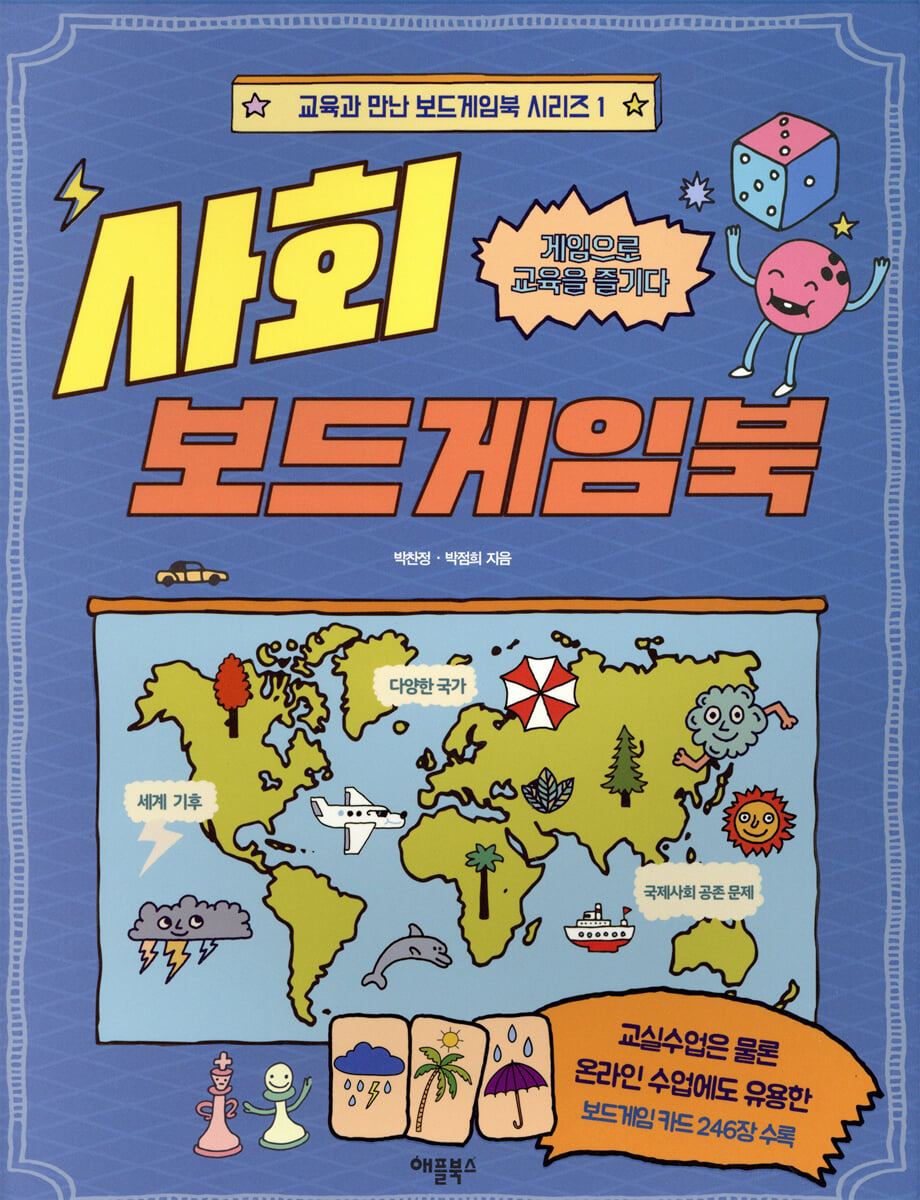
The problem of coexistence between world climate, countries, and the international community. . . A fun and educational social exploration journey with three board games! Gamification, or gamification in education, is a teaching method that increases student engagement by transforming boring and difficult classes into enjoyable activities and problem-solving using game-like thinking and game techniques. However, it is realistically very difficult to catch both rabbits of fun and learning in the classroom. For teachers and instructors struggling with these issues, Apple Books has published a collection of board game activity materials, "Social Board Game Book," which combines fun elements with learning, reconstructs classes based on each curriculum, and includes experiences in evaluation and recording. Authors Chan-Jeong Park and Jeom-Hee Park are Korea's top game education experts who have long dedicated themselves to popularizing gamification. The games introduced in this book are not simply entertainment or a pursuit of interest, but are also the product of collective intelligence that has been continuously refined through a long period of use in schools and has generously provided feedback and advice based on the experiences of fellow teachers across the country. |
- You can preview some of the book's contents.
Preview
index
Recommendation for this book
Prologue - Beyond simple pursuit of interest, to be used as a teaching tool
Structure and Use of This Book
Chapter 1: Adding Games to Education
Chapter 2: Climate Games
Climate World Game
Climate Pizza Game
Chapter 3: The International Coexistence Game
International Coexistence Game
Activity materials
Climate World Game Manual
Climate World Game Cards (80 cards)
Climate Pizza Game Manual
Climate Pizza Game Board
Climate Pizza Game Cards (130 cards)
International Coexistence Game Manual
National Cards (20 cards)
World Issues Cards (16 cards)
Points and Penalty Table for Presenters
blank check
Dice (developed)
Card cover
Prologue - Beyond simple pursuit of interest, to be used as a teaching tool
Structure and Use of This Book
Chapter 1: Adding Games to Education
Chapter 2: Climate Games
Climate World Game
Climate Pizza Game
Chapter 3: The International Coexistence Game
International Coexistence Game
Activity materials
Climate World Game Manual
Climate World Game Cards (80 cards)
Climate Pizza Game Manual
Climate Pizza Game Board
Climate Pizza Game Cards (130 cards)
International Coexistence Game Manual
National Cards (20 cards)
World Issues Cards (16 cards)
Points and Penalty Table for Presenters
blank check
Dice (developed)
Card cover
Detailed image

Into the book
But why aren't games widely used as classroom activities? The reason is that while games can be fun, few accurately address the intended learning and topic, or align perfectly with the learning topic.
It was precisely because of this problem that the authors decided to create a game.
We believed that if we could create games that were fun and appropriate for learning the subject matter, it would be of great benefit to both teachers and students.
---"prolog.
From “I hope it will be used as a teaching tool beyond simple pursuit of interest”
Board games are only available offline?
Let's break the prejudice.
It can also be used in various ways in online classes.
1.
Let's show various climate world cards in an online class and play a climate guessing game.
If you get it right, try increasing the difficulty and playing with undifferentiated climate pizza cards.
2.
Let's show a few sample Climate World cards and have students research the characteristics of climate and create their own cards.
3.
Showing students 4-5 climate pizza cards and having them discover commonalities or find cards that correspond to different climates based on differences can also develop students' thinking skills.
4.
After selecting a world problem card online, you can discuss and present international efforts to solve it.
You can also predict and discuss the stance that the country selected with the country card will take on the relevant world issue.
---From “The Structure and Use of This Book”
The author uses games as part of a student-centered class to break the stereotype that "studying is not fun" and to inspire "the will to stay awake and participate in class."
The nature of the games the authors play is not simply for fun, but as part of a class activity.
To achieve this, the curriculum is structured to improve the quality of learning by structuring learning content around the core concepts of the subject and appropriately adjusting the amount of learning.
In addition, we are activating various student-participatory classes that are suitable for the characteristics of the subject, so that students can develop self-directed learning skills and experience the joy of learning.
---From "Chapter 1: Adding Games to Education"
This happened when I was teaching a class about tundra climate.
When I told the students about the local people's reproduction and mosquito swarms, they showed great interest.
But when I showed the students a picture of a mosquito a few days later, they just thought it was a mosquito and didn't connect it to the tundra climate.
So, I started thinking about a fun way to learn that would help me remember things for a long time, rather than just learning by memorizing.
As a result, the class was designed to enable students to remember the characteristics of the climate as images and explore the characteristics in detail.
In particular, we created cards using images that students were interested in and organized the class into a game, which had a noticeable effect.
---From "Chapter 2: Climate Game"
The term "global village" is no longer a new concept, and problems occurring anywhere on Earth become my problems as a global citizen.
Globalization has become so widespread that it is difficult to separate local, national, and global issues, and your problems are organically linked to my problems and our problems.
But it still seems like a long way off before we can expect students to have the attitude of global citizens.
So, let's learn about the world's problems through games, participate as a member of the effort to solve them, and experience the attitude that is required of a global citizen.
Of course, it would be better if you could directly participate in the decision-making of international organizations, but considering practical constraints, these simulation games provide a good opportunity.
---From "Chapter 3: The International Coexistence Game"
Example of writing a life record book
· In the 'International Community Coexistence Game' activity, we identified the characteristics of the international community that prioritize their own interests and presented a logical basis for the attitude necessary to overcome this.
· In the 'International Community Coexistence Game' activity, we worked to accurately understand the problem to be solved and to lead the way toward solving the problem by demonstrating communication and collaboration skills.
· Through the 'International Community Coexistence Game' activity, I became interested in various problems facing humanity and had the opportunity to think about political and economic factors to solve them.
It was precisely because of this problem that the authors decided to create a game.
We believed that if we could create games that were fun and appropriate for learning the subject matter, it would be of great benefit to both teachers and students.
---"prolog.
From “I hope it will be used as a teaching tool beyond simple pursuit of interest”
Board games are only available offline?
Let's break the prejudice.
It can also be used in various ways in online classes.
1.
Let's show various climate world cards in an online class and play a climate guessing game.
If you get it right, try increasing the difficulty and playing with undifferentiated climate pizza cards.
2.
Let's show a few sample Climate World cards and have students research the characteristics of climate and create their own cards.
3.
Showing students 4-5 climate pizza cards and having them discover commonalities or find cards that correspond to different climates based on differences can also develop students' thinking skills.
4.
After selecting a world problem card online, you can discuss and present international efforts to solve it.
You can also predict and discuss the stance that the country selected with the country card will take on the relevant world issue.
---From “The Structure and Use of This Book”
The author uses games as part of a student-centered class to break the stereotype that "studying is not fun" and to inspire "the will to stay awake and participate in class."
The nature of the games the authors play is not simply for fun, but as part of a class activity.
To achieve this, the curriculum is structured to improve the quality of learning by structuring learning content around the core concepts of the subject and appropriately adjusting the amount of learning.
In addition, we are activating various student-participatory classes that are suitable for the characteristics of the subject, so that students can develop self-directed learning skills and experience the joy of learning.
---From "Chapter 1: Adding Games to Education"
This happened when I was teaching a class about tundra climate.
When I told the students about the local people's reproduction and mosquito swarms, they showed great interest.
But when I showed the students a picture of a mosquito a few days later, they just thought it was a mosquito and didn't connect it to the tundra climate.
So, I started thinking about a fun way to learn that would help me remember things for a long time, rather than just learning by memorizing.
As a result, the class was designed to enable students to remember the characteristics of the climate as images and explore the characteristics in detail.
In particular, we created cards using images that students were interested in and organized the class into a game, which had a noticeable effect.
---From "Chapter 2: Climate Game"
The term "global village" is no longer a new concept, and problems occurring anywhere on Earth become my problems as a global citizen.
Globalization has become so widespread that it is difficult to separate local, national, and global issues, and your problems are organically linked to my problems and our problems.
But it still seems like a long way off before we can expect students to have the attitude of global citizens.
So, let's learn about the world's problems through games, participate as a member of the effort to solve them, and experience the attitude that is required of a global citizen.
Of course, it would be better if you could directly participate in the decision-making of international organizations, but considering practical constraints, these simulation games provide a good opportunity.
---From "Chapter 3: The International Coexistence Game"
Example of writing a life record book
· In the 'International Community Coexistence Game' activity, we identified the characteristics of the international community that prioritize their own interests and presented a logical basis for the attitude necessary to overcome this.
· In the 'International Community Coexistence Game' activity, we worked to accurately understand the problem to be solved and to lead the way toward solving the problem by demonstrating communication and collaboration skills.
· Through the 'International Community Coexistence Game' activity, I became interested in various problems facing humanity and had the opportunity to think about political and economic factors to solve them.
---From "Chapter 3: The International Coexistence Game"
Publisher's Review
The ultimate goal of gamification, or classes utilizing games, is to make classes engaging and engaging for both teachers and students, thereby achieving significant learning outcomes.
However, the biggest concern for many teachers who want to utilize gamification is that the ideal of gamification as 'fun learning' is difficult to implement in real-world settings.
This book reflects this reality, paying careful attention to each element to encourage students to think proactively and participate in class through games.
Climate, geography, global citizenship, international social issues, etc.
Learn various social studies topics through games!
The educational effect of games is maximized through hands-on activities, such as touching with hands and feet, touching with the body, seeing with the eyes, hearing with the ears, and speaking.
The "Social Board Game Book" utilizes the strengths of these games to create a class that allows for learning while approaching difficult and complex issues such as climate, geography, and international coexistence in a friendly and fun way.
Each game can have different difficulty levels and methods to suit the age and level of the learners and the number of participants.
Additionally, the learning objectives are clearly presented, and the learning procedures, materials, and activity materials required for the game are included, so readers can immediately play the game on site without any additional preparation.
A new and innovative social studies board game book
The three games introduced in this book are broadly divided into climate games and international coexistence games.
Climate Games are further divided into Climate World Game and Climate Pizza Game.
The difference between the two climate games is the skills required to solve them.
In other words, while the Climate World game requires the ability to strategically place the acquired cards, the Climate Pizza game requires creative ability in card placement.
Even games that seem similar can be approached differently depending on your target skill level.
While climate games primarily focus on knowledge development, international coexistence games emphasize community capacity.
The International Coexistence Game is based on the understanding that problems occurring anywhere on Earth are our own problems. It allows players to think interestingly about the attitude each country should have toward solving international problems, and to experience becoming a direct agent in problem solving.
In this way, through the games in this book, participants can become active participants in class who enjoy the process rather than the outcome, and develop the ability to solve problems and think independently.
In the era of contactless, presenting new class content through gamification!
Includes 246 board game cards useful for both classroom and online classes.
This book specifically breaks the prejudice that board games are only available offline, and suggests various ways to utilize them in online classes.
In online classes, you can display climate cards, play a climate-guessing game, sample a few Climate World cards, and have students research climate characteristics and create their own cards.
You can also develop students' thinking skills by showing them 4-5 climate pizza cards and having them discover commonalities or designing a game where they find cards that correspond to different climates based on differences.
The International Coexistence Game allows users to select a world problem card online, then discuss and present international solutions.
You can also predict and discuss the stance that the country selected with the country card will take on the relevant world issue.
Who needs this book?
* Teachers who want to make online and offline classes more fun
* Board game instructors preparing new content in the non-face-to-face era
* Instructors who need differentiated after-school learning materials
* Students who want to learn social concepts such as climate, environment, and international issues in a fun way.
However, the biggest concern for many teachers who want to utilize gamification is that the ideal of gamification as 'fun learning' is difficult to implement in real-world settings.
This book reflects this reality, paying careful attention to each element to encourage students to think proactively and participate in class through games.
Climate, geography, global citizenship, international social issues, etc.
Learn various social studies topics through games!
The educational effect of games is maximized through hands-on activities, such as touching with hands and feet, touching with the body, seeing with the eyes, hearing with the ears, and speaking.
The "Social Board Game Book" utilizes the strengths of these games to create a class that allows for learning while approaching difficult and complex issues such as climate, geography, and international coexistence in a friendly and fun way.
Each game can have different difficulty levels and methods to suit the age and level of the learners and the number of participants.
Additionally, the learning objectives are clearly presented, and the learning procedures, materials, and activity materials required for the game are included, so readers can immediately play the game on site without any additional preparation.
A new and innovative social studies board game book
The three games introduced in this book are broadly divided into climate games and international coexistence games.
Climate Games are further divided into Climate World Game and Climate Pizza Game.
The difference between the two climate games is the skills required to solve them.
In other words, while the Climate World game requires the ability to strategically place the acquired cards, the Climate Pizza game requires creative ability in card placement.
Even games that seem similar can be approached differently depending on your target skill level.
While climate games primarily focus on knowledge development, international coexistence games emphasize community capacity.
The International Coexistence Game is based on the understanding that problems occurring anywhere on Earth are our own problems. It allows players to think interestingly about the attitude each country should have toward solving international problems, and to experience becoming a direct agent in problem solving.
In this way, through the games in this book, participants can become active participants in class who enjoy the process rather than the outcome, and develop the ability to solve problems and think independently.
In the era of contactless, presenting new class content through gamification!
Includes 246 board game cards useful for both classroom and online classes.
This book specifically breaks the prejudice that board games are only available offline, and suggests various ways to utilize them in online classes.
In online classes, you can display climate cards, play a climate-guessing game, sample a few Climate World cards, and have students research climate characteristics and create their own cards.
You can also develop students' thinking skills by showing them 4-5 climate pizza cards and having them discover commonalities or designing a game where they find cards that correspond to different climates based on differences.
The International Coexistence Game allows users to select a world problem card online, then discuss and present international solutions.
You can also predict and discuss the stance that the country selected with the country card will take on the relevant world issue.
Who needs this book?
* Teachers who want to make online and offline classes more fun
* Board game instructors preparing new content in the non-face-to-face era
* Instructors who need differentiated after-school learning materials
* Students who want to learn social concepts such as climate, environment, and international issues in a fun way.
GOODS SPECIFICS
- Date of issue: September 23, 2020
- Page count, weight, size: 168 pages | 668g | 190*250*20mm
- ISBN13: 9791190147309
- ISBN10: 1190147300
You may also like
카테고리
korean


korean

![GQ KOREA Mark (Monthly): December [2025]](http://librairie.coreenne.fr/cdn/shop/files/8ef265dbbfbf186523ed75ba7319009d.jpg?v=1765340328&width=3840)


