

Kim Kwan-young's challenge
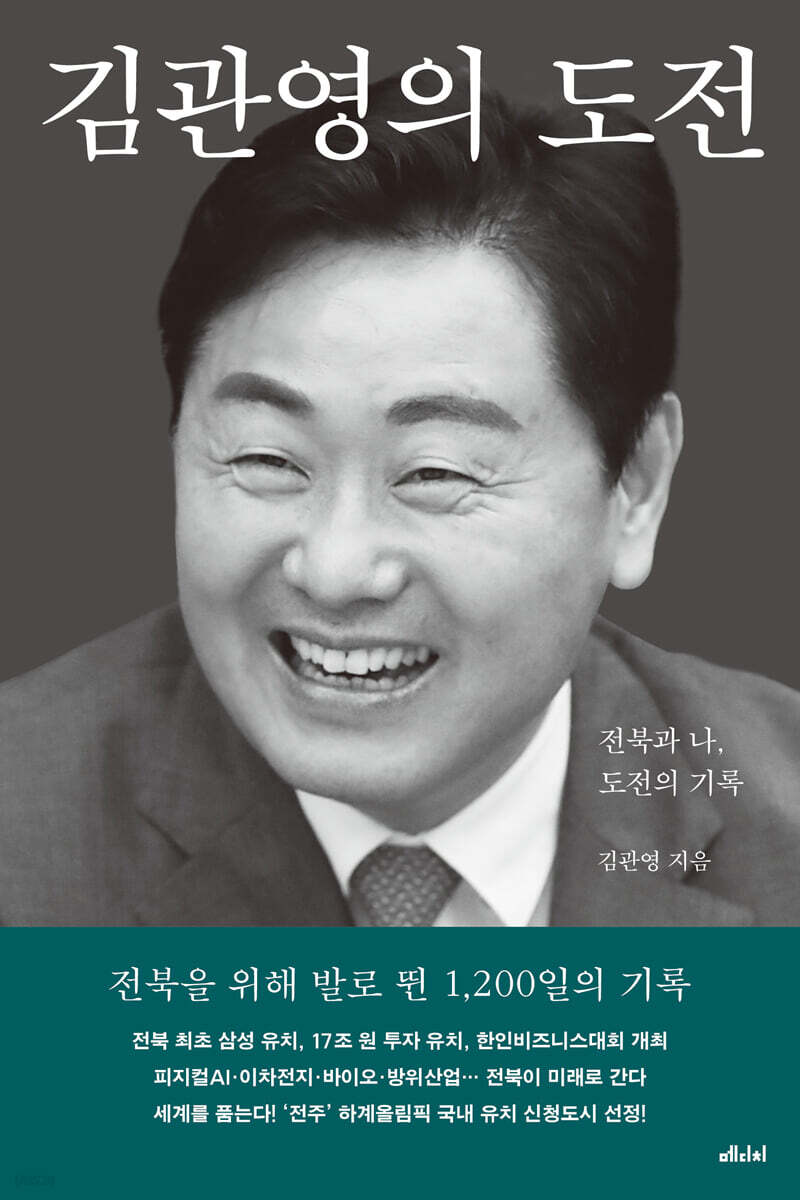 |
Description
Book Introduction
“Be humble to the people, be competent in administration.”
From a 17 trillion won investment to "AI Jeonbuk," and even hosting the Summer Olympics, leadership is taking on the challenge.
Everything You Need to Know About Kim Kwan-young's Politics, Which Gave Him the Highest Voting Rating in the Nation
We need competent administrators! In just three years since taking office, Governor Kim Kwan-young has secured 17 trillion won in investment, created a 1 trillion won startup fund, selected a specialized secondary battery complex, and even selected Jeonju as the city to bid for the Summer Olympics. The challenges of Governor Kim Kwan-young, who is transforming the future of Jeollabuk-do, and indeed the future of the Republic of Korea, continue.
Instead of using the typical politician-introducing phrases, Governor Kim Kwan-young defines himself as a “challenging man who never rests” and a “governor who gets things done.”
He defined the essence of the 'challenge' ahead of the lunar exploration, John F.
I like to quote US President Kennedy.
“We decided to go to the moon.
“It’s not because it’s easy, it’s because it’s hard.”
The author challenges and challenges again to reform Jeollabuk-do, which remains underdeveloped amidst multiple layers of marginalization: regional marginalization, Honam marginalization, and marginalization within Honam.
By attracting large-scale investments and global events, we are redrawing Jeonbuk's industrial map in areas such as physical AI, secondary batteries, biotechnology, and defense, and designing future strategies for Jeonbuk and the Republic of Korea.
"Kim Kwan-young's Challenge" is not a self-help book that boasts of the author's impressive background as a "triple crown winner" or a top lawyer at Kim & Chang.
This is a 'field record of innovation' that he is experiencing and breaking through in real time to become a 'governor who is humble to the people and competent in administration.'
“Challenges don’t start with perfect preparation.
Rather, it is a record of how he has proven the single sentence, “It starts from an imperfect passion,” through specific choices from his days as a rural boy to today’s governor of Jeollabuk-do Special Self-Governing Province.
From a 17 trillion won investment to "AI Jeonbuk," and even hosting the Summer Olympics, leadership is taking on the challenge.
Everything You Need to Know About Kim Kwan-young's Politics, Which Gave Him the Highest Voting Rating in the Nation
We need competent administrators! In just three years since taking office, Governor Kim Kwan-young has secured 17 trillion won in investment, created a 1 trillion won startup fund, selected a specialized secondary battery complex, and even selected Jeonju as the city to bid for the Summer Olympics. The challenges of Governor Kim Kwan-young, who is transforming the future of Jeollabuk-do, and indeed the future of the Republic of Korea, continue.
Instead of using the typical politician-introducing phrases, Governor Kim Kwan-young defines himself as a “challenging man who never rests” and a “governor who gets things done.”
He defined the essence of the 'challenge' ahead of the lunar exploration, John F.
I like to quote US President Kennedy.
“We decided to go to the moon.
“It’s not because it’s easy, it’s because it’s hard.”
The author challenges and challenges again to reform Jeollabuk-do, which remains underdeveloped amidst multiple layers of marginalization: regional marginalization, Honam marginalization, and marginalization within Honam.
By attracting large-scale investments and global events, we are redrawing Jeonbuk's industrial map in areas such as physical AI, secondary batteries, biotechnology, and defense, and designing future strategies for Jeonbuk and the Republic of Korea.
"Kim Kwan-young's Challenge" is not a self-help book that boasts of the author's impressive background as a "triple crown winner" or a top lawyer at Kim & Chang.
This is a 'field record of innovation' that he is experiencing and breaking through in real time to become a 'governor who is humble to the people and competent in administration.'
“Challenges don’t start with perfect preparation.
Rather, it is a record of how he has proven the single sentence, “It starts from an imperfect passion,” through specific choices from his days as a rural boy to today’s governor of Jeollabuk-do Special Self-Governing Province.
- You can preview some of the book's contents.
Preview
index
Prologue Challenge is my other name
Part 1: A Country Boy's Struggle
From boy worker to worker of the Republic of Korea
Chapter 1: Even the government can do it!: The challenge is learning.
Chapter 2: The Challenge of Remembering Shame: Mother's Letter
Chapter 3, 1987: College Student Kim Kwan-young
Chapter 4: People Don't Grow Alone: The Angels in Our Lives
Chapter 5: Thinking about the Nation for the First Time: The Experiences of Civil Servants at the Ministry of Strategy and Finance
Chapter 6: Practical Insights Learned from a Top Law Firm: 10 Years of Experience at Kim & Chang
Part 2: Q&A
Why I Should Go Into Politics
Chapter 7: Becoming a Good Member of Parliament: Getting Started in Politics
Chapter 8: The Outline of Kim Kwan-young's Politics: Pragmatism and Principles, National Interest and the People
Chapter 9: The Nation's Highest Vote: Jeonbuk Governor's Challenge for a Bigger Politics
Governor doing PT in Part 3
Jeollabuk-do representative worker Kim Gwan-young
Chapter 10: The Future Lies in the Economy: Attracting Investment: The Businessmen and Governors
Chapter 11: Building Jeonbuk Special Self-Governing Province Together: Dreaming of a One-Team Jeonbuk
Chapter 12: If Youth Persevere, So Will the Region Persevere: How to Save Population and Talent
Chapter 13: Let's Host the Olympics in Jeonbuk: We Embrace the World
Epilogue: Governor's business record: 5 wins, 1 draw, 1 loss. I will continue to challenge myself!
Part 1: A Country Boy's Struggle
From boy worker to worker of the Republic of Korea
Chapter 1: Even the government can do it!: The challenge is learning.
Chapter 2: The Challenge of Remembering Shame: Mother's Letter
Chapter 3, 1987: College Student Kim Kwan-young
Chapter 4: People Don't Grow Alone: The Angels in Our Lives
Chapter 5: Thinking about the Nation for the First Time: The Experiences of Civil Servants at the Ministry of Strategy and Finance
Chapter 6: Practical Insights Learned from a Top Law Firm: 10 Years of Experience at Kim & Chang
Part 2: Q&A
Why I Should Go Into Politics
Chapter 7: Becoming a Good Member of Parliament: Getting Started in Politics
Chapter 8: The Outline of Kim Kwan-young's Politics: Pragmatism and Principles, National Interest and the People
Chapter 9: The Nation's Highest Vote: Jeonbuk Governor's Challenge for a Bigger Politics
Governor doing PT in Part 3
Jeollabuk-do representative worker Kim Gwan-young
Chapter 10: The Future Lies in the Economy: Attracting Investment: The Businessmen and Governors
Chapter 11: Building Jeonbuk Special Self-Governing Province Together: Dreaming of a One-Team Jeonbuk
Chapter 12: If Youth Persevere, So Will the Region Persevere: How to Save Population and Talent
Chapter 13: Let's Host the Olympics in Jeonbuk: We Embrace the World
Epilogue: Governor's business record: 5 wins, 1 draw, 1 loss. I will continue to challenge myself!
Into the book
The challenge to the impossible continues.
Because it is that difficult and there are many goals to achieve.
First, I will host the world's first 'City Solidarity Olympics' with other regions, centered around the Jeonbuk Special Self-Governing Province.
On February 28, 2025, when Jeollabuk-do Special Self-Governing Province was selected as a domestic candidate city for the 2036 Olympics, many people congratulated and praised it, but there was also a lot of sarcasm, such as, "What kind of international event is this in a rural area?"
Although not to my face, people I knew said the same thing, and anonymous message boards were noisy with even regionally discriminatory remarks.
I don't care about such words.
If you ask, 'How is it possible to hold an international event in a village?', I will answer point by point and persuade you.
Because there are numerous grounds for answering.
But if you are asking for qualifications by saying something like, 'What kind of international event is this in a small town?' then there is no need to answer that.
This is because it is an attitude that does not acknowledge challenges, drawing the line first by saying that it is not possible without asking whether it is possible or not.
--- From "Prologue: Challenge is my other name"
I stood quietly next to my mother and looked out the car window.
Honestly, I was embarrassed.
There were cousins and friends on the bus, and I felt ashamed of my mother's stubbornness as she argued with the driver.
As I was going through puberty, I could see the female students glancing at me.
I slowly went to the back seat and stayed quiet before getting off the bus.
My mother never mentioned it, but I kept thinking about that day when I ignored her and ignored her as if I didn't know her.
What would my mother do if I had been fighting with the driver over something similar?
He would have been more upset than me and taken my side.
The scene where I turned away from a mother who suffered so much for her child, unable to understand her heart, played over and over again in my head, making me feel ashamed.
--- From "Chapter 2: The Challenge of Remembering Shame: Mother's Letter"
When you're in politics, it's easy to make excessive remarks or engage in harsh attacks, as if you're determined to win without compromise or retreat for the sake of your camp's victory.
I have never insulted him as a person, although I have sometimes embarrassed him with sharp questions.
The same goes for Representative Choi Kyung-hwan and other politicians.
Because I thought that was the courtesy that I should have as a politician, or rather as a mature citizen.
Knowing that criticism and rudeness are not the same thing has helped me maintain long-term relationships with people.
In the end, isn't it 'people who remain'?
--- From "Chapter 5: Thinking about the Country for the First Time: Experiences of Civil Servants in the Ministry of Strategy and Finance"
At the time, Kim & Chang partner lawyers were paid based on the number of hours they worked.
For them, time spent eating and drinking beer with clients is a 'loss', so they rarely meet clients outside.
Because it doesn't help your income.
At the time, Kim & Chang seemed to think that since they were always busy even if they just sat still, there was no need to be kind to clients and build relationships.
But I thought differently.
As competition among law firms becomes increasingly fierce, I believe that the time will soon come when client management will become necessary.
I thought that if I built a personal relationship with my customers, they would keep coming back to me.
At some point, clients started calling me 'the most un-Kim & Chang-like lawyer.'
He is the only lawyer at Kim & Chang who has broken away from the image of a businesslike and individualistic lawyer.
--- From "Chapter 6: Practical Sense Learned from a Top Law Firm: 10 Years of Experience at Kim & Chang"
The concerns about "post-democracy," achieved through the blood and sweat of the people, ultimately led to the question of how to solve the social problems facing our country.
Since democratization, the social demands and conflicts that have erupted throughout our society have not been able to reach the National Assembly, the temple of public opinion, and have remained in the public square.
For democracy to take root and mature, the National Assembly and political parties must fulfill their original roles.
The politics of the new era must be to create a political culture of dialogue and compromise to resolve the conflicts and confrontations in our society and realize a mature democracy.
When I came to this conclusion, I felt much more at ease.
Because it became clear why I had to get into politics.
--- From "Chapter 7: Becoming a Good Member of the National Assembly: Starting Politics"
Politics must not miss even the smallest elements that affect citizens' daily lives.
While crises that could threaten the very existence of the Republic of Korea, such as fine dust, suicide, and low birth rates, are ongoing, politics has been idle.
With one year left in the 20th National Assembly's term, I appealed to everyone not to miss this golden time.
The emphasis on 'politics that serve the people' later became a major foundation for my running for governor of Jeollabuk-do, being elected governor, and implementing policies.
--- From "Chapter 8: The Outline of Kim Kwan-young's Politics: Pragmatism and Principles, National Interest and the People"
I was elected Governor of North Jeolla Province in the 8th National Simultaneous Local Elections held on June 1, 2022, with 82.11% of the votes, the highest among the 17 metropolitan government heads nationwide.
It was the first time that the vote rate exceeded 80% in the Jeonbuk gubernatorial election, and it was also the highest vote rate ever.
The moment I saw the number 82.11, I felt more fear than joy.
The overwhelming support I received from the people of Jeollabuk-do was a stern command: "Revive the collapsed Jeollabuk-do economy," "Reform Jeollabuk-do politics that are complacent with vested interests and the status quo," and "Restore Jeollabuk-do's pride through clean and competent provincial administration."
Jeonbuk has not had much experience with great success in national projects in recent years.
I don't have much experience winning first place in a national competition.
I wanted to create a success story for our residents.
I wanted to show Jeonbuk that a new leap forward and success is not an impossible dream, but a reality that can be achieved through constant challenge, and to instill confidence in them.
Attracting large corporations is the most realistic solution to all of Jeollabuk-do's pressing issues: economic stagnation, lack of quality jobs, population decline crisis, and education problems.
Because many of the problems facing the region stem from economic difficulties.
The reason why Jeonbuk's economy has been struggling is largely because it has not been able to establish a proper growth engine since entering the industrialization era.
(…) To keep young people in the region, there must be good jobs, and to create good jobs, there must be good, promising companies.
In that sense, attracting companies such as large corporations and startups was not an option for Jeonbuk, but a survival strategy.
--- From "Chapter 10: The Future Lies in the Economy: The Businessmen Governors Who Attract Investment"
The 'Century Forum' is held three times a month, every Tuesday, in the wiretapping conference room.
This is a forum to delve into issues of coexistence and livelihood, starting with diplomacy and security, previously considered merely national issues, while simultaneously exploring policy solutions to ensure our province plays a leading role.
This forum was planned based on my motto, “Let’s study with the best experts in Korea.”
Because without studying, you cannot take responsibility for the lives of the citizens and manage them.
I think 'the most dangerous leader is the one who works by feeling without studying.'
--- From "Chapter 11: Creating Jeonbuk Special Self-Governing Province Together: Dreaming of a One-Team Jeonbuk"
“I believe our goal should be to ensure that young people in Jeollabuk-do are born in Jeollabuk-do, study in Jeollabuk-do, get a job in Jeollabuk-do, get married in Jeollabuk-do, and raise their children in Jeollabuk-do.
We need to support people so that they don't give up on marriage and postpone their future because of worries about an uncertain future.
The 'Youth Hope High, Children High' project is a policy that fosters hope in young people and happiness in children. In order to give hope to young people and children, the provincial government had to take the lead.
A project has been launched to make wiretapping a family-friendly workplace.
First, to encourage childbirth, we expanded childcare leave for civil servants with multiple children.
Civil servants with children under 8 years of age or in the second grade of elementary school or lower are granted childcare leave of only 5 days per year, regardless of the number of children, but this has been expanded to 7 days for those with two children and 10 days for those with three or more children.
--- From "Chapter 12: If Youth Persevere, Regions Persevere: How to Save Population and Talent"
I am a representative worker of Jeonbuk Special Self-Governing Province.
He is the first person to go to places where the people of Jeollabuk-do are in need, and the last person to go to bed for their peace.
Sometimes it brings pride, sometimes it leaves scars, but the journey always makes my heart race.
The reason why he never gives up even in moments of failure and frustration is because he understands the hearts of Jeollabuk-do and its people better than anyone else.
(…) According to the Sports Basic Act enacted in 2021, ‘all citizens shall not be discriminated against in their right to enjoy sports.’
The state has a duty to eliminate regional sports disparities and promote balanced development, and its citizens must be able to enjoy sports equally.
If we only consider infrastructure, all international events should be held in Seoul for a thousand years to come.
Now we need to turn our attention to the provinces.
We need to show the world that South Korea is not just about Seoul.
--- From "Chapter 13: Let's Have an Olympics in Jeonbuk: We Embrace the World"
I have set the goal of my journey as 'Challenge leads to success', which means 'if you challenge, you will succeed', and have been constantly challenging myself.
And as a representative worker for the people of Jeollabuk-do, he took on the role of constantly sowing seeds.
We must not be greedy and expect to see the fruits of our sowing within our term of office.
My role is to make sure that the seeds take root in the ground and sprout vibrant leaves.
If we lay a solid foundation, anyone who comes will be able to fully realize the potential of Jeollabuk-do.
The future of Jeollabuk-do that I envision is one where Jeollabuk-do continues to prosper under a strong system.
This is why I am dedicated to the basic work needed in Jeollabuk-do.
Because it is that difficult and there are many goals to achieve.
First, I will host the world's first 'City Solidarity Olympics' with other regions, centered around the Jeonbuk Special Self-Governing Province.
On February 28, 2025, when Jeollabuk-do Special Self-Governing Province was selected as a domestic candidate city for the 2036 Olympics, many people congratulated and praised it, but there was also a lot of sarcasm, such as, "What kind of international event is this in a rural area?"
Although not to my face, people I knew said the same thing, and anonymous message boards were noisy with even regionally discriminatory remarks.
I don't care about such words.
If you ask, 'How is it possible to hold an international event in a village?', I will answer point by point and persuade you.
Because there are numerous grounds for answering.
But if you are asking for qualifications by saying something like, 'What kind of international event is this in a small town?' then there is no need to answer that.
This is because it is an attitude that does not acknowledge challenges, drawing the line first by saying that it is not possible without asking whether it is possible or not.
--- From "Prologue: Challenge is my other name"
I stood quietly next to my mother and looked out the car window.
Honestly, I was embarrassed.
There were cousins and friends on the bus, and I felt ashamed of my mother's stubbornness as she argued with the driver.
As I was going through puberty, I could see the female students glancing at me.
I slowly went to the back seat and stayed quiet before getting off the bus.
My mother never mentioned it, but I kept thinking about that day when I ignored her and ignored her as if I didn't know her.
What would my mother do if I had been fighting with the driver over something similar?
He would have been more upset than me and taken my side.
The scene where I turned away from a mother who suffered so much for her child, unable to understand her heart, played over and over again in my head, making me feel ashamed.
--- From "Chapter 2: The Challenge of Remembering Shame: Mother's Letter"
When you're in politics, it's easy to make excessive remarks or engage in harsh attacks, as if you're determined to win without compromise or retreat for the sake of your camp's victory.
I have never insulted him as a person, although I have sometimes embarrassed him with sharp questions.
The same goes for Representative Choi Kyung-hwan and other politicians.
Because I thought that was the courtesy that I should have as a politician, or rather as a mature citizen.
Knowing that criticism and rudeness are not the same thing has helped me maintain long-term relationships with people.
In the end, isn't it 'people who remain'?
--- From "Chapter 5: Thinking about the Country for the First Time: Experiences of Civil Servants in the Ministry of Strategy and Finance"
At the time, Kim & Chang partner lawyers were paid based on the number of hours they worked.
For them, time spent eating and drinking beer with clients is a 'loss', so they rarely meet clients outside.
Because it doesn't help your income.
At the time, Kim & Chang seemed to think that since they were always busy even if they just sat still, there was no need to be kind to clients and build relationships.
But I thought differently.
As competition among law firms becomes increasingly fierce, I believe that the time will soon come when client management will become necessary.
I thought that if I built a personal relationship with my customers, they would keep coming back to me.
At some point, clients started calling me 'the most un-Kim & Chang-like lawyer.'
He is the only lawyer at Kim & Chang who has broken away from the image of a businesslike and individualistic lawyer.
--- From "Chapter 6: Practical Sense Learned from a Top Law Firm: 10 Years of Experience at Kim & Chang"
The concerns about "post-democracy," achieved through the blood and sweat of the people, ultimately led to the question of how to solve the social problems facing our country.
Since democratization, the social demands and conflicts that have erupted throughout our society have not been able to reach the National Assembly, the temple of public opinion, and have remained in the public square.
For democracy to take root and mature, the National Assembly and political parties must fulfill their original roles.
The politics of the new era must be to create a political culture of dialogue and compromise to resolve the conflicts and confrontations in our society and realize a mature democracy.
When I came to this conclusion, I felt much more at ease.
Because it became clear why I had to get into politics.
--- From "Chapter 7: Becoming a Good Member of the National Assembly: Starting Politics"
Politics must not miss even the smallest elements that affect citizens' daily lives.
While crises that could threaten the very existence of the Republic of Korea, such as fine dust, suicide, and low birth rates, are ongoing, politics has been idle.
With one year left in the 20th National Assembly's term, I appealed to everyone not to miss this golden time.
The emphasis on 'politics that serve the people' later became a major foundation for my running for governor of Jeollabuk-do, being elected governor, and implementing policies.
--- From "Chapter 8: The Outline of Kim Kwan-young's Politics: Pragmatism and Principles, National Interest and the People"
I was elected Governor of North Jeolla Province in the 8th National Simultaneous Local Elections held on June 1, 2022, with 82.11% of the votes, the highest among the 17 metropolitan government heads nationwide.
It was the first time that the vote rate exceeded 80% in the Jeonbuk gubernatorial election, and it was also the highest vote rate ever.
The moment I saw the number 82.11, I felt more fear than joy.
The overwhelming support I received from the people of Jeollabuk-do was a stern command: "Revive the collapsed Jeollabuk-do economy," "Reform Jeollabuk-do politics that are complacent with vested interests and the status quo," and "Restore Jeollabuk-do's pride through clean and competent provincial administration."
Jeonbuk has not had much experience with great success in national projects in recent years.
I don't have much experience winning first place in a national competition.
I wanted to create a success story for our residents.
I wanted to show Jeonbuk that a new leap forward and success is not an impossible dream, but a reality that can be achieved through constant challenge, and to instill confidence in them.
Attracting large corporations is the most realistic solution to all of Jeollabuk-do's pressing issues: economic stagnation, lack of quality jobs, population decline crisis, and education problems.
Because many of the problems facing the region stem from economic difficulties.
The reason why Jeonbuk's economy has been struggling is largely because it has not been able to establish a proper growth engine since entering the industrialization era.
(…) To keep young people in the region, there must be good jobs, and to create good jobs, there must be good, promising companies.
In that sense, attracting companies such as large corporations and startups was not an option for Jeonbuk, but a survival strategy.
--- From "Chapter 10: The Future Lies in the Economy: The Businessmen Governors Who Attract Investment"
The 'Century Forum' is held three times a month, every Tuesday, in the wiretapping conference room.
This is a forum to delve into issues of coexistence and livelihood, starting with diplomacy and security, previously considered merely national issues, while simultaneously exploring policy solutions to ensure our province plays a leading role.
This forum was planned based on my motto, “Let’s study with the best experts in Korea.”
Because without studying, you cannot take responsibility for the lives of the citizens and manage them.
I think 'the most dangerous leader is the one who works by feeling without studying.'
--- From "Chapter 11: Creating Jeonbuk Special Self-Governing Province Together: Dreaming of a One-Team Jeonbuk"
“I believe our goal should be to ensure that young people in Jeollabuk-do are born in Jeollabuk-do, study in Jeollabuk-do, get a job in Jeollabuk-do, get married in Jeollabuk-do, and raise their children in Jeollabuk-do.
We need to support people so that they don't give up on marriage and postpone their future because of worries about an uncertain future.
The 'Youth Hope High, Children High' project is a policy that fosters hope in young people and happiness in children. In order to give hope to young people and children, the provincial government had to take the lead.
A project has been launched to make wiretapping a family-friendly workplace.
First, to encourage childbirth, we expanded childcare leave for civil servants with multiple children.
Civil servants with children under 8 years of age or in the second grade of elementary school or lower are granted childcare leave of only 5 days per year, regardless of the number of children, but this has been expanded to 7 days for those with two children and 10 days for those with three or more children.
--- From "Chapter 12: If Youth Persevere, Regions Persevere: How to Save Population and Talent"
I am a representative worker of Jeonbuk Special Self-Governing Province.
He is the first person to go to places where the people of Jeollabuk-do are in need, and the last person to go to bed for their peace.
Sometimes it brings pride, sometimes it leaves scars, but the journey always makes my heart race.
The reason why he never gives up even in moments of failure and frustration is because he understands the hearts of Jeollabuk-do and its people better than anyone else.
(…) According to the Sports Basic Act enacted in 2021, ‘all citizens shall not be discriminated against in their right to enjoy sports.’
The state has a duty to eliminate regional sports disparities and promote balanced development, and its citizens must be able to enjoy sports equally.
If we only consider infrastructure, all international events should be held in Seoul for a thousand years to come.
Now we need to turn our attention to the provinces.
We need to show the world that South Korea is not just about Seoul.
--- From "Chapter 13: Let's Have an Olympics in Jeonbuk: We Embrace the World"
I have set the goal of my journey as 'Challenge leads to success', which means 'if you challenge, you will succeed', and have been constantly challenging myself.
And as a representative worker for the people of Jeollabuk-do, he took on the role of constantly sowing seeds.
We must not be greedy and expect to see the fruits of our sowing within our term of office.
My role is to make sure that the seeds take root in the ground and sprout vibrant leaves.
If we lay a solid foundation, anyone who comes will be able to fully realize the potential of Jeollabuk-do.
The future of Jeollabuk-do that I envision is one where Jeollabuk-do continues to prosper under a strong system.
This is why I am dedicated to the basic work needed in Jeollabuk-do.
--- From "Epilogue: Governor's business record: 5 wins, 1 draw, 1 loss, I will continue to challenge!"
Publisher's Review
“For me, work is a challenge, and challenge is a way of life.”
“I will take on a challenge even if there is only a 1% chance.”
“If Jeonbuk does well, South Korea does well.”
Let's erase the 'Southern Limit Line'!
There is a saying, 'The southern limit of large corporations.'
This means that below a certain point in Gyeonggi-do, there will be no large corporations, no talent, no technological innovation, and no economic development.
Jeonbuk Special Self-Governing Province Governor Kim Kwan-young believes that the term "southern limit of large corporations" is a bad term that denies "challenge" and "possibility" from the outset.
Bad words bring bad effects like a spell and act as a limit to our thinking.
The author is erasing the term 'Southern Limit Line' through challenges and the achievements that follow.
Of course, it is true that areas outside the metropolitan area lack many things and are economically stagnant.
In particular, Jeonbuk has a weak manufacturing base.
However, Governor Kim Kwan-young sees this ‘emptiness’ as an opportunity.
Because it is a space that holds the possibility of a new beginning.
The challenge has already been successful.
Within three years of taking office as governor, he achieved significant investment results that secured the future, such as attracting 17 trillion won in investment, establishing a 1 trillion won startup fund, and selecting a secondary battery specialized complex. He also successfully hosted the World Korean Business Conference and, most notably, was selected as the city to bid for the Jeonju Summer Olympics, competing with Seoul. He also recorded remarkable results.
These are challenges that will change the future of Jeonbuk, no, the future of the Republic of Korea.
Governor Kim Kwan-young is also redrawing the regional industrial map to ensure that physical AI, secondary batteries, bio, and defense industries become the province's bread and butter. He is also exploring various support measures, including smart factories, to ensure that local businesses can thrive and grow.
These are all future strategies for the region to survive in the long term.
A record of a politician who chose action over words and substance over form.
Kim Kwan-young, the governor of North Jeolla Province, started out as a so-called "triple crown winner" by passing the Certified Public Accountant exam, the Civil Service Exam, and the Bar Exam. He then served as a bureaucrat at the Ministry of Strategy and Finance, a lawyer at Kim & Chang, a member of the National Assembly, and a floor leader before becoming the governor of North Jeolla Province.
But what this book shows is not a list of brilliant careers.
The story honestly unfolds, including the shameful memory of ignoring his mother while she was out selling food on the school bus, the image of a boy growing up in poverty who helped his parents by twisting ropes and pulling out songs during rice planting, and the story of failing an exam because he fell in love for the first time.
The author had failed several exams before earning the title of 'triple crown champion', and had even lost his third term as a member of the National Assembly.
But Governor Kim Kwan-young never stopped challenging himself or chose to settle for anything.
This book showcases the struggles, mistakes, and moments of success of a politician who designed policies with challenging numbers, met people's livelihoods on the ground, and prioritized the region and the future over partisan interests.
The keyword that runs through all these scenes is ‘challenge.’
The burden, responsibility, and reward of choosing a new path over the safe route are expressed in honest sentences.
A governor who is not afraid of failure and does personal training himself.
Governor Kim Kwan-young is famous as a 'provincial governor who does PT.'
If it is something important to the future of Tao, he personally steps forward and presents it after much preparation and practice.
The self-revealed report card was 5 wins, 1 draw, and 1 loss! Everyone around him was trying to dissuade him, saying it was "impossible."
The five wins include the Hypertube vacuum tube project, the Iksan Youth Stepping Center project, the secondary battery specialized complex, the World Korean Business Conference, and the candidate city for the Summer Olympics.
The bio-specialized complex was recorded as a draw due to the government's delay in designating it, and the construction project for the Republic of Korea Tidal Flat Conservation Center was recorded as a loss as it was given to Sinan County in South Jeolla Province.
Although the result was a defeat, the Ministry of Oceans and Fisheries promised an additional 5 billion won in support to the region.
The author believes that one must be willing to embrace failure in order to continue challenging oneself.
Because we know that we can't do anything if we're afraid of failure, and that the lessons we learn from failure are sometimes more valuable than success.
Besides, failure doesn't mean there are no results.
Because by analyzing why you failed, you can learn a new formula for success.
Now, even the people of North Jeolla Province, including the wiretapping staff, believe Governor Kim Kwan-young's claim that "if you challenge yourself, you will succeed."
Because I saw the results of the challenge with my own eyes.
The belief that “the path Jeonbuk will open is the path that the Republic of Korea will take.”
Governor Kim Kwan-young, who led the launch of the Jeollabuk-do Special Self-Governing Province, has repeatedly emphasized the message since taking office that “the path Jeollabuk-do will open is the path the Republic of Korea will take.”
This book interprets that sentence not as political rhetoric, but as the language of concrete plans and projects.
We calmly examine, from Governor Kim Kwan-young's perspective, what changes the special autonomous province system seeks to make, how the Jeonbuk model is being designed in areas such as industry, finance, education, and welfare, and what cards local governments can actually choose amidst population decline and the crisis of regional extinction.
Rather than a rigid explanation like a policy report, it explains “why this path was chosen” based on experience gained from working with real people and the field.
The author created industrial complexes in Saemangeum and other areas, worked to attract large corporations, and introduced and supported smart factories to help local businesses survive and grow.
Under the belief that "only when young people persevere can the region ultimately persevere," Jeollabuk-do implemented support policies for youth housing, marriage, childbirth, and childcare. Furthermore, Jeollabuk-do actively embraced the ideas of public officials and engaged in internal training to ensure that the province could operate as a "one team."
Why must Jeonbuk survive? Because if only Seoul and the metropolitan area survive, South Korea has no future.
Governor Kim Kwan-young changes the region and changes the Republic of Korea.
That is his challenge.
Questions about Korean politics
"Kim Kwan-young's Challenge" goes beyond the memoir of a local government head to pose several questions about Korean politics as a whole.
①Is pragmatic politics possible?
Beyond ideology and factions, how can politics that "make things happen" be realized in reality?
② In an age of political hatred, how should politicians be evaluated?
Was Governor Kim Kwan-young's attempt to be evaluated based on the results of his budget and policies, rather than his words, successful? If there were limitations, what were the causes?
③How far can local governments go in their challenges?
Can the special autonomous province system and Governor Kim Kwan-young's various experiments truly transform the region's future, or will they remain just another administrative term?
Rather than providing answers to these questions, the book presents real-life examples and the process of thinking before the reader, encouraging them to think together.
“I will take on a challenge even if there is only a 1% chance.”
“If Jeonbuk does well, South Korea does well.”
Let's erase the 'Southern Limit Line'!
There is a saying, 'The southern limit of large corporations.'
This means that below a certain point in Gyeonggi-do, there will be no large corporations, no talent, no technological innovation, and no economic development.
Jeonbuk Special Self-Governing Province Governor Kim Kwan-young believes that the term "southern limit of large corporations" is a bad term that denies "challenge" and "possibility" from the outset.
Bad words bring bad effects like a spell and act as a limit to our thinking.
The author is erasing the term 'Southern Limit Line' through challenges and the achievements that follow.
Of course, it is true that areas outside the metropolitan area lack many things and are economically stagnant.
In particular, Jeonbuk has a weak manufacturing base.
However, Governor Kim Kwan-young sees this ‘emptiness’ as an opportunity.
Because it is a space that holds the possibility of a new beginning.
The challenge has already been successful.
Within three years of taking office as governor, he achieved significant investment results that secured the future, such as attracting 17 trillion won in investment, establishing a 1 trillion won startup fund, and selecting a secondary battery specialized complex. He also successfully hosted the World Korean Business Conference and, most notably, was selected as the city to bid for the Jeonju Summer Olympics, competing with Seoul. He also recorded remarkable results.
These are challenges that will change the future of Jeonbuk, no, the future of the Republic of Korea.
Governor Kim Kwan-young is also redrawing the regional industrial map to ensure that physical AI, secondary batteries, bio, and defense industries become the province's bread and butter. He is also exploring various support measures, including smart factories, to ensure that local businesses can thrive and grow.
These are all future strategies for the region to survive in the long term.
A record of a politician who chose action over words and substance over form.
Kim Kwan-young, the governor of North Jeolla Province, started out as a so-called "triple crown winner" by passing the Certified Public Accountant exam, the Civil Service Exam, and the Bar Exam. He then served as a bureaucrat at the Ministry of Strategy and Finance, a lawyer at Kim & Chang, a member of the National Assembly, and a floor leader before becoming the governor of North Jeolla Province.
But what this book shows is not a list of brilliant careers.
The story honestly unfolds, including the shameful memory of ignoring his mother while she was out selling food on the school bus, the image of a boy growing up in poverty who helped his parents by twisting ropes and pulling out songs during rice planting, and the story of failing an exam because he fell in love for the first time.
The author had failed several exams before earning the title of 'triple crown champion', and had even lost his third term as a member of the National Assembly.
But Governor Kim Kwan-young never stopped challenging himself or chose to settle for anything.
This book showcases the struggles, mistakes, and moments of success of a politician who designed policies with challenging numbers, met people's livelihoods on the ground, and prioritized the region and the future over partisan interests.
The keyword that runs through all these scenes is ‘challenge.’
The burden, responsibility, and reward of choosing a new path over the safe route are expressed in honest sentences.
A governor who is not afraid of failure and does personal training himself.
Governor Kim Kwan-young is famous as a 'provincial governor who does PT.'
If it is something important to the future of Tao, he personally steps forward and presents it after much preparation and practice.
The self-revealed report card was 5 wins, 1 draw, and 1 loss! Everyone around him was trying to dissuade him, saying it was "impossible."
The five wins include the Hypertube vacuum tube project, the Iksan Youth Stepping Center project, the secondary battery specialized complex, the World Korean Business Conference, and the candidate city for the Summer Olympics.
The bio-specialized complex was recorded as a draw due to the government's delay in designating it, and the construction project for the Republic of Korea Tidal Flat Conservation Center was recorded as a loss as it was given to Sinan County in South Jeolla Province.
Although the result was a defeat, the Ministry of Oceans and Fisheries promised an additional 5 billion won in support to the region.
The author believes that one must be willing to embrace failure in order to continue challenging oneself.
Because we know that we can't do anything if we're afraid of failure, and that the lessons we learn from failure are sometimes more valuable than success.
Besides, failure doesn't mean there are no results.
Because by analyzing why you failed, you can learn a new formula for success.
Now, even the people of North Jeolla Province, including the wiretapping staff, believe Governor Kim Kwan-young's claim that "if you challenge yourself, you will succeed."
Because I saw the results of the challenge with my own eyes.
The belief that “the path Jeonbuk will open is the path that the Republic of Korea will take.”
Governor Kim Kwan-young, who led the launch of the Jeollabuk-do Special Self-Governing Province, has repeatedly emphasized the message since taking office that “the path Jeollabuk-do will open is the path the Republic of Korea will take.”
This book interprets that sentence not as political rhetoric, but as the language of concrete plans and projects.
We calmly examine, from Governor Kim Kwan-young's perspective, what changes the special autonomous province system seeks to make, how the Jeonbuk model is being designed in areas such as industry, finance, education, and welfare, and what cards local governments can actually choose amidst population decline and the crisis of regional extinction.
Rather than a rigid explanation like a policy report, it explains “why this path was chosen” based on experience gained from working with real people and the field.
The author created industrial complexes in Saemangeum and other areas, worked to attract large corporations, and introduced and supported smart factories to help local businesses survive and grow.
Under the belief that "only when young people persevere can the region ultimately persevere," Jeollabuk-do implemented support policies for youth housing, marriage, childbirth, and childcare. Furthermore, Jeollabuk-do actively embraced the ideas of public officials and engaged in internal training to ensure that the province could operate as a "one team."
Why must Jeonbuk survive? Because if only Seoul and the metropolitan area survive, South Korea has no future.
Governor Kim Kwan-young changes the region and changes the Republic of Korea.
That is his challenge.
Questions about Korean politics
"Kim Kwan-young's Challenge" goes beyond the memoir of a local government head to pose several questions about Korean politics as a whole.
①Is pragmatic politics possible?
Beyond ideology and factions, how can politics that "make things happen" be realized in reality?
② In an age of political hatred, how should politicians be evaluated?
Was Governor Kim Kwan-young's attempt to be evaluated based on the results of his budget and policies, rather than his words, successful? If there were limitations, what were the causes?
③How far can local governments go in their challenges?
Can the special autonomous province system and Governor Kim Kwan-young's various experiments truly transform the region's future, or will they remain just another administrative term?
Rather than providing answers to these questions, the book presents real-life examples and the process of thinking before the reader, encouraging them to think together.
GOODS SPECIFICS
- Date of issue: December 15, 2025
- Page count, weight, size: 352 pages | 140*210*30mm
- ISBN13: 9791157065035
- ISBN10: 1157065031
You may also like
카테고리
korean


korean

![GQ KOREA Mark (Monthly): December [2025]](http://librairie.coreenne.fr/cdn/shop/files/8ef265dbbfbf186523ed75ba7319009d.jpg?v=1765340328&width=3840)


