

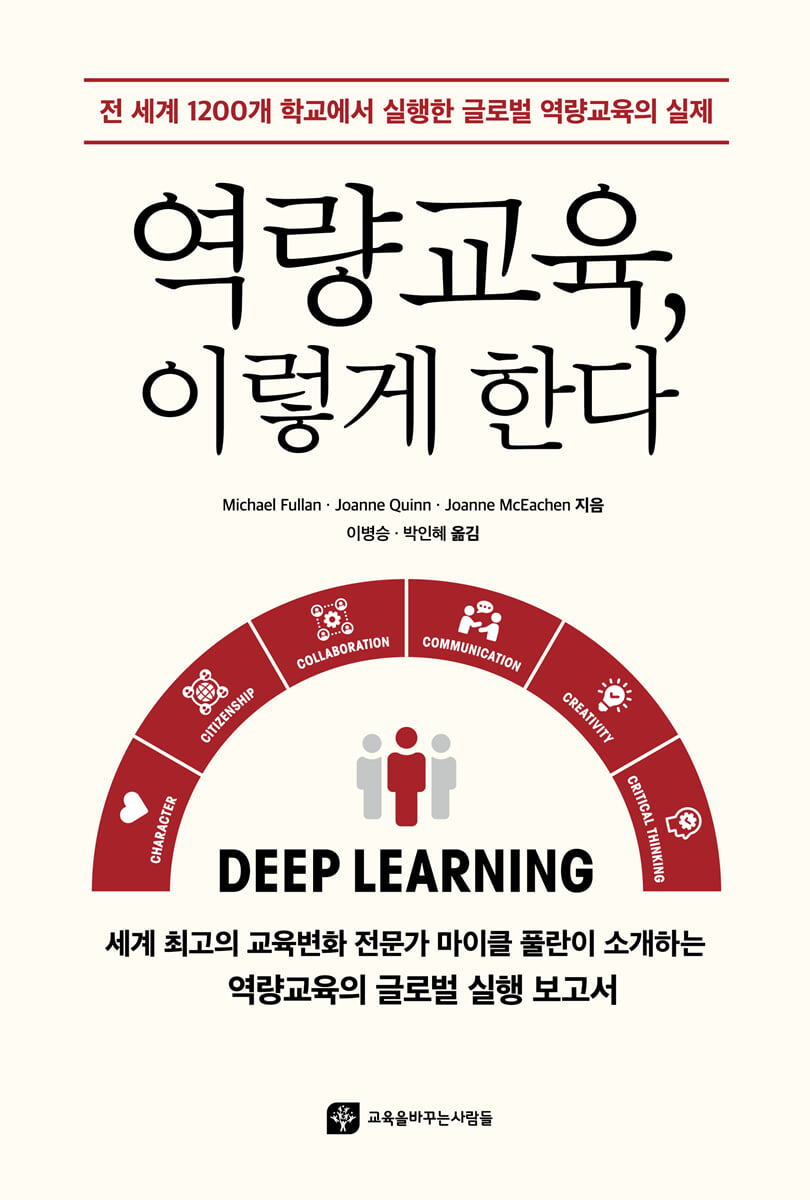
This is how to do competency training
 |
Description
Book Introduction
The term "competency," which originated in the 2015 revised curriculum, is still mentioned as an important factor in the 2022 revised curriculum.
However, the true nature of the term 'competence' has not yet been clearly elucidated.
Although it means more than just knowledge or skills, its boundaries are unclear and there is much controversy over how to teach and cultivate it in the educational field, so it is being ignored even by teachers.
People Who Change Education have been seriously raising this issue since the beginning of the curriculum revision.
How can competencies be developed? Are they transferable? What are core competencies, and how can they be assessed? Is the view that the goal of school education is to cultivate core competencies valid? Competency is a keyword in education that will require ongoing research and extensive discussion.
“A desirable direction for competency education should begin with a correct understanding of what it means to introduce competency into the context of school education, an understanding of the ambiguity and lack of substance of the concept of competency, the criticisms and limitations of competency education, and a correct understanding of the relationship between traditional knowledge-based education and competency-based education.” (Lee Chan-seung, December 2019.
(From the column “The Fourth Way of Education”)
This book is a global implementation report that presents the specific form of 'competency education' that should be pursued in this context.
This book, which clearly shows the philosophy and practical implementation methods of 'Deep Learning' proposed by world-renowned education change experts Michael Fullan, Joanne Quinn, and Joanne McEachen, with specific examples, is not a simple teaching method guide, but a strategy book for 'system change' that encompasses students, teachers, schools, regions, and the nation.
In a rapidly changing society driven by tremendous technological advancements, current school education systems are failing to fully prepare students for their future lives, and as a result, students naturally lose motivation to engage in their education.
Therefore, 'deep learning' establishes six new future competencies that learners should possess and provides specific examples of how these can be implemented in actual classes and school operations.
The numerous examples confirmed through the New Pedagogies for Deep Learning (NPDL) partnership, which targeted 1,200 schools across seven countries with different educational cultures and student sizes, including Canada, the United States, Finland, Australia, New Zealand, the Netherlands, and Uruguay, show that deep learning is not an abstract desk theory, but a model that can be implemented immediately in the classroom.
Students who had lost motivation and become apathetic are now discovering the meaning of learning through project-based collaboration and various digital technologies, setting their own research topics, solving community problems, and finding meaning in their own learning.
Deep learning returns the essence of education to the ability to understand and transform the world, and redefines the standards for future education.
It offers powerful inspiration to all educators who seek to move beyond traditional knowledge-based instruction, restore student autonomy, and redesign schools as living learning communities.
However, the true nature of the term 'competence' has not yet been clearly elucidated.
Although it means more than just knowledge or skills, its boundaries are unclear and there is much controversy over how to teach and cultivate it in the educational field, so it is being ignored even by teachers.
People Who Change Education have been seriously raising this issue since the beginning of the curriculum revision.
How can competencies be developed? Are they transferable? What are core competencies, and how can they be assessed? Is the view that the goal of school education is to cultivate core competencies valid? Competency is a keyword in education that will require ongoing research and extensive discussion.
“A desirable direction for competency education should begin with a correct understanding of what it means to introduce competency into the context of school education, an understanding of the ambiguity and lack of substance of the concept of competency, the criticisms and limitations of competency education, and a correct understanding of the relationship between traditional knowledge-based education and competency-based education.” (Lee Chan-seung, December 2019.
(From the column “The Fourth Way of Education”)
This book is a global implementation report that presents the specific form of 'competency education' that should be pursued in this context.
This book, which clearly shows the philosophy and practical implementation methods of 'Deep Learning' proposed by world-renowned education change experts Michael Fullan, Joanne Quinn, and Joanne McEachen, with specific examples, is not a simple teaching method guide, but a strategy book for 'system change' that encompasses students, teachers, schools, regions, and the nation.
In a rapidly changing society driven by tremendous technological advancements, current school education systems are failing to fully prepare students for their future lives, and as a result, students naturally lose motivation to engage in their education.
Therefore, 'deep learning' establishes six new future competencies that learners should possess and provides specific examples of how these can be implemented in actual classes and school operations.
The numerous examples confirmed through the New Pedagogies for Deep Learning (NPDL) partnership, which targeted 1,200 schools across seven countries with different educational cultures and student sizes, including Canada, the United States, Finland, Australia, New Zealand, the Netherlands, and Uruguay, show that deep learning is not an abstract desk theory, but a model that can be implemented immediately in the classroom.
Students who had lost motivation and become apathetic are now discovering the meaning of learning through project-based collaboration and various digital technologies, setting their own research topics, solving community problems, and finding meaning in their own learning.
Deep learning returns the essence of education to the ability to understand and transform the world, and redefines the standards for future education.
It offers powerful inspiration to all educators who seek to move beyond traditional knowledge-based instruction, restore student autonomy, and redesign schools as living learning communities.
- You can preview some of the book's contents.
Preview
index
Recommendation
Entering
PART 1: Join the World's Change
Chapter 1.
Why Deep Learning Now?
Relevance to life
The allure of deep learning
Challenges for the Future
Chapter 2.
Deep Learning: What's Different?
A new imagination for learning
The essence of deep learning
The need for deep learning
Reestablishing school culture
In conclusion
Chapter 3.
The changes brought about by deep learning
System innovation and consistency
Building consistency through deep learning
Deep Learning Framework
In conclusion
PART 2 Living Laboratory
Chapter 4.
Deep Learning in Practice
Changes in the classroom
Discovering new possibilities
Realizing Deep Learning
In conclusion
Chapter 5.
Deep Learning Design 1 - Learning Partnerships
New education
Learning Partnership
In conclusion
Chapter 6.
Deep Learning Design 2 - Learning Environments, Digital Utilization, and Pedagogical Implementation
Design of Learning
learning environment
Digital Utilization
Implementing teaching methods
Integration of four key elements
In conclusion
Chapter 7.
The Power of Collaboration: Facilitating Deep Learning
The importance of collaboration
collaborative inquiry
Collaborative Design of Learning Experiences
Collaborative Coordination for Student Growth
In conclusion
Chapter 8.
System-wide changes
Shifting the learning culture
Conditions for promoting deep learning
New power
Practice examples
In conclusion
Chapter 9.
New Measurement and Evaluation
The need for new tools
Initial measurement results
Global-level coordination
In conclusion
PART 3: An Unstable Future
Chapter 10.
Destruction or Salvation
Siren
Interesting point
References
Countries Joining the Deep Learning Journey
[List of charts]
〈Figure 2.1〉 Definition of the 6Cs for Deep Learning
Figure 2.2: Example of Deep Learning Progress (Complementary Collaboration Area of Collaborative Competencies)
Figure 2.3: Four Developmental Domains of Well-Being
〈Figure 3.1〉 Consistency Framework
Figure 3.2: Deep Learning Framework
Figure 4.1: Six Global Competencies of Deep Learning
〈Figure 4.2〉 Job competencies required in the future society
Figure 5.1: Four Elements of Learning Design
〈Figure 5.2〉 Learning Partnership
Figure 5.3 Student Learning Model
Figure 5.4: The Teacher's New Role
〈Figure 6.1〉 Learning Environment
〈Figure 6.2〉 Digital Utilization
〈Diagram 6.3〉Practice of Teaching Methods
〈Figure 6.4〉Fusion of existing teaching methods with newly emerging innovative teaching methods
Figure 6.5: New and Old, Good and Bad Teaching Methods
Figure 6.6: Australian Cluster Template for Deep Learning Design
Figure 7.1 Collaborative inquiry supporting learning design
〈Diagram 7.2〉 Collaborative Inquiry Process (Reorganized into Four Stages)
Figure 7.3 Deep Learning Global Challenge (UN Convention on the Rights of the Child)
Figure 7.4: Example Prompts for Collaborative Assessment and Coordination
Figure 7.5: Enigma Mission Redesigned with Deep Learning
Figure 8.1: Four Elements for Introducing and Designing Deep Learning
Figure 8.2: Example Deep Learning Conditions Rubric
〈Figure 8.3〉 New Drivers of Change
Figure 8.4: Pine River High School's Annual Development Plan (2017)
Figure 9.1: Example of Deep Learning Progress (Collaborative Competency)
〈Figure 9.2〉 Results of the Deep Learning Progress Evaluation by Competency
Figure 9.3: Learning Design Clues Included in the Deep Learning Adventure Case Study
〈Figure 9.4〉 Assessment Form for Competency Assessment (Before Class)
〈Figure 9.5〉 Assessment Form for Competency Assessment (After Class)
Figure 9.6: Example of Linking Deep Learning and Curriculum (Millgrove Public Schools, Canada)
Figure 9.7: Example of Linking Deep Learning and Curriculum (Finland)
[List of Deep Learning Case Studies]
Case 1.1: A student who did not speak up at school
Case 1.2: A student who submitted a creative application
Case 1.3: A student with no motivation and no energy
Case 4.1: Students Learning About Climate Change Through a New Approach
Case 4.2: Students who set and solved their own challenges
Case 4.3: Students Taking Action to Achieve Their Goals
Case 4.4: Students Leading Deep Learning
Case 4.5: Students who promoted connections with the local community
Case 4.6: Students Who Transformed the School Environment Through Collaboration
Case 4.7: A Student Who Changed His Own Life and the Life of His Community
Case 4.8: A student who awakened his potential through life-related learning.
Case 5.1: Students Developing New Partnerships
Case 5.2: Changes in Learning Partnerships for Teachers
Case 5.3: Students Leading a Local Exhibition to Solve Problems
Case 5.4: Students who learned the necessary skills through actual learning.
Case 5.5: Changes brought about by partnerships with the community
Case 6.1: Students Leading the Small Library Establishment Project
Case 6.2: Students Growing Through Community Contributions
Case 6.3: Students Developing Creativity Through Failure
Case 6.4: Students Who Turned Their Curiosity into a Challenging Task
Case 6.5: Students who took on the challenge of solving everyday problems
Case 6.6 Students Discovering and Putting into Practice the Meaning of Donation
Case 6.7: Students Discovering the Meaning of Fair Trade Through Chocolate
Case 8.1: Teachers Who Led School Change
Case 8.2: The Office of Education Leading Regional Change
Case 8.3 Leaders Who Drive System Change
Entering
PART 1: Join the World's Change
Chapter 1.
Why Deep Learning Now?
Relevance to life
The allure of deep learning
Challenges for the Future
Chapter 2.
Deep Learning: What's Different?
A new imagination for learning
The essence of deep learning
The need for deep learning
Reestablishing school culture
In conclusion
Chapter 3.
The changes brought about by deep learning
System innovation and consistency
Building consistency through deep learning
Deep Learning Framework
In conclusion
PART 2 Living Laboratory
Chapter 4.
Deep Learning in Practice
Changes in the classroom
Discovering new possibilities
Realizing Deep Learning
In conclusion
Chapter 5.
Deep Learning Design 1 - Learning Partnerships
New education
Learning Partnership
In conclusion
Chapter 6.
Deep Learning Design 2 - Learning Environments, Digital Utilization, and Pedagogical Implementation
Design of Learning
learning environment
Digital Utilization
Implementing teaching methods
Integration of four key elements
In conclusion
Chapter 7.
The Power of Collaboration: Facilitating Deep Learning
The importance of collaboration
collaborative inquiry
Collaborative Design of Learning Experiences
Collaborative Coordination for Student Growth
In conclusion
Chapter 8.
System-wide changes
Shifting the learning culture
Conditions for promoting deep learning
New power
Practice examples
In conclusion
Chapter 9.
New Measurement and Evaluation
The need for new tools
Initial measurement results
Global-level coordination
In conclusion
PART 3: An Unstable Future
Chapter 10.
Destruction or Salvation
Siren
Interesting point
References
Countries Joining the Deep Learning Journey
[List of charts]
〈Figure 2.1〉 Definition of the 6Cs for Deep Learning
Figure 2.2: Example of Deep Learning Progress (Complementary Collaboration Area of Collaborative Competencies)
Figure 2.3: Four Developmental Domains of Well-Being
〈Figure 3.1〉 Consistency Framework
Figure 3.2: Deep Learning Framework
Figure 4.1: Six Global Competencies of Deep Learning
〈Figure 4.2〉 Job competencies required in the future society
Figure 5.1: Four Elements of Learning Design
〈Figure 5.2〉 Learning Partnership
Figure 5.3 Student Learning Model
Figure 5.4: The Teacher's New Role
〈Figure 6.1〉 Learning Environment
〈Figure 6.2〉 Digital Utilization
〈Diagram 6.3〉Practice of Teaching Methods
〈Figure 6.4〉Fusion of existing teaching methods with newly emerging innovative teaching methods
Figure 6.5: New and Old, Good and Bad Teaching Methods
Figure 6.6: Australian Cluster Template for Deep Learning Design
Figure 7.1 Collaborative inquiry supporting learning design
〈Diagram 7.2〉 Collaborative Inquiry Process (Reorganized into Four Stages)
Figure 7.3 Deep Learning Global Challenge (UN Convention on the Rights of the Child)
Figure 7.4: Example Prompts for Collaborative Assessment and Coordination
Figure 7.5: Enigma Mission Redesigned with Deep Learning
Figure 8.1: Four Elements for Introducing and Designing Deep Learning
Figure 8.2: Example Deep Learning Conditions Rubric
〈Figure 8.3〉 New Drivers of Change
Figure 8.4: Pine River High School's Annual Development Plan (2017)
Figure 9.1: Example of Deep Learning Progress (Collaborative Competency)
〈Figure 9.2〉 Results of the Deep Learning Progress Evaluation by Competency
Figure 9.3: Learning Design Clues Included in the Deep Learning Adventure Case Study
〈Figure 9.4〉 Assessment Form for Competency Assessment (Before Class)
〈Figure 9.5〉 Assessment Form for Competency Assessment (After Class)
Figure 9.6: Example of Linking Deep Learning and Curriculum (Millgrove Public Schools, Canada)
Figure 9.7: Example of Linking Deep Learning and Curriculum (Finland)
[List of Deep Learning Case Studies]
Case 1.1: A student who did not speak up at school
Case 1.2: A student who submitted a creative application
Case 1.3: A student with no motivation and no energy
Case 4.1: Students Learning About Climate Change Through a New Approach
Case 4.2: Students who set and solved their own challenges
Case 4.3: Students Taking Action to Achieve Their Goals
Case 4.4: Students Leading Deep Learning
Case 4.5: Students who promoted connections with the local community
Case 4.6: Students Who Transformed the School Environment Through Collaboration
Case 4.7: A Student Who Changed His Own Life and the Life of His Community
Case 4.8: A student who awakened his potential through life-related learning.
Case 5.1: Students Developing New Partnerships
Case 5.2: Changes in Learning Partnerships for Teachers
Case 5.3: Students Leading a Local Exhibition to Solve Problems
Case 5.4: Students who learned the necessary skills through actual learning.
Case 5.5: Changes brought about by partnerships with the community
Case 6.1: Students Leading the Small Library Establishment Project
Case 6.2: Students Growing Through Community Contributions
Case 6.3: Students Developing Creativity Through Failure
Case 6.4: Students Who Turned Their Curiosity into a Challenging Task
Case 6.5: Students who took on the challenge of solving everyday problems
Case 6.6 Students Discovering and Putting into Practice the Meaning of Donation
Case 6.7: Students Discovering the Meaning of Fair Trade Through Chocolate
Case 8.1: Teachers Who Led School Change
Case 8.2: The Office of Education Leading Regional Change
Case 8.3 Leaders Who Drive System Change
Into the book
Deep learning focuses learning on problems that are meaningful to individual students or communities, and delves deeply into the causes and solutions of those problems.
This learning fundamentally changes the roles of everyone involved in education—students, teachers, parents—and impacts all constituents, leading to system-wide reform and innovation.
--- p.15
This book presents a comprehensive model of deep learning, drawing on real-world examples of progress made in numerous public schools across seven countries.
As in the case of Uruguay, we can also find cases where new software and devices have had a positive effect on many vulnerable learners.
We have been working intensively on system changes.
Our approach is to partner with large systems units to drive significant change, learn from it to better execute the next step, and then feed back into theory, improving both theory and practice—"practice that drives theory."
--- p.18
There are some huge barriers that need to be addressed first.
It's a combination of flawed policies, inadequate testing systems, inequalities perpetuated and exacerbated by those in power, and inadequate and uneven investment in public education.
Another barrier is the complexity of proving that the new concept of deep learning is on the right track and can deliver results in a short period of time.
--- p.21
Deep learning benefits everyone, but it has a particularly powerful effect on those who have been marginalized by traditional education systems.
Achieving excellence through equity is a challenge facing our society, and deep learning can play a key role in solving it.
Deep learning can not only combine equity and excellence for all, but also reduce the learning gap caused by socioeconomic inequality.
This is not simply a moral imperative; it is a matter of urgency and necessity for the survival and prosperity of humanity.
--- p.23
Another factor that makes traditional school education feel meaningless, a 'pushing' factor, is the nature of the future world of work.
The future job market is not only difficult to predict, but the number of jobs is also decreasing due to factors such as the increase in robots.
Compared to older generations, for whom a diploma was a sufficient motivation to attend school to secure a good future, the current generation finds it difficult to even imagine how they can achieve a desirable future.
This uncertainty is even more acute for students from low-income and minority communities.
I feel a sense of despair, not to mention a sense of belonging or solidarity with the school, and not even being able to receive protection.
To cut to the chase, for most students, traditional schooling has no reason to be taken seriously.
--- p.28
Of course, not all schools and all regions showed such rapid spread.
Although it is said that beginning is half the battle, it cannot be said with certainty that a great transformation will occur automatically just by starting deep learning.
This is because there are forces that resist change and seek to maintain the status quo, and many resistances that seek to suppress innovation even when it begins.
--- p.40
In schools where deep learning is taking place, systems play an important role.
While classrooms and schools can innovate on their own and develop deep learning, they face limitations if the systems are not supportive.
When teachers and principals who were passionate about innovation leave and a new principal takes over, they tend to be more focused on maintaining the current activities rather than on development or improvement.
Conversely, in schools where deep learning is well-established, the system plays a strategic role.
--- p.48
The important implication of this for educators is that brain development is deeply influenced not only by cognitive stimulation but also by the social and emotional environment.
In other words, authentic learning with opportunities for choice, along with emotionally stable relationships and environments, promote brain development, which leads to deep learning.
--- p.60~61
The lesson here is clear.
The focus of change is not on the form or structure of learning, but on the culture, and what we need to change is the culture of learning itself.
Policy or administrative guidelines alone cannot bring about change.
Real change can only happen by fostering new learning processes and engaging members voluntarily.
--- p.68
The challenge Soledad and Claudia set for themselves was to create a robot that could solve humanity's problems by connecting it to green technology.
Some kids, after studying about war, created a robot that detects landmines.
Soon after, the students began to think about using robots to solve problems around them.
A year ago, five people, including a 10-year-old boy, were struck by lightning and killed on a Montevideo beach.
Students tried to create a warning device that would sound an alarm to warn people when lightning was about to strike, and they succeeded.
--- p.95~96
Students who have experienced deep learning have a sense of global citizenship.
These students, we've experienced, are deeply engaged in global issues, grounded in a deep understanding of diverse values and worldviews. They demonstrate an interest and passion for solving complex, real-world problems that impact the sustainability of humanity and the environment.
At the same time, they develop personal qualities such as determination, perseverance, patience, empathy, compassion, and resilience, and develop the ability to integrate learning into their lives.
--- p.101
The deep learning tasks presented in this class were:
Each student would choose an elite athlete and create a nutritional supplement from natural ingredients by exploring essential nutrients to help that athlete recover and prepare for intense competition. They would also host a marketing forum where they would invite industry experts to the class to promote their nutritional supplement and receive feedback.
Community members, including a former professional ice hockey player, a CrossFit gym owner, a recent marathon finisher, and a personal trainer for elite swimmers, participated to review the products and ask the students a variety of questions.
--- p.110
This class was a truly hands-on project that involved creatively designing and building a new school playground.
Students formed departments and met weekly to design and inspect the construction.
The task also included contacting local experts to develop specifications for the bid.
The students divided up the work and sent emails to various companies and experts, but after several days, not a single response came.
The teacher assumed that the students would be adept at this form of communication because they frequently handled and used digital devices, but realized that this was a preconceived notion.
Students needed to develop persuasive writing and message crafting skills.
After learning the basic skills for basic communication and partnership, the project gained momentum and progressed smoothly.
Community professionals who initially did not respond to emails gradually became more involved in the work.
--- p.145~146
Innovative learning environments are emerging around the world.
Coachella Valley Unified School District in the United States deployed Wi-Fi-equipped buses to high-poverty areas to improve digital accessibility and usability.
Australia's Derrimut Public School has divided its learning space into three types: a space for thinking (the cave), a space for sharing information (the spring), and a space for learning (the campfire).
Although it is a traditional learning space, there are cases where creativity and vision are added to create innovative and rigorous learning.
Of course, there are schools that only have expensive digital equipment and lack an approach that takes teaching methods into account.
--- p.155
Teachers must develop the capacity to utilize a variety of learning models to prepare students to be lifelong learners.
Learning is not a one-time event, but an ongoing process, and now occurs in a variety of ways, including through community activities, personal networks, and work-related tasks.
The use of technology is changing our brains or making our neural networks more efficient, and many processes previously considered learning theory (especially cognitive information processing) are now implemented by technology or can be aided by technology.
Learning styles are constantly evolving, and teachers need to have a broad and robust repertoire of practices to adapt.
--- p.163
Upon entering the school, you'll see students using their personal devices to collaborate and use the space in ways that are conducive to movement.
The project involves filming a video using the green walls located throughout the building and adding background and audio later.
The walls are filled with students' work and artwork.
Classrooms are filled with a vibrant, engaged learning environment, and students taking responsibility for their own learning is a common sight.
It's not just students who are learning in new ways.
Teaching and learning activities take place openly and collaboratively throughout the school.
Teachers work in teams across grade levels or subjects to design lessons together and assess students' learning levels and outcomes.
A teacher's learning goes beyond simply lesson planning.
Throughout the classroom, teachers can be seen exploring unfamiliar concepts, digital devices, and materials with their students, sometimes even learning directly from them.
--- p.237
I wonder if there has ever been a time when humanity was so aware of the dangers and opportunities it faces, and so uncertain about what to do about them and what decisions to make.
Now is the time for Paulo Freire (2000, p.
32) It is time to seriously consider the advice he left about the role of education.
“To transform the world, and through that transformation, to move both individuals and communities toward new possibilities for a richer and more complete life.” Perhaps no definition of deep learning more clearly captures the purpose of deep learning.
--- p.279
There are two external factors that slow down the progress of deep learning.
One is the rapidly increasing social inequality, and the other is the rapidly accelerating digital future.
Gordon Moore, an engineer and co-founder of Intel, coined "Moore's Law," which predicts that computer processing power and the pace of technological advancement will double every 18 to 24 months. However, the digital world is evolving so rapidly that even this forecast seems conservative.
--- p.283
There has never been a time when awake learners needed to collaborate with one another and stay connected to the larger currents of the world.
Of course, all of this could go wrong.
But it is clear that learners who have the 6C competencies can live much better lives in any situation.
The best hope we can all hope for is that the future world will be inherited by deep learners.
This learning fundamentally changes the roles of everyone involved in education—students, teachers, parents—and impacts all constituents, leading to system-wide reform and innovation.
--- p.15
This book presents a comprehensive model of deep learning, drawing on real-world examples of progress made in numerous public schools across seven countries.
As in the case of Uruguay, we can also find cases where new software and devices have had a positive effect on many vulnerable learners.
We have been working intensively on system changes.
Our approach is to partner with large systems units to drive significant change, learn from it to better execute the next step, and then feed back into theory, improving both theory and practice—"practice that drives theory."
--- p.18
There are some huge barriers that need to be addressed first.
It's a combination of flawed policies, inadequate testing systems, inequalities perpetuated and exacerbated by those in power, and inadequate and uneven investment in public education.
Another barrier is the complexity of proving that the new concept of deep learning is on the right track and can deliver results in a short period of time.
--- p.21
Deep learning benefits everyone, but it has a particularly powerful effect on those who have been marginalized by traditional education systems.
Achieving excellence through equity is a challenge facing our society, and deep learning can play a key role in solving it.
Deep learning can not only combine equity and excellence for all, but also reduce the learning gap caused by socioeconomic inequality.
This is not simply a moral imperative; it is a matter of urgency and necessity for the survival and prosperity of humanity.
--- p.23
Another factor that makes traditional school education feel meaningless, a 'pushing' factor, is the nature of the future world of work.
The future job market is not only difficult to predict, but the number of jobs is also decreasing due to factors such as the increase in robots.
Compared to older generations, for whom a diploma was a sufficient motivation to attend school to secure a good future, the current generation finds it difficult to even imagine how they can achieve a desirable future.
This uncertainty is even more acute for students from low-income and minority communities.
I feel a sense of despair, not to mention a sense of belonging or solidarity with the school, and not even being able to receive protection.
To cut to the chase, for most students, traditional schooling has no reason to be taken seriously.
--- p.28
Of course, not all schools and all regions showed such rapid spread.
Although it is said that beginning is half the battle, it cannot be said with certainty that a great transformation will occur automatically just by starting deep learning.
This is because there are forces that resist change and seek to maintain the status quo, and many resistances that seek to suppress innovation even when it begins.
--- p.40
In schools where deep learning is taking place, systems play an important role.
While classrooms and schools can innovate on their own and develop deep learning, they face limitations if the systems are not supportive.
When teachers and principals who were passionate about innovation leave and a new principal takes over, they tend to be more focused on maintaining the current activities rather than on development or improvement.
Conversely, in schools where deep learning is well-established, the system plays a strategic role.
--- p.48
The important implication of this for educators is that brain development is deeply influenced not only by cognitive stimulation but also by the social and emotional environment.
In other words, authentic learning with opportunities for choice, along with emotionally stable relationships and environments, promote brain development, which leads to deep learning.
--- p.60~61
The lesson here is clear.
The focus of change is not on the form or structure of learning, but on the culture, and what we need to change is the culture of learning itself.
Policy or administrative guidelines alone cannot bring about change.
Real change can only happen by fostering new learning processes and engaging members voluntarily.
--- p.68
The challenge Soledad and Claudia set for themselves was to create a robot that could solve humanity's problems by connecting it to green technology.
Some kids, after studying about war, created a robot that detects landmines.
Soon after, the students began to think about using robots to solve problems around them.
A year ago, five people, including a 10-year-old boy, were struck by lightning and killed on a Montevideo beach.
Students tried to create a warning device that would sound an alarm to warn people when lightning was about to strike, and they succeeded.
--- p.95~96
Students who have experienced deep learning have a sense of global citizenship.
These students, we've experienced, are deeply engaged in global issues, grounded in a deep understanding of diverse values and worldviews. They demonstrate an interest and passion for solving complex, real-world problems that impact the sustainability of humanity and the environment.
At the same time, they develop personal qualities such as determination, perseverance, patience, empathy, compassion, and resilience, and develop the ability to integrate learning into their lives.
--- p.101
The deep learning tasks presented in this class were:
Each student would choose an elite athlete and create a nutritional supplement from natural ingredients by exploring essential nutrients to help that athlete recover and prepare for intense competition. They would also host a marketing forum where they would invite industry experts to the class to promote their nutritional supplement and receive feedback.
Community members, including a former professional ice hockey player, a CrossFit gym owner, a recent marathon finisher, and a personal trainer for elite swimmers, participated to review the products and ask the students a variety of questions.
--- p.110
This class was a truly hands-on project that involved creatively designing and building a new school playground.
Students formed departments and met weekly to design and inspect the construction.
The task also included contacting local experts to develop specifications for the bid.
The students divided up the work and sent emails to various companies and experts, but after several days, not a single response came.
The teacher assumed that the students would be adept at this form of communication because they frequently handled and used digital devices, but realized that this was a preconceived notion.
Students needed to develop persuasive writing and message crafting skills.
After learning the basic skills for basic communication and partnership, the project gained momentum and progressed smoothly.
Community professionals who initially did not respond to emails gradually became more involved in the work.
--- p.145~146
Innovative learning environments are emerging around the world.
Coachella Valley Unified School District in the United States deployed Wi-Fi-equipped buses to high-poverty areas to improve digital accessibility and usability.
Australia's Derrimut Public School has divided its learning space into three types: a space for thinking (the cave), a space for sharing information (the spring), and a space for learning (the campfire).
Although it is a traditional learning space, there are cases where creativity and vision are added to create innovative and rigorous learning.
Of course, there are schools that only have expensive digital equipment and lack an approach that takes teaching methods into account.
--- p.155
Teachers must develop the capacity to utilize a variety of learning models to prepare students to be lifelong learners.
Learning is not a one-time event, but an ongoing process, and now occurs in a variety of ways, including through community activities, personal networks, and work-related tasks.
The use of technology is changing our brains or making our neural networks more efficient, and many processes previously considered learning theory (especially cognitive information processing) are now implemented by technology or can be aided by technology.
Learning styles are constantly evolving, and teachers need to have a broad and robust repertoire of practices to adapt.
--- p.163
Upon entering the school, you'll see students using their personal devices to collaborate and use the space in ways that are conducive to movement.
The project involves filming a video using the green walls located throughout the building and adding background and audio later.
The walls are filled with students' work and artwork.
Classrooms are filled with a vibrant, engaged learning environment, and students taking responsibility for their own learning is a common sight.
It's not just students who are learning in new ways.
Teaching and learning activities take place openly and collaboratively throughout the school.
Teachers work in teams across grade levels or subjects to design lessons together and assess students' learning levels and outcomes.
A teacher's learning goes beyond simply lesson planning.
Throughout the classroom, teachers can be seen exploring unfamiliar concepts, digital devices, and materials with their students, sometimes even learning directly from them.
--- p.237
I wonder if there has ever been a time when humanity was so aware of the dangers and opportunities it faces, and so uncertain about what to do about them and what decisions to make.
Now is the time for Paulo Freire (2000, p.
32) It is time to seriously consider the advice he left about the role of education.
“To transform the world, and through that transformation, to move both individuals and communities toward new possibilities for a richer and more complete life.” Perhaps no definition of deep learning more clearly captures the purpose of deep learning.
--- p.279
There are two external factors that slow down the progress of deep learning.
One is the rapidly increasing social inequality, and the other is the rapidly accelerating digital future.
Gordon Moore, an engineer and co-founder of Intel, coined "Moore's Law," which predicts that computer processing power and the pace of technological advancement will double every 18 to 24 months. However, the digital world is evolving so rapidly that even this forecast seems conservative.
--- p.283
There has never been a time when awake learners needed to collaborate with one another and stay connected to the larger currents of the world.
Of course, all of this could go wrong.
But it is clear that learners who have the 6C competencies can live much better lives in any situation.
The best hope we can all hope for is that the future world will be inherited by deep learners.
--- p.289
Publisher's Review
The world is changing every day.
New technologies evolve at a pace and scale that is difficult to gauge, and these changes are shaking up not only industrial sites but also our daily lives and education.
The world that children will face as adults will operate under a completely different order and rules than the world we live in today.
The problem is that current school education is already lagging behind that change, and the gap will only widen in the future.
Attending school faithfully does not guarantee a stable life, and ‘imparting knowledge’ alone is no longer enough to prepare children for the future.
So what should today's schools teach and how?
The authors provide a clear answer to this question.
We need to redefine the very purpose of education and redesign the entire education system around the six core competencies that will be required in the future: creativity, critical thinking, collaboration, communication, citizenship, and character.
This book goes beyond simple declarations and provides step-by-step guidance on how to implement them in actual school settings.
Through a variety of real-world examples, you can vividly see how competency education works and how students change.
A particularly striking point was the authors' emphasis on the 'equity hypothesis', namely, that deep learning is of great help in achieving equity.
Children who are marginalized in learning, students who are considered "losers" in traditional school systems, grow most rapidly and dramatically through projects, collaborations, and problem-solving experiences connected to the real world.
This has very real implications for the reality of Korean education: the learning gap, apathetic students, and an overly entrance exam-focused culture.
This book shows everyone involved in education how to make changes that can begin right now.
This book will be a great inspiration to everyone considering competency education.
New technologies evolve at a pace and scale that is difficult to gauge, and these changes are shaking up not only industrial sites but also our daily lives and education.
The world that children will face as adults will operate under a completely different order and rules than the world we live in today.
The problem is that current school education is already lagging behind that change, and the gap will only widen in the future.
Attending school faithfully does not guarantee a stable life, and ‘imparting knowledge’ alone is no longer enough to prepare children for the future.
So what should today's schools teach and how?
The authors provide a clear answer to this question.
We need to redefine the very purpose of education and redesign the entire education system around the six core competencies that will be required in the future: creativity, critical thinking, collaboration, communication, citizenship, and character.
This book goes beyond simple declarations and provides step-by-step guidance on how to implement them in actual school settings.
Through a variety of real-world examples, you can vividly see how competency education works and how students change.
A particularly striking point was the authors' emphasis on the 'equity hypothesis', namely, that deep learning is of great help in achieving equity.
Children who are marginalized in learning, students who are considered "losers" in traditional school systems, grow most rapidly and dramatically through projects, collaborations, and problem-solving experiences connected to the real world.
This has very real implications for the reality of Korean education: the learning gap, apathetic students, and an overly entrance exam-focused culture.
This book shows everyone involved in education how to make changes that can begin right now.
This book will be a great inspiration to everyone considering competency education.
GOODS SPECIFICS
- Date of issue: November 25, 2025
- Page count, weight, size: 304 pages | 152*225*30mm
- ISBN13: 9788997724420
- ISBN10: 8997724428
You may also like
카테고리
korean


korean

![GQ KOREA Mark (Monthly): December [2025]](http://librairie.coreenne.fr/cdn/shop/files/8ef265dbbfbf186523ed75ba7319009d.jpg?v=1765340328&width=3840)


