

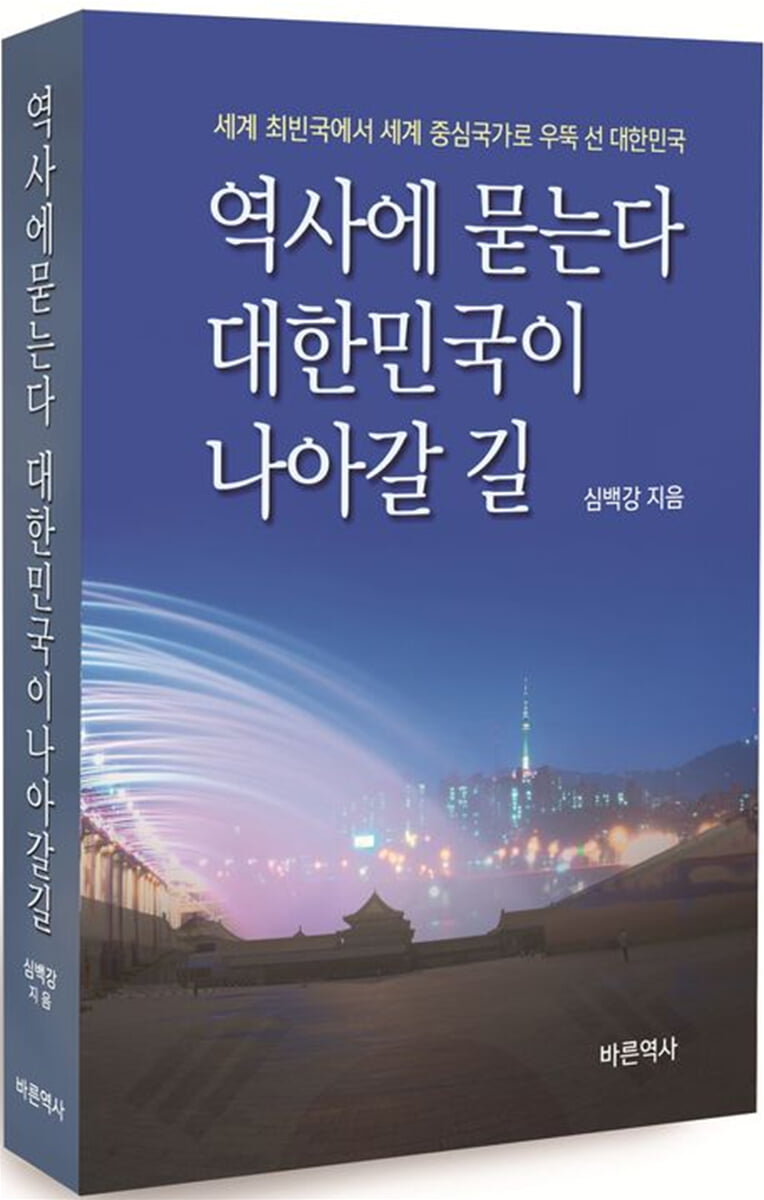
Asking History: What Path Should South Korea Take?
 |
Description
Book Introduction
In life, and even in a country, direction is more important than speed.
If we take the wrong direction while walking and a person who was supposed to go to Seoul ends up going to Busan, our schedule for the day will be completely ruined.
But the disaster is limited to one individual.
If the country's top leader sets the wrong direction, the damage will be felt by the entire nation.
Ultimately, it could lead to an unfortunate situation that destroys the country, the people, and the history.
Therefore, in life and in a country, setting direction is more important than speed.
If we take the wrong direction while walking and a person who was supposed to go to Seoul ends up going to Busan, our schedule for the day will be completely ruined.
But the disaster is limited to one individual.
If the country's top leader sets the wrong direction, the damage will be felt by the entire nation.
Ultimately, it could lead to an unfortunate situation that destroys the country, the people, and the history.
Therefore, in life and in a country, setting direction is more important than speed.
index
Asking History: The Path Forward for the Republic of Korea - Introduction
Chapter 1: Who are the Korean people?
The Path the Korean People Walked - From Baikal to Mt. Baekak
1.
The great journey of the Korean people
2.
The splendid Balhae civilization created by the Korean people in the Balhae region
3.
The Balhae civilization, not the Yellow River civilization, is the civilization that represents China.
4.
Korea's contemporary challenges, nestled beneath Mt. Baekak on the Korean Peninsula
Chapter 2: Politics for Correcting National Spirit
ㆍIn an era where national spirit transcends national wealth, how can we build a nation with a righteous national spirit?
1.
preface
2.
Korea, the immortal nation and land of eternal youth
3.
The Korean spirit, Hongik Ingan
4.
A modern expression of Hongik Ingan is humanity love.
5.
What evidence supports the claim that Hongik Ingan, based on love for humanity, is the Korean spirit?
6.
Candlelight, the Taegeukgi, and the division of North and South Korea are the result of the loss of the Hongik Ingan spirit.
7.
Let's create a nation where national spirit is upright, beyond wealth.
8.
Nine Proposals for a Nation with a Righteous Spirit
9.
Conclusion
Let's revive the Gyeongyeon system and improve the shortcomings of the presidential system.
1.
The Oriental contest system for systematically implementing education in the study of imperial affairs
2.
China's competition system was extremely weak.
3.
The purpose of establishing Gyeongyeon during the Goryeo Dynasty
4.
Joseon kings who lived the lives of students
5.
The driving force behind the 500-year existence of the Hanyang Joseon Dynasty was its advanced contest system.
6.
Let's revive the competitive system to complement the flaws of the presidential system.
Chapter 3: The Direction of Education in the Republic of Korea
ㆍThe Hongik Ingan spirit of Gojoseon and the direction of education in the Republic of Korea
1.
preface
2.
Hongik Ingan, the founding ideology of Hwan-guk
3.
The 81 characters of "Cheonbugyeong" containing the philosophy of Hongik Ingan
4.
"Hongbeomguju" (Hongbeom Guju), which explains nine methods for practicing Hongik Ingan (a philosophy of humanism)
5.
The direction in which education in Korea should move forward
6.
Conclusion
Chapter 4 Response to the Northeast Project
ㆍThe Northeast Project is a Korean project.
1.
History is a mixture of glory and shame.
2.
Korean history is overly highlighted as a history of humiliation.
3.
The glorious history of the Balhae region in the northeast was truncated by the colonial perspective of the four great powers in ancient Korean history.
4.
China's Northeast Project is a Korean project aimed at stealing ancient Korean history from the Balhae region.
How far has China's Northeast Project come?
1.
How far has China's Northeast Project come?
2.
Xi Jinping and the Northeast Project
3.
China is spurring cultural processes beyond historical processes.
4.
Xi Jinping's hidden intentions in renewing his commitment to deepening research on the origins of Chinese civilization.
5.
The Chinese Communist Party is waging a historical and cultural war.
6.
Korea at the center of the historical and cultural war
7.
A war without gunfire requires a wise response.
8.
After Taiwan's unification, it's Korea's turn.
What is the Chinese Communist Party's third attack on ancient Korean history aimed at?
1.
The Chinese Communist Party's Third Terrorism Against Korean Ancient History
2.
The complacent response of the Korean government, which lacks historical awareness
3.
Korea remains quiet even as its foundation is shaken. How easy does China think Korea is?
4.
If the great revival of the Chinese nation becomes a reality,
5.
How should we deal with this grave situation?
ㆍThe direction of Korean history in the 21st century
1.
Lack of historical awareness is the root cause of chaos in Korean society.
2.
History textbooks that inherit colonial views must be revised.
3.
The research results of national history studies should be reflected in national history textbooks.
4.
We must abolish the academic history of the Joseon Dynasty led by successors from the Joseon Government-General's Joseon History Compilation Committee.
5.
National orthodoxy must be the driving force behind Korean history studies.
Chapter 5: Liquidation of Colonial History
ㆍJapan's colonial view of history and measures to eliminate it
1.
On the head
2.
What is a colonial historian?
3.
80 years after liberation, the colonial view of history still remains unresolved.
4.
Why We Must Eliminate Colonialism
5.
The reason why colonial history was not liquidated after liberation
6.
The new hope for Korean history studies: "The Complete Works of the Four Treasuries"
7.
Concrete measures to accelerate the liquidation of colonial officials
8.
Conclusion
Chapter 6: Restoration of the Chuncheon Jungdo Historic Site
ㆍThe soul of Korea will live only if the Gojoseon ruins in Chuncheon are preserved.
1.
On the head
2.
The Chuncheon Jungdo site is a landmark discovery that marks a turning point in the study of Gojoseon history.
3.
Today's Chuncheon is the ancient land of Maekguk.
4.
The Jungdo culture is a relic of the Gojoseon Dynasty.
5.
Maekguk is the Chinese character for the Korean word Brightdalguk.
6.
When and through what route was Chuncheon's maekguk formed?
7.
Hongshan Culture of Inner Mongolia, China and Zhongdao Culture of Chuncheon, Korea
8.
Destroying the Jungdo ruins with a forklift and building Legoland is the greatest historical disaster since Dangun.
9.
Korea's national spirit cannot be revived without reviving Chuncheon Jungdo.
10.
The president, governor of Gangwon Province, head of the Cultural Heritage Administration, and chairman of the Cultural Heritage Committee who promoted the Legoland project at the time are the five major sinners in this historical disaster.
11.
To prevent this from happening again, we must punish those responsible for this historical disaster.
12.
The Yoon Seok-yeol government should demolish Legoland and restore Jungdo Culture to its original state, leaving it for future generations.
13.
Conclusion
Chapter 7: Restoring National Spirit
The Han River in Seoul, South Korea's capital, is called the Han River, not the Han River itself. Reclaiming the Han River's Old Korean Name
1.
On the head
2.
Han River, one of China's four major rivers
3.
Liu Bang laid the foundation for the Han Dynasty in Hanzhong, China, along the Han River.
4.
The Han River in China established itself as the birthplace of the Han people and culture.
5.
Our nation's first Han River was located north of the Great Wall of China.
6.
The historical background of the emergence of the name Han River on the Korean Peninsula
7.
The old Korean name for the Han River that appears in our history is Baekgang, or Baekdal River.
8.
More concrete evidence that the Han River in Seoul, Korea was originally called the Bright Moon River
9.
The bright moon is a symbol of our people.
10.
In Hanyang Joseon, which was a tributary state, the name of the Bright Moon River was distorted to mean the Han River of the Han Chinese.
11.
Why should we now change the Chinese characters for the Hangang River to Hangang?
12.
The Han River, the Ari River, the Dae River, and the Ukri River
13.
Conclusion
ㆍLet's change the signboard of Daehanmun Gate in front of Seoul City Hall to Daeanmun Gate.
Chapter 8: The Path That Political Leaders Should Take to Lead the Republic of Korea
ㆍDon't follow Gyeon Hwon's path, follow Wang Geon's path.
1.
Gyeon Hwon's path
Born into an extraordinary family as a farmer's son
Enter the military and display bravery, rising to the rank of lieutenant general
Founded Later Baekje in Jeonju and became a powerful nation in the Later Three Kingdoms.
An incident that shows part of Gyeon Hwon's cruel nature.
Lack of tolerance leads to subordinates and colleagues leaving
The invasion of Silla, a decisive moment that led to the loss of public support
Betrayed by one's family
A war of life and death between rich and poor
meet a miserable end
2.
Wang Geon's path
Born in Songak as the son of a powerful family
He entered Gung Ye's service and distinguished himself by achieving great feats.
He was supported by several generals and drove out Gung Ye, becoming the king of Goryeo.
In the early days of the nation's founding, he devoted himself to talent development and institutional reform.
Focus on winning public support through inclusive leadership.
Formed a two-party system with Later Baekje's Gyeon Hwon and engaged in a fierce battle
Gyeon Hwon surrenders after being betrayed by his son.
King Gyeongsun of Silla offered his country to Goryeo.
Achieving the feat of unifying the Later Three Kingdoms
He closed his eyes without realizing his dream of restoration.
3.
Political leaders who will lead the Republic of Korea should not follow the path of Gyeon Hwon, but rather the path of Wang Geon.
Wang Geon's Leadership: Lessons for Political Leaders Leading South Korea
Chapter 1: Who are the Korean people?
The Path the Korean People Walked - From Baikal to Mt. Baekak
1.
The great journey of the Korean people
2.
The splendid Balhae civilization created by the Korean people in the Balhae region
3.
The Balhae civilization, not the Yellow River civilization, is the civilization that represents China.
4.
Korea's contemporary challenges, nestled beneath Mt. Baekak on the Korean Peninsula
Chapter 2: Politics for Correcting National Spirit
ㆍIn an era where national spirit transcends national wealth, how can we build a nation with a righteous national spirit?
1.
preface
2.
Korea, the immortal nation and land of eternal youth
3.
The Korean spirit, Hongik Ingan
4.
A modern expression of Hongik Ingan is humanity love.
5.
What evidence supports the claim that Hongik Ingan, based on love for humanity, is the Korean spirit?
6.
Candlelight, the Taegeukgi, and the division of North and South Korea are the result of the loss of the Hongik Ingan spirit.
7.
Let's create a nation where national spirit is upright, beyond wealth.
8.
Nine Proposals for a Nation with a Righteous Spirit
9.
Conclusion
Let's revive the Gyeongyeon system and improve the shortcomings of the presidential system.
1.
The Oriental contest system for systematically implementing education in the study of imperial affairs
2.
China's competition system was extremely weak.
3.
The purpose of establishing Gyeongyeon during the Goryeo Dynasty
4.
Joseon kings who lived the lives of students
5.
The driving force behind the 500-year existence of the Hanyang Joseon Dynasty was its advanced contest system.
6.
Let's revive the competitive system to complement the flaws of the presidential system.
Chapter 3: The Direction of Education in the Republic of Korea
ㆍThe Hongik Ingan spirit of Gojoseon and the direction of education in the Republic of Korea
1.
preface
2.
Hongik Ingan, the founding ideology of Hwan-guk
3.
The 81 characters of "Cheonbugyeong" containing the philosophy of Hongik Ingan
4.
"Hongbeomguju" (Hongbeom Guju), which explains nine methods for practicing Hongik Ingan (a philosophy of humanism)
5.
The direction in which education in Korea should move forward
6.
Conclusion
Chapter 4 Response to the Northeast Project
ㆍThe Northeast Project is a Korean project.
1.
History is a mixture of glory and shame.
2.
Korean history is overly highlighted as a history of humiliation.
3.
The glorious history of the Balhae region in the northeast was truncated by the colonial perspective of the four great powers in ancient Korean history.
4.
China's Northeast Project is a Korean project aimed at stealing ancient Korean history from the Balhae region.
How far has China's Northeast Project come?
1.
How far has China's Northeast Project come?
2.
Xi Jinping and the Northeast Project
3.
China is spurring cultural processes beyond historical processes.
4.
Xi Jinping's hidden intentions in renewing his commitment to deepening research on the origins of Chinese civilization.
5.
The Chinese Communist Party is waging a historical and cultural war.
6.
Korea at the center of the historical and cultural war
7.
A war without gunfire requires a wise response.
8.
After Taiwan's unification, it's Korea's turn.
What is the Chinese Communist Party's third attack on ancient Korean history aimed at?
1.
The Chinese Communist Party's Third Terrorism Against Korean Ancient History
2.
The complacent response of the Korean government, which lacks historical awareness
3.
Korea remains quiet even as its foundation is shaken. How easy does China think Korea is?
4.
If the great revival of the Chinese nation becomes a reality,
5.
How should we deal with this grave situation?
ㆍThe direction of Korean history in the 21st century
1.
Lack of historical awareness is the root cause of chaos in Korean society.
2.
History textbooks that inherit colonial views must be revised.
3.
The research results of national history studies should be reflected in national history textbooks.
4.
We must abolish the academic history of the Joseon Dynasty led by successors from the Joseon Government-General's Joseon History Compilation Committee.
5.
National orthodoxy must be the driving force behind Korean history studies.
Chapter 5: Liquidation of Colonial History
ㆍJapan's colonial view of history and measures to eliminate it
1.
On the head
2.
What is a colonial historian?
3.
80 years after liberation, the colonial view of history still remains unresolved.
4.
Why We Must Eliminate Colonialism
5.
The reason why colonial history was not liquidated after liberation
6.
The new hope for Korean history studies: "The Complete Works of the Four Treasuries"
7.
Concrete measures to accelerate the liquidation of colonial officials
8.
Conclusion
Chapter 6: Restoration of the Chuncheon Jungdo Historic Site
ㆍThe soul of Korea will live only if the Gojoseon ruins in Chuncheon are preserved.
1.
On the head
2.
The Chuncheon Jungdo site is a landmark discovery that marks a turning point in the study of Gojoseon history.
3.
Today's Chuncheon is the ancient land of Maekguk.
4.
The Jungdo culture is a relic of the Gojoseon Dynasty.
5.
Maekguk is the Chinese character for the Korean word Brightdalguk.
6.
When and through what route was Chuncheon's maekguk formed?
7.
Hongshan Culture of Inner Mongolia, China and Zhongdao Culture of Chuncheon, Korea
8.
Destroying the Jungdo ruins with a forklift and building Legoland is the greatest historical disaster since Dangun.
9.
Korea's national spirit cannot be revived without reviving Chuncheon Jungdo.
10.
The president, governor of Gangwon Province, head of the Cultural Heritage Administration, and chairman of the Cultural Heritage Committee who promoted the Legoland project at the time are the five major sinners in this historical disaster.
11.
To prevent this from happening again, we must punish those responsible for this historical disaster.
12.
The Yoon Seok-yeol government should demolish Legoland and restore Jungdo Culture to its original state, leaving it for future generations.
13.
Conclusion
Chapter 7: Restoring National Spirit
The Han River in Seoul, South Korea's capital, is called the Han River, not the Han River itself. Reclaiming the Han River's Old Korean Name
1.
On the head
2.
Han River, one of China's four major rivers
3.
Liu Bang laid the foundation for the Han Dynasty in Hanzhong, China, along the Han River.
4.
The Han River in China established itself as the birthplace of the Han people and culture.
5.
Our nation's first Han River was located north of the Great Wall of China.
6.
The historical background of the emergence of the name Han River on the Korean Peninsula
7.
The old Korean name for the Han River that appears in our history is Baekgang, or Baekdal River.
8.
More concrete evidence that the Han River in Seoul, Korea was originally called the Bright Moon River
9.
The bright moon is a symbol of our people.
10.
In Hanyang Joseon, which was a tributary state, the name of the Bright Moon River was distorted to mean the Han River of the Han Chinese.
11.
Why should we now change the Chinese characters for the Hangang River to Hangang?
12.
The Han River, the Ari River, the Dae River, and the Ukri River
13.
Conclusion
ㆍLet's change the signboard of Daehanmun Gate in front of Seoul City Hall to Daeanmun Gate.
Chapter 8: The Path That Political Leaders Should Take to Lead the Republic of Korea
ㆍDon't follow Gyeon Hwon's path, follow Wang Geon's path.
1.
Gyeon Hwon's path
Born into an extraordinary family as a farmer's son
Enter the military and display bravery, rising to the rank of lieutenant general
Founded Later Baekje in Jeonju and became a powerful nation in the Later Three Kingdoms.
An incident that shows part of Gyeon Hwon's cruel nature.
Lack of tolerance leads to subordinates and colleagues leaving
The invasion of Silla, a decisive moment that led to the loss of public support
Betrayed by one's family
A war of life and death between rich and poor
meet a miserable end
2.
Wang Geon's path
Born in Songak as the son of a powerful family
He entered Gung Ye's service and distinguished himself by achieving great feats.
He was supported by several generals and drove out Gung Ye, becoming the king of Goryeo.
In the early days of the nation's founding, he devoted himself to talent development and institutional reform.
Focus on winning public support through inclusive leadership.
Formed a two-party system with Later Baekje's Gyeon Hwon and engaged in a fierce battle
Gyeon Hwon surrenders after being betrayed by his son.
King Gyeongsun of Silla offered his country to Goryeo.
Achieving the feat of unifying the Later Three Kingdoms
He closed his eyes without realizing his dream of restoration.
3.
Political leaders who will lead the Republic of Korea should not follow the path of Gyeon Hwon, but rather the path of Wang Geon.
Wang Geon's Leadership: Lessons for Political Leaders Leading South Korea
Into the book
The greatest challenge facing us now is to create a nation that transcends national wealth and has a right national spirit.
What we desperately need now is neither bread to fill our stomachs nor democracy to gain freedom, but to revive the Hongik Ingan spirit, the national spirit of the Korean people, the national spirit that our ancestors have preserved for thousands of years, and to build a country where the national spirit is upright.
--- p.54
There is active discussion on constitutional amendment, pointing out the limitations of the current imperial presidential system, which was established in 1987.
However, Mencius said bluntly, “Good government cannot be achieved with a good heart alone, and good governance cannot be achieved with good systems alone.”
No matter how good a system is created, it is difficult to expect good politics if the people who operate it are not qualified.
I propose establishing a special presidential education organization within the Office of the President that creatively elevates the monarchical system of competition to suit the democratic era.
--- p.85
If we look at the lessons of history, those who were ahead of their time also failed, and those who were behind the times also failed.
We must keep in mind that only those who accurately read the times and are thoroughly immersed in the spirit of the times will be recorded as winners in history.
--- p.105
Just because a few lines claiming that Goguryeo history is Chinese history were included in a Chinese university textbook, it doesn't mean Korea will immediately perish.
However, if Xi Jinping's dream of a great revival of the Chinese nation becomes a reality and students who were taught that Goguryeo history is Chinese history come to lead China, who can guarantee that Korea's nation, people, and history will continue to exist on earth?
--- p.135
There is no need to worry too much, as if Japan properly preserves the materials that were taken from our country during the Japanese colonial period, they will one day be brought to light again.
However, Japan is a country where earthquakes occur frequently.
If a major earthquake were to strike Japan and all these precious documents were buried underground or burned to ashes, we would forever lose the opportunity to establish Korean history based on documents hand-written by our ancestors.
How can we obtain that data now?
The Korean government requests cooperation from the Japanese government and receives permission to go and investigate materials related to Korean history and copy the necessary materials.
Of course, it would be nice to get the original back, but realistically, that may not be easy.
However, if you request a copy of each document for preservation purposes, I don't think there is any reason in Japan to refuse even that.
--- p.171
In South Korea today, hoping to maintain a stable regime without resolving the public sentiment divided by candlelight vigils and the Taegeukgi is no different from trying to catch fish while climbing a tree.
To open a new era of national harmony and unification by crossing the sea of chaos and conflict in the Republic of Korea, which is no less than that of the Later Three Kingdoms period, the person in power should not follow in the footsteps of Gyeon Hwon, but rather follow the path of Wang Geon, who demonstrated inclusive leadership.
What we desperately need now is neither bread to fill our stomachs nor democracy to gain freedom, but to revive the Hongik Ingan spirit, the national spirit of the Korean people, the national spirit that our ancestors have preserved for thousands of years, and to build a country where the national spirit is upright.
--- p.54
There is active discussion on constitutional amendment, pointing out the limitations of the current imperial presidential system, which was established in 1987.
However, Mencius said bluntly, “Good government cannot be achieved with a good heart alone, and good governance cannot be achieved with good systems alone.”
No matter how good a system is created, it is difficult to expect good politics if the people who operate it are not qualified.
I propose establishing a special presidential education organization within the Office of the President that creatively elevates the monarchical system of competition to suit the democratic era.
--- p.85
If we look at the lessons of history, those who were ahead of their time also failed, and those who were behind the times also failed.
We must keep in mind that only those who accurately read the times and are thoroughly immersed in the spirit of the times will be recorded as winners in history.
--- p.105
Just because a few lines claiming that Goguryeo history is Chinese history were included in a Chinese university textbook, it doesn't mean Korea will immediately perish.
However, if Xi Jinping's dream of a great revival of the Chinese nation becomes a reality and students who were taught that Goguryeo history is Chinese history come to lead China, who can guarantee that Korea's nation, people, and history will continue to exist on earth?
--- p.135
There is no need to worry too much, as if Japan properly preserves the materials that were taken from our country during the Japanese colonial period, they will one day be brought to light again.
However, Japan is a country where earthquakes occur frequently.
If a major earthquake were to strike Japan and all these precious documents were buried underground or burned to ashes, we would forever lose the opportunity to establish Korean history based on documents hand-written by our ancestors.
How can we obtain that data now?
The Korean government requests cooperation from the Japanese government and receives permission to go and investigate materials related to Korean history and copy the necessary materials.
Of course, it would be nice to get the original back, but realistically, that may not be easy.
However, if you request a copy of each document for preservation purposes, I don't think there is any reason in Japan to refuse even that.
--- p.171
In South Korea today, hoping to maintain a stable regime without resolving the public sentiment divided by candlelight vigils and the Taegeukgi is no different from trying to catch fish while climbing a tree.
To open a new era of national harmony and unification by crossing the sea of chaos and conflict in the Republic of Korea, which is no less than that of the Later Three Kingdoms period, the person in power should not follow in the footsteps of Gyeon Hwon, but rather follow the path of Wang Geon, who demonstrated inclusive leadership.
--- p.302
Publisher's Review
The purpose of historical research is to unravel the mystery of the present and the future.
History is a record of human thoughts and actions in time and space.
Korean history is the root of our lives today, as it is the traces of the Korean people's thoughts, actions, and lives in time and space.
The purpose of studying the history of our past is to correctly understand the present and properly plan for the future.
The ultimate goal of studying history is to wisely unravel the problems of the present and the future.
The red blood of a continent that ruled the world flows through the DNA of Koreans.
The history of our bright people has been a vast journey from Baikal to Baekaksan Mountain in Seoul.
The path our people have taken is to create the Hongshan culture in the Balhae basin, which preceded the Yellow River civilization, and to lead the history and culture of Asia.
The red blood of the continent that once ruled and governed the world flows through the DNA of Koreans.
The shoulders of the leaders of South Korea, a historically and culturally advanced nation, are heavy.
The Huns, Khitan, and Jurchen were once powerful forces that ruled the continent, but now they have neither a nation nor a people.
In world history, we, the Korean people, are the only ones who have preserved our nation, people, and history for over half a millennium.
Therefore, the responsibility placed on the shoulders of the leaders of the Republic of Korea, a historically and culturally advanced nation, is greater than that of any other country, and the importance of setting the direction for leading the nation in the right direction cannot be overemphasized.
South Korea's leaders must establish domestic and international policies with a firm view of history.
The founding of Korea's first state, Hwan-guk, 5,000 years ago is archaeologically proven by the excavation of the Hongshan Culture outside the Great Wall of China, and the reality of Gojoseon, which existed near Balhae Bay, is documented through the dissemination of the "Four Treasury Complete Books."
South Korea's leaders must formulate domestic policies and establish international relations with a long-term historical perspective based on a firm understanding of the nation, its people, and its history.
History is a record of human thoughts and actions in time and space.
Korean history is the root of our lives today, as it is the traces of the Korean people's thoughts, actions, and lives in time and space.
The purpose of studying the history of our past is to correctly understand the present and properly plan for the future.
The ultimate goal of studying history is to wisely unravel the problems of the present and the future.
The red blood of a continent that ruled the world flows through the DNA of Koreans.
The history of our bright people has been a vast journey from Baikal to Baekaksan Mountain in Seoul.
The path our people have taken is to create the Hongshan culture in the Balhae basin, which preceded the Yellow River civilization, and to lead the history and culture of Asia.
The red blood of the continent that once ruled and governed the world flows through the DNA of Koreans.
The shoulders of the leaders of South Korea, a historically and culturally advanced nation, are heavy.
The Huns, Khitan, and Jurchen were once powerful forces that ruled the continent, but now they have neither a nation nor a people.
In world history, we, the Korean people, are the only ones who have preserved our nation, people, and history for over half a millennium.
Therefore, the responsibility placed on the shoulders of the leaders of the Republic of Korea, a historically and culturally advanced nation, is greater than that of any other country, and the importance of setting the direction for leading the nation in the right direction cannot be overemphasized.
South Korea's leaders must establish domestic and international policies with a firm view of history.
The founding of Korea's first state, Hwan-guk, 5,000 years ago is archaeologically proven by the excavation of the Hongshan Culture outside the Great Wall of China, and the reality of Gojoseon, which existed near Balhae Bay, is documented through the dissemination of the "Four Treasury Complete Books."
South Korea's leaders must formulate domestic policies and establish international relations with a long-term historical perspective based on a firm understanding of the nation, its people, and its history.
GOODS SPECIFICS
- Date of issue: November 21, 2025
- Page count, weight, size: 302 pages | 150*214*30mm
- ISBN13: 9791195284276
- ISBN10: 1195284276
You may also like
카테고리
korean


korean

![GQ KOREA Mark (Monthly): December [2025]](http://librairie.coreenne.fr/cdn/shop/files/8ef265dbbfbf186523ed75ba7319009d.jpg?v=1765340328&width=3840)


