

I am becoming increasingly invisible
 |
Description
Book Introduction
"I'm Increasingly Blind" is a memoir by Andrew Leland, a writer who is losing his sight, and a grand exploration of history and society through the theme of "blindness."
As Leland learns to exist as a blind person, he explores the meaning of love, family, art, technology, and politics in new ways.
As a teenager, Andrew Leland was diagnosed with retinitis pigmentosa.
The world he took for granted is slowly disappearing as this disease slowly but steadily takes away his vision.
Grief-stricken by the thought of not being able to see his son's graduation or his wife's smile, he decides to boldly step into the "land of the blind," a world still unknown to him, where he will one day live.
This book is the author's first, written while struggling with deteriorating eyesight, and was praised by the press immediately after its publication, calling it "a wonderful journey that crosses various boundaries," "a story that will serve as a bridge between the visually impaired and the non-visually impaired," and "a book that will overturn everything you thought you knew."
It also achieved the feat of being a finalist in the 2024 Pulitzer Prize memoir category, heralding “a new era of writing by people with disabilities.”
The author's confession, a mixture of fear and excitement, leads readers to reflect on what shapes our existence and creates joy and sorrow.
As Leland learns to exist as a blind person, he explores the meaning of love, family, art, technology, and politics in new ways.
As a teenager, Andrew Leland was diagnosed with retinitis pigmentosa.
The world he took for granted is slowly disappearing as this disease slowly but steadily takes away his vision.
Grief-stricken by the thought of not being able to see his son's graduation or his wife's smile, he decides to boldly step into the "land of the blind," a world still unknown to him, where he will one day live.
This book is the author's first, written while struggling with deteriorating eyesight, and was praised by the press immediately after its publication, calling it "a wonderful journey that crosses various boundaries," "a story that will serve as a bridge between the visually impaired and the non-visually impaired," and "a book that will overturn everything you thought you knew."
It also achieved the feat of being a finalist in the 2024 Pulitzer Prize memoir category, heralding “a new era of writing by people with disabilities.”
The author's confession, a mixture of fear and excitement, leads readers to reflect on what shapes our existence and creates joy and sorrow.
- You can preview some of the book's contents.
Preview
index
Introduction: The Beginning of the End
Part 1 Fake Limp
Chapter 1: Viewing the Stars
Chapter 2: Solidarity and Conflict among the Staffs
Chapter 3: Defining Real Names
Part 2: The Lost World
Chapter 4: Male Gaze
Chapter 5 Camera Obscura
Chapter 6: The Library of Babel
Chapter 7: The Creators
Part 3 Structured Discovery
Chapter 8 Against Blindness
Chapter 9: Goddess of Justice
Chapter 10: A Subtle Smile
Exit: Endgame
Acknowledgements
Translator's Note
About capitalization
References and Notes
Description of the cover of this book
Part 1 Fake Limp
Chapter 1: Viewing the Stars
Chapter 2: Solidarity and Conflict among the Staffs
Chapter 3: Defining Real Names
Part 2: The Lost World
Chapter 4: Male Gaze
Chapter 5 Camera Obscura
Chapter 6: The Library of Babel
Chapter 7: The Creators
Part 3 Structured Discovery
Chapter 8 Against Blindness
Chapter 9: Goddess of Justice
Chapter 10: A Subtle Smile
Exit: Endgame
Acknowledgements
Translator's Note
About capitalization
References and Notes
Description of the cover of this book
Detailed image
Into the book
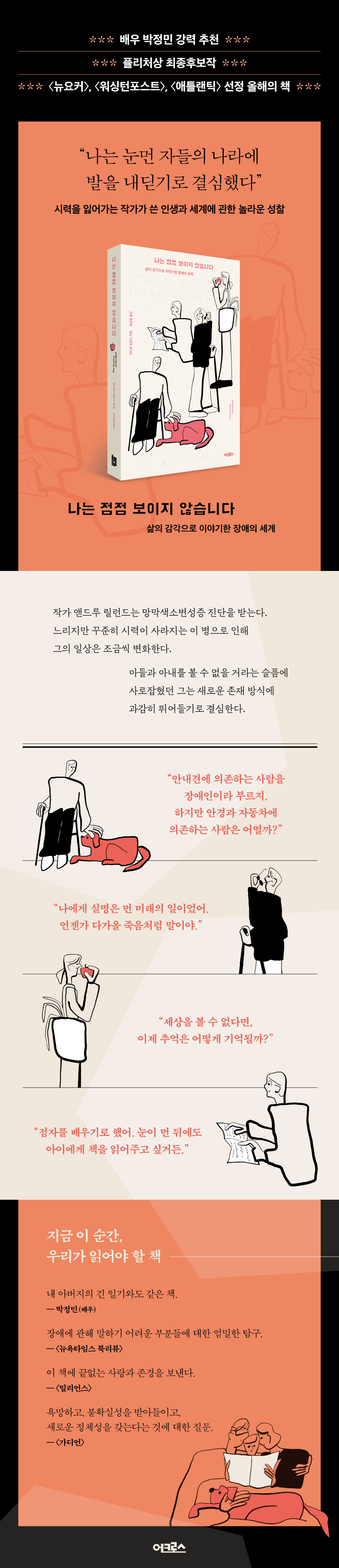
Figuring out what kind of blind person I should be has, in some ways, been a continual process not unlike figuring out who I am, or want to be, regardless of my disability.
--- From "Entering: The Beginning of the End"
Walking through the park, I realized that I hadn't enjoyed the visual beauty so freely in years.
It was so heartbreaking, so pretentious, so painful for a man who would soon go blind to look at a mountain ridge, a bluebird, a child's face, and feel such tender admiration.
I would probably see something beautiful that I would miss someday, and I would immediately be overcome with confusion and repulsion.
--- From "Chapter 3: Defining Real Names"
When we are with living beings, the possibility of interdependence arises.
The needs of guide dogs, such as grooming, resting, and toileting, which people at the National Federation of the Blind viewed negatively, are ultimately proof that guide dogs are beings in need of love.
That's the hybrid relationship that led artist Emily Gasio to create herself as a "dog girl," a hybrid of human and guide dog.
--- From "Chapter 7 Creators"
Before he went blind, he was a black man who stood 189 centimeters tall and weighed over 104 kilograms, and he was said to have looked like a typical 'apex predator'.
When he approached, people “crossed the street and locked their car doors.”
But now that I am blind, “when I walk down the street, even a frail, small white woman stops and tries to help me cross the street.”
He concluded.
“If I hadn’t been holding a white cane, the woman would have left before I got there.”
--- From "Chapter 9 Goddess of Justice"
While standing in the crowded subway, I wrapped my arms around Oscar to sharpen my sense of touch.
The moment my hand touched her, she leaned her head toward me, a gesture that was both a functional convenience for my blindness and a moment of love.
The barrier between the two types of contact has melted away.
That day wasn't a day that was wonderful despite my visual impairment, or a day that was wonderful because of my visual impairment.
However, it was a wonderful day even with my visual impairment.
--- From "Entering: The Beginning of the End"
Walking through the park, I realized that I hadn't enjoyed the visual beauty so freely in years.
It was so heartbreaking, so pretentious, so painful for a man who would soon go blind to look at a mountain ridge, a bluebird, a child's face, and feel such tender admiration.
I would probably see something beautiful that I would miss someday, and I would immediately be overcome with confusion and repulsion.
--- From "Chapter 3: Defining Real Names"
When we are with living beings, the possibility of interdependence arises.
The needs of guide dogs, such as grooming, resting, and toileting, which people at the National Federation of the Blind viewed negatively, are ultimately proof that guide dogs are beings in need of love.
That's the hybrid relationship that led artist Emily Gasio to create herself as a "dog girl," a hybrid of human and guide dog.
--- From "Chapter 7 Creators"
Before he went blind, he was a black man who stood 189 centimeters tall and weighed over 104 kilograms, and he was said to have looked like a typical 'apex predator'.
When he approached, people “crossed the street and locked their car doors.”
But now that I am blind, “when I walk down the street, even a frail, small white woman stops and tries to help me cross the street.”
He concluded.
“If I hadn’t been holding a white cane, the woman would have left before I got there.”
--- From "Chapter 9 Goddess of Justice"
While standing in the crowded subway, I wrapped my arms around Oscar to sharpen my sense of touch.
The moment my hand touched her, she leaned her head toward me, a gesture that was both a functional convenience for my blindness and a moment of love.
The barrier between the two types of contact has melted away.
That day wasn't a day that was wonderful despite my visual impairment, or a day that was wonderful because of my visual impairment.
However, it was a wonderful day even with my visual impairment.
--- From "Going Out: Endgame"
Publisher's Review
★ 2024 Pulitzer Prize Finalist
★ Strongly recommended by actor Park Jung-min
★ Book of the Year by The New Yorker, The Washington Post, The Atlantic, and Publisher's Weekly
“I decided to set foot in the land of the blind.”
A surprising reflection on life and the world from a writer losing his sight.
With this book, our world becomes more expansive.
"I'm Increasingly Blind" is a memoir by Andrew Leland, a writer who is losing his sight, and a grand exploration of history and society through the theme of "blindness."
As Leland learns to exist as a blind person, he explores the meaning of love, family, art, technology, and politics in new ways.
As a teenager, Andrew Leland was diagnosed with retinitis pigmentosa.
The world he took for granted is slowly disappearing as this disease slowly but steadily takes away his vision.
Grief-stricken by the thought of not being able to see his son's graduation or his wife's smile, he decides to boldly step into the "land of the blind," a world still unknown to him, where he will one day live.
This book is the author's first, written while struggling with deteriorating eyesight, and was praised by the press immediately after its publication, calling it "a wonderful journey that crosses various boundaries," "a story that will serve as a bridge between the visually impaired and the non-visually impaired," and "a book that will overturn everything you thought you knew."
It also heralded a 'new era of writing by people with disabilities' by achieving the feat of being a finalist in the 2024 Pulitzer Prize memoir category.
The author's confession, a mixture of fear and excitement, leads readers to reflect on what shapes our existence and creates joy and sorrow.
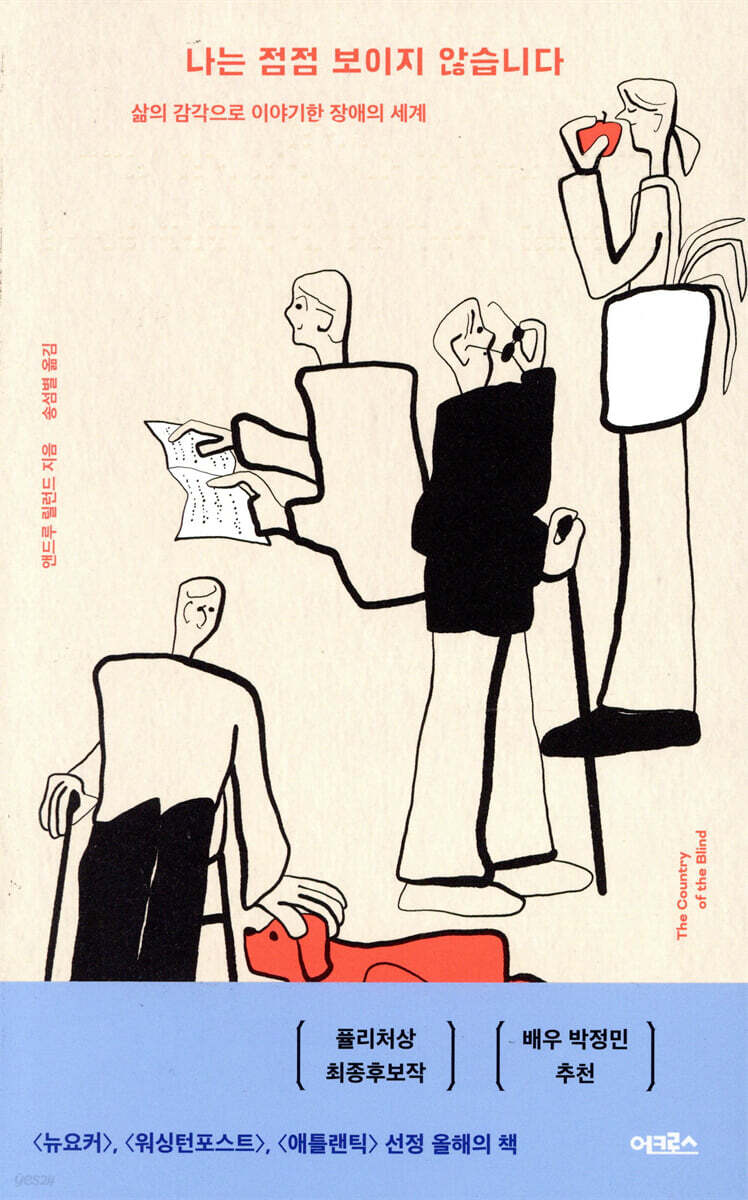
In the Korean edition being published this time, the title, subtitle, author's name, and translator's name are written in Braille on the cover.
In addition, just like the original book, the cover illustration captions were included in the text in consideration of the possibility of the book being produced in a different format than the paper book, such as an e-book.
Actor Park Jung-min, who has been involved in various activities such as screening movies with narration for the visually impaired, donating his narration talent for barrier-free movies, and participating as a volunteer reader for an audiobook production project for the visually impaired, also wrote a recommendation and introduced the contents of a book that will broaden understanding of visual impairment.
Park Jeong-min talks about his visually impaired father and the things we must do as family and as members of the community.
“When I picked up my cane, all my relationships changed.”
When you step outside the 'normal,' everyday life reveals its true colors.
Leland would often hypnotize himself into thinking he wasn't blind because he could still see the world.
But after nearly hitting someone with his car and being unable to find a cup he left behind the day before, Leland comes to terms with the seriousness of his visual impairment.
He overcomes his shame and tries to go out with a cane.
But walking with a cane was not a matter of individual courage.
Leland's wife, Lily, is perplexed when her husband unfolds his cane.
As Leland carries his son Oscar, leaning on a cane, people look at him with concern, thinking, 'That blind man will kill the baby.'
The prejudice against real names and the reality that real names bring about frustrates Leland and those around him in fulfilling the roles of 'protector', 'nurturer', 'husband', and 'father' that they expected of him.
These events lead Leland to realize his unconscious desire to be a patriarch and the old social convention that "not being able to see means being incompetent."
Leland also argues that the physical ability of sight cannot be separated from the social concept of the 'male gaze'.
Men who have gone from being visually impaired to visually impaired still wonder about women's stepmothers and want to meet women who are beautiful.
Even though we cannot see the image, we are still obsessed with women as images.
Leland points out the problem of the male gaze, which exerts a powerful presence even after losing sight, through the cases of Bill Cosby and Steve Wynn, who were tried for sexual assault while visually impaired.
When the conditions we take for granted disappear, everyday life reveals its true form.
Our daily lives are underpinned by stereotypes about family, gender, disability and inability.
Leland's family finds ways to care and love where these conventions have disappeared.
His wife, Lily, always puts Leland's shoes aside to prevent him from falling, and she organizes the refrigerator into a set system so he can easily find food.
Leland learns Braille so he can read picture books to his son like he used to.
We learn to love in a world riddled with inconvenient problems, not a world of smooth, orderly lines.
The author shows these everyday changes, and tells us that conventional notions about family, love, and gender can be shattered at any time, and that in the moment of that rupture, we can imagine a wider world and relationships.
"Are you disabled because you rely on a guide dog and a cane? Or because you rely on glasses and a car?"
Bold and playful questions that cross the lines between disability and race, disability and non-disability, and diverse identities.
Even after being legally declared blind, Leland continues to question his identity.
Even though he was in a dangerous condition without a cane, he was treated as a fraud by passersby because he could see 'a little', and people who treated the visually impaired as absolute weaklings often refused even the smallest help he offered.
I'm blind, but I'm also a father, Jewish, and a writer. Is it acceptable to be treated solely as a blind person? And is it acceptable to think of blindness as a sign of weakness and incompetence? Is blindness a real weakness, or a neutral trait, like skin color?
Leland's question about personal identity was also a common one for visually impaired people who have made significant contributions to history.
Adrian Ash, the bioethicist who led the way in passing anti-discrimination laws in the workplace, admits that despite being blind himself, he didn't feel a sense of kinship with other blind people.
Anil Lewis, a blind Black activist, admits that she was so focused on her identity as a disabled person that she ignored the discrimination Black people faced.
In the wake of George Floyd's murder, Lewis speaks cautiously about the possibility of the two identities converging, saying the Black Lives Matter movement could help people with disabilities live the lives they want.
The National Federation of the Blind, the largest organization for the visually impaired in the United States, constantly challenges authors to question the definition of visual impairment.
The group argues that visual impairment is a secondary characteristic that has no impact on a person's abilities.
Leaders of the National Federation of the Blind also took a critical look at the reliance of visually impaired people on guide dogs.
Dogs, with their biological needs and vulnerabilities, are not as reliable as canes and are at odds with the ultimate goal of true independence for the blind.
But blind sociologist Rod Michalko says the interdependent relationship he developed with his guide dog actually helped him regain his independence.
This is because caring for and relying on a guide dog that has the need to relieve itself and rest has brought about an active act of 'love'.
Blind artist Emily Gasio also creates paintings that blend herself with her guide dog, suggesting that all subjects are ultimately interdependent.
This book explores the boundaries between disability and non-disability, independence and dependence, questioning whether perfectly independent humans exist and whether non-disabled people, too, are inevitably dependent on others and technology.
“Even after a story ends, a new one can begin.”
The story of a blind man who turns everything he thought he knew upside down.
For Leland, who had considered visual impairment the end of his life, the stories of visually impaired people who lived more passionate lives than anyone else became an opportunity to learn a new way of being.
The history of the creation of Braille also stems from the passion of visually impaired people who wanted to read and write.
Students at the National School for the Blind in Paris tried to improve the tactile letters created by Charles Barbier into Braille so that the visually impaired could read them, and a student named Louis Braille succeeded in this, giving birth to the Braille we know today.
There was great opposition from non-visually impaired teachers who had to learn Braille anew, but Braille eventually spread throughout the world.
The desire of visually impaired people to enjoy works that cannot be seen has also led to technological advancements.
In the early 20th century, Robert Irwin, a blind man, began researching with electrical engineers to increase the playing time of records and create a "talking book," which led to the birth of the LP.
Also, in 1993, 15 years before the launch of the Amazon Kindle, a digital reading format created by blind technologists became ePub, today's industry standard for e-books.
Deprivation is an inevitable obstacle in life, but it is also the key to creativity and a condition of life that all humans share.
The same goes for visual impairment.
In his arduous yet exhilarating journey to discover a new way of being, Leland learns that he can desire others without images, that he can enjoy the joy of creation, and that he can create life's cherished moments.
As you turn the last page of the book, the boundaries of the world we live in will expand amazingly.
★ Strongly recommended by actor Park Jung-min
★ Book of the Year by The New Yorker, The Washington Post, The Atlantic, and Publisher's Weekly
“I decided to set foot in the land of the blind.”
A surprising reflection on life and the world from a writer losing his sight.
With this book, our world becomes more expansive.
"I'm Increasingly Blind" is a memoir by Andrew Leland, a writer who is losing his sight, and a grand exploration of history and society through the theme of "blindness."
As Leland learns to exist as a blind person, he explores the meaning of love, family, art, technology, and politics in new ways.
As a teenager, Andrew Leland was diagnosed with retinitis pigmentosa.
The world he took for granted is slowly disappearing as this disease slowly but steadily takes away his vision.
Grief-stricken by the thought of not being able to see his son's graduation or his wife's smile, he decides to boldly step into the "land of the blind," a world still unknown to him, where he will one day live.
This book is the author's first, written while struggling with deteriorating eyesight, and was praised by the press immediately after its publication, calling it "a wonderful journey that crosses various boundaries," "a story that will serve as a bridge between the visually impaired and the non-visually impaired," and "a book that will overturn everything you thought you knew."
It also heralded a 'new era of writing by people with disabilities' by achieving the feat of being a finalist in the 2024 Pulitzer Prize memoir category.
The author's confession, a mixture of fear and excitement, leads readers to reflect on what shapes our existence and creates joy and sorrow.
In the Korean edition being published this time, the title, subtitle, author's name, and translator's name are written in Braille on the cover.
In addition, just like the original book, the cover illustration captions were included in the text in consideration of the possibility of the book being produced in a different format than the paper book, such as an e-book.
Actor Park Jung-min, who has been involved in various activities such as screening movies with narration for the visually impaired, donating his narration talent for barrier-free movies, and participating as a volunteer reader for an audiobook production project for the visually impaired, also wrote a recommendation and introduced the contents of a book that will broaden understanding of visual impairment.
Park Jeong-min talks about his visually impaired father and the things we must do as family and as members of the community.
“When I picked up my cane, all my relationships changed.”
When you step outside the 'normal,' everyday life reveals its true colors.
Leland would often hypnotize himself into thinking he wasn't blind because he could still see the world.
But after nearly hitting someone with his car and being unable to find a cup he left behind the day before, Leland comes to terms with the seriousness of his visual impairment.
He overcomes his shame and tries to go out with a cane.
But walking with a cane was not a matter of individual courage.
Leland's wife, Lily, is perplexed when her husband unfolds his cane.
As Leland carries his son Oscar, leaning on a cane, people look at him with concern, thinking, 'That blind man will kill the baby.'
The prejudice against real names and the reality that real names bring about frustrates Leland and those around him in fulfilling the roles of 'protector', 'nurturer', 'husband', and 'father' that they expected of him.
These events lead Leland to realize his unconscious desire to be a patriarch and the old social convention that "not being able to see means being incompetent."
Leland also argues that the physical ability of sight cannot be separated from the social concept of the 'male gaze'.
Men who have gone from being visually impaired to visually impaired still wonder about women's stepmothers and want to meet women who are beautiful.
Even though we cannot see the image, we are still obsessed with women as images.
Leland points out the problem of the male gaze, which exerts a powerful presence even after losing sight, through the cases of Bill Cosby and Steve Wynn, who were tried for sexual assault while visually impaired.
When the conditions we take for granted disappear, everyday life reveals its true form.
Our daily lives are underpinned by stereotypes about family, gender, disability and inability.
Leland's family finds ways to care and love where these conventions have disappeared.
His wife, Lily, always puts Leland's shoes aside to prevent him from falling, and she organizes the refrigerator into a set system so he can easily find food.
Leland learns Braille so he can read picture books to his son like he used to.
We learn to love in a world riddled with inconvenient problems, not a world of smooth, orderly lines.
The author shows these everyday changes, and tells us that conventional notions about family, love, and gender can be shattered at any time, and that in the moment of that rupture, we can imagine a wider world and relationships.
"Are you disabled because you rely on a guide dog and a cane? Or because you rely on glasses and a car?"
Bold and playful questions that cross the lines between disability and race, disability and non-disability, and diverse identities.
Even after being legally declared blind, Leland continues to question his identity.
Even though he was in a dangerous condition without a cane, he was treated as a fraud by passersby because he could see 'a little', and people who treated the visually impaired as absolute weaklings often refused even the smallest help he offered.
I'm blind, but I'm also a father, Jewish, and a writer. Is it acceptable to be treated solely as a blind person? And is it acceptable to think of blindness as a sign of weakness and incompetence? Is blindness a real weakness, or a neutral trait, like skin color?
Leland's question about personal identity was also a common one for visually impaired people who have made significant contributions to history.
Adrian Ash, the bioethicist who led the way in passing anti-discrimination laws in the workplace, admits that despite being blind himself, he didn't feel a sense of kinship with other blind people.
Anil Lewis, a blind Black activist, admits that she was so focused on her identity as a disabled person that she ignored the discrimination Black people faced.
In the wake of George Floyd's murder, Lewis speaks cautiously about the possibility of the two identities converging, saying the Black Lives Matter movement could help people with disabilities live the lives they want.
The National Federation of the Blind, the largest organization for the visually impaired in the United States, constantly challenges authors to question the definition of visual impairment.
The group argues that visual impairment is a secondary characteristic that has no impact on a person's abilities.
Leaders of the National Federation of the Blind also took a critical look at the reliance of visually impaired people on guide dogs.
Dogs, with their biological needs and vulnerabilities, are not as reliable as canes and are at odds with the ultimate goal of true independence for the blind.
But blind sociologist Rod Michalko says the interdependent relationship he developed with his guide dog actually helped him regain his independence.
This is because caring for and relying on a guide dog that has the need to relieve itself and rest has brought about an active act of 'love'.
Blind artist Emily Gasio also creates paintings that blend herself with her guide dog, suggesting that all subjects are ultimately interdependent.
This book explores the boundaries between disability and non-disability, independence and dependence, questioning whether perfectly independent humans exist and whether non-disabled people, too, are inevitably dependent on others and technology.
“Even after a story ends, a new one can begin.”
The story of a blind man who turns everything he thought he knew upside down.
For Leland, who had considered visual impairment the end of his life, the stories of visually impaired people who lived more passionate lives than anyone else became an opportunity to learn a new way of being.
The history of the creation of Braille also stems from the passion of visually impaired people who wanted to read and write.
Students at the National School for the Blind in Paris tried to improve the tactile letters created by Charles Barbier into Braille so that the visually impaired could read them, and a student named Louis Braille succeeded in this, giving birth to the Braille we know today.
There was great opposition from non-visually impaired teachers who had to learn Braille anew, but Braille eventually spread throughout the world.
The desire of visually impaired people to enjoy works that cannot be seen has also led to technological advancements.
In the early 20th century, Robert Irwin, a blind man, began researching with electrical engineers to increase the playing time of records and create a "talking book," which led to the birth of the LP.
Also, in 1993, 15 years before the launch of the Amazon Kindle, a digital reading format created by blind technologists became ePub, today's industry standard for e-books.
Deprivation is an inevitable obstacle in life, but it is also the key to creativity and a condition of life that all humans share.
The same goes for visual impairment.
In his arduous yet exhilarating journey to discover a new way of being, Leland learns that he can desire others without images, that he can enjoy the joy of creation, and that he can create life's cherished moments.
As you turn the last page of the book, the boundaries of the world we live in will expand amazingly.
GOODS SPECIFICS
- Date of issue: September 20, 2024
- Page count, weight, size: 432 pages | 532g | 135*215*22mm
- ISBN13: 9791167741639
You may also like
카테고리
korean


korean

![GQ KOREA Mark (Monthly): December [2025]](http://librairie.coreenne.fr/cdn/shop/files/8ef265dbbfbf186523ed75ba7319009d.jpg?v=1765340328&width=3840)


