

Understanding Political and Ideological Terms
 |
Description
Book Introduction
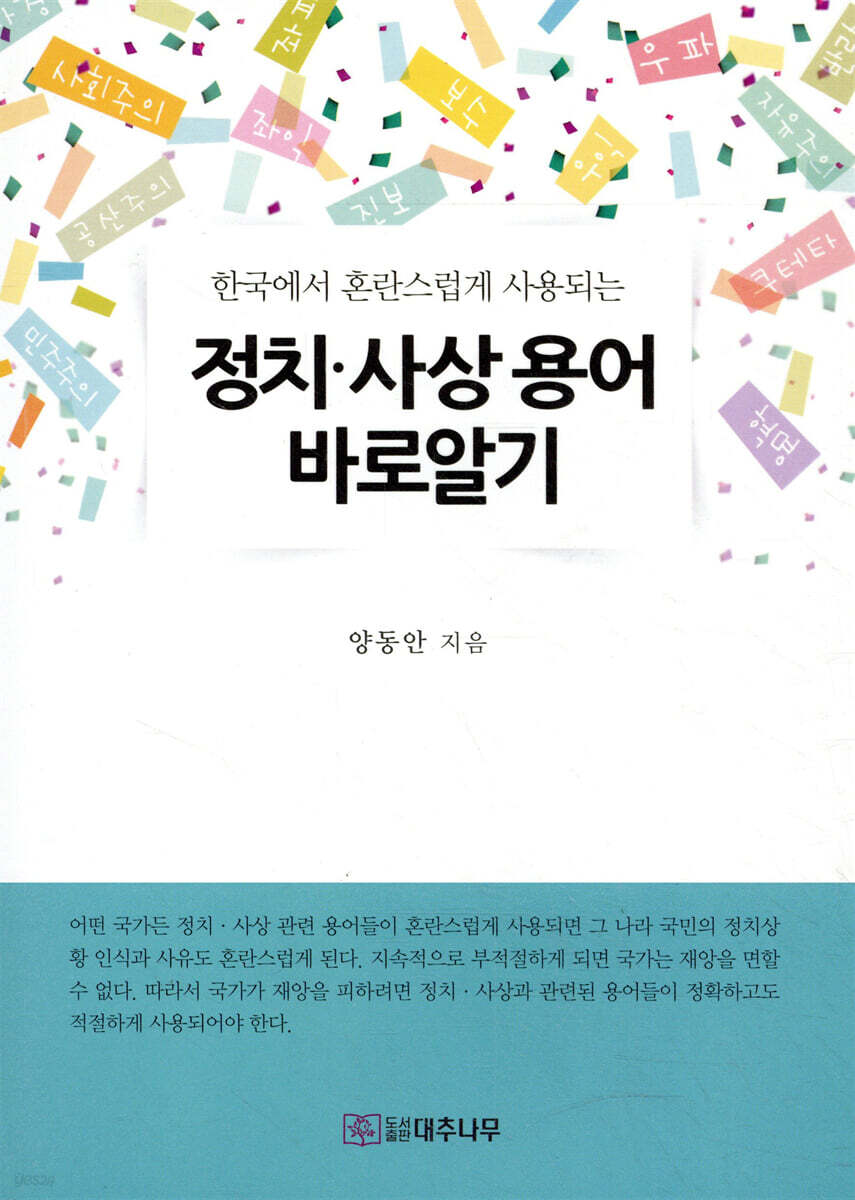
"Ilta Instructor" provides clear explanations of confusingly used political and ideological terms in Korea.
South Korea is evaluated as the country in the world where political and ideological terms are used most confusingly.
The use of political and ideological terms with different meanings among citizens is causing serious confusion in social perception and social conflict.
This confusion over terminology has led to a breakdown in communication between people, conflicts, and clashes, and even arguments over terminology are common among friends and family members.
These conflicts cause confusion in the direction of national administration and ultimately lead the Republic of Korea to ruin.
To prevent this national disaster, we desperately need textbooks that explain the precise meaning of political and ideological terms.
Professor Emeritus Yang Dong-an of the Academy of Korean Studies, a leading authority on politics and ideology in Korea, published a book to address this issue.
This book is called “Understanding Political and Ideological Terms Used Confusingly in Korea.”
The book Professor Yang Dong-an recently wrote clearly organizes various political and ideological terms that are used in a very confusing way in our society, such as 'conservatism and progressivism, left wing and right wing, liberalism and neoliberalism, communism and socialism,' etc.
What you can gain from reading this book is that △political and ideological terms that have been confusing and ambiguous until now are clearly organized, △not only the terms, but also the origins and historical changes of various ideologies such as communism, socialism, liberalism, conservatism, and participatory democracy can be clearly understood as if looking at a genome map, △while explaining the terms, the ideological history and genealogy of the world, including not only Korea but also Europe and the United States, can be understood at a glance, △it is also excellent for understanding the historical roots of the ideological conflict in the United States, which has become particularly serious surrounding the recent U.S. presidential election, △it can also contribute to ending wasteful debates by providing accurate definitions of terms that are overused in Korea such as “revolution, coup d’état, and rebellion.”
South Korea is evaluated as the country in the world where political and ideological terms are used most confusingly.
The use of political and ideological terms with different meanings among citizens is causing serious confusion in social perception and social conflict.
This confusion over terminology has led to a breakdown in communication between people, conflicts, and clashes, and even arguments over terminology are common among friends and family members.
These conflicts cause confusion in the direction of national administration and ultimately lead the Republic of Korea to ruin.
To prevent this national disaster, we desperately need textbooks that explain the precise meaning of political and ideological terms.
Professor Emeritus Yang Dong-an of the Academy of Korean Studies, a leading authority on politics and ideology in Korea, published a book to address this issue.
This book is called “Understanding Political and Ideological Terms Used Confusingly in Korea.”
The book Professor Yang Dong-an recently wrote clearly organizes various political and ideological terms that are used in a very confusing way in our society, such as 'conservatism and progressivism, left wing and right wing, liberalism and neoliberalism, communism and socialism,' etc.
What you can gain from reading this book is that △political and ideological terms that have been confusing and ambiguous until now are clearly organized, △not only the terms, but also the origins and historical changes of various ideologies such as communism, socialism, liberalism, conservatism, and participatory democracy can be clearly understood as if looking at a genome map, △while explaining the terms, the ideological history and genealogy of the world, including not only Korea but also Europe and the United States, can be understood at a glance, △it is also excellent for understanding the historical roots of the ideological conflict in the United States, which has become particularly serious surrounding the recent U.S. presidential election, △it can also contribute to ending wasteful debates by providing accurate definitions of terms that are overused in Korea such as “revolution, coup d’état, and rebellion.”
Into the book
The confusing use of political and ideological terms can lead to national disaster.
“Language is a tool of communication, but it is also a tool of cognition and thought.
Therefore, the terms used in language life and their meanings have a strong influence on the perception of objects and thoughts of the people who use the terms.
Terms related to politics and ideology also have a strong influence on the political situation awareness and ideology of those who use them.
For this reason, when political and ideological terms are used in a confusing way (inappropriately and with incorrect meanings) in a country, the perception and thinking of the political situation of the people of that country also become confused.
If the confusion in the people's perception of the political situation and their thinking continues for a long time, it will bring disaster to the fate of the nation.
If the people's perception and reasoning about the political situation become confused, their political and social behavior will inevitably become inappropriate, and if the people's political and social behavior continues to be inappropriate, the country will not be able to avoid disaster.
Therefore, if a nation is to avoid disaster, terms related to politics and ideology must be used accurately and appropriately. (From the preface)
“Our society has already suffered considerable damage due to the inaccurate and inappropriate use of political and ideological terms.
“People with ideologies that run counter to the course of human history are labeled ‘progressives,’ people with ideologies and careers that run counter to liberal democracy call themselves ‘democratic figures’ and occupy important public offices, and people mistake those who seek to destroy the Republic of Korea for those who work for the Republic of Korea.” (From the preface)
“Despite the widespread inaccuracy and inappropriate use of political and ideological terms in our society, intellectuals in this country make little effort to correct this misunderstanding.”
“Language is a tool of communication, but it is also a tool of cognition and thought.
Therefore, the terms used in language life and their meanings have a strong influence on the perception of objects and thoughts of the people who use the terms.
Terms related to politics and ideology also have a strong influence on the political situation awareness and ideology of those who use them.
For this reason, when political and ideological terms are used in a confusing way (inappropriately and with incorrect meanings) in a country, the perception and thinking of the political situation of the people of that country also become confused.
If the confusion in the people's perception of the political situation and their thinking continues for a long time, it will bring disaster to the fate of the nation.
If the people's perception and reasoning about the political situation become confused, their political and social behavior will inevitably become inappropriate, and if the people's political and social behavior continues to be inappropriate, the country will not be able to avoid disaster.
Therefore, if a nation is to avoid disaster, terms related to politics and ideology must be used accurately and appropriately. (From the preface)
“Our society has already suffered considerable damage due to the inaccurate and inappropriate use of political and ideological terms.
“People with ideologies that run counter to the course of human history are labeled ‘progressives,’ people with ideologies and careers that run counter to liberal democracy call themselves ‘democratic figures’ and occupy important public offices, and people mistake those who seek to destroy the Republic of Korea for those who work for the Republic of Korea.” (From the preface)
“Despite the widespread inaccuracy and inappropriate use of political and ideological terms in our society, intellectuals in this country make little effort to correct this misunderstanding.”
--- From the "Preface"
Publisher's Review
What you can gain from reading this book is that △political and ideological terms that have been confusing and ambiguous until now are clearly organized, △not only the terms, but also the origins and historical changes of various ideologies such as communism, socialism, liberalism, conservatism, and participatory democracy can be clearly understood as if looking at a genome map, △while explaining the terms, the ideological history and genealogy of the world, including not only Korea but also Europe and the United States, can be understood at a glance, △it is also excellent for understanding the historical roots of the ideological conflict in the United States, which has become particularly serious surrounding the recent U.S. presidential election, △it can also contribute to ending wasteful debates by providing accurate definitions of terms that are overused in Korea such as “revolution, coup d’état, and rebellion.”
GOODS SPECIFICS
- Publication date: December 14, 2020
- Page count, weight, size: 412 pages | 584g | 154*215*20mm
- ISBN13: 9791196754563
- ISBN10: 119675456X
You may also like
카테고리
korean


korean

![GQ KOREA Mark (Monthly): December [2025]](http://librairie.coreenne.fr/cdn/shop/files/8ef265dbbfbf186523ed75ba7319009d.jpg?v=1765340328&width=3840)


