

Leisure class theory
 |
Description
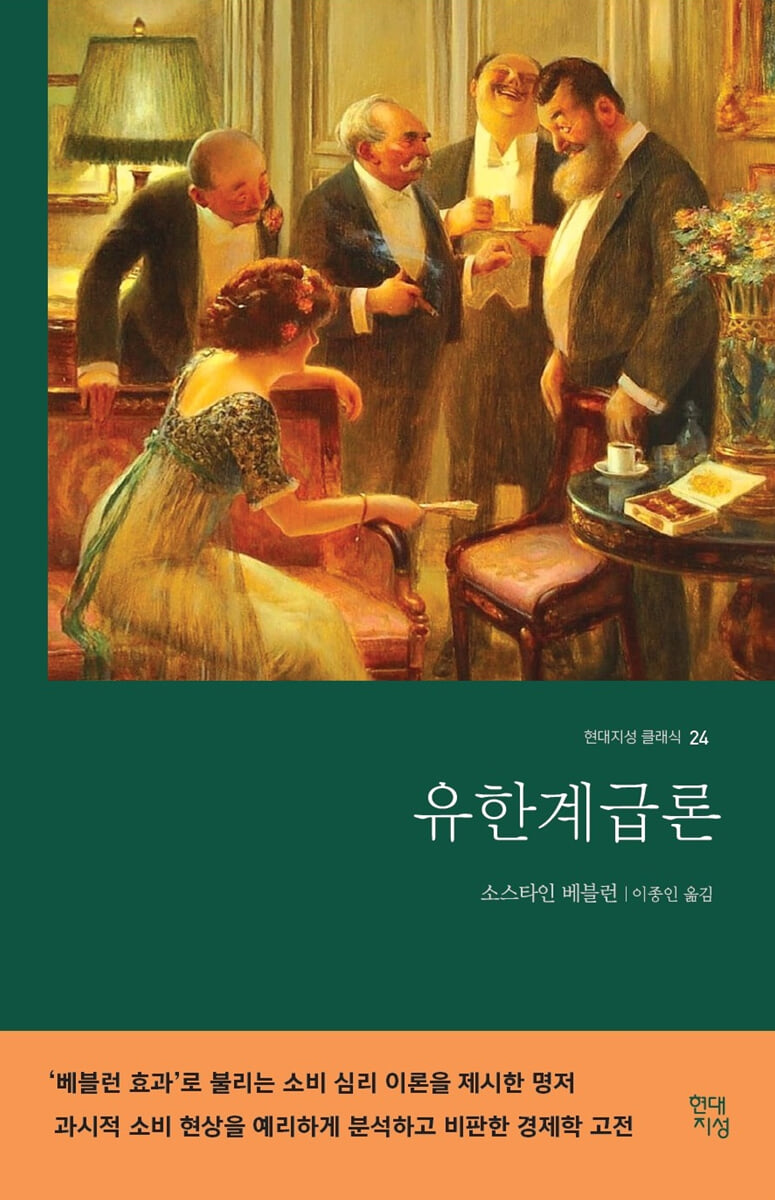
Book Introduction
A famous book that presents a theory of consumer psychology called the 'Veblen effect'
A classic economics work that sharply analyzes and criticizes the phenomenon of conspicuous consumption.
This book is the 24th volume of the 'Modern Intellectual Classics' and is a complete translation of Thorstein Veblen's masterpiece, 'The Theory of the Leisure Class'.
Through this book, Veblen directly refuted the law of supply and demand, the mainstream economic theory of the time.
Economists at the time argued that supply and demand were inversely proportional, but Veblen thought differently.
People belonging to the upper class, or the wealthy class, equate wealth with fame, and do not hesitate to purchase expensive items to show off their fame to others.
Based on this phenomenon, Veblen argued that demand for goods could increase even if their prices rose. Veblen's insight and argument are applicable not only to his time but also to our society today.
In this way, Veblen's analysis and arguments were novel, sharp, and ahead of their time.
His argument is summarized in the economic term 'Veblen effect' and is cited to criticize our conspicuous consumption and wasteful behavior today, where we define ourselves through consumption and show off.
Readers will gain deeper insight into society through this book, which critiques the contradictions of the capitalist economic system.
A classic economics work that sharply analyzes and criticizes the phenomenon of conspicuous consumption.
This book is the 24th volume of the 'Modern Intellectual Classics' and is a complete translation of Thorstein Veblen's masterpiece, 'The Theory of the Leisure Class'.
Through this book, Veblen directly refuted the law of supply and demand, the mainstream economic theory of the time.
Economists at the time argued that supply and demand were inversely proportional, but Veblen thought differently.
People belonging to the upper class, or the wealthy class, equate wealth with fame, and do not hesitate to purchase expensive items to show off their fame to others.
Based on this phenomenon, Veblen argued that demand for goods could increase even if their prices rose. Veblen's insight and argument are applicable not only to his time but also to our society today.
In this way, Veblen's analysis and arguments were novel, sharp, and ahead of their time.
His argument is summarized in the economic term 'Veblen effect' and is cited to criticize our conspicuous consumption and wasteful behavior today, where we define ourselves through consumption and show off.
Readers will gain deeper insight into society through this book, which critiques the contradictions of the capitalist economic system.
- You can preview some of the book's contents.
Preview
index
Author's Preface
Chapter 1: Prologue
Chapter 2 Financial Competition
Chapter 3: Conspicuous Leisure
Chapter 4 Conspicuous Consumption
Chapter 5 Financial Standard of Living
Chapter 6: The Standard of Taste Influenced by Money
Chapter 7 Clothing Expressing Money Culture
Chapter 8: Labor Exemption and Conservatism
Chapter 9: Preservation of Primordial Features
Chapter 10: Traces of Courage Found in Modern Society
Chapter 11: Belief in Luck
Chapter 12 Devout Religious Ceremonies
Chapter 13: Remnants of Non-Discriminatory Interests
Chapter 14: Higher Education Expressing a Culture of Money
Author's chronology
clear
Chapter 1: Prologue
Chapter 2 Financial Competition
Chapter 3: Conspicuous Leisure
Chapter 4 Conspicuous Consumption
Chapter 5 Financial Standard of Living
Chapter 6: The Standard of Taste Influenced by Money
Chapter 7 Clothing Expressing Money Culture
Chapter 8: Labor Exemption and Conservatism
Chapter 9: Preservation of Primordial Features
Chapter 10: Traces of Courage Found in Modern Society
Chapter 11: Belief in Luck
Chapter 12 Devout Religious Ceremonies
Chapter 13: Remnants of Non-Discriminatory Interests
Chapter 14: Higher Education Expressing a Culture of Money
Author's chronology
clear
Detailed image

Into the book
Working was traditionally seen as a sign of inferiority and therefore, to put it simply, inherently degrading.
To that extent, having leisure time demonstrates superiority in power and gives one the self-satisfaction that one does not have to do such menial work.
--- p.47
Apart from the instinct of self-preservation, the competitive instinct is the most powerful and agile of the economic motives.
In industrial society, the competitive spirit expresses itself in monetary competition.
This is equivalent to saying that, from the perspective of today's Western civilized societies, the competitive spirit expresses itself in the form of ostentatious waste.
Thus, once the most basic physical needs have been met, the need for conspicuous waste is ready to absorb any increase in society's industrial efficiency or in the production of goods.
--- pp.115-116
As far as the element of conspicuous waste is concerned, the standard of living of any particular class rises to the extent that its earning capacity allows.
And that limit tends to get higher.
The effect this has on human serious behavior is this:
Humans become obsessed with the goal of accumulating more wealth and exclude things that do not bring monetary income.
At the same time, the effect on consumption is as follows.
Consumption behavior should be focused in a way that is highly visible to observers who want to be evaluated favorably by the consumer.
Thus, temperaments and inclinations that do not involve honorable expenditure of time or material gradually disappear because they have no opportunity to be expressed.
--- p.117
Whether in writing or speaking, elegant language is an effective means of gaining favorable reviews.
It is very important to know exactly what level of formalism is customarily required to address a particular topic.
From the stage to the marketplace, the grammar used varies considerably depending on the location.
As always in the marketplace, it is acceptable to use relatively new and efficient words and expressions, and even the most demanding people behave in accordance with the market atmosphere.
It is an honorable thing for the person who exercises judgment and avoids neologisms.
Because it proves that the person not only wasted time acquiring old linguistic habits, but also spent time with people who were familiar with old grammar from a very young age.
Because of this, he can subtly reveal that he is a person of a limited class.
The very high purity of the language is evidence that it has not been used for anything of general utility for generations.
Although the evidence does not entirely determine such identity factors.
To that extent, having leisure time demonstrates superiority in power and gives one the self-satisfaction that one does not have to do such menial work.
--- p.47
Apart from the instinct of self-preservation, the competitive instinct is the most powerful and agile of the economic motives.
In industrial society, the competitive spirit expresses itself in monetary competition.
This is equivalent to saying that, from the perspective of today's Western civilized societies, the competitive spirit expresses itself in the form of ostentatious waste.
Thus, once the most basic physical needs have been met, the need for conspicuous waste is ready to absorb any increase in society's industrial efficiency or in the production of goods.
--- pp.115-116
As far as the element of conspicuous waste is concerned, the standard of living of any particular class rises to the extent that its earning capacity allows.
And that limit tends to get higher.
The effect this has on human serious behavior is this:
Humans become obsessed with the goal of accumulating more wealth and exclude things that do not bring monetary income.
At the same time, the effect on consumption is as follows.
Consumption behavior should be focused in a way that is highly visible to observers who want to be evaluated favorably by the consumer.
Thus, temperaments and inclinations that do not involve honorable expenditure of time or material gradually disappear because they have no opportunity to be expressed.
--- p.117
Whether in writing or speaking, elegant language is an effective means of gaining favorable reviews.
It is very important to know exactly what level of formalism is customarily required to address a particular topic.
From the stage to the marketplace, the grammar used varies considerably depending on the location.
As always in the marketplace, it is acceptable to use relatively new and efficient words and expressions, and even the most demanding people behave in accordance with the market atmosphere.
It is an honorable thing for the person who exercises judgment and avoids neologisms.
Because it proves that the person not only wasted time acquiring old linguistic habits, but also spent time with people who were familiar with old grammar from a very young age.
Because of this, he can subtly reveal that he is a person of a limited class.
The very high purity of the language is evidence that it has not been used for anything of general utility for generations.
Although the evidence does not entirely determine such identity factors.
--- pp.375-376
Publisher's Review
“This is the most interesting book among Veblen’s works.
He was a prominent social critic of his time who satirized American society with great brilliance.” - Time
What kind of book is "The Theory of the Leisure Class"?
Veblen was an American economist and social critic, considered one of the most original social thinkers of the 20th century.
His representative work, The Theory of the Leisure Class, was first published in 1899 and a revised edition in 1912, and has been loved by readers around the world and established itself as a classic in the field of economics.
The Great Books series, published by the University of Chicago in the United States, published four volumes of modern classics under the title “Classics of the Social Sciences of the 20th Century” (Volumes 57 and 58) in 1990.
Veblen's "Theory of the Leisure Class" is included here and its value has been recognized.
Social philosopher Lewis Mumford said:
“He is one of the most outstanding scholars America has produced since the Civil War.
“Veblen was the most pioneering scholar since Marx in analyzing the social contradictions inherent in our economic order,” said John Kenneth Galbraith, a professor of economics at Harvard University.
“The Theory of the Leisure Class” brilliantly and clearly shows the consequences of the behavior of the rich.
Some of it may be applicable to American society at the time, but it applies even more accurately to modern society… .
“Neither in his time nor since has anyone seen with such cool and penetrating insight the way people act in order to acquire money, rather than money itself.”
This book is not only an economics book, but it could also be said to be a humanities book with a strong social critique.
The book does not contain a single economic diagram or formula, and it extensively cites relevant cases from various fields of study.
Readers can read this book as an economics book, a critique of society and humanity, or a psychology book, depending on their own tastes.
We can easily discover Veblen's erudition in The Theory of the Leisure Class, and we cannot help but admire the sharp and profound insights found throughout.
This book analyzes American capitalism in the late 19th and early 20th centuries, but even now, 120 years after its publication, it presents a direction for our society as if it were written yesterday.
The social background at the time of writing "The Theory of the Leisure Class"
The period in which Veblen was active was a time when capitalism was experiencing growing pains.
In the late 19th century, the American economy developed into a uniquely American form of monopoly capitalism, and the monopolies of new large corporations first appeared in the overbuilt railroad sector.
This monopolistic behavior led to the emergence of prominent conglomerates within American society.
They had little sense of noblesse oblige (the moral obligations that come with high social status), and they would do anything to make money.
The pattern was similar to that of Korean companies that rose to become conglomerates during the developmental dictatorship of the 1960s and 1970s.
Veblen's "The Theory of the Leisure Class" was born in this very historical context.
Veblen argued that the ostentatious competition and consumption of the leisure class, the monopoly capitalists, were hindering the competition and evolution of workers and technicians who were responsible for social progress.
Veblen was greatly influenced by the social Darwinism of the British philosopher Herbert Spencer, which is the idea that human society thrives through competition, and that those who adapt to their environment in the process naturally survive.
What does this book say?
The first half of this book explains the theory of the leisure class, and the second half presents cases related to that theory.
A brief summary of Veblen's argument in this book is as follows:
People who earn more than the subsistence level do not use their surplus funds for useful purposes.
They don't want to live their lives a little wiser, smarter, or more thoughtfully, but rather they want to advertise that they have as much income as everyone else.
Veblen called this impulse and motivation to impress upon others the perception of one's wealth 'conspicuous consumption.'
This consumption aims to make one's social status appear greater than it actually is, and for this purpose, people spend money, time, and energy without sparing any effort.
Veblen warns that this is not only an unsuitable behavior for modern industrial society, but that such extravagant consumption is spreading to other areas of culture, which is a serious problem.
He argues that the future of humanity will unfold as a conflict between the leisure class and the industrial class, with the industrial class ultimately winning.
Why You Should Read The Theory of the Leisure Class
American novelist Dean Howells evaluated the book as a literary work satirizing the emerging capitalist class in American society rather than an academic work.
Veblen's erudition and original insight, both academic and literary, are highly commendable in this book.
『The Theory of the Leisure Class』 shares similarities with Max Weber's 『The Protestant Ethic and the Spirit of Capitalism』 in that it deals with capitalism and the behavior of the capitalist class in earnest.
Like Weber, Veblen, in writing The Theory of the Leisure Class, cynically satirized American society while also revealing a strong desire to change that society.
He pointed out the various flaws of the American leisure class and corporations in the 1890s, and mentioned various possibilities for changing them, saying that in order to cure the patient (capitalism), you have to know the patient's symptoms in detail, just as Joseph Schumpeter did 50 years later.
A century later, the book has become recognized as a classic not only in economics but also in sociology and history.
Marx believed that workers around the world could unite and overthrow the capitalist class, but Veblen was much more cynical.
He devoted his passion to portraying poignant portraits of the leisure capitalists.
Many readers took the book as satire rather than economic analysis, and Veblen also gained a reputation as a social critic.
The reason we should read The Theory of the Leisure Class is because it is an excellent comprehensive humanities book that makes us think a lot about human society and nature.
One of the purposes of reading is to develop the habit of thinking independently about various topics, and this book perfectly satisfies that purpose, making it highly recommended even to students just entering college.
Although Veblen's arguments may not be entirely correct, the core idea of contrasting monetary (leisure class) value with mechanical (industrial class) value remains valid today.
He was a prominent social critic of his time who satirized American society with great brilliance.” - Time
What kind of book is "The Theory of the Leisure Class"?
Veblen was an American economist and social critic, considered one of the most original social thinkers of the 20th century.
His representative work, The Theory of the Leisure Class, was first published in 1899 and a revised edition in 1912, and has been loved by readers around the world and established itself as a classic in the field of economics.
The Great Books series, published by the University of Chicago in the United States, published four volumes of modern classics under the title “Classics of the Social Sciences of the 20th Century” (Volumes 57 and 58) in 1990.
Veblen's "Theory of the Leisure Class" is included here and its value has been recognized.
Social philosopher Lewis Mumford said:
“He is one of the most outstanding scholars America has produced since the Civil War.
“Veblen was the most pioneering scholar since Marx in analyzing the social contradictions inherent in our economic order,” said John Kenneth Galbraith, a professor of economics at Harvard University.
“The Theory of the Leisure Class” brilliantly and clearly shows the consequences of the behavior of the rich.
Some of it may be applicable to American society at the time, but it applies even more accurately to modern society… .
“Neither in his time nor since has anyone seen with such cool and penetrating insight the way people act in order to acquire money, rather than money itself.”
This book is not only an economics book, but it could also be said to be a humanities book with a strong social critique.
The book does not contain a single economic diagram or formula, and it extensively cites relevant cases from various fields of study.
Readers can read this book as an economics book, a critique of society and humanity, or a psychology book, depending on their own tastes.
We can easily discover Veblen's erudition in The Theory of the Leisure Class, and we cannot help but admire the sharp and profound insights found throughout.
This book analyzes American capitalism in the late 19th and early 20th centuries, but even now, 120 years after its publication, it presents a direction for our society as if it were written yesterday.
The social background at the time of writing "The Theory of the Leisure Class"
The period in which Veblen was active was a time when capitalism was experiencing growing pains.
In the late 19th century, the American economy developed into a uniquely American form of monopoly capitalism, and the monopolies of new large corporations first appeared in the overbuilt railroad sector.
This monopolistic behavior led to the emergence of prominent conglomerates within American society.
They had little sense of noblesse oblige (the moral obligations that come with high social status), and they would do anything to make money.
The pattern was similar to that of Korean companies that rose to become conglomerates during the developmental dictatorship of the 1960s and 1970s.
Veblen's "The Theory of the Leisure Class" was born in this very historical context.
Veblen argued that the ostentatious competition and consumption of the leisure class, the monopoly capitalists, were hindering the competition and evolution of workers and technicians who were responsible for social progress.
Veblen was greatly influenced by the social Darwinism of the British philosopher Herbert Spencer, which is the idea that human society thrives through competition, and that those who adapt to their environment in the process naturally survive.
What does this book say?
The first half of this book explains the theory of the leisure class, and the second half presents cases related to that theory.
A brief summary of Veblen's argument in this book is as follows:
People who earn more than the subsistence level do not use their surplus funds for useful purposes.
They don't want to live their lives a little wiser, smarter, or more thoughtfully, but rather they want to advertise that they have as much income as everyone else.
Veblen called this impulse and motivation to impress upon others the perception of one's wealth 'conspicuous consumption.'
This consumption aims to make one's social status appear greater than it actually is, and for this purpose, people spend money, time, and energy without sparing any effort.
Veblen warns that this is not only an unsuitable behavior for modern industrial society, but that such extravagant consumption is spreading to other areas of culture, which is a serious problem.
He argues that the future of humanity will unfold as a conflict between the leisure class and the industrial class, with the industrial class ultimately winning.
Why You Should Read The Theory of the Leisure Class
American novelist Dean Howells evaluated the book as a literary work satirizing the emerging capitalist class in American society rather than an academic work.
Veblen's erudition and original insight, both academic and literary, are highly commendable in this book.
『The Theory of the Leisure Class』 shares similarities with Max Weber's 『The Protestant Ethic and the Spirit of Capitalism』 in that it deals with capitalism and the behavior of the capitalist class in earnest.
Like Weber, Veblen, in writing The Theory of the Leisure Class, cynically satirized American society while also revealing a strong desire to change that society.
He pointed out the various flaws of the American leisure class and corporations in the 1890s, and mentioned various possibilities for changing them, saying that in order to cure the patient (capitalism), you have to know the patient's symptoms in detail, just as Joseph Schumpeter did 50 years later.
A century later, the book has become recognized as a classic not only in economics but also in sociology and history.
Marx believed that workers around the world could unite and overthrow the capitalist class, but Veblen was much more cynical.
He devoted his passion to portraying poignant portraits of the leisure capitalists.
Many readers took the book as satire rather than economic analysis, and Veblen also gained a reputation as a social critic.
The reason we should read The Theory of the Leisure Class is because it is an excellent comprehensive humanities book that makes us think a lot about human society and nature.
One of the purposes of reading is to develop the habit of thinking independently about various topics, and this book perfectly satisfies that purpose, making it highly recommended even to students just entering college.
Although Veblen's arguments may not be entirely correct, the core idea of contrasting monetary (leisure class) value with mechanical (industrial class) value remains valid today.
GOODS SPECIFICS
- Date of issue: October 1, 2018
- Page count, weight, size: 416 pages | 538g | 150*225*30mm
- ISBN13: 9791187142584
- ISBN10: 1187142581
You may also like
카테고리
korean


korean

![GQ KOREA Mark (Monthly): December [2025]](http://librairie.coreenne.fr/cdn/shop/files/8ef265dbbfbf186523ed75ba7319009d.jpg?v=1765340328&width=3840)


