

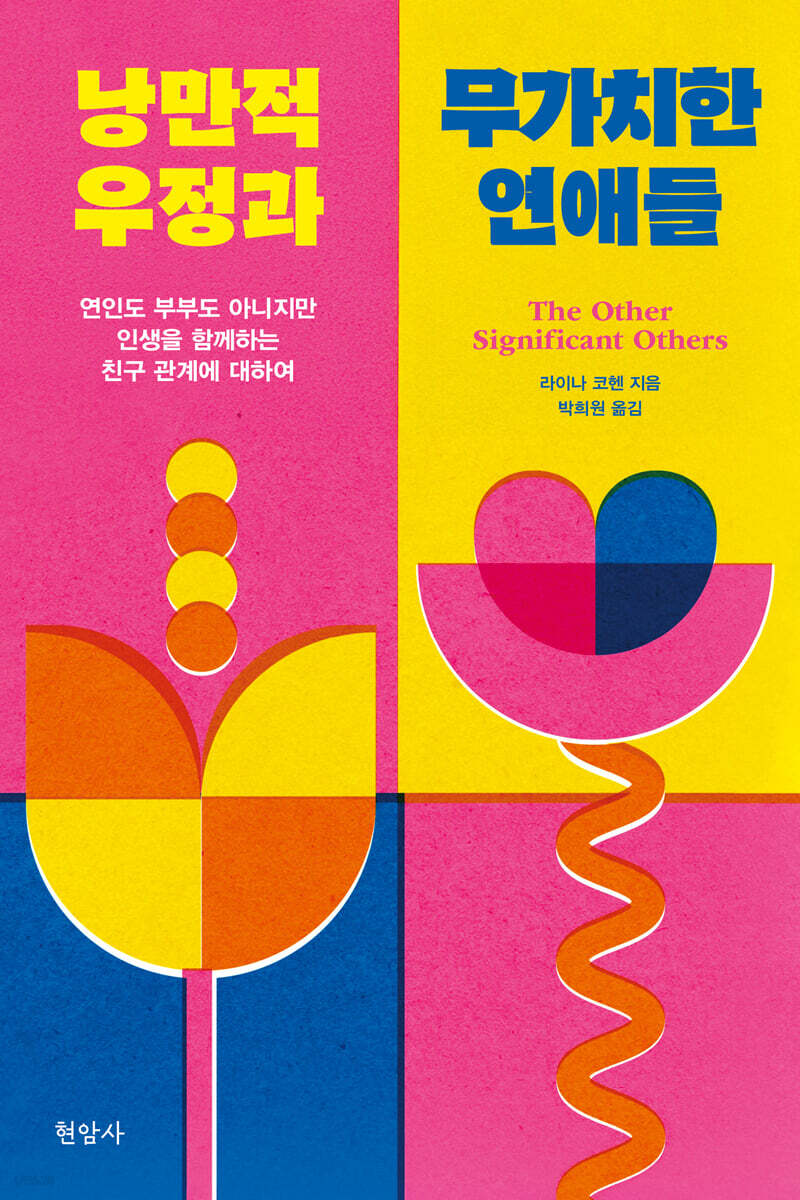
Romantic friendships and worthless romances
 |
Description
Book Introduction
What kind of lifestyle can friendships give us?
How far can we go with friends?
When you start dating a new partner, you lose touch with your friends, and the person you've been with for a month or so becomes more important than the friend you've known for over a decade.
No matter how close your friends are, if you don't have a lover, you are without a 'soulmate', so you must always leave room for a lover who might come along someday.
In this way, we subconsciously believe that we should prioritize lovers over friends and romance over friendship.
The notion that one-on-one romantic relationships are normal and essential, known as "forced coupledom," is widespread.
But is this notion truly justified? Is there a single relationship model—dating and marriage—that fits everyone?
This book is about people who broke away from the universal formula of relationships and decided to take a different path with their friends.
After meeting his friend M and realizing the potential for deeper friendships, the author set out to find diverse people who were forming similar yet different forms of deep friendships.
These friends are each other's caregivers, executors, co-owners and co-parents.
Through their stories, the author rethinks the concepts of relationships we take for granted and delves into them from a new perspective.
The author points out that we expect too much from romance, which weakens the relationship, and we expect too little from friendship, which hinders its development.
By examining the historical shifts in perspective on friendship, the institutional discrimination and restrictions placed on friendship, and more, we are encouraged to think about what we truly want from relationships and what kind of relationships we need.
How far can we go with friends?
When you start dating a new partner, you lose touch with your friends, and the person you've been with for a month or so becomes more important than the friend you've known for over a decade.
No matter how close your friends are, if you don't have a lover, you are without a 'soulmate', so you must always leave room for a lover who might come along someday.
In this way, we subconsciously believe that we should prioritize lovers over friends and romance over friendship.
The notion that one-on-one romantic relationships are normal and essential, known as "forced coupledom," is widespread.
But is this notion truly justified? Is there a single relationship model—dating and marriage—that fits everyone?
This book is about people who broke away from the universal formula of relationships and decided to take a different path with their friends.
After meeting his friend M and realizing the potential for deeper friendships, the author set out to find diverse people who were forming similar yet different forms of deep friendships.
These friends are each other's caregivers, executors, co-owners and co-parents.
Through their stories, the author rethinks the concepts of relationships we take for granted and delves into them from a new perspective.
The author points out that we expect too much from romance, which weakens the relationship, and we expect too little from friendship, which hinders its development.
By examining the historical shifts in perspective on friendship, the institutional discrimination and restrictions placed on friendship, and more, we are encouraged to think about what we truly want from relationships and what kind of relationships we need.
- You can preview some of the book's contents.
Preview
index
Author's Note
Introduction
1 Defining Relationships: Past, Present, and the Possibilities of Platonic Love
2 Other Companions: Beyond 'Destined Mates'
3. What's Sex Got to Do With It?: Rethinking Partnerships
4 Becoming Your Own Man: Finding Your Way to Masculinity and Intimacy
5 A Family-Like Family: From Friends to Co-Children
6 Over the Long Years: Adapting to Life as We Age
7 Allow Mourning: When Platonic Love Is Lost
8 Rights to Friends: The Price We Pay in a World Monopolized by Marriage
Outgoing post
Acknowledgements
Americas
Introduction
1 Defining Relationships: Past, Present, and the Possibilities of Platonic Love
2 Other Companions: Beyond 'Destined Mates'
3. What's Sex Got to Do With It?: Rethinking Partnerships
4 Becoming Your Own Man: Finding Your Way to Masculinity and Intimacy
5 A Family-Like Family: From Friends to Co-Children
6 Over the Long Years: Adapting to Life as We Age
7 Allow Mourning: When Platonic Love Is Lost
8 Rights to Friends: The Price We Pay in a World Monopolized by Marriage
Outgoing post
Acknowledgements
Americas
Detailed image

Into the book
This book is about friends who became "us" in a situation where there were few pre-determined frameworks, no ceremonies to celebrate, and no models to model themselves after to guide them into a platonic, committed, long-term relationship.
These friends traveled across states and continents together.
I became the primary caregiver for my friend while he was undergoing organ transplant and chemotherapy.
They are co-parents, co-owners of the house, and executors of each other's wills.
You are a member of a club without a name or membership form, and in many cases you are unaware that there are others like you.
They fall into a broader category that Northwestern University psychology professor Eli Finkel has dubbed "other companions."
By rejecting the typical set-pieces of life, these friends face risks they otherwise would not have faced and make discoveries they otherwise would not have made.
--- From the "Introductory Note"
Although Mako and M expressed themselves differently, I felt that the fundamental elements that made up my romantic relationship with Mako and my friendship with M were similar.
The obvious difference was that I had sex with Mako and not with M.
My friend Adam told me I was polyamorous.
Adam's experience with polyamory allowed him to make that diagnosis without hesitation.
In Adam's view, both Marco and M were partners to me.
A partnership with M just doesn't involve sex.
But the concept of polyamory didn't resonate with me.
Polyamory brought to mind sexual relationships, and it seemed to be the same for other people.
When I explain that I'm in a polyamorous relationship with Marco, M, what good is a label if people interpret it differently than they actually do?
--- 「1.
From "Defining Relationships"
A decline in the number of close friends is linked to loneliness, and loneliness is linked to a range of negative health outcomes, from high blood pressure to depression and cognitive decline.
Compared to women who lose their husbands, men who lose their spouses experience significantly higher levels of loneliness and depression, and these feelings persist for a longer period of time.
They are more likely to end their lives by suicide than women.
Researchers believe this difference stems from women's more diverse social support systems.
--- 「4.
From "Becoming Your Own Man"
A few years after moving, Inez was hospitalized for emergency surgery on a fractured wrist, and after returning home, she called Barb in the middle of the night in excruciating pain.
Inez slept with the door open, and although Barb's bedroom was right next door, Barb did not hear Inez's voice.
The next day, the two decided to hang a bell on Aeneas' bed.
It was the bell that Aeneas's mother used to call her family to dinner.
There were times when they thought it would be difficult for them to be each other's caregivers since they were close in age and that the role should be given to a younger person, but Barb said that living together "changed both of our mindsets."
“From then on, we decided to take care of each other for as long as we could.” Living together opened up new possibilities for interdependence.
--- 「6.
From "Over the Long Years"
It wasn't until Hannah's place was vacant that Joey realized what that friendship meant to him.
After Hannah died, Joey understood how rare and precious the friendship they shared was.
“I knew it was special when I was enjoying it, but I didn’t realize how special it was until Hannah left for another world.” Therein lies the dark irony of deprived mourning.
The depth of Joy's grief should be a powerful testament to how important that friendship was.
As Joni Mitchell famously said, I only realize what I had when it's gone.
But Joy's mourning was not acknowledged.
It was the same with company and government policies, and it was the same with those closest to me.
--- 「7.
From "Allow Mourning"
Like most products that claim to be one-size-fits-all and then fit everyone, the single-size-fits-all model of romantic couples doesn't actually work for many people, especially those who haven't found or don't want a one-stop-shop romantic relationship.
We are not free to choose our romantic unions if we have only one choice.
Even if everyone finds a partner, marriage won't be a panacea for the widespread epidemic of loneliness.
We need other forms of intimate connection.
These friends traveled across states and continents together.
I became the primary caregiver for my friend while he was undergoing organ transplant and chemotherapy.
They are co-parents, co-owners of the house, and executors of each other's wills.
You are a member of a club without a name or membership form, and in many cases you are unaware that there are others like you.
They fall into a broader category that Northwestern University psychology professor Eli Finkel has dubbed "other companions."
By rejecting the typical set-pieces of life, these friends face risks they otherwise would not have faced and make discoveries they otherwise would not have made.
--- From the "Introductory Note"
Although Mako and M expressed themselves differently, I felt that the fundamental elements that made up my romantic relationship with Mako and my friendship with M were similar.
The obvious difference was that I had sex with Mako and not with M.
My friend Adam told me I was polyamorous.
Adam's experience with polyamory allowed him to make that diagnosis without hesitation.
In Adam's view, both Marco and M were partners to me.
A partnership with M just doesn't involve sex.
But the concept of polyamory didn't resonate with me.
Polyamory brought to mind sexual relationships, and it seemed to be the same for other people.
When I explain that I'm in a polyamorous relationship with Marco, M, what good is a label if people interpret it differently than they actually do?
--- 「1.
From "Defining Relationships"
A decline in the number of close friends is linked to loneliness, and loneliness is linked to a range of negative health outcomes, from high blood pressure to depression and cognitive decline.
Compared to women who lose their husbands, men who lose their spouses experience significantly higher levels of loneliness and depression, and these feelings persist for a longer period of time.
They are more likely to end their lives by suicide than women.
Researchers believe this difference stems from women's more diverse social support systems.
--- 「4.
From "Becoming Your Own Man"
A few years after moving, Inez was hospitalized for emergency surgery on a fractured wrist, and after returning home, she called Barb in the middle of the night in excruciating pain.
Inez slept with the door open, and although Barb's bedroom was right next door, Barb did not hear Inez's voice.
The next day, the two decided to hang a bell on Aeneas' bed.
It was the bell that Aeneas's mother used to call her family to dinner.
There were times when they thought it would be difficult for them to be each other's caregivers since they were close in age and that the role should be given to a younger person, but Barb said that living together "changed both of our mindsets."
“From then on, we decided to take care of each other for as long as we could.” Living together opened up new possibilities for interdependence.
--- 「6.
From "Over the Long Years"
It wasn't until Hannah's place was vacant that Joey realized what that friendship meant to him.
After Hannah died, Joey understood how rare and precious the friendship they shared was.
“I knew it was special when I was enjoying it, but I didn’t realize how special it was until Hannah left for another world.” Therein lies the dark irony of deprived mourning.
The depth of Joy's grief should be a powerful testament to how important that friendship was.
As Joni Mitchell famously said, I only realize what I had when it's gone.
But Joy's mourning was not acknowledged.
It was the same with company and government policies, and it was the same with those closest to me.
--- 「7.
From "Allow Mourning"
Like most products that claim to be one-size-fits-all and then fit everyone, the single-size-fits-all model of romantic couples doesn't actually work for many people, especially those who haven't found or don't want a one-stop-shop romantic relationship.
We are not free to choose our romantic unions if we have only one choice.
Even if everyone finds a partner, marriage won't be a panacea for the widespread epidemic of loneliness.
We need other forms of intimate connection.
--- From "Outgoing Writing"
Publisher's Review
There is no order between love and friendship.
We learn how to relate to others and make friends as children, and as we grow up, our relationships with friends become more important than ever.
As we grow older and become adults, friends take a backseat and romantic partners emerge as the most important relationships.
Romantic relationships in adulthood are the only way to alleviate loneliness, and because those without a romantic partner are still incomplete half-selves, people dream of finding that one soulmate who will complete them.
We believe that having just one romantic partner will eliminate loneliness, provide sexual satisfaction, allow us to start a family, and raise children together.
When we place excessive roles and expectations on one person, we become so focused on meeting those expectations that we neglect other relationships.
It's becoming increasingly difficult to make friends and deepening relationships with them isn't easy.
It's easier to break up with a partner who doesn't meet your expectations.
That's how we become more and more lonely.
Author Raina Cohen felt a similar passion when she met M as when she started dating her boyfriend, Marko.
The author quickly became close with M and became a friend with whom he shared everything.
Having discovered that friendship can be so powerful and expansive, the author began to explore friendship from various angles.
The conventional wisdom that romance must come before friendship has never been true in any era.
In the past, it was important to share your feelings with friends more than with your spouse, and that attitude was not strange.
Love and friendship were equal, individual relationships, and friendship could deepen as much as it wanted.
The formula for creating new relationships with friends
The author set out to find people with whom he had formed very deep friendships.
People from all walks of life, with different races, religions, genders, and sexualities, all shared important aspects of their lives with friends, although their friendships took slightly different forms.
They lived together, raised their children, went to the hospital together, and entrusted the execution of their will to him.
They broke away from the conventional wisdom about what a friend should do and how far friendship can go, and wrote their own new relationship formula.
The author focuses on each friendship in each chapter.
Cammy and Tilly met at Marine Corps training camp and had a brief estrangement due to a conflict between Cammy's boyfriend and Tilly, but now they are closer than anyone else's friends.
Cammy now makes it clear to her date that Tilly will always be her number one priority.
Longtime friends Inez and Barb leaned on each other to survive the death of their child.
Now they live in the same house, spend their old age together, and take care of each other as they grow older.
John and Emily, who are nearly 20 years apart in age, introduce themselves as "non-romantic life partners" and attend every party together, and Emily's name is included in John's will.
These are relationships that are more deeply committed than anyone else, but are easily overlooked for lack of romance and excluded from the system for not being married.
These stories alone suggest the possibility of friendship, but the author does not stop there; he delves into the discourse surrounding friendship and friends from various angles.
Why do we feel we must parent with someone in a romantic relationship? Why isn't the breakup of a friend considered as tragic as the breakup of a romantic partner? Can't the many privileges afforded to marriage be extended to other relationships? Through the friendship between Art, a gay man, and Nick, a straight man, this book examines the impact of homosexuality on male friendships. Through the relationship between single mother Natasha and her legal co-parent, Linda, this book explores the changing legal rights surrounding romantic relationships and parenting.
In an increasingly lonely society, we need new models of relationships.
We can connect more deeply with others through friendship.
The path outside the conventional relationship formula may not be easy, but new landscapes will unfold where you go with your friends.
We learn how to relate to others and make friends as children, and as we grow up, our relationships with friends become more important than ever.
As we grow older and become adults, friends take a backseat and romantic partners emerge as the most important relationships.
Romantic relationships in adulthood are the only way to alleviate loneliness, and because those without a romantic partner are still incomplete half-selves, people dream of finding that one soulmate who will complete them.
We believe that having just one romantic partner will eliminate loneliness, provide sexual satisfaction, allow us to start a family, and raise children together.
When we place excessive roles and expectations on one person, we become so focused on meeting those expectations that we neglect other relationships.
It's becoming increasingly difficult to make friends and deepening relationships with them isn't easy.
It's easier to break up with a partner who doesn't meet your expectations.
That's how we become more and more lonely.
Author Raina Cohen felt a similar passion when she met M as when she started dating her boyfriend, Marko.
The author quickly became close with M and became a friend with whom he shared everything.
Having discovered that friendship can be so powerful and expansive, the author began to explore friendship from various angles.
The conventional wisdom that romance must come before friendship has never been true in any era.
In the past, it was important to share your feelings with friends more than with your spouse, and that attitude was not strange.
Love and friendship were equal, individual relationships, and friendship could deepen as much as it wanted.
The formula for creating new relationships with friends
The author set out to find people with whom he had formed very deep friendships.
People from all walks of life, with different races, religions, genders, and sexualities, all shared important aspects of their lives with friends, although their friendships took slightly different forms.
They lived together, raised their children, went to the hospital together, and entrusted the execution of their will to him.
They broke away from the conventional wisdom about what a friend should do and how far friendship can go, and wrote their own new relationship formula.
The author focuses on each friendship in each chapter.
Cammy and Tilly met at Marine Corps training camp and had a brief estrangement due to a conflict between Cammy's boyfriend and Tilly, but now they are closer than anyone else's friends.
Cammy now makes it clear to her date that Tilly will always be her number one priority.
Longtime friends Inez and Barb leaned on each other to survive the death of their child.
Now they live in the same house, spend their old age together, and take care of each other as they grow older.
John and Emily, who are nearly 20 years apart in age, introduce themselves as "non-romantic life partners" and attend every party together, and Emily's name is included in John's will.
These are relationships that are more deeply committed than anyone else, but are easily overlooked for lack of romance and excluded from the system for not being married.
These stories alone suggest the possibility of friendship, but the author does not stop there; he delves into the discourse surrounding friendship and friends from various angles.
Why do we feel we must parent with someone in a romantic relationship? Why isn't the breakup of a friend considered as tragic as the breakup of a romantic partner? Can't the many privileges afforded to marriage be extended to other relationships? Through the friendship between Art, a gay man, and Nick, a straight man, this book examines the impact of homosexuality on male friendships. Through the relationship between single mother Natasha and her legal co-parent, Linda, this book explores the changing legal rights surrounding romantic relationships and parenting.
In an increasingly lonely society, we need new models of relationships.
We can connect more deeply with others through friendship.
The path outside the conventional relationship formula may not be easy, but new landscapes will unfold where you go with your friends.
GOODS SPECIFICS
- Date of issue: September 10, 2025
- Page count, weight, size: 408 pages | 512g | 140*210*20mm
- ISBN13: 9788932324470
- ISBN10: 8932324476
You may also like
카테고리
korean


korean

![GQ KOREA Mark (Monthly): December [2025]](http://librairie.coreenne.fr/cdn/shop/files/8ef265dbbfbf186523ed75ba7319009d.jpg?v=1765340328&width=3840)


