

Poverty alleviation
 |
Description
Book Introduction
The abundance of things that are thrown away without even opening the packaging and the desperation of living on $1.90 a day
In this age of coexistence, what should we do?
『Animal Liberation』, 『The Table of Death』
A wake-up call to the way humans treat life on Earth.
A world-renowned master of practical ethics and one of the most controversial philosophers alive today,
Peter Singer's masterpiece of practical ethics!
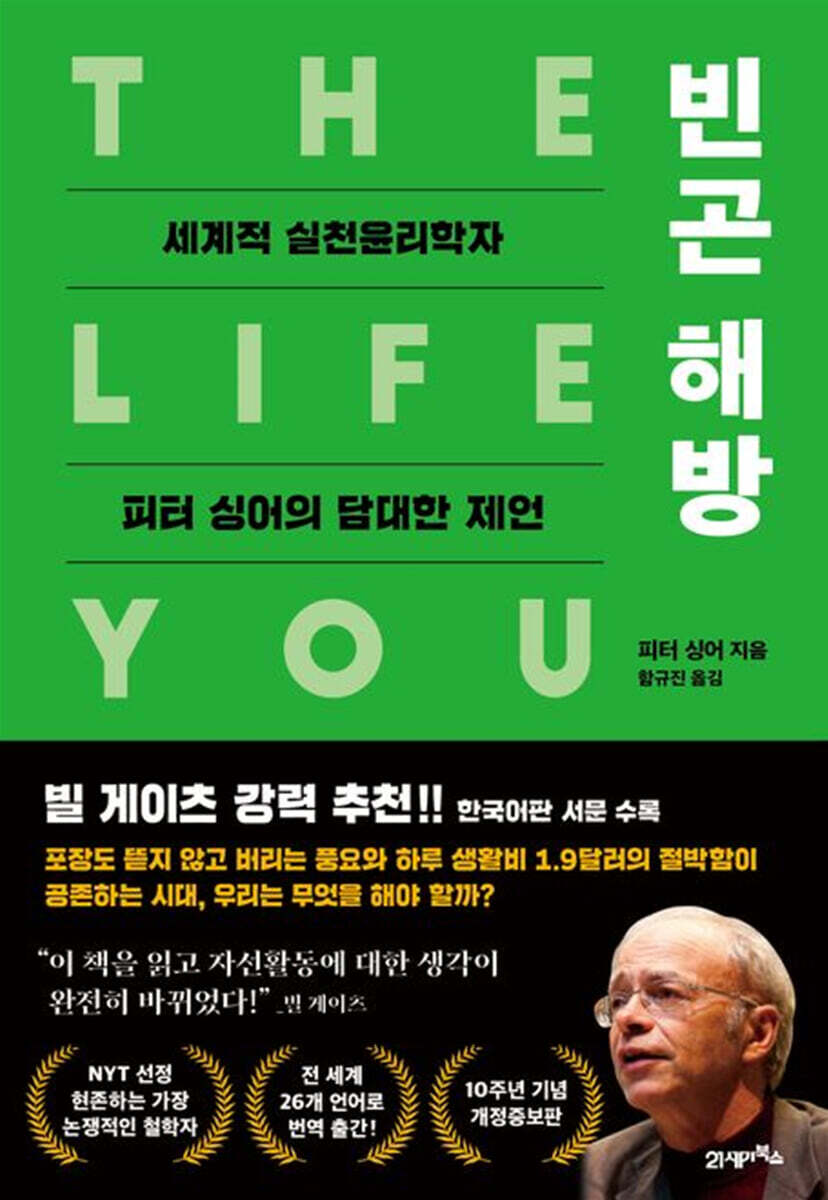
"This book completely changed my perspective on philanthropy!" - Bill Gates
Peter Singer, a world-renowned master of practical ethics, has published a completely revised edition of his masterpiece, The Life You Can Save, to mark its 10th anniversary.
This book, which presents a revolutionary approach to the problem of global inequality and emphasizes the ethical responsibility of individuals, became the catalyst for Bill Gates and Warren Buffett's "The Giving Pledge" campaign and brought about significant changes, such as readers voluntarily establishing foundations.
Translated into 26 languages, it has established itself as a leading book in the field of practical ethics, providing moral standards for readers around the world.
The 10th anniversary edition includes updated information and new case studies, as well as a special preface by the author for Korean readers.
Peter Singer emphasizes that while progress has been made in reducing extreme poverty around the world over the past decade, there is still much work to be done, noting that millions of people still live on less than $1.90 a day.
This book offers readers hope that small individual actions can change the world, and prompts deep reflection on human morality.
"Poverty Liberation" is not just a book of theory, but a guide to action that brings about practical change.
It broadens readers' awareness of the issue of poverty through systematically organized content ranging from the reality of poverty to what we can do.
It is also expected to spread a new culture of donation in our society by encouraging readers to reflect on their own spending habits and think about effective ways to donate.
The message that we can significantly improve the lives of others with minimal sacrifice provides a powerful motivation to seek concrete, practical solutions to address poverty.
In this age of coexistence, what should we do?
『Animal Liberation』, 『The Table of Death』
A wake-up call to the way humans treat life on Earth.
A world-renowned master of practical ethics and one of the most controversial philosophers alive today,
Peter Singer's masterpiece of practical ethics!
"This book completely changed my perspective on philanthropy!" - Bill Gates
Peter Singer, a world-renowned master of practical ethics, has published a completely revised edition of his masterpiece, The Life You Can Save, to mark its 10th anniversary.
This book, which presents a revolutionary approach to the problem of global inequality and emphasizes the ethical responsibility of individuals, became the catalyst for Bill Gates and Warren Buffett's "The Giving Pledge" campaign and brought about significant changes, such as readers voluntarily establishing foundations.
Translated into 26 languages, it has established itself as a leading book in the field of practical ethics, providing moral standards for readers around the world.
The 10th anniversary edition includes updated information and new case studies, as well as a special preface by the author for Korean readers.
Peter Singer emphasizes that while progress has been made in reducing extreme poverty around the world over the past decade, there is still much work to be done, noting that millions of people still live on less than $1.90 a day.
This book offers readers hope that small individual actions can change the world, and prompts deep reflection on human morality.
"Poverty Liberation" is not just a book of theory, but a guide to action that brings about practical change.
It broadens readers' awareness of the issue of poverty through systematically organized content ranging from the reality of poverty to what we can do.
It is also expected to spread a new culture of donation in our society by encouraging readers to reflect on their own spending habits and think about effective ways to donate.
The message that we can significantly improve the lives of others with minimal sacrifice provides a powerful motivation to seek concrete, practical solutions to address poverty.
- You can preview some of the book's contents.
Preview
index
Preface to the 10th Anniversary Korean Edition: What We Can Save Is Never Small
Endorsement_"You could think of it this way!"_Michael Schur
Preface: What You Can Do Right Here
Part 1: Will You Help or Ignore?
Chapter 1: Saving a Drowning Child
Chapter 2: Is it immoral not to help?
Chapter 3: Refusing to Donate and What We Commonly Say
Part 2: Why People Hesitate to Donate
Chapter 4: Five Psychological Obstacles to Donation
Chapter 5: How to Create a Culture of Giving 1
Part 3: The Best Way to Help Others
Chapter 6 How much does it cost to save a life?
Chapter 7: Finding Better Relief Methods
A new standard for 4th-tier donations
Chapter 8: My Child and Other People's Children
Chapter 9 Is this too much to ask?
Chapter 10: Realistic Standards
Conclusion: What Can One Person Do?
From Thought to Action by Charlie Bressler, Executive Director of LYCS
Appendix_How much should I donate? - Donation rate table
Acknowledgements
Translator's Note
Endorsement_"You could think of it this way!"_Michael Schur
Preface: What You Can Do Right Here
Part 1: Will You Help or Ignore?
Chapter 1: Saving a Drowning Child
Chapter 2: Is it immoral not to help?
Chapter 3: Refusing to Donate and What We Commonly Say
Part 2: Why People Hesitate to Donate
Chapter 4: Five Psychological Obstacles to Donation
Chapter 5: How to Create a Culture of Giving 1
Part 3: The Best Way to Help Others
Chapter 6 How much does it cost to save a life?
Chapter 7: Finding Better Relief Methods
A new standard for 4th-tier donations
Chapter 8: My Child and Other People's Children
Chapter 9 Is this too much to ask?
Chapter 10: Realistic Standards
Conclusion: What Can One Person Do?
From Thought to Action by Charlie Bressler, Executive Director of LYCS
Appendix_How much should I donate? - Donation rate table
Acknowledgements
Translator's Note
Detailed image

Into the book
The first edition of this book sparked much discussion and challenge, and the "effective altruism movement" gave rise to a large body of research on how to best use money.
Now fully revised to commemorate its 10th anniversary, this book captures the wisdom we've accumulated over the years on questions like: "Why do we help others? Why do we sometimes not help others? How should we approach helping others?"
--- p.18
We tend to assume that if we don't harm others, keep our promises, don't lie or cheat, take care of our children and parents, and perhaps even help out a little bit with our less fortunate neighbors, we're living well.
We believe that after we have met our own and our dependents' basic needs, we can spend the remaining money however we want.
Giving to strangers, especially those who don't live nearby, can be a nice thing to do, but I don't think it's something you have to do.
But if the basic argument above is correct, then the behavior we normally consider desirable will appear entirely new and undesirable.
--- p.52
Clearly, life expectancy today is higher than ever before.
Let's go back to 1800, 39 years ago.
Even in Belgium, the country with the highest life expectancy in the world, the life expectancy of a newborn was 40 years.
In India, it was only 25 years.
Today, life expectancy exceeds 50 years in every country around the world.
A baby born in Sierra Leone today can expect to live 10 years longer than a baby born in Belgium in 1800.
So the idea that we're not making any progress is a myth.
Why is this myth so widespread?
--- p.90
Similarly, ChildFund.org tells its website visitors, "Donating one mosquito net can save a life."
The mosquito net costs $11.
If you can take those numbers at face value, Givewell's job won't be so difficult.
To find out which organization can save lives in Africa at the lowest cost, simply pick the lowest number.
But while these low numbers are certainly an important part of charities' efforts to attract donors, they don't accurately represent the true cost of saving a life.
--- p.173
If a museum were to catch fire, would anyone think it right to save Manet's paintings instead of the child? And that child wouldn't be the only one.
There are countless children in the world who are in more difficult situations.
In a world where all urgent needs were met, philanthropy in the arts would be a noble act.
But unfortunately, we do not live in such a world.
So neither the "fair share" theory nor the "appropriate burden" view provides a definitive answer to the question, "What should we do for those in great need?"
However, I believe that such views can provide some answers to other practical questions.
Now, let me tell you that story.
Now fully revised to commemorate its 10th anniversary, this book captures the wisdom we've accumulated over the years on questions like: "Why do we help others? Why do we sometimes not help others? How should we approach helping others?"
--- p.18
We tend to assume that if we don't harm others, keep our promises, don't lie or cheat, take care of our children and parents, and perhaps even help out a little bit with our less fortunate neighbors, we're living well.
We believe that after we have met our own and our dependents' basic needs, we can spend the remaining money however we want.
Giving to strangers, especially those who don't live nearby, can be a nice thing to do, but I don't think it's something you have to do.
But if the basic argument above is correct, then the behavior we normally consider desirable will appear entirely new and undesirable.
--- p.52
Clearly, life expectancy today is higher than ever before.
Let's go back to 1800, 39 years ago.
Even in Belgium, the country with the highest life expectancy in the world, the life expectancy of a newborn was 40 years.
In India, it was only 25 years.
Today, life expectancy exceeds 50 years in every country around the world.
A baby born in Sierra Leone today can expect to live 10 years longer than a baby born in Belgium in 1800.
So the idea that we're not making any progress is a myth.
Why is this myth so widespread?
--- p.90
Similarly, ChildFund.org tells its website visitors, "Donating one mosquito net can save a life."
The mosquito net costs $11.
If you can take those numbers at face value, Givewell's job won't be so difficult.
To find out which organization can save lives in Africa at the lowest cost, simply pick the lowest number.
But while these low numbers are certainly an important part of charities' efforts to attract donors, they don't accurately represent the true cost of saving a life.
--- p.173
If a museum were to catch fire, would anyone think it right to save Manet's paintings instead of the child? And that child wouldn't be the only one.
There are countless children in the world who are in more difficult situations.
In a world where all urgent needs were met, philanthropy in the arts would be a noble act.
But unfortunately, we do not live in such a world.
So neither the "fair share" theory nor the "appropriate burden" view provides a definitive answer to the question, "What should we do for those in great need?"
However, I believe that such views can provide some answers to other practical questions.
Now, let me tell you that story.
--- p.261
Publisher's Review
Peter Singer, a world-renowned master of practical ethics, suggests
The easiest and clearest solution to ending world poverty
The 10th anniversary edition of "Poverty Emancipation," a bold proposal from Peter Singer, a world-renowned master of practical ethics, is being published by 21st Century Books.
This book is a masterpiece by Professor Singer, who changed the standards of bioethics around the world with 『Animal Liberation』 and 『The Table of Death』. It is evaluated to have boldly broken down the walls of existing national borders and customs and ignited the spark of a practical poverty eradication movement by emphasizing the ethical responsibility of individuals and presenting a revolutionary approach to the problem of global inequality.
The book faced strong opposition immediately after its publication, saying that it held the rich to too high an ethical standard and made them seem as if they did not care about world hunger. However, it was launched with the intention of encouraging Bill Gates and Warren Buffett to donate more than half of their wealth to society.
It became the catalyst for the birth of the 'The Giving Pledge' campaign, and readers who read the book voluntarily founded the The Life You Can Save Foundation, the original title of the book, and donated its assets to operate it, bringing about great changes. It has become one of the representative books on practical ethics today.
Translated into 26 languages, it has become a moral standard for readers around the world.
A comprehensively revised edition commemorating the 10th anniversary of the leading book in practical ethics!
Peter Singer is Professor Emeritus of Bioethics at Princeton University and has been selected by journalists as "the world's most influential living philosopher."
In a world where 18 million people, twice the population of Seoul, die from poverty and hunger every year, Singer has argued that each of us can and should work to alleviate the suffering caused by poverty, not just in our own communities or countries, but everywhere around the world.
To that end, the author wrote the first edition of "Freeing Poverty," a book that shows why we should care about and help those living in extreme poverty around the world, and how easy it is to improve and save lives by giving effectively.
This 10th anniversary edition features many new chapters, reflecting recent developments and new cases that have arisen in the past decade since its publication. It also includes a special preface from the author addressed to Korean readers.
In the preface to the 10th anniversary edition, the author notes that while dramatic progress has been made in reducing extreme poverty worldwide in the decade since the first edition of this book was published, millions of people still live on less than $1.90 a day, and much work remains to be done.
Through various perspectives and colorful questions and answers on the issue of poverty,
A modern philosophy book that offers in-depth reflection on the question, "What is morality?"
'There is a child in front of me who can be saved with just a little effort.
This book begins with the question, "What should we do?" and is reminiscent of a philosophy class conducted through questions and answers.
"What if your dollar, your meal could save someone's life? With minimal sacrifice, you can greatly improve the lives of others." This powerful message offers readers hope that small individual actions can change the world. It also provides a reading experience that encourages deep reflection on human morality, while simultaneously encouraging them to explore concrete, practical solutions to address poverty.
From the reality of poverty to what we can do, readers can naturally understand the problem of poverty through systematically organized content.
It can broaden your awareness.
I recommend that you read the book, reflect on your spending habits, and think about effective ways to donate.
This book is not simply a theoretical book, but a guide to practical change that will spread a new culture of giving in our society.
The easiest and clearest solution to ending world poverty
The 10th anniversary edition of "Poverty Emancipation," a bold proposal from Peter Singer, a world-renowned master of practical ethics, is being published by 21st Century Books.
This book is a masterpiece by Professor Singer, who changed the standards of bioethics around the world with 『Animal Liberation』 and 『The Table of Death』. It is evaluated to have boldly broken down the walls of existing national borders and customs and ignited the spark of a practical poverty eradication movement by emphasizing the ethical responsibility of individuals and presenting a revolutionary approach to the problem of global inequality.
The book faced strong opposition immediately after its publication, saying that it held the rich to too high an ethical standard and made them seem as if they did not care about world hunger. However, it was launched with the intention of encouraging Bill Gates and Warren Buffett to donate more than half of their wealth to society.
It became the catalyst for the birth of the 'The Giving Pledge' campaign, and readers who read the book voluntarily founded the The Life You Can Save Foundation, the original title of the book, and donated its assets to operate it, bringing about great changes. It has become one of the representative books on practical ethics today.
Translated into 26 languages, it has become a moral standard for readers around the world.
A comprehensively revised edition commemorating the 10th anniversary of the leading book in practical ethics!
Peter Singer is Professor Emeritus of Bioethics at Princeton University and has been selected by journalists as "the world's most influential living philosopher."
In a world where 18 million people, twice the population of Seoul, die from poverty and hunger every year, Singer has argued that each of us can and should work to alleviate the suffering caused by poverty, not just in our own communities or countries, but everywhere around the world.
To that end, the author wrote the first edition of "Freeing Poverty," a book that shows why we should care about and help those living in extreme poverty around the world, and how easy it is to improve and save lives by giving effectively.
This 10th anniversary edition features many new chapters, reflecting recent developments and new cases that have arisen in the past decade since its publication. It also includes a special preface from the author addressed to Korean readers.
In the preface to the 10th anniversary edition, the author notes that while dramatic progress has been made in reducing extreme poverty worldwide in the decade since the first edition of this book was published, millions of people still live on less than $1.90 a day, and much work remains to be done.
Through various perspectives and colorful questions and answers on the issue of poverty,
A modern philosophy book that offers in-depth reflection on the question, "What is morality?"
'There is a child in front of me who can be saved with just a little effort.
This book begins with the question, "What should we do?" and is reminiscent of a philosophy class conducted through questions and answers.
"What if your dollar, your meal could save someone's life? With minimal sacrifice, you can greatly improve the lives of others." This powerful message offers readers hope that small individual actions can change the world. It also provides a reading experience that encourages deep reflection on human morality, while simultaneously encouraging them to explore concrete, practical solutions to address poverty.
From the reality of poverty to what we can do, readers can naturally understand the problem of poverty through systematically organized content.
It can broaden your awareness.
I recommend that you read the book, reflect on your spending habits, and think about effective ways to donate.
This book is not simply a theoretical book, but a guide to practical change that will spread a new culture of giving in our society.
GOODS SPECIFICS
- Date of issue: April 23, 2025
- Page count, weight, size: Checking page count | Checking size
- ISBN13: 9791173571633
- ISBN10: 1173571639
You may also like
카테고리
korean


korean

![GQ KOREA Mark (Monthly): December [2025]](http://librairie.coreenne.fr/cdn/shop/files/8ef265dbbfbf186523ed75ba7319009d.jpg?v=1765340328&width=3840)


