

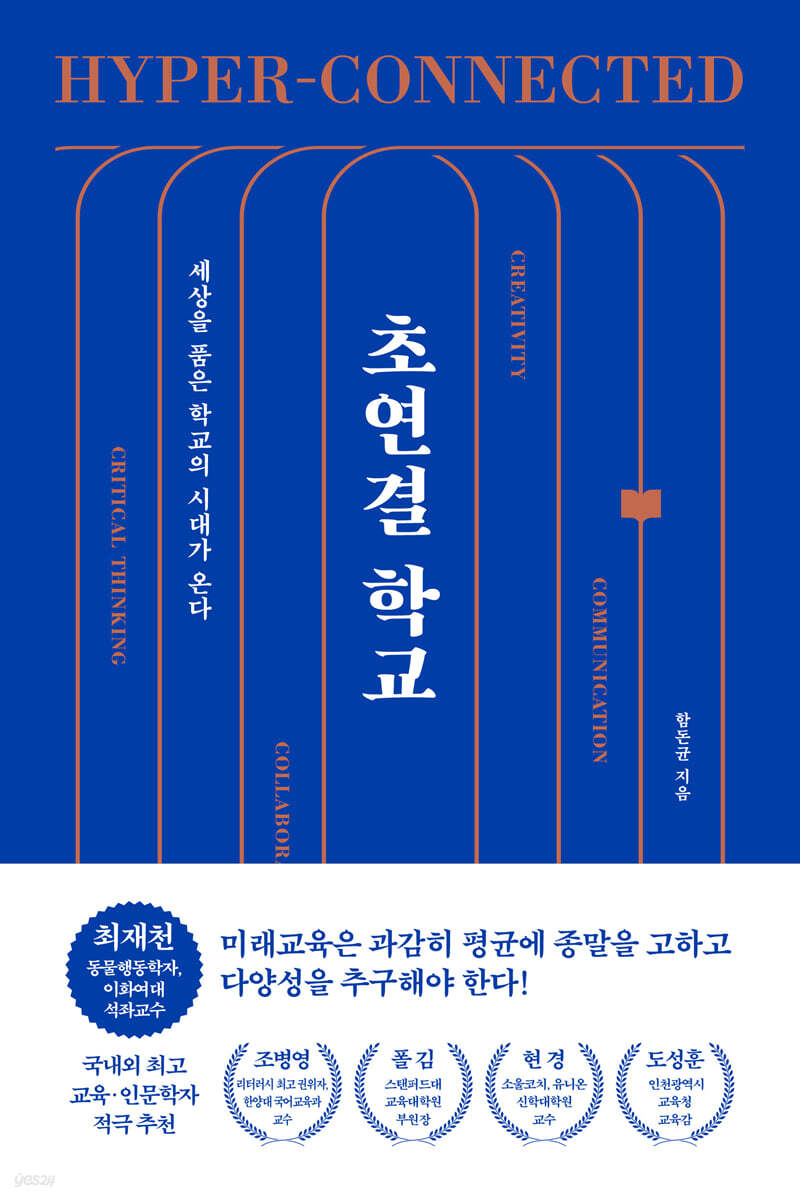
Hyperconnected School
 |
Description
Book Introduction
What if the education of 30 years ago made us who we are today?
What kind of future will today's education create 30 years from now?
The question of how to prepare for the future amidst an unprecedented crisis of civilization and the rapidly changing technological, industrial, and social landscape in human history is of paramount concern to all of humanity.
Above all, the transformation of education into a future school, which should prepare students for life changes, help them enter social life stably, and help them develop their personal growth and identity, has become a hot topic of discussion in civilization.
In particular, discussions about future education are focused on technological innovations, particularly AI, and fail to provide a definitive answer to the question of why and for what purpose the future of education should be linked to a technological vision. In South Korea, with its advanced IT industry, education has been viewed from a technological engineering perspective, focusing for years on "smart classrooms" and "coding education." However, in the field of education, there is even a backlash against this technological perspective on education.
This book raises reasonable questions about this and provides a broad perspective on the direction of future education.
This book, "Hyperconnected School," is a book on future education that compiles the author's ten-year experience and case studies on educational and social phenomena, compiled from his research, lectures, and literary critic experience at a university. He then became a humanities and education activist.
The author, who has been deeply pained and repeatedly lamenting the blindness, irresponsibility, violence, and inefficiency inherent in Korean school education, naturally came to feel a sense of calling that the time had come to move toward the emergence of a new educational model.
The problems that Korean education has created are thought to be only a difference in degree, and there is no essential difference between secondary and higher education.
The entrance exam-centered education system, which is always cited as a negative aspect of Korean education, is merely a phenomenon that reveals the disadvantages of life and learning, and I have come to suspect that it is ultimately producing 'monster humans' rather than nurturing 'proper humans - thinking humans'.
The author, who thus shifted his direction to become an 'education-humanities activist', believes that the current era is not one in which the critical philosophy, critical social science, social activists, and NGOs of the past 'criticize' the system, but rather one in which we must immediately seek various solutions and apply and practice those solutions in our lives.
What kind of future will today's education create 30 years from now?
The question of how to prepare for the future amidst an unprecedented crisis of civilization and the rapidly changing technological, industrial, and social landscape in human history is of paramount concern to all of humanity.
Above all, the transformation of education into a future school, which should prepare students for life changes, help them enter social life stably, and help them develop their personal growth and identity, has become a hot topic of discussion in civilization.
In particular, discussions about future education are focused on technological innovations, particularly AI, and fail to provide a definitive answer to the question of why and for what purpose the future of education should be linked to a technological vision. In South Korea, with its advanced IT industry, education has been viewed from a technological engineering perspective, focusing for years on "smart classrooms" and "coding education." However, in the field of education, there is even a backlash against this technological perspective on education.
This book raises reasonable questions about this and provides a broad perspective on the direction of future education.
This book, "Hyperconnected School," is a book on future education that compiles the author's ten-year experience and case studies on educational and social phenomena, compiled from his research, lectures, and literary critic experience at a university. He then became a humanities and education activist.
The author, who has been deeply pained and repeatedly lamenting the blindness, irresponsibility, violence, and inefficiency inherent in Korean school education, naturally came to feel a sense of calling that the time had come to move toward the emergence of a new educational model.
The problems that Korean education has created are thought to be only a difference in degree, and there is no essential difference between secondary and higher education.
The entrance exam-centered education system, which is always cited as a negative aspect of Korean education, is merely a phenomenon that reveals the disadvantages of life and learning, and I have come to suspect that it is ultimately producing 'monster humans' rather than nurturing 'proper humans - thinking humans'.
The author, who thus shifted his direction to become an 'education-humanities activist', believes that the current era is not one in which the critical philosophy, critical social science, social activists, and NGOs of the past 'criticize' the system, but rather one in which we must immediately seek various solutions and apply and practice those solutions in our lives.
- You can preview some of the book's contents.
Preview
index
prolog
0th period reopening
The School of the Future: Just Start Now
Be aware of the connection in the first period
001 Umbrella and Water Cup, Sewing Machine and Umbrella on the Operating Table - Strange Connections and Creativity
An umbrella is not lonely | Philosopher Hegel said it's okay to go on a summer vacation to the sea | Inevitable connection
The truth play that creates
002 Borges's Library is Infinite - 20th-Century Logic Education and the 21st-Century Object Environment
The algorithm of things with one answer | There is no right answer and infinite connections are possible
Even the greatest architects cannot analyze a city alone.
003 The Little Prince Meets a Geographer - The Virtuality of the Classroom and Alienated Knowledge
The school I went to didn't teach me about life | Abstract knowledge isn't bad knowledge, but
Knowledge of all places, knowledge that reaches nowhere
004 A school for gifted students who don't know life
Stanford's Laboratory Revolution and the Carousel of Hungry Children | Contextualized Learning Fails
You can die even after doing good deeds | Global, International, Multicultural, World Citizen, Different Fingers
Stanford University Goes All-In on Diversity
005 A virtual space of a world-renowned architect who has never connected with the people of Seoul.
If he had designed this building himself in Seoul, the disconnect would have created alienation.
| Machine Man and Machine City, Kafka and the Study of Disconnection
What is connected and how is it learned in the 2nd period hyper-connected school?
006 Connecting Future Questions with Refrigerators and School Buses
Connecting everyday discoveries to learning | How to see apples in a new light | Cracking open a clam
Open the door with your own hands | You can meet God simply by observing and asking questions.
Why did the 007 poets go to global IT and home appliance companies?
How to Design Experiences | Lifestyle Service Design with "Alice in Wonderland"
Robot vacuum cleaners designed by poets
008 Humanities and Arts Classes Are More Important Than Coding
Aristotle Resurrected | Humanities and Arts Education, Not Cultural Arts Education | Humanities
People are generous
009 Olafur Eliasson and the School of the End, Protecting the Earth
Novelty itself is not creativity | Scientist, philosopher, child, and artist-teacher | Yes
The Sulga is an art teacher who embraces the universe | The apocalyptic school that shattered the "future-assurance theory"
010 Why the World's Best Engineering Schools Are Now Focusing on Music Classes
- MIT Music Class at the Future Children's School
Fingers Pointing to the Moon: Technology | Different Questions Pointing to One | Music Lessons
Engineering humanistic ideals with
011 Some Ways Schools Connect the World
What are the top two universities in the US ranking for innovation connecting?
Minerva University, eliminating campuses and connecting cities | Schools without teachers and classrooms
Healthy | The Secret Key to the Future of Educational Administration | Arizona State University, for Everyone
Schools for All | Designing Inclusive Schools, Great Schools
3rd period is close, but reconnecting things that were disconnected
012 For whom and for what purpose is 'self-direction'?
A very old but not yet realized | Learner-led learning goes beyond student-centeredness |
Teachers change and parents leave.
013 Self-development or self-growth?
Before talking about learner-led initiative, we must first ask ourselves: Now, even Seoul National University has no choice.
Must Follow | OECD Learning Compass and the Ignorant Teacher
014 Connecting the Hearts of Schools and Learners
- Learning and spirituality
Why Google is Incorporating Meditation into its Educational Program | Designer Steve Jobs and Emotional Intelligence |
Awards Should Go Beyond Self-Improvement Programs | Oprah Winfrey on "Who Am I?"
| Spirituality dictates hyperconnectivity
015 Four Classrooms and an Old Future
School, Leisure and Rest | The First Classroom, Socrates, the Multidisciplinary Dialogue Coach | Learners
The midwife-teacher who stimulates | Teachers kill the ego, schools live in the present | Part 2
Classroom, the Psychoanalyst's Safe Couch | The Third Classroom: Zhuangzi, the Guide to Forgetting and Knowing Myself
Liberating Classroom | The Fourth Classroom: Borges' Analog Library for Reading Literature
0th period reopening
The School of the Future: Just Start Now
Be aware of the connection in the first period
001 Umbrella and Water Cup, Sewing Machine and Umbrella on the Operating Table - Strange Connections and Creativity
An umbrella is not lonely | Philosopher Hegel said it's okay to go on a summer vacation to the sea | Inevitable connection
The truth play that creates
002 Borges's Library is Infinite - 20th-Century Logic Education and the 21st-Century Object Environment
The algorithm of things with one answer | There is no right answer and infinite connections are possible
Even the greatest architects cannot analyze a city alone.
003 The Little Prince Meets a Geographer - The Virtuality of the Classroom and Alienated Knowledge
The school I went to didn't teach me about life | Abstract knowledge isn't bad knowledge, but
Knowledge of all places, knowledge that reaches nowhere
004 A school for gifted students who don't know life
Stanford's Laboratory Revolution and the Carousel of Hungry Children | Contextualized Learning Fails
You can die even after doing good deeds | Global, International, Multicultural, World Citizen, Different Fingers
Stanford University Goes All-In on Diversity
005 A virtual space of a world-renowned architect who has never connected with the people of Seoul.
If he had designed this building himself in Seoul, the disconnect would have created alienation.
| Machine Man and Machine City, Kafka and the Study of Disconnection
What is connected and how is it learned in the 2nd period hyper-connected school?
006 Connecting Future Questions with Refrigerators and School Buses
Connecting everyday discoveries to learning | How to see apples in a new light | Cracking open a clam
Open the door with your own hands | You can meet God simply by observing and asking questions.
Why did the 007 poets go to global IT and home appliance companies?
How to Design Experiences | Lifestyle Service Design with "Alice in Wonderland"
Robot vacuum cleaners designed by poets
008 Humanities and Arts Classes Are More Important Than Coding
Aristotle Resurrected | Humanities and Arts Education, Not Cultural Arts Education | Humanities
People are generous
009 Olafur Eliasson and the School of the End, Protecting the Earth
Novelty itself is not creativity | Scientist, philosopher, child, and artist-teacher | Yes
The Sulga is an art teacher who embraces the universe | The apocalyptic school that shattered the "future-assurance theory"
010 Why the World's Best Engineering Schools Are Now Focusing on Music Classes
- MIT Music Class at the Future Children's School
Fingers Pointing to the Moon: Technology | Different Questions Pointing to One | Music Lessons
Engineering humanistic ideals with
011 Some Ways Schools Connect the World
What are the top two universities in the US ranking for innovation connecting?
Minerva University, eliminating campuses and connecting cities | Schools without teachers and classrooms
Healthy | The Secret Key to the Future of Educational Administration | Arizona State University, for Everyone
Schools for All | Designing Inclusive Schools, Great Schools
3rd period is close, but reconnecting things that were disconnected
012 For whom and for what purpose is 'self-direction'?
A very old but not yet realized | Learner-led learning goes beyond student-centeredness |
Teachers change and parents leave.
013 Self-development or self-growth?
Before talking about learner-led initiative, we must first ask ourselves: Now, even Seoul National University has no choice.
Must Follow | OECD Learning Compass and the Ignorant Teacher
014 Connecting the Hearts of Schools and Learners
- Learning and spirituality
Why Google is Incorporating Meditation into its Educational Program | Designer Steve Jobs and Emotional Intelligence |
Awards Should Go Beyond Self-Improvement Programs | Oprah Winfrey on "Who Am I?"
| Spirituality dictates hyperconnectivity
015 Four Classrooms and an Old Future
School, Leisure and Rest | The First Classroom, Socrates, the Multidisciplinary Dialogue Coach | Learners
The midwife-teacher who stimulates | Teachers kill the ego, schools live in the present | Part 2
Classroom, the Psychoanalyst's Safe Couch | The Third Classroom: Zhuangzi, the Guide to Forgetting and Knowing Myself
Liberating Classroom | The Fourth Classroom: Borges' Analog Library for Reading Literature
Detailed image
Into the book
It also suggests that meaning is not something that exists on its own, but rather something that is infinitely 'constructed' through the connection of information.
Above all, The Library of Babel mysteriously detonates the poverty and narrowness of the logical algorithms taught by 20th-century education through a wonderful literary allegory.
Rather than being limited, 'meaning-logic' can be infinitely expanded and created depending on how one views the world and whether one has the eyes to connect the meanings of words and objects.
If we interpret the Library of Babel from the perspective of educational theory, which is being discussed these days, we can say that it is a world itself built on literacy.
Literacy is usually translated as 'literacy', but it is originally understood broadly as the selection and acceptance of information, and the triggers and strategies of reading and writing that construct meaning, operated for a specific purpose or to secure reader identity.
By connecting information with information, the reader constructs the necessity of information, and in that sense, the reader becomes an active subject of meaning and a practitioner of meaning.
--- From "There is no right answer, and infinite connections are possible"
There was a project to create an innovative electric motor pump in a remote village in South America where there was no electricity and water could not be pumped from wells.
Students participating in this project will design a project that can generate electricity simply and without any additional facilities, while simultaneously contributing to children's health and play.
What they created was a carousel for a children's playground.
They developed a motor pump system that uses the power of children turning a carousel with their feet to turn a turbine... However, after installing their invention in several local playgrounds, they were shocked to discover that the project had failed.
No matter how long I waited, the children never showed up at the playground.
The children of that village had no time to use the playground because they had been working as laborers on coffee plantations, sugarcane plantations, and cotton plantations from a very young age with little hands, and moreover, they were so hungry that they had no physical energy left to run the rides after work.
--- From "Stanford University's Laboratory Revolution and the Carousel of Hungry Children"
I would like to confess that one of the moments when I, as a student, gained profound insight during the Korean institutional education system was during a lecture given by my university professor on this very issue.
The teacher was someone who would refer to various classical texts while teaching literature. That day, he referred to a scene from the Book of Exodus in the Bible and interpreted it as follows.
This is a scene where Moses, who was wandering on the mountain, saw a strange fire rising from a thornbush. He was drawn to the unfamiliar figure and cautiously approached it. Suddenly, he heard the following voice from the burning bush:
“Moses, stop right there and take off your shoes.
“The place where you stand is a holy place.” The teacher interpreted literature as the voice of God that made him realize that the place where he stood was a holy place.
The shock I felt the day I heard those words, that I should regard the place where I live as a sacred place, is still vivid in my mind, and I have come to accept it as the greatest lesson of my life.
--- From "How to Look at an Apple"
In this era, education cannot help but focus on creativity—inventing and transforming perspectives—rather than simply imparting information and knowledge. The emphasis must shift from education focused on quickly finding answers to existing questions to process-centered instruction, where the invention of creative questions becomes the learning goal itself.
Of course, creative questions were important in traditional education as well.
However, while in traditional education, questions were a process for 'answering,' now creative questions themselves are becoming 'goals' that directly influence the industrial market and improve the quality of life.
In this changing environment, it is not easy for students who are solely focused on finding a single answer from a disciplinary perspective to take a leading role.
At this point, education can only be understood as an outlet or plug-in knowledge that enables 'connections' between domains.
‘Humanities’ play a more important role there as a point-of-view knowledge rather than as content.
--- From "Designing Lifestyle Services with 'Alice in Wonderland'"
They have clearly defined the slogan 'global' in their own way.
What does "global" mean in education? Are Korean "international schools" that teach in English truly global? Is a school truly global if it has a large number of students studying abroad at prestigious universities? Is a school truly global if it has a large number of international students? Minerva University concluded that "global" means a "global learning experience."
It is contextualized learning that connects the world and the learner, and it brings intellectual and cultural diversity into the learning experience, and the way to do that is through 'connection.'
They connected space, people, and culture to the school, and directly linked the academic process to workplace learning and internships.
The course is designed to be a collaborative communication process within the various public institutions, businesses, and civil society organizations of the region, and to connect with communities that experience and realize intellectual diversity.
--- From "Schools are still alive even without teachers and classrooms"
In Korea, the concept of educational subjectivity began to be recognized and examined from the perspective of 'students' in the educational movement around 1990, especially when the Korean Teachers and Education Workers' Union began to advocate that the subjects of education were students, teachers, and parents.
If you think about it, it seems so obvious that students are the "subjects" in schools, which are places where they study, but this declaration of educational subjectivity has a sharp aspect that reveals the reality of how schools have treated students in Korean society.
If students existed as "owners" of the school, schools would not have been able to treat students so violently in the Korean elementary education system before the 1990s.
The most important issue concerning student subjectivity that those pursuing educational innovation during this period had was the struggle for awareness and recognition that students are also "citizens" and "human beings" with full rights.
The issue of students as subjects was in fact no different from the issue of students' human rights.
--- From "Very Old But Unfulfilled"
The ultimate goal of learning should be to make the learner realize that he or she is not intellectually inferior to the teacher-professor.
The fundamental reason why learners' self-directedness is not expressed is that they feel intimidated in front of teachers who have a hierarchy of knowledge.
He says that even those with progressive educational views consider the 'resulting equality' of knowledge gained through intellectual acquisition as an educational goal.
However, Jacotot argues that the miracle of learning and the miracle of education can only occur if we assume equality of cognitive ability and intellectual ability itself from the very beginning.
What is absolutely crucial in this learning process is not for teachers to do nothing, but to encourage students based on a belief in intellectual equality.
This encouragement does not mean unconditionally imparting knowledge to learners, but rather 'coaching' that enables learners to believe in themselves.
--- From “OECD Learning Compass and Ignorant Teachers”
The concept of 'spirituality' has been understood in a religious context.
However, according to the renowned religious scholar Philip Shelderlake, spirituality is not specific to religion, but rather involves a fully integrated approach to life, a holistic understanding, a pursuit of what is right and sacred, and, at a personal level, the pursuit of the capacity to elevate one's potential in all its dimensions...
Moreover, the wholeness of life seeks an integrated vision and "connection" between knowledge and practice, individuality and community, happiness and ethics, physicality and spirituality, materiality and spirit, nature and civilization, and technological tools and goals...
This humanistic perspective on spirituality surprisingly aligns with the goals that education has pursued so far.
In a sense, it is a clear example of the limitations of civilized education and schools that still need to be overcome, as they have reached a point where they have become destructive and oppressive, and the ultimate vision of the educational ideal that we are trying to pursue but have not yet reached.
And this is a much more important area in the concept of future education and future schools...
I am convinced that 'spirituality' will become an important educational goal and methodology.
--- From "Meditation Must Go Beyond a Self-Improvement Program"
It is very significant that OFSTED's document on secondary education standards in the UK includes a section on 'spiritual development'.
This document defines spirituality as the immaterial element of human life, and emphasizes the introduction of a reflective existence into education that goes beyond developing the immaterial aspects of life, as life is more than just biological.
In particular, in the general education curriculum, the meaning of 'spiritual development' is to foster social and civic values, which are the core values of communal life, and to accept these within the inherent principles of learning.
This has the effect of replacing the perspective that approaches education as instrumental and results-oriented.
Spirituality, introduced into the realm of education, has the effect of raising questions about the ultimate purpose of education, what it means to be an educated person, and what constitutes an educated society...
The pursuit of practical and ultimate wisdom about life is the original goal of education and the goal of future education, and this is no different from the spiritual perspective on education.
The school of the future may need to understand the cultivation of spirituality as one of the goals of its curriculum, perhaps even its ultimate purpose.
--- From "Spirituality Directs Hyperconnection"
The most advanced future school is not one that sets the "future" as a task to be accomplished, but one that immediately puts its principles into practice, a "school here and now."
If we understand the principles of evolution, then schools pursuing evolution can immediately implement the principles of evolution as best they can.
Among the schools I have experienced and observed, the successful future schools immediately implement the principles to the extent possible now, while the less successful schools postpone them as 'future tasks' 'like studying'... The fastest way for a pioneer who aspires to the evolution of humanity and life to advance that aspiration is to 'live' life 'here and now' in that way by pulling the present forward as if it were the future.
Instead of studying the sheet music, you can just sing the song with the sheet music....
The school of the future will be the school of the here and now.
Above all, The Library of Babel mysteriously detonates the poverty and narrowness of the logical algorithms taught by 20th-century education through a wonderful literary allegory.
Rather than being limited, 'meaning-logic' can be infinitely expanded and created depending on how one views the world and whether one has the eyes to connect the meanings of words and objects.
If we interpret the Library of Babel from the perspective of educational theory, which is being discussed these days, we can say that it is a world itself built on literacy.
Literacy is usually translated as 'literacy', but it is originally understood broadly as the selection and acceptance of information, and the triggers and strategies of reading and writing that construct meaning, operated for a specific purpose or to secure reader identity.
By connecting information with information, the reader constructs the necessity of information, and in that sense, the reader becomes an active subject of meaning and a practitioner of meaning.
--- From "There is no right answer, and infinite connections are possible"
There was a project to create an innovative electric motor pump in a remote village in South America where there was no electricity and water could not be pumped from wells.
Students participating in this project will design a project that can generate electricity simply and without any additional facilities, while simultaneously contributing to children's health and play.
What they created was a carousel for a children's playground.
They developed a motor pump system that uses the power of children turning a carousel with their feet to turn a turbine... However, after installing their invention in several local playgrounds, they were shocked to discover that the project had failed.
No matter how long I waited, the children never showed up at the playground.
The children of that village had no time to use the playground because they had been working as laborers on coffee plantations, sugarcane plantations, and cotton plantations from a very young age with little hands, and moreover, they were so hungry that they had no physical energy left to run the rides after work.
--- From "Stanford University's Laboratory Revolution and the Carousel of Hungry Children"
I would like to confess that one of the moments when I, as a student, gained profound insight during the Korean institutional education system was during a lecture given by my university professor on this very issue.
The teacher was someone who would refer to various classical texts while teaching literature. That day, he referred to a scene from the Book of Exodus in the Bible and interpreted it as follows.
This is a scene where Moses, who was wandering on the mountain, saw a strange fire rising from a thornbush. He was drawn to the unfamiliar figure and cautiously approached it. Suddenly, he heard the following voice from the burning bush:
“Moses, stop right there and take off your shoes.
“The place where you stand is a holy place.” The teacher interpreted literature as the voice of God that made him realize that the place where he stood was a holy place.
The shock I felt the day I heard those words, that I should regard the place where I live as a sacred place, is still vivid in my mind, and I have come to accept it as the greatest lesson of my life.
--- From "How to Look at an Apple"
In this era, education cannot help but focus on creativity—inventing and transforming perspectives—rather than simply imparting information and knowledge. The emphasis must shift from education focused on quickly finding answers to existing questions to process-centered instruction, where the invention of creative questions becomes the learning goal itself.
Of course, creative questions were important in traditional education as well.
However, while in traditional education, questions were a process for 'answering,' now creative questions themselves are becoming 'goals' that directly influence the industrial market and improve the quality of life.
In this changing environment, it is not easy for students who are solely focused on finding a single answer from a disciplinary perspective to take a leading role.
At this point, education can only be understood as an outlet or plug-in knowledge that enables 'connections' between domains.
‘Humanities’ play a more important role there as a point-of-view knowledge rather than as content.
--- From "Designing Lifestyle Services with 'Alice in Wonderland'"
They have clearly defined the slogan 'global' in their own way.
What does "global" mean in education? Are Korean "international schools" that teach in English truly global? Is a school truly global if it has a large number of students studying abroad at prestigious universities? Is a school truly global if it has a large number of international students? Minerva University concluded that "global" means a "global learning experience."
It is contextualized learning that connects the world and the learner, and it brings intellectual and cultural diversity into the learning experience, and the way to do that is through 'connection.'
They connected space, people, and culture to the school, and directly linked the academic process to workplace learning and internships.
The course is designed to be a collaborative communication process within the various public institutions, businesses, and civil society organizations of the region, and to connect with communities that experience and realize intellectual diversity.
--- From "Schools are still alive even without teachers and classrooms"
In Korea, the concept of educational subjectivity began to be recognized and examined from the perspective of 'students' in the educational movement around 1990, especially when the Korean Teachers and Education Workers' Union began to advocate that the subjects of education were students, teachers, and parents.
If you think about it, it seems so obvious that students are the "subjects" in schools, which are places where they study, but this declaration of educational subjectivity has a sharp aspect that reveals the reality of how schools have treated students in Korean society.
If students existed as "owners" of the school, schools would not have been able to treat students so violently in the Korean elementary education system before the 1990s.
The most important issue concerning student subjectivity that those pursuing educational innovation during this period had was the struggle for awareness and recognition that students are also "citizens" and "human beings" with full rights.
The issue of students as subjects was in fact no different from the issue of students' human rights.
--- From "Very Old But Unfulfilled"
The ultimate goal of learning should be to make the learner realize that he or she is not intellectually inferior to the teacher-professor.
The fundamental reason why learners' self-directedness is not expressed is that they feel intimidated in front of teachers who have a hierarchy of knowledge.
He says that even those with progressive educational views consider the 'resulting equality' of knowledge gained through intellectual acquisition as an educational goal.
However, Jacotot argues that the miracle of learning and the miracle of education can only occur if we assume equality of cognitive ability and intellectual ability itself from the very beginning.
What is absolutely crucial in this learning process is not for teachers to do nothing, but to encourage students based on a belief in intellectual equality.
This encouragement does not mean unconditionally imparting knowledge to learners, but rather 'coaching' that enables learners to believe in themselves.
--- From “OECD Learning Compass and Ignorant Teachers”
The concept of 'spirituality' has been understood in a religious context.
However, according to the renowned religious scholar Philip Shelderlake, spirituality is not specific to religion, but rather involves a fully integrated approach to life, a holistic understanding, a pursuit of what is right and sacred, and, at a personal level, the pursuit of the capacity to elevate one's potential in all its dimensions...
Moreover, the wholeness of life seeks an integrated vision and "connection" between knowledge and practice, individuality and community, happiness and ethics, physicality and spirituality, materiality and spirit, nature and civilization, and technological tools and goals...
This humanistic perspective on spirituality surprisingly aligns with the goals that education has pursued so far.
In a sense, it is a clear example of the limitations of civilized education and schools that still need to be overcome, as they have reached a point where they have become destructive and oppressive, and the ultimate vision of the educational ideal that we are trying to pursue but have not yet reached.
And this is a much more important area in the concept of future education and future schools...
I am convinced that 'spirituality' will become an important educational goal and methodology.
--- From "Meditation Must Go Beyond a Self-Improvement Program"
It is very significant that OFSTED's document on secondary education standards in the UK includes a section on 'spiritual development'.
This document defines spirituality as the immaterial element of human life, and emphasizes the introduction of a reflective existence into education that goes beyond developing the immaterial aspects of life, as life is more than just biological.
In particular, in the general education curriculum, the meaning of 'spiritual development' is to foster social and civic values, which are the core values of communal life, and to accept these within the inherent principles of learning.
This has the effect of replacing the perspective that approaches education as instrumental and results-oriented.
Spirituality, introduced into the realm of education, has the effect of raising questions about the ultimate purpose of education, what it means to be an educated person, and what constitutes an educated society...
The pursuit of practical and ultimate wisdom about life is the original goal of education and the goal of future education, and this is no different from the spiritual perspective on education.
The school of the future may need to understand the cultivation of spirituality as one of the goals of its curriculum, perhaps even its ultimate purpose.
--- From "Spirituality Directs Hyperconnection"
The most advanced future school is not one that sets the "future" as a task to be accomplished, but one that immediately puts its principles into practice, a "school here and now."
If we understand the principles of evolution, then schools pursuing evolution can immediately implement the principles of evolution as best they can.
Among the schools I have experienced and observed, the successful future schools immediately implement the principles to the extent possible now, while the less successful schools postpone them as 'future tasks' 'like studying'... The fastest way for a pioneer who aspires to the evolution of humanity and life to advance that aspiration is to 'live' life 'here and now' in that way by pulling the present forward as if it were the future.
Instead of studying the sheet music, you can just sing the song with the sheet music....
The school of the future will be the school of the here and now.
--- From "Teachers, kill your ego, schools, live in the present"
Publisher's Review
The Future of Education: Connecting Life and Learning—Transforming into a "Hyper-Connected School"
In particular, the author has been involved in the design and consulting of new humanities education policies, civic education, arts education, and corporate convergence education through various channels including universities, NGOs, government agencies, education offices, cultural foundations, arts institutions, and large corporations. Unusually for a humanist, he has participated in designer training programs for a global electronics company and the design of actual home appliances, served as editor-in-chief for a publishing project for a global automobile company, and even took on the challenge of establishing an experimental future higher education institution.
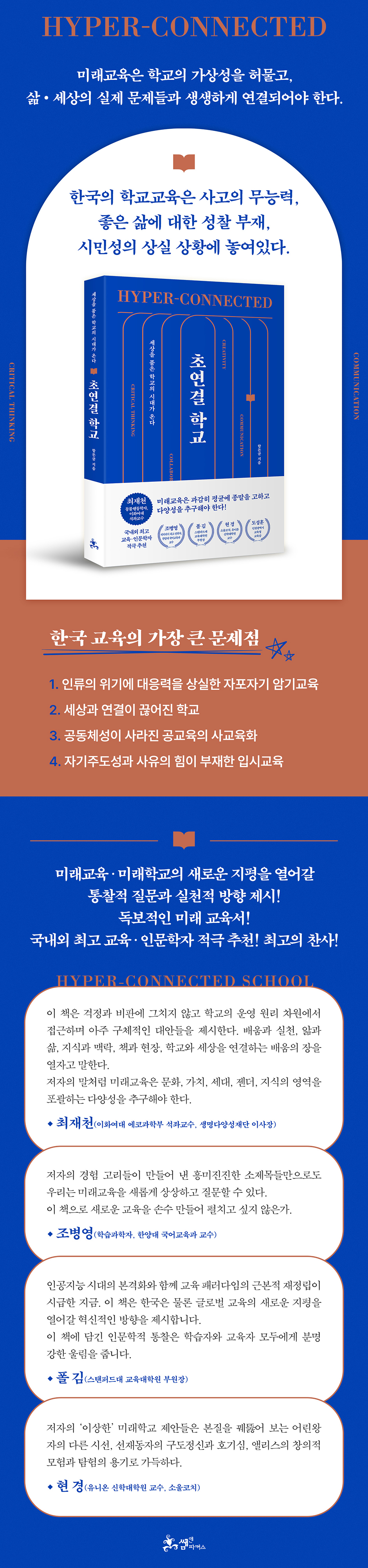
Based on these practical experiences, this book expresses the will to solve the problems that have been considered the biggest problems in Korean education: education that betrays life, education that is only practical, schools that are disconnected from the world, and the privatization of public education that places community in parentheses.
The keyword "hyperconnectivity" has already begun to be used as a keyword for understanding the transitional civilization, but there are still no books or discourses that clearly link "education" or "school" to this perspective.
This book focuses its discussion on the "school of the future" because the keyword "education" is too broad a category, and argues that "future education" should be viewed not as a discourse, but as a technological upgrade or a matter of content, but as a major shift in the "principles of school operation."
Therefore, the major trends of future schools are summarized under the keyword of ‘hyper-connected schools.’
Schools, which were previously the sole credible institutions for knowledge transmission, must transform from their role as the sole producer or transmitter of knowledge to a knowledge platform organization that acts as an agent mediating various connections with the real world outside of school, in a situation where traditional and fixed knowledge content can no longer exert strong authority or social persuasiveness.
This marks the beginning of a new and profound journey of identity evolution, one in which the school expands its learning space into the realm of life by becoming a networking hub for the world, and becomes a larger school that embraces the world.
In this respect, the author says that now is the time to design a real-world educational field called a "school transformation," rather than an abstract "educational transformation."
A future school that connects learning and practice, knowledge and life, knowledge and context, books and the field, and school and the world.
This book explains in detail how and why this transition to a future school is possible in reality.
By presenting concrete examples from global educational institutions and personal experiences, the author explains the impact of this "school transformation" on individuals, society, and civilization.
Ultimately, this transition to future schools goes beyond changes in the educational sphere and envisions a social design perspective that fosters personal growth, secures connections between individuals and society, restores a sense of community in the future, and enhances social trust and efficiency.
In the end, the book concludes by saying that the type of human being that 'the era of schools embracing the world' ultimately pursues is 'an analog human being with hyperconnectivity', and by helping readers understand the significance of this paradoxical human being on both a personal level and a future civilizational level.
This goes beyond the abstract discourse on future education and provides practical directions for the transformation into actual future schools, thereby providing more specific educational guidance to educators, while also clearly presenting the vision and significance of fostering "humane individuals" pursued by "Future Education_Hyper-Connected Schools."
In particular, the author has been involved in the design and consulting of new humanities education policies, civic education, arts education, and corporate convergence education through various channels including universities, NGOs, government agencies, education offices, cultural foundations, arts institutions, and large corporations. Unusually for a humanist, he has participated in designer training programs for a global electronics company and the design of actual home appliances, served as editor-in-chief for a publishing project for a global automobile company, and even took on the challenge of establishing an experimental future higher education institution.
Based on these practical experiences, this book expresses the will to solve the problems that have been considered the biggest problems in Korean education: education that betrays life, education that is only practical, schools that are disconnected from the world, and the privatization of public education that places community in parentheses.
The keyword "hyperconnectivity" has already begun to be used as a keyword for understanding the transitional civilization, but there are still no books or discourses that clearly link "education" or "school" to this perspective.
This book focuses its discussion on the "school of the future" because the keyword "education" is too broad a category, and argues that "future education" should be viewed not as a discourse, but as a technological upgrade or a matter of content, but as a major shift in the "principles of school operation."
Therefore, the major trends of future schools are summarized under the keyword of ‘hyper-connected schools.’
Schools, which were previously the sole credible institutions for knowledge transmission, must transform from their role as the sole producer or transmitter of knowledge to a knowledge platform organization that acts as an agent mediating various connections with the real world outside of school, in a situation where traditional and fixed knowledge content can no longer exert strong authority or social persuasiveness.
This marks the beginning of a new and profound journey of identity evolution, one in which the school expands its learning space into the realm of life by becoming a networking hub for the world, and becomes a larger school that embraces the world.
In this respect, the author says that now is the time to design a real-world educational field called a "school transformation," rather than an abstract "educational transformation."
A future school that connects learning and practice, knowledge and life, knowledge and context, books and the field, and school and the world.
This book explains in detail how and why this transition to a future school is possible in reality.
By presenting concrete examples from global educational institutions and personal experiences, the author explains the impact of this "school transformation" on individuals, society, and civilization.
Ultimately, this transition to future schools goes beyond changes in the educational sphere and envisions a social design perspective that fosters personal growth, secures connections between individuals and society, restores a sense of community in the future, and enhances social trust and efficiency.
In the end, the book concludes by saying that the type of human being that 'the era of schools embracing the world' ultimately pursues is 'an analog human being with hyperconnectivity', and by helping readers understand the significance of this paradoxical human being on both a personal level and a future civilizational level.
This goes beyond the abstract discourse on future education and provides practical directions for the transformation into actual future schools, thereby providing more specific educational guidance to educators, while also clearly presenting the vision and significance of fostering "humane individuals" pursued by "Future Education_Hyper-Connected Schools."
GOODS SPECIFICS
- Date of issue: January 3, 2025
- Page count, weight, size: 272 pages | 434g | 140*210*18mm
- ISBN13: 9791194246602
- ISBN10: 1194246605
You may also like
카테고리
korean


korean

![GQ KOREA Mark (Monthly): December [2025]](http://librairie.coreenne.fr/cdn/shop/files/8ef265dbbfbf186523ed75ba7319009d.jpg?v=1765340328&width=3840)


