

Meritocracy and Inequality
 |
Description
Book Introduction
A book that analyzes the meritocracy that dominates Korean education and society and criticizes its harmful effects.
The college entrance exam system that takes minorities into consideration is causing resentment among test takers, and doctors who pride themselves on being the top students in their school are opposed to it, saying that doctors from public medical schools will have lower skills.
The policy of converting irregular workers to regular workers is met with opposition that it is 'unfair.'
These appearances are nothing new.
It was just a prominent display of the meritocracy that has been an open rule in Korean society since long ago: "If you feel wronged, study hard and get ahead", "If you are poor, it is the fault of individuals who are lazy and do not study well."
The foundation of competitive education, discrimination based on academic background and academic achievement, labor control and polarization, and elite privilege is a meritocracy and ideology.
This book examines the logic, operation, and harmful effects of meritocracy, which states that "discrimination based on individual ability is fair," from various angles.
Rather than pursuing ‘true meritocracy’ or ‘ideal meritocracy,’ it aims for a fundamental critique of meritocracy.
The college entrance exam system that takes minorities into consideration is causing resentment among test takers, and doctors who pride themselves on being the top students in their school are opposed to it, saying that doctors from public medical schools will have lower skills.
The policy of converting irregular workers to regular workers is met with opposition that it is 'unfair.'
These appearances are nothing new.
It was just a prominent display of the meritocracy that has been an open rule in Korean society since long ago: "If you feel wronged, study hard and get ahead", "If you are poor, it is the fault of individuals who are lazy and do not study well."
The foundation of competitive education, discrimination based on academic background and academic achievement, labor control and polarization, and elite privilege is a meritocracy and ideology.
This book examines the logic, operation, and harmful effects of meritocracy, which states that "discrimination based on individual ability is fair," from various angles.
Rather than pursuing ‘true meritocracy’ or ‘ideal meritocracy,’ it aims for a fundamental critique of meritocracy.
- You can preview some of the book's contents.
Preview
index
index
Opening Article: The Paradox of Meritocracy: Justifying Inequality and Privilege | Park Kwon-il … 006
Part 1: Exams and Schools: The Birthplace of Meritocracy
What Education Needs: De-meritocracy | Gong Hyeon… 015
Humanity and the Right to Education in the Testing/Evaluation System | Lee Kyung-sook … 034
Can Hyunsoo live a happy life through his own abilities? | Jeong Yong-ju … 063
Is Academic Background the End? | Chae Hyo-jeong … 093
Part 2: Why Meritocracy Is Harmful to Society
Four Questions for Anatomy of Meritocracy | Park Kwon-il … 135
Meritocracy Justifies Discriminatory Labor | Kim Hye-jin … 165
Doctors' Elitism and the Misalignment of Justice | Kim Hye-kyung, Moon Jong-wan … 183
Can Outstanding Women Save Their Own Pie? | Lee Yu-rim … 198
Closing Remarks: A Brief Essay on "Intellectual Racism" | Hong Se-hwa … 216
Opening Article: The Paradox of Meritocracy: Justifying Inequality and Privilege | Park Kwon-il … 006
Part 1: Exams and Schools: The Birthplace of Meritocracy
What Education Needs: De-meritocracy | Gong Hyeon… 015
Humanity and the Right to Education in the Testing/Evaluation System | Lee Kyung-sook … 034
Can Hyunsoo live a happy life through his own abilities? | Jeong Yong-ju … 063
Is Academic Background the End? | Chae Hyo-jeong … 093
Part 2: Why Meritocracy Is Harmful to Society
Four Questions for Anatomy of Meritocracy | Park Kwon-il … 135
Meritocracy Justifies Discriminatory Labor | Kim Hye-jin … 165
Doctors' Elitism and the Misalignment of Justice | Kim Hye-kyung, Moon Jong-wan … 183
Can Outstanding Women Save Their Own Pie? | Lee Yu-rim … 198
Closing Remarks: A Brief Essay on "Intellectual Racism" | Hong Se-hwa … 216
Into the book
Meritocracy has a strong appeal because it touches on humanity's age-old proportional justice, such as "those who do not work shall not eat."
It is no coincidence that many studies on meritocracy criticize hereditary and pseudo-meritocracy disguised as meritocracy, but ultimately call for a "true meritocracy."
A meritocratic mindset is not easy to shake off.
--- p.9~10, from Park Kwon-il, “Introduction: The Paradox of Meritocracy that Justifies Inequality and Privilege”
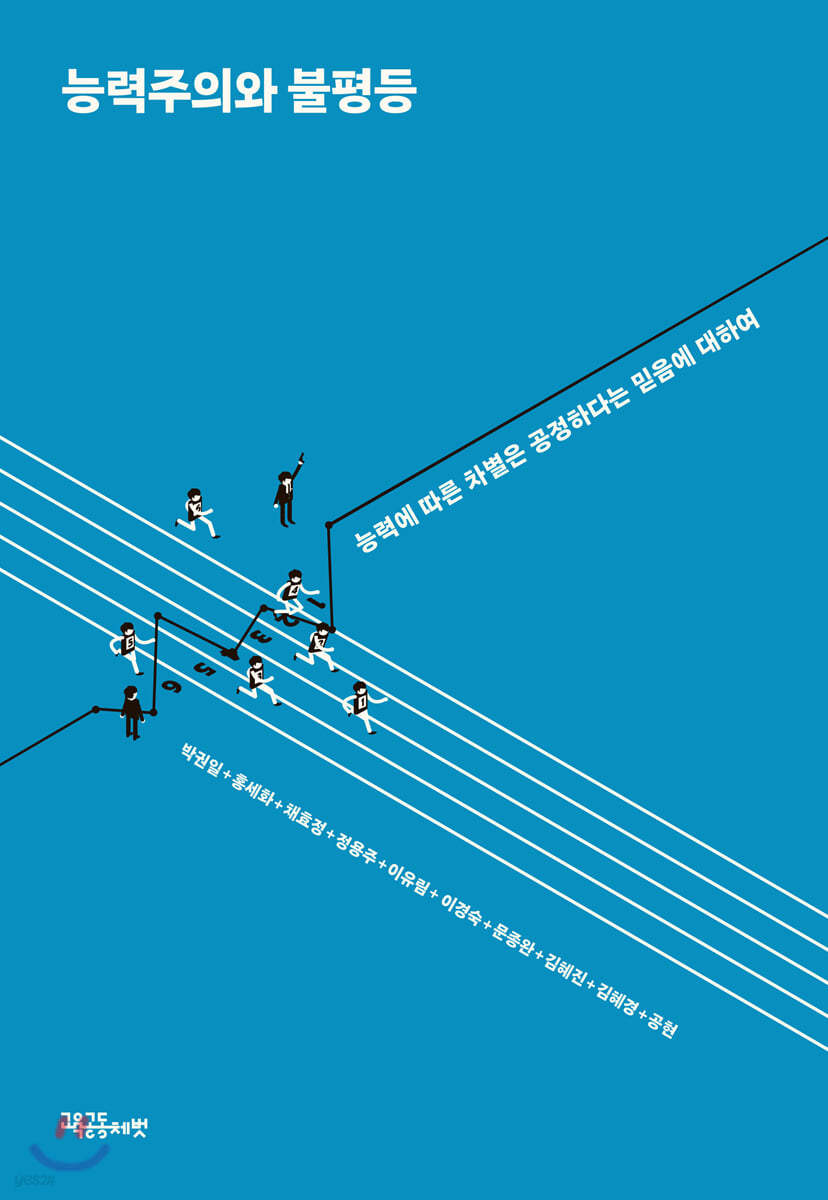
A typical metaphor for meritocracy is a race such as a race.
At this time, we see whether the starting line (opportunity) was equal, whether the rules (process) were fair, and whether the ranking and win/loss (result) derived from this were just.
But our society and life are not races or competitions in which individuals participate.
Even if there are races or competitions, that is only a part of it.
If we view society and life as a race, we must ultimately fill our lives with constant tests and evaluations to measure each other's speed and records.
Unnecessary competition and meaningless suffering are demanded from the majority.
If we focus on this, the power that creates and enforces the rules of evaluation and discrimination becomes obscured.
--- p.31, from Gong Hyeon, “What Education Needs is Post-meritocracy”
In the 20th century, as compulsory education expanded and society began to select and assign people, the most common mechanism for operating meritocracy in the East and the West was testing, and the real form of ability was scores.
Today, in the 21st century, tests and test results are increasingly written in a universal language, and report cards are accepted anywhere in the world.
The score, which is the reality of ability, makes humans transparent with only one comparison value.
It removes all the factors surrounding a person, such as family, career, and ideology, and allows comparison with oneself or others based solely on scores.
Across time and space, people believe and trust that their scores provide an intuitive sense of an individual's abilities.
This is the power of scores and the magic of numerical scores.
--- p.37, from Lee Gyeong-suk, “Humans and the Right to Education in the Examination/Evaluation System”
Meritocracy believes that everyone has an equal opportunity to succeed within the current system, and therefore all outcomes are based on individual ability, effort, and qualifications.
Education strengthens these beliefs.
After attending school for 12 years, Hyunsoo will come to see wealth inequality and poverty as fair, just, and desirable.
Because we've learned that social mobility is possible through education and that policies that reward individual effort are fair, we come to believe that success is a function of equal opportunity and individual effort, not external factors like luck or birth or upbringing.
--- p.88, Jeong Yong-ju, from “Can Hyun-soo live a happy life with his own abilities?”
In the era of knowledge capitalism, as knowledge becomes more liquid, academic background becomes an important means of entering a high-income, full-time professional job.
Because academic background is like an ID card in a meritocratic society.
What has changed from the past is that academic background has become a defensive tool for ‘protection’ rather than ‘taking away’.
In a situation where the fear of falling has grown greater than the desire for rising, academic background has become a means of kicking away the ladder rather than a means of climbing it.
At the time of the dissolution of the society without academic background, Eom Ki-ho pointed out that while the lower levels of the university hierarchy were collapsing, the upper levels of the academic background structure were becoming more exclusive and monopolistic in power.
If in the past the driving force behind academic competition was the desire to climb up the ladder, now the driving force behind competition is the fear of falling, the fear of not falling off a cliff.
--- p.116~117, from Chae Hyo-jeong, “Is Academic Background Over?”
The obsession with fairness and the emphasis on ability are expressed in reality mainly in the form of ‘discrimination and hatred against those who have failed, minorities, and the weak’ rather than in the form of ‘preferential treatment for the capable.’
In fact, the concept of ability is vague, so it is not easy to clearly prove some kind of excellence.
But it is clear who will fail the test.
It's easy to find people who deviate from the norms dictated by society.
This is why there are many people who believe that excluding such people is the same as protecting their own stake.
So the civil war over fairness quickly becomes a discourse of hate disguised as fairness.
One of the key motivations that drives and perpetuates hatred against minorities and the weak is meritocracy.
--- p.145, from Park Kwon-il, “Four Questions for Anatomy of Meritocracy”
As good jobs gradually disappear and there are no ways to get into good jobs, workers become obsessed with taking exams.
Because we have been experiencing competition as a natural part of our lives since we were students, we come to believe that our lives can only change through exams.
The reason young regular workers talk about 'fairness' is not because they believe our society is fair.
Because society is unfair, people who don't have as much as they do are clinging to the idea that they can only get a stable job through exams.
The anxiety that if even this test becomes meaningless, ordinary people will not be given any opportunities, and the anxiety that all their hard work and effort will be for nothing are the factors that lead to fierce opposition to converting irregular workers to regular workers.
--- p.176~177, from Kim Hye-jin, “Abilityism that Justifies Discriminatory Labor”
This kind of appearance can be said to be a negative result of meritocracy.
The ideology of meritocracy regards individual success solely as the result of an individual's inherent abilities and efforts.
The remark made by Park Ji-hyun, president of the Korean Intern Residents Association, at a street rally on August 14, 2020, that “the government has never provided even 10 cents to buy textbooks,” clearly demonstrated the influence of the ideology of meritocracy on the mentality of Korea’s power elite.
'I earned my position through my own efforts, with my own money and my own will. What right does a society, which has done nothing for me, have to demand responsibility from me?'
--- p.194, from Kim Hye-kyung and Moon Jong-wan, “Doctors’ Elitism and Misaligned Justice”
Gender gaps and gender conflicts are in fact addressed as agendas outside the politically significant category of 'youth.'
In contrast to the widespread social consensus on the burnout experienced by the "young generation" in Korea's hyper-competitive system and the active recognition of it as a social issue, the gender discrimination experienced by young women in the workplace is addressed at a different level.
In this process, the contradictory life landscape of young women, who are required to succeed as 'individuals' in the midst of constant competition and self-development, but at the same time cannot be free from gender as a mechanism of structural discrimination and violence, calls for feminism.
--- p.206~207, from Lee Yu-rim's "Can Excellent Women Get Their Own Piece of Pie?"
The term ‘intellectual racism’ itself is unfamiliar to us.
Perhaps that is why they boldly tell students, “You are a first-class citizen,” or “You are a ninth-class citizen.”
This could be called a blatant form of intellectual racism, but it is difficult to find a reflective question about just how cruel such regulations are.
For example, we should ask how different this is from the behavior of American buses before the 1960s, when white people sat in the front and people of color sat in the back.
It is no coincidence that many studies on meritocracy criticize hereditary and pseudo-meritocracy disguised as meritocracy, but ultimately call for a "true meritocracy."
A meritocratic mindset is not easy to shake off.
--- p.9~10, from Park Kwon-il, “Introduction: The Paradox of Meritocracy that Justifies Inequality and Privilege”
A typical metaphor for meritocracy is a race such as a race.
At this time, we see whether the starting line (opportunity) was equal, whether the rules (process) were fair, and whether the ranking and win/loss (result) derived from this were just.
But our society and life are not races or competitions in which individuals participate.
Even if there are races or competitions, that is only a part of it.
If we view society and life as a race, we must ultimately fill our lives with constant tests and evaluations to measure each other's speed and records.
Unnecessary competition and meaningless suffering are demanded from the majority.
If we focus on this, the power that creates and enforces the rules of evaluation and discrimination becomes obscured.
--- p.31, from Gong Hyeon, “What Education Needs is Post-meritocracy”
In the 20th century, as compulsory education expanded and society began to select and assign people, the most common mechanism for operating meritocracy in the East and the West was testing, and the real form of ability was scores.
Today, in the 21st century, tests and test results are increasingly written in a universal language, and report cards are accepted anywhere in the world.
The score, which is the reality of ability, makes humans transparent with only one comparison value.
It removes all the factors surrounding a person, such as family, career, and ideology, and allows comparison with oneself or others based solely on scores.
Across time and space, people believe and trust that their scores provide an intuitive sense of an individual's abilities.
This is the power of scores and the magic of numerical scores.
--- p.37, from Lee Gyeong-suk, “Humans and the Right to Education in the Examination/Evaluation System”
Meritocracy believes that everyone has an equal opportunity to succeed within the current system, and therefore all outcomes are based on individual ability, effort, and qualifications.
Education strengthens these beliefs.
After attending school for 12 years, Hyunsoo will come to see wealth inequality and poverty as fair, just, and desirable.
Because we've learned that social mobility is possible through education and that policies that reward individual effort are fair, we come to believe that success is a function of equal opportunity and individual effort, not external factors like luck or birth or upbringing.
--- p.88, Jeong Yong-ju, from “Can Hyun-soo live a happy life with his own abilities?”
In the era of knowledge capitalism, as knowledge becomes more liquid, academic background becomes an important means of entering a high-income, full-time professional job.
Because academic background is like an ID card in a meritocratic society.
What has changed from the past is that academic background has become a defensive tool for ‘protection’ rather than ‘taking away’.
In a situation where the fear of falling has grown greater than the desire for rising, academic background has become a means of kicking away the ladder rather than a means of climbing it.
At the time of the dissolution of the society without academic background, Eom Ki-ho pointed out that while the lower levels of the university hierarchy were collapsing, the upper levels of the academic background structure were becoming more exclusive and monopolistic in power.
If in the past the driving force behind academic competition was the desire to climb up the ladder, now the driving force behind competition is the fear of falling, the fear of not falling off a cliff.
--- p.116~117, from Chae Hyo-jeong, “Is Academic Background Over?”
The obsession with fairness and the emphasis on ability are expressed in reality mainly in the form of ‘discrimination and hatred against those who have failed, minorities, and the weak’ rather than in the form of ‘preferential treatment for the capable.’
In fact, the concept of ability is vague, so it is not easy to clearly prove some kind of excellence.
But it is clear who will fail the test.
It's easy to find people who deviate from the norms dictated by society.
This is why there are many people who believe that excluding such people is the same as protecting their own stake.
So the civil war over fairness quickly becomes a discourse of hate disguised as fairness.
One of the key motivations that drives and perpetuates hatred against minorities and the weak is meritocracy.
--- p.145, from Park Kwon-il, “Four Questions for Anatomy of Meritocracy”
As good jobs gradually disappear and there are no ways to get into good jobs, workers become obsessed with taking exams.
Because we have been experiencing competition as a natural part of our lives since we were students, we come to believe that our lives can only change through exams.
The reason young regular workers talk about 'fairness' is not because they believe our society is fair.
Because society is unfair, people who don't have as much as they do are clinging to the idea that they can only get a stable job through exams.
The anxiety that if even this test becomes meaningless, ordinary people will not be given any opportunities, and the anxiety that all their hard work and effort will be for nothing are the factors that lead to fierce opposition to converting irregular workers to regular workers.
--- p.176~177, from Kim Hye-jin, “Abilityism that Justifies Discriminatory Labor”
This kind of appearance can be said to be a negative result of meritocracy.
The ideology of meritocracy regards individual success solely as the result of an individual's inherent abilities and efforts.
The remark made by Park Ji-hyun, president of the Korean Intern Residents Association, at a street rally on August 14, 2020, that “the government has never provided even 10 cents to buy textbooks,” clearly demonstrated the influence of the ideology of meritocracy on the mentality of Korea’s power elite.
'I earned my position through my own efforts, with my own money and my own will. What right does a society, which has done nothing for me, have to demand responsibility from me?'
--- p.194, from Kim Hye-kyung and Moon Jong-wan, “Doctors’ Elitism and Misaligned Justice”
Gender gaps and gender conflicts are in fact addressed as agendas outside the politically significant category of 'youth.'
In contrast to the widespread social consensus on the burnout experienced by the "young generation" in Korea's hyper-competitive system and the active recognition of it as a social issue, the gender discrimination experienced by young women in the workplace is addressed at a different level.
In this process, the contradictory life landscape of young women, who are required to succeed as 'individuals' in the midst of constant competition and self-development, but at the same time cannot be free from gender as a mechanism of structural discrimination and violence, calls for feminism.
--- p.206~207, from Lee Yu-rim's "Can Excellent Women Get Their Own Piece of Pie?"
The term ‘intellectual racism’ itself is unfamiliar to us.
Perhaps that is why they boldly tell students, “You are a first-class citizen,” or “You are a ninth-class citizen.”
This could be called a blatant form of intellectual racism, but it is difficult to find a reflective question about just how cruel such regulations are.
For example, we should ask how different this is from the behavior of American buses before the 1960s, when white people sat in the front and people of color sat in the back.
--- p.218, from Hong Se-hwa, “Closing Note: A Brief Essay on ‘Intellectual Racism’”
Publisher's Review
Features and structure of the book
As the commonly heard saying, “ability is important, not academic background,” suggests, meritocracy is often cited as an alternative to academic background.
There are also growing voices calling for strengthening testing and creating a more "fair" merit-based system to eliminate "parental chance" and other preferential treatment.
However, this book points out that academic background and school elitism are a type of meritocracy, and that meritocracy is not an alternative but rather the cause of many problems in our society.
And the reality of meritocracy, which promotes 'individuality' and 'fairness', is criticized as a system for the power of those who evaluate and select, and as one that obscures class issues and justifies privilege.
This book covers the basic concepts of meritocracy, its critical logic, and the realities of Korean society, making it easy for readers who are new to the issue of meritocracy to understand.
Furthermore, we sought to create a broad forum for discussion by examining the issues of meritocracy in various areas, such as school education, testing/evaluation, academic elitism and knowledge/financial capitalism, the hierarchization of labor, the elitism and public nature of the medical community, and the meritocratic tendency in feminist practice.
Above all, rather than ordering an 'ideal meritocracy', we sought to lay the foundation for fundamentally criticizing and overcoming meritocracy.
This book is divided into two parts.
In his opening remarks, Park Kwon-il calls for a social discussion on meritocracy, moving beyond the reality that meritocracy is seen as a goal to be pursued and demands a “true meritocracy.”
Part 1, “Tests and Schools, the Birthplace of Meritocracy,” primarily addresses the issue of meritocracy related to the education system and testing.
In the first article, youth activist Gong Hyeon points out that the logic of meritocracy is currently replacing equality, and that meritocracy is closely linked to school education and examinations.
In the first article, I summarize the main elements of meritocracy and emphasize that meritocracy must be eliminated from education.
Second, Lee Kyung-sook, an educationist, speaks of the reality in which the testing/evaluation system ranks and ranks people, and interprets the meritocratic elements of the current constitution's right to education clause.
And it discusses whether it is right for the right to education to be restricted 'according to ability'.
Elementary school teacher Jeong Yong-ju uses the example of a hypothetical student from a poor family to point out that the student cannot become an "independent individual."
In doing so, it persuasively presents the problems of meritocracy and the arguments for criticizing meritocracy.
Chae Hyo-jeong, a former activist for a society without academic background and a political scientist, asks, "Is academic background the end?" and analyzes how the value of "academic background capital" has changed amidst the shifts of neoliberalism.
Through this, we reflect on what the movement for a society without academic background missed and examine the flow of meritocracy that drives marketization and class reproduction.
Part 2, “Why Meritocracy is Harmful,” addresses the problems that meritocracy causes in various areas of society.
Park Kwon-il's article identifies aspects of meritocracy in Korean society, including the "fairness civil war" and "meritocracy transformed into a discourse of hate."
He clarifies why a critique of meritocracy is necessary through four questions about meritocracy, and presents the dual task of exposing and criticizing hereditary system and land-seeking disguised as meritocracy, while simultaneously requiring a fundamental and intrinsic critique of meritocracy.
Labor activist Kim Hye-jin says that meritocracy is becoming widespread in the workplace through performance-based pay systems and is being implemented not only through exams but also through job hierarchy, discrimination, and performance-based competition.
He seeks to overcome the problem of meritocracy in labor from the perspective of universal rights and equality of the working class.
Kim Hye-kyung and Moon Jong-wan of 'Medical Students/Residents with Different Thoughts' point out that the elitism displayed during the doctors' collective refusal to treat patients was due to the logic of meritocracy that doctors have internalized since their school education, and that meritocracy is having a negative impact on publicness and democracy.
Feminist Lee Yu-rim examines the neoliberal and meritocratic practices and narratives of digital feminism, analyzing that the contradictory life conditions of young women, who are expected to succeed as individuals in the blind spot of "youth discourse" but are simultaneously discriminated against, lead them to long for meritocracy.
In doing so, he argues that we must politically challenge the criteria for distributing power and resources that define ability beyond a meritocratic perspective.
This article provides a three-dimensional understanding of what meritocracy means to minorities.
Finally, Hong Se-hwa's 'closing remarks' introduce the concept of 'intellectual racism' as mentioned by Bourdieu, and concisely show that meritocracy, which justifies inequality and its inheritance, is detrimental to education and society.
It contains reasons why we must overcome meritocracy as the 'most subtle and difficult to detect' form of racism.
As the commonly heard saying, “ability is important, not academic background,” suggests, meritocracy is often cited as an alternative to academic background.
There are also growing voices calling for strengthening testing and creating a more "fair" merit-based system to eliminate "parental chance" and other preferential treatment.
However, this book points out that academic background and school elitism are a type of meritocracy, and that meritocracy is not an alternative but rather the cause of many problems in our society.
And the reality of meritocracy, which promotes 'individuality' and 'fairness', is criticized as a system for the power of those who evaluate and select, and as one that obscures class issues and justifies privilege.
This book covers the basic concepts of meritocracy, its critical logic, and the realities of Korean society, making it easy for readers who are new to the issue of meritocracy to understand.
Furthermore, we sought to create a broad forum for discussion by examining the issues of meritocracy in various areas, such as school education, testing/evaluation, academic elitism and knowledge/financial capitalism, the hierarchization of labor, the elitism and public nature of the medical community, and the meritocratic tendency in feminist practice.
Above all, rather than ordering an 'ideal meritocracy', we sought to lay the foundation for fundamentally criticizing and overcoming meritocracy.
This book is divided into two parts.
In his opening remarks, Park Kwon-il calls for a social discussion on meritocracy, moving beyond the reality that meritocracy is seen as a goal to be pursued and demands a “true meritocracy.”
Part 1, “Tests and Schools, the Birthplace of Meritocracy,” primarily addresses the issue of meritocracy related to the education system and testing.
In the first article, youth activist Gong Hyeon points out that the logic of meritocracy is currently replacing equality, and that meritocracy is closely linked to school education and examinations.
In the first article, I summarize the main elements of meritocracy and emphasize that meritocracy must be eliminated from education.
Second, Lee Kyung-sook, an educationist, speaks of the reality in which the testing/evaluation system ranks and ranks people, and interprets the meritocratic elements of the current constitution's right to education clause.
And it discusses whether it is right for the right to education to be restricted 'according to ability'.
Elementary school teacher Jeong Yong-ju uses the example of a hypothetical student from a poor family to point out that the student cannot become an "independent individual."
In doing so, it persuasively presents the problems of meritocracy and the arguments for criticizing meritocracy.
Chae Hyo-jeong, a former activist for a society without academic background and a political scientist, asks, "Is academic background the end?" and analyzes how the value of "academic background capital" has changed amidst the shifts of neoliberalism.
Through this, we reflect on what the movement for a society without academic background missed and examine the flow of meritocracy that drives marketization and class reproduction.
Part 2, “Why Meritocracy is Harmful,” addresses the problems that meritocracy causes in various areas of society.
Park Kwon-il's article identifies aspects of meritocracy in Korean society, including the "fairness civil war" and "meritocracy transformed into a discourse of hate."
He clarifies why a critique of meritocracy is necessary through four questions about meritocracy, and presents the dual task of exposing and criticizing hereditary system and land-seeking disguised as meritocracy, while simultaneously requiring a fundamental and intrinsic critique of meritocracy.
Labor activist Kim Hye-jin says that meritocracy is becoming widespread in the workplace through performance-based pay systems and is being implemented not only through exams but also through job hierarchy, discrimination, and performance-based competition.
He seeks to overcome the problem of meritocracy in labor from the perspective of universal rights and equality of the working class.
Kim Hye-kyung and Moon Jong-wan of 'Medical Students/Residents with Different Thoughts' point out that the elitism displayed during the doctors' collective refusal to treat patients was due to the logic of meritocracy that doctors have internalized since their school education, and that meritocracy is having a negative impact on publicness and democracy.
Feminist Lee Yu-rim examines the neoliberal and meritocratic practices and narratives of digital feminism, analyzing that the contradictory life conditions of young women, who are expected to succeed as individuals in the blind spot of "youth discourse" but are simultaneously discriminated against, lead them to long for meritocracy.
In doing so, he argues that we must politically challenge the criteria for distributing power and resources that define ability beyond a meritocratic perspective.
This article provides a three-dimensional understanding of what meritocracy means to minorities.
Finally, Hong Se-hwa's 'closing remarks' introduce the concept of 'intellectual racism' as mentioned by Bourdieu, and concisely show that meritocracy, which justifies inequality and its inheritance, is detrimental to education and society.
It contains reasons why we must overcome meritocracy as the 'most subtle and difficult to detect' form of racism.
GOODS SPECIFICS
- Publication date: November 20, 2020
- Page count, weight, size: 228 pages | 274g | 145*210*12mm
- ISBN13: 9788968801426
- ISBN10: 8968801428
You may also like
카테고리
korean


korean

![GQ KOREA Mark (Monthly): December [2025]](http://librairie.coreenne.fr/cdn/shop/files/8ef265dbbfbf186523ed75ba7319009d.jpg?v=1765340328&width=3840)


