

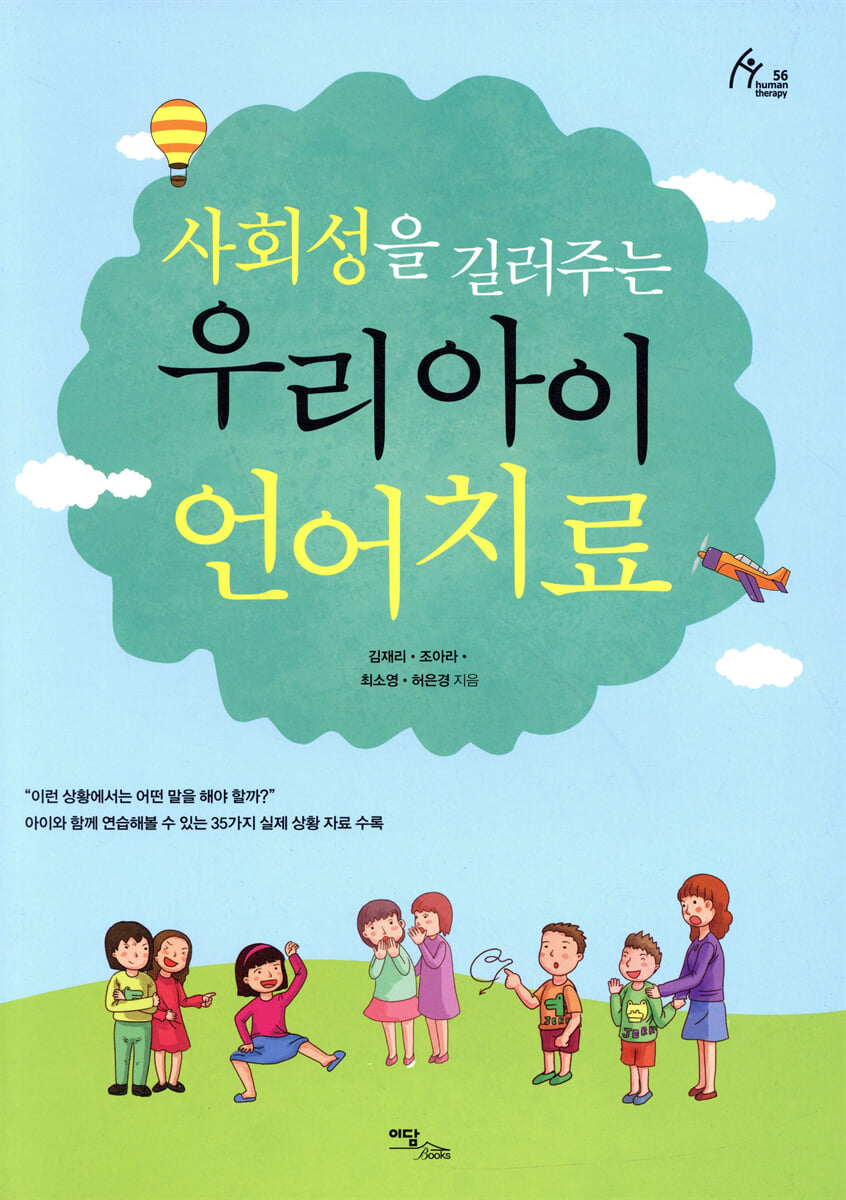
Speech therapy for our children to develop social skills
 |
Description
Book Introduction
This is a teaching material created by speech therapists in the field, focusing on children's social skills.
It presents a total of 35 social situations, helping children to regulate themselves, acquire appropriate interpersonal skills, and smoothly resolve problematic situations that arise in social relationships.
It helps you understand the situation by adding cognitive and emotional questions along with situational pictures.
Additionally, it is structured so that you can apply it to real life through application questions.
It presents a total of 35 social situations, helping children to regulate themselves, acquire appropriate interpersonal skills, and smoothly resolve problematic situations that arise in social relationships.
It helps you understand the situation by adding cognitive and emotional questions along with situational pictures.
Additionally, it is structured so that you can apply it to real life through application questions.
- You can preview some of the book's contents.
Preview
index
preface
Features of this book
Progress Guide
Take a step and talk to your friends
01 Welcome your friend's greetings.
02 Some questions embarrass your friends
03 Compliments make your friends feel good.
04 When talking to a friend, focus on your friend.
05 I want to join my friends' conversations
06 Some words have multiple meanings
07 If you keep talking about the same thing, your friend might get bored.
08 When you decline, be sorry.
09 Be careful when revealing embarrassing information.
10 Sometimes you need a white lie
11 I don't follow what you say
Become a good friend in two steps
12 Comfort a friend who is upset
13 It's also necessary to know how to give up.
14 Keep a secret
15 Share with your friends
16 A gift is a gift that contains the heart of a friend.
17 My friend likes me
18 It can't always be the first.
19. Get the feel of the atmosphere
20 When working together, I take full responsibility for my actions.
21 Being blindly suspicious can drive a wedge between friends.
22 Sometimes it's not a good idea to call your friends
23 I'm not the only one laughing
24 Laughter has many meanings
25 My friends might think my hobbies are weird.
26 Respect your elders
Three steps No to this behavior!
27 A clean body and neat clothes make a good impression.
28 Don't eat food that has fallen on the floor.
29 I hate dirty habits
30 You shouldn't hit your friends
31 Cursing makes people uncomfortable
32 Control your anger
33 Talking to yourself may seem strange
34 Be careful about touching yourself in front of people.
35 Taking off your clothes can embarrass your friends.
Features of this book
Progress Guide
Take a step and talk to your friends
01 Welcome your friend's greetings.
02 Some questions embarrass your friends
03 Compliments make your friends feel good.
04 When talking to a friend, focus on your friend.
05 I want to join my friends' conversations
06 Some words have multiple meanings
07 If you keep talking about the same thing, your friend might get bored.
08 When you decline, be sorry.
09 Be careful when revealing embarrassing information.
10 Sometimes you need a white lie
11 I don't follow what you say
Become a good friend in two steps
12 Comfort a friend who is upset
13 It's also necessary to know how to give up.
14 Keep a secret
15 Share with your friends
16 A gift is a gift that contains the heart of a friend.
17 My friend likes me
18 It can't always be the first.
19. Get the feel of the atmosphere
20 When working together, I take full responsibility for my actions.
21 Being blindly suspicious can drive a wedge between friends.
22 Sometimes it's not a good idea to call your friends
23 I'm not the only one laughing
24 Laughter has many meanings
25 My friends might think my hobbies are weird.
26 Respect your elders
Three steps No to this behavior!
27 A clean body and neat clothes make a good impression.
28 Don't eat food that has fallen on the floor.
29 I hate dirty habits
30 You shouldn't hit your friends
31 Cursing makes people uncomfortable
32 Control your anger
33 Talking to yourself may seem strange
34 Be careful about touching yourself in front of people.
35 Taking off your clothes can embarrass your friends.
Publisher's Review
Parents want their children to be loved outside of the home as well as at home, and teachers want their children to get along well with their peers, but that's often not the case.
I wish our children knew what is socially inappropriate behavior and how to behave appropriately, so they could be loved by their peers and have better relationships with their peers.
With this in mind, speech therapists in the field created teaching materials that focused on children's social skills.
We provide vivid problems that can be applied in daily life and help children understand through situational pictures drawn by ourselves.
This book can be of practical help in improving children's social skills.
Children grow up forming relationships with other people.
Building positive relationships requires the ability to behave in a way that conforms to society's expectations and standards, resolve conflicts effectively, understand the feelings and thoughts of others, and communicate appropriately.
These skills are called social skills.
The goal of this book is to help children learn and master it on their own.
This book is designed to help children learn self-regulation, acquire appropriate interpersonal skills, and successfully resolve challenging situations they encounter in social relationships.
Due to the nature of social situation questions, no set answers are provided.
Parents and teachers can apply the information to the child's situation and characteristics to derive an appropriate answer.
We have presented an effective method to foster social skills.
This book presents a total of 35 social situations in pictures.
We've presented cognitive and emotional questions to help you understand the situation with the pictures, and we've also structured it so that you can apply it to real life through application questions.
I wish our children knew what is socially inappropriate behavior and how to behave appropriately, so they could be loved by their peers and have better relationships with their peers.
With this in mind, speech therapists in the field created teaching materials that focused on children's social skills.
We provide vivid problems that can be applied in daily life and help children understand through situational pictures drawn by ourselves.
This book can be of practical help in improving children's social skills.
Children grow up forming relationships with other people.
Building positive relationships requires the ability to behave in a way that conforms to society's expectations and standards, resolve conflicts effectively, understand the feelings and thoughts of others, and communicate appropriately.
These skills are called social skills.
The goal of this book is to help children learn and master it on their own.
This book is designed to help children learn self-regulation, acquire appropriate interpersonal skills, and successfully resolve challenging situations they encounter in social relationships.
Due to the nature of social situation questions, no set answers are provided.
Parents and teachers can apply the information to the child's situation and characteristics to derive an appropriate answer.
We have presented an effective method to foster social skills.
This book presents a total of 35 social situations in pictures.
We've presented cognitive and emotional questions to help you understand the situation with the pictures, and we've also structured it so that you can apply it to real life through application questions.
GOODS SPECIFICS
- Publication date: November 29, 2013
- Page count, weight, size: 230 pages | 936g | 210*297*20mm
- ISBN13: 9788926853542
- ISBN10: 8926853543
You may also like
카테고리
korean


korean

![GQ KOREA Mark (Monthly): December [2025]](http://librairie.coreenne.fr/cdn/shop/files/8ef265dbbfbf186523ed75ba7319009d.jpg?v=1765340328&width=3840)


