

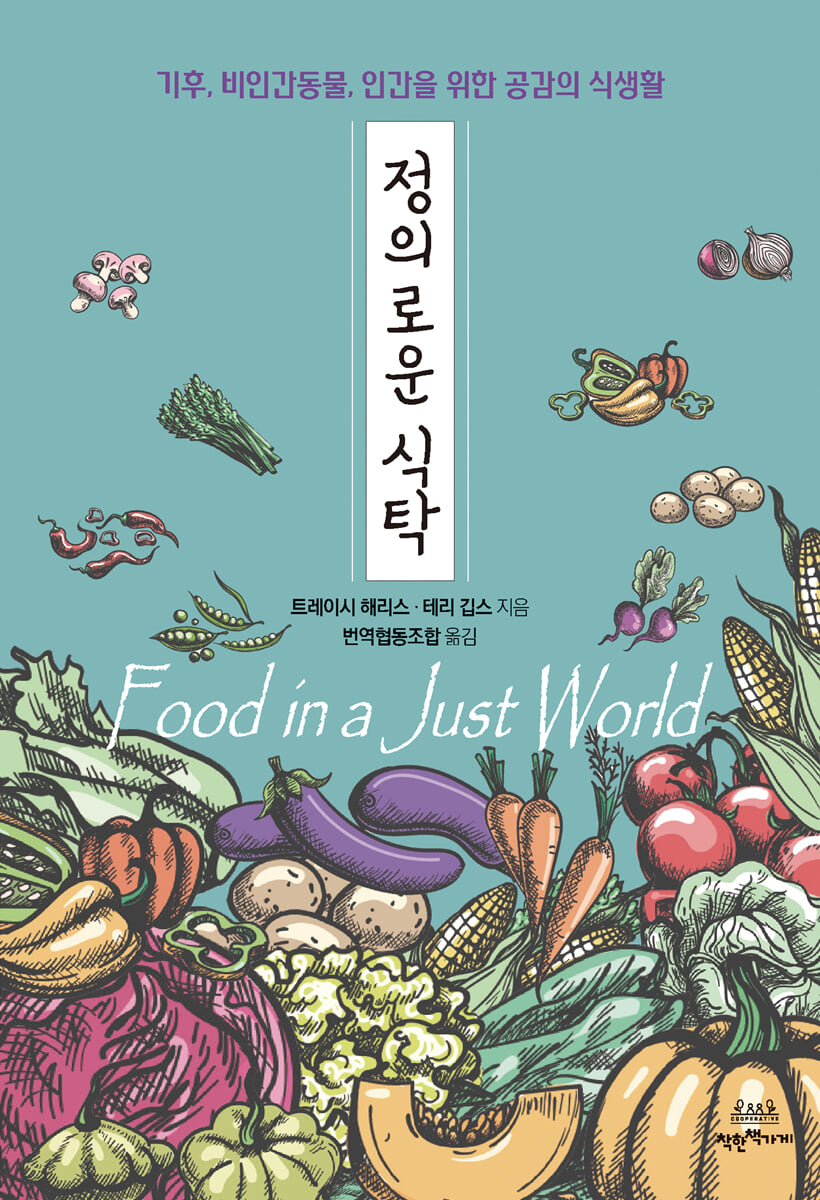
Righteous Table
 |
Description
Book Introduction
"In the age of climate collapse, our dining table has become the front line of just survival."
Beyond inequality, violence, and labor exploitation, towards a food system of life and coexistence.
Our current food system shamelessly commodifies nonhuman animals, and this is closely intertwined with the commodification of land and people.
But voices revealing this reality are rarely heard.
This book exposes the uncomfortable truths about class, race, gender, and species discrimination surrounding our eating habits.
At the same time, it sharply criticizes the global food system, which is the main culprit of exploitation, violence, and ecological destruction.
This approach is particularly novel in that it analyzes the detrimental impact of the capitalist profit-driven economy on meat industry workers from both social structure and human psychology, and draws our attention to the labor, resistance, and exploitation of non-human animals.
Beyond inequality, violence, and labor exploitation, towards a food system of life and coexistence.
Our current food system shamelessly commodifies nonhuman animals, and this is closely intertwined with the commodification of land and people.
But voices revealing this reality are rarely heard.
This book exposes the uncomfortable truths about class, race, gender, and species discrimination surrounding our eating habits.
At the same time, it sharply criticizes the global food system, which is the main culprit of exploitation, violence, and ecological destruction.
This approach is particularly novel in that it analyzes the detrimental impact of the capitalist profit-driven economy on meat industry workers from both social structure and human psychology, and draws our attention to the labor, resistance, and exploitation of non-human animals.
index
Introduction
Chapter 1: Achieving Food Justice Requires a Just World
Fighting structural violence against land, humans, and non-human animals
Chapter 2: The Dream and Nightmare of Capitalism
Food system, animal industrial complex, and climate breakdown
Chapter 3: Hell's Labor
Labor for industrial production of animals as food
Chapter 4: What if we are what we eat?
Challenging the colonial capitalist diet
Chapter 5: The World Turned Upside Down
The Hidden World of Nonhuman Animals Used in Food Production
Chapter 6: Towards a Compassionate Food System
Appendix 1: Research Approach
Appendix 2: Research Methodology
Acknowledgements
Translator's Note
About the Study Participants | References | Notes | Index
Chapter 1: Achieving Food Justice Requires a Just World
Fighting structural violence against land, humans, and non-human animals
Chapter 2: The Dream and Nightmare of Capitalism
Food system, animal industrial complex, and climate breakdown
Chapter 3: Hell's Labor
Labor for industrial production of animals as food
Chapter 4: What if we are what we eat?
Challenging the colonial capitalist diet
Chapter 5: The World Turned Upside Down
The Hidden World of Nonhuman Animals Used in Food Production
Chapter 6: Towards a Compassionate Food System
Appendix 1: Research Approach
Appendix 2: Research Methodology
Acknowledgements
Translator's Note
About the Study Participants | References | Notes | Index
Into the book
There are a few more interesting parallels that connect us personally and to this project.
We are both mothers, deeply saddened by what is happening to the Earth, and feel a sense of urgency to leave it 'whole' for our children, their children's children, and their children's children's descendants.
We both eat only plant-based foods and strive for a vegan lifestyle, but our children are vegetarian and our spouses are omnivores.
Since we mostly prepare our own meals at home, our family also eats mostly vegetarian meals.
--- p.20
What's the best way to address animal violence on factory farms? Eliminate animals from the factories.
Let the animals be in your family, with you, on your small farm.
My mother considered animals family.
Where compassion and care begin in a very natural way is in the arms of family.
There can be no compassion in an extractive economy where the only criterion is how much can be extracted.
Compassion is in relationships.
--- p.41
Europeans would not have been able to invade and dominate the world if they had not used animals as weapons of war and food since the beginning of the colonial era.
The real cause of the destruction of the lives of many indigenous peoples around the world at that time was zoonotic diseases brought by European invaders, such as smallpox, which occurred during the process of suppressing animals.
Terrible epidemics ravaged indigenous societies, and European invaders, riding on the backs of exploited horses, massacred and enslaved indigenous peoples in their conquest.
What is important is that a significant portion of the land taken by Europeans during the colonization process was used for pasture.
--- p.99
“There are two currents.
One is celebrating one's life with diversity, democracy, freedom, joy, and culture, and the other is monoculture and death.
Everyone is depressed.
Everyone takes antidepressants.
More and more young people are losing their jobs.
“We do not want such a world of death,” he said, continuing:
“If the seeds were in the hands of the farmer and the gardener, and the land was in the hands of the farmer, there would be no hunger in the world.
They are desperate to take it away.”
--- p.124
While it is essential to understand the suffering non-human animals experience during these death processes, we must also recognize the serious psychological distress experienced by veterinarians involved in the work of mass-killing or inhumanely disposing of healthy animals.
Their suffering manifests as trauma and burnout.
The act of killing non-human animals appears to have a major impact on livestock workers, such as farmers and veterinarians, because “regardless of their background or level of preparedness, those who are required to perform animal euthanasia are widely suffering from mental illnesses characterized by depression and anxiety.”
Euthanasia is by no means an easy task, and the enormous human sacrifice it requires cannot even be measured in money.”
--- p.137~138
Looking back, I don't think I ever thought of the meat I slaughtered as living, or sentient, creatures.
It was just meat.
Growing up in a society disconnected from anything that could be called nature, whether it be edible animals or anything else, I saw animals only as commodities, as food.
Having lived exclusively in cities, I didn't feel particularly close to most non-human animals, or to what we commonly call nature.
The important thing is that, like my fellow butchers, I enjoyed my job.
Just as miners can't imagine leaving the coal mines for any other job, most of us probably can't imagine any other dangerous work beyond the butcher shop.
--- p.152~153
The heat, the smell, the blood, the cries of animals, the repetitive, horrific tasks, the slaughterhouse building… these things torment me.
It was only three months, not a few years, in my life, but it still remains a huge shock.
For years I couldn't stand the smell of lamb in particular.
I felt sick when I smelled it and realized it was lamb.
The meat I saw at the slaughterhouse was unusually red.
When I describe that time, I talk about it in terms of senses.
Anyone who is in such a place will remember almost everything they felt at that time, including sight, smell, hearing, and taste.
--- p.159
I took Opie to a nearby vet.
The vet asked why we were wasting our time, as the child had little chance of survival and there was no financial benefit.
I told the vet that I wasn't trying to make money, I just wanted to help the opi.
The vet gave her intravenous fluids and I brought her back to the shelter to care for her overnight.
Soon the guy's eyes began to slowly return to normal.
We started feeding Opie with a bottle when he was able to lift his head and stand.
However, although he has recovered physically, he has not returned to a completely healthy state.
Suddenly, it occurred to him that he should be with his group.
When I took Opi to the barn, other cows gathered around him.
Only then did Opi begin to regain his composure.
Community was important to animals too.
--- p.187
We're talking about decolonizing language again.
Calling a space where access to food, and healthy food, is truly difficult a "desert" is an attempt to erase a structurally constructed reality.
Because deserts are largely naturally occurring ecosystems, and are ecosystems in themselves.
Because I don't think the desert is a place where plants and animals don't have the conditions necessary for evolution and survival.
But what we are saying is that the apartheid we are talking about was intentionally created.
Apartheid exists to rule over people as they wish.
--- p.212~213
For those who haven't watched Netflix's hit show Stranger Things, the Upside Down will, on the surface, look just like the regular world.
But beneath the surface of that world lies a strange parallel universe, filled with nightmarish tales and monsters.
Much of what happens to non-human animals, workers, consumers, and the environment is hidden, distorted, or blocked.
Most consumer citizens are either unaware of the resulting externalities or only vaguely understand them.
In that sense, the current intensive food production system can be said to resemble the situation in “Stranger Things.”
--- p.253
Both greenwashing and humanewashing are based on the premise that people are, above all, consumers, and the common belief that the only way citizens can influence what happens in institutions and economic systems is through their voting power and spending.
“When you hear the word ‘humane,’ you tend to suspect that something bad is happening to the animals,” Bekov said.
“The word ‘humane’ is a dirty, narrow-minded lie, so you can be sure that someone is trying to whitewash the fact that something bad is happening to animals and make it look less ugly,” he argues.
--- p.287
As a community, strengthening our resilience and compassion is crucial, enabling us to respond more powerfully and effectively to the climate crisis and the societal disruption it will bring.
At best, these efforts would send a red flag to the current system and, over time, dismantle the institutions and processes that continue to inflict structural violence on the land, people, and other animals.
We are both mothers, deeply saddened by what is happening to the Earth, and feel a sense of urgency to leave it 'whole' for our children, their children's children, and their children's children's descendants.
We both eat only plant-based foods and strive for a vegan lifestyle, but our children are vegetarian and our spouses are omnivores.
Since we mostly prepare our own meals at home, our family also eats mostly vegetarian meals.
--- p.20
What's the best way to address animal violence on factory farms? Eliminate animals from the factories.
Let the animals be in your family, with you, on your small farm.
My mother considered animals family.
Where compassion and care begin in a very natural way is in the arms of family.
There can be no compassion in an extractive economy where the only criterion is how much can be extracted.
Compassion is in relationships.
--- p.41
Europeans would not have been able to invade and dominate the world if they had not used animals as weapons of war and food since the beginning of the colonial era.
The real cause of the destruction of the lives of many indigenous peoples around the world at that time was zoonotic diseases brought by European invaders, such as smallpox, which occurred during the process of suppressing animals.
Terrible epidemics ravaged indigenous societies, and European invaders, riding on the backs of exploited horses, massacred and enslaved indigenous peoples in their conquest.
What is important is that a significant portion of the land taken by Europeans during the colonization process was used for pasture.
--- p.99
“There are two currents.
One is celebrating one's life with diversity, democracy, freedom, joy, and culture, and the other is monoculture and death.
Everyone is depressed.
Everyone takes antidepressants.
More and more young people are losing their jobs.
“We do not want such a world of death,” he said, continuing:
“If the seeds were in the hands of the farmer and the gardener, and the land was in the hands of the farmer, there would be no hunger in the world.
They are desperate to take it away.”
--- p.124
While it is essential to understand the suffering non-human animals experience during these death processes, we must also recognize the serious psychological distress experienced by veterinarians involved in the work of mass-killing or inhumanely disposing of healthy animals.
Their suffering manifests as trauma and burnout.
The act of killing non-human animals appears to have a major impact on livestock workers, such as farmers and veterinarians, because “regardless of their background or level of preparedness, those who are required to perform animal euthanasia are widely suffering from mental illnesses characterized by depression and anxiety.”
Euthanasia is by no means an easy task, and the enormous human sacrifice it requires cannot even be measured in money.”
--- p.137~138
Looking back, I don't think I ever thought of the meat I slaughtered as living, or sentient, creatures.
It was just meat.
Growing up in a society disconnected from anything that could be called nature, whether it be edible animals or anything else, I saw animals only as commodities, as food.
Having lived exclusively in cities, I didn't feel particularly close to most non-human animals, or to what we commonly call nature.
The important thing is that, like my fellow butchers, I enjoyed my job.
Just as miners can't imagine leaving the coal mines for any other job, most of us probably can't imagine any other dangerous work beyond the butcher shop.
--- p.152~153
The heat, the smell, the blood, the cries of animals, the repetitive, horrific tasks, the slaughterhouse building… these things torment me.
It was only three months, not a few years, in my life, but it still remains a huge shock.
For years I couldn't stand the smell of lamb in particular.
I felt sick when I smelled it and realized it was lamb.
The meat I saw at the slaughterhouse was unusually red.
When I describe that time, I talk about it in terms of senses.
Anyone who is in such a place will remember almost everything they felt at that time, including sight, smell, hearing, and taste.
--- p.159
I took Opie to a nearby vet.
The vet asked why we were wasting our time, as the child had little chance of survival and there was no financial benefit.
I told the vet that I wasn't trying to make money, I just wanted to help the opi.
The vet gave her intravenous fluids and I brought her back to the shelter to care for her overnight.
Soon the guy's eyes began to slowly return to normal.
We started feeding Opie with a bottle when he was able to lift his head and stand.
However, although he has recovered physically, he has not returned to a completely healthy state.
Suddenly, it occurred to him that he should be with his group.
When I took Opi to the barn, other cows gathered around him.
Only then did Opi begin to regain his composure.
Community was important to animals too.
--- p.187
We're talking about decolonizing language again.
Calling a space where access to food, and healthy food, is truly difficult a "desert" is an attempt to erase a structurally constructed reality.
Because deserts are largely naturally occurring ecosystems, and are ecosystems in themselves.
Because I don't think the desert is a place where plants and animals don't have the conditions necessary for evolution and survival.
But what we are saying is that the apartheid we are talking about was intentionally created.
Apartheid exists to rule over people as they wish.
--- p.212~213
For those who haven't watched Netflix's hit show Stranger Things, the Upside Down will, on the surface, look just like the regular world.
But beneath the surface of that world lies a strange parallel universe, filled with nightmarish tales and monsters.
Much of what happens to non-human animals, workers, consumers, and the environment is hidden, distorted, or blocked.
Most consumer citizens are either unaware of the resulting externalities or only vaguely understand them.
In that sense, the current intensive food production system can be said to resemble the situation in “Stranger Things.”
--- p.253
Both greenwashing and humanewashing are based on the premise that people are, above all, consumers, and the common belief that the only way citizens can influence what happens in institutions and economic systems is through their voting power and spending.
“When you hear the word ‘humane,’ you tend to suspect that something bad is happening to the animals,” Bekov said.
“The word ‘humane’ is a dirty, narrow-minded lie, so you can be sure that someone is trying to whitewash the fact that something bad is happening to animals and make it look less ugly,” he argues.
--- p.287
As a community, strengthening our resilience and compassion is crucial, enabling us to respond more powerfully and effectively to the climate crisis and the societal disruption it will bring.
At best, these efforts would send a red flag to the current system and, over time, dismantle the institutions and processes that continue to inflict structural violence on the land, people, and other animals.
--- p.320
Publisher's Review
The resonance of a blend of sharp criticism and compassionate gaze
The book argues that food justice is connected to all other social justice struggles and is directly linked to the destruction of biodiversity, mass extinction of species, and climate change.
Through a fundamental and novel approach, we delve into the complexities of our survival crisis, revealing what food justice and compassionate food systems look like, how they are structured globally, and how they foster hope.
While never shying away from sharp criticism of our society, it never for a moment shirks its warm and affectionate gaze toward humans and non-human animals, inspiring hope and empathy for how humans can live in harmony with nature and other species.
Food, land, and water systems are among the sectors most vulnerable to the climate crisis.
In 2023, UN Secretary-General António Guterres declared that “the era of global tropicalization has arrived.”
July of that year was recorded as the hottest month in history, marking the beginning of the 'boiling earth' era.
Currently, global disasters caused by climate change are occurring across the globe, transcending national and regional boundaries, and extreme climate events are seriously threatening the lives of the global community and the survival of species.
In the summer of 2025, just before the book's publication, the violence of climate change has become even more evident.
International organizations and experts in the field of climate change, including the Intergovernmental Panel on Climate Change (IPCC), predict that extreme weather events will occur “more frequently and more intensely.”
The recently published IPCC Sixth Assessment Report recognizes that food, land, and water systems are the most vulnerable sectors to the climate crisis, and emphasizes that fundamental and innovative changes in the food system, which is a major cause of carbon emissions and ecosystem destruction, are an urgent task.
How does food justice connect with social justice and climate justice?
This book contains deep reflections and inclusive reflections on the question, “How does food justice connect with social justice and climate justice?” in the era of climate crisis.
In particular, we can read respect and compassion for all living beings in the affectionate and warm gaze toward 'non-human animals'.
The authors argue that “achieving food justice requires a just world,” and expand the discussion beyond structural violence against land, humans, and non-human animals to encompass broader issues such as the food system, the animal industrial complex, climate collapse, and democracy.
We conclude our discussion with suggestions for a compassionate food system and positive change.
This book is the result of a long period of development.
Initially, it was planned to provide an overview of the various harmful effects that the animal industrial complex, a large-scale industrial system that manufactures, distributes, and consumes animals as "food" in the global capitalist system, has on humans, non-human animals, and the ecosystem.
However, while there are many resources covering these topics, we found that few resources comprehensively weave together the broader narrative of social justice and climate justice, without treating nonhuman animals as "additional content" or limiting them to a readership primarily interested in nonhuman animals.
So, this book goes on to emphasize that creating a just world by addressing various issues such as racism, classism, homophobia, transphobia, ableism, sexism, and speciesism, and creating a truly "just" food system are inseparable.
The lives of non-human animals under the industrialized food production system
This book examines the lives of non-human animals within the industrialized food production system.
At the same time, it is noted that the commodification of non-human animals is neither ‘normal’ nor inevitable.
And while not justifying the disregard or misuse of non-human animals, we strive to present gradual changes to improve their treatment.
However, we must be careful not to allow this to become a basis for maintaining the status quo, especially when it comes to animal welfare.
Industrial food production involves cruel and violent treatment of animals.
To speed up growth and lower prices, animals are kept in overcrowded indoors or in isolation, a practice that often results in painful physical deformities as a result of the unusually small spaces they are kept in.
Chickens have their beaks cut off or their claws removed to prevent them from pecking each other.
Horizontal or sick chicks are ground to death in a grinder because they are not marketable.
Pigs have their tails cut off to prevent them from biting each other, and are confined to refrigerator-sized nursing pens during pregnancy.
Dairy cows spend their entire lives suffering from repeated pregnancy and milking, and are eventually taken to the slaughterhouse because their productivity is low.
Also, if an infectious disease becomes widespread, mass slaughter may occur.
This book argues that efforts to correct the oppression and destruction of animals are the cornerstone of the struggle for a more compassionate and just food system, and ultimately, a more just world.
The long history of human exploitation and abuse of animals is linked to the history of colonialism and capitalism, as well as the abuse endured by non-white people, particularly Indigenous peoples and many in the Global South.
We also argue that recognizing non-human animals as workers in the food system will be an important starting point for recognizing their inherent value.
Most animals today exist solely for human profit and food.
For this reason, it is very useful to understand animals as workers under the capitalist system.
Defining animals as workers leads to the perception of them as subjects of production, subjects who do not want painful and exploitative labor, and subjects who instinctively avoid work that harms their healthy lives.
Human Labor in the Industrial Production of Food Animals and the "Care-Kill Paradox"
The book also focuses on the labor involved in producing animals for food.
Following the logic of capital, workers engaged in food production spend their days receiving low wages and working in unsafe environments.
The situation is no different for agricultural workers, fast food restaurant and grocery retail workers.
Additionally, agricultural labor often relies on undocumented migrant workers.
However, they are forced to rely on their employers for essential services such as housing and welfare benefits, and are thus forced to endure unstable conditions without enjoying the same rights as other citizens.
This reality is not much different in our country, as evidenced by the case of a Nepalese worker who committed suicide after suffering from chronic violence on a pig farm.
This book introduces the theory of the 'care-killing paradox' first presented by sociologist Arnold Aluq.
This theory can be a useful tool for considering how to cope with contradictory situations in which the obligations humans feel toward non-human animals with which they interact conflict with each other.
Workers lovingly care for animals in animal shelters, on farms, and as veterinarians, but on the other hand, they are responsible for killing them.
These contradictions cause serious psychological stress.
Farmers are also placed in a situation where they must treat the animals in front of them as personal relationships on the one hand, and as 'commodities' on the other, a situation that sociologist Coulter Ellis used the term "boundary labor" to describe.
Reflecting this psychology, livestock workers and veterinarians who must carry out mass culling during epidemics also experience severe stress, trauma, and alcoholism in our country.
Indigenous Knowledge Systems and the Wisdom of 28 Interview Participants
The authors, who wrote this book on Mi'kma'ki, the land of the Mi'kmaq people in Canada, begin by acknowledging that the settlement of these lands by colonists was an illegal invasion and plunder.
Britain neither acquired this land by treaty nor bought it with money.
What's important is that the impact of industrial production systems, such as resource exploitation and food manufacturing, on indigenous communities, not only here but around the world, is disproportionate and infringing on their rights and their lands.
Moreover, climate change, one of the negative effects of producing animals for food in factories, is also having a unilateral negative impact on indigenous communities.
This book begins with the perspective that Indigenous knowledge systems are crucial not only for addressing social justice issues related to food, but also for addressing broader issues such as climate change and global citizenship.
This perspective fundamentally challenges the harmful and violent nature of today's global economic system, which operates on profit-seeking and overconsumption.
And it leads us to view humans in a warm and healthy relationship with other people, non-human animals, and the earth.
So this book is based on the wisdom of the Migmak people, such as Emsit Nogmak (all my relationships), Etuaptmumk (seeing from two perspectives), and Netukulimk (having enough but not too much).
The book also interviews 28 thinkers and practitioners who are striving to restructure food systems with consideration for the well-being of non-human animals, workers, consumers, and the environment, sharing their vivid experiences and profound ideological insights.
These precious words and writings empower many people to understand and empathize with them, especially by representing those who have difficulty speaking out, such as the marginalized and non-human animals.
So, while the future of life on Earth is uncertain and precarious, we hope to inspire and demonstrate that positive change is not only possible, but is already happening in many communities.
Beyond Carnivore Democracy, Towards Global Democracy, Species Democracy
“The agricultural industry has become so powerful that they are above the law.
“It would be safe to say that our democracy has become a carnivore democracy, because we are in a position to make laws rather than respect them,” said sociologist Melanie Joy, who coined the term “carnism.”
This book revisits democracy from the perspective of social and ecological justice, and as an institution that must have complete transparency and accountability.
Before we can think about food in particular and how to create a more democratic and compassionate food system, we must first understand our interdependent relationship with the land and with all life forms, including plants, that share the planet. This is what Migmak Elder Albert Marshall called planetary democracy and species democracy.
'Earth Democracy' was coined by ecologist Vandana Shiva and refers to a community of all beings supported by the Earth, connecting particularity and universality, diversity and commonality, and local and global.
Indigenous cultures around the world, including in North America, understand life as a continuum between human and non-human species, and between present, past, and future generations.
'Species democracy' is a concept developed by Indigenous ecologist Robin Will Kimmerer, and serves as a guide for practicing respect not only for plants that keep ecosystems healthy, but also for non-human animals that provide ecosystem services as part of 'essential species' and strive to live as best they can.
These notions of democracy are particularly relevant in the context of building compassionate food systems, with a shift in perception toward a “long-term shift away from a wasteful system that demands constant growth by instrumentalizing and commodifying land, nonhuman animals, and humans,” and the understanding that “as we grapple with the many issues of climate change and the resulting chaos, communities play a crucial role in protecting us from the worst harm.”
Through this book, the authors ponder various questions about the connectedness of all living beings, peaceful coexistence, and compassionate food systems in the era of climate crisis, while simultaneously providing us with an opportunity to reflect on the pressing issues of our time.
Main contents of this book
Chapter 1 draws on a range of knowledge systems and perspectives, including those of Indigenous peoples, to explore what a more authentic and profound form of democracy and accountability might look like, and how it could transform the way we think about food.
In particular, we examine all of this within the context of the concept of 'structural violence' (all direct and indirect violence existing in the system) and the current global capitalist economic system.
Chapter 2 examines the 'animal industrial complex', a key feature of the global economic system, in the context of climate change and biodiversity loss.
Describes the impact of this system on nature, land, non-human animals, and humans.
It also criticizes the linear concept of 'development' and colonialism, focusing on the topic of food, and discusses a shift away from 'domination' over land and other animals to a culture that recognizes and protects the 'commons' of the Earth.
Chapter 3 examines the labor involved in the industrialized production of animals for food, for both humans and non-human animals.
We also examine how these issues were exacerbated, particularly during the early stages of the COVID-19 pandemic, and how they pose a risk of future disease outbreaks and health crises.
It also examines the meaning, potential, and shape of resistance in a just transition away from the use of animals in industrialized food production.
Chapter 4 examines the current animal-intensive food system within the framework of colonial-capitalist food, and analyzes what this means for consumer citizens.
It explores food from a fundamental human right perspective, addressing the reality that increased production does not lead to sufficient nutrition for all, as well as issues such as food shortages, an overabundance of processed foods, unequal food distribution, and food insecurity.
We also examine recent discussions about zoonotic diseases, which are transmitted from animal to human across species boundaries, and their potential consequences.
Chapter 5 examines the food system that commodifies non-human animals on an industrial scale.
In particular, it introduces standard industry guidelines from various countries such as Canada, the United States, and the European Union.
This profit-driven system makes it easier for individual workers and consumers to make decisions and practices that often ignore the welfare of nonhuman animals, even if they do not intentionally treat other animals with cruelty.
It also focuses on the welfare of non-human animals through a critical analysis of what needs to change to promote democracy.
Chapter 6 sheds light on the Mi'gmak concept of 'Eptuaptmumk' or 'seeing from two perspectives' and its practice and implementation, while concretizing the concept of 'radical democracy' and examining the characteristics suitable for a compassionate food system.
In the context of ensuring transparency and as a prerequisite for social and ecological justice, we advocate a precautionary approach to economic development that aims to minimize or eliminate harm to the Earth and all animals, including humans.
We also consider ideas suggested by interviewees that reflect the shift in perception needed to move towards a more democratic decision-making system that is rooted in local communities.
The final conclusion synthesizes these diverse topics, highlighting the challenges and opportunities facing the democratization of food systems and identifying areas for future work and research.
The book argues that food justice is connected to all other social justice struggles and is directly linked to the destruction of biodiversity, mass extinction of species, and climate change.
Through a fundamental and novel approach, we delve into the complexities of our survival crisis, revealing what food justice and compassionate food systems look like, how they are structured globally, and how they foster hope.
While never shying away from sharp criticism of our society, it never for a moment shirks its warm and affectionate gaze toward humans and non-human animals, inspiring hope and empathy for how humans can live in harmony with nature and other species.
Food, land, and water systems are among the sectors most vulnerable to the climate crisis.
In 2023, UN Secretary-General António Guterres declared that “the era of global tropicalization has arrived.”
July of that year was recorded as the hottest month in history, marking the beginning of the 'boiling earth' era.
Currently, global disasters caused by climate change are occurring across the globe, transcending national and regional boundaries, and extreme climate events are seriously threatening the lives of the global community and the survival of species.
In the summer of 2025, just before the book's publication, the violence of climate change has become even more evident.
International organizations and experts in the field of climate change, including the Intergovernmental Panel on Climate Change (IPCC), predict that extreme weather events will occur “more frequently and more intensely.”
The recently published IPCC Sixth Assessment Report recognizes that food, land, and water systems are the most vulnerable sectors to the climate crisis, and emphasizes that fundamental and innovative changes in the food system, which is a major cause of carbon emissions and ecosystem destruction, are an urgent task.
How does food justice connect with social justice and climate justice?
This book contains deep reflections and inclusive reflections on the question, “How does food justice connect with social justice and climate justice?” in the era of climate crisis.
In particular, we can read respect and compassion for all living beings in the affectionate and warm gaze toward 'non-human animals'.
The authors argue that “achieving food justice requires a just world,” and expand the discussion beyond structural violence against land, humans, and non-human animals to encompass broader issues such as the food system, the animal industrial complex, climate collapse, and democracy.
We conclude our discussion with suggestions for a compassionate food system and positive change.
This book is the result of a long period of development.
Initially, it was planned to provide an overview of the various harmful effects that the animal industrial complex, a large-scale industrial system that manufactures, distributes, and consumes animals as "food" in the global capitalist system, has on humans, non-human animals, and the ecosystem.
However, while there are many resources covering these topics, we found that few resources comprehensively weave together the broader narrative of social justice and climate justice, without treating nonhuman animals as "additional content" or limiting them to a readership primarily interested in nonhuman animals.
So, this book goes on to emphasize that creating a just world by addressing various issues such as racism, classism, homophobia, transphobia, ableism, sexism, and speciesism, and creating a truly "just" food system are inseparable.
The lives of non-human animals under the industrialized food production system
This book examines the lives of non-human animals within the industrialized food production system.
At the same time, it is noted that the commodification of non-human animals is neither ‘normal’ nor inevitable.
And while not justifying the disregard or misuse of non-human animals, we strive to present gradual changes to improve their treatment.
However, we must be careful not to allow this to become a basis for maintaining the status quo, especially when it comes to animal welfare.
Industrial food production involves cruel and violent treatment of animals.
To speed up growth and lower prices, animals are kept in overcrowded indoors or in isolation, a practice that often results in painful physical deformities as a result of the unusually small spaces they are kept in.
Chickens have their beaks cut off or their claws removed to prevent them from pecking each other.
Horizontal or sick chicks are ground to death in a grinder because they are not marketable.
Pigs have their tails cut off to prevent them from biting each other, and are confined to refrigerator-sized nursing pens during pregnancy.
Dairy cows spend their entire lives suffering from repeated pregnancy and milking, and are eventually taken to the slaughterhouse because their productivity is low.
Also, if an infectious disease becomes widespread, mass slaughter may occur.
This book argues that efforts to correct the oppression and destruction of animals are the cornerstone of the struggle for a more compassionate and just food system, and ultimately, a more just world.
The long history of human exploitation and abuse of animals is linked to the history of colonialism and capitalism, as well as the abuse endured by non-white people, particularly Indigenous peoples and many in the Global South.
We also argue that recognizing non-human animals as workers in the food system will be an important starting point for recognizing their inherent value.
Most animals today exist solely for human profit and food.
For this reason, it is very useful to understand animals as workers under the capitalist system.
Defining animals as workers leads to the perception of them as subjects of production, subjects who do not want painful and exploitative labor, and subjects who instinctively avoid work that harms their healthy lives.
Human Labor in the Industrial Production of Food Animals and the "Care-Kill Paradox"
The book also focuses on the labor involved in producing animals for food.
Following the logic of capital, workers engaged in food production spend their days receiving low wages and working in unsafe environments.
The situation is no different for agricultural workers, fast food restaurant and grocery retail workers.
Additionally, agricultural labor often relies on undocumented migrant workers.
However, they are forced to rely on their employers for essential services such as housing and welfare benefits, and are thus forced to endure unstable conditions without enjoying the same rights as other citizens.
This reality is not much different in our country, as evidenced by the case of a Nepalese worker who committed suicide after suffering from chronic violence on a pig farm.
This book introduces the theory of the 'care-killing paradox' first presented by sociologist Arnold Aluq.
This theory can be a useful tool for considering how to cope with contradictory situations in which the obligations humans feel toward non-human animals with which they interact conflict with each other.
Workers lovingly care for animals in animal shelters, on farms, and as veterinarians, but on the other hand, they are responsible for killing them.
These contradictions cause serious psychological stress.
Farmers are also placed in a situation where they must treat the animals in front of them as personal relationships on the one hand, and as 'commodities' on the other, a situation that sociologist Coulter Ellis used the term "boundary labor" to describe.
Reflecting this psychology, livestock workers and veterinarians who must carry out mass culling during epidemics also experience severe stress, trauma, and alcoholism in our country.
Indigenous Knowledge Systems and the Wisdom of 28 Interview Participants
The authors, who wrote this book on Mi'kma'ki, the land of the Mi'kmaq people in Canada, begin by acknowledging that the settlement of these lands by colonists was an illegal invasion and plunder.
Britain neither acquired this land by treaty nor bought it with money.
What's important is that the impact of industrial production systems, such as resource exploitation and food manufacturing, on indigenous communities, not only here but around the world, is disproportionate and infringing on their rights and their lands.
Moreover, climate change, one of the negative effects of producing animals for food in factories, is also having a unilateral negative impact on indigenous communities.
This book begins with the perspective that Indigenous knowledge systems are crucial not only for addressing social justice issues related to food, but also for addressing broader issues such as climate change and global citizenship.
This perspective fundamentally challenges the harmful and violent nature of today's global economic system, which operates on profit-seeking and overconsumption.
And it leads us to view humans in a warm and healthy relationship with other people, non-human animals, and the earth.
So this book is based on the wisdom of the Migmak people, such as Emsit Nogmak (all my relationships), Etuaptmumk (seeing from two perspectives), and Netukulimk (having enough but not too much).
The book also interviews 28 thinkers and practitioners who are striving to restructure food systems with consideration for the well-being of non-human animals, workers, consumers, and the environment, sharing their vivid experiences and profound ideological insights.
These precious words and writings empower many people to understand and empathize with them, especially by representing those who have difficulty speaking out, such as the marginalized and non-human animals.
So, while the future of life on Earth is uncertain and precarious, we hope to inspire and demonstrate that positive change is not only possible, but is already happening in many communities.
Beyond Carnivore Democracy, Towards Global Democracy, Species Democracy
“The agricultural industry has become so powerful that they are above the law.
“It would be safe to say that our democracy has become a carnivore democracy, because we are in a position to make laws rather than respect them,” said sociologist Melanie Joy, who coined the term “carnism.”
This book revisits democracy from the perspective of social and ecological justice, and as an institution that must have complete transparency and accountability.
Before we can think about food in particular and how to create a more democratic and compassionate food system, we must first understand our interdependent relationship with the land and with all life forms, including plants, that share the planet. This is what Migmak Elder Albert Marshall called planetary democracy and species democracy.
'Earth Democracy' was coined by ecologist Vandana Shiva and refers to a community of all beings supported by the Earth, connecting particularity and universality, diversity and commonality, and local and global.
Indigenous cultures around the world, including in North America, understand life as a continuum between human and non-human species, and between present, past, and future generations.
'Species democracy' is a concept developed by Indigenous ecologist Robin Will Kimmerer, and serves as a guide for practicing respect not only for plants that keep ecosystems healthy, but also for non-human animals that provide ecosystem services as part of 'essential species' and strive to live as best they can.
These notions of democracy are particularly relevant in the context of building compassionate food systems, with a shift in perception toward a “long-term shift away from a wasteful system that demands constant growth by instrumentalizing and commodifying land, nonhuman animals, and humans,” and the understanding that “as we grapple with the many issues of climate change and the resulting chaos, communities play a crucial role in protecting us from the worst harm.”
Through this book, the authors ponder various questions about the connectedness of all living beings, peaceful coexistence, and compassionate food systems in the era of climate crisis, while simultaneously providing us with an opportunity to reflect on the pressing issues of our time.
Main contents of this book
Chapter 1 draws on a range of knowledge systems and perspectives, including those of Indigenous peoples, to explore what a more authentic and profound form of democracy and accountability might look like, and how it could transform the way we think about food.
In particular, we examine all of this within the context of the concept of 'structural violence' (all direct and indirect violence existing in the system) and the current global capitalist economic system.
Chapter 2 examines the 'animal industrial complex', a key feature of the global economic system, in the context of climate change and biodiversity loss.
Describes the impact of this system on nature, land, non-human animals, and humans.
It also criticizes the linear concept of 'development' and colonialism, focusing on the topic of food, and discusses a shift away from 'domination' over land and other animals to a culture that recognizes and protects the 'commons' of the Earth.
Chapter 3 examines the labor involved in the industrialized production of animals for food, for both humans and non-human animals.
We also examine how these issues were exacerbated, particularly during the early stages of the COVID-19 pandemic, and how they pose a risk of future disease outbreaks and health crises.
It also examines the meaning, potential, and shape of resistance in a just transition away from the use of animals in industrialized food production.
Chapter 4 examines the current animal-intensive food system within the framework of colonial-capitalist food, and analyzes what this means for consumer citizens.
It explores food from a fundamental human right perspective, addressing the reality that increased production does not lead to sufficient nutrition for all, as well as issues such as food shortages, an overabundance of processed foods, unequal food distribution, and food insecurity.
We also examine recent discussions about zoonotic diseases, which are transmitted from animal to human across species boundaries, and their potential consequences.
Chapter 5 examines the food system that commodifies non-human animals on an industrial scale.
In particular, it introduces standard industry guidelines from various countries such as Canada, the United States, and the European Union.
This profit-driven system makes it easier for individual workers and consumers to make decisions and practices that often ignore the welfare of nonhuman animals, even if they do not intentionally treat other animals with cruelty.
It also focuses on the welfare of non-human animals through a critical analysis of what needs to change to promote democracy.
Chapter 6 sheds light on the Mi'gmak concept of 'Eptuaptmumk' or 'seeing from two perspectives' and its practice and implementation, while concretizing the concept of 'radical democracy' and examining the characteristics suitable for a compassionate food system.
In the context of ensuring transparency and as a prerequisite for social and ecological justice, we advocate a precautionary approach to economic development that aims to minimize or eliminate harm to the Earth and all animals, including humans.
We also consider ideas suggested by interviewees that reflect the shift in perception needed to move towards a more democratic decision-making system that is rooted in local communities.
The final conclusion synthesizes these diverse topics, highlighting the challenges and opportunities facing the democratization of food systems and identifying areas for future work and research.
GOODS SPECIFICS
- Date of issue: August 19, 2025
- Page count, weight, size: 416 pages | 128*188*30mm
- ISBN13: 9791190400640
- ISBN10: 1190400642
You may also like
카테고리
korean


korean

![GQ KOREA Mark (Monthly): December [2025]](http://librairie.coreenne.fr/cdn/shop/files/8ef265dbbfbf186523ed75ba7319009d.jpg?v=1765340328&width=3840)


