

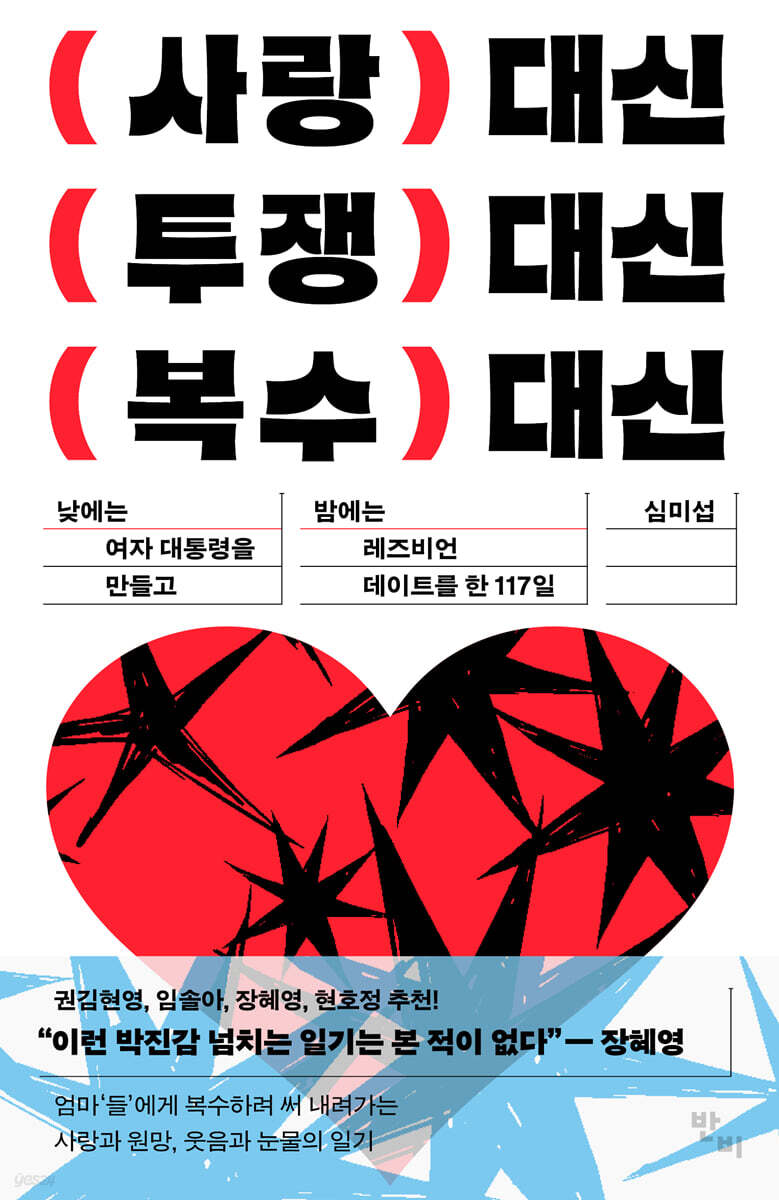
Instead of love, instead of struggle, instead of revenge
 |
Description
Book Introduction
To my girlfriend who broke up with me and said, "I'm leaving Korea"
Decided to work for the presidential campaign to get revenge!
117 days of struggle to get rid of the women I loved
On December 7, 2024, Sim Mi-seop proudly raised her voice as a lesbian feminist at a rally calling for the impeachment of Yoon Seok-yeol held in front of the National Assembly following the December 3rd civil war.
The statement that day, which called for an equal assembly without hate, played a significant role in creating a space for women and minorities in the square that continued for four months afterward.
Sim Mi-seop, who founded the group 'Feminist Party' with her friends to strengthen feminist politics and has been active in various feminist issues including the movement to abolish the abortion law, has published her first solo book, 'Instead of Love, Instead of Fight, Instead of Revenge'.
Sim Mi-seop, who “creates her own stage and gathers colleagues to build a breakwater when there is no place to speak” (Kwon Kim Hyun-young), passionately proves through this essay “how she became herself” (Jang Hye-young).
In November 2021, ahead of the 20th presidential election, the author, who had just moved to San Francisco, USA, broke up with his girlfriend and decided to join the progressive party's presidential campaign.
My ex-girlfriend said that after leaving Korea, she felt more secure living abroad where there was less discrimination and hatred, and I wanted to prove to her that through struggle, Korea can be made into a place worth living in.
The author, a graduate student studying philosophy and a feminist activist, works on a progressive party's presidential campaign during the day to create a female president, and at night, she surfs dating apps, constantly going on lesbian dates.
Counting down each day until March 9, 2022, the presidential election day, in a D-Day format, the book thrillingly chronicles the daily life of a campaign worker and queer person.
This is a vivid record of 117 days that connects party politics and one person's life in parallel, and weaves together democracy, women's lives, and queer lives.
It can be called a “feminist diary of war” (Jang Hye-young).
Decided to work for the presidential campaign to get revenge!
117 days of struggle to get rid of the women I loved
On December 7, 2024, Sim Mi-seop proudly raised her voice as a lesbian feminist at a rally calling for the impeachment of Yoon Seok-yeol held in front of the National Assembly following the December 3rd civil war.
The statement that day, which called for an equal assembly without hate, played a significant role in creating a space for women and minorities in the square that continued for four months afterward.
Sim Mi-seop, who founded the group 'Feminist Party' with her friends to strengthen feminist politics and has been active in various feminist issues including the movement to abolish the abortion law, has published her first solo book, 'Instead of Love, Instead of Fight, Instead of Revenge'.
Sim Mi-seop, who “creates her own stage and gathers colleagues to build a breakwater when there is no place to speak” (Kwon Kim Hyun-young), passionately proves through this essay “how she became herself” (Jang Hye-young).
In November 2021, ahead of the 20th presidential election, the author, who had just moved to San Francisco, USA, broke up with his girlfriend and decided to join the progressive party's presidential campaign.
My ex-girlfriend said that after leaving Korea, she felt more secure living abroad where there was less discrimination and hatred, and I wanted to prove to her that through struggle, Korea can be made into a place worth living in.
The author, a graduate student studying philosophy and a feminist activist, works on a progressive party's presidential campaign during the day to create a female president, and at night, she surfs dating apps, constantly going on lesbian dates.
Counting down each day until March 9, 2022, the presidential election day, in a D-Day format, the book thrillingly chronicles the daily life of a campaign worker and queer person.
This is a vivid record of 117 days that connects party politics and one person's life in parallel, and weaves together democracy, women's lives, and queer lives.
It can be called a “feminist diary of war” (Jang Hye-young).
- You can preview some of the book's contents.
Preview
index
prolog
Diaries
Epilogue
Diaries
Epilogue
Detailed image

Into the book
Suddenly, I felt like I had to join the presidential campaign.
I explained to my friends that the three months I planned to spend in San Francisco roughly corresponded to the presidential election period.
That wasn't the whole reason.
Was it simply because he needed something to focus on? Or was it out of revenge against H? He said he felt at ease since he left for San Francisco and H was always outside of Korea.
He said that living away from discrimination, anger and absurdity helped prevent his depression from worsening.
Well, I've lived abroad too, but my experience was more like the opposite.
A person who has been completely erased from the context of society, and who finds it difficult to even become a subject of struggle.
The experience of living as an invisible person rather than a minority could not be called pleasant.
To be honest, I was just terribly lonely.
I think it depends on the individual's personality which situation makes them happier, but I wanted to show H.
I will fight here.
Not everyone can do that, but I'm one of those people who can.
--- p.17~18
On the way home from the bus, my mom listened to my 15-minute summary of my failed love story and spoke coldly as usual.
“Hey, I don’t know if it’s an open relationship or polyamory, but what’s the difference between you and my friends who cry and complain even when their husbands cheat on them?” My mom was not one to be unreasonable, so she explained at length again.
About the nature of queer relationships, where innate patriarchal power doesn't operate, and the various relationships where people meet other people consensually.
There's also the concept of a "key partner," whereby even if each person is free to meet other people, some two people can promise to be each other's most important relationship.
After listening quietly, Mom spoke again.
“That’s it.
Someone's husband got caught cheating and was making excuses to his wife, but she said, "That woman is just seeing you for a little while, and you and I have a family together, we raise children, and even perform ancestral rites together." Ah, I melted at the word "ancestral rites."
Lesbian or whatever, love is love.
They're all the same in terms of being noisy.
--- p.25~26
What is youth politics? I asked the chairman.
Are you satisfied with the activities of the Youth Committee?
To be honest, I wanted to join the Central Party's Election Committee, but I was disappointed when I heard it was the Youth Committee.
I started my social activism as a student activist, and now I'm thirty, so I've been a young person for ten years. How long will I be relegated to the role of sprinkles on a cake baked by older people? It may not be solely a matter of age.
I've been involved in the movement by throwing parties and festivals, but the feminist movement and the movement by throwing parties and festivals were initially treated as side projects.
--- p.49
I joked to my mom as we wandered among the giant, meaningless sculptures.
“Mom should be thankful to H!” Actually, I wasn’t joking, I was completely serious.
There was also quite a bit of blame mixed in.
“So,” my mother answered curtly, without even looking at me.
I already knew.
That H re-raised me.
The fact that he gave me what my mother couldn't give me.
--- p.56
I keep thinking about the staff meeting I attended yesterday.
The moment when the men were debating and discussing whether to make the loan term for low-income youth living expenses 30 years or 35 years.
Like people who have to take power and implement policies tomorrow.
Are politicians always hoping for a magical victory, no matter how unlikely it seems? How genuine are they? Does S really believe he can become president and campaign around it? If so, would I be moved or disappointed by that belief?
--- p.87
It might seem obvious when you think of American political dramas.
Isn't there a separate profession called speechwriter?
Because no one thinks the president wrote what he said on television.
Is that so? In college, they teach that it's wrong to use someone else's writing without permission.
Even if you copy posts on personal Twitter or Instagram without citing the source, you will face social criticism.
But since this is a political party, isn't it natural that my writing, including my perspective and opinion, is published under the name of a 'representative'?
--- p.95
They say my father didn't come to the hospital when I was born.
According to my mom, she couldn't come because she was drinking with her friends to celebrate my birth.
My mother thought about me after giving birth to me after a full night of labor.
‘I should just have a baby and then get a divorce.’ But in the end, I had another baby.
How did I end up being born as a role model for those who have decided to quit smoking?
The hate groups that come to the Queer Culture Festival every year hold placards with similar phrases every year. --- p. Do they take turns using the same hand-held placards every year? Are those placards piled up in some church storage room all year long?) One of those regular phrases was, “Mom and Dad gave birth to me because they loved me.” Was I born from the love of my mom and dad? Can a baby born with the decision to divorce be said to be born from the love of its parents? The only proof that they once loved each other and were close enough to touch skin was my existence.
--- p.113~114
I wish my mom was a lesbian.
There are many cases where people meet their father and get married, but they become unidentified in middle age.
Why isn't Mom a lesbian? She'd be happier.
No, can't queerness run in the family?
--- p.129
Is being an activist, or working for a progressive party, really a laughing stock? The advantage of identifying as a feminist activist is that you'll be surrounded by people who understand you.
And you end up living in a very small and precious bubble.
If you say that homosexuality is as natural as heterosexuality, and furthermore, “Homosexuality is as natural as heterosexuality,” then people will ask, “Why are you only mentioning homosexuality?”
In a bubble where responses like “Asexuality? Bisexuality? Pansexuality?” will pop up.
Until now, the only way out of the bubble was through dating.
I don't work at a company, so how could I possibly meet someone from a different environment than me?
When I met someone I barely knew by face through an app and introduced myself, I often got this kind of response.
“So, are you planning to go into politics in the future?” I just dismissed it as a joke.
“I can’t do politics because of that womanizing.”
--- p.146
The day I was confirmed to go to work at the election campaign, I bought a diary at Aladdin Used Bookstore, the only bookstore near my house.
I picked up my notebook and made a decision.
I will record everything that happened at ○○ Party.
If the structure of party politics privatizes my writing as the property of a single individual, I will take revenge by writing, in my own words, everything I experienced in that time and space.
With that in mind, I felt less resentful when I sent the materials the chairman had requested via Telegram in the middle of the night.
--- p.153
One day, while I was out on business at the National Assembly, I was crossing the crosswalk on my way back to the office when a passerby wearing his employee ID around his neck said to me.
“Mad man, it’s crazy again today.” Looking around, I saw people with placards on their bodies telling stories of suffering from Chinese wiretapping devices, and people holding megaphones preaching about the god they believed in.
Groups holding picket demonstrations demanding the enactment of the Anti-Discrimination Law Enactment Coalition and the Nursing Law were also noticeable.
Election campaign materials posted by political parties were also posted everywhere.
Who is the 'madman' that the passerby spoke of?
Are they all on the street? Are we all the same, like those warning about the 666 VeriChip or those calling for the abolition of abortion? Are we just the crazy ones shouting on the street while everyone else is at work?
--- p.158~159
At the end of the consultation, the teacher said.
“Mr. Mi-seop says that the things he experienced because of his father were impressive.
The important person was the mother.
My father was a supporting actor.
“In Mr. Mi-seop’s life.”
That was right.
He continued to cry and then said.
“It’s so unfair.
My father didn't really blame me for neglecting me, and my mother raised me diligently, but my daughter cried a lot during counseling sessions and said it was all her fault.
“The world is so unfair to women.”
--- p.163
It wasn't that I was reluctant to take responsibility, but rather that I was uncomfortable being the 'face' of this group.
I guess I hesitated, wondering if I could act like this.
Self-censorship that I stand in front because I want to stand out too much and like being noticed.
From that day on, I decided to take responsibility for my work at the forefront of the Feminist Party.
Even if it seems like showing off.
But aren't we ignoring a more important question?
Whether out of a sense of responsibility or a desire to show off, can one person truly represent others?
--- p.170~171
In the middle of a meeting or a repetitive conversation, the office door suddenly opened and an old man dressed half in a suit and half in a modified hanbok came in.
The purpose of my visit was... to buy maps? Is that modern-day Mr. Kim Jeong-ho going around Yeouido offices selling maps? A presidential candidate has disappeared, and now it's not reporters but the old map guy who's barging in. What's going on here?
Again, M: I heard that there has been no communication between the candidate and the campaign team up until now.
The party leader is now telling the candidates to do whatever they want with the secretariat system, rather than the election committee.
Voices are heard here and there: Turn on Job Korea quickly.
I'm already browsing Worknet.
--- p.175
When I first started Feminist Party, I desperately wanted to meet the older generation of feminist activists.
Some people called the period we were active in the "feminism reboot," but if it's a reboot, shouldn't we first turn everything off?
It was a time when the feminist movement was, or was recorded as having been, cut off after the 'Young Feminist' movement in the 1990s.
While I have no doubt that the feminist movement has existed since women first lived in this country, it always felt like it was starting from scratch.
We were together, but genealogically we were lonely.
First, I wanted to meet my seniors who had been active before, like my mother or aunt, and ask for advice, share opinions, and if possible, hear some compliments.
But I was actually embarrassed because among my seniors, there were many who said, “Oh, I didn’t do anything special,” whether it was about abolishing the household system or the Young Feminist Movement.
Now you know that it's not humility, it's solidarity.
Still, I'll just have to slap a metal plate on the face and declare, "I did it!" and take responsibility.
There's the option of saying "we" did it, and of course that's closer to the truth, but it would be better if countless of us could all shamelessly say, "I did it!"
--- p.220
I must confess that sometimes I wish I could do an exercise that would make me feel more involved.
As I identify and live as a lesbian, it was difficult for me to fully embrace abortion as my own business.
Of course I knew it in my head.
The fight for the right to abortion is a fight to win the right to self-determination over one's reproductive organs and, more broadly, one's entire body.
Even though I kept repeating phrases like “the right to give birth, the right not to give birth” and “abolish abortion for all,” I sometimes felt lonely.
After receiving that call, I was no longer lonely.
I realized that what I was doing was really for my friends.
All this time I've only talked about it, but never actually felt it.
Seeing my close friend so happy made me feel as happy as if it were my own.
Not with the head, but with the heart, that was enough.
--- p.222
During the last presidential election, S also scolded many male candidates during the debate.
When Moon Jae-in said he was against homosexuality, he used his own time to rebut, saying, “Homosexuality is not a matter of pros and cons.” He also scolded Hong Jun-pyo, who said, “Washing the dishes is a woman’s job” and that it was “ordained by heaven,” saying, “Apologize to your daughters.”
Yes, I scolded him.
Why did I feel grateful first, rather than feeling right or refreshed?
Oh, why did S have to ask me to apologize to my "daughters"? Then I feel like I owe them an eternal debt.
Maybe it was those two moments that led me to work in this election campaign where there were no answers.
How did S get all the daughters with just one word, being the mother of a son?
--- p.224~225
How many people believe the saying, “If you pick S, you get S”?
No one is voting for S to become president right now.
However, as a feminist, as a queer person, and as a worker, I feel that I cannot survive if my existence is erased in the presidential election, and that is why I am submitting my resignation, which will make me a laughing stock.
--- p.237
The lunch ended with the question, “Why did you join the campaign?”
He replied that he was trying to repay the debt he owed to S, who used up his one-minute chance in the last presidential election.
He also said that he liked the way he looked when he was in high school, and that he was glad to see someone like his mother on top of the campaign vehicle driving around the academy area, rather than some old man.
After brushing my teeth and sitting down to think about it again, I realized that apart from age, my mom and S have nothing in common.
Mom is tall and has a cool, refreshing feel.
S is more than that… … no.
What's the point of talking about appearance? Anyway, I saw my mother in S.
--- p.243~244
Leading a progressive party and shouting at businesspeople during state audits is highly regarded everywhere.
So, a guardian who does ‘national affairs’ might think that he or she can neglect ‘housework’ a little.
Just as the story of S disappointing his son is consumed as a good story rather than a bad one.
But my mother, who worked just to support her family, still gets resentment from her daughter for not even bringing her an umbrella.
It must have been even more difficult working without being able to yell at your boss.
Yeah, I feel better now that I think about it.
--- p.245~246
Growing up, I never once saw my father write.
But with only one computer at home, my mother revised her manuscript every day.
After spending several months like that, and my mother being so sick that she was about to get sick, the book was finally published.
I looked at the book that arrived by courier with a proud but also clearly confused heart and put it away on a shelf.
It was a space filled with my father's name.
--- p.270
The habit of distancing myself from life by narrating my experiences directly has definitely protected me.
But these days, I envy people who express their feelings without organizing them.
Because the lump that I want to release with evil words rather than cynical language is growing bigger.
Would it have been possible if I had grown up as a poet's daughter, not an editor's? And I hate to blame my mother, but...
--- p.281
But that's not how solidarity works.
Solidarity is neither a form of taking turns in debt nor a form of taking sides based on affection.
It's just an act of doing the right thing together.
If S had spoken about the rights of sexual minorities as a party concerned, I would not have thought about sacrificing anything for him, nor would I have decided to help him in any way.
If so, it should have been the same even if he was not a party.
I didn't owe S anything.
--- p.292~293
But the solidarity that S showed was more acceptable than anything else.
These were the words and actions that a progressive politician should show.
If I truly believed in the proposition that “all power in the Republic of Korea emanates from the people,” I would have no reason to feel embarrassed by politicians for representing me as a citizen.
I consciously straightened my shoulders once.
This is because the results of a psychological test showed that people with high levels of revenge tend to have low levels of solidarity.
Revenge is giving back something that was received from me.
Therefore, ‘revenge out of gratitude’ cannot be established.
If you are truly grateful, you should show solidarity with the other person instead of repaying their debt.
--- p.299
I no longer want to be in that awkward attachment with my 'mothers' and take care of each other.
I want to stand in solidarity with them.
All solidarity relationships presuppose independence.
Solidarity is possible without the need for a clingy attachment.
Solidarity can also be done with people who are completely different from me.
Above all, solidarity owes no debt to anyone.
--- p.302
I already have the confidence to connect with anyone.
The first person I ever met was my mother.
I explained to my friends that the three months I planned to spend in San Francisco roughly corresponded to the presidential election period.
That wasn't the whole reason.
Was it simply because he needed something to focus on? Or was it out of revenge against H? He said he felt at ease since he left for San Francisco and H was always outside of Korea.
He said that living away from discrimination, anger and absurdity helped prevent his depression from worsening.
Well, I've lived abroad too, but my experience was more like the opposite.
A person who has been completely erased from the context of society, and who finds it difficult to even become a subject of struggle.
The experience of living as an invisible person rather than a minority could not be called pleasant.
To be honest, I was just terribly lonely.
I think it depends on the individual's personality which situation makes them happier, but I wanted to show H.
I will fight here.
Not everyone can do that, but I'm one of those people who can.
--- p.17~18
On the way home from the bus, my mom listened to my 15-minute summary of my failed love story and spoke coldly as usual.
“Hey, I don’t know if it’s an open relationship or polyamory, but what’s the difference between you and my friends who cry and complain even when their husbands cheat on them?” My mom was not one to be unreasonable, so she explained at length again.
About the nature of queer relationships, where innate patriarchal power doesn't operate, and the various relationships where people meet other people consensually.
There's also the concept of a "key partner," whereby even if each person is free to meet other people, some two people can promise to be each other's most important relationship.
After listening quietly, Mom spoke again.
“That’s it.
Someone's husband got caught cheating and was making excuses to his wife, but she said, "That woman is just seeing you for a little while, and you and I have a family together, we raise children, and even perform ancestral rites together." Ah, I melted at the word "ancestral rites."
Lesbian or whatever, love is love.
They're all the same in terms of being noisy.
--- p.25~26
What is youth politics? I asked the chairman.
Are you satisfied with the activities of the Youth Committee?
To be honest, I wanted to join the Central Party's Election Committee, but I was disappointed when I heard it was the Youth Committee.
I started my social activism as a student activist, and now I'm thirty, so I've been a young person for ten years. How long will I be relegated to the role of sprinkles on a cake baked by older people? It may not be solely a matter of age.
I've been involved in the movement by throwing parties and festivals, but the feminist movement and the movement by throwing parties and festivals were initially treated as side projects.
--- p.49
I joked to my mom as we wandered among the giant, meaningless sculptures.
“Mom should be thankful to H!” Actually, I wasn’t joking, I was completely serious.
There was also quite a bit of blame mixed in.
“So,” my mother answered curtly, without even looking at me.
I already knew.
That H re-raised me.
The fact that he gave me what my mother couldn't give me.
--- p.56
I keep thinking about the staff meeting I attended yesterday.
The moment when the men were debating and discussing whether to make the loan term for low-income youth living expenses 30 years or 35 years.
Like people who have to take power and implement policies tomorrow.
Are politicians always hoping for a magical victory, no matter how unlikely it seems? How genuine are they? Does S really believe he can become president and campaign around it? If so, would I be moved or disappointed by that belief?
--- p.87
It might seem obvious when you think of American political dramas.
Isn't there a separate profession called speechwriter?
Because no one thinks the president wrote what he said on television.
Is that so? In college, they teach that it's wrong to use someone else's writing without permission.
Even if you copy posts on personal Twitter or Instagram without citing the source, you will face social criticism.
But since this is a political party, isn't it natural that my writing, including my perspective and opinion, is published under the name of a 'representative'?
--- p.95
They say my father didn't come to the hospital when I was born.
According to my mom, she couldn't come because she was drinking with her friends to celebrate my birth.
My mother thought about me after giving birth to me after a full night of labor.
‘I should just have a baby and then get a divorce.’ But in the end, I had another baby.
How did I end up being born as a role model for those who have decided to quit smoking?
The hate groups that come to the Queer Culture Festival every year hold placards with similar phrases every year. --- p. Do they take turns using the same hand-held placards every year? Are those placards piled up in some church storage room all year long?) One of those regular phrases was, “Mom and Dad gave birth to me because they loved me.” Was I born from the love of my mom and dad? Can a baby born with the decision to divorce be said to be born from the love of its parents? The only proof that they once loved each other and were close enough to touch skin was my existence.
--- p.113~114
I wish my mom was a lesbian.
There are many cases where people meet their father and get married, but they become unidentified in middle age.
Why isn't Mom a lesbian? She'd be happier.
No, can't queerness run in the family?
--- p.129
Is being an activist, or working for a progressive party, really a laughing stock? The advantage of identifying as a feminist activist is that you'll be surrounded by people who understand you.
And you end up living in a very small and precious bubble.
If you say that homosexuality is as natural as heterosexuality, and furthermore, “Homosexuality is as natural as heterosexuality,” then people will ask, “Why are you only mentioning homosexuality?”
In a bubble where responses like “Asexuality? Bisexuality? Pansexuality?” will pop up.
Until now, the only way out of the bubble was through dating.
I don't work at a company, so how could I possibly meet someone from a different environment than me?
When I met someone I barely knew by face through an app and introduced myself, I often got this kind of response.
“So, are you planning to go into politics in the future?” I just dismissed it as a joke.
“I can’t do politics because of that womanizing.”
--- p.146
The day I was confirmed to go to work at the election campaign, I bought a diary at Aladdin Used Bookstore, the only bookstore near my house.
I picked up my notebook and made a decision.
I will record everything that happened at ○○ Party.
If the structure of party politics privatizes my writing as the property of a single individual, I will take revenge by writing, in my own words, everything I experienced in that time and space.
With that in mind, I felt less resentful when I sent the materials the chairman had requested via Telegram in the middle of the night.
--- p.153
One day, while I was out on business at the National Assembly, I was crossing the crosswalk on my way back to the office when a passerby wearing his employee ID around his neck said to me.
“Mad man, it’s crazy again today.” Looking around, I saw people with placards on their bodies telling stories of suffering from Chinese wiretapping devices, and people holding megaphones preaching about the god they believed in.
Groups holding picket demonstrations demanding the enactment of the Anti-Discrimination Law Enactment Coalition and the Nursing Law were also noticeable.
Election campaign materials posted by political parties were also posted everywhere.
Who is the 'madman' that the passerby spoke of?
Are they all on the street? Are we all the same, like those warning about the 666 VeriChip or those calling for the abolition of abortion? Are we just the crazy ones shouting on the street while everyone else is at work?
--- p.158~159
At the end of the consultation, the teacher said.
“Mr. Mi-seop says that the things he experienced because of his father were impressive.
The important person was the mother.
My father was a supporting actor.
“In Mr. Mi-seop’s life.”
That was right.
He continued to cry and then said.
“It’s so unfair.
My father didn't really blame me for neglecting me, and my mother raised me diligently, but my daughter cried a lot during counseling sessions and said it was all her fault.
“The world is so unfair to women.”
--- p.163
It wasn't that I was reluctant to take responsibility, but rather that I was uncomfortable being the 'face' of this group.
I guess I hesitated, wondering if I could act like this.
Self-censorship that I stand in front because I want to stand out too much and like being noticed.
From that day on, I decided to take responsibility for my work at the forefront of the Feminist Party.
Even if it seems like showing off.
But aren't we ignoring a more important question?
Whether out of a sense of responsibility or a desire to show off, can one person truly represent others?
--- p.170~171
In the middle of a meeting or a repetitive conversation, the office door suddenly opened and an old man dressed half in a suit and half in a modified hanbok came in.
The purpose of my visit was... to buy maps? Is that modern-day Mr. Kim Jeong-ho going around Yeouido offices selling maps? A presidential candidate has disappeared, and now it's not reporters but the old map guy who's barging in. What's going on here?
Again, M: I heard that there has been no communication between the candidate and the campaign team up until now.
The party leader is now telling the candidates to do whatever they want with the secretariat system, rather than the election committee.
Voices are heard here and there: Turn on Job Korea quickly.
I'm already browsing Worknet.
--- p.175
When I first started Feminist Party, I desperately wanted to meet the older generation of feminist activists.
Some people called the period we were active in the "feminism reboot," but if it's a reboot, shouldn't we first turn everything off?
It was a time when the feminist movement was, or was recorded as having been, cut off after the 'Young Feminist' movement in the 1990s.
While I have no doubt that the feminist movement has existed since women first lived in this country, it always felt like it was starting from scratch.
We were together, but genealogically we were lonely.
First, I wanted to meet my seniors who had been active before, like my mother or aunt, and ask for advice, share opinions, and if possible, hear some compliments.
But I was actually embarrassed because among my seniors, there were many who said, “Oh, I didn’t do anything special,” whether it was about abolishing the household system or the Young Feminist Movement.
Now you know that it's not humility, it's solidarity.
Still, I'll just have to slap a metal plate on the face and declare, "I did it!" and take responsibility.
There's the option of saying "we" did it, and of course that's closer to the truth, but it would be better if countless of us could all shamelessly say, "I did it!"
--- p.220
I must confess that sometimes I wish I could do an exercise that would make me feel more involved.
As I identify and live as a lesbian, it was difficult for me to fully embrace abortion as my own business.
Of course I knew it in my head.
The fight for the right to abortion is a fight to win the right to self-determination over one's reproductive organs and, more broadly, one's entire body.
Even though I kept repeating phrases like “the right to give birth, the right not to give birth” and “abolish abortion for all,” I sometimes felt lonely.
After receiving that call, I was no longer lonely.
I realized that what I was doing was really for my friends.
All this time I've only talked about it, but never actually felt it.
Seeing my close friend so happy made me feel as happy as if it were my own.
Not with the head, but with the heart, that was enough.
--- p.222
During the last presidential election, S also scolded many male candidates during the debate.
When Moon Jae-in said he was against homosexuality, he used his own time to rebut, saying, “Homosexuality is not a matter of pros and cons.” He also scolded Hong Jun-pyo, who said, “Washing the dishes is a woman’s job” and that it was “ordained by heaven,” saying, “Apologize to your daughters.”
Yes, I scolded him.
Why did I feel grateful first, rather than feeling right or refreshed?
Oh, why did S have to ask me to apologize to my "daughters"? Then I feel like I owe them an eternal debt.
Maybe it was those two moments that led me to work in this election campaign where there were no answers.
How did S get all the daughters with just one word, being the mother of a son?
--- p.224~225
How many people believe the saying, “If you pick S, you get S”?
No one is voting for S to become president right now.
However, as a feminist, as a queer person, and as a worker, I feel that I cannot survive if my existence is erased in the presidential election, and that is why I am submitting my resignation, which will make me a laughing stock.
--- p.237
The lunch ended with the question, “Why did you join the campaign?”
He replied that he was trying to repay the debt he owed to S, who used up his one-minute chance in the last presidential election.
He also said that he liked the way he looked when he was in high school, and that he was glad to see someone like his mother on top of the campaign vehicle driving around the academy area, rather than some old man.
After brushing my teeth and sitting down to think about it again, I realized that apart from age, my mom and S have nothing in common.
Mom is tall and has a cool, refreshing feel.
S is more than that… … no.
What's the point of talking about appearance? Anyway, I saw my mother in S.
--- p.243~244
Leading a progressive party and shouting at businesspeople during state audits is highly regarded everywhere.
So, a guardian who does ‘national affairs’ might think that he or she can neglect ‘housework’ a little.
Just as the story of S disappointing his son is consumed as a good story rather than a bad one.
But my mother, who worked just to support her family, still gets resentment from her daughter for not even bringing her an umbrella.
It must have been even more difficult working without being able to yell at your boss.
Yeah, I feel better now that I think about it.
--- p.245~246
Growing up, I never once saw my father write.
But with only one computer at home, my mother revised her manuscript every day.
After spending several months like that, and my mother being so sick that she was about to get sick, the book was finally published.
I looked at the book that arrived by courier with a proud but also clearly confused heart and put it away on a shelf.
It was a space filled with my father's name.
--- p.270
The habit of distancing myself from life by narrating my experiences directly has definitely protected me.
But these days, I envy people who express their feelings without organizing them.
Because the lump that I want to release with evil words rather than cynical language is growing bigger.
Would it have been possible if I had grown up as a poet's daughter, not an editor's? And I hate to blame my mother, but...
--- p.281
But that's not how solidarity works.
Solidarity is neither a form of taking turns in debt nor a form of taking sides based on affection.
It's just an act of doing the right thing together.
If S had spoken about the rights of sexual minorities as a party concerned, I would not have thought about sacrificing anything for him, nor would I have decided to help him in any way.
If so, it should have been the same even if he was not a party.
I didn't owe S anything.
--- p.292~293
But the solidarity that S showed was more acceptable than anything else.
These were the words and actions that a progressive politician should show.
If I truly believed in the proposition that “all power in the Republic of Korea emanates from the people,” I would have no reason to feel embarrassed by politicians for representing me as a citizen.
I consciously straightened my shoulders once.
This is because the results of a psychological test showed that people with high levels of revenge tend to have low levels of solidarity.
Revenge is giving back something that was received from me.
Therefore, ‘revenge out of gratitude’ cannot be established.
If you are truly grateful, you should show solidarity with the other person instead of repaying their debt.
--- p.299
I no longer want to be in that awkward attachment with my 'mothers' and take care of each other.
I want to stand in solidarity with them.
All solidarity relationships presuppose independence.
Solidarity is possible without the need for a clingy attachment.
Solidarity can also be done with people who are completely different from me.
Above all, solidarity owes no debt to anyone.
--- p.302
I already have the confidence to connect with anyone.
The first person I ever met was my mother.
--- p.303
Publisher's Review
“I will take revenge by writing in my own words everything I experienced in that time and space.”
We care for each other, nag each other, pay each other back, and show solidarity to the point of being sick and tired of it.
A revenge battle between women and women and women
While they shout for labor rights in the square, the working conditions of the progressive party are actually poor.
After-work work instructions are routine, and it seems like it would be difficult to maintain the principle of 'equal pay, equal work'.
How much of a gap exists between the progressive party's slogan of creating a more equal world and the actual experiences within it? The author's chosen method of struggle, amidst the endless absurdities he encounters, is to "take revenge" by writing about everything he experienced with brutal honesty.
The author's revenge is not directed only at poor working conditions.
I aim my pencil lead at my ex-girlfriend who I loved but abandoned me in an instant, my mother who raised me but was cold to me, and the presidential candidate S who I am grateful to for representing me but disappeared for a moment.
The story of women and women and women who care for each other to the point of being tiresome, repaying each other's debts, disappointing each other, and supporting each other is intertwined with the 20th presidential election.
A conservative party that pledged to abolish the Ministry of Gender Equality and Family, a leading presidential candidate who avoids enacting anti-discrimination laws, politicians desperate to win over young men… … In this midst, Sim Mi-seop shamelessly reveals her daily life as a lesbian feminist, as if it were a given.
She talks about meeting people through dating apps because it is difficult to 'seek natural encounters', about lesbian sex, which is more equal than any other relationship but involves complex desires and emotions, and about her inner thoughts about 'consent' as a feminist activist.
These stories, in contrast to the capital-letter politics within the presidential campaign, extend the private realm of intimacy into politics.
This “lesbian story, so frankly honest and desperately struggling” (Im Sol-ah), which refuses to objectify itself by dwelling on its weaknesses, is in itself a courageous strategy for confronting discrimination and hatred head-on.
Instead of a mother, instead of a girlfriend, instead of a female politician… …
117 days to become independent from the mother who raised me and the mothers I raised.
But no matter how sad you are, just shed 'one tear at a time'
Aren't "revenge" and "repaying a favor" two sides of the same coin, both of which involve returning what you've received? One of the many reasons the author decided to work for a progressive party's presidential campaign was presidential candidate S.
This is thanks to S's rebuttal to a candidate who opposed homosexuality during the 19th presidential debate, saying, "Homosexuality is not a matter of pro or con."
The author, who feels indebted to politician S, who used 'One Minute Chance' to represent sexual minorities, works to make S president in order to repay his 'debt'.
The same goes for my ex-girlfriend and my mother.
The 117 days I spent working on the presidential campaign after breaking up with my ex-girlfriend were nothing less than a process of paying off my debt to my ex-girlfriend who loved and cared for me, the female politician who represented me, and even my mother who passed on my language and cultural capital… In other words, it was a process of becoming truly independent, paying off my debt to those who raised me like a mother, yet on whom I had no choice but to rely, like a mother, and yet who constantly disappointed me.
The author, who has protected himself by looking at any pain from a distance and comically portraying it as a genre called black comedy, unravels this process not as a narrative of suffering, but with his characteristically sharp humor.
No matter how sad, lonely, or angry you are, you can only shed 'one tear at a time', which makes it an even more poignant and truthful revenge story.
“Can one person represent others in the first place?”
A most personal exploration of feminism, politics, power, and writing.
“But since this is a political party, is it natural that an article written with my perspective and opinion would be published under the name of the ‘representative’?” (p. 95) As a public relations director and spokesperson for an election campaign, the author questions the fact that an article he wrote is published under the chairman’s personal name.
During my time as an activist, I raised the issue of language being privatized as if the writings I wrote were the thoughts and opinions of a single “representative,” rather than published under the name of “our” organization.
This problem awareness extends to my childhood memories of my mother, who was an editor, and my experience as a feminist activist.
Clearly, I sat at my desk for months, working hard and refining my writing every day, but the bookshelves were filled with books, and only the names of male authors remained. “My mother’s name was not on any of the bookshelves” (p. 11).
In this way, 『Instead of Love, Instead of Struggle, Instead of Revenge』 rewrites the concepts of power and feminism, records and genealogy through the figures of women encountered within progressive politics and social movements by telling personal and intimate experiences.
Through concrete and vivid experiences, women question the male-centered culture of "leaving one's name" from which they have been excluded, the position of feminism within social movements, the meaning of continuing and recording the lineage of the women's movement, and the power structure organized around representatives.
This book freely moves between the 'personal' and the 'political', making us ponder the true meaning of love and solidarity.
We care for each other, nag each other, pay each other back, and show solidarity to the point of being sick and tired of it.
A revenge battle between women and women and women
While they shout for labor rights in the square, the working conditions of the progressive party are actually poor.
After-work work instructions are routine, and it seems like it would be difficult to maintain the principle of 'equal pay, equal work'.
How much of a gap exists between the progressive party's slogan of creating a more equal world and the actual experiences within it? The author's chosen method of struggle, amidst the endless absurdities he encounters, is to "take revenge" by writing about everything he experienced with brutal honesty.
The author's revenge is not directed only at poor working conditions.
I aim my pencil lead at my ex-girlfriend who I loved but abandoned me in an instant, my mother who raised me but was cold to me, and the presidential candidate S who I am grateful to for representing me but disappeared for a moment.
The story of women and women and women who care for each other to the point of being tiresome, repaying each other's debts, disappointing each other, and supporting each other is intertwined with the 20th presidential election.
A conservative party that pledged to abolish the Ministry of Gender Equality and Family, a leading presidential candidate who avoids enacting anti-discrimination laws, politicians desperate to win over young men… … In this midst, Sim Mi-seop shamelessly reveals her daily life as a lesbian feminist, as if it were a given.
She talks about meeting people through dating apps because it is difficult to 'seek natural encounters', about lesbian sex, which is more equal than any other relationship but involves complex desires and emotions, and about her inner thoughts about 'consent' as a feminist activist.
These stories, in contrast to the capital-letter politics within the presidential campaign, extend the private realm of intimacy into politics.
This “lesbian story, so frankly honest and desperately struggling” (Im Sol-ah), which refuses to objectify itself by dwelling on its weaknesses, is in itself a courageous strategy for confronting discrimination and hatred head-on.
Instead of a mother, instead of a girlfriend, instead of a female politician… …
117 days to become independent from the mother who raised me and the mothers I raised.
But no matter how sad you are, just shed 'one tear at a time'
Aren't "revenge" and "repaying a favor" two sides of the same coin, both of which involve returning what you've received? One of the many reasons the author decided to work for a progressive party's presidential campaign was presidential candidate S.
This is thanks to S's rebuttal to a candidate who opposed homosexuality during the 19th presidential debate, saying, "Homosexuality is not a matter of pro or con."
The author, who feels indebted to politician S, who used 'One Minute Chance' to represent sexual minorities, works to make S president in order to repay his 'debt'.
The same goes for my ex-girlfriend and my mother.
The 117 days I spent working on the presidential campaign after breaking up with my ex-girlfriend were nothing less than a process of paying off my debt to my ex-girlfriend who loved and cared for me, the female politician who represented me, and even my mother who passed on my language and cultural capital… In other words, it was a process of becoming truly independent, paying off my debt to those who raised me like a mother, yet on whom I had no choice but to rely, like a mother, and yet who constantly disappointed me.
The author, who has protected himself by looking at any pain from a distance and comically portraying it as a genre called black comedy, unravels this process not as a narrative of suffering, but with his characteristically sharp humor.
No matter how sad, lonely, or angry you are, you can only shed 'one tear at a time', which makes it an even more poignant and truthful revenge story.
“Can one person represent others in the first place?”
A most personal exploration of feminism, politics, power, and writing.
“But since this is a political party, is it natural that an article written with my perspective and opinion would be published under the name of the ‘representative’?” (p. 95) As a public relations director and spokesperson for an election campaign, the author questions the fact that an article he wrote is published under the chairman’s personal name.
During my time as an activist, I raised the issue of language being privatized as if the writings I wrote were the thoughts and opinions of a single “representative,” rather than published under the name of “our” organization.
This problem awareness extends to my childhood memories of my mother, who was an editor, and my experience as a feminist activist.
Clearly, I sat at my desk for months, working hard and refining my writing every day, but the bookshelves were filled with books, and only the names of male authors remained. “My mother’s name was not on any of the bookshelves” (p. 11).
In this way, 『Instead of Love, Instead of Struggle, Instead of Revenge』 rewrites the concepts of power and feminism, records and genealogy through the figures of women encountered within progressive politics and social movements by telling personal and intimate experiences.
Through concrete and vivid experiences, women question the male-centered culture of "leaving one's name" from which they have been excluded, the position of feminism within social movements, the meaning of continuing and recording the lineage of the women's movement, and the power structure organized around representatives.
This book freely moves between the 'personal' and the 'political', making us ponder the true meaning of love and solidarity.
GOODS SPECIFICS
- Date of issue: July 31, 2025
- Page count, weight, size: 304 pages | 364g | 130*200*16mm
- ISBN13: 9791194087892
- ISBN10: 1194087892
You may also like
카테고리
korean


korean

![GQ KOREA Mark (Monthly): December [2025]](http://librairie.coreenne.fr/cdn/shop/files/8ef265dbbfbf186523ed75ba7319009d.jpg?v=1765340328&width=3840)


