

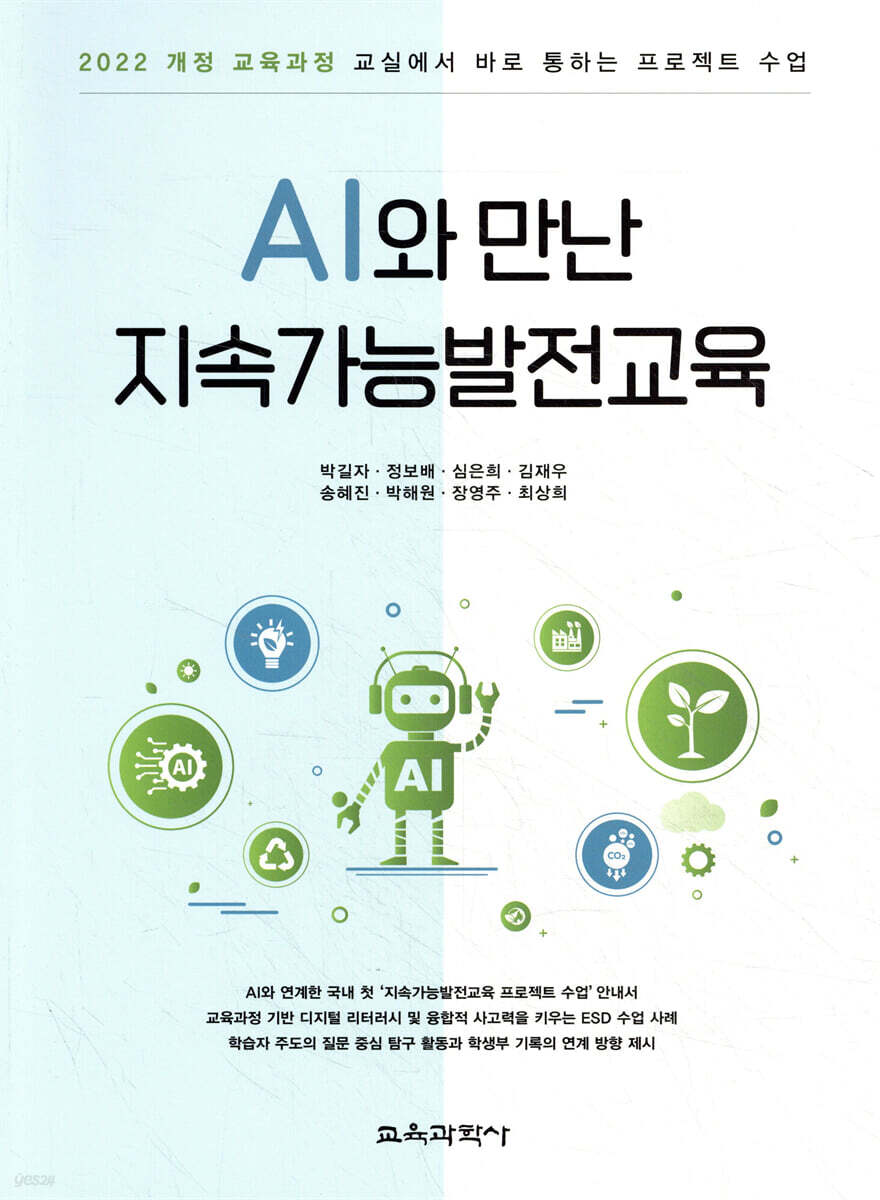
Sustainable Development Education with AI
 |
Description
Book Introduction
This book aims to serve as a guide for teachers to immediately implement sustainable development education project classes using generative AI.
Sustainable development education is one of the most important topics in the 2022 revised curriculum.
The revised curriculum actively reflects the challenges of sustainable development education, including the digital transformation brought about by advancements in artificial intelligence technology, infectious disease pandemics, and climate and ecological changes.
Sustainable Development Education focuses on fostering core competencies that enable students to proactively address the uncertainties of future society, actively and responsibly participate in sustainable development through open and inclusive values and attitudes, and proactively lead their own lives and learning.
Reflecting this spirit, a new subject called “Climate Change and a Sustainable World” was created in the high school social studies area, and “Climate Change and the Ecological Environment” was created in the science studies area.
Additionally, we are addressing sustainable development issues as an important topic in the curriculum of all subjects, including Korean, English, mathematics, social studies, science, art, information, and career guidance.
We selected the project-based teaching method as the optimal teaching method for implementing sustainable development education using generative AI.
Through project-based learning, students can analyze issues that need to be addressed at individual, societal, and international levels, using "sustainable development" as a keyword, develop solutions, and explore practical solutions.
For example, by utilizing generative AI to analyze climate change-related data and then conducting project-based classes to suggest solutions, students can develop practical problem-solving skills.
Additionally, you can develop your collaboration and communication skills while solving problems.
Ultimately, through project-based learning, students go beyond simply acquiring knowledge and grow into proactive citizens who pursue the values of a sustainable life.
Sustainable development education is one of the most important topics in the 2022 revised curriculum.
The revised curriculum actively reflects the challenges of sustainable development education, including the digital transformation brought about by advancements in artificial intelligence technology, infectious disease pandemics, and climate and ecological changes.
Sustainable Development Education focuses on fostering core competencies that enable students to proactively address the uncertainties of future society, actively and responsibly participate in sustainable development through open and inclusive values and attitudes, and proactively lead their own lives and learning.
Reflecting this spirit, a new subject called “Climate Change and a Sustainable World” was created in the high school social studies area, and “Climate Change and the Ecological Environment” was created in the science studies area.
Additionally, we are addressing sustainable development issues as an important topic in the curriculum of all subjects, including Korean, English, mathematics, social studies, science, art, information, and career guidance.
We selected the project-based teaching method as the optimal teaching method for implementing sustainable development education using generative AI.
Through project-based learning, students can analyze issues that need to be addressed at individual, societal, and international levels, using "sustainable development" as a keyword, develop solutions, and explore practical solutions.
For example, by utilizing generative AI to analyze climate change-related data and then conducting project-based classes to suggest solutions, students can develop practical problem-solving skills.
Additionally, you can develop your collaboration and communication skills while solving problems.
Ultimately, through project-based learning, students go beyond simply acquiring knowledge and grow into proactive citizens who pursue the values of a sustainable life.
index
preface
Chapter 1: Why 'Sustainable Development Education'?
Chapter 2: All About Sustainable Development Education
Chapter 3: Preparing Project Classes with AI
Chapter 4: AI Project Class Practice
Chapter 5: Social Sector: "Reading One Book" and the Sustainable Development Goals Implementation Project
Chapter 6: Economic Sector: Career-Linked Data Analysis Project Using Generative AI
Chapter 7: Environmental Area: Habitat Protection Projects to Prevent the Spread of Infectious Diseases
Chapter 8: Social and Economic Integration Area ①: Project to Create Regional Promotional Materials Using Local Tales
Chapter 9: Social and Economic Integration Area ②: Sustainable Cultural Heritage Digital Restoration Project
Chapter 10: Social, Economic, and Environmental Integration Area ①: Social Issues Exploration Project for Fair and Just Social Development
Chapter 11: Social, Economic, and Environmental Integration Area ②: Career Development Projects Realizing Public Value
Appendix 1: Curriculum Analysis by Subject and Area
Appendix 2: Project Overview by Subject and Area
Epilogue
References
Chapter 1: Why 'Sustainable Development Education'?
Chapter 2: All About Sustainable Development Education
Chapter 3: Preparing Project Classes with AI
Chapter 4: AI Project Class Practice
Chapter 5: Social Sector: "Reading One Book" and the Sustainable Development Goals Implementation Project
Chapter 6: Economic Sector: Career-Linked Data Analysis Project Using Generative AI
Chapter 7: Environmental Area: Habitat Protection Projects to Prevent the Spread of Infectious Diseases
Chapter 8: Social and Economic Integration Area ①: Project to Create Regional Promotional Materials Using Local Tales
Chapter 9: Social and Economic Integration Area ②: Sustainable Cultural Heritage Digital Restoration Project
Chapter 10: Social, Economic, and Environmental Integration Area ①: Social Issues Exploration Project for Fair and Just Social Development
Chapter 11: Social, Economic, and Environmental Integration Area ②: Career Development Projects Realizing Public Value
Appendix 1: Curriculum Analysis by Subject and Area
Appendix 2: Project Overview by Subject and Area
Epilogue
References
Publisher's Review
Structure of this book
The first examined the following questions: "What is education for sustainable development, and how is it reflected in the 2022 revised curriculum?" and "How should the curriculum be structured to implement education for sustainable development as proposed by UNESCO?"
The second part examined "How can we implement project-based learning using AI?", "How can we implement sustainable development education through project-based learning?", and "What are the procedures, design, implementation, and evaluation methods for project-based learning?"
Third, we have compiled practical teaching examples in Korean, English, mathematics, social studies, science, career, and art, with the 2022 revised curriculum in mind.
The case studies of class practice were selected based on topics centered on the three areas of sustainable development—social, economic, and environmental—and the convergence between these areas. The aim was to present a fair and just social development plan that balances sustainable economic growth and environmental conservation to achieve the Sustainable Development Goals.
Note: Year of application of the '2022 Revised Curriculum'
- March 1, 2024: 1st and 2nd grade elementary school students
- March 1, 2025: 3rd and 4th grade elementary school students, 1st grade middle school students, and 1st grade high school students
- March 1, 2026: 5th and 6th grades of elementary school, 2nd grade of middle school, 2nd grade of high school
- March 1, 2027: 3rd year of middle school, 3rd year of high school
The first examined the following questions: "What is education for sustainable development, and how is it reflected in the 2022 revised curriculum?" and "How should the curriculum be structured to implement education for sustainable development as proposed by UNESCO?"
The second part examined "How can we implement project-based learning using AI?", "How can we implement sustainable development education through project-based learning?", and "What are the procedures, design, implementation, and evaluation methods for project-based learning?"
Third, we have compiled practical teaching examples in Korean, English, mathematics, social studies, science, career, and art, with the 2022 revised curriculum in mind.
The case studies of class practice were selected based on topics centered on the three areas of sustainable development—social, economic, and environmental—and the convergence between these areas. The aim was to present a fair and just social development plan that balances sustainable economic growth and environmental conservation to achieve the Sustainable Development Goals.
Note: Year of application of the '2022 Revised Curriculum'
- March 1, 2024: 1st and 2nd grade elementary school students
- March 1, 2025: 3rd and 4th grade elementary school students, 1st grade middle school students, and 1st grade high school students
- March 1, 2026: 5th and 6th grades of elementary school, 2nd grade of middle school, 2nd grade of high school
- March 1, 2027: 3rd year of middle school, 3rd year of high school
GOODS SPECIFICS
- Date of issue: April 20, 2025
- Page count, weight, size: 312 pages | 188*257*30mm
- ISBN13: 9788925420318
- ISBN10: 8925420317
You may also like
카테고리
korean


korean

![GQ KOREA Mark (Monthly): December [2025]](http://librairie.coreenne.fr/cdn/shop/files/8ef265dbbfbf186523ed75ba7319009d.jpg?v=1765340328&width=3840)


