

Time inequality
 |
Description
Book Introduction
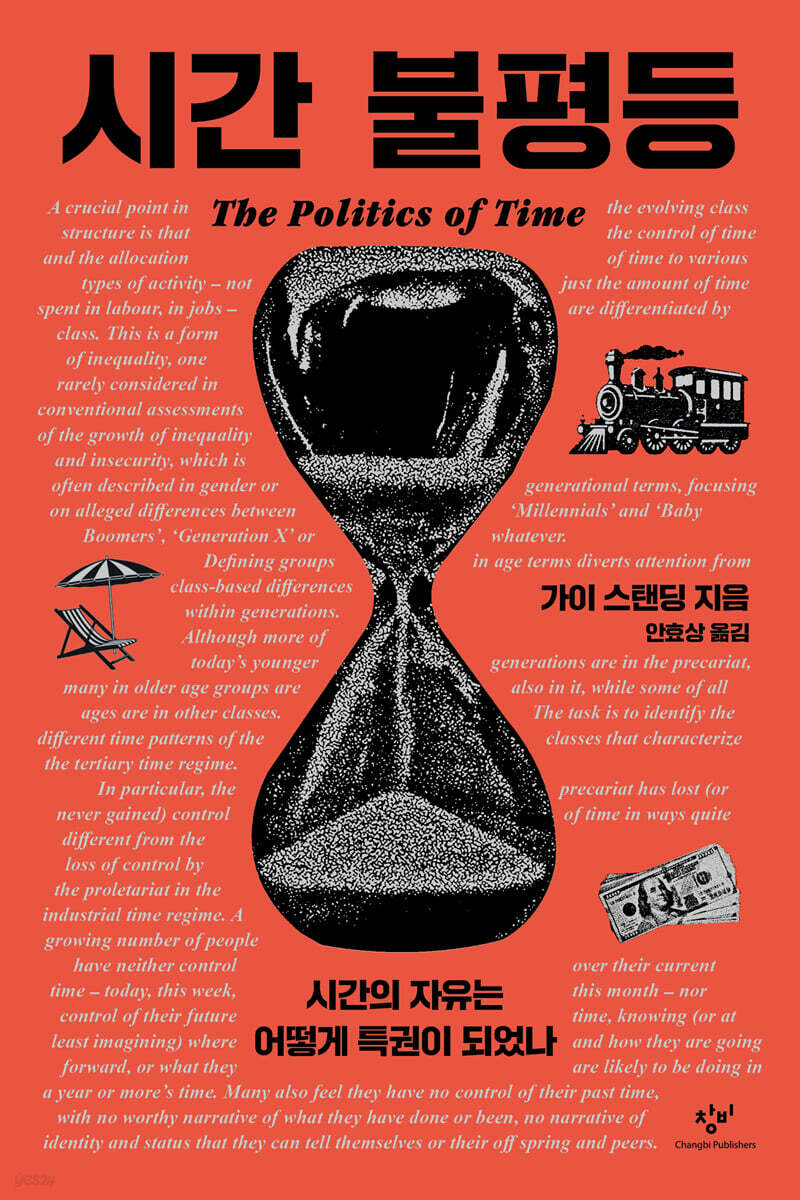
Of all inequalities, the worst is time inequality!
Why do some people enjoy the freedom of plenty of time?
Should someone else mortgage their life to make a living?
Guy Standing, a pioneering political economist who has established the concept of a new social class called the 'precariat' and advocated for basic income as a fundamental and innovative alternative to combat social and economic inequality, has published a new book, 'Time Inequality.'
In this book, the author describes in detail the pervasive reality of "time inequality" and its historical development, and comprehensively reviews and criticizes the history and mechanisms of capitalism that have perpetuated and deepened inequality.
John Maynard Keynes predicted that by 2030, people would work an average of only 15 hours per week.
However, with 2030 just around the corner, the global average annual working hours are approaching 1,800 hours, and Korea has yet to shake off the labels of a “long-hours working nation,” an “overwork society,” and a “workaholic society.”
Nevertheless, there was an attempt at institutional regression to allow working hours of up to 69 hours per week under the pretext of flexible working hours.
Most people are unable to free themselves from work and spend each day barely recovering their exhausted body and mind through short periods of entertainment and rest.
In a time immersed in labor, spaces for care, friendship, political participation, and deliberation have become increasingly narrow.
The author warns that time inequality is “the worst of all inequalities” (p. 5), as the exclusion of activities essential for becoming active political citizens weakens the foundations of democracy and further deepens various inequalities, poverty, and instability.
This book goes beyond simply capturing the reality of time inequality. It penetrates the capitalist system that governs our time and even offers bold and concrete political strategies to overcome it. It will serve as a valuable guide for those who dream of a fundamental transformation of their lives at a time when our time and daily lives face harsh demands.
Why do some people enjoy the freedom of plenty of time?
Should someone else mortgage their life to make a living?
Guy Standing, a pioneering political economist who has established the concept of a new social class called the 'precariat' and advocated for basic income as a fundamental and innovative alternative to combat social and economic inequality, has published a new book, 'Time Inequality.'
In this book, the author describes in detail the pervasive reality of "time inequality" and its historical development, and comprehensively reviews and criticizes the history and mechanisms of capitalism that have perpetuated and deepened inequality.
John Maynard Keynes predicted that by 2030, people would work an average of only 15 hours per week.
However, with 2030 just around the corner, the global average annual working hours are approaching 1,800 hours, and Korea has yet to shake off the labels of a “long-hours working nation,” an “overwork society,” and a “workaholic society.”
Nevertheless, there was an attempt at institutional regression to allow working hours of up to 69 hours per week under the pretext of flexible working hours.
Most people are unable to free themselves from work and spend each day barely recovering their exhausted body and mind through short periods of entertainment and rest.
In a time immersed in labor, spaces for care, friendship, political participation, and deliberation have become increasingly narrow.
The author warns that time inequality is “the worst of all inequalities” (p. 5), as the exclusion of activities essential for becoming active political citizens weakens the foundations of democracy and further deepens various inequalities, poverty, and instability.
This book goes beyond simply capturing the reality of time inequality. It penetrates the capitalist system that governs our time and even offers bold and concrete political strategies to overcome it. It will serve as a valuable guide for those who dream of a fundamental transformation of their lives at a time when our time and daily lives face harsh demands.
index
Preface to the Korean edition
introduction
Chapter 1: Ancient Times
Chapter 2: The Age of Agricultural Time
Chapter 3: Industrial Time: The Triumph of Laborism
Chapter 4: The Third Hour: The Final Stage of Laborism
Chapter 5: Reaction to the Third Time
Chapter 6: Time from the Perspective of the Coronavirus
Chapter 7: The Job Option: The Final Stage of Laborism
Chapter 8: Liberation of Time
Epilogue
Translator's Note
main
Search
introduction
Chapter 1: Ancient Times
Chapter 2: The Age of Agricultural Time
Chapter 3: Industrial Time: The Triumph of Laborism
Chapter 4: The Third Hour: The Final Stage of Laborism
Chapter 5: Reaction to the Third Time
Chapter 6: Time from the Perspective of the Coronavirus
Chapter 7: The Job Option: The Final Stage of Laborism
Chapter 8: Liberation of Time
Epilogue
Translator's Note
main
Search
Detailed image

Publisher's Review
What was time originally for?
To stimulate our meager imagination about how to spend our time, the author begins the story by going back to ancient Athens, Greece.
Modern people try to protect their lives from work with the compromising term “work-life balance,” but long ago, the Athenians avoided “labor” as “a painful and difficult activity performed under conditions of poverty” (p. 24).
They spent a lot of time on 'work' and leisure instead of labor.
'Work' was clearly distinct from labor, as it was defined as "an activity that maintains and develops the physical, intellectual, and emotional qualities of an individual, as well as social structures and community bonds" (p. 25), including care, study, education, and creative work.
The author emphasizes this distinction between 'work' and 'labor', reminding us that labor was not actually essential or natural in our time.
This distinction continued until the 13th century "Forest Charter".
The Forest Charter, which states that vulnerable groups can depend on commons, a public resource shared by all for their livelihoods and livelihoods, encourages “work” such as commoning, which is the preservation and care of commons, while acknowledging “the right and power to refuse work” (p. 40).
During this period, even the poor could enjoy some protection from long and harsh labor.
In addition, the author shows the landscape of time before it became inextricably linked to labor, based on historical examples of how time was used in different ways than we do today, such as the traditions of medieval European agricultural societies that held long festivals during fallow periods, and the customs of guilds (guilds of medieval European merchants and artisans) that required people to devote a lot of time to politics.
Time consumed by labor
The author states that the way we use time has changed along with the economic structure, and points to the period around the 'Industrial Revolution' in the 18th century as the point when labor was fully recorded in time.
There were signs earlier than that.
The 'era of sharing' ended with enclosures that privatized commons.
When their share of the commons disappeared, the majority had to work to survive, which ultimately meant becoming dependent on the few who monopolized the resources and means of production, thus increasing their wealth and freedom.
Time has been reorganized to benefit the few.
With the invention of the clock and the widespread adoption of Taylorism, which advocated extreme division of labor, and Fordism, a mass production system, labor became easier to manage and increased productivity became the ultimate goal, so the public became accustomed to working long hours.
Capitalism has come to redefine how we use our time.
The author names this changing time as 'industrial time' and points out that the most serious problem of this period was 'laborism'.
Laborism is “the false belief that work is an appropriate and desirable way to work and earn a living” (p. 91), and during the rise of capitalism, large-scale political and social adjustments were made to instill this belief in the masses who did not want to work.
The author reveals in detail the violent and ingenious process of adjustment, including institutionally isolating and punishing those who did not conform to the new labor order and promoting legislation that guaranteed employment stability to ensure that workers would remain in their jobs for a long time. Above all, he strongly criticizes the social democrats and communists who accepted laborism from a Marxist perspective.
The left, which had to take the lead in opposing proletarianization, which was nothing more than “training people to view wage labor as a normal way of working and living” (p. 91), embraced laborism while upholding the “dignity of labor.”
The author criticizes the left's actions, which have stopped at demanding fair distribution of income and universal welfare rather than liberation from unfree labor, as "a colossal historical mistake committed by modernity" (p. 100).
In the end, laborism joined hands with capitalism and ushered in an era of time inequality by justifying the sacrifice of the time of the many for the wealth of the few.
Never-ending work, poor rest,
The pressures of side hustles and self-improvement, yet an uncertain future.
Living in worse times
In modern times, time has become more distorted and irrational, in what is called the 'third time system'.
As economic growth became the ultimate political and economic goal, job security was seen as an enemy of economic growth, leading to far more workers working in precarious jobs than in the industrial era.
Moreover, as neoliberalism gained ground and self-entrepreneurship became the new norm, workers were forced to work more, driven by the need to remodel and remarketize themselves.
Working outside the workplace has become the norm, we are performing multiple tasks simultaneously, and the boundaries between work and leisure have become blurred, making it impossible to accurately measure working hours.
The author says that this worsening situation is more threatening to the precariat.
The precariat is a class whose income is not derived from rent, regular salaries, or non-wage benefits, but solely from wage labor, and whose work is primarily precarious.
Most of them are mobilized for temporary, short-term contract, errand, and platform work, which do not have set working hours or workplaces and do not require skilled skills. The uncertainty of such jobs not only makes it difficult for them to secure a stable income, but also leaves them with little control over their time.
More seriously, you end up spending a significant amount of time on unnecessary and unproductive tasks.
These include 'waiting work', where people kill time while waiting for work that may or may not be given, 'work as a job search', where people have to prove their job search to receive government benefits, and 'work as training', where people have to participate in formal job training programs to increase their employability.
The author presents new types of labor that have emerged in the third time system, starkly exposing the reality of time exploitation and inequality, and warns that these trends are present across almost all classes except the wealthy.
For the right not to work, but to work
Some argue that the only way out of this predicament is through 'full employment,' but the author firmly disagrees.
In the author's view, what people need is not simply job security, but a way to make a living without being tied to precarious and meaningless jobs.
But full employment, by aiming to get everyone into full-time work, tends to force people into “unemployable, boring, and poorly paid jobs” (p. 326), often against their will.
The author sharply criticizes the UK's welfare system, Universal Credit, which uses conditional benefits and workfare to achieve full employment by exploiting "people who, due to extreme poverty or insecurity, have no other choice but to accept jobs they do not want" (p. 120).
Both systems require recipients to be job-seeking and job-training or to work in public employment to receive welfare benefits, and they must prove this.
The author criticizes such a system as seriously infringing on the time and freedom of vulnerable workers, and argues that establishing an “income-distribution system” that prioritizes the right not to work over the right to work and “respects everyone’s time” (p. 326) is key to resolving time inequality, rather than a temporary and deceptive job security system.
Dreaming of a time free from labor
A more progressive politics of time
In the final chapter of the book, Guy Standing reimagines and rewrites Keynes' previously optimistic scenario for the 2030s.
The article, which begins with the sentence “We are living in the 2030s” (page 363), depicts the process by which British progressive politics overcomes time inequality and transforms capitalist reality through innovative transformation and subversive policies.
First, an unconditional basic income was provided so that everyone could secure freedom over their own time without being tied down to work to make a living.
This basic income is funded by fees levied on the exploitation of common land, such as land value taxes and carbon emissions charges.
Another innovation was the introduction of a new economic indicator that reflects the quality of time, reduction of inequality, and sustainability, instead of GDP, which evaluates economic growth based on labor and production.
Activities such as care work and housework, which had been marginalized due to the focus on paid labor such as jobs, have been recognized for their value and included in economic evaluations.
This concrete, long-term policy roadmap, aimed at “reversing the tendencies of rent-seeking capitalism that lead to greater inequality” (p. 375), provides a blueprint for a feasible social transformation and offers profound inspiration to today’s readers.
"Time Inequality" emphasizes that the distribution of time, as unequal and unjust as the distribution of wealth, is the most urgent and acute problem of our time, and historically examines when and why the majority's time was reorganized around labor, and freedom of time became a privilege enjoyed only by a few.
What would politics look like if it valued the time of the many over the wealth of the few? What would our future look like if people spent more time on quality leisure, care, and political deliberation rather than labor? It boldly poses and answers questions that could lead to subversive imaginations.
To stimulate our meager imagination about how to spend our time, the author begins the story by going back to ancient Athens, Greece.
Modern people try to protect their lives from work with the compromising term “work-life balance,” but long ago, the Athenians avoided “labor” as “a painful and difficult activity performed under conditions of poverty” (p. 24).
They spent a lot of time on 'work' and leisure instead of labor.
'Work' was clearly distinct from labor, as it was defined as "an activity that maintains and develops the physical, intellectual, and emotional qualities of an individual, as well as social structures and community bonds" (p. 25), including care, study, education, and creative work.
The author emphasizes this distinction between 'work' and 'labor', reminding us that labor was not actually essential or natural in our time.
This distinction continued until the 13th century "Forest Charter".
The Forest Charter, which states that vulnerable groups can depend on commons, a public resource shared by all for their livelihoods and livelihoods, encourages “work” such as commoning, which is the preservation and care of commons, while acknowledging “the right and power to refuse work” (p. 40).
During this period, even the poor could enjoy some protection from long and harsh labor.
In addition, the author shows the landscape of time before it became inextricably linked to labor, based on historical examples of how time was used in different ways than we do today, such as the traditions of medieval European agricultural societies that held long festivals during fallow periods, and the customs of guilds (guilds of medieval European merchants and artisans) that required people to devote a lot of time to politics.
Time consumed by labor
The author states that the way we use time has changed along with the economic structure, and points to the period around the 'Industrial Revolution' in the 18th century as the point when labor was fully recorded in time.
There were signs earlier than that.
The 'era of sharing' ended with enclosures that privatized commons.
When their share of the commons disappeared, the majority had to work to survive, which ultimately meant becoming dependent on the few who monopolized the resources and means of production, thus increasing their wealth and freedom.
Time has been reorganized to benefit the few.
With the invention of the clock and the widespread adoption of Taylorism, which advocated extreme division of labor, and Fordism, a mass production system, labor became easier to manage and increased productivity became the ultimate goal, so the public became accustomed to working long hours.
Capitalism has come to redefine how we use our time.
The author names this changing time as 'industrial time' and points out that the most serious problem of this period was 'laborism'.
Laborism is “the false belief that work is an appropriate and desirable way to work and earn a living” (p. 91), and during the rise of capitalism, large-scale political and social adjustments were made to instill this belief in the masses who did not want to work.
The author reveals in detail the violent and ingenious process of adjustment, including institutionally isolating and punishing those who did not conform to the new labor order and promoting legislation that guaranteed employment stability to ensure that workers would remain in their jobs for a long time. Above all, he strongly criticizes the social democrats and communists who accepted laborism from a Marxist perspective.
The left, which had to take the lead in opposing proletarianization, which was nothing more than “training people to view wage labor as a normal way of working and living” (p. 91), embraced laborism while upholding the “dignity of labor.”
The author criticizes the left's actions, which have stopped at demanding fair distribution of income and universal welfare rather than liberation from unfree labor, as "a colossal historical mistake committed by modernity" (p. 100).
In the end, laborism joined hands with capitalism and ushered in an era of time inequality by justifying the sacrifice of the time of the many for the wealth of the few.
Never-ending work, poor rest,
The pressures of side hustles and self-improvement, yet an uncertain future.
Living in worse times
In modern times, time has become more distorted and irrational, in what is called the 'third time system'.
As economic growth became the ultimate political and economic goal, job security was seen as an enemy of economic growth, leading to far more workers working in precarious jobs than in the industrial era.
Moreover, as neoliberalism gained ground and self-entrepreneurship became the new norm, workers were forced to work more, driven by the need to remodel and remarketize themselves.
Working outside the workplace has become the norm, we are performing multiple tasks simultaneously, and the boundaries between work and leisure have become blurred, making it impossible to accurately measure working hours.
The author says that this worsening situation is more threatening to the precariat.
The precariat is a class whose income is not derived from rent, regular salaries, or non-wage benefits, but solely from wage labor, and whose work is primarily precarious.
Most of them are mobilized for temporary, short-term contract, errand, and platform work, which do not have set working hours or workplaces and do not require skilled skills. The uncertainty of such jobs not only makes it difficult for them to secure a stable income, but also leaves them with little control over their time.
More seriously, you end up spending a significant amount of time on unnecessary and unproductive tasks.
These include 'waiting work', where people kill time while waiting for work that may or may not be given, 'work as a job search', where people have to prove their job search to receive government benefits, and 'work as training', where people have to participate in formal job training programs to increase their employability.
The author presents new types of labor that have emerged in the third time system, starkly exposing the reality of time exploitation and inequality, and warns that these trends are present across almost all classes except the wealthy.
For the right not to work, but to work
Some argue that the only way out of this predicament is through 'full employment,' but the author firmly disagrees.
In the author's view, what people need is not simply job security, but a way to make a living without being tied to precarious and meaningless jobs.
But full employment, by aiming to get everyone into full-time work, tends to force people into “unemployable, boring, and poorly paid jobs” (p. 326), often against their will.
The author sharply criticizes the UK's welfare system, Universal Credit, which uses conditional benefits and workfare to achieve full employment by exploiting "people who, due to extreme poverty or insecurity, have no other choice but to accept jobs they do not want" (p. 120).
Both systems require recipients to be job-seeking and job-training or to work in public employment to receive welfare benefits, and they must prove this.
The author criticizes such a system as seriously infringing on the time and freedom of vulnerable workers, and argues that establishing an “income-distribution system” that prioritizes the right not to work over the right to work and “respects everyone’s time” (p. 326) is key to resolving time inequality, rather than a temporary and deceptive job security system.
Dreaming of a time free from labor
A more progressive politics of time
In the final chapter of the book, Guy Standing reimagines and rewrites Keynes' previously optimistic scenario for the 2030s.
The article, which begins with the sentence “We are living in the 2030s” (page 363), depicts the process by which British progressive politics overcomes time inequality and transforms capitalist reality through innovative transformation and subversive policies.
First, an unconditional basic income was provided so that everyone could secure freedom over their own time without being tied down to work to make a living.
This basic income is funded by fees levied on the exploitation of common land, such as land value taxes and carbon emissions charges.
Another innovation was the introduction of a new economic indicator that reflects the quality of time, reduction of inequality, and sustainability, instead of GDP, which evaluates economic growth based on labor and production.
Activities such as care work and housework, which had been marginalized due to the focus on paid labor such as jobs, have been recognized for their value and included in economic evaluations.
This concrete, long-term policy roadmap, aimed at “reversing the tendencies of rent-seeking capitalism that lead to greater inequality” (p. 375), provides a blueprint for a feasible social transformation and offers profound inspiration to today’s readers.
"Time Inequality" emphasizes that the distribution of time, as unequal and unjust as the distribution of wealth, is the most urgent and acute problem of our time, and historically examines when and why the majority's time was reorganized around labor, and freedom of time became a privilege enjoyed only by a few.
What would politics look like if it valued the time of the many over the wealth of the few? What would our future look like if people spent more time on quality leisure, care, and political deliberation rather than labor? It boldly poses and answers questions that could lead to subversive imaginations.
GOODS SPECIFICS
- Date of issue: December 13, 2024
- Page count, weight, size: 544 pages | 544g | 140*210*25mm
- ISBN13: 9788936480646
You may also like
카테고리
korean


korean

![GQ KOREA Mark (Monthly): December [2025]](http://librairie.coreenne.fr/cdn/shop/files/8ef265dbbfbf186523ed75ba7319009d.jpg?v=1765340328&width=3840)


