

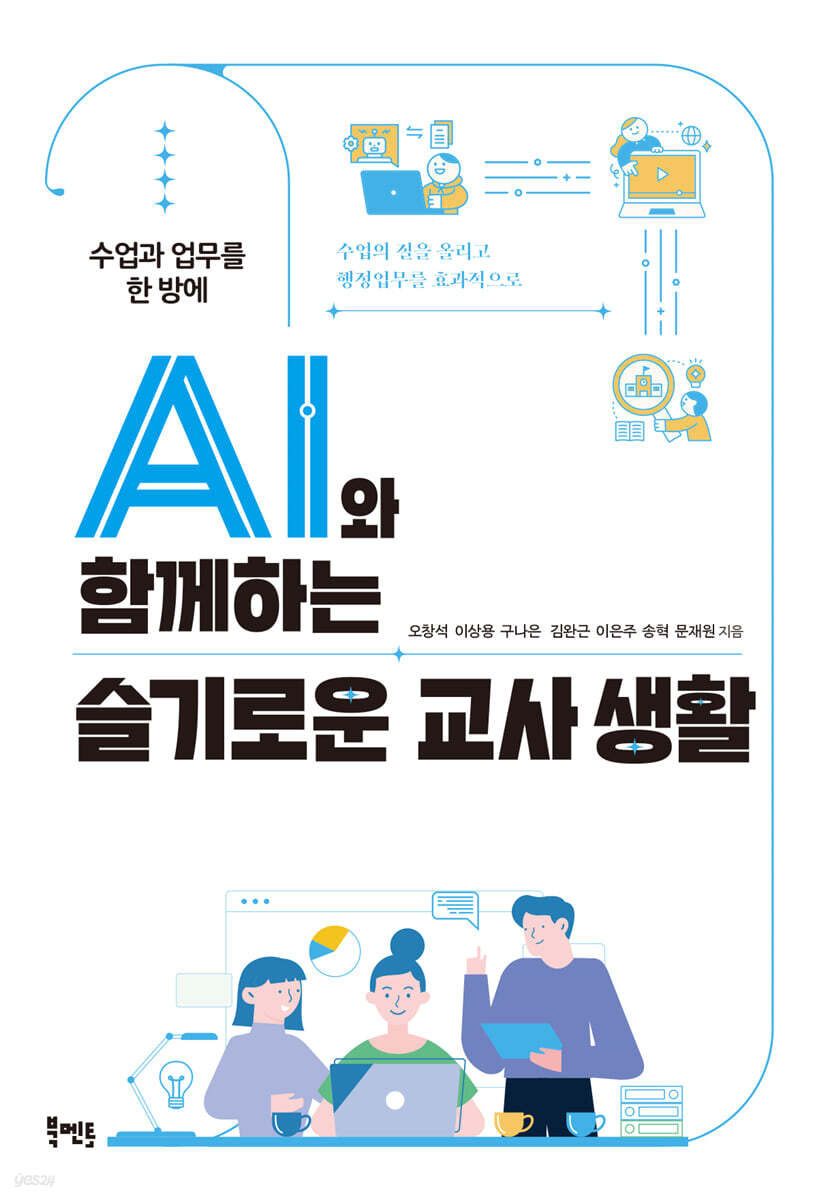
Smart Teacher Life with AI
 |
Description
Book Introduction
The world we will live in in the future will focus on conversations between people and artificial intelligence, rather than just between people.
It is no longer optional for teachers and parents to teach AI to children of the AI generation and provide them with rich experiences.
"A Smart Teacher's Life with AI" contains effective methods for creating teaching materials, picture books, role-play scripts, posters, and videos using ChatGPT, BingChat, Bard, AskUp, Rutton, and Brew, as well as for counseling students, writing student records, and official documents.
Reflecting the latest generative AI education guidelines and applying them to actual educational settings, this book provides an opportunity to deeply consider how AI technology has transformed education and what changes await us in the future.
It is no longer optional for teachers and parents to teach AI to children of the AI generation and provide them with rich experiences.
"A Smart Teacher's Life with AI" contains effective methods for creating teaching materials, picture books, role-play scripts, posters, and videos using ChatGPT, BingChat, Bard, AskUp, Rutton, and Brew, as well as for counseling students, writing student records, and official documents.
Reflecting the latest generative AI education guidelines and applying them to actual educational settings, this book provides an opportunity to deeply consider how AI technology has transformed education and what changes await us in the future.
- You can preview some of the book's contents.
Preview
index
preface
Prologue: Artificial Intelligence and Education
PART 1: Teaching Curriculum with Generative AI in the AI Era
Chapter 1: Korean Language Education Using Generative AI
1. The Encounter of Generative AI and Korean Language Education
2. Creating a Question-and-Answer Chatbot - WRTN
3 Picture Book Creation - Poket
4. Creating Presentation Materials - Bing Chat
5. Create teaching materials that help children understand.
6 Case Studies of Korean Language Classes Using Generative AI
Chapter 2: English Education Using Generative AI
1. Create a role-play script and demonstrate it.
2. Create a video using a role-playing script
3. Create writing practice questions
4. Create a poster promoting K-culture
5. Using Chatbots to Learn English Conversation
Chapter 3: Coding Education Using Generative AI
1. Implementing Coding Ideas Using the "Havruta" Method
2. Generative AI-based training for real-world problems
3 Coding Education for Real-Life Problems Using Generative AI
Chapter 4: Social Education Using Generative AI
1. Direction of application of artificial intelligence
2 Application of generative AI from a social studies perspective
3. Creating Cultural Heritage Posters - Bing Chat
4 Writing a Historical Role-Playing Script - Bard (wrtn)
5. Exploring the Causes of Terrain Creation - Bing Chat
6 Discuss Current Issues - AskUp
Chapter 5: Art Education Using Generative AI
1 How can artificial intelligence transform elementary arts education?
2 Generative AI for use in elementary art education
3. Case Studies of Art Classes Using Generative AI
PART 2: The AI Era: Extracurricular Education with Generative AI
Chapter 6: Character Education Using Generative AI
1. Counseling using generative AI
2. How to Improve Empathy Using Generative AI
3 Practical Ways to Restore Relationships Using Generative AI
Chapter 7: Reducing School Workloads Using Generative AI
1. Prompting Techniques That Can Be Used in Teacher Work
2. Use it for work
3. Practice creating an AI tool for a student record book.
4. Practice Building an AI Chatbot for Sending Text Messages to Parents
Chapter 8: Video Production Using Generative AI
1. The Need for Video Production Using Generative AI
2. Writing a Video Production Script with Generative AI
3. Creating Videos Using Vrew
4. Application Cases and Methods of Video Production Using Generative AI
Appendix: Useful AI Training Programs
annotation
Prologue: Artificial Intelligence and Education
PART 1: Teaching Curriculum with Generative AI in the AI Era
Chapter 1: Korean Language Education Using Generative AI
1. The Encounter of Generative AI and Korean Language Education
2. Creating a Question-and-Answer Chatbot - WRTN
3 Picture Book Creation - Poket
4. Creating Presentation Materials - Bing Chat
5. Create teaching materials that help children understand.
6 Case Studies of Korean Language Classes Using Generative AI
Chapter 2: English Education Using Generative AI
1. Create a role-play script and demonstrate it.
2. Create a video using a role-playing script
3. Create writing practice questions
4. Create a poster promoting K-culture
5. Using Chatbots to Learn English Conversation
Chapter 3: Coding Education Using Generative AI
1. Implementing Coding Ideas Using the "Havruta" Method
2. Generative AI-based training for real-world problems
3 Coding Education for Real-Life Problems Using Generative AI
Chapter 4: Social Education Using Generative AI
1. Direction of application of artificial intelligence
2 Application of generative AI from a social studies perspective
3. Creating Cultural Heritage Posters - Bing Chat
4 Writing a Historical Role-Playing Script - Bard (wrtn)
5. Exploring the Causes of Terrain Creation - Bing Chat
6 Discuss Current Issues - AskUp
Chapter 5: Art Education Using Generative AI
1 How can artificial intelligence transform elementary arts education?
2 Generative AI for use in elementary art education
3. Case Studies of Art Classes Using Generative AI
PART 2: The AI Era: Extracurricular Education with Generative AI
Chapter 6: Character Education Using Generative AI
1. Counseling using generative AI
2. How to Improve Empathy Using Generative AI
3 Practical Ways to Restore Relationships Using Generative AI
Chapter 7: Reducing School Workloads Using Generative AI
1. Prompting Techniques That Can Be Used in Teacher Work
2. Use it for work
3. Practice creating an AI tool for a student record book.
4. Practice Building an AI Chatbot for Sending Text Messages to Parents
Chapter 8: Video Production Using Generative AI
1. The Need for Video Production Using Generative AI
2. Writing a Video Production Script with Generative AI
3. Creating Videos Using Vrew
4. Application Cases and Methods of Video Production Using Generative AI
Appendix: Useful AI Training Programs
annotation
Detailed image

Into the book
Generative AI uses existing content to create new content tailored to user needs.
Artificial intelligence is reaching out to the 'ability to create new things,' an area that was previously believed to be beyond the reach of machines and technology.
ChatGPT and various other text-generating AIs are the most representative examples.
Generative AI already exists that can draw, create videos, and compose music.
There was even an instance where a work created using image-generating AI won first place in an international photography competition.
In this way, generative AI can create works that are superior to those of humans.
---From the "Prologue"
With the advent of generative AI, Korean language education is becoming increasingly important.
Depending on how you create the command (prompt), the results will differ, and you need to provide appropriate words and sentences to produce the results you intended.
When writing, rather than writing down a simple and transcendent command like "create a piece of writing," it is more effective to think about the overall structure of the piece in your head and then write down commands that contain the content of each part of the piece, or to write down commands that can be used as a reference while writing.
Therefore, while I wholeheartedly sympathize with the concerns that generative AI could hinder students' writing skills, I believe that the need for Korean language education will never fade, as the quality of writing ultimately depends on human commands.
---From "Chapter 1: Korean Language Education Using Generative AI"
The following example is one where students wrote their own prompts and posted them on the class homepage assignment board.
You can create a role-play script using expressions learned in class, and you can use them as is if you want to use different expressions with the same meaning.
By using various generative AI to complete role-play scripts and using new expressions along with what was learned in class, students' expressive power is enriched.
---From "English Education Using Generative AI in Chapter 2"
Have students briefly write down their thoughts on marine pollution.
At the same time, based on questions prepared in advance, ask questions in the form of content prompts about areas of interest in marine pollution.
Based on students' questions, we used Bingchat to explain that 'marine pollution is the ocean being polluted.'
I entered the content prompt as 'Can you tell me what impact plastic has on us?'
Bing briefly outlined the severity of marine pollution by mentioning the impact plastic pollution has on our daily lives and the threat it poses to marine life.
Also, I provided the exact source below.
---From "Chapter 3 Coding Education Using Generative AI"
In social science models, generative AI can be used as a search tool to collect objective data.
Objective evidence is needed to verify a hypothesis, but it is difficult for students to select only the necessary facts from a vast amount of data.
It would be very useful if we could easily obtain data by inputting appropriate prompts into the AI.
It is also possible to get help setting up hypotheses outside of the data collection stage.
For example, if we want to investigate the cause of the formation of mountains in our region, we can set up a hypothesis by asking questions such as, "What causes mountains to form?"
For generative AI that performs this role, ‘truthfulness’ is very important.
Because collecting incorrect data can lead to incorrect conclusions.
---From "Chapter 4 Social Education Using Generative AI"
This class aims to create creative works through the fusion of art and music, and in the process, students will experience how generative AI can help them generate ideas.
Using Google Experiment's 'PaintWithMusic', you will learn how to manipulate and combine various artistic elements such as images and musical compositions.
The course aims not simply to teach students how to create artwork, but to foster creativity, problem-solving skills, and convergent thinking by allowing them to experience how generative AI technologies can aid their ideas and artistic expression.
---From "Art Education Using Generative AI" in Chapter 5
The AI chatbot, Sangnyang, listens to the everyday concerns of teenagers like a friend, offering empathy, comfort, support, and ways to address their concerns through conversation and personalized content recommendations.
Additionally, it provides about 20 standardized psychological tests for emotional problems, behavioral problems, and addiction self-diagnosis, allowing adolescents to self-diagnose their own conditions, such as depression and anxiety.
It provides coping strategies for youth crisis situations such as suicide, self-harm, school violence, and sexual violence, and in emergency cases, it guides people to specialized organizations.
---From "Chapter 6: Character Education Using Generative AI"
Teachers are already great prompt engineers.
Because they are experts at giving clear and specific instructions to students.
Let's approach prompt engineering with this mindset.
"If humans can do what they want, what about artificial intelligence?" It's a good idea to approach conversational AI like a ten-year-old third-grade elementary school student.
How can we convey our intentions to this child? We can do so using simple words he or she can understand.
Speak in as short a sentence as possible and explain as clearly and specifically as possible.
Prompt engineering is like this too.
Prompts should be concise and easy to write, and communicate clearly and specifically.
Then, AI can understand our intentions more clearly and produce the desired results.
---From "Chapter 7 Reducing School Work Using Generative AI"
While mastering video production and effectively communicating content is crucial, the utility of generative AI may be questioned.
This is because generative AI is fundamentally a language model, so it can be thought of as being different from video production that utilizes images and sounds.
But if you look at the order and method of video production, you will change your mind.
Video production is divided into three stages.
It is pre-production-production-post-production, and can be simply viewed as planning-filming-editing.
Pre-production is the planning and preparation stage of video production, including creating storyboards, writing scenarios, deciding on filming locations and times, casting actors and staff, and planning the budget.
Literally prepare everything you need for filming and get ready to shoot.
(Omitted) One area where generative AI can be helpful in video production is writing scripts, which are video scenarios and storyboards.
In the future, when creating videos, we will use programs that incorporate artificial intelligence.
Based on this, the final completed video is produced.
Artificial intelligence is reaching out to the 'ability to create new things,' an area that was previously believed to be beyond the reach of machines and technology.
ChatGPT and various other text-generating AIs are the most representative examples.
Generative AI already exists that can draw, create videos, and compose music.
There was even an instance where a work created using image-generating AI won first place in an international photography competition.
In this way, generative AI can create works that are superior to those of humans.
---From the "Prologue"
With the advent of generative AI, Korean language education is becoming increasingly important.
Depending on how you create the command (prompt), the results will differ, and you need to provide appropriate words and sentences to produce the results you intended.
When writing, rather than writing down a simple and transcendent command like "create a piece of writing," it is more effective to think about the overall structure of the piece in your head and then write down commands that contain the content of each part of the piece, or to write down commands that can be used as a reference while writing.
Therefore, while I wholeheartedly sympathize with the concerns that generative AI could hinder students' writing skills, I believe that the need for Korean language education will never fade, as the quality of writing ultimately depends on human commands.
---From "Chapter 1: Korean Language Education Using Generative AI"
The following example is one where students wrote their own prompts and posted them on the class homepage assignment board.
You can create a role-play script using expressions learned in class, and you can use them as is if you want to use different expressions with the same meaning.
By using various generative AI to complete role-play scripts and using new expressions along with what was learned in class, students' expressive power is enriched.
---From "English Education Using Generative AI in Chapter 2"
Have students briefly write down their thoughts on marine pollution.
At the same time, based on questions prepared in advance, ask questions in the form of content prompts about areas of interest in marine pollution.
Based on students' questions, we used Bingchat to explain that 'marine pollution is the ocean being polluted.'
I entered the content prompt as 'Can you tell me what impact plastic has on us?'
Bing briefly outlined the severity of marine pollution by mentioning the impact plastic pollution has on our daily lives and the threat it poses to marine life.
Also, I provided the exact source below.
---From "Chapter 3 Coding Education Using Generative AI"
In social science models, generative AI can be used as a search tool to collect objective data.
Objective evidence is needed to verify a hypothesis, but it is difficult for students to select only the necessary facts from a vast amount of data.
It would be very useful if we could easily obtain data by inputting appropriate prompts into the AI.
It is also possible to get help setting up hypotheses outside of the data collection stage.
For example, if we want to investigate the cause of the formation of mountains in our region, we can set up a hypothesis by asking questions such as, "What causes mountains to form?"
For generative AI that performs this role, ‘truthfulness’ is very important.
Because collecting incorrect data can lead to incorrect conclusions.
---From "Chapter 4 Social Education Using Generative AI"
This class aims to create creative works through the fusion of art and music, and in the process, students will experience how generative AI can help them generate ideas.
Using Google Experiment's 'PaintWithMusic', you will learn how to manipulate and combine various artistic elements such as images and musical compositions.
The course aims not simply to teach students how to create artwork, but to foster creativity, problem-solving skills, and convergent thinking by allowing them to experience how generative AI technologies can aid their ideas and artistic expression.
---From "Art Education Using Generative AI" in Chapter 5
The AI chatbot, Sangnyang, listens to the everyday concerns of teenagers like a friend, offering empathy, comfort, support, and ways to address their concerns through conversation and personalized content recommendations.
Additionally, it provides about 20 standardized psychological tests for emotional problems, behavioral problems, and addiction self-diagnosis, allowing adolescents to self-diagnose their own conditions, such as depression and anxiety.
It provides coping strategies for youth crisis situations such as suicide, self-harm, school violence, and sexual violence, and in emergency cases, it guides people to specialized organizations.
---From "Chapter 6: Character Education Using Generative AI"
Teachers are already great prompt engineers.
Because they are experts at giving clear and specific instructions to students.
Let's approach prompt engineering with this mindset.
"If humans can do what they want, what about artificial intelligence?" It's a good idea to approach conversational AI like a ten-year-old third-grade elementary school student.
How can we convey our intentions to this child? We can do so using simple words he or she can understand.
Speak in as short a sentence as possible and explain as clearly and specifically as possible.
Prompt engineering is like this too.
Prompts should be concise and easy to write, and communicate clearly and specifically.
Then, AI can understand our intentions more clearly and produce the desired results.
---From "Chapter 7 Reducing School Work Using Generative AI"
While mastering video production and effectively communicating content is crucial, the utility of generative AI may be questioned.
This is because generative AI is fundamentally a language model, so it can be thought of as being different from video production that utilizes images and sounds.
But if you look at the order and method of video production, you will change your mind.
Video production is divided into three stages.
It is pre-production-production-post-production, and can be simply viewed as planning-filming-editing.
Pre-production is the planning and preparation stage of video production, including creating storyboards, writing scenarios, deciding on filming locations and times, casting actors and staff, and planning the budget.
Literally prepare everything you need for filming and get ready to shoot.
(Omitted) One area where generative AI can be helpful in video production is writing scripts, which are video scenarios and storyboards.
In the future, when creating videos, we will use programs that incorporate artificial intelligence.
Based on this, the final completed video is produced.
---From "Chapter 8: Video Production Using Generative AI"
Publisher's Review
What future classes should students learn in the age of artificial intelligence?
AI education is bridging the academic gap and fostering children's dreams of reaching out to the world.
The COVID-19 pandemic that has rocked the world over the past few years has brought about profound changes to our daily lives, and the educational field has been no exception.
Students, parents, and teachers have been adapting to new educational methods amidst unprecedented circumstances, including remote classes and online education using digital devices.
The pandemic ended in May 2023, but in the meantime, the educational landscape has changed dramatically in both content and format.
The education community has seriously recognized the social changes that artificial intelligence (AI) will bring, and the '2022 Revised Curriculum' reflects this well.
Education utilizing artificial intelligence has spread across all subject areas, including Korean, English, social studies, music, art, ethics, and practical arts, and 'generative AI' is at the center of this.
Generative AI, which was an unfamiliar concept until recently, has been appearing one after another since the release of ChatGPT by OpenAI in March 2023, which created a sensation.
Although generative AI has some problems, it is absolutely necessary to learn about and teach AI in schools.
"A Smart Teacher's Life with AI" is a book that contains essential teaching and learning methods for students living in the age of artificial intelligence, providing useful guidance to students, parents, and teachers alike.
Strengthening classroom and work capabilities: Finding answers in generative AI!
This book details how to use generative AI in subjects such as Korean, English, social studies, music, art, ethics, and practical arts, as well as in character education, reducing school workload, and video production.
The following various examples demonstrate how this approach can provide students with new knowledge and enriching experiences while effectively reducing administrative workload.
· Create learning materials such as lesson plans, practice problems, PPTs, and videos using ChatGPT.
· Create student records, meeting minutes, budget reports, and parent texts using Luton.
· Create presentation materials by selecting a topic, organizing a table of contents, and selecting content through Bingchat.
· Create a picture book by writing a story with proverbs and drawing illustrations that match the content.
· Practice speaking English with AI chatbot Alice using Chat D-ID.
· Write a historical role-playing script with dialogue, character descriptions, and scene descriptions for Bard.
· Discuss current issues on society, economy, environment, etc. through AskUp.
· Draw creatively and imaginatively with Dali 2.
· Create works of art that fuse art and music with Paint with Music.
· Create short-form content videos with Brew.
This book also includes over 30 AI tools that can be helpful in class and work, along with QR codes, so you can conveniently check the latest information.
A book that will help you nurture the AI generation into future convergence talents!
Now humanity faces a new challenge: generative AI.
Faced with such a massive shift in the times, we must not fear or reject this technology, but rather discover the potential it holds.
This book explores how to integrate generative AI tools into your curriculum and how to ensure students can use them safely.
This book, which presents various directions for establishing AI-based technology education among students, will serve as a useful guide for nurturing the children of the AI generation into convergent talents for future society.
AI education is bridging the academic gap and fostering children's dreams of reaching out to the world.
The COVID-19 pandemic that has rocked the world over the past few years has brought about profound changes to our daily lives, and the educational field has been no exception.
Students, parents, and teachers have been adapting to new educational methods amidst unprecedented circumstances, including remote classes and online education using digital devices.
The pandemic ended in May 2023, but in the meantime, the educational landscape has changed dramatically in both content and format.
The education community has seriously recognized the social changes that artificial intelligence (AI) will bring, and the '2022 Revised Curriculum' reflects this well.
Education utilizing artificial intelligence has spread across all subject areas, including Korean, English, social studies, music, art, ethics, and practical arts, and 'generative AI' is at the center of this.
Generative AI, which was an unfamiliar concept until recently, has been appearing one after another since the release of ChatGPT by OpenAI in March 2023, which created a sensation.
Although generative AI has some problems, it is absolutely necessary to learn about and teach AI in schools.
"A Smart Teacher's Life with AI" is a book that contains essential teaching and learning methods for students living in the age of artificial intelligence, providing useful guidance to students, parents, and teachers alike.
Strengthening classroom and work capabilities: Finding answers in generative AI!
This book details how to use generative AI in subjects such as Korean, English, social studies, music, art, ethics, and practical arts, as well as in character education, reducing school workload, and video production.
The following various examples demonstrate how this approach can provide students with new knowledge and enriching experiences while effectively reducing administrative workload.
· Create learning materials such as lesson plans, practice problems, PPTs, and videos using ChatGPT.
· Create student records, meeting minutes, budget reports, and parent texts using Luton.
· Create presentation materials by selecting a topic, organizing a table of contents, and selecting content through Bingchat.
· Create a picture book by writing a story with proverbs and drawing illustrations that match the content.
· Practice speaking English with AI chatbot Alice using Chat D-ID.
· Write a historical role-playing script with dialogue, character descriptions, and scene descriptions for Bard.
· Discuss current issues on society, economy, environment, etc. through AskUp.
· Draw creatively and imaginatively with Dali 2.
· Create works of art that fuse art and music with Paint with Music.
· Create short-form content videos with Brew.
This book also includes over 30 AI tools that can be helpful in class and work, along with QR codes, so you can conveniently check the latest information.
A book that will help you nurture the AI generation into future convergence talents!
Now humanity faces a new challenge: generative AI.
Faced with such a massive shift in the times, we must not fear or reject this technology, but rather discover the potential it holds.
This book explores how to integrate generative AI tools into your curriculum and how to ensure students can use them safely.
This book, which presents various directions for establishing AI-based technology education among students, will serve as a useful guide for nurturing the children of the AI generation into convergent talents for future society.
GOODS SPECIFICS
- Date of issue: February 26, 2024
- Page count, weight, size: 292 pages | 450g | 152*225*20mm
- ISBN13: 9788963195704
- ISBN10: 8963195708
You may also like
카테고리
korean


korean

![GQ KOREA Mark (Monthly): December [2025]](http://librairie.coreenne.fr/cdn/shop/files/8ef265dbbfbf186523ed75ba7319009d.jpg?v=1765340328&width=3840)


