

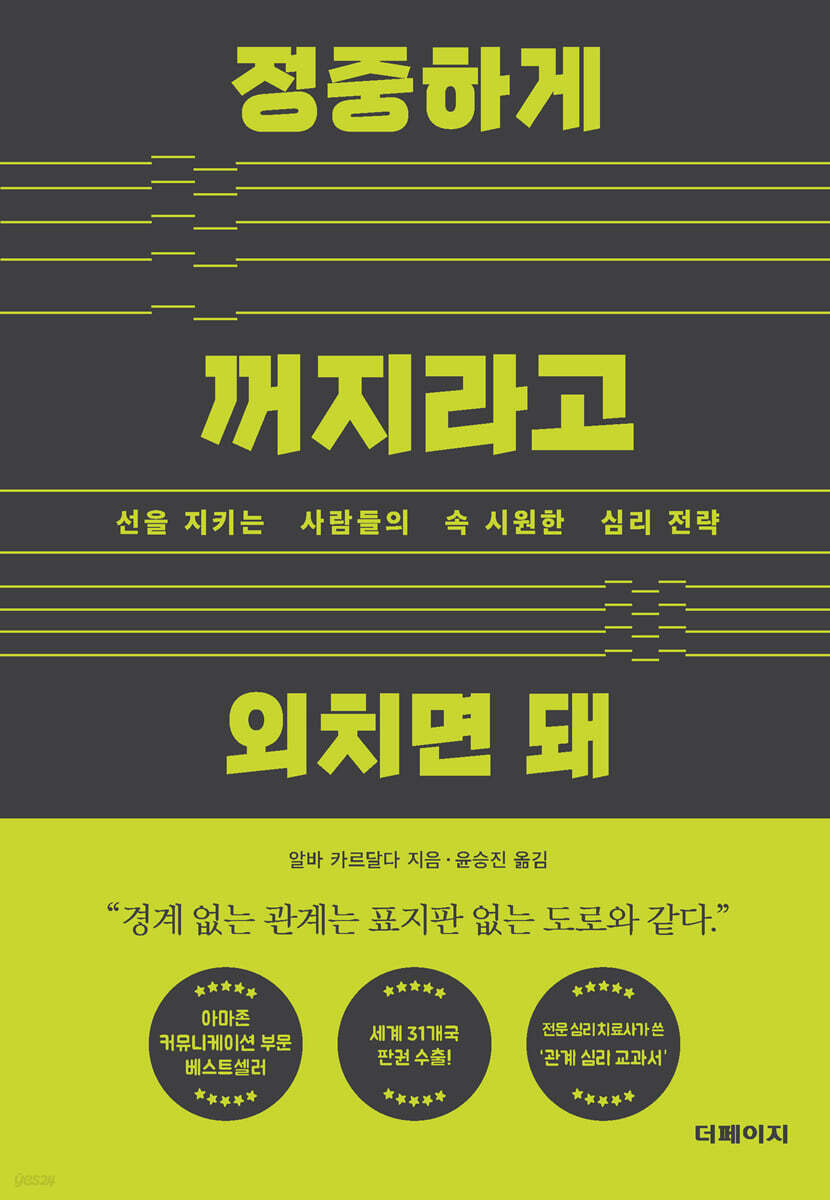
Just politely tell them to get out
 |
Description
Book Introduction
Protecting me without getting hurt
How to Respond Gracefully to Someone Who Crosses the Line
Just as roads need lanes, relationships need boundaries.
★★★Amazon Communications Bestseller & Steady Seller
★★★Exported to 31 countries worldwide
Have you ever wanted to say no, but ended up saying, “It’s okay.”
Have you ever felt exhausted because you couldn't refuse someone's request, or have you ever been so concerned about other people's feelings that your own feelings always took a backseat?
If so, this book is a must-read for you.
How to say 'no' firmly and gracefully, without guilt.
Now is the time to set healthy relationship boundaries.
Author Alba Kardalda, a psychotherapy and neuropsychology expert, sharply dissects the relationship fatigue of modern people, pointing out that guilt and the psychological mechanisms that make people feel swayed by others are at work behind it.
The author argues that dismantling this mechanism and regaining control of relationships is the most urgent task for a healthy life.
To this end, we present specific solutions for setting healthy boundaries based on psychology and neuroscience.
The author defines the act of drawing boundaries as not being selfish, but rather as “an expression of love for others.”
This new perspective dispels the guilt we feel in relationships and awakens us to the meaning of "polite but firm distancing."
What should I do with people who make me uncomfortable, hurt me, and criticize me? The author provides detailed guidance on how to respond respectfully, yet not too politely.
We introduce practical cognitive-behavioral strategies step by step, such as the "fog cloud technique" for responding to emotional criticism without being swayed, and the "sticking record technique" for reducing unnecessary excuses and rejecting people gracefully.
All of these techniques are aimed at developing strong assertiveness that allows you to defend yourself without violating the rights of others.
The result is clear.
As the author says, “Saying ‘no’ is very difficult and takes a long time at first, but with repetition, you eventually reach a point where you can do it without thinking.” You will regain control of your relationships, feel more respected and loved, and most of all, gain the freedom to live as your true self.
It has been said that a good life is built on good relationships.
It's time to end a life swayed by the desires of others and, through this book, establish a new formula for relationships that preserves self-esteem.
How to Respond Gracefully to Someone Who Crosses the Line
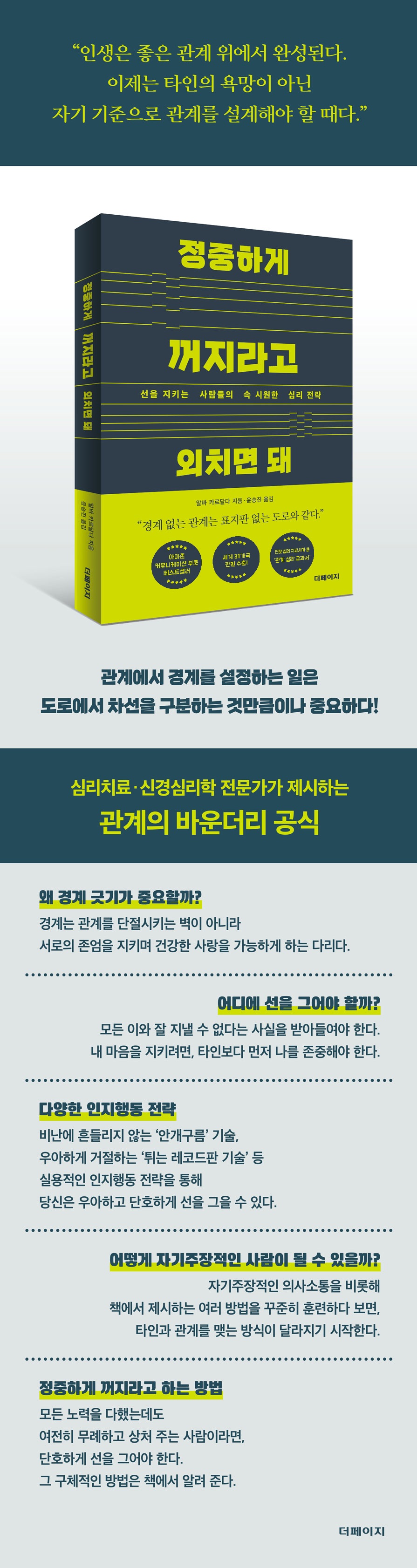
Just as roads need lanes, relationships need boundaries.
★★★Amazon Communications Bestseller & Steady Seller
★★★Exported to 31 countries worldwide
Have you ever wanted to say no, but ended up saying, “It’s okay.”
Have you ever felt exhausted because you couldn't refuse someone's request, or have you ever been so concerned about other people's feelings that your own feelings always took a backseat?
If so, this book is a must-read for you.
How to say 'no' firmly and gracefully, without guilt.
Now is the time to set healthy relationship boundaries.
Author Alba Kardalda, a psychotherapy and neuropsychology expert, sharply dissects the relationship fatigue of modern people, pointing out that guilt and the psychological mechanisms that make people feel swayed by others are at work behind it.
The author argues that dismantling this mechanism and regaining control of relationships is the most urgent task for a healthy life.
To this end, we present specific solutions for setting healthy boundaries based on psychology and neuroscience.
The author defines the act of drawing boundaries as not being selfish, but rather as “an expression of love for others.”
This new perspective dispels the guilt we feel in relationships and awakens us to the meaning of "polite but firm distancing."
What should I do with people who make me uncomfortable, hurt me, and criticize me? The author provides detailed guidance on how to respond respectfully, yet not too politely.
We introduce practical cognitive-behavioral strategies step by step, such as the "fog cloud technique" for responding to emotional criticism without being swayed, and the "sticking record technique" for reducing unnecessary excuses and rejecting people gracefully.
All of these techniques are aimed at developing strong assertiveness that allows you to defend yourself without violating the rights of others.
The result is clear.
As the author says, “Saying ‘no’ is very difficult and takes a long time at first, but with repetition, you eventually reach a point where you can do it without thinking.” You will regain control of your relationships, feel more respected and loved, and most of all, gain the freedom to live as your true self.
It has been said that a good life is built on good relationships.
It's time to end a life swayed by the desires of others and, through this book, establish a new formula for relationships that preserves self-esteem.
- You can preview some of the book's contents.
Preview
index
1.
What is a boundary and what is not a boundary?
What is a boundary?
What is not a boundary?
2.
Relationships, Love and Happiness
Groundbreaking research
Masterpiece
3.
quality relationships
Quality goods vs. quality relationships
advertising industry
What is a quality relationship?
4.
Culture, beliefs, and parenting attitudes
World model
culture
faith
Parenting attitude
5.
Breaking the myth
Real-life examples
Treatment process
self-actualization
6.
What about the guilt?
Guilt, a mechanism that triggers manipulation
mind and reason
Frustration, our friend
7.
Depending on the degree, it can be medicine or poison.
vigilance
Too naive psychology
cognitive bias
8.
Where the boundary will be placed
Negotiable and non-negotiable boundaries
Non-negotiable boundaries
Negotiable boundaries
Loss is gain
9.
Assertiveness and communication style
What is assertiveness?
How can I become an assertive person?
communication style
The basis of assertiveness
10.
Cognitive-behavioral strategies for effective communication
Assertiveness learned through action
Three Golden Rules for Effective Communication
Proportional and Consistent Results
If the favor is repeated
'As if' strategy
Mind Mapping Strategy
Analyzing other people's intentions
11.
Effective communication strategies for setting boundaries and negotiating
More than assertiveness
nonverbal communication
Active listening
Radio strategy
Rephrase
lie detector
Using the passive voice
12.
Strategies for Saying “No”
The freedom not to say “yes”
Say “no” without further explanation
Thank you + refusal (+ apology) + polite expression
Thank you + refusal + alternative suggestion
Extension request
Bouncing record technology
13.
Assertive Strategies for Responding to Criticism
How to not be swayed by criticism
Basic assertiveness
Negative question
Fog Cloud Technology
sandwich technology
Responding to ridicule and criticism disguised as humor
14.
How to Set Boundaries Against Psychological Manipulators
“Look what you did to me.”
Minimize self-disclosure
body language
Using imperative
Proving the other person's actions
Be silent
Respond with another question
Thanks, but I won't answer.
Dealing with Moralists and Authoritarians
How to respond to someone who speaks without knowing much about them
Dealing with gossip
Responding to Blamers
15.
How to politely tell someone to get out
Like water and oil
“Get out! Get out!”
How to tell someone to get out very politely
Guilt-inducing manipulation
The words of a man who tries to justify a lie
Gaslighting-style insults
Manipulative words containing emotional blackmail
Unsolicited opinions
What is a boundary and what is not a boundary?
What is a boundary?
What is not a boundary?
2.
Relationships, Love and Happiness
Groundbreaking research
Masterpiece
3.
quality relationships
Quality goods vs. quality relationships
advertising industry
What is a quality relationship?
4.
Culture, beliefs, and parenting attitudes
World model
culture
faith
Parenting attitude
5.
Breaking the myth
Real-life examples
Treatment process
self-actualization
6.
What about the guilt?
Guilt, a mechanism that triggers manipulation
mind and reason
Frustration, our friend
7.
Depending on the degree, it can be medicine or poison.
vigilance
Too naive psychology
cognitive bias
8.
Where the boundary will be placed
Negotiable and non-negotiable boundaries
Non-negotiable boundaries
Negotiable boundaries
Loss is gain
9.
Assertiveness and communication style
What is assertiveness?
How can I become an assertive person?
communication style
The basis of assertiveness
10.
Cognitive-behavioral strategies for effective communication
Assertiveness learned through action
Three Golden Rules for Effective Communication
Proportional and Consistent Results
If the favor is repeated
'As if' strategy
Mind Mapping Strategy
Analyzing other people's intentions
11.
Effective communication strategies for setting boundaries and negotiating
More than assertiveness
nonverbal communication
Active listening
Radio strategy
Rephrase
lie detector
Using the passive voice
12.
Strategies for Saying “No”
The freedom not to say “yes”
Say “no” without further explanation
Thank you + refusal (+ apology) + polite expression
Thank you + refusal + alternative suggestion
Extension request
Bouncing record technology
13.
Assertive Strategies for Responding to Criticism
How to not be swayed by criticism
Basic assertiveness
Negative question
Fog Cloud Technology
sandwich technology
Responding to ridicule and criticism disguised as humor
14.
How to Set Boundaries Against Psychological Manipulators
“Look what you did to me.”
Minimize self-disclosure
body language
Using imperative
Proving the other person's actions
Be silent
Respond with another question
Thanks, but I won't answer.
Dealing with Moralists and Authoritarians
How to respond to someone who speaks without knowing much about them
Dealing with gossip
Responding to Blamers
15.
How to politely tell someone to get out
Like water and oil
“Get out! Get out!”
How to tell someone to get out very politely
Guilt-inducing manipulation
The words of a man who tries to justify a lie
Gaslighting-style insults
Manipulative words containing emotional blackmail
Unsolicited opinions
Detailed image
Into the book
Everyone has the right to set boundaries.
But there is something you need to know.
When setting boundaries, you need to consider the feelings of others and yourself.
The right words and the right moment are also important.
Only when all of these are met can we build healthy relationships not only with others but also with ourselves.
--- p.19
If children lack self-respect as children, they will feel that they do not have such rights as adults and will be unable to protect their rights.
When children are denied their right to self-respect, they become easily manipulated and vulnerable to abuse.
--- p.32
People in their 50s who maintained healthy, high-quality relationships maintained better health into their 80s than those who did not, and older adults who maintained stable relationships experienced less cognitive and physical decline and better long-term memory than those who did not.
And that's not all.
It was also concluded that fulfilling relationships have a positive effect on stress management and sleep quality, making them a very important factor in preventing various serious diseases.
--- p.41
To realize that saying "yes" doesn't make you a good person, and saying "no" doesn't make you a selfish person, you have to shatter some of the beliefs you've taken for granted.
--- p.70
We must shatter our absurd beliefs and realize that true love is not like that.
Healthy love is never unconditional.
Love also requires boundaries, and only through rewards and empathy can it be real, safe, and lasting.
--- p.77
Changing the way you express yourself can have a psychological domino effect.
That is, a series of increasingly profound and complex changes occur in the dynamics of relationships, self-concept, thoughts, and even emotions.
--- p.137
You learn to take the other person's actions and words not personally, but as a result of how they see and interpret the world, and you learn to adjust your response based on whether the other person's intentions are positive or negative.
--- p.170
Mentally flexible people are able to navigate the unpredictable challenges life presents without being overwhelmed by them or affected by the minor problems that arise in everyday life.
One of the best ways to become this type of person is to actively listen to what the person you are talking to says, without judgment, especially if the person has an opposing viewpoint.
--- p.181
The judgments someone makes are not simply determined by their thoughts.
That judgment is the result of a complex intertwining of many factors, including the person's past experiences and history, current goals, beliefs and values, level of education, and mood of the day.
--- p.219
Some people are like water, and some are like oil.
Neither side is at fault.
They just don't fit together.
But when problems arise, we always make the mistake of trying to find someone to blame.
--- p.257
It is only natural that no one should be allowed to violate your rights, disrespect you, limit your freedom, or manipulate you.
So to speak, reflecting on your own position means committing to yourself that you will do what is absolutely necessary to protect your feelings.
But there is something you need to know.
When setting boundaries, you need to consider the feelings of others and yourself.
The right words and the right moment are also important.
Only when all of these are met can we build healthy relationships not only with others but also with ourselves.
--- p.19
If children lack self-respect as children, they will feel that they do not have such rights as adults and will be unable to protect their rights.
When children are denied their right to self-respect, they become easily manipulated and vulnerable to abuse.
--- p.32
People in their 50s who maintained healthy, high-quality relationships maintained better health into their 80s than those who did not, and older adults who maintained stable relationships experienced less cognitive and physical decline and better long-term memory than those who did not.
And that's not all.
It was also concluded that fulfilling relationships have a positive effect on stress management and sleep quality, making them a very important factor in preventing various serious diseases.
--- p.41
To realize that saying "yes" doesn't make you a good person, and saying "no" doesn't make you a selfish person, you have to shatter some of the beliefs you've taken for granted.
--- p.70
We must shatter our absurd beliefs and realize that true love is not like that.
Healthy love is never unconditional.
Love also requires boundaries, and only through rewards and empathy can it be real, safe, and lasting.
--- p.77
Changing the way you express yourself can have a psychological domino effect.
That is, a series of increasingly profound and complex changes occur in the dynamics of relationships, self-concept, thoughts, and even emotions.
--- p.137
You learn to take the other person's actions and words not personally, but as a result of how they see and interpret the world, and you learn to adjust your response based on whether the other person's intentions are positive or negative.
--- p.170
Mentally flexible people are able to navigate the unpredictable challenges life presents without being overwhelmed by them or affected by the minor problems that arise in everyday life.
One of the best ways to become this type of person is to actively listen to what the person you are talking to says, without judgment, especially if the person has an opposing viewpoint.
--- p.181
The judgments someone makes are not simply determined by their thoughts.
That judgment is the result of a complex intertwining of many factors, including the person's past experiences and history, current goals, beliefs and values, level of education, and mood of the day.
--- p.219
Some people are like water, and some are like oil.
Neither side is at fault.
They just don't fit together.
But when problems arise, we always make the mistake of trying to find someone to blame.
--- p.257
It is only natural that no one should be allowed to violate your rights, disrespect you, limit your freedom, or manipulate you.
So to speak, reflecting on your own position means committing to yourself that you will do what is absolutely necessary to protect your feelings.
--- p.261
Publisher's Review
“Are you just a pushover for everyone?”
When I say 'NO', a relationship that protects me begins!
Research has shown that the most important factor in determining the happiness and health of our lives is not our socioeconomic status, but the quality of our relationships with those closest to us.
So why, then, do we remain so oblivious to the importance and methods of setting boundaries in quality relationships, even though we know we're sabotaging these crucial relationships?
"Just ask them to get out politely" starts from this question and explores the psychology of "boundary setting" to secure a safe distance in relationships.
The author clearly defines boundaries not as sanctions against others or an expression of selfishness, but rather as an "act of love" that creates healthy and sustainable relationships.
However, due to the influence of the culture, beliefs, and parenting styles that formed during our upbringing, we have internalized the false belief that 'other people's feelings are more important than our own.'
This belief ultimately makes us vulnerable to manipulation or emotional abuse from others, and it poisons our relationships by fostering the guilt that comes with saying "no."
The author points out that this guilt is a powerful psychological mechanism through which others control us.
To break free from that cycle, he says, you need to accept frustration as an inevitable process and, above all, recover an attitude that respects your own needs and feelings.
The author, an expert in psychotherapy and neuropsychology, analyzes the psychology of "good people" who fall apart in relationships and provides specific guidance on how to be assertive without hurting others, using real-life conversation examples.
To those who treat you rudely, hurt you, and make your relationship tiring.
Practical cognitive-behavioral strategies you can apply immediately
A road without signs is like a relationship without boundaries.
I don't know what's acceptable and what's not, what to expect from others, and what others expect from me.
Since there are no standards, it is impossible to know whether people are respecting each other's distance.
We all know that setting boundaries in relationships is important, but why is it so difficult? Are we afraid of losing our jobs? Are we afraid of interfering with romantic love? Are we afraid that saying "no" will make us unlovable? For all these reasons, we hesitate to set boundaries.
Even if you decide to give it a try, you end up feeling some inexplicable guilt, fear, or anxiety.
Of course, setting boundaries can be either a blessing or a curse, depending on the degree to which it is used.
We must avoid extreme marginalization that cuts off all relationships, and instead preserve the relationships that are meaningful in our lives.
To this end, the author offers a practical framework that distinguishes between negotiable and non-negotiable boundaries, and argues that sometimes constructive compromises—where "loss becomes gain"—are necessary to maintain relationships.
And as a key tool for communicating these boundaries in a healthy way, we guide you in developing assertiveness that simultaneously respects your own rights and those of others.
The heart of this book is specific cognitive-behavioral strategies for communicating effectively about boundaries.
The author emphasizes the power of nonverbal expressions, which are more powerful than words, and suggests conversational techniques that avoid emotional conflict and understand the other person's position.
It explains specifically how to successfully lead a conversation using practical methods such as mind mapping strategies.
It also teaches you how to say "no" without getting emotional, such as saying no firmly without further explanation or saying no gracefully with an alternative.
Finally, it offers tips on how to firmly draw the line against critics or psychological manipulators who constantly test your boundaries.
Through techniques such as the 'Silence Technique', which conveys firm authority without revealing emotions, the 'Fog Cloud Technique', which neutralizes the opponent's attacks, and the 'Bounce Record Technique', which avoids unnecessary arguments and maintains firmness, you establish the last line of defense in various relationships.
And when all these efforts fail, the author says to end the relationship firmly by 'telling them to get out very politely, but not too politely.'
Because that is the way to achieve true freedom by not being swayed by the expectations of others, and by controlling your own emotions and situations.
The book resonated with readers throughout Spain and Latin America, selling hundreds of thousands of copies.
Major media outlets have hailed this book as “the most practical self-defense manual,” and its influence has spread worldwide, earning it a high degree of trust as it has been translated and published in over a dozen countries.
When I say 'NO', a relationship that protects me begins!
Research has shown that the most important factor in determining the happiness and health of our lives is not our socioeconomic status, but the quality of our relationships with those closest to us.
So why, then, do we remain so oblivious to the importance and methods of setting boundaries in quality relationships, even though we know we're sabotaging these crucial relationships?
"Just ask them to get out politely" starts from this question and explores the psychology of "boundary setting" to secure a safe distance in relationships.
The author clearly defines boundaries not as sanctions against others or an expression of selfishness, but rather as an "act of love" that creates healthy and sustainable relationships.
However, due to the influence of the culture, beliefs, and parenting styles that formed during our upbringing, we have internalized the false belief that 'other people's feelings are more important than our own.'
This belief ultimately makes us vulnerable to manipulation or emotional abuse from others, and it poisons our relationships by fostering the guilt that comes with saying "no."
The author points out that this guilt is a powerful psychological mechanism through which others control us.
To break free from that cycle, he says, you need to accept frustration as an inevitable process and, above all, recover an attitude that respects your own needs and feelings.
The author, an expert in psychotherapy and neuropsychology, analyzes the psychology of "good people" who fall apart in relationships and provides specific guidance on how to be assertive without hurting others, using real-life conversation examples.
To those who treat you rudely, hurt you, and make your relationship tiring.
Practical cognitive-behavioral strategies you can apply immediately
A road without signs is like a relationship without boundaries.
I don't know what's acceptable and what's not, what to expect from others, and what others expect from me.
Since there are no standards, it is impossible to know whether people are respecting each other's distance.
We all know that setting boundaries in relationships is important, but why is it so difficult? Are we afraid of losing our jobs? Are we afraid of interfering with romantic love? Are we afraid that saying "no" will make us unlovable? For all these reasons, we hesitate to set boundaries.
Even if you decide to give it a try, you end up feeling some inexplicable guilt, fear, or anxiety.
Of course, setting boundaries can be either a blessing or a curse, depending on the degree to which it is used.
We must avoid extreme marginalization that cuts off all relationships, and instead preserve the relationships that are meaningful in our lives.
To this end, the author offers a practical framework that distinguishes between negotiable and non-negotiable boundaries, and argues that sometimes constructive compromises—where "loss becomes gain"—are necessary to maintain relationships.
And as a key tool for communicating these boundaries in a healthy way, we guide you in developing assertiveness that simultaneously respects your own rights and those of others.
The heart of this book is specific cognitive-behavioral strategies for communicating effectively about boundaries.
The author emphasizes the power of nonverbal expressions, which are more powerful than words, and suggests conversational techniques that avoid emotional conflict and understand the other person's position.
It explains specifically how to successfully lead a conversation using practical methods such as mind mapping strategies.
It also teaches you how to say "no" without getting emotional, such as saying no firmly without further explanation or saying no gracefully with an alternative.
Finally, it offers tips on how to firmly draw the line against critics or psychological manipulators who constantly test your boundaries.
Through techniques such as the 'Silence Technique', which conveys firm authority without revealing emotions, the 'Fog Cloud Technique', which neutralizes the opponent's attacks, and the 'Bounce Record Technique', which avoids unnecessary arguments and maintains firmness, you establish the last line of defense in various relationships.
And when all these efforts fail, the author says to end the relationship firmly by 'telling them to get out very politely, but not too politely.'
Because that is the way to achieve true freedom by not being swayed by the expectations of others, and by controlling your own emotions and situations.
The book resonated with readers throughout Spain and Latin America, selling hundreds of thousands of copies.
Major media outlets have hailed this book as “the most practical self-defense manual,” and its influence has spread worldwide, earning it a high degree of trust as it has been translated and published in over a dozen countries.
GOODS SPECIFICS
- Date of issue: December 10, 2025
- Page count, weight, size: 280 pages | 147*212*20mm
- ISBN13: 9791194156321
- ISBN10: 1194156320
You may also like
카테고리
korean


korean

![GQ KOREA Mark (Monthly): December [2025]](http://librairie.coreenne.fr/cdn/shop/files/8ef265dbbfbf186523ed75ba7319009d.jpg?v=1765340328&width=3840)


