

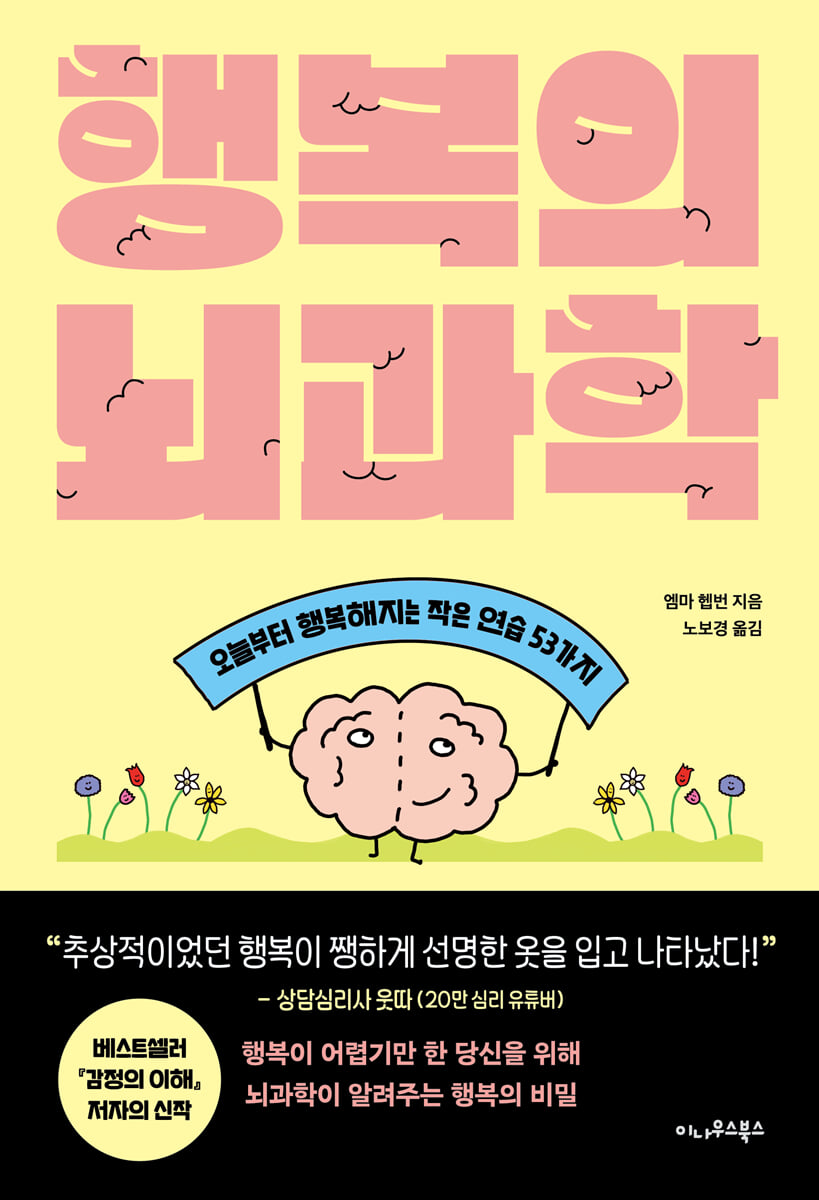
The Brain Science of Happiness
 |
Description
Book Introduction
*A new book from the best-selling author of "Understanding Emotions"
* Includes illustrations that have garnered 150,000 followers
*Highly recommended by 200,000 psychology YouTuber Utta!
Happiness, which had felt abstract and difficult, appeared before us in bright and vivid clothes.
In fact, it was there from the beginning, but I feel like I was deceived and didn't realize it because of the numerous lies.
This book will help you stop looking for happiness far away and start being happy today.
It will be the starting point for reclaiming the happiness that already exists within me, rather than seeking it from outside.
- Utta (counseling psychologist, YouTuber with 200,000 subscribers)
For those who feel happiness is far away
The Easy and Clear Art of Happiness Revealed by Brain Science
A new book by Emma Hepburn, author of the best-selling book "Understanding Emotions," has been translated and published.
The author, who dealt with techniques for dealing with 'emotions' in his previous work, focuses on 'happiness' this time.
The author says that we cannot achieve true happiness if we misunderstand what happiness is, and changes the framework of our perception of happiness itself.
The brain doesn't exist to please us.
Starting from this simple truth, Hepburn explains, from a neuroscientific perspective, why happiness is difficult to feel and sustain.
The way our brains work—sensitive to threats, prone to harboring negative emotions, and prone to addiction to rewards—is the main reason we struggle to find happiness. "The Brain Science of Happiness" is a book filled with accessible brain science knowledge and practical psychological prescriptions.
If you practice the "happiness practice" suggested in this book one by one, you will be able to transform into a person who "easily feels happiness" in everyday moments without breaking down in the face of hardship.
* Includes illustrations that have garnered 150,000 followers
*Highly recommended by 200,000 psychology YouTuber Utta!
Happiness, which had felt abstract and difficult, appeared before us in bright and vivid clothes.
In fact, it was there from the beginning, but I feel like I was deceived and didn't realize it because of the numerous lies.
This book will help you stop looking for happiness far away and start being happy today.
It will be the starting point for reclaiming the happiness that already exists within me, rather than seeking it from outside.
- Utta (counseling psychologist, YouTuber with 200,000 subscribers)
For those who feel happiness is far away
The Easy and Clear Art of Happiness Revealed by Brain Science
A new book by Emma Hepburn, author of the best-selling book "Understanding Emotions," has been translated and published.
The author, who dealt with techniques for dealing with 'emotions' in his previous work, focuses on 'happiness' this time.
The author says that we cannot achieve true happiness if we misunderstand what happiness is, and changes the framework of our perception of happiness itself.
The brain doesn't exist to please us.
Starting from this simple truth, Hepburn explains, from a neuroscientific perspective, why happiness is difficult to feel and sustain.
The way our brains work—sensitive to threats, prone to harboring negative emotions, and prone to addiction to rewards—is the main reason we struggle to find happiness. "The Brain Science of Happiness" is a book filled with accessible brain science knowledge and practical psychological prescriptions.
If you practice the "happiness practice" suggested in this book one by one, you will be able to transform into a person who "easily feels happiness" in everyday moments without breaking down in the face of hardship.
- You can preview some of the book's contents.
Preview
index
prolog
Chapter 1: The Secret to Happiness as Revealed by Neuroscience
Things We Misunderstand About Happiness
The brain interferes with our happiness
People who find happiness in unexpected places
Finding the happiness that's right for me
Chapter 2: Dealing with Emotions Leads to Happiness
Even a very small relationship is enough
There is no happiness without meaning and purpose.
Make feeling good a priority!
How to Cope with Difficult Emotions
Building Control in an Uncertain Life
Chapter 3: How to Avoid Being Fooled by the Brain's Tricks
The brain persistently deceives us.
The more compassionate you are, the happier you become.
Get the thought leader on your side
Savor more good things
Chapter 4: The Art of Preserving Happiness
Stress, the biggest enemy of happiness
The rich in time are happy
Why do we easily miss out on happiness?
Chapter 5: Happiness Requires Practice
The brain that creates happy habits
A push-and-pull game between the brain and happiness
Laying the foundation for happiness to grow
Chapter 6: When a Broken Heart Needs Healing
We suffer to be happy
Brain science that protects a healthy mind
“Don’t put off being happy any longer.”
Chapter 1: The Secret to Happiness as Revealed by Neuroscience
Things We Misunderstand About Happiness
The brain interferes with our happiness
People who find happiness in unexpected places
Finding the happiness that's right for me
Chapter 2: Dealing with Emotions Leads to Happiness
Even a very small relationship is enough
There is no happiness without meaning and purpose.
Make feeling good a priority!
How to Cope with Difficult Emotions
Building Control in an Uncertain Life
Chapter 3: How to Avoid Being Fooled by the Brain's Tricks
The brain persistently deceives us.
The more compassionate you are, the happier you become.
Get the thought leader on your side
Savor more good things
Chapter 4: The Art of Preserving Happiness
Stress, the biggest enemy of happiness
The rich in time are happy
Why do we easily miss out on happiness?
Chapter 5: Happiness Requires Practice
The brain that creates happy habits
A push-and-pull game between the brain and happiness
Laying the foundation for happiness to grow
Chapter 6: When a Broken Heart Needs Healing
We suffer to be happy
Brain science that protects a healthy mind
“Don’t put off being happy any longer.”
Detailed image

Into the book
“I believe that the purpose of life is to be happy.” I still vividly remember the moment I read this sentence from the Dalai Lama.
At the age of twenty-one, as I was wandering around searching for my purpose in life, these words stopped me in my tracks.
For a while, I was so overwhelmed by the weight of those words that I even forgot about my next home visit appointment.
My heart was moved by this simple statement that the purpose of life is happiness itself.
It was in that car next to an old streetlight that I realized that happiness was not a secondary emotion that came with something else, but a goal worth pursuing in and of itself.
--- p.7
Is feeling good enough to be happy? I get excited when I go shopping, but I get depressed when I look at my credit card statement.
Nothing lasts forever, whether it's a bad feeling or a good feeling.
Rather, if you just suppress bad feelings, you may end up suffering from guilt or self-doubt when those feelings arise.
Suppressing negative thoughts puts a strain on your brain and body, and the resulting stress gradually reduces your happiness.
Maintaining good emotions doesn't mean eliminating bad emotions, but rather understanding them and responding to them wisely.
--- p.26
People want to live safely and securely within social connections.
In this area, our brain and I have the same orientation.
We move towards one goal.
But sometimes our brain doesn't work the way we want it to.
When we hear something unpleasant, we forget all the good memories of that day and spend the whole day fixated on that word, feeling depressed.
Even though we don't want to remember it, the reason those words keep coming back to us is because our brain keeps reminding us of them so that we don't get hurt by the same words later.
In times like these, our brain and our mind create dissonance.
--- p.33
Many people deny themselves happiness by falling into traps of their own making.
People who are afraid that happiness will disappear even at the moment they feel it, people who are afraid that unhappiness will follow happiness, people who think negatively that they should not have positive emotions, people who think that pride is arrogance… … These people suppress themselves by saying that they should not be happy.
People who feel they don't deserve happiness don't trust themselves.
However, positive emotions and experiences should never be a secondary priority.
Positive activities and the pleasant feelings that follow are not only good for your brain, body, and health, but they also increase your happiness index.
Positivity is the essence of life and should be the center of happiness.
--- p.45
The brain perceives uncertainty as a threat and seeks to understand and resolve the unknown.
However, in an attempt to reduce uncertainty, we often fill the unknown with inaccurate information, which only increases anxiety.
Efforts to fill the unknown—anticipating worst-case scenarios, endlessly gathering information (watching the news all day during COVID), constantly searching for answers when there are none (Google searches), and constantly seeking confirmation—may provide short-term peace of mind, but they don't address the uncertainty itself, and can only make things worse.
--- p.105
The brain is persistent.
In a vast ocean of information, the brain only collects evidence that reinforces the information it trusts.
This is called confirmation bias.
One of my favorite studies in psychology involves showing the same article to two groups with opposing views.
What were the results? Interestingly, both groups responded that the article supported their own views.
Both groups read only information that reinforced their respective beliefs.
The brain has an amazing ability to selectively pay attention to only that information.
If the brain has negative beliefs, its functioning becomes at its worst.
--- p.112
Some people equate failing in an exam with failing in life, becoming sad and despairing, while others, though difficult, accept it as a one-time event.
Or, some people may take this failure as a sign that they have been living wrongly up to now, use it as a turning point in their lives, and seek a new path.
Even in the same event, interpretations can vary because various factors, such as each person's life, experiences, and internal belief systems, interact in a complex manner.
There is no wrong interpretation, but there is no right answer either.
--- p.132
From a psychologist's perspective, "coping" means knowing what to do when experiencing difficult emotions and responding in a way that will help you return to happiness in the long run.
When difficulties arise, some people cope well with the crisis, while others struggle.
In any case, we must respond well to these challenging emotions.
At the age of twenty-one, as I was wandering around searching for my purpose in life, these words stopped me in my tracks.
For a while, I was so overwhelmed by the weight of those words that I even forgot about my next home visit appointment.
My heart was moved by this simple statement that the purpose of life is happiness itself.
It was in that car next to an old streetlight that I realized that happiness was not a secondary emotion that came with something else, but a goal worth pursuing in and of itself.
--- p.7
Is feeling good enough to be happy? I get excited when I go shopping, but I get depressed when I look at my credit card statement.
Nothing lasts forever, whether it's a bad feeling or a good feeling.
Rather, if you just suppress bad feelings, you may end up suffering from guilt or self-doubt when those feelings arise.
Suppressing negative thoughts puts a strain on your brain and body, and the resulting stress gradually reduces your happiness.
Maintaining good emotions doesn't mean eliminating bad emotions, but rather understanding them and responding to them wisely.
--- p.26
People want to live safely and securely within social connections.
In this area, our brain and I have the same orientation.
We move towards one goal.
But sometimes our brain doesn't work the way we want it to.
When we hear something unpleasant, we forget all the good memories of that day and spend the whole day fixated on that word, feeling depressed.
Even though we don't want to remember it, the reason those words keep coming back to us is because our brain keeps reminding us of them so that we don't get hurt by the same words later.
In times like these, our brain and our mind create dissonance.
--- p.33
Many people deny themselves happiness by falling into traps of their own making.
People who are afraid that happiness will disappear even at the moment they feel it, people who are afraid that unhappiness will follow happiness, people who think negatively that they should not have positive emotions, people who think that pride is arrogance… … These people suppress themselves by saying that they should not be happy.
People who feel they don't deserve happiness don't trust themselves.
However, positive emotions and experiences should never be a secondary priority.
Positive activities and the pleasant feelings that follow are not only good for your brain, body, and health, but they also increase your happiness index.
Positivity is the essence of life and should be the center of happiness.
--- p.45
The brain perceives uncertainty as a threat and seeks to understand and resolve the unknown.
However, in an attempt to reduce uncertainty, we often fill the unknown with inaccurate information, which only increases anxiety.
Efforts to fill the unknown—anticipating worst-case scenarios, endlessly gathering information (watching the news all day during COVID), constantly searching for answers when there are none (Google searches), and constantly seeking confirmation—may provide short-term peace of mind, but they don't address the uncertainty itself, and can only make things worse.
--- p.105
The brain is persistent.
In a vast ocean of information, the brain only collects evidence that reinforces the information it trusts.
This is called confirmation bias.
One of my favorite studies in psychology involves showing the same article to two groups with opposing views.
What were the results? Interestingly, both groups responded that the article supported their own views.
Both groups read only information that reinforced their respective beliefs.
The brain has an amazing ability to selectively pay attention to only that information.
If the brain has negative beliefs, its functioning becomes at its worst.
--- p.112
Some people equate failing in an exam with failing in life, becoming sad and despairing, while others, though difficult, accept it as a one-time event.
Or, some people may take this failure as a sign that they have been living wrongly up to now, use it as a turning point in their lives, and seek a new path.
Even in the same event, interpretations can vary because various factors, such as each person's life, experiences, and internal belief systems, interact in a complex manner.
There is no wrong interpretation, but there is no right answer either.
--- p.132
From a psychologist's perspective, "coping" means knowing what to do when experiencing difficult emotions and responding in a way that will help you return to happiness in the long run.
When difficulties arise, some people cope well with the crisis, while others struggle.
In any case, we must respond well to these challenging emotions.
--- p.210
Publisher's Review
Why do we quickly forget good things and remember bad things for a long time?
How to avoid being fooled by your brain's tricks that try to sabotage your happiness.
In "The Brain Science of Happiness," Emma Hepburn points out how the emotion of "happiness" is different from the basic design of the brain.
Our brains prioritize survival, focusing on detecting danger, predicting the future, and constantly preparing for anxiety.
There is also a 'negativity bias', which means being more sensitive to negative information.
As a result, we can ruin our day with a single unpleasant word, and we suffer by remembering bad memories longer than good ones.
On the other hand, the happiness we truly desire lies in emotions such as stability, connection, and joy.
This book explains that this is where the 'dissonance' between the brain and the mind arises, and it offers detailed psychological strategies to overcome it.
By understanding the physiological characteristics and psychological mechanisms of the brain, we can understand why we easily become unhappy.
This book doesn't just emphasize a positive mindset; it also emphasizes that understanding how the brain works is the key to happiness.
For people who have negative thoughts every day
53 Small Exercises to Increase Your Mental Capacity
"The Brain Science of Happiness" views happiness not as a simple emotion, but as a trainable skill.
This book believes that the ability to feel happiness is not innate but can be cultivated through practice, and presents 53 specific methods that can be implemented in daily life to achieve this.
These methods are not special or grand, but small but effective practices that help you shift your thinking and avoid being swayed by your emotions.
It contains specific methods to help you break free from negative thinking, become more flexible in your thinking patterns, and manage your emotions in a healthy way.
This book kindly guides readers to take charge of their own happiness.
* Happiness Practices You Can Do Today
Experiencing awe/Creating moments of joy in everyday life/Recognizing and categorizing emotions/Thinking flexibly/Focusing on what you can control/Reframing your story/Understanding common humanity/Breaking out of the habit of rumination/Staying in the present/Saying “no”/Accepting pain as a part of life/Don’t label yourself/Thinking flexibly/Finding meaning in adversity
Easily conveying the principles of emotions and brain science concepts
Contains cute and warm illustrations
『The Brain Science of Happiness』 is filled with cute and warm illustrations drawn by author Emma Hepburn herself.
This illustration, which has already garnered sympathy from many people through the Instagram account 'The Psychology Mom (@thepsychologymum)' with 150,000 followers, simply and wittily conveys the workings of emotions and brain science concepts.
In particular, some illustrations have space for you to write down your feelings or resolutions, so you can use them not only as a simple read but also as a practical tool for organizing your thoughts and reflecting on your emotions.
Proven effective enough to be used by organizations such as the American Association for Suicide Prevention and the British Society for Public Health, these illustrations capture readers' attention by conveying emotions and insights that are difficult to convey through words alone.
How to avoid being fooled by your brain's tricks that try to sabotage your happiness.
In "The Brain Science of Happiness," Emma Hepburn points out how the emotion of "happiness" is different from the basic design of the brain.
Our brains prioritize survival, focusing on detecting danger, predicting the future, and constantly preparing for anxiety.
There is also a 'negativity bias', which means being more sensitive to negative information.
As a result, we can ruin our day with a single unpleasant word, and we suffer by remembering bad memories longer than good ones.
On the other hand, the happiness we truly desire lies in emotions such as stability, connection, and joy.
This book explains that this is where the 'dissonance' between the brain and the mind arises, and it offers detailed psychological strategies to overcome it.
By understanding the physiological characteristics and psychological mechanisms of the brain, we can understand why we easily become unhappy.
This book doesn't just emphasize a positive mindset; it also emphasizes that understanding how the brain works is the key to happiness.
For people who have negative thoughts every day
53 Small Exercises to Increase Your Mental Capacity
"The Brain Science of Happiness" views happiness not as a simple emotion, but as a trainable skill.
This book believes that the ability to feel happiness is not innate but can be cultivated through practice, and presents 53 specific methods that can be implemented in daily life to achieve this.
These methods are not special or grand, but small but effective practices that help you shift your thinking and avoid being swayed by your emotions.
It contains specific methods to help you break free from negative thinking, become more flexible in your thinking patterns, and manage your emotions in a healthy way.
This book kindly guides readers to take charge of their own happiness.
* Happiness Practices You Can Do Today
Experiencing awe/Creating moments of joy in everyday life/Recognizing and categorizing emotions/Thinking flexibly/Focusing on what you can control/Reframing your story/Understanding common humanity/Breaking out of the habit of rumination/Staying in the present/Saying “no”/Accepting pain as a part of life/Don’t label yourself/Thinking flexibly/Finding meaning in adversity
Easily conveying the principles of emotions and brain science concepts
Contains cute and warm illustrations
『The Brain Science of Happiness』 is filled with cute and warm illustrations drawn by author Emma Hepburn herself.
This illustration, which has already garnered sympathy from many people through the Instagram account 'The Psychology Mom (@thepsychologymum)' with 150,000 followers, simply and wittily conveys the workings of emotions and brain science concepts.
In particular, some illustrations have space for you to write down your feelings or resolutions, so you can use them not only as a simple read but also as a practical tool for organizing your thoughts and reflecting on your emotions.
Proven effective enough to be used by organizations such as the American Association for Suicide Prevention and the British Society for Public Health, these illustrations capture readers' attention by conveying emotions and insights that are difficult to convey through words alone.
GOODS SPECIFICS
- Date of issue: July 23, 2025
- Page count, weight, size: 242 pages | 386g | 140*205*17mm
- ISBN13: 9791160643589
- ISBN10: 116064358X
You may also like
카테고리
korean


korean

![GQ KOREA Mark (Monthly): December [2025]](http://librairie.coreenne.fr/cdn/shop/files/8ef265dbbfbf186523ed75ba7319009d.jpg?v=1765340328&width=3840)


