

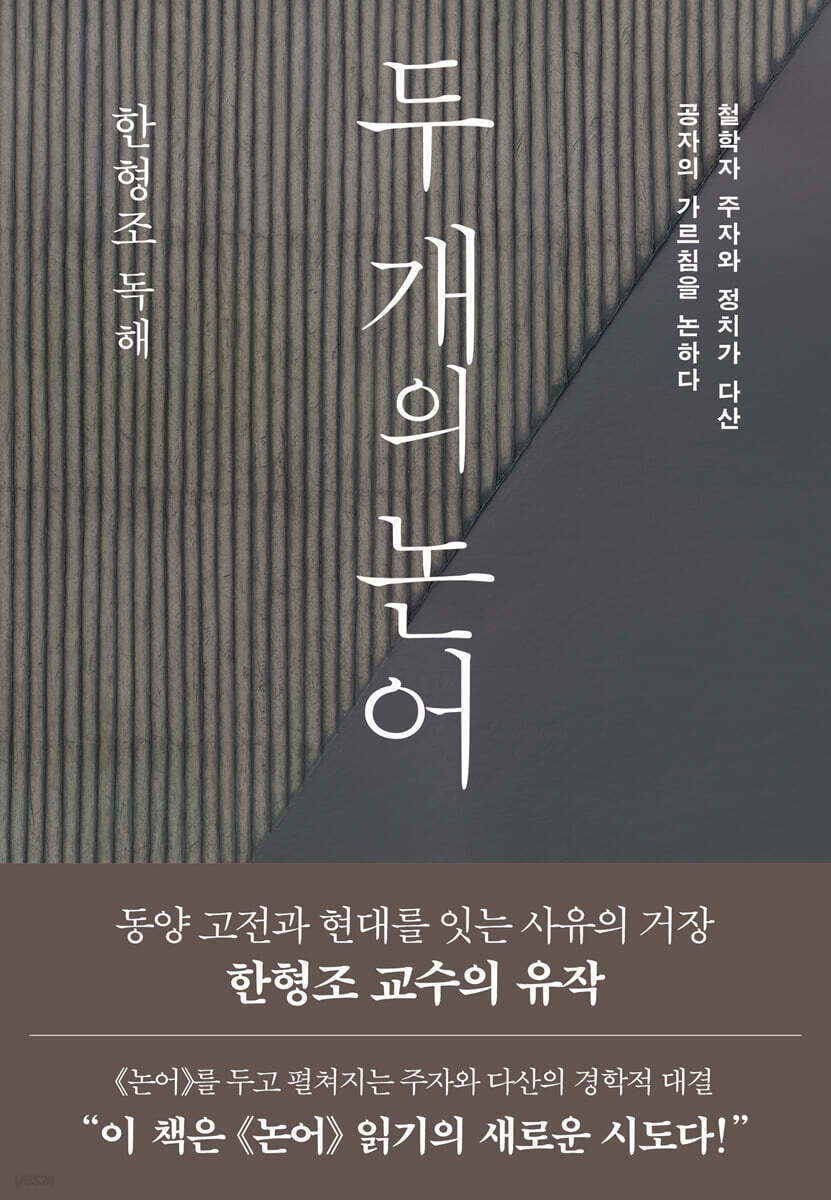
Two Analects
 |
Description
Book Introduction
The legacy of Professor Han Hyeong-jo, a master of thought bridging Eastern classics and the modern era.
The Confucian debate between Zhu Xi and Dasan over the Analects
After three years of intense and meticulous research, the manuscript was almost finished when the late Professor Han Hyeong-jo (1958-2024)'s last work, "Two Analects," was finally published after a year of editing.
This book is a humanities textbook that examines the true teachings of Confucius through the differences in interpretations of the Analects by Zhu Xi and Dasan, and is the fruit of Professor Han Hyeong-jo's lifelong research that encapsulates the "essence of Eastern thought," a subject he has pursued throughout his life.
Through this book, readers will be able to fully experience his academic passion and depth of thought.
The Analects, as they are commonly known, are an interpretation of Zhu Xi, who led the Joseon Dynasty for 500 years.
Even today, many people believe that Zhu Xi's interpretation is the authentic Analects.
However, Dasan's interpretation of the Analects shows considerable differences from Zhu Xi's interpretation.
Even Dasan pointed out that Zhu Xi's interpretation was wrong and went on to verify it based on various documents.
The differences in interpretation between Zhu Xi as a philosopher, a meditator, and Dasan as a politician, a historian, are a product of their circumstances, problems, and individuality.
The author tackles this fascinating topic with modern, bold language and sensibility, giving a light and refreshing interpretation to the Analects, which can sometimes feel heavy. He also polished the sentences into concise yet insightful sentences to give readers room to think.
In addition, to help readers easily understand the events and circumstances of the time scattered throughout the Analects, a translation of Sima Qian's "Gongja Sega" and a commentary on Professor Jeong Min's 2023 presentation on Dasan as a "hidden Catholic" are included as appendices.
The Confucian debate between Zhu Xi and Dasan over the Analects
After three years of intense and meticulous research, the manuscript was almost finished when the late Professor Han Hyeong-jo (1958-2024)'s last work, "Two Analects," was finally published after a year of editing.
This book is a humanities textbook that examines the true teachings of Confucius through the differences in interpretations of the Analects by Zhu Xi and Dasan, and is the fruit of Professor Han Hyeong-jo's lifelong research that encapsulates the "essence of Eastern thought," a subject he has pursued throughout his life.
Through this book, readers will be able to fully experience his academic passion and depth of thought.
The Analects, as they are commonly known, are an interpretation of Zhu Xi, who led the Joseon Dynasty for 500 years.
Even today, many people believe that Zhu Xi's interpretation is the authentic Analects.
However, Dasan's interpretation of the Analects shows considerable differences from Zhu Xi's interpretation.
Even Dasan pointed out that Zhu Xi's interpretation was wrong and went on to verify it based on various documents.
The differences in interpretation between Zhu Xi as a philosopher, a meditator, and Dasan as a politician, a historian, are a product of their circumstances, problems, and individuality.
The author tackles this fascinating topic with modern, bold language and sensibility, giving a light and refreshing interpretation to the Analects, which can sometimes feel heavy. He also polished the sentences into concise yet insightful sentences to give readers room to think.
In addition, to help readers easily understand the events and circumstances of the time scattered throughout the Analects, a translation of Sima Qian's "Gongja Sega" and a commentary on Professor Jeong Min's 2023 presentation on Dasan as a "hidden Catholic" are included as appendices.
- You can preview some of the book's contents.
Preview
index
Introduction
Lifting up my skirt and crossing this river | An exile thrown into the southern end | Why Confucian classics? | From meditation to politics | How to read?
Part 1.
Events and Characters
Chapter 1.
The exile of the old nobleman
Chapter 2.
My conversation with Kyung-gong
The Monarch No One Remembers | Four Encounters | The Virtue of a Monarch, the Responsibility of Politics
Chapter 3.
Good and Evil
A long-lasting relationship with Yangho
Chapter 4.
Above airspace and wife man
A conversation between a pretty woman and a man
Chapter 5.
The suffering of the first hermits and the hermits, the Jinchae
A Conversation with the First Prince | The Hermits | The Trials of Jinchae
Part 2.
Confucius's disciples
Chapter 1.
Jaro, Poho Glacier
A Crawler | To the Sea on a Raft | Character and Study | Jaro's Political Ambition | Jaro's Prayer | Jaro's Death
Chapter 2.
Jakong, Park Sijejung
Splendid Vessels | The Wealthy Zigong | Zigong's Critical Appreciation | Zigong Discusses Politics | Loyalty and Forgiveness, Confucius's Ilgwanji | Confucius's Inner Self and Religious Depths | Zigong, Are You Superior to Confucius?
Chapter 3.
Anhui, extreme repentance
Anhui's Learning | Anhui's Character | Anhui's Death | The Realm of Academic Achievement | The Highest Ideal of Confucianism
Part 3.
Confucius's thoughts
Chapter 1.
study
What should I do? | I am not born knowing | Learning, mastering the art of life | Teachings of service | The realm of learning acquired by three disciples | Tradition and classics, learning through books | Confucius, a man of learning | The first verse of the Analects | What is learning? | Born knowing | Only learning or only thinking | Confucius, reflecting on the path of learning | Lower learning and higher attainment
Chapter 2.
heaven
Wealth and honor | Zhu Xi speaks of the laws of heaven | Dasan hears the mandate of heaven | What is there to fear? | I knew the mandate of heaven at fifty | The world of sacrifices and gods | Heaven's punishment | Heaven cannot be deceived | The Ilgwanji reaches the heavens
Chapter 3.
仁
Make benevolence your home | Why didn't I speak of benevolence? | The burden is heavy, and the road is long | How to advance toward benevolence | Consideration and wholeness | The principle of reciprocity | Training in overcoming oneself, the joy of serving oneself | The continuity of benevolence | The three wise men of the Yin Dynasty | Bai Yi and Shu Zhu | Traitors of virtue | Betrayal or hypocrisy | Is benevolence inside or outside? | From benevolence to sage, the civilization of politics | I am only a man of learning | Confucius's Ilgwanji
Chapter 4.
politics
Leaving Home | The Master's Way Is Too High | Confucius's Political Revolution | Ethics of the Heart and Ethics of Responsibility | What is Non-Desire? | The Ideal of Virtue Rule, Confucianism and Legalism | Non-action or Action? | The Politics of Yao and Shun: On the Reality | Respect: Self-Conscious Attention or Job-Responsibility? | The Goal of Politics | Trust, the Foundation of Politics | The Military and the Army | Prisons and Punishment | The Art of Managing Finance | Dasan's Political Realism
Conclusion
Events and Circumstances | Confucius's Disciples | Confucius' Thought | Meaning and Prospects
References
supplement
1.
Translation of the "Gongjasega"
Ancestors, childhood, and youth (551–523 BC) | After returning from Qi (522–503 BC) | In the midst of Lu politics (502–497 BC) | Five years of first wandering (496–492 BC) | Trouble between Qin and Cai (491–489 BC) | Continued wandering (488–484 BC) | Activities as a scholar and personal habits (484–481 BC) | Death and evaluation of Confucius
2.
An Apology for Fertility (Commentary on Professor Jeongmin's Presentation)
Kang Yi-won's Leak | Is Lee Ga-hwan the Leader of a Heretic? | Seongho Lee Ik's View of Seohak | Dasan's Four Works: Evasion or Reflection? | A Separate Faction of Confucianism or a Confucian Theist | Absurd and Bizarre, Defying Heaven and Blaspheming God | The Court of Reason | Conclusion | Postscript
3.
My favorite classic quote
Eulogy.
Han Hyeong-jo's Sea and Life, Academics and Philosophy
Han Hyeong-jo, the Man of the Sea | A Few Memories from My Graduate School of Korean Studies | Truly Beautiful Times | The Difference Between Zhu Xi's and Dasan's Schools | The Two Analects of Confucius, or the Sea as "All Things in the World" | Buddhism and the Light-Making Aspect
Search
Lifting up my skirt and crossing this river | An exile thrown into the southern end | Why Confucian classics? | From meditation to politics | How to read?
Part 1.
Events and Characters
Chapter 1.
The exile of the old nobleman
Chapter 2.
My conversation with Kyung-gong
The Monarch No One Remembers | Four Encounters | The Virtue of a Monarch, the Responsibility of Politics
Chapter 3.
Good and Evil
A long-lasting relationship with Yangho
Chapter 4.
Above airspace and wife man
A conversation between a pretty woman and a man
Chapter 5.
The suffering of the first hermits and the hermits, the Jinchae
A Conversation with the First Prince | The Hermits | The Trials of Jinchae
Part 2.
Confucius's disciples
Chapter 1.
Jaro, Poho Glacier
A Crawler | To the Sea on a Raft | Character and Study | Jaro's Political Ambition | Jaro's Prayer | Jaro's Death
Chapter 2.
Jakong, Park Sijejung
Splendid Vessels | The Wealthy Zigong | Zigong's Critical Appreciation | Zigong Discusses Politics | Loyalty and Forgiveness, Confucius's Ilgwanji | Confucius's Inner Self and Religious Depths | Zigong, Are You Superior to Confucius?
Chapter 3.
Anhui, extreme repentance
Anhui's Learning | Anhui's Character | Anhui's Death | The Realm of Academic Achievement | The Highest Ideal of Confucianism
Part 3.
Confucius's thoughts
Chapter 1.
study
What should I do? | I am not born knowing | Learning, mastering the art of life | Teachings of service | The realm of learning acquired by three disciples | Tradition and classics, learning through books | Confucius, a man of learning | The first verse of the Analects | What is learning? | Born knowing | Only learning or only thinking | Confucius, reflecting on the path of learning | Lower learning and higher attainment
Chapter 2.
heaven
Wealth and honor | Zhu Xi speaks of the laws of heaven | Dasan hears the mandate of heaven | What is there to fear? | I knew the mandate of heaven at fifty | The world of sacrifices and gods | Heaven's punishment | Heaven cannot be deceived | The Ilgwanji reaches the heavens
Chapter 3.
仁
Make benevolence your home | Why didn't I speak of benevolence? | The burden is heavy, and the road is long | How to advance toward benevolence | Consideration and wholeness | The principle of reciprocity | Training in overcoming oneself, the joy of serving oneself | The continuity of benevolence | The three wise men of the Yin Dynasty | Bai Yi and Shu Zhu | Traitors of virtue | Betrayal or hypocrisy | Is benevolence inside or outside? | From benevolence to sage, the civilization of politics | I am only a man of learning | Confucius's Ilgwanji
Chapter 4.
politics
Leaving Home | The Master's Way Is Too High | Confucius's Political Revolution | Ethics of the Heart and Ethics of Responsibility | What is Non-Desire? | The Ideal of Virtue Rule, Confucianism and Legalism | Non-action or Action? | The Politics of Yao and Shun: On the Reality | Respect: Self-Conscious Attention or Job-Responsibility? | The Goal of Politics | Trust, the Foundation of Politics | The Military and the Army | Prisons and Punishment | The Art of Managing Finance | Dasan's Political Realism
Conclusion
Events and Circumstances | Confucius's Disciples | Confucius' Thought | Meaning and Prospects
References
supplement
1.
Translation of the "Gongjasega"
Ancestors, childhood, and youth (551–523 BC) | After returning from Qi (522–503 BC) | In the midst of Lu politics (502–497 BC) | Five years of first wandering (496–492 BC) | Trouble between Qin and Cai (491–489 BC) | Continued wandering (488–484 BC) | Activities as a scholar and personal habits (484–481 BC) | Death and evaluation of Confucius
2.
An Apology for Fertility (Commentary on Professor Jeongmin's Presentation)
Kang Yi-won's Leak | Is Lee Ga-hwan the Leader of a Heretic? | Seongho Lee Ik's View of Seohak | Dasan's Four Works: Evasion or Reflection? | A Separate Faction of Confucianism or a Confucian Theist | Absurd and Bizarre, Defying Heaven and Blaspheming God | The Court of Reason | Conclusion | Postscript
3.
My favorite classic quote
Eulogy.
Han Hyeong-jo's Sea and Life, Academics and Philosophy
Han Hyeong-jo, the Man of the Sea | A Few Memories from My Graduate School of Korean Studies | Truly Beautiful Times | The Difference Between Zhu Xi's and Dasan's Schools | The Two Analects of Confucius, or the Sea as "All Things in the World" | Buddhism and the Light-Making Aspect
Search
Detailed image

Into the book
The interpretations of the Analects by Zhu Xi and Dasan are ‘completely’ different.
How can we understand such different, often conflicting, interpretations of the same book? In this sense, the Analects are not singular.
Don't they say, "There are as many Buddhists in Tibet as there are monks," and "There are as many rooms in my father's house"? In this way, the Analects shine like stars in the night sky.
--- p.34
Confucius says to Jeonggong.
The rise and fall of politics is not easily predictable.
But one thing is clear:
When a monarch perceives his position as 'power' and wields tyranny as he pleases, and no one objects or opposes, then the country is certainly in ruins.
Otherwise, when the monarch understands his position as a 'responsibility', that is, when he loses sleep worrying about the stability and welfare of his people, then the country will undoubtedly rise on the track to prosperity.
To this end, the relationship between the monarch and his subjects must be based on mutual respect and cooperation, not one of unilateral domination and subordination.
--- p.95
Dasan wants to recover the 'principles' of Confucianism not in cosmological metaphysics but in 'social relations'.
That is the long-standing tradition of Confucianism that has been passed down through the ages, starting from Confucius.
However, some criticize the Song Dynasty Confucianism, including Zhu Xi, for distorting this frame.
“A single principle has entangled humanity and the universe, plunging us into a swamp of metaphysics, leaving us clueless about what to achieve in our daily lives.”
--- p.273
Runners value 'nature'.
It is no exaggeration to say that I have set it as my life philosophy.
Although Confucianism is known as a moral code, it is understood as a process or a beginner's guide.
Like woodworking or driving a car, it requires intention and effort at first, but as you become more proficient, all intentionality falls away and the natural movements of your hands and body become your own.
Morality, like that, begins with 'I should be careful not to do to others what I would not want done to me,' but when it is perfected, we practice it naturally without being conscious of it.
The runner divided the stage of effort into forgiveness (恕) and the state of natural detachment into benevolence (仁).
--- p.350~351
Confucianism and Dasan cannot be viewed solely as oppositional.
Both systems belong to the sciences in a macroscopic perspective.
Science seeks the meaning of life beyond worldly practices.
It is recommended to control one's senses and desires to be considerate of others and cooperate with the overall order.
Although they are engaged in a fierce battle over the innateness and accumulation of virtue, they are not different in that they are both projects of 'social morality'.
--- p.492
Filial piety is not about following your parents' wishes and always obeying them.
Parents' judgments may be wrong, and they may force choices that are not at all righteous.
Children should resist and reject things if they feel they are not good enough.
But I advise you not to openly criticize and start a war here.
Be filial at home, and respect and serve others when you leave home.
That is the basic training that humans must have to learn.
--- p.515
The ethics of fertility are more rugged than those of Zhu Xi.
It will feel like you are standing in front of a daily battlefield.
The runner is much more even in that he restores the naturalness of the way of heaven.
However, you just need to be careful not to deviate from temperament and materialism, and take good care of yourself.
Fertility is not like that.
Within humans, conflicting desires struggle for dominance.
It depicts an ethical situation where angels and demons are constantly fighting within humans.
When Zhu Xi spoke of the laws of nature and Dasan emphasized the nature of the mandate of nature, these different directions of ethics were practically foreshadowed.
--- p.600
Dasan believes that Zhu Xi's rational explanation does not convey the real meaning of 'heaven' as Confucius said.
God is not nature….
He is the creator of nature and is therefore superior to it.
We must fearfully and cautiously obey His unseen form and His unheard voice! Otherwise, if we act contrary to His will and lead a negligent life, His wrath will fall upon us.
At that time, there is nowhere to run.
--- p.676
Confucius hated the color purple.
If it's red, it should be a bright red, blood red, but why is it a vague and ambiguous purple?
It also seems unusual to me that this passage is right next to the previous chapter on skillful speech and color.
Through this parable, Confucius seems to be telling us that there is a great chasm between a true gentleman and a person who is socially recognized.
This is called ‘pseudo-false’.
People who appear virtuous on the outside, but are actually the furthest from virtue.
Dasan calls these 'thieves of virtue', or hypocrites, 'Hyangwon'.
--- p.744
Zhu Xi says that if we break down the walls that block us from one another, true communication will take place between you and me, and that energy will spread beyond the entire country, to the world, and into the universe.
At that time, I become nature, and no further artificial effort is needed.
Desirable political behavior and leadership would also be included in it.
Because my wall has been broken down by not insisting on myself, my actions at that time are not mine but nature's and blossom into something of the universe.
The runner wrote, “The will of heaven prevails.”
--- p.769
What is loyalty and forgiveness? As a philosopher of meditation, Zhu Xi interpreted loyalty as securing the inner essence of the self, and forgiveness as an extension of external things and events.
However, Dasan puts the brakes on this voluminous thinking.
If so, wouldn't the principles be two, not one? He asserted that "loyalty" (忠) is an adverb meaning "with sincerity, truthfulness," and the core keyword is the single character "forgiveness."
The following conversation with Zigong clears the fog of time and awakens Confucius's thoughts and the spirit of Confucianism like a thunderbolt.
--- p.773
Again, the fundamental principle of Confucianism is not 'heredity'.
A system in which one becomes a monarch or noble and exercises power simply by inheriting the lineage without any effort or qualifications is against the Confucian principle of meritocracy.
The watershed moment for hereditary succession in Xianyang was Emperor Wu.
He himself 'abdicated' the throne from the king, but passed the succession to his son.
How can we understand such different, often conflicting, interpretations of the same book? In this sense, the Analects are not singular.
Don't they say, "There are as many Buddhists in Tibet as there are monks," and "There are as many rooms in my father's house"? In this way, the Analects shine like stars in the night sky.
--- p.34
Confucius says to Jeonggong.
The rise and fall of politics is not easily predictable.
But one thing is clear:
When a monarch perceives his position as 'power' and wields tyranny as he pleases, and no one objects or opposes, then the country is certainly in ruins.
Otherwise, when the monarch understands his position as a 'responsibility', that is, when he loses sleep worrying about the stability and welfare of his people, then the country will undoubtedly rise on the track to prosperity.
To this end, the relationship between the monarch and his subjects must be based on mutual respect and cooperation, not one of unilateral domination and subordination.
--- p.95
Dasan wants to recover the 'principles' of Confucianism not in cosmological metaphysics but in 'social relations'.
That is the long-standing tradition of Confucianism that has been passed down through the ages, starting from Confucius.
However, some criticize the Song Dynasty Confucianism, including Zhu Xi, for distorting this frame.
“A single principle has entangled humanity and the universe, plunging us into a swamp of metaphysics, leaving us clueless about what to achieve in our daily lives.”
--- p.273
Runners value 'nature'.
It is no exaggeration to say that I have set it as my life philosophy.
Although Confucianism is known as a moral code, it is understood as a process or a beginner's guide.
Like woodworking or driving a car, it requires intention and effort at first, but as you become more proficient, all intentionality falls away and the natural movements of your hands and body become your own.
Morality, like that, begins with 'I should be careful not to do to others what I would not want done to me,' but when it is perfected, we practice it naturally without being conscious of it.
The runner divided the stage of effort into forgiveness (恕) and the state of natural detachment into benevolence (仁).
--- p.350~351
Confucianism and Dasan cannot be viewed solely as oppositional.
Both systems belong to the sciences in a macroscopic perspective.
Science seeks the meaning of life beyond worldly practices.
It is recommended to control one's senses and desires to be considerate of others and cooperate with the overall order.
Although they are engaged in a fierce battle over the innateness and accumulation of virtue, they are not different in that they are both projects of 'social morality'.
--- p.492
Filial piety is not about following your parents' wishes and always obeying them.
Parents' judgments may be wrong, and they may force choices that are not at all righteous.
Children should resist and reject things if they feel they are not good enough.
But I advise you not to openly criticize and start a war here.
Be filial at home, and respect and serve others when you leave home.
That is the basic training that humans must have to learn.
--- p.515
The ethics of fertility are more rugged than those of Zhu Xi.
It will feel like you are standing in front of a daily battlefield.
The runner is much more even in that he restores the naturalness of the way of heaven.
However, you just need to be careful not to deviate from temperament and materialism, and take good care of yourself.
Fertility is not like that.
Within humans, conflicting desires struggle for dominance.
It depicts an ethical situation where angels and demons are constantly fighting within humans.
When Zhu Xi spoke of the laws of nature and Dasan emphasized the nature of the mandate of nature, these different directions of ethics were practically foreshadowed.
--- p.600
Dasan believes that Zhu Xi's rational explanation does not convey the real meaning of 'heaven' as Confucius said.
God is not nature….
He is the creator of nature and is therefore superior to it.
We must fearfully and cautiously obey His unseen form and His unheard voice! Otherwise, if we act contrary to His will and lead a negligent life, His wrath will fall upon us.
At that time, there is nowhere to run.
--- p.676
Confucius hated the color purple.
If it's red, it should be a bright red, blood red, but why is it a vague and ambiguous purple?
It also seems unusual to me that this passage is right next to the previous chapter on skillful speech and color.
Through this parable, Confucius seems to be telling us that there is a great chasm between a true gentleman and a person who is socially recognized.
This is called ‘pseudo-false’.
People who appear virtuous on the outside, but are actually the furthest from virtue.
Dasan calls these 'thieves of virtue', or hypocrites, 'Hyangwon'.
--- p.744
Zhu Xi says that if we break down the walls that block us from one another, true communication will take place between you and me, and that energy will spread beyond the entire country, to the world, and into the universe.
At that time, I become nature, and no further artificial effort is needed.
Desirable political behavior and leadership would also be included in it.
Because my wall has been broken down by not insisting on myself, my actions at that time are not mine but nature's and blossom into something of the universe.
The runner wrote, “The will of heaven prevails.”
--- p.769
What is loyalty and forgiveness? As a philosopher of meditation, Zhu Xi interpreted loyalty as securing the inner essence of the self, and forgiveness as an extension of external things and events.
However, Dasan puts the brakes on this voluminous thinking.
If so, wouldn't the principles be two, not one? He asserted that "loyalty" (忠) is an adverb meaning "with sincerity, truthfulness," and the core keyword is the single character "forgiveness."
The following conversation with Zigong clears the fog of time and awakens Confucius's thoughts and the spirit of Confucianism like a thunderbolt.
--- p.773
Again, the fundamental principle of Confucianism is not 'heredity'.
A system in which one becomes a monarch or noble and exercises power simply by inheriting the lineage without any effort or qualifications is against the Confucian principle of meritocracy.
The watershed moment for hereditary succession in Xianyang was Emperor Wu.
He himself 'abdicated' the throne from the king, but passed the succession to his son.
--- p.800
Publisher's Review
A runner focused on the individual and the inner self
Dasan, who valued society and relationships
Two thinkers' different perspectives on Confucius's teachings
The Analects are composed of short and concise aphorisms.
Every single letter is questionable, and the meaning of phrases and sentences becomes even more difficult and unclear.
The background and context of the incident are buried, and there is controversy over whether the tone is direct, sarcastic, or exclamation.
Zhu Xi was the center of thought and culture in Joseon for 500 years, and Dasan, as a representative of Silhak, devoted his life's energy to reestablishing the way of the previous kings.
The interpretations of the Analects by Zhu Xi and Dasan are ‘completely’ different.
The academic confrontation between Zhu Xi and Dasan is so intense that sparks fly, and the differences are fundamental.
The author describes the difference in the interpretive spirit of the two masters in Western classical language as “meditation (vita contemplativa) vs.
It is read as “activity (vita activa).”
For the runner, the core of his existence is a cosmic force, like Buddha nature in Buddhism, and it is fundamentally good.
In other words, human evil comes from ignorance and bad habits, and if one becomes aware of one's own nature and corrects bad habits, one can recover one's original 'nature' and live as a healthy member of society.
And the awakened sage is the one who awakens his family, his neighbors, and the entire world to help them regain their true nature.
In this way, the plan of Confucianism is condensed into a healing technique that aims to restore alienated people to their original selves and to heal sick bodies and minds so that they can live as healthy people.
Dasan thought that this naive plan was a philosopher's utopia, not a solution that took real politics into account.
The age of fertility was a time when 'artificial' design of fundamental transformation was needed.
He did not forget that Confucianism was a discipline that dealt with social ethics.
Dasan believed that virtue was not something that could be 'discovered', but rather something that was 'accumulated' and 'growth' through external activities.
In other words, an inward-looking gaze is empty and is likely to ruin human affairs.
Dasan expressed his indignation, saying that the fact that politics in the late Joseon Dynasty had become so rotten and corrupt was a result of Zhu Xi's internal tendencies.
The life-changing events and people Confucius encountered
Part 1 explores notable events and figures in Confucius's life.
The first major event was the exile of Duke Shao of Lu in 517 BC.
Through this, we can read Confucius's view of civilization.
Here, Confucius meets with Duke Jing of Qi and explores his political participation.
Meeting him also provides important clues to reading Confucius's political thought.
There is also Yang Ho, a person who was intertwined with Confucius throughout his life.
Ever since Confucius was rudely kicked out of a banquet given by a nobleman in his youth, he had had a bad relationship with Yang Hao.
After Yang Hu's rebellion failed and he went into exile, Confucius became involved in the politics of the state of Lu and seemed to be pursuing his own ambitions by serving as the Grand Master, but the experiment failed and he ended up going into exile.
After that, the first place I went to was Wei, and it was also the place I stayed the longest.
There are conversations between Duke Ying of Wei, a feudal lord at the time, and his beautiful and powerful wife, Namja.
Confucius's wanderings continued far to the southernmost part of the country.
There are the hermits I met there, and the hardships of Jinchae.
Through this hardship, we can encounter the reality of the Way, which Confucius could not compromise on.
While Zhu Xi devoted all his efforts to developing his philosophy through the Analects, he paid little attention to the time and circumstances.
In contrast, Dasan delves into the circumstances of the Analects as thoroughly as possible, based on his historical inclinations and political interests.
This work has allowed me to rediscover and contextualize previously buried moments, sometimes revealing the meaning of utterances in a whole new light.
Anhui of virtue, Zigong of language, Zi Zi of politics
Part 2 deals with Confucius's representative disciples.
There are ten representative disciples in the 'four fields' covered in the Analects.
The author chose three here.
They are Anhui of virtue, Zigong of language, and Zilu of politics.
These three are the most outstanding personalities of the public document, they traveled with Confucius for a long time, and they appear most frequently in the Analects.
There is no need to mention the bond and closeness with Confucius.
The most important and profound themes in Confucius's thought are also revealed through conversations with them.
Through his dialogue with his disciples, we can examine his political ideology and the training of virtue.
We can also read clearly about Confucius's ability as a teacher, acknowledging his disciple An Hui's indifference to poverty, Zigong's practical ability, and Zilu's courage, and trying to complement their shortcomings and deficiencies.
Among these three, Zhu Xi clearly puts forward 'An Hui' as the representative figure, while simultaneously belittling Zigong and Zilu as second-rate officials.
However, through a new interpretation, Dasan reveals that Confucius highly recognized Zigong's capable political skills and that he had a sound common sense about production and wealth.
Jaro also shows that he was not only an expert in the finances and military of a country, but also possessed fair judgment.
Through these, we can also glimpse the conflicting views of Zhu Xi and Dasan on wealth and poverty.
Four Core Ideas of Confucius as Seen by Zhu Xi and Dasan
Part 3 shows that Zhu Xi and Dasan have different perspectives on the relationship between Confucius's four core ideas: learning (學), origin (天), virtue (仁), and politics (政).
Confucianism holds benevolence as its highest goal.
What exactly is this benevolence? While Zhu Xi advocated that benevolence is an internal force of the universe and human nature, and urged us to discover it within ourselves through "meditation," Dasan argued that benevolence is not internal, but rather an extrinsic virtue painstakingly accumulated through behavioral choices in social spaces.
These different perspectives naturally lead to different paths to learning, that is, benevolence.
The runner grasped that the path to benevolence was to remove the old self's oblivion and its pollution and restore the original light and strength.
Dasan places 'relationship' at the center of all learning.
For him, learning is a general term for all efforts to achieve benevolence, and benevolence is merely a virtue that is built up like bricks through appropriate actions in the field of ‘relationships between people.’
In addition, Zhu Xi replaced the heaven and the mandate of heaven that appear in the Book of Songs, the Book of Documents, and the Analects with the natural concept of heavenly law.
Because of this, the supernatural and religious horizon contained in heaven was stripped away.
Dasan seeks to restore the old religious concept of a transcendent being, saying that Confucius's Heaven cannot be reduced to 'nature'.
Dasan says that Heaven created all things and gave humans a special calling, and that He resonates in the hearts of humans as a faint voice of conscience.
Finally, the perspectives on the ideal of political order are also different.
Zhu Xi said that if the nature of the country is restored, the country can be managed properly, and he attributed politics to morality.
But Dasan shouts, “Practice is more important than name.”
In other words, the key is what benefits it provides to others and what contribution it makes to society.
A New Attempt at Reading the Analects
The Analects are not one.
Buddhism says, “There are as many Buddhists in Tibet as there are monks,” and the Bible says, “There are as many rooms in the Father’s house.”
Confucianism also has as many Analects as commentators.
Nevertheless, the authority of interpretation, especially in Joseon, has been monopolized by Zhu Xi.
Therefore, the meaning of Dasan's Analects cannot be fully revealed without comparison or confrontation with Zhu Xi.
With this problem in mind, the author conducted research for three years.
By clarifying the meaning of the Analects through the interpretations of Zhu Xi and Dasan, the author provides a way to approach Confucius's thought and its system.
This is a new attempt at reading the Analects.
Even though the opinions of these two thinkers sometimes diverge dramatically, if readers grasp these two horns and reflect, they will hear the voice of Confucius somewhere in between.
By following the guidance of these two thinkers, both familiar with the classics and creative in their thinking, you may have the good fortune to open your ears to the voice of Confucius and gauge his thoughts and aspirations.
Dasan, who valued society and relationships
Two thinkers' different perspectives on Confucius's teachings
The Analects are composed of short and concise aphorisms.
Every single letter is questionable, and the meaning of phrases and sentences becomes even more difficult and unclear.
The background and context of the incident are buried, and there is controversy over whether the tone is direct, sarcastic, or exclamation.
Zhu Xi was the center of thought and culture in Joseon for 500 years, and Dasan, as a representative of Silhak, devoted his life's energy to reestablishing the way of the previous kings.
The interpretations of the Analects by Zhu Xi and Dasan are ‘completely’ different.
The academic confrontation between Zhu Xi and Dasan is so intense that sparks fly, and the differences are fundamental.
The author describes the difference in the interpretive spirit of the two masters in Western classical language as “meditation (vita contemplativa) vs.
It is read as “activity (vita activa).”
For the runner, the core of his existence is a cosmic force, like Buddha nature in Buddhism, and it is fundamentally good.
In other words, human evil comes from ignorance and bad habits, and if one becomes aware of one's own nature and corrects bad habits, one can recover one's original 'nature' and live as a healthy member of society.
And the awakened sage is the one who awakens his family, his neighbors, and the entire world to help them regain their true nature.
In this way, the plan of Confucianism is condensed into a healing technique that aims to restore alienated people to their original selves and to heal sick bodies and minds so that they can live as healthy people.
Dasan thought that this naive plan was a philosopher's utopia, not a solution that took real politics into account.
The age of fertility was a time when 'artificial' design of fundamental transformation was needed.
He did not forget that Confucianism was a discipline that dealt with social ethics.
Dasan believed that virtue was not something that could be 'discovered', but rather something that was 'accumulated' and 'growth' through external activities.
In other words, an inward-looking gaze is empty and is likely to ruin human affairs.
Dasan expressed his indignation, saying that the fact that politics in the late Joseon Dynasty had become so rotten and corrupt was a result of Zhu Xi's internal tendencies.
The life-changing events and people Confucius encountered
Part 1 explores notable events and figures in Confucius's life.
The first major event was the exile of Duke Shao of Lu in 517 BC.
Through this, we can read Confucius's view of civilization.
Here, Confucius meets with Duke Jing of Qi and explores his political participation.
Meeting him also provides important clues to reading Confucius's political thought.
There is also Yang Ho, a person who was intertwined with Confucius throughout his life.
Ever since Confucius was rudely kicked out of a banquet given by a nobleman in his youth, he had had a bad relationship with Yang Hao.
After Yang Hu's rebellion failed and he went into exile, Confucius became involved in the politics of the state of Lu and seemed to be pursuing his own ambitions by serving as the Grand Master, but the experiment failed and he ended up going into exile.
After that, the first place I went to was Wei, and it was also the place I stayed the longest.
There are conversations between Duke Ying of Wei, a feudal lord at the time, and his beautiful and powerful wife, Namja.
Confucius's wanderings continued far to the southernmost part of the country.
There are the hermits I met there, and the hardships of Jinchae.
Through this hardship, we can encounter the reality of the Way, which Confucius could not compromise on.
While Zhu Xi devoted all his efforts to developing his philosophy through the Analects, he paid little attention to the time and circumstances.
In contrast, Dasan delves into the circumstances of the Analects as thoroughly as possible, based on his historical inclinations and political interests.
This work has allowed me to rediscover and contextualize previously buried moments, sometimes revealing the meaning of utterances in a whole new light.
Anhui of virtue, Zigong of language, Zi Zi of politics
Part 2 deals with Confucius's representative disciples.
There are ten representative disciples in the 'four fields' covered in the Analects.
The author chose three here.
They are Anhui of virtue, Zigong of language, and Zilu of politics.
These three are the most outstanding personalities of the public document, they traveled with Confucius for a long time, and they appear most frequently in the Analects.
There is no need to mention the bond and closeness with Confucius.
The most important and profound themes in Confucius's thought are also revealed through conversations with them.
Through his dialogue with his disciples, we can examine his political ideology and the training of virtue.
We can also read clearly about Confucius's ability as a teacher, acknowledging his disciple An Hui's indifference to poverty, Zigong's practical ability, and Zilu's courage, and trying to complement their shortcomings and deficiencies.
Among these three, Zhu Xi clearly puts forward 'An Hui' as the representative figure, while simultaneously belittling Zigong and Zilu as second-rate officials.
However, through a new interpretation, Dasan reveals that Confucius highly recognized Zigong's capable political skills and that he had a sound common sense about production and wealth.
Jaro also shows that he was not only an expert in the finances and military of a country, but also possessed fair judgment.
Through these, we can also glimpse the conflicting views of Zhu Xi and Dasan on wealth and poverty.
Four Core Ideas of Confucius as Seen by Zhu Xi and Dasan
Part 3 shows that Zhu Xi and Dasan have different perspectives on the relationship between Confucius's four core ideas: learning (學), origin (天), virtue (仁), and politics (政).
Confucianism holds benevolence as its highest goal.
What exactly is this benevolence? While Zhu Xi advocated that benevolence is an internal force of the universe and human nature, and urged us to discover it within ourselves through "meditation," Dasan argued that benevolence is not internal, but rather an extrinsic virtue painstakingly accumulated through behavioral choices in social spaces.
These different perspectives naturally lead to different paths to learning, that is, benevolence.
The runner grasped that the path to benevolence was to remove the old self's oblivion and its pollution and restore the original light and strength.
Dasan places 'relationship' at the center of all learning.
For him, learning is a general term for all efforts to achieve benevolence, and benevolence is merely a virtue that is built up like bricks through appropriate actions in the field of ‘relationships between people.’
In addition, Zhu Xi replaced the heaven and the mandate of heaven that appear in the Book of Songs, the Book of Documents, and the Analects with the natural concept of heavenly law.
Because of this, the supernatural and religious horizon contained in heaven was stripped away.
Dasan seeks to restore the old religious concept of a transcendent being, saying that Confucius's Heaven cannot be reduced to 'nature'.
Dasan says that Heaven created all things and gave humans a special calling, and that He resonates in the hearts of humans as a faint voice of conscience.
Finally, the perspectives on the ideal of political order are also different.
Zhu Xi said that if the nature of the country is restored, the country can be managed properly, and he attributed politics to morality.
But Dasan shouts, “Practice is more important than name.”
In other words, the key is what benefits it provides to others and what contribution it makes to society.
A New Attempt at Reading the Analects
The Analects are not one.
Buddhism says, “There are as many Buddhists in Tibet as there are monks,” and the Bible says, “There are as many rooms in the Father’s house.”
Confucianism also has as many Analects as commentators.
Nevertheless, the authority of interpretation, especially in Joseon, has been monopolized by Zhu Xi.
Therefore, the meaning of Dasan's Analects cannot be fully revealed without comparison or confrontation with Zhu Xi.
With this problem in mind, the author conducted research for three years.
By clarifying the meaning of the Analects through the interpretations of Zhu Xi and Dasan, the author provides a way to approach Confucius's thought and its system.
This is a new attempt at reading the Analects.
Even though the opinions of these two thinkers sometimes diverge dramatically, if readers grasp these two horns and reflect, they will hear the voice of Confucius somewhere in between.
By following the guidance of these two thinkers, both familiar with the classics and creative in their thinking, you may have the good fortune to open your ears to the voice of Confucius and gauge his thoughts and aspirations.
GOODS SPECIFICS
- Date of issue: November 24, 2025
- Format: Hardcover book binding method guide
- Page count, weight, size: 1,096 pages | 150*225*60mm
- ISBN13: 9791173323935
- ISBN10: 1173323937
You may also like
카테고리
korean


korean

![GQ KOREA Mark (Monthly): December [2025]](http://librairie.coreenne.fr/cdn/shop/files/8ef265dbbfbf186523ed75ba7319009d.jpg?v=1765340328&width=3840)


