

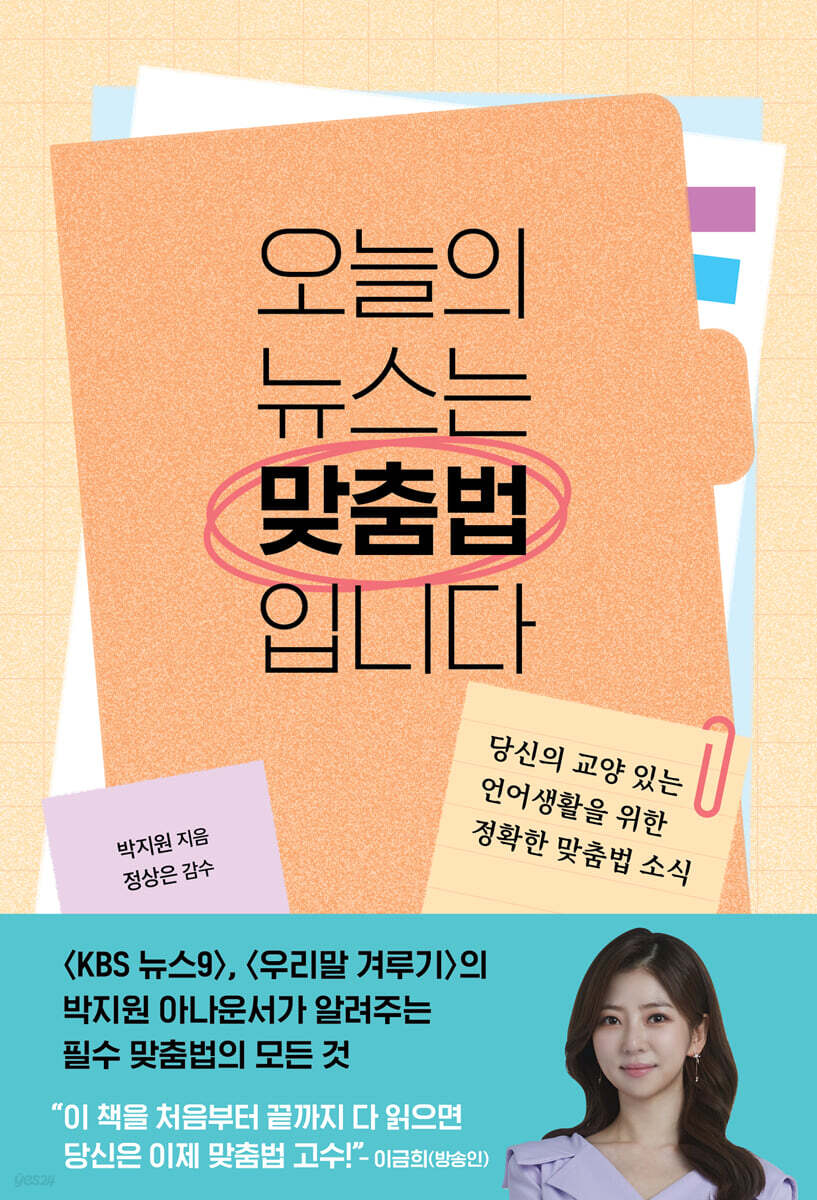
Today's news is spelling
 |
Description
Book Introduction
“If you read this book from cover to cover, you will now be a spelling expert!”
★★★Recommended by Lee Geum-hee (broadcaster)★★★
KBS News 9, 'Our Language Competition'
Announcer Park Ji-won tells us
Everything you need to know about everyday spelling
Park Ji-won, an announcer who reports on the day-to-day lives of South Korea every night on KBS News 9 and hosts the show “Our Language Competition” every Monday, has written a spelling book.
Having been broadcasting for several years and living more passionately with the Korean language than anyone else, he says that he is very upset that the importance of spelling seems to be gradually being forgotten amidst the growing interest in the Korean language worldwide.
"Today's News is Spelling" is a book filled with essential expressions that announcer Park Ji-won, who loves the Korean language, has carefully selected and compiled.
Spelling may seem stiff and boring, but this book is not like that.
We've made it more fun by illustrating common cases, and after explaining each case, we've summarized the key points in the 'Summary' and 'Easy to Remember' boxes.
It's not difficult as it only explains the grammar necessary.
It is interesting until the last chapter, with tips organized throughout, including explanations of 'Surprisingly Standard Language', 'Essential Literacy Vocabulary', and 'Pronunciation Common Sense'.
This book will be a resource for anyone who struggles with the difference between "돼" and "되," for those who no longer want to rely on spell checkers, and for everyone from job seekers and office workers to middle, high school, and college students who want to write neatly using accurate spelling.
★★★Recommended by Lee Geum-hee (broadcaster)★★★
KBS News 9, 'Our Language Competition'
Announcer Park Ji-won tells us
Everything you need to know about everyday spelling
Park Ji-won, an announcer who reports on the day-to-day lives of South Korea every night on KBS News 9 and hosts the show “Our Language Competition” every Monday, has written a spelling book.
Having been broadcasting for several years and living more passionately with the Korean language than anyone else, he says that he is very upset that the importance of spelling seems to be gradually being forgotten amidst the growing interest in the Korean language worldwide.
"Today's News is Spelling" is a book filled with essential expressions that announcer Park Ji-won, who loves the Korean language, has carefully selected and compiled.
Spelling may seem stiff and boring, but this book is not like that.
We've made it more fun by illustrating common cases, and after explaining each case, we've summarized the key points in the 'Summary' and 'Easy to Remember' boxes.
It's not difficult as it only explains the grammar necessary.
It is interesting until the last chapter, with tips organized throughout, including explanations of 'Surprisingly Standard Language', 'Essential Literacy Vocabulary', and 'Pronunciation Common Sense'.
This book will be a resource for anyone who struggles with the difference between "돼" and "되," for those who no longer want to rely on spell checkers, and for everyone from job seekers and office workers to middle, high school, and college students who want to write neatly using accurate spelling.
- You can preview some of the book's contents.
Preview
index
Recommendation
Introduction
Spelling Test
Headline 1.
25 Spelling Rules You Need to Know Right Now
01.
Why and why
02.
Here's a summary
03.
Come on, come on
04.
Stop by and listen
05.
Different and wrong
06.
Sundaeguk and Sundaeguk
Manduguk and Manduguk
07.
Stew and stew
08.
Hurry up and hurry up
[Breaking News] We're bringing you "Surprisingly Standard Korean."
09.
Strange and strange
10.
Gujiwa Guji
11.
It's ridiculous and ridiculous
12.
No eye surgery
13.
Better and give birth
14.
Teach, point out, and point out
15.
See you soon
16.
Copy and duplicate
17.
How many days and how many days
18.
The year before last and the year before
[Breaking News] We're bringing you "Surprisingly Standard Korean."
19.
On purpose and in part
20.
Eye boogers and boogers
21.
Embarrassed and embarrassed
22.
Excited and excited
23.
Break up and break up
24.
Role and Role
25.
Soon and soon
The quiz is out
Headline 2.
29 spelling mistakes that keep getting confusing
01.
How come, what should I do, what should I do?
02.
Of course and
03.
Awkward and awkward
04.
I'll be there later
05.
It's been a long time and it's been a long time
For a long time and for a long time
06.
Dun and Dun
07.
On the contrary, on the contrary
[Breaking News] We've received a report on literacy issues.
08.
Yes and yes
09.
Tail and tail legs
10.
Bored and bored
11.
Jigsaw and Jigut
12.
All and nothing
13.
Tips and warnings
14.
Pick and stick
15.
To force in and to force in
16.
Pull, pull, and pull
[Breaking News] We've received a report on literacy issues.
17.
Patchwork and patchwork
18.
Place and seat
19.
Soak and soak
20.
Support and offer
21.
Chodullida and Chodallida
22.
Payment and settlement
23.
After party and after party
24.
Gayo and Gayo
[Breaking News] We've received a report on literacy issues.
25.
Width and area
26.
As much as possible and as much as possible
27.
Dustpan and dustpan
28.
Duster and duster
29.
Iwahi
The quiz is out
Headline 3.
At this point, I'm a spelling expert too. 19
01.
Do you believe it and can you believe it?
02.
chase and chase
03.
As and as
04.
Have a nice weekend
05.
Red and blue and red and blue
06.
pale and haggard
[Special Report] Just Knowing This Much: Pronunciation Common Sense
07.
shell and husk
08.
Patou and Patou
09.
Messeukdaero and gourmet
10.
Match and match
11.
Accurate and precise
12.
Vines and vines
vines and vines
13.
Hanchang and Hancham
14.
Blurry and hazy
15.
To flirt and to linger
[Special Report] Just Knowing This Much: Pronunciation Common Sense
16.
Enganhada and Enganhada
17.
The four seasons come and the four seasons come
18.
Wide and spacious
19.
I hope and I hope
The quiz is out
Introduction
Spelling Test
Headline 1.
25 Spelling Rules You Need to Know Right Now
01.
Why and why
02.
Here's a summary
03.
Come on, come on
04.
Stop by and listen
05.
Different and wrong
06.
Sundaeguk and Sundaeguk
Manduguk and Manduguk
07.
Stew and stew
08.
Hurry up and hurry up
[Breaking News] We're bringing you "Surprisingly Standard Korean."
09.
Strange and strange
10.
Gujiwa Guji
11.
It's ridiculous and ridiculous
12.
No eye surgery
13.
Better and give birth
14.
Teach, point out, and point out
15.
See you soon
16.
Copy and duplicate
17.
How many days and how many days
18.
The year before last and the year before
[Breaking News] We're bringing you "Surprisingly Standard Korean."
19.
On purpose and in part
20.
Eye boogers and boogers
21.
Embarrassed and embarrassed
22.
Excited and excited
23.
Break up and break up
24.
Role and Role
25.
Soon and soon
The quiz is out
Headline 2.
29 spelling mistakes that keep getting confusing
01.
How come, what should I do, what should I do?
02.
Of course and
03.
Awkward and awkward
04.
I'll be there later
05.
It's been a long time and it's been a long time
For a long time and for a long time
06.
Dun and Dun
07.
On the contrary, on the contrary
[Breaking News] We've received a report on literacy issues.
08.
Yes and yes
09.
Tail and tail legs
10.
Bored and bored
11.
Jigsaw and Jigut
12.
All and nothing
13.
Tips and warnings
14.
Pick and stick
15.
To force in and to force in
16.
Pull, pull, and pull
[Breaking News] We've received a report on literacy issues.
17.
Patchwork and patchwork
18.
Place and seat
19.
Soak and soak
20.
Support and offer
21.
Chodullida and Chodallida
22.
Payment and settlement
23.
After party and after party
24.
Gayo and Gayo
[Breaking News] We've received a report on literacy issues.
25.
Width and area
26.
As much as possible and as much as possible
27.
Dustpan and dustpan
28.
Duster and duster
29.
Iwahi
The quiz is out
Headline 3.
At this point, I'm a spelling expert too. 19
01.
Do you believe it and can you believe it?
02.
chase and chase
03.
As and as
04.
Have a nice weekend
05.
Red and blue and red and blue
06.
pale and haggard
[Special Report] Just Knowing This Much: Pronunciation Common Sense
07.
shell and husk
08.
Patou and Patou
09.
Messeukdaero and gourmet
10.
Match and match
11.
Accurate and precise
12.
Vines and vines
vines and vines
13.
Hanchang and Hancham
14.
Blurry and hazy
15.
To flirt and to linger
[Special Report] Just Knowing This Much: Pronunciation Common Sense
16.
Enganhada and Enganhada
17.
The four seasons come and the four seasons come
18.
Wide and spacious
19.
I hope and I hope
The quiz is out
Detailed image
.jpg)
Into the book
When conveying someone's words indirectly, we use 'daeyo', which is a shortened form of 'da-go-hae-yo'.
“My daughter said it was better than bungeoppang!” In other words, since it conveys what my daughter said, it should be written as ‘she said it was delicious.’
'Deyo' is used when describing something or a situation that the speaker has personally experienced.
Like, 'This bread is really delicious', 'This spelling book is really interesting', 'The atmosphere here is not that great'.
--- p.22~23
For convenience, there are times when 'what' is written or pronounced as 'meo'.
'What are you doing?' becomes 'What are you doing?', 'What is it?' becomes 'Where?', and 'What did you say?' becomes 'What did you say?'.
'What' I thought, 'Isn't that the wrong expression?'
You can use it! '머' is a colloquial expression for '뭐' and can be used in phrases such as '머는 마먹는?', '머 해?', and '머가?'.
--- p.43
There is no word 'how'.
That's a completely wrong expression.
To make it easier to remember, memorize that when 'ㅎ's are used consecutively, they collide! In '어뭐해', 'ㅎ's are used consecutively.
This expression is not available.
After the final consonant 'ㅎ', 'ge' follows, so it is written as 'how', and after the final consonant 'ㄱ', 'hae' follows, so it is written as 'how to'.
Please remember that 'ㅎ' is followed by 'ㄱ', and 'ㄱ' is followed by 'ㅎ'.
--- p.109
The words 'all' and 'all' are often used incorrectly.
Although we all know that the form and meaning are similar, these are words that must be clearly distinguished.
One of the reasons why these two words are confused is because they use the same Chinese characters.
Both '一种' and '一體' use the same Chinese character '一切'.
'切' has two meanings and sounds: 'cut off' and 'complete body'.
So, ‘all’ and ‘all’ are used with completely different meanings.
--- p.145
Most people write it as 'Dwipuli', but the correct spelling is 'Dwipuli'.
The 'ㅅ' consonant is not included.
Are you confused? How did "Dwipul-i" become more commonly known as "Dwipul-i"? It seems to be because words derived from "Dwi" (back), such as "Dwitmun" (back door) and "Dwitmeori" (back head), are often used in the same form.
The consonant 'sai-shiot' is used in compound words when the first sound of the following word is an aspirated sound or when the 'n' sound is added.
However, when it is already a tense sound or a strong sound, the middle consonant is not used.
'Aftermath' is already considered a strong argument.
The sash is not attached.
--- p.184
'As much as possible' is an adverbial phrase used to mean 'under the conditions that can be done or become possible', 'as much as possible', or 'as possible'.
In the sentence “Please come as soon as possible,” “as soon as possible” means “as soon as possible” and serves to emphasize “quickly.”
In this way, 'as much as possible' implies doing one's best within certain criteria.
--- p.198
These days, the passive form of 'believe' is often used as 'believed' or 'unbelievable'.
One time, I was listening to the radio, and a host said, “Can you believe this is happening in South Korea?”
I'm sure there are some people who don't find it awkward.
That's not an appropriate expression.
'Missed' is the passive form of 'believe', and '-eojida' is added to it to form a double passive.
Something unnecessary was added.
The correct expression is 'I can't believe it', not 'I can't believe it', and 'Do you believe it?', not 'Do you believe it?'
--- p.217
When you expect something to happen as you wish, the correct expression is 'hope'.
'Barada' is a word used when the color changes or becomes white, such as 'color fades' or 'fades in the sun'.
That is why, when you wish with your heart, you write it in the form of ‘I hope, I hope, I will hope, I hope.’
I hope that through this book, you will grow into a spelling expert.
“My daughter said it was better than bungeoppang!” In other words, since it conveys what my daughter said, it should be written as ‘she said it was delicious.’
'Deyo' is used when describing something or a situation that the speaker has personally experienced.
Like, 'This bread is really delicious', 'This spelling book is really interesting', 'The atmosphere here is not that great'.
--- p.22~23
For convenience, there are times when 'what' is written or pronounced as 'meo'.
'What are you doing?' becomes 'What are you doing?', 'What is it?' becomes 'Where?', and 'What did you say?' becomes 'What did you say?'.
'What' I thought, 'Isn't that the wrong expression?'
You can use it! '머' is a colloquial expression for '뭐' and can be used in phrases such as '머는 마먹는?', '머 해?', and '머가?'.
--- p.43
There is no word 'how'.
That's a completely wrong expression.
To make it easier to remember, memorize that when 'ㅎ's are used consecutively, they collide! In '어뭐해', 'ㅎ's are used consecutively.
This expression is not available.
After the final consonant 'ㅎ', 'ge' follows, so it is written as 'how', and after the final consonant 'ㄱ', 'hae' follows, so it is written as 'how to'.
Please remember that 'ㅎ' is followed by 'ㄱ', and 'ㄱ' is followed by 'ㅎ'.
--- p.109
The words 'all' and 'all' are often used incorrectly.
Although we all know that the form and meaning are similar, these are words that must be clearly distinguished.
One of the reasons why these two words are confused is because they use the same Chinese characters.
Both '一种' and '一體' use the same Chinese character '一切'.
'切' has two meanings and sounds: 'cut off' and 'complete body'.
So, ‘all’ and ‘all’ are used with completely different meanings.
--- p.145
Most people write it as 'Dwipuli', but the correct spelling is 'Dwipuli'.
The 'ㅅ' consonant is not included.
Are you confused? How did "Dwipul-i" become more commonly known as "Dwipul-i"? It seems to be because words derived from "Dwi" (back), such as "Dwitmun" (back door) and "Dwitmeori" (back head), are often used in the same form.
The consonant 'sai-shiot' is used in compound words when the first sound of the following word is an aspirated sound or when the 'n' sound is added.
However, when it is already a tense sound or a strong sound, the middle consonant is not used.
'Aftermath' is already considered a strong argument.
The sash is not attached.
--- p.184
'As much as possible' is an adverbial phrase used to mean 'under the conditions that can be done or become possible', 'as much as possible', or 'as possible'.
In the sentence “Please come as soon as possible,” “as soon as possible” means “as soon as possible” and serves to emphasize “quickly.”
In this way, 'as much as possible' implies doing one's best within certain criteria.
--- p.198
These days, the passive form of 'believe' is often used as 'believed' or 'unbelievable'.
One time, I was listening to the radio, and a host said, “Can you believe this is happening in South Korea?”
I'm sure there are some people who don't find it awkward.
That's not an appropriate expression.
'Missed' is the passive form of 'believe', and '-eojida' is added to it to form a double passive.
Something unnecessary was added.
The correct expression is 'I can't believe it', not 'I can't believe it', and 'Do you believe it?', not 'Do you believe it?'
--- p.217
When you expect something to happen as you wish, the correct expression is 'hope'.
'Barada' is a word used when the color changes or becomes white, such as 'color fades' or 'fades in the sun'.
That is why, when you wish with your heart, you write it in the form of ‘I hope, I hope, I will hope, I hope.’
I hope that through this book, you will grow into a spelling expert.
--- p.284~285
Publisher's Review
If you are hesitating between 'dwae' and 'doe'
Don't hesitate and open this book.
There are three major spelling mistakes that confuse many people.
'Doe and doe', 'Why and why', 'Byeoyeo and 'Byeoyeo'.
It is difficult to estimate how much he hesitated before this.
“I was confused last time too, so I looked it up...” It’s not easy to remember.
This is not the only problem.
‘How come and how do you do?’, ‘It’s been a while and it’s been a while’, ‘Daeyo and Deyo’, ‘An and An’, ‘Eyo and Eyo’, ‘Mandu-guk and Mandu-guk’, ‘Eui and E’… When you turn around, a series of confusing spellings continue.
How can I easily remember? If I know that "-dwae" is a shortened form of "doedeo" (doeseo), that "daeyo" is a shortened form of "daego haeyo" (daeyo), and that "-ui" is primarily used to indicate possession and belonging, and that "-e" is primarily used to indicate place, time, and direction, then I won't forget easily.
Also, once you understand that it should be written as “만뚜국” instead of “만두국” due to the double consonant, you will naturally come to know that it is correct to write “순대국” instead of “순대국.”
Just as the world seemed clearer to me when I first learned Korean as a child and was able to read the letters on signs, the more I learn correct expressions and spelling, the more I can move forward in the world of language without feeling lost and writing properly.
Can I eat this bread?
What the heck is this rice cake!
See you next time.
You want me to do this (somehow/somehow/somehow) by myself!
You all know that there is a (after party/after party) tomorrow, right?
I'm going to leave work early today.
When using the correct expression,
We look neat
There is probably no one who does not care about their image in social life or interpersonal relationships.
In companies, it is common to write reports and emails, as well as exchange opinions via messenger.
While doing your job well is the most important, you can also create a good impression by being able to express and convey your work clearly to your superiors and colleagues.
If you misspell something in an important report or use a word that should be basic, your credibility will plummet.
Saramin, an online job search platform, conducted a survey on 'evaluation of spelling mistakes in self-introductions.'
A whopping 88.4% of HR managers responded that they would negatively evaluate a cover letter with misspellings.
The first reason given was 'I feel like I lack basic skills'.
A matchmaking company looked into 'dating manners that couples should keep in mind', and 32.2% of the respondents answered that the moment when they feel the most attached to their partner is when they repeatedly make spelling mistakes.
On the Internet, instances of misspellings are often posted as humor.
When a person breaks up with their lover and sends a message saying, “We broke up,” they receive a reply saying, “With King Sejong…?”
Expressions that are often mistaken for each other because their forms and pronunciations are very similar, such as 'to break up' and 'to break up', 'to support' and 'to offer', 'to settle' and 'to settle', 'to chase' and 'to chase', 'to teach' and 'to point', 'to soak' and 'to soak', 'to place' and 'to sit', and 'to match', can no longer be confused if you properly understand their exact meanings.
This book consists of three parts.
Headline 1 introduces essential spelling rules you need to know, Headline 2 introduces spelling rules that are often confusing, and Headline 3 introduces spelling rules that will help you become a spelling expert.
It includes 'surprisingly standard language' that most people are not familiar with, vocabulary that will help with literacy, and 'pronunciation common sense' that you only need to know to this extent.
If you need just one book to help you develop a cultured language life, "Today's News is Spelling" will do the job perfectly.
Don't hesitate and open this book.
There are three major spelling mistakes that confuse many people.
'Doe and doe', 'Why and why', 'Byeoyeo and 'Byeoyeo'.
It is difficult to estimate how much he hesitated before this.
“I was confused last time too, so I looked it up...” It’s not easy to remember.
This is not the only problem.
‘How come and how do you do?’, ‘It’s been a while and it’s been a while’, ‘Daeyo and Deyo’, ‘An and An’, ‘Eyo and Eyo’, ‘Mandu-guk and Mandu-guk’, ‘Eui and E’… When you turn around, a series of confusing spellings continue.
How can I easily remember? If I know that "-dwae" is a shortened form of "doedeo" (doeseo), that "daeyo" is a shortened form of "daego haeyo" (daeyo), and that "-ui" is primarily used to indicate possession and belonging, and that "-e" is primarily used to indicate place, time, and direction, then I won't forget easily.
Also, once you understand that it should be written as “만뚜국” instead of “만두국” due to the double consonant, you will naturally come to know that it is correct to write “순대국” instead of “순대국.”
Just as the world seemed clearer to me when I first learned Korean as a child and was able to read the letters on signs, the more I learn correct expressions and spelling, the more I can move forward in the world of language without feeling lost and writing properly.
Can I eat this bread?
What the heck is this rice cake!
See you next time.
You want me to do this (somehow/somehow/somehow) by myself!
You all know that there is a (after party/after party) tomorrow, right?
I'm going to leave work early today.
When using the correct expression,
We look neat
There is probably no one who does not care about their image in social life or interpersonal relationships.
In companies, it is common to write reports and emails, as well as exchange opinions via messenger.
While doing your job well is the most important, you can also create a good impression by being able to express and convey your work clearly to your superiors and colleagues.
If you misspell something in an important report or use a word that should be basic, your credibility will plummet.
Saramin, an online job search platform, conducted a survey on 'evaluation of spelling mistakes in self-introductions.'
A whopping 88.4% of HR managers responded that they would negatively evaluate a cover letter with misspellings.
The first reason given was 'I feel like I lack basic skills'.
A matchmaking company looked into 'dating manners that couples should keep in mind', and 32.2% of the respondents answered that the moment when they feel the most attached to their partner is when they repeatedly make spelling mistakes.
On the Internet, instances of misspellings are often posted as humor.
When a person breaks up with their lover and sends a message saying, “We broke up,” they receive a reply saying, “With King Sejong…?”
Expressions that are often mistaken for each other because their forms and pronunciations are very similar, such as 'to break up' and 'to break up', 'to support' and 'to offer', 'to settle' and 'to settle', 'to chase' and 'to chase', 'to teach' and 'to point', 'to soak' and 'to soak', 'to place' and 'to sit', and 'to match', can no longer be confused if you properly understand their exact meanings.
This book consists of three parts.
Headline 1 introduces essential spelling rules you need to know, Headline 2 introduces spelling rules that are often confusing, and Headline 3 introduces spelling rules that will help you become a spelling expert.
It includes 'surprisingly standard language' that most people are not familiar with, vocabulary that will help with literacy, and 'pronunciation common sense' that you only need to know to this extent.
If you need just one book to help you develop a cultured language life, "Today's News is Spelling" will do the job perfectly.
GOODS SPECIFICS
- Date of issue: December 7, 2025
- Page count, weight, size: 288 pages | 376g | 128*188*18mm
- ISBN13: 9791192742588
- ISBN10: 1192742583
You may also like
카테고리
korean


korean

![GQ KOREA Mark (Monthly): December [2025]](http://librairie.coreenne.fr/cdn/shop/files/8ef265dbbfbf186523ed75ba7319009d.jpg?v=1765340328&width=3840)


