

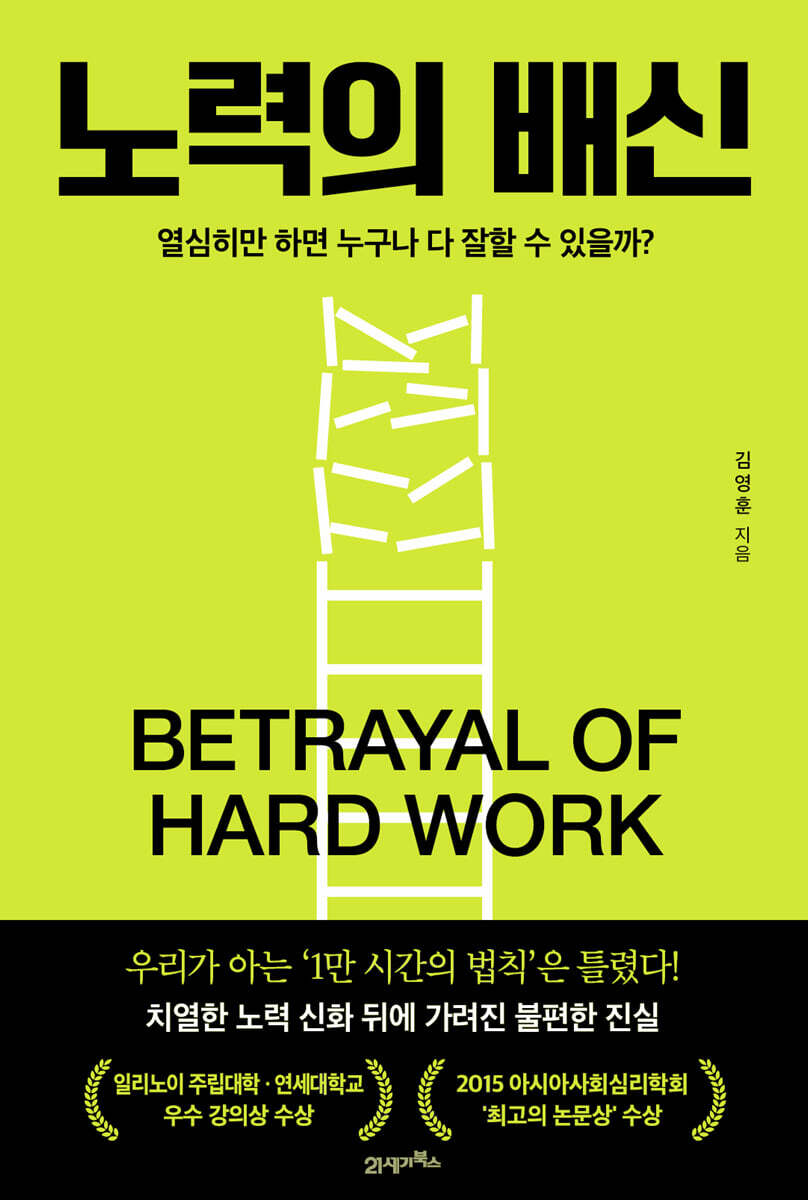
Betrayal of effort
 |
Description
Book Introduction
The '10,000-hour rule' we all know is wrong!
The Inconvenient Truth Behind the Myth of Fierce Effort
The '10,000-hour rule' states that anyone can become a top expert by investing 10,000 hours in something.
It gained support from many people with its hopeful message that anyone can succeed if they just work hard.
But what if we're misunderstanding the 10,000-hour rule? In fact, what the 10,000-hour rule emphasizes isn't effort, but the environment and opportunities that allow talent to blossom.
But now we are putting in all our effort, emphasizing only the '10,000 hours' of effort.
In his book, “The Betrayal of Effort,” Professor Kim Young-hoon of Yonsei University’s Department of Psychology questions the power of effort, which we have long believed to be the truth.
And we objectively examine the effectiveness of effort by analyzing scientific evidence on the impact of effort and talent on performance.
The author logically explains, from four perspectives, how hard work and talent contribute to success, and examines the meaning of this "belief in hard work" prevalent in our society.
Above all, it sharply analyzes the real reason why Korean society emphasizes only individual effort, and reveals the problems of a society that believes in effort and how it affects us.
Through this book, we will be able to reflect on how we should view the power of effort and how we should live in a society that worships effort.
The Inconvenient Truth Behind the Myth of Fierce Effort
The '10,000-hour rule' states that anyone can become a top expert by investing 10,000 hours in something.
It gained support from many people with its hopeful message that anyone can succeed if they just work hard.
But what if we're misunderstanding the 10,000-hour rule? In fact, what the 10,000-hour rule emphasizes isn't effort, but the environment and opportunities that allow talent to blossom.
But now we are putting in all our effort, emphasizing only the '10,000 hours' of effort.
In his book, “The Betrayal of Effort,” Professor Kim Young-hoon of Yonsei University’s Department of Psychology questions the power of effort, which we have long believed to be the truth.
And we objectively examine the effectiveness of effort by analyzing scientific evidence on the impact of effort and talent on performance.
The author logically explains, from four perspectives, how hard work and talent contribute to success, and examines the meaning of this "belief in hard work" prevalent in our society.
Above all, it sharply analyzes the real reason why Korean society emphasizes only individual effort, and reveals the problems of a society that believes in effort and how it affects us.
Through this book, we will be able to reflect on how we should view the power of effort and how we should live in a society that worships effort.
- You can preview some of the book's contents.
Preview
index
Prologue: Is Your Failure Due to a Lack of Effort?
PART 1: The Betrayal of Effort
01 Republic of Effort and Faith
If I try my best, can I really do well?
What to Study for 70 and 90-Point Subjects
A country that determines college admissions based on IQ tests
People in the 'Republic of Hard Work' who work too hard
02 Can a person change through effort?
A land of admonitions and nagging
How Criminals Are Born
The expectation that people can change creates conflict.
A society that does not recognize innate qualities
PART 2: The Endless Battle of Hard Work and Talent
01 Effort vs.
Talent: Who Will Be the Ultimate Winner?
The '10,000-hour rule' is wrong.
Scientific Evidence on Effort and Talent
02 Perspective ① - Who is doing the effort?
Are talent and effort completely different things?
Talent is what makes effort possible.
03 Perspective ② - Who Succeeds Through Effort?
Whose efforts are rewarded?
If you don't put in the effort, your talent won't shine.
04 Perspective ③ - What is Effort?
Is there a passionate persistence that transcends IQ, talent, and circumstance?
Is Grit Innate or Trainable?
05 Perspective ④ - The Wall of Competition and Time
Competition neutralizes effort
The correlation between finite time and effort
PART 3: IS YOUR SUCCESS JUSTIFIED?
01 The True Meaning of Fairness
Rewards and punishments based on success or failure: Is this a given?
Two Reasons Why Talent is Luck
The illusion that hard work brings success
02 Why Meritocracy is Dangerous
The personal suffering brought about by the republic of hard work
Social suffering brought about by blind faith in effort
Our focus on wealth and effort and our lack of social responsibility
03 How to Live in a Society That Believes in Hard Work
Don't be hard on yourself in the name of effort.
Your success has no justification.
Emphasize social responsibility over personal responsibility.
Epilogue For efforts to truly shine
References
PART 1: The Betrayal of Effort
01 Republic of Effort and Faith
If I try my best, can I really do well?
What to Study for 70 and 90-Point Subjects
A country that determines college admissions based on IQ tests
People in the 'Republic of Hard Work' who work too hard
02 Can a person change through effort?
A land of admonitions and nagging
How Criminals Are Born
The expectation that people can change creates conflict.
A society that does not recognize innate qualities
PART 2: The Endless Battle of Hard Work and Talent
01 Effort vs.
Talent: Who Will Be the Ultimate Winner?
The '10,000-hour rule' is wrong.
Scientific Evidence on Effort and Talent
02 Perspective ① - Who is doing the effort?
Are talent and effort completely different things?
Talent is what makes effort possible.
03 Perspective ② - Who Succeeds Through Effort?
Whose efforts are rewarded?
If you don't put in the effort, your talent won't shine.
04 Perspective ③ - What is Effort?
Is there a passionate persistence that transcends IQ, talent, and circumstance?
Is Grit Innate or Trainable?
05 Perspective ④ - The Wall of Competition and Time
Competition neutralizes effort
The correlation between finite time and effort
PART 3: IS YOUR SUCCESS JUSTIFIED?
01 The True Meaning of Fairness
Rewards and punishments based on success or failure: Is this a given?
Two Reasons Why Talent is Luck
The illusion that hard work brings success
02 Why Meritocracy is Dangerous
The personal suffering brought about by the republic of hard work
Social suffering brought about by blind faith in effort
Our focus on wealth and effort and our lack of social responsibility
03 How to Live in a Society That Believes in Hard Work
Don't be hard on yourself in the name of effort.
Your success has no justification.
Emphasize social responsibility over personal responsibility.
Epilogue For efforts to truly shine
References
Detailed image

Into the book
It's sad, but in this world, there are 'those who work hard' and 'those who are good at it'.
There are countless friends at school or work who work hard but don't do well.
To be honest, most people are like that.
The reason why the phrase, "That friend works really hard" often sounds lonely and empty is because there is no "good job" following it.
People know from experience that there is a difference between working hard and doing well.
---From "Page 23, Can You Really Do Well If You Try Your Best?"
Westerners worked harder on follow-up tasks when they received feedback saying, "You did quite well!", while Easterners worked harder on follow-up tasks when they received feedback saying, "You did quite poorly!"
Why do Westerners work harder when they receive feedback like, "You did pretty poorly!" and harder when they receive feedback like, "You did pretty well!"? It's because they believe in and acknowledge innate talent, and don't place much trust in the ability to work hard.
---From "Page 28, 70 and 90 Point Subjects, What to Study"
How much does studying well have to do with effort? It might not be 100 percent, but it's probably at least 90 percent. Surprisingly, the answer is 4 percent.
This means that studying well and putting in effort have little to do with each other.
It is a mistake to think that we can study well by putting in our best effort.
It's just our belief.
---From "Page 100, Scientific Evidence on Effort and Talent"
What if it had nothing to do with survival and no special reason to do well? You'd never work hard.
Who would do their best at something they have no talent for?
People who can't sing won't sing, people who aren't talented at cooking won't cook unless there's a special reason, and people who aren't talented at sports won't exercise.
This is human nature.
---From "Page 111, Are Talent and Effort Completely Different?"
We investigated what percentage of cases resulted in high achievements because of hard work based on high talent.
The study results were 25 percent.
What does this figure mean? It means that only 25 percent of the reasons talented people achieve well are due to hard work built on their talent.
So what about the remaining 75 percent? Talented people have a 75 percent chance of achieving high performance without any effort.
---From "Page 133, If You Don't Work Hard, Your Talent Won't Shine"
If we define grit as integrity, Professor Angela Duckworth's problem becomes more difficult.
Because conscientiousness is a personality trait.
How does the concept of personality traits affect this debate? Personality refers to innate, genetic traits, and therefore, personality is a trait that doesn't change much.
How can we change our personality?
There is a saying that 'when a person changes, he dies', so it is almost impossible for a person's personality to change.
---From "Page 158, Is there a passionate persistence that transcends IQ, talent, and environment?"
None of the three reasons for being good at studying were chosen arbitrarily by the individual.
It is given regardless of the individual's will.
So rewards and punishments for success and failure may not be justified.
Our society emphasizes responsibility, rewarding those who succeed with money and fame, and punishing those who fail with appropriate punishment.
But it is questionable whether the reward and punishment are just.
---From "Page 206, Rewards and Punishments Based on Success or Failure: Is This a Natural Truth?"
From a political perspective of running a society and a country, a republic that believes in hard work is a very good society to run.
Because all the problems can be blamed on individuals.
It doesn't matter if you starve to death, can't find a job, have a limited number of good jobs, or have a low minimum wage.
Because it can all be attributed to individual responsibility.
Anyone can live well and have a good job if they work hard.
---From "Page 256, Our Views on Wealth and Effort and the Absence of Social Responsibility"
Our success is no different.
I just benefited from my innate talent and the environment I was given.
But in a republic that believes in hard work, all success is attributed to effort.
So proud and upright.
The progressive income tax policy is both frustrating and unfair.
I even wonder, 'Are people who earn a lot of money fools?'
I feel like the world is unfair and unjust.
But if we analyze it properly, the people who have benefited the most from an unjust world and environment are none other than the successful ones.
There are countless friends at school or work who work hard but don't do well.
To be honest, most people are like that.
The reason why the phrase, "That friend works really hard" often sounds lonely and empty is because there is no "good job" following it.
People know from experience that there is a difference between working hard and doing well.
---From "Page 23, Can You Really Do Well If You Try Your Best?"
Westerners worked harder on follow-up tasks when they received feedback saying, "You did quite well!", while Easterners worked harder on follow-up tasks when they received feedback saying, "You did quite poorly!"
Why do Westerners work harder when they receive feedback like, "You did pretty poorly!" and harder when they receive feedback like, "You did pretty well!"? It's because they believe in and acknowledge innate talent, and don't place much trust in the ability to work hard.
---From "Page 28, 70 and 90 Point Subjects, What to Study"
How much does studying well have to do with effort? It might not be 100 percent, but it's probably at least 90 percent. Surprisingly, the answer is 4 percent.
This means that studying well and putting in effort have little to do with each other.
It is a mistake to think that we can study well by putting in our best effort.
It's just our belief.
---From "Page 100, Scientific Evidence on Effort and Talent"
What if it had nothing to do with survival and no special reason to do well? You'd never work hard.
Who would do their best at something they have no talent for?
People who can't sing won't sing, people who aren't talented at cooking won't cook unless there's a special reason, and people who aren't talented at sports won't exercise.
This is human nature.
---From "Page 111, Are Talent and Effort Completely Different?"
We investigated what percentage of cases resulted in high achievements because of hard work based on high talent.
The study results were 25 percent.
What does this figure mean? It means that only 25 percent of the reasons talented people achieve well are due to hard work built on their talent.
So what about the remaining 75 percent? Talented people have a 75 percent chance of achieving high performance without any effort.
---From "Page 133, If You Don't Work Hard, Your Talent Won't Shine"
If we define grit as integrity, Professor Angela Duckworth's problem becomes more difficult.
Because conscientiousness is a personality trait.
How does the concept of personality traits affect this debate? Personality refers to innate, genetic traits, and therefore, personality is a trait that doesn't change much.
How can we change our personality?
There is a saying that 'when a person changes, he dies', so it is almost impossible for a person's personality to change.
---From "Page 158, Is there a passionate persistence that transcends IQ, talent, and environment?"
None of the three reasons for being good at studying were chosen arbitrarily by the individual.
It is given regardless of the individual's will.
So rewards and punishments for success and failure may not be justified.
Our society emphasizes responsibility, rewarding those who succeed with money and fame, and punishing those who fail with appropriate punishment.
But it is questionable whether the reward and punishment are just.
---From "Page 206, Rewards and Punishments Based on Success or Failure: Is This a Natural Truth?"
From a political perspective of running a society and a country, a republic that believes in hard work is a very good society to run.
Because all the problems can be blamed on individuals.
It doesn't matter if you starve to death, can't find a job, have a limited number of good jobs, or have a low minimum wage.
Because it can all be attributed to individual responsibility.
Anyone can live well and have a good job if they work hard.
---From "Page 256, Our Views on Wealth and Effort and the Absence of Social Responsibility"
Our success is no different.
I just benefited from my innate talent and the environment I was given.
But in a republic that believes in hard work, all success is attributed to effort.
So proud and upright.
The progressive income tax policy is both frustrating and unfair.
I even wonder, 'Are people who earn a lot of money fools?'
I feel like the world is unfair and unjust.
But if we analyze it properly, the people who have benefited the most from an unjust world and environment are none other than the successful ones.
---From "Page 269, Your Success Has No Justification"
Publisher's Review
“Is your success justified?”
“Is discrimination based on meritocracy fair?”
Dismantling the illusion of effort we've always believed to be the truth
“The early bird catches the worm, a rolling stone gathers no moss, heaven helps those who help themselves….”
These are proverbs that anyone who grew up in Korea has heard at least once.
These proverbs all contain the message that if you work hard, you can do well in anything, so work hard.
In this way, there are many people in our country who praise the power and strength of effort.
This is because the belief that if you work hard, you can eventually do anything well, and that the reason I failed was because I didn't try hard enough, is widespread in our society regardless of gender or age.
But can anyone really do well if they just work hard?
Professor Kim Young-hoon, author of “Betrayal of Effort,” says that putting in a lot of effort does not lead to success, nor does putting in little effort lead to failure.
Effort is just one of many conditions.
But when I say this, many people ask questions.
But isn't one of the most important conditions effort?
This book introduces the process of revealing the answer to that very question.
An endless battle between effort and talent,
Who will be the final winner?
In "The Betrayal of Effort," it is said that many people misunderstand the "10,000-Hour Rule."
The 10,000-hour rule, as we know it, is the belief that anyone can become a top expert by investing 10,000 hours in something.
What made it so popular was the hopeful message that anyone could succeed if they worked hard enough to the point of death.
But did Malcolm Gladwell say that anyone can achieve success with 10,000 hours of effort? No.
The author says that what Malcolm was trying to say was not 'effort'.
In fact, what he emphasized was 'environment and opportunity'.
The success and wealth of the top 1 percent are not created through exceptional talent, but rather through the environment and opportunities that allow such talent to flourish.
If I say this, someone might say, 'Only those who work hard can seize opportunities!'
Is that really true? This book objectively analyzes the effectiveness of effort by uncovering scientific evidence on the impact of effort and talent on performance.
We mathematically calculate the percentage of success attributed to effort and talent, revealing whether our "belief in effort" is worthwhile.
“We are living too hard now.”
The Real Reason Korean Society Emphasizes Individual Effort
“So you’re saying I shouldn’t try?” Many people might ask this if you tell them that effort doesn’t affect performance.
But that's not what this book is trying to say.
In a society that believes in hard work, everyone, regardless of age, pushes themselves and others in the name of hard work.
Because hard work is the only way to survive, and hard work is everyone's hope.
However, the author paradoxically says that the more we believe in effort as the only god, the more miserable our lives become.
Because not everyone who tries their best will succeed.
In such a society, all failures are attributed to a lack of individual effort.
As failures continue to occur, you cannot help but feel a sense of inferiority, thinking that you are incompetent and pathetic.
The author points out this very point.
In a society that values hard work, we examine how people view success and failure, and reveal why the endless competition in the name of hard work is unfair.
Through this, we reflect on how we should live and propose a society in which we can acknowledge and understand each other's innate qualities and the circumstances we are given.
“Is discrimination based on meritocracy fair?”
Dismantling the illusion of effort we've always believed to be the truth
“The early bird catches the worm, a rolling stone gathers no moss, heaven helps those who help themselves….”
These are proverbs that anyone who grew up in Korea has heard at least once.
These proverbs all contain the message that if you work hard, you can do well in anything, so work hard.
In this way, there are many people in our country who praise the power and strength of effort.
This is because the belief that if you work hard, you can eventually do anything well, and that the reason I failed was because I didn't try hard enough, is widespread in our society regardless of gender or age.
But can anyone really do well if they just work hard?
Professor Kim Young-hoon, author of “Betrayal of Effort,” says that putting in a lot of effort does not lead to success, nor does putting in little effort lead to failure.
Effort is just one of many conditions.
But when I say this, many people ask questions.
But isn't one of the most important conditions effort?
This book introduces the process of revealing the answer to that very question.
An endless battle between effort and talent,
Who will be the final winner?
In "The Betrayal of Effort," it is said that many people misunderstand the "10,000-Hour Rule."
The 10,000-hour rule, as we know it, is the belief that anyone can become a top expert by investing 10,000 hours in something.
What made it so popular was the hopeful message that anyone could succeed if they worked hard enough to the point of death.
But did Malcolm Gladwell say that anyone can achieve success with 10,000 hours of effort? No.
The author says that what Malcolm was trying to say was not 'effort'.
In fact, what he emphasized was 'environment and opportunity'.
The success and wealth of the top 1 percent are not created through exceptional talent, but rather through the environment and opportunities that allow such talent to flourish.
If I say this, someone might say, 'Only those who work hard can seize opportunities!'
Is that really true? This book objectively analyzes the effectiveness of effort by uncovering scientific evidence on the impact of effort and talent on performance.
We mathematically calculate the percentage of success attributed to effort and talent, revealing whether our "belief in effort" is worthwhile.
“We are living too hard now.”
The Real Reason Korean Society Emphasizes Individual Effort
“So you’re saying I shouldn’t try?” Many people might ask this if you tell them that effort doesn’t affect performance.
But that's not what this book is trying to say.
In a society that believes in hard work, everyone, regardless of age, pushes themselves and others in the name of hard work.
Because hard work is the only way to survive, and hard work is everyone's hope.
However, the author paradoxically says that the more we believe in effort as the only god, the more miserable our lives become.
Because not everyone who tries their best will succeed.
In such a society, all failures are attributed to a lack of individual effort.
As failures continue to occur, you cannot help but feel a sense of inferiority, thinking that you are incompetent and pathetic.
The author points out this very point.
In a society that values hard work, we examine how people view success and failure, and reveal why the endless competition in the name of hard work is unfair.
Through this, we reflect on how we should live and propose a society in which we can acknowledge and understand each other's innate qualities and the circumstances we are given.
GOODS SPECIFICS
- Date of issue: July 19, 2023
- Page count, weight, size: 292 pages | 390g | 138*205*20mm
- ISBN13: 9788950957421
- ISBN10: 8950957426
You may also like
카테고리
korean


korean

![GQ KOREA Mark (Monthly): December [2025]](http://librairie.coreenne.fr/cdn/shop/files/8ef265dbbfbf186523ed75ba7319009d.jpg?v=1765340328&width=3840)


