

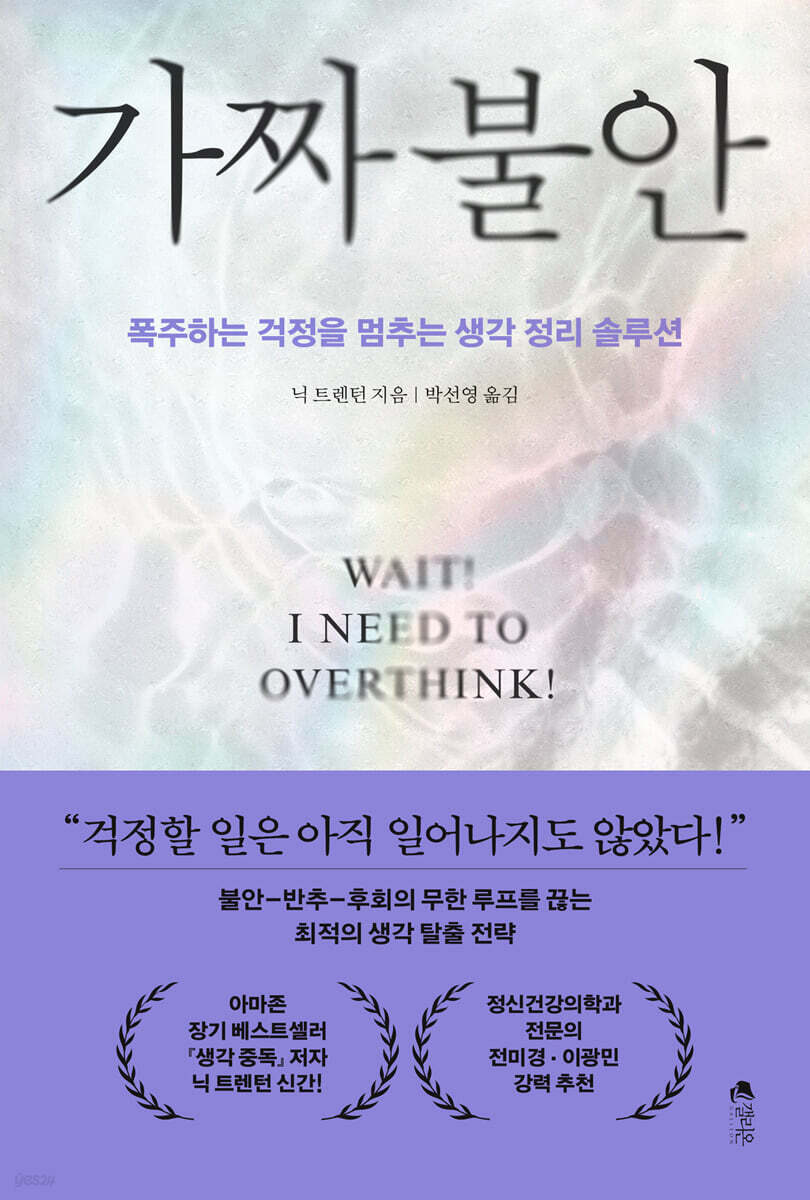
fake anxiety
 |
Description
Book Introduction
“Endless anxiety and rumination,
“The problem is not in reality, it’s in your head.”
A new book from Nick Trenton, author of the global bestseller "Thought Addiction"!
Do you find yourself constantly wondering, "What if?" even when nothing is happening, endlessly running simulations until you can't make a decision and procrastinate? If so, you've fallen into the trap of false anxiety.
In many cases, the negative emotions you feel now, such as anxiety and regret, may seem threatening enough to cause you to collapse, but the truth is that those emotions have no real substance and nothing actually happened.
Nick Trenton, author of the hit book 『Thought Addiction』, which was published independently and sold 400,000 copies through word of mouth alone, becoming an Amazon long-term bestseller, has returned to Korean readers with his new book 『Fake Anxiety』.
This book is for all modern people who are overwhelmed by vague and insubstantial anxieties, wasting enormous energy and time worrying, but are unable to solve their problems and are struggling.
The author presents proven strategies and specific, concrete action guidelines based on psychology and brain science, helping us distinguish between the "false anxieties" that plague us and guide us on the path to living in the here and now.
“The problem is not in reality, it’s in your head.”
A new book from Nick Trenton, author of the global bestseller "Thought Addiction"!
Do you find yourself constantly wondering, "What if?" even when nothing is happening, endlessly running simulations until you can't make a decision and procrastinate? If so, you've fallen into the trap of false anxiety.
In many cases, the negative emotions you feel now, such as anxiety and regret, may seem threatening enough to cause you to collapse, but the truth is that those emotions have no real substance and nothing actually happened.
Nick Trenton, author of the hit book 『Thought Addiction』, which was published independently and sold 400,000 copies through word of mouth alone, becoming an Amazon long-term bestseller, has returned to Korean readers with his new book 『Fake Anxiety』.
This book is for all modern people who are overwhelmed by vague and insubstantial anxieties, wasting enormous energy and time worrying, but are unable to solve their problems and are struggling.
The author presents proven strategies and specific, concrete action guidelines based on psychology and brain science, helping us distinguish between the "false anxieties" that plague us and guide us on the path to living in the here and now.
- You can preview some of the book's contents.
Preview
index
Special Preface to the Korean Edition
Chapter 1.
That anxiety is now unfounded.
Emotions are information, not commands.
Anxiety-inducing thought addiction
Beliefs and assumptions that obscure the facts
Chapter 2.
Mechanism of anxiety
Not all thoughts matter
Visualize your anxiety
The brain's malfunctioning warning system
Chapter 3.
Are my thoughts trustworthy?
The brain trusts emotions more than facts
Is it imagination or fact?
Excessive sense of responsibility and need for control
Chapter 4.
How to properly look at the present
Practice letting go of thoughts
Fake anxiety that steals your attention
The truth is more ordinary than you think.
Chapter 5.
You can't control everything
Break free from the trap of perfectionism
The power to endure uncertainty
How to manipulate your mind as you wish
Chapter 6.
Free yourself from false anxiety
Break free from analysis paralysis
Breaking the cycle of anxiety
If you can't stop thinking, change direction.
Chapter 1.
That anxiety is now unfounded.
Emotions are information, not commands.
Anxiety-inducing thought addiction
Beliefs and assumptions that obscure the facts
Chapter 2.
Mechanism of anxiety
Not all thoughts matter
Visualize your anxiety
The brain's malfunctioning warning system
Chapter 3.
Are my thoughts trustworthy?
The brain trusts emotions more than facts
Is it imagination or fact?
Excessive sense of responsibility and need for control
Chapter 4.
How to properly look at the present
Practice letting go of thoughts
Fake anxiety that steals your attention
The truth is more ordinary than you think.
Chapter 5.
You can't control everything
Break free from the trap of perfectionism
The power to endure uncertainty
How to manipulate your mind as you wish
Chapter 6.
Free yourself from false anxiety
Break free from analysis paralysis
Breaking the cycle of anxiety
If you can't stop thinking, change direction.
Detailed image

Into the book
Each chapter is structured around simple, clear core topics and action-oriented solutions.
Unnecessary examples and repetitive concept explanations have been boldly removed.
Each page has a clear purpose, and each exercise leads to real change.
We will move quickly from problem to solution, from theory to practice.
Because what we want is not mere comfort, but real change.
--- From the "Special Preface to the Korean Edition"
Accepting and experiencing your emotions fully is crucial for your mental health and has a positive impact on your physical health as well.
Emotions give depth, meaning, and color to our experiences, and they play a crucial role in our decision-making processes.
If you don't properly confront and accept your emotions, you're kicking away important learning opportunities.
In other words, emotions are not commands we must follow, but 'information' we must refer to.
For people suffering from anxiety, the problem isn't simply feeling a lot of "bad emotions."
The real problem is our inability to deal with our emotions effectively or wisely.
No one can control every situation in life.
We can never fully understand every situation we find ourselves in.
So we need to be able to think flexibly.
The stories we create can be tools to help us live the lives we want.
However, assumptions that are unrealistic, irrational, and inflexible do not serve as such tools; rather, they hinder us from living the lives we want.
--- From "Chapter 1: That Anxiety Now Has No Reality"
As you organize your thoughts, you realize that the complexly intertwined thoughts are actually the same thoughts repeated in various forms.
In other words, many thoughts are tangled together and everything seems confusing, but in reality, it is often just the same thought being varied in many ways.
Mind maps help you organize overlapping thoughts and summarize them into one core idea.
This will reduce unnecessary clutter in your head and give you more peace of mind.
--- From "Chapter 2: The Mechanism of Anxiety"
Being firmly connected to reality means facing and accepting your life as it is.
To do this, it is important to understand and utilize your time and resources well.
Managing time, a limited resource, efficiently is essential, especially when it comes to recognizing your limitations and setting realistic goals.
--- From "Chapter 3: Can I Trust My Thoughts?"
As we practice letting go of unnecessary attachments and focusing our consciousness, we begin to realize that many of the thoughts that arise from our "thinking mind" are nothing more than meaningless distractions.
They just stay for a while and then disappear.
Of all the thoughts floating through our minds, how many are actually meaningful? If you think about it, not many.
Remember that while you are training your attention, you can decide what you focus on and where you direct your mind.
It doesn't matter what my feelings or situation are right now.
It is up to me to decide where to focus my attention.
--- From "Chapter 4: How to Properly View the Present"
Ultimately, overthinking is an attempt to gain some degree of control over a situation.
When we don't know much about a situation, we tend to constantly seek information or overthink it to relieve discomfort and anxiety.
For example, let's say you're at a hospital having an important test and are waiting for the results.
Could it be a serious illness or not? The outcome is still unknown.
Uncertainty makes people suffer more.
When my mind is tormented by anxiety, I would rather just get rid of it.
Because my mind feels like a torture device.
But let's remember.
The mind can be a terrible master to us, but it can also be a wonderful servant.
The way to deal with overthinking is not to think 'less', but to think 'better'.
It is important to cultivate conscious, positive, and helpful thinking patterns rather than habitual, unhealthy thoughts.
--- From "Chapter 5 You Can't Control Everything"
We can always choose the best way to solve problems and live a better life.
And in the process, we don't have to be anxious for a single moment.
Just knowing this fact will make your heart feel much lighter.
Unnecessary examples and repetitive concept explanations have been boldly removed.
Each page has a clear purpose, and each exercise leads to real change.
We will move quickly from problem to solution, from theory to practice.
Because what we want is not mere comfort, but real change.
--- From the "Special Preface to the Korean Edition"
Accepting and experiencing your emotions fully is crucial for your mental health and has a positive impact on your physical health as well.
Emotions give depth, meaning, and color to our experiences, and they play a crucial role in our decision-making processes.
If you don't properly confront and accept your emotions, you're kicking away important learning opportunities.
In other words, emotions are not commands we must follow, but 'information' we must refer to.
For people suffering from anxiety, the problem isn't simply feeling a lot of "bad emotions."
The real problem is our inability to deal with our emotions effectively or wisely.
No one can control every situation in life.
We can never fully understand every situation we find ourselves in.
So we need to be able to think flexibly.
The stories we create can be tools to help us live the lives we want.
However, assumptions that are unrealistic, irrational, and inflexible do not serve as such tools; rather, they hinder us from living the lives we want.
--- From "Chapter 1: That Anxiety Now Has No Reality"
As you organize your thoughts, you realize that the complexly intertwined thoughts are actually the same thoughts repeated in various forms.
In other words, many thoughts are tangled together and everything seems confusing, but in reality, it is often just the same thought being varied in many ways.
Mind maps help you organize overlapping thoughts and summarize them into one core idea.
This will reduce unnecessary clutter in your head and give you more peace of mind.
--- From "Chapter 2: The Mechanism of Anxiety"
Being firmly connected to reality means facing and accepting your life as it is.
To do this, it is important to understand and utilize your time and resources well.
Managing time, a limited resource, efficiently is essential, especially when it comes to recognizing your limitations and setting realistic goals.
--- From "Chapter 3: Can I Trust My Thoughts?"
As we practice letting go of unnecessary attachments and focusing our consciousness, we begin to realize that many of the thoughts that arise from our "thinking mind" are nothing more than meaningless distractions.
They just stay for a while and then disappear.
Of all the thoughts floating through our minds, how many are actually meaningful? If you think about it, not many.
Remember that while you are training your attention, you can decide what you focus on and where you direct your mind.
It doesn't matter what my feelings or situation are right now.
It is up to me to decide where to focus my attention.
--- From "Chapter 4: How to Properly View the Present"
Ultimately, overthinking is an attempt to gain some degree of control over a situation.
When we don't know much about a situation, we tend to constantly seek information or overthink it to relieve discomfort and anxiety.
For example, let's say you're at a hospital having an important test and are waiting for the results.
Could it be a serious illness or not? The outcome is still unknown.
Uncertainty makes people suffer more.
When my mind is tormented by anxiety, I would rather just get rid of it.
Because my mind feels like a torture device.
But let's remember.
The mind can be a terrible master to us, but it can also be a wonderful servant.
The way to deal with overthinking is not to think 'less', but to think 'better'.
It is important to cultivate conscious, positive, and helpful thinking patterns rather than habitual, unhealthy thoughts.
--- From "Chapter 5 You Can't Control Everything"
We can always choose the best way to solve problems and live a better life.
And in the process, we don't have to be anxious for a single moment.
Just knowing this fact will make your heart feel much lighter.
--- From "Chapter 6: Freeing Yourself from False Anxiety"
Publisher's Review
“The problem you are worried about hasn’t happened yet.”
You're wasting your life worrying about problems that don't exist.
The perfect thought-organizing solution for you!
Do you feel compelled to do even the smallest tasks yourself, meddling in everything? Do you feel satisfied only after examining and comparing 50 items before purchasing something? While these behaviors may seem like efforts to improve your life, they may actually stem from a false sense of anxiety.
Simply put, 'false anxiety' is when you imagine the worst-case scenario in your head when there is nothing wrong in reality, causing yourself to feel unfounded anxiety.
Nick Trenton, author of "Thought Addiction," which has changed the lives of 400,000 readers worldwide, has now written a book titled "Fake Anxiety," which provides a detailed guide on how to focus on reality without being swayed by vague anxiety.
We often confuse 'preparing for the future' with 'cultivating vague anxiety.'
But the author confronts us with the fact that most of the things we worry about never actually happen, and when they do, the consequences are far less severe than anticipated.
In other words, much of our anxiety is not real, but rather false signals sent by our brain.
We get caught up in a state of overthinking, constantly checking and analyzing to reduce our worries.
But the more you cling to anxiety, the more worry you have, and more worry creates new anxiety.
The author argues that "thinking too much" may be just another avoidance behavior rather than a way to solve a problem, and emphasizes that recognizing false anxiety and realizing that it is a vague fear is the first real step toward moving forward.
So how can we distinguish between false anxiety and real anxiety?
Don't be fooled by your brain's false alarms.
How to Break the Vicious Cycle of Anxiety, Rumination, and Regret
When the human brain detects a potential threat, it focuses all its attention on ways to minimize damage and protect itself.
Anxiety is an instinctive emotion that evolved to protect us from danger.
But in modern society, our brains work differently than in the past.
Endless news feeds and social media platforms that bombard us with sensational information heighten our alertness, causing our brains to overreact and blare alarms when there's no danger.
In reality, you feel more anxious and worried even when there's nothing wrong! Rumination, the act of repeatedly thinking about a specific thought or topic, doesn't help you solve the problem; it only serves to amplify the feeling of anxiety.
Even negative thoughts that come up repeatedly can lead to avoidance of uncomfortable and anxious situations, which in the long run leads to learning greater anxiety (regret).
Rumination and avoidance like this may provide a sense of relief in the short term, but in the long run, it results in being trapped in an endless loop of anxiety-rumination-regret.
The author strategically introduces ways to stop this kind of rumination, break the vicious cycle, and transform 'anxiety' into thoughts that can help you find real solutions to your problems.
He suggests a method of escaping thoughts, emphasizing that the important thing is not to completely eliminate excessive thoughts and anxiety, but to cultivate the power to freely control them.
First, we regain control of our minds in anxious situations through 'gradual exposure', and then we change the direction of our thoughts through a step-by-step problem-solving method.
This will allow you to break free from your wandering thoughts and take concrete action to find a solution.
Throw away, organize, and change!
3 Principles of Thinking Out of Your Mind: Transforming Anxiety into a Problem-Solving Tool
This book doesn't devote pages to analyzing the causes of overthinking and anxiety.
Focusing on practice and solutions rather than theory and problems, we present a concise introduction to effective strategies that can be put to use immediately.
In particular, we have compiled solutions that have been developed and verified over the years based on the principles of cognitive behavioral therapy (CBT).
The goal of cognitive behavioral therapy is to develop optimal ways of thinking that serve you best, helping you change your perspective on and interpret situations for the better.
Among the many anxiety management techniques we are familiar with today, such as mindfulness and meditation, many emphasize calming the mind and alleviating anxiety.
However, the author points out that the more we try to get rid of anxiety, the stronger it becomes, and in the long run, we fail to transform our 'thoughts' into a driving force that improves our lives.
Here, I propose three principles to help you transform your thoughts and anxieties into 'tools for problem solving.'
The first is 'letting go', which involves looking at the swirling thoughts and emotions objectively and then letting go of unnecessary worries.
Emotions are not commands to be followed, but 'information'.
The attitude of viewing emotions as information allows us to name and analyze complex emotions accurately and deal with them usefully.
The second is ‘organizing’.
Organizing is learning strategies to objectively evaluate your thoughts.
To this end, we introduce effective, easy-to-implement methods that can be implemented in real life, such as brain dumps, mind maps, writing helpful thought journals, and time management, along with a mindset that cultivates an attitude of accepting uncertainty without taking on excessive responsibility.
Finally, 'change' is about developing the optimal mindset that helps us.
Knowing that it is not the situation itself but how we perceive and interpret it that determines our thoughts and actions, we strive to make our minds into excellent servants who help us live the lives we desire.
“The ultimate goal is not to think less,
“It’s about thinking better.”
Includes a variety of everyday activities and worksheets to help you change your thinking patterns!
Most people who worry about thinking too much blame their overthinking nature and have mistakenly believed that anxiety itself should be eliminated.
However, the author strongly argues that 'overthinking' is actually just an acquired habit, and that high anxiety can change if you learn how to deal with it, giving courage to the listless mind.
"Fake Anxiety" is like an emergency brake that will stop your thoughts from running wild.
The various activities introduced so that you can immediately apply them to frequently encountered problem situations or thought patterns are very effective.
For example, training to reduce rumination, reset assumptions, train attention, and break free from analysis paralysis can help you recognize your anxiety and objectively assess whether it is an illusion without substance.
It also includes a variety of worksheets that you can fill out yourself, such as an 'emotion vocabulary' to name your emotions, a writing guide to manage stress, and an anxiety level assessment chart, so you can feel real changes.
We can always choose the best way to solve problems and live a better life.
And in the process, we don't have to be anxious for a single moment.
Just knowing this fact will lighten your mind. (p. 221) Even at this very moment, you may be daydreaming about the next thing to do, the next worry, and countless other possibilities.
But remember.
If you just look at the present properly and change the way you deal with anxiety, you can live a much lighter and freer life right now.
『Fake Anxiety』 will give you a strong push on your back as you take your first step.
You're wasting your life worrying about problems that don't exist.
The perfect thought-organizing solution for you!
Do you feel compelled to do even the smallest tasks yourself, meddling in everything? Do you feel satisfied only after examining and comparing 50 items before purchasing something? While these behaviors may seem like efforts to improve your life, they may actually stem from a false sense of anxiety.
Simply put, 'false anxiety' is when you imagine the worst-case scenario in your head when there is nothing wrong in reality, causing yourself to feel unfounded anxiety.
Nick Trenton, author of "Thought Addiction," which has changed the lives of 400,000 readers worldwide, has now written a book titled "Fake Anxiety," which provides a detailed guide on how to focus on reality without being swayed by vague anxiety.
We often confuse 'preparing for the future' with 'cultivating vague anxiety.'
But the author confronts us with the fact that most of the things we worry about never actually happen, and when they do, the consequences are far less severe than anticipated.
In other words, much of our anxiety is not real, but rather false signals sent by our brain.
We get caught up in a state of overthinking, constantly checking and analyzing to reduce our worries.
But the more you cling to anxiety, the more worry you have, and more worry creates new anxiety.
The author argues that "thinking too much" may be just another avoidance behavior rather than a way to solve a problem, and emphasizes that recognizing false anxiety and realizing that it is a vague fear is the first real step toward moving forward.
So how can we distinguish between false anxiety and real anxiety?
Don't be fooled by your brain's false alarms.
How to Break the Vicious Cycle of Anxiety, Rumination, and Regret
When the human brain detects a potential threat, it focuses all its attention on ways to minimize damage and protect itself.
Anxiety is an instinctive emotion that evolved to protect us from danger.
But in modern society, our brains work differently than in the past.
Endless news feeds and social media platforms that bombard us with sensational information heighten our alertness, causing our brains to overreact and blare alarms when there's no danger.
In reality, you feel more anxious and worried even when there's nothing wrong! Rumination, the act of repeatedly thinking about a specific thought or topic, doesn't help you solve the problem; it only serves to amplify the feeling of anxiety.
Even negative thoughts that come up repeatedly can lead to avoidance of uncomfortable and anxious situations, which in the long run leads to learning greater anxiety (regret).
Rumination and avoidance like this may provide a sense of relief in the short term, but in the long run, it results in being trapped in an endless loop of anxiety-rumination-regret.
The author strategically introduces ways to stop this kind of rumination, break the vicious cycle, and transform 'anxiety' into thoughts that can help you find real solutions to your problems.
He suggests a method of escaping thoughts, emphasizing that the important thing is not to completely eliminate excessive thoughts and anxiety, but to cultivate the power to freely control them.
First, we regain control of our minds in anxious situations through 'gradual exposure', and then we change the direction of our thoughts through a step-by-step problem-solving method.
This will allow you to break free from your wandering thoughts and take concrete action to find a solution.
Throw away, organize, and change!
3 Principles of Thinking Out of Your Mind: Transforming Anxiety into a Problem-Solving Tool
This book doesn't devote pages to analyzing the causes of overthinking and anxiety.
Focusing on practice and solutions rather than theory and problems, we present a concise introduction to effective strategies that can be put to use immediately.
In particular, we have compiled solutions that have been developed and verified over the years based on the principles of cognitive behavioral therapy (CBT).
The goal of cognitive behavioral therapy is to develop optimal ways of thinking that serve you best, helping you change your perspective on and interpret situations for the better.
Among the many anxiety management techniques we are familiar with today, such as mindfulness and meditation, many emphasize calming the mind and alleviating anxiety.
However, the author points out that the more we try to get rid of anxiety, the stronger it becomes, and in the long run, we fail to transform our 'thoughts' into a driving force that improves our lives.
Here, I propose three principles to help you transform your thoughts and anxieties into 'tools for problem solving.'
The first is 'letting go', which involves looking at the swirling thoughts and emotions objectively and then letting go of unnecessary worries.
Emotions are not commands to be followed, but 'information'.
The attitude of viewing emotions as information allows us to name and analyze complex emotions accurately and deal with them usefully.
The second is ‘organizing’.
Organizing is learning strategies to objectively evaluate your thoughts.
To this end, we introduce effective, easy-to-implement methods that can be implemented in real life, such as brain dumps, mind maps, writing helpful thought journals, and time management, along with a mindset that cultivates an attitude of accepting uncertainty without taking on excessive responsibility.
Finally, 'change' is about developing the optimal mindset that helps us.
Knowing that it is not the situation itself but how we perceive and interpret it that determines our thoughts and actions, we strive to make our minds into excellent servants who help us live the lives we desire.
“The ultimate goal is not to think less,
“It’s about thinking better.”
Includes a variety of everyday activities and worksheets to help you change your thinking patterns!
Most people who worry about thinking too much blame their overthinking nature and have mistakenly believed that anxiety itself should be eliminated.
However, the author strongly argues that 'overthinking' is actually just an acquired habit, and that high anxiety can change if you learn how to deal with it, giving courage to the listless mind.
"Fake Anxiety" is like an emergency brake that will stop your thoughts from running wild.
The various activities introduced so that you can immediately apply them to frequently encountered problem situations or thought patterns are very effective.
For example, training to reduce rumination, reset assumptions, train attention, and break free from analysis paralysis can help you recognize your anxiety and objectively assess whether it is an illusion without substance.
It also includes a variety of worksheets that you can fill out yourself, such as an 'emotion vocabulary' to name your emotions, a writing guide to manage stress, and an anxiety level assessment chart, so you can feel real changes.
We can always choose the best way to solve problems and live a better life.
And in the process, we don't have to be anxious for a single moment.
Just knowing this fact will lighten your mind. (p. 221) Even at this very moment, you may be daydreaming about the next thing to do, the next worry, and countless other possibilities.
But remember.
If you just look at the present properly and change the way you deal with anxiety, you can live a much lighter and freer life right now.
『Fake Anxiety』 will give you a strong push on your back as you take your first step.
GOODS SPECIFICS
- Date of issue: March 21, 2025
- Page count, weight, size: 224 pages | 374g | 145*215*16mm
- ISBN13: 9788901294087
- ISBN10: 8901294087
You may also like
카테고리
korean


korean

![GQ KOREA Mark (Monthly): December [2025]](http://librairie.coreenne.fr/cdn/shop/files/8ef265dbbfbf186523ed75ba7319009d.jpg?v=1765340328&width=3840)


