

Journalist's Writing: The Art of Fighting (Principles)
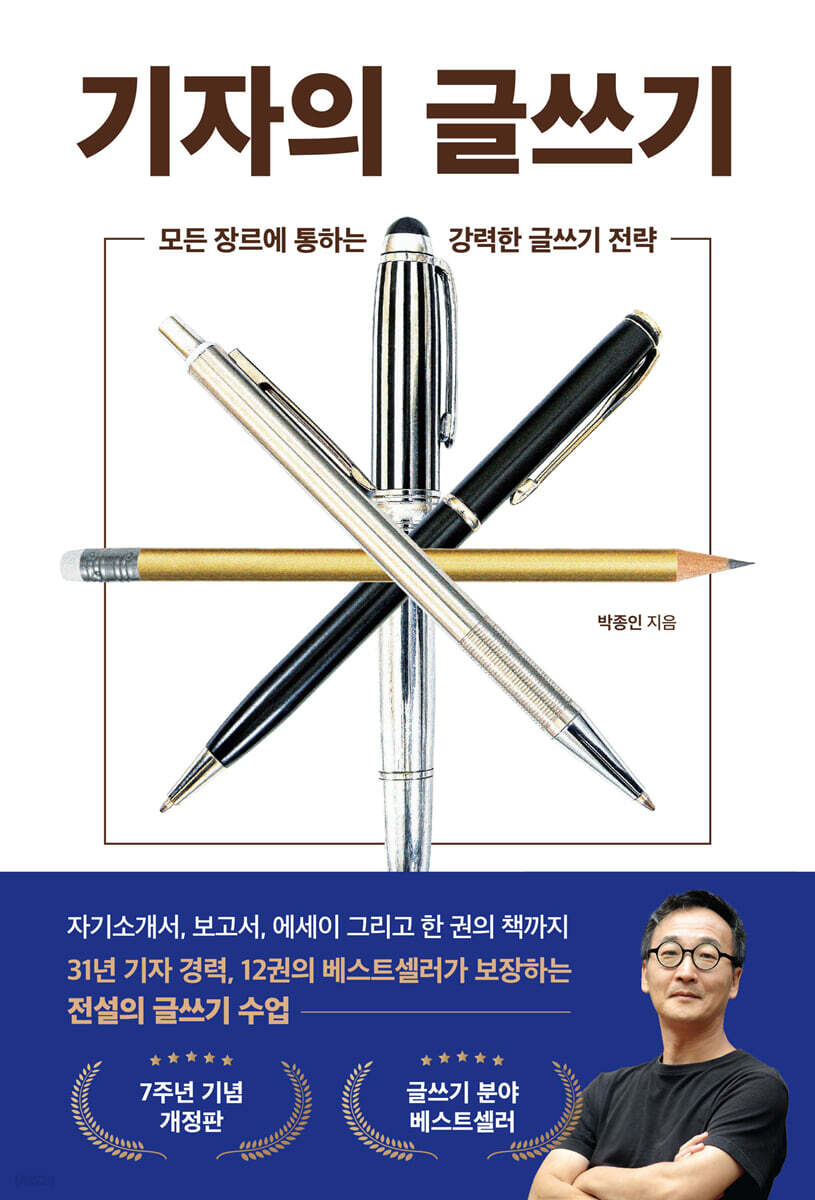 |
Description
Book Introduction
“If it’s not fun, no one will read it.
“Write your own story that will move even the devil!”
A personal statement, a report, an essay, and even a book
A legendary writing class guaranteed by 31 years of journalism and 12 best-selling books.
〈7th Anniversary Revised Edition〉 〈Bestseller in Writing〉
“Here are all the writing principles I learned while working as a journalist.
I guarantee that if you read this book carefully and in order just once, you will be able to get rid of your fear of writing.” _From the preface
A legendary out-of-print book from the used-book world, finally republished! Park Jong-in's "The Journalist's Writing," hailed as a "writing primer" since its initial publication in 2016, has returned with a fresh new look after seven years.
"A Journalist's Writing," which has been so popular with readers that it has even led to a shortage of used copies, is a book that contains the know-how that was not covered in class based on the writing lecture that was a hot topic at the "Chosun Ilbo Journalism Academy."
The reason so many readers have been waiting for this book is simple.
Because it is easier and more powerful than any other writing book.
It is also called the genre-neutral 'writing bible' for its clear explanations that apply to all genres.
"The Journalist's Writing" is neither a book about proper writing nor a critique of good writing.
It's just a writing cookbook that gives you recipes for 'fun' writing.
Anyone can write interesting articles if they follow the basic principles.
With this one book containing all the secrets, we can build a solid foundation for writing that will last a lifetime.
If you're afraid that writing is difficult and can't even begin, try ingraining the author's basic principles of writing: "Read, internalize, and throw away."
“Write your own story that will move even the devil!”
A personal statement, a report, an essay, and even a book
A legendary writing class guaranteed by 31 years of journalism and 12 best-selling books.
〈7th Anniversary Revised Edition〉 〈Bestseller in Writing〉
“Here are all the writing principles I learned while working as a journalist.
I guarantee that if you read this book carefully and in order just once, you will be able to get rid of your fear of writing.” _From the preface
A legendary out-of-print book from the used-book world, finally republished! Park Jong-in's "The Journalist's Writing," hailed as a "writing primer" since its initial publication in 2016, has returned with a fresh new look after seven years.
"A Journalist's Writing," which has been so popular with readers that it has even led to a shortage of used copies, is a book that contains the know-how that was not covered in class based on the writing lecture that was a hot topic at the "Chosun Ilbo Journalism Academy."
The reason so many readers have been waiting for this book is simple.
Because it is easier and more powerful than any other writing book.
It is also called the genre-neutral 'writing bible' for its clear explanations that apply to all genres.
"The Journalist's Writing" is neither a book about proper writing nor a critique of good writing.
It's just a writing cookbook that gives you recipes for 'fun' writing.
Anyone can write interesting articles if they follow the basic principles.
With this one book containing all the secrets, we can build a solid foundation for writing that will last a lifetime.
If you're afraid that writing is difficult and can't even begin, try ingraining the author's basic principles of writing: "Read, internalize, and throw away."
- You can preview some of the book's contents.
Preview
index
A cheeky preface to the revised edition
Introduction_Writing that moves even the devil
Chapter 1.
Three Stories About Writing
Easy | Short | Facts
Chapter 2.
Preparation: Pack your bags
Note-taking and archiving tools
Chapter 3.
Basic principles of writing
Writing is a Product | Principles to Follow When Writing | Seven Characteristics of Good Writing
Chapter 4.
From text design to production
The Writing Process | Characteristics and Differences by Genre | Parentheses, Indentation, and Titles | Genre-Specific Examples 1: Travel Essay | Genre-Specific Examples 2: Historical Criticism | Genre-Specific Examples 3: Personality Essays
Chapter 5.
Rhythmic sentences and structure
Writing Rhythmic Sentences | Characteristics of the Korean Language: Form and Rhythm | Structure with Rhythm | Talking About 'Facts': Writing Facts, Not Arguments | Reading for Writing
Before and After Sentences with Rhythm and Facts | Example 1 | Example 2
Chapter 6.
Fun Writing 1: Rhythm
Masters Don't Imitate: A Crooked Perspective | Masters Don't Blame Their Equipment: Easy Writing | The Elements of Writing - Content and Form | Writing is a Story
Before and After Sentences with Rhythm and Facts | Example 3 | Example 4 | Example 5
Chapter 7.
Writing Interesting Essays 2: Introduction, Development, Turn, and Conclusion
Why not "Introduction-Body-Conclusion"? | What is a "Presentation-Development-Current-Conclusion"? | Three Things to Keep in Mind in the Presentation-Development-Current-Conclusion Structure
Chapter 8.
Fun Writing 3: From the Monkey's Butthole to Baekdu Mountain
How to Transform Facts into Stories
Before and After Sentences with Rhythm and Facts | Example 6 | Example 7
Chapter 9.
Gateway: Last sentence
The lingering feeling comes from closing the door | The Sixth Sense's twist | How to properly close a door: Mastering the final sentence
Before and After Sentences with Rhythm and Facts | Example 8 | Example 9 | Example 10 | Example 11
Articles that do not require analysis or general commentary
Chapter 10.
Would you read it?: Resignation
Five Criteria for Revising Writing
Classy writing
Introduction_Writing that moves even the devil
Chapter 1.
Three Stories About Writing
Easy | Short | Facts
Chapter 2.
Preparation: Pack your bags
Note-taking and archiving tools
Chapter 3.
Basic principles of writing
Writing is a Product | Principles to Follow When Writing | Seven Characteristics of Good Writing
Chapter 4.
From text design to production
The Writing Process | Characteristics and Differences by Genre | Parentheses, Indentation, and Titles | Genre-Specific Examples 1: Travel Essay | Genre-Specific Examples 2: Historical Criticism | Genre-Specific Examples 3: Personality Essays
Chapter 5.
Rhythmic sentences and structure
Writing Rhythmic Sentences | Characteristics of the Korean Language: Form and Rhythm | Structure with Rhythm | Talking About 'Facts': Writing Facts, Not Arguments | Reading for Writing
Before and After Sentences with Rhythm and Facts | Example 1 | Example 2
Chapter 6.
Fun Writing 1: Rhythm
Masters Don't Imitate: A Crooked Perspective | Masters Don't Blame Their Equipment: Easy Writing | The Elements of Writing - Content and Form | Writing is a Story
Before and After Sentences with Rhythm and Facts | Example 3 | Example 4 | Example 5
Chapter 7.
Writing Interesting Essays 2: Introduction, Development, Turn, and Conclusion
Why not "Introduction-Body-Conclusion"? | What is a "Presentation-Development-Current-Conclusion"? | Three Things to Keep in Mind in the Presentation-Development-Current-Conclusion Structure
Chapter 8.
Fun Writing 3: From the Monkey's Butthole to Baekdu Mountain
How to Transform Facts into Stories
Before and After Sentences with Rhythm and Facts | Example 6 | Example 7
Chapter 9.
Gateway: Last sentence
The lingering feeling comes from closing the door | The Sixth Sense's twist | How to properly close a door: Mastering the final sentence
Before and After Sentences with Rhythm and Facts | Example 8 | Example 9 | Example 10 | Example 11
Articles that do not require analysis or general commentary
Chapter 10.
Would you read it?: Resignation
Five Criteria for Revising Writing
Classy writing
Detailed image

Into the book
Writing is the source from which all kinds of content grow.
Writing becomes a movie, a drama, a poem, and a photograph.
All content is rooted in writing.
That's why everyone says writing is important.
In my 32 years of writing experience, I've found that the principles of writing remain the same regardless of genre.
A complicated principle is not a principle.
The principle should be simple.
You can write great essays by learning just a few principles.
People simply cannot apply the principles because they are afraid of writing itself.
This book was written with the purpose of helping you realize that very principle.
Writing is not difficult.
If you don't know the principles, you can't write well. If you know the principles, anyone can write well.
--- From the "Preface"
Many people wonder, 'What is writing?' or 'What is good writing?'
This is especially true for people whose job is writing.
How can you write well without worrying about the writing?
Since ancient times, people who have made writing their profession have always thought about writing.
Selfishly, I studied ways to write better than others, and more broadly, I thought about writing methods that could move readers.
This book has little meaning for someone who keeps a diary hidden away from others, intending to burn it when they die.
But anyone who wants to write for the general public needs to think about good writing.
The purpose of thinking is to impress the reader, and the object of thinking is the principles that compose good writing.
--- 「Chapter 3.
From “Basic Principles of Writing”
Just throwing in words doesn't make for a good piece of writing.
There must be strength and weakness.
That way, readers can take a breath while reading, and also get sucked in quickly.
It's not like I'm including everything just because it's important.
To write interesting articles, you need to know when to hide and when to omit.
Good writing flows like water.
It reads like flowing water.
When it meets a rock, it turns around and turns into a rapid current, flowing away in an instant.
It flows rhythmically and smoothly.
No matter how excellent the content is, if it is written with rhythmless sentences and structure, it cannot impress.
--- 「Chapter 5.
From “Rhythmic Sentences and Structure”
Write confidently and decisively.
This is a direct statement to use it harshly.
When you lack confidence, two things happen in the world of writing.
First of all, the text is long.
Rather than writing definitively, you will be describing and using formulas.
If you say something, if you say something, if you say something, if you say something, you keep explaining it.
Because I have no confidence.
Even when we speak, if we are not confident, we speak while looking at the other person's expression.
'This person doesn't seem to believe me, so how should I talk to them?' This thought crosses my mind countless times.
Naturally, the speech becomes longer and longer.
--- Chapter 6.
From "Fun Writing 1: Rhythm"
Writing is not about writing, it's about editing.
The writing is finished only after it has been written and revised.
The criteria for editing text are as follows:
First, is it fun? First, see if it's fun or not.
Read it again and ask yourself questions.
“Would you read it yourself?” If you answer yes, it means the article is interesting.
Otherwise, you need to edit the text.
Second, if you read it all and still have questions, it's a bad article.
If you want to leave a lingering impression, you shouldn't end it with an ellipsis.
Third, a quality piece of writing must have a good ending.
The formality and minor details must be well done.
The details are nothing special.
This means that you should check for typos and grammatical errors.
Is the fourth rhythm correct?
Be sure to read it out loud.
If you don't make a sound, you can't find the rhythm.
Fifth, isn't it difficult?
If it's difficult, you'll be ignored.
Check for unnecessary, pedantic expressions and clichéd expressions.
Writing becomes a movie, a drama, a poem, and a photograph.
All content is rooted in writing.
That's why everyone says writing is important.
In my 32 years of writing experience, I've found that the principles of writing remain the same regardless of genre.
A complicated principle is not a principle.
The principle should be simple.
You can write great essays by learning just a few principles.
People simply cannot apply the principles because they are afraid of writing itself.
This book was written with the purpose of helping you realize that very principle.
Writing is not difficult.
If you don't know the principles, you can't write well. If you know the principles, anyone can write well.
--- From the "Preface"
Many people wonder, 'What is writing?' or 'What is good writing?'
This is especially true for people whose job is writing.
How can you write well without worrying about the writing?
Since ancient times, people who have made writing their profession have always thought about writing.
Selfishly, I studied ways to write better than others, and more broadly, I thought about writing methods that could move readers.
This book has little meaning for someone who keeps a diary hidden away from others, intending to burn it when they die.
But anyone who wants to write for the general public needs to think about good writing.
The purpose of thinking is to impress the reader, and the object of thinking is the principles that compose good writing.
--- 「Chapter 3.
From “Basic Principles of Writing”
Just throwing in words doesn't make for a good piece of writing.
There must be strength and weakness.
That way, readers can take a breath while reading, and also get sucked in quickly.
It's not like I'm including everything just because it's important.
To write interesting articles, you need to know when to hide and when to omit.
Good writing flows like water.
It reads like flowing water.
When it meets a rock, it turns around and turns into a rapid current, flowing away in an instant.
It flows rhythmically and smoothly.
No matter how excellent the content is, if it is written with rhythmless sentences and structure, it cannot impress.
--- 「Chapter 5.
From “Rhythmic Sentences and Structure”
Write confidently and decisively.
This is a direct statement to use it harshly.
When you lack confidence, two things happen in the world of writing.
First of all, the text is long.
Rather than writing definitively, you will be describing and using formulas.
If you say something, if you say something, if you say something, if you say something, you keep explaining it.
Because I have no confidence.
Even when we speak, if we are not confident, we speak while looking at the other person's expression.
'This person doesn't seem to believe me, so how should I talk to them?' This thought crosses my mind countless times.
Naturally, the speech becomes longer and longer.
--- Chapter 6.
From "Fun Writing 1: Rhythm"
Writing is not about writing, it's about editing.
The writing is finished only after it has been written and revised.
The criteria for editing text are as follows:
First, is it fun? First, see if it's fun or not.
Read it again and ask yourself questions.
“Would you read it yourself?” If you answer yes, it means the article is interesting.
Otherwise, you need to edit the text.
Second, if you read it all and still have questions, it's a bad article.
If you want to leave a lingering impression, you shouldn't end it with an ellipsis.
Third, a quality piece of writing must have a good ending.
The formality and minor details must be well done.
The details are nothing special.
This means that you should check for typos and grammatical errors.
Is the fourth rhythm correct?
Be sure to read it out loud.
If you don't make a sound, you can't find the rhythm.
Fifth, isn't it difficult?
If it's difficult, you'll be ignored.
Check for unnecessary, pedantic expressions and clichéd expressions.
--- 「Chapter 10.
Would You Read It?: From "Revised"
Would You Read It?: From "Revised"
Publisher's Review
31 years of business secrets revealed by a writing mentor for journalists and writers!
People want to write well. They want to get lots of likes on their social media posts and be recognized for their compelling proposals and reports.
I want to publish at least one book in my lifetime.
People with different goals and levels want to learn and write.
Still, writing is difficult.
According to the author's experience of making a living from writing for over 30 years, the principles of writing are the same regardless of genre.
"The Journalist's Writing" clearly shows how a dull piece of writing can be transformed into an engaging piece when it meets "principles."
Park Jong-in's practical "one-point lesson" that you won't find anywhere else! Since writing is a "product" offered to readers, the consumer, you should "produce" your writing in accordance with the principles by which they choose products.
This book will be the best guide for those who want to write more interesting articles than anyone else, those who want to write short and clear articles, and those who feel a vague burden about writing.
Of course, you are also trying to write something that will appeal to everyone from Brunch readers to publishers, not just a 'diary'.
This book will help you write something that will impress even the devil!
《The Journalist's Writing》 has been published in a revised edition to commemorate its 7th anniversary.
It has undergone a comprehensive revision, including the addition of chapters on ‘Notes’ and ‘Archiving’ (Chapter 2) and examples by genre, such as ‘Travel Essay’, ‘Historical Review’, and ‘Character Essay’ (Chapter 4).
Chapter 1 provides strategies for writing simple yet powerful pieces, emphasizing the principles of writing: "easy," "short," and "factual."
Chapter 3 breaks down the arrogance and prejudice held by most of the public and introduces the process of writing in which the "reader" is the master, such as "the power of writing comes from the first and last sentences," "good writing is written verbally," and "good writing leaves no room for curiosity."
From Chapter 5 onwards, the process is vividly revealed by using examples of students' writings that were actually edited in class.
In addition, it generously contains writing techniques that everyone can apply immediately, such as things to keep in mind when composing a story with a beginning, development, turn, and conclusion (Chapter 7), how to transform facts into a story (Chapter 8), how to write the final sentence, and how to review (Chapters 9 and 10).
"Reporter's Writing" will provide a hopeful solution for all those who struggle with writing self-introductions, including college students and job seekers, and for office workers who are constantly stressed by work emails and proposals.
People want to write well. They want to get lots of likes on their social media posts and be recognized for their compelling proposals and reports.
I want to publish at least one book in my lifetime.
People with different goals and levels want to learn and write.
Still, writing is difficult.
According to the author's experience of making a living from writing for over 30 years, the principles of writing are the same regardless of genre.
"The Journalist's Writing" clearly shows how a dull piece of writing can be transformed into an engaging piece when it meets "principles."
Park Jong-in's practical "one-point lesson" that you won't find anywhere else! Since writing is a "product" offered to readers, the consumer, you should "produce" your writing in accordance with the principles by which they choose products.
This book will be the best guide for those who want to write more interesting articles than anyone else, those who want to write short and clear articles, and those who feel a vague burden about writing.
Of course, you are also trying to write something that will appeal to everyone from Brunch readers to publishers, not just a 'diary'.
This book will help you write something that will impress even the devil!
《The Journalist's Writing》 has been published in a revised edition to commemorate its 7th anniversary.
It has undergone a comprehensive revision, including the addition of chapters on ‘Notes’ and ‘Archiving’ (Chapter 2) and examples by genre, such as ‘Travel Essay’, ‘Historical Review’, and ‘Character Essay’ (Chapter 4).
Chapter 1 provides strategies for writing simple yet powerful pieces, emphasizing the principles of writing: "easy," "short," and "factual."
Chapter 3 breaks down the arrogance and prejudice held by most of the public and introduces the process of writing in which the "reader" is the master, such as "the power of writing comes from the first and last sentences," "good writing is written verbally," and "good writing leaves no room for curiosity."
From Chapter 5 onwards, the process is vividly revealed by using examples of students' writings that were actually edited in class.
In addition, it generously contains writing techniques that everyone can apply immediately, such as things to keep in mind when composing a story with a beginning, development, turn, and conclusion (Chapter 7), how to transform facts into a story (Chapter 8), how to write the final sentence, and how to review (Chapters 9 and 10).
"Reporter's Writing" will provide a hopeful solution for all those who struggle with writing self-introductions, including college students and job seekers, and for office workers who are constantly stressed by work emails and proposals.
GOODS SPECIFICS
- Date of issue: August 20, 2023
- Page count, weight, size: 344 pages | 148*218*30mm
- ISBN13: 9791189328672
- ISBN10: 1189328674
You may also like
카테고리
korean


korean

![GQ KOREA Mark (Monthly): December [2025]](http://librairie.coreenne.fr/cdn/shop/files/8ef265dbbfbf186523ed75ba7319009d.jpg?v=1765340328&width=3840)


