

The forefront of writing
 |
Description
Book Introduction
The revised edition of 『The Front Line of Writing』, a book that "elevates readers with a passion for writing" and inspires them to "read and write 'together' rather than alone," has been published.
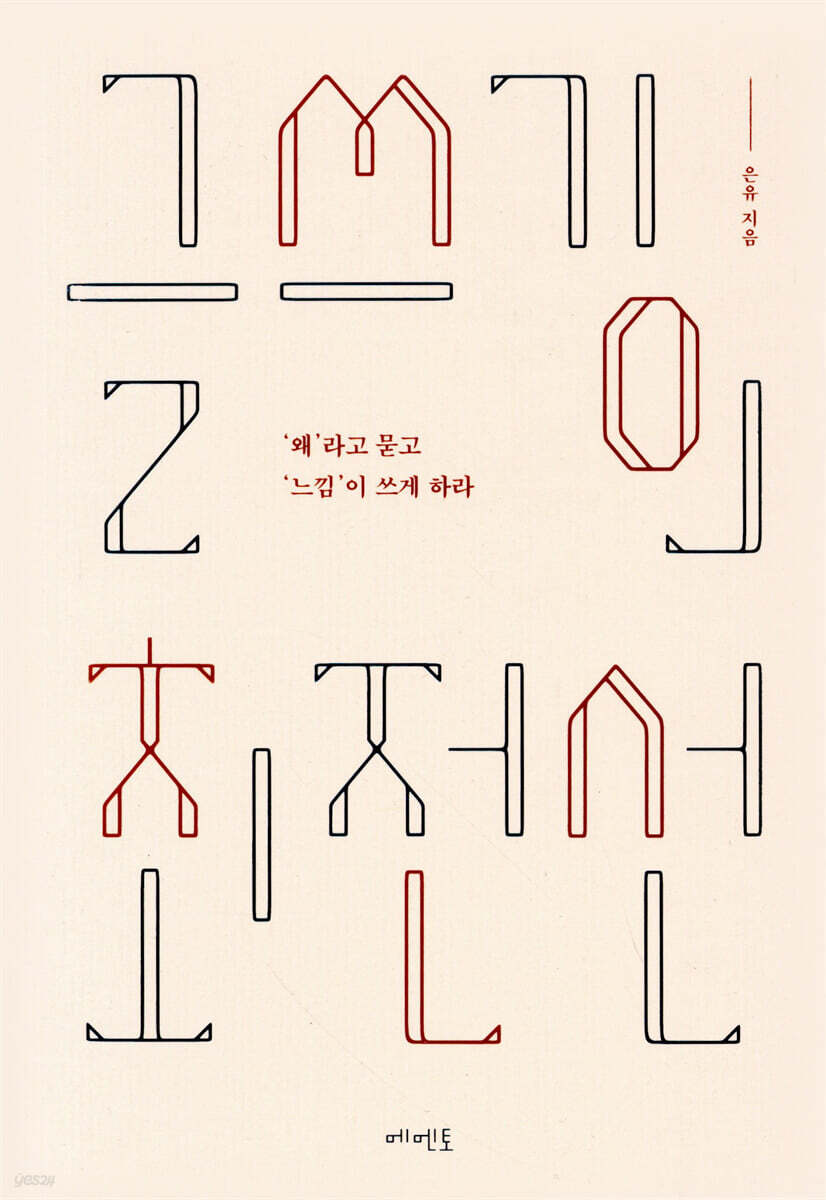
It reflects the changes made over the past seven years since its first publication in 2015, including a new cover and a reorganization of the popular "Books Read in Writing Class" list.
A collection of essays containing “very profound reflections on reading, thinking, and writing,” a collection of kind advice on the problems and concerns that anyone who begins writing faces, and a class journal documenting the changes students experience before and after a writing class.
"The Front Line of Writing" is a book like a warm hand extended to those who are hungry for "feeling," who want to shake the limits of "me" and "life," who want to broaden their understanding of humanity, and in other words, who want to change their lives through writing.
It reflects the changes made over the past seven years since its first publication in 2015, including a new cover and a reorganization of the popular "Books Read in Writing Class" list.
A collection of essays containing “very profound reflections on reading, thinking, and writing,” a collection of kind advice on the problems and concerns that anyone who begins writing faces, and a class journal documenting the changes students experience before and after a writing class.
"The Front Line of Writing" is a book like a warm hand extended to those who are hungry for "feeling," who want to shake the limits of "me" and "life," who want to broaden their understanding of humanity, and in other words, who want to change their lives through writing.
- You can preview some of the book's contents.
Preview
index
Why do I write?
Entering: To the forefront of writing
PART 1: Writing as an Advocacy of Life
Become an advocate for life
Time to face the history of another life
Shaking the limits of 'me' and 'life'
What I write is me
Writing of pain, a place of confusion and excess
Anyone who does not have their own language is weak.
Speaking in a way that cannot be spoken
As my body passes through many people's lives
PART 2: Building a Responsive Body
Books that stimulate us like misfortune
Enjoying the scenery of horses
The poetic experience of uselessness
To prevent sinking feelings
Curiosity, something that escapes me
Hapyeong, physical transformation of the reverse position
PART 3: Honing Your Reasons
Questioning the obvious
Expressing one's position
How differently can you think?
Let's write something that only I can write
Observe the place where the incident occurred
A book that many people should read, Nietzsche
PART 4 From the Abstract to the Concrete
Are Short Sentences Always Better?: Writing Short Sentences
With a writing body: copying
Writing About Things That Matter: Finding Motivation
From the Abstract to the Concrete: The Contents of the Article
Who will my writing help: The positioning of writing
Constellation Writing: The Structure of Writing
You can't write better or worse: let go of the power
Writing is a mirror of life: Conclusion
PART 5: Writing Reports and Interviews
Labor Report: George Orwell and the Harsh Downfall
Time to understand people, interviews
An interview is a thoughtful conversation.
My Own People's Autobiography Project
The importance of small and trivial things
Interviewing a 100-Year-Old Grandmother Who Lost Her Speech
PART 6 APPENDIX
Labor Report: Hyo-ju's Night Work / A Record of Three Months of Part-Time Work at McDonald's (Kang Hyo-ju)
Interview 1: "I was fine, even though I was lying in bed and having to urinate and defecate." / Princess Syndrome: A Mother's Story of Overcoming Depression (Park Seon-mi)
Interview 2: "Mr. Jangsu" / He and I (Sa-eun) Exist Only in the Family Registry
Reference books: Books read in writing class
Coming out: Sadness saves sadness
Entering: To the forefront of writing
PART 1: Writing as an Advocacy of Life
Become an advocate for life
Time to face the history of another life
Shaking the limits of 'me' and 'life'
What I write is me
Writing of pain, a place of confusion and excess
Anyone who does not have their own language is weak.
Speaking in a way that cannot be spoken
As my body passes through many people's lives
PART 2: Building a Responsive Body
Books that stimulate us like misfortune
Enjoying the scenery of horses
The poetic experience of uselessness
To prevent sinking feelings
Curiosity, something that escapes me
Hapyeong, physical transformation of the reverse position
PART 3: Honing Your Reasons
Questioning the obvious
Expressing one's position
How differently can you think?
Let's write something that only I can write
Observe the place where the incident occurred
A book that many people should read, Nietzsche
PART 4 From the Abstract to the Concrete
Are Short Sentences Always Better?: Writing Short Sentences
With a writing body: copying
Writing About Things That Matter: Finding Motivation
From the Abstract to the Concrete: The Contents of the Article
Who will my writing help: The positioning of writing
Constellation Writing: The Structure of Writing
You can't write better or worse: let go of the power
Writing is a mirror of life: Conclusion
PART 5: Writing Reports and Interviews
Labor Report: George Orwell and the Harsh Downfall
Time to understand people, interviews
An interview is a thoughtful conversation.
My Own People's Autobiography Project
The importance of small and trivial things
Interviewing a 100-Year-Old Grandmother Who Lost Her Speech
PART 6 APPENDIX
Labor Report: Hyo-ju's Night Work / A Record of Three Months of Part-Time Work at McDonald's (Kang Hyo-ju)
Interview 1: "I was fine, even though I was lying in bed and having to urinate and defecate." / Princess Syndrome: A Mother's Story of Overcoming Depression (Park Seon-mi)
Interview 2: "Mr. Jangsu" / He and I (Sa-eun) Exist Only in the Family Registry
Reference books: Books read in writing class
Coming out: Sadness saves sadness
Detailed image
Into the book
“As our lives become more precarious and the world moves toward greater misery, I believe writing should be a means to speak to my ever-fleeing life, to grasp the true nature of things, to bring life to living things, and to contemplate human dignity.”
--- p.23
“As with all things in life, writing doesn’t really change anything.
But everything changes.
“It is in the sense that we become ‘advocates of life’ who feel that life is not getting any worse, and who are able to maintain dignity even when it gets worse, and who strive to be sensitive to the being we encounter at every moment.”
--- p.42
“Writing is a craft for understanding life, and it requires constant practice.
It is about developing a sense of awareness of what is welling up within oneself, the logical and emotional capacity to express one's desires and rights, and the knowledge and perspective to read the world.
Then, you may or may not become a master of life, but you can live without getting any worse.”
--- p.43
“Writing must begin with shaking the limits of ‘me’ and ‘life.’
'Life' is a boring repetition of the same routine day after day.
The series of events, big and small, that bring joy and sorrow is only a small part of life.
The scope of ‘I’ is also not limited to the physical body with flesh and blood.
It is the sum total of the mind and the sum total of relationships. I am made up of things that are not me. Let's look at the language I use. It is the sum total of the words of the books I've read, the media I've encountered, the family I've lived with, the lovers I've met, and the friends I've played with.
--- p.53
“Wanting to write and actually writing are the same thing. They are two completely different worlds. One is something that makes you feel good, and the other is something that makes your body feel exhausted.
(...)? I often see people around me who want to write but haven't written a single article in years.
“You have to distinguish between wanting to write and enjoying the ‘feeling’ of wanting to write.”
--- pp.55~56
“What I write is me.
Even if it seems lacking, it is who you are now.
I like writing because it allows me to reveal and accept myself as I am, and because I improve little by little through my failures.
The constant process of writing, getting disappointed, and then writing again is very similar to living.
As Kim Su-yeong's poem "Aejeongjidun" says, "Life is infinite" and writing is also infinite."
--- p.58
“Writing about pain is writing about struggle.
It is a struggle against the illusion of self created by the gaze of others, a struggle between the possibilities that can be used and the possibilities that cannot be used, a struggle to select words that arise from a place of confusion and excess at every moment.
After this fierce fight, even if it is a petty self-assertion or a timid revenge against life, it is meaningful.”
--- p.64
“Almost all good writers have read good books.
Reading and writing are different acts, but their content is closely connected.
Reading becomes the foundation and writing sprouts the leaves.
Reading books broadens your perspective on the world and develops an eye for understanding people.
Gain insight into what the world is like.
“Learn the use, construction, and expressive power of your native language.”
--- p.82
“A poem that is not useful and therefore not oppressive.
A poem that is considered useless in this day and age.
A poem that disturbs the mind with its strange combination of words.
“As they pass through the simplest of poems, the scholars become aware of the oppression imposed on them.”
--- p.95
“Even if it is simple and rough, studying is reading poetry and struggling to explain it with your own feelings and thoughts.
This is the true joy of reading.
Don't submit to the authority of (the scholar) but focus on (your own) feelings.
The essence of poetry is not to expand knowledge, but to infinitely unfold the fabric of life.
No matter how difficult the poem is, I advised people not to look at reference books when reading it for the first time.”
--- pp.100~101
“Good writing asks questions.
Before telling people to be good citizens, good mothers, and good students, let's ask for their definitions.
Who decides what a good mother is? From whose perspective is it good? Is it peace in the family, or is it the happiness of a woman?
Sometimes morality is nothing more than a cheap device to protect real-world institutions like family and school.
It cultivates tame individuals who live by habitually sticking to the average of everyday life.
But there is no such thing as an average life or a set moral code.
“If there are a thousand lives, there must be a thousand morals.”
--- p.118
“Awareness of the problem is neither grand nor difficult.
It's an interest in things that people don't pay attention to.
It's questionable.
“It’s about focusing on, observing, and questioning situations and emotions, such as the natural flow of the world as if it were always there, such as a mother waking up every day to cook, a supermarket employee offering a mechanical greeting, or a feeling of discomfort for no reason.”
--- pp.137~138
“People with many question marks in their hearts are more likely to write good articles.
Because you will be triggered and inspired by even the smallest stimulus.
At some point, that question mark turns into an exclamation mark, and as you pass through another phase of life, that exclamation mark becomes a question mark again.
I started to think that maybe that wasn't all that I believed.
“The repetition and circulation of those question marks and exclamation marks gives rise to one’s own thoughts.”
--- p.23
“As with all things in life, writing doesn’t really change anything.
But everything changes.
“It is in the sense that we become ‘advocates of life’ who feel that life is not getting any worse, and who are able to maintain dignity even when it gets worse, and who strive to be sensitive to the being we encounter at every moment.”
--- p.42
“Writing is a craft for understanding life, and it requires constant practice.
It is about developing a sense of awareness of what is welling up within oneself, the logical and emotional capacity to express one's desires and rights, and the knowledge and perspective to read the world.
Then, you may or may not become a master of life, but you can live without getting any worse.”
--- p.43
“Writing must begin with shaking the limits of ‘me’ and ‘life.’
'Life' is a boring repetition of the same routine day after day.
The series of events, big and small, that bring joy and sorrow is only a small part of life.
The scope of ‘I’ is also not limited to the physical body with flesh and blood.
It is the sum total of the mind and the sum total of relationships. I am made up of things that are not me. Let's look at the language I use. It is the sum total of the words of the books I've read, the media I've encountered, the family I've lived with, the lovers I've met, and the friends I've played with.
--- p.53
“Wanting to write and actually writing are the same thing. They are two completely different worlds. One is something that makes you feel good, and the other is something that makes your body feel exhausted.
(...)? I often see people around me who want to write but haven't written a single article in years.
“You have to distinguish between wanting to write and enjoying the ‘feeling’ of wanting to write.”
--- pp.55~56
“What I write is me.
Even if it seems lacking, it is who you are now.
I like writing because it allows me to reveal and accept myself as I am, and because I improve little by little through my failures.
The constant process of writing, getting disappointed, and then writing again is very similar to living.
As Kim Su-yeong's poem "Aejeongjidun" says, "Life is infinite" and writing is also infinite."
--- p.58
“Writing about pain is writing about struggle.
It is a struggle against the illusion of self created by the gaze of others, a struggle between the possibilities that can be used and the possibilities that cannot be used, a struggle to select words that arise from a place of confusion and excess at every moment.
After this fierce fight, even if it is a petty self-assertion or a timid revenge against life, it is meaningful.”
--- p.64
“Almost all good writers have read good books.
Reading and writing are different acts, but their content is closely connected.
Reading becomes the foundation and writing sprouts the leaves.
Reading books broadens your perspective on the world and develops an eye for understanding people.
Gain insight into what the world is like.
“Learn the use, construction, and expressive power of your native language.”
--- p.82
“A poem that is not useful and therefore not oppressive.
A poem that is considered useless in this day and age.
A poem that disturbs the mind with its strange combination of words.
“As they pass through the simplest of poems, the scholars become aware of the oppression imposed on them.”
--- p.95
“Even if it is simple and rough, studying is reading poetry and struggling to explain it with your own feelings and thoughts.
This is the true joy of reading.
Don't submit to the authority of (the scholar) but focus on (your own) feelings.
The essence of poetry is not to expand knowledge, but to infinitely unfold the fabric of life.
No matter how difficult the poem is, I advised people not to look at reference books when reading it for the first time.”
--- pp.100~101
“Good writing asks questions.
Before telling people to be good citizens, good mothers, and good students, let's ask for their definitions.
Who decides what a good mother is? From whose perspective is it good? Is it peace in the family, or is it the happiness of a woman?
Sometimes morality is nothing more than a cheap device to protect real-world institutions like family and school.
It cultivates tame individuals who live by habitually sticking to the average of everyday life.
But there is no such thing as an average life or a set moral code.
“If there are a thousand lives, there must be a thousand morals.”
--- p.118
“Awareness of the problem is neither grand nor difficult.
It's an interest in things that people don't pay attention to.
It's questionable.
“It’s about focusing on, observing, and questioning situations and emotions, such as the natural flow of the world as if it were always there, such as a mother waking up every day to cook, a supermarket employee offering a mechanical greeting, or a feeling of discomfort for no reason.”
--- pp.137~138
“People with many question marks in their hearts are more likely to write good articles.
Because you will be triggered and inspired by even the smallest stimulus.
At some point, that question mark turns into an exclamation mark, and as you pass through another phase of life, that exclamation mark becomes a question mark again.
I started to think that maybe that wasn't all that I believed.
“The repetition and circulation of those question marks and exclamation marks gives rise to one’s own thoughts.”
--- p.138
Publisher's Review
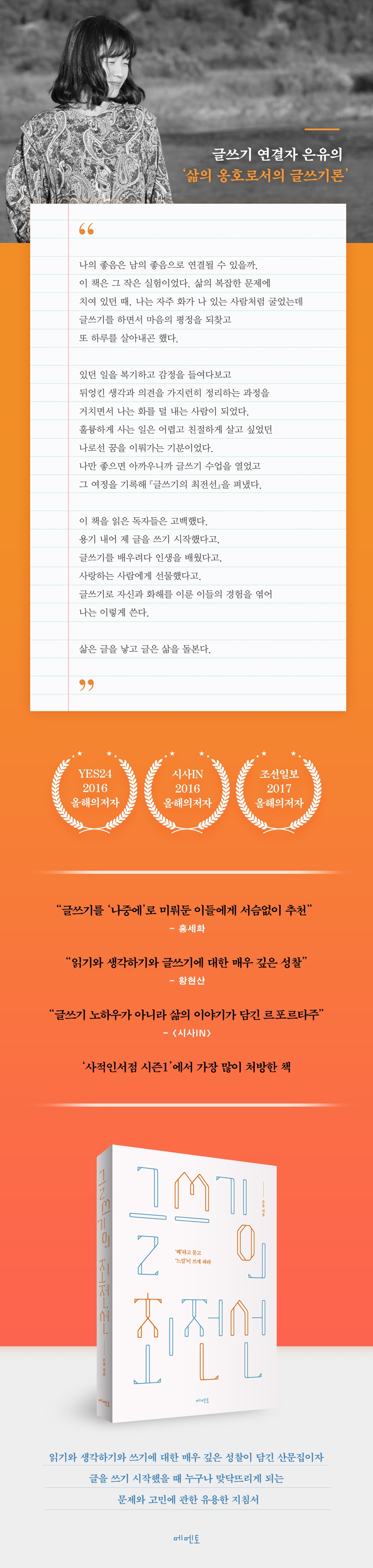
★ Yes24 Employee Selected Author of the Year 2015
★ Selected as Author of the Year 2016 by SisaIN
★ Chosun Ilbo's 2017 Author of the Year
★ “I recommend this book without hesitation to those who have put off writing until later.” - Hong Se-hwa
★ “A very profound reflection on reading, thinking, and writing” - Hwang Hyeon-san
★ "Not just writing tips, but reportage filled with life stories" - 〈Sisa IN〉
★ The most prescribed book in 'Private Bookstore Season 1'
1.
Life gives birth to writing, and writing nurtures life.
Author Eunyu's "Writing as a Defense of Life"
The revised edition of 『The Front Line of Writing』, a book that "elevates readers with a passion for writing" and inspires them to "read and write 'together' rather than alone," has been published.
It reflects the changes made over the past seven years since its first publication in 2015, including a new cover and a reorganization of the popular "Books Read in Writing Class" list.
Eun-yu, a writer who dreamed of a life of writing since she was fifteen, worked as a securities firm employee and a housewife before jumping into the world of writing in her mid-thirties.
At the same time, I studied humanities because I wanted to have words to describe myself and a language to understand myself.
From then on, I read, wrote, and thought almost every moment.
Writing didn't make much of a difference.
But I have a feeling that life is not getting any worse, and that even if it does get worse, I can still maintain my dignity.
If Jeon Tae-il, a worker who was working on a sewing machine in Cheonggyecheon, had not kept a diary, would there be a Jeon Tae-il today?
Until the cleaning worker confessed to the 900 won monthly lunch allowance, they were invisible ghosts.
When we can say in our own voices that young people have human rights and that old people have sexual desires, only then will young people and old people be recognized as living beings and individuals with blood flowing through them.
A piece of writing that was written with all my heart on the front lines of life.
Only those fierce and vivid records can provide a home for those who are exiled from this society.
This is what the metaphor says: 'Why everyone should write.'
“Can my goodness be connected to the goodness of others?
This book was that little experiment.
When I was caught up in the complexities of life, I often acted like an angry person, but writing helped me regain my composure and get through another day.
By going through the process of reviewing what happened, examining my emotions, and organizing my tangled thoughts and opinions, I became a less angry person.
Living well is difficult, and for me, who wanted to live kindly, it felt like a dream come true.
I opened a writing class because I thought it would be a waste if I were the only one who liked it, and I recorded that journey and published 『The Front Line of Writing』.
Readers who have read this book have confessed.
I started writing with courage, I learned about life while learning to write, I gave it to someone I love.
I write this by weaving together the experiences of those who have made peace with themselves through writing.
“Life gives birth to writing, and writing nurtures life.” - Author’s Note
2.
About reading, thinking and writing
It is a collection of prose with very deep reflections.
When we start writing, we all face this problem.
A useful guide to problems and concerns
This book is a collection of essays that contains “very profound reflections on reading, thinking, and writing,” a useful guide to the problems and concerns that anyone who begins writing faces, and a class journal that records the changes students experience before and after a writing class.
This book is like a warm hand reaching out to those who are hungry for 'feeling', who want to shake the limits of 'me' and 'life', who want to broaden their understanding of humanity, and who want to change their lives through writing.
The metaphorical writing class, which embraces 'reading', focuses on developing the muscles of sensitivity and the ability to empathize with the suffering of others through unique methods such as poetry recitation and memorization, reading, group critique, and interviews.
Students seeking writing classes range in age from their twenties to their fifties, including aspiring writers, housewives, office workers, teachers, and college students.
Most people, while living their daily lives faithful to their social roles, often come here with the intention of overcoming the feeling of being lost in self-expression or the loneliness of self-alienation.
They spend several months reading books together, reciting poetry, and critiquing each other's writing, experiencing a shift in their selves before and after writing.
As each person becomes able to 'invent their own language' that springs from their own lives, they also learn how to understand the lives of others and record the world.
This is because once self-exploration and organization are accomplished, space is created in the mind to listen to the stories of others.
Metaphor suggests 'writing reports and interviews' as the best study to cultivate sensitivity to pain and help understand humanity.
Translating other people's lives into my own language is like another 'life lesson'.
★ Selected as Author of the Year 2016 by SisaIN
★ Chosun Ilbo's 2017 Author of the Year
★ “I recommend this book without hesitation to those who have put off writing until later.” - Hong Se-hwa
★ “A very profound reflection on reading, thinking, and writing” - Hwang Hyeon-san
★ "Not just writing tips, but reportage filled with life stories" - 〈Sisa IN〉
★ The most prescribed book in 'Private Bookstore Season 1'
1.
Life gives birth to writing, and writing nurtures life.
Author Eunyu's "Writing as a Defense of Life"
The revised edition of 『The Front Line of Writing』, a book that "elevates readers with a passion for writing" and inspires them to "read and write 'together' rather than alone," has been published.
It reflects the changes made over the past seven years since its first publication in 2015, including a new cover and a reorganization of the popular "Books Read in Writing Class" list.
Eun-yu, a writer who dreamed of a life of writing since she was fifteen, worked as a securities firm employee and a housewife before jumping into the world of writing in her mid-thirties.
At the same time, I studied humanities because I wanted to have words to describe myself and a language to understand myself.
From then on, I read, wrote, and thought almost every moment.
Writing didn't make much of a difference.
But I have a feeling that life is not getting any worse, and that even if it does get worse, I can still maintain my dignity.
If Jeon Tae-il, a worker who was working on a sewing machine in Cheonggyecheon, had not kept a diary, would there be a Jeon Tae-il today?
Until the cleaning worker confessed to the 900 won monthly lunch allowance, they were invisible ghosts.
When we can say in our own voices that young people have human rights and that old people have sexual desires, only then will young people and old people be recognized as living beings and individuals with blood flowing through them.
A piece of writing that was written with all my heart on the front lines of life.
Only those fierce and vivid records can provide a home for those who are exiled from this society.
This is what the metaphor says: 'Why everyone should write.'
“Can my goodness be connected to the goodness of others?
This book was that little experiment.
When I was caught up in the complexities of life, I often acted like an angry person, but writing helped me regain my composure and get through another day.
By going through the process of reviewing what happened, examining my emotions, and organizing my tangled thoughts and opinions, I became a less angry person.
Living well is difficult, and for me, who wanted to live kindly, it felt like a dream come true.
I opened a writing class because I thought it would be a waste if I were the only one who liked it, and I recorded that journey and published 『The Front Line of Writing』.
Readers who have read this book have confessed.
I started writing with courage, I learned about life while learning to write, I gave it to someone I love.
I write this by weaving together the experiences of those who have made peace with themselves through writing.
“Life gives birth to writing, and writing nurtures life.” - Author’s Note
2.
About reading, thinking and writing
It is a collection of prose with very deep reflections.
When we start writing, we all face this problem.
A useful guide to problems and concerns
This book is a collection of essays that contains “very profound reflections on reading, thinking, and writing,” a useful guide to the problems and concerns that anyone who begins writing faces, and a class journal that records the changes students experience before and after a writing class.
This book is like a warm hand reaching out to those who are hungry for 'feeling', who want to shake the limits of 'me' and 'life', who want to broaden their understanding of humanity, and who want to change their lives through writing.
The metaphorical writing class, which embraces 'reading', focuses on developing the muscles of sensitivity and the ability to empathize with the suffering of others through unique methods such as poetry recitation and memorization, reading, group critique, and interviews.
Students seeking writing classes range in age from their twenties to their fifties, including aspiring writers, housewives, office workers, teachers, and college students.
Most people, while living their daily lives faithful to their social roles, often come here with the intention of overcoming the feeling of being lost in self-expression or the loneliness of self-alienation.
They spend several months reading books together, reciting poetry, and critiquing each other's writing, experiencing a shift in their selves before and after writing.
As each person becomes able to 'invent their own language' that springs from their own lives, they also learn how to understand the lives of others and record the world.
This is because once self-exploration and organization are accomplished, space is created in the mind to listen to the stories of others.
Metaphor suggests 'writing reports and interviews' as the best study to cultivate sensitivity to pain and help understand humanity.
Translating other people's lives into my own language is like another 'life lesson'.
GOODS SPECIFICS
- Publication date: November 1, 2022
- Page count, weight, size: 272 pages | 362g | 145*210*11mm
- ISBN13: 9791192099118
- ISBN10: 1192099117
You may also like
카테고리
korean


korean

![GQ KOREA Mark (Monthly): December [2025]](http://librairie.coreenne.fr/cdn/shop/files/8ef265dbbfbf186523ed75ba7319009d.jpg?v=1765340328&width=3840)


