

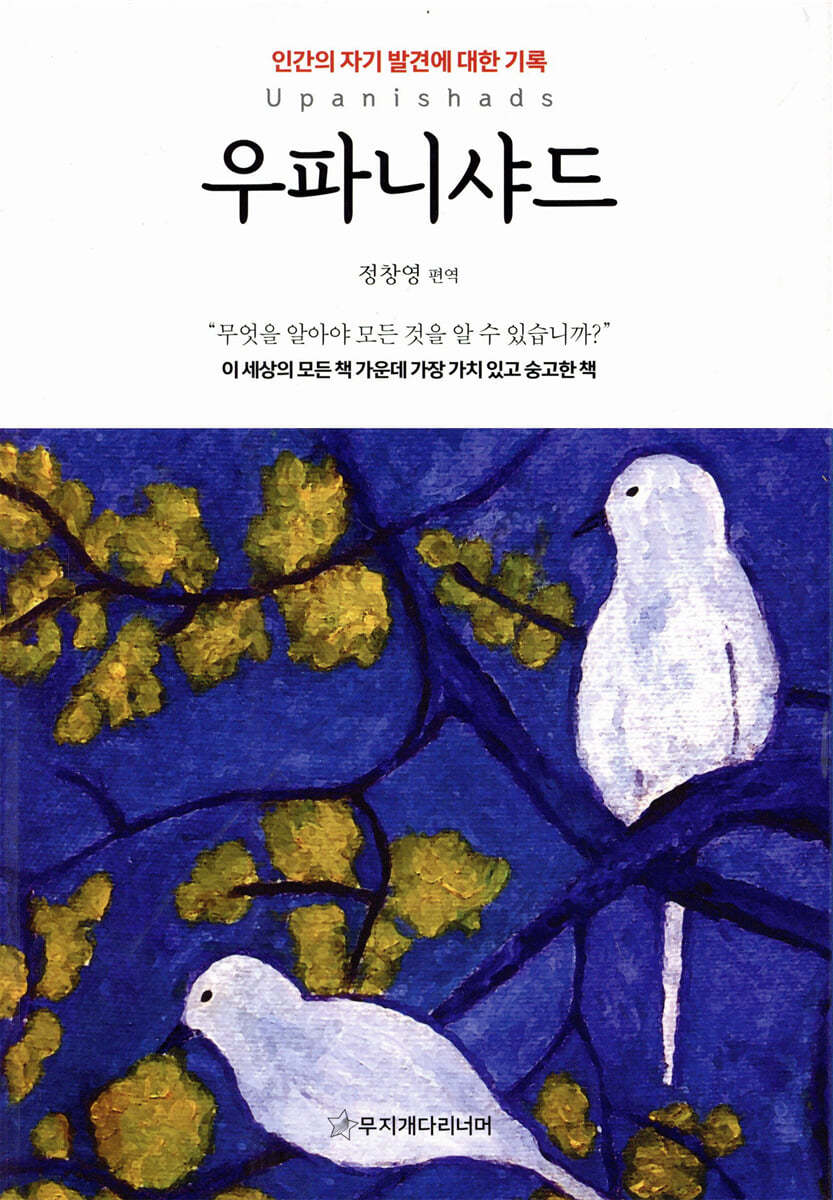
Upanishads
 |
Description
Book Introduction
Ancient messages passed down for thousands of years transcend time and space, providing a necessary life guide for us living in the modern era.
Who am I? Am I this physical body, composed of matter? Or am I the mind that thinks, feels, suffers, and enjoys? Or is there a true self, and if so, what is it? The Upanishads strive to answer these questions.
The Upanishads are a record of human self-discovery.
Through this book, you will deeply resonate with the realization of the one truth, the ultimate reality.
The Upanishads, known only as the source of Indian thought and Hindu scriptures and not easily accessible to the general public, are in fact full of deep and rich inspiration and intuitive foresight.
Translator Jeong Chang-yeong, considered one of the best storytellers in the field of spirituality, has tried to convey the meaning contained in these messages in an easy-to-understand manner.
Who am I? Am I this physical body, composed of matter? Or am I the mind that thinks, feels, suffers, and enjoys? Or is there a true self, and if so, what is it? The Upanishads strive to answer these questions.
The Upanishads are a record of human self-discovery.
Through this book, you will deeply resonate with the realization of the one truth, the ultimate reality.
The Upanishads, known only as the source of Indian thought and Hindu scriptures and not easily accessible to the general public, are in fact full of deep and rich inspiration and intuitive foresight.
Translator Jeong Chang-yeong, considered one of the best storytellers in the field of spirituality, has tried to convey the meaning contained in these messages in an easy-to-understand manner.
- You can preview some of the book's contents.
Preview
index
What kind of book is the Upanishad?
Katha Upanishad - Teachings of Yama, the God of Death
Translation Notes
Mundaka Upanishad - Two Kinds of Knowledge
Translation Notes
Shvetasvatara Upanishad - The Three Faces of God
Translation Notes
Prasna Upanishad - The Breath of Life
Translation Notes
Mandukya Upanishad - The Means of Enlightenment
Translation Notes
Brihadaranyaka Upanishad - Teachings of the Forest Sages
Translation Notes
Isha Upanishad - The Inner Ruler
Translation Notes
Chandogya Upanishad - The Sacred Songs
Translation Notes
Aitareya Upanishad - The Universe Within Man
Translation Notes
Kena Upanishad - Who is the protagonist?
Translation Notes
Taittiriya Upanishad - The Five Bodies and Foods
Translation Notes
Explanation
Key concepts of the Upanishads
The philosophy of the Upanishads
Katha Upanishad - Teachings of Yama, the God of Death
Translation Notes
Mundaka Upanishad - Two Kinds of Knowledge
Translation Notes
Shvetasvatara Upanishad - The Three Faces of God
Translation Notes
Prasna Upanishad - The Breath of Life
Translation Notes
Mandukya Upanishad - The Means of Enlightenment
Translation Notes
Brihadaranyaka Upanishad - Teachings of the Forest Sages
Translation Notes
Isha Upanishad - The Inner Ruler
Translation Notes
Chandogya Upanishad - The Sacred Songs
Translation Notes
Aitareya Upanishad - The Universe Within Man
Translation Notes
Kena Upanishad - Who is the protagonist?
Translation Notes
Taittiriya Upanishad - The Five Bodies and Foods
Translation Notes
Explanation
Key concepts of the Upanishads
The philosophy of the Upanishads
Into the book
Depending on what you eat and drink
As the state of the body changes,
The soul trapped in the body
Depending on what you see, what you hear, and what you think
Appropriate to the actions of the body
Reborn into a new body and environment.
--- p.124
“Teacher, when people sleep,
Who is the 'sleeper' in that person?
When you dream, who is the 'dreamer'?
When we wake up, who is the 'awakened one'?
When you fall into a deep, dreamless sleep,
Who is the 'deep sleeper' among them?
“Who is the ‘experiencer’ of these four states?”
--- p.151
“In the intermediate stage, the third plane of consciousness, which is like a dream, there is no carriage, no horses, and no road.
There, one's own consciousness creates words, carriages, and roads.
There is no joy or pleasure in that dimension.
But your own consciousness creates joy and pleasure.
In that dimension there are no lotus-covered ponds, lakes, or rivers, but your own consciousness creates ponds, lakes, and rivers.
A person in this state creates and experiences these things from the impressions of past lives received while awake.”
--- p.189
People who think that the external world is everything
Fall into the darkness of the soul.
People who think that only the inner world is real
Falling into deeper darkness.
People who think that only the external world is everything
Go the way of action.
People who think that only the inner world is real
Walk the path of wisdom.
But actions and wisdom,
A person who combines these two paths and achieves harmony
Crossing the sea of death through action
Immortality is achieved through wisdom.
This is the teaching of the ancient sages.
--- p.217~218
A place where thoughts cannot reach,
A place where all words and sounds return.
Be aware of that place.
Then you will know the bliss of Brahman and be free from all fear.
You will be free from all suffering caused by discrimination.
I will not lament, 'Why didn't I do the right thing?'
I will not be tormented by the thought, 'Why did I do something wrong?'
A person who enters the place of experiencing the bliss of Brahman
We will be freed forever from the duality of good and evil.
This is the Upanishad, the secret teaching.
As the state of the body changes,
The soul trapped in the body
Depending on what you see, what you hear, and what you think
Appropriate to the actions of the body
Reborn into a new body and environment.
--- p.124
“Teacher, when people sleep,
Who is the 'sleeper' in that person?
When you dream, who is the 'dreamer'?
When we wake up, who is the 'awakened one'?
When you fall into a deep, dreamless sleep,
Who is the 'deep sleeper' among them?
“Who is the ‘experiencer’ of these four states?”
--- p.151
“In the intermediate stage, the third plane of consciousness, which is like a dream, there is no carriage, no horses, and no road.
There, one's own consciousness creates words, carriages, and roads.
There is no joy or pleasure in that dimension.
But your own consciousness creates joy and pleasure.
In that dimension there are no lotus-covered ponds, lakes, or rivers, but your own consciousness creates ponds, lakes, and rivers.
A person in this state creates and experiences these things from the impressions of past lives received while awake.”
--- p.189
People who think that the external world is everything
Fall into the darkness of the soul.
People who think that only the inner world is real
Falling into deeper darkness.
People who think that only the external world is everything
Go the way of action.
People who think that only the inner world is real
Walk the path of wisdom.
But actions and wisdom,
A person who combines these two paths and achieves harmony
Crossing the sea of death through action
Immortality is achieved through wisdom.
This is the teaching of the ancient sages.
--- p.217~218
A place where thoughts cannot reach,
A place where all words and sounds return.
Be aware of that place.
Then you will know the bliss of Brahman and be free from all fear.
You will be free from all suffering caused by discrimination.
I will not lament, 'Why didn't I do the right thing?'
I will not be tormented by the thought, 'Why did I do something wrong?'
A person who enters the place of experiencing the bliss of Brahman
We will be freed forever from the duality of good and evil.
This is the Upanishad, the secret teaching.
--- p.327
Publisher's Review
A book that purifies our hearts!
“When the mind is purified, memories become clear,
When memory becomes transparent
“All the knots that bind my heart will be untied.”
Ancient messages passed down for thousands of years transcend time and space, providing a necessary life guide for us living in the modern era.
Who am I? Am I this physical body, composed of matter? Or am I the mind that thinks, feels, suffers, and enjoys? Or is there a true self? If so, what is it? The Upanishads strive to answer these questions.
The Upanishads are a record of human self-discovery.
Through this book, you will deeply resonate with the realization of the one truth, the ultimate reality.
The Upanishads, known only as the source of Indian thought and Hindu scriptures and not easily accessible to the general public, are in fact full of deep and rich inspiration and intuitive foresight.
Translator Jeong Chang-yeong, considered one of the best storytellers in the field of spirituality, has tried to convey the meaning contained in these messages in an easy-to-understand manner.
The enlightenment of the Upanishads cannot be understood through knowledge of the Vedas or study of the etymology of words.
The translator says that to understand the intuitive insights of the Upanishads, a great shift in consciousness is necessary, from the level of rational knowledge to the level of intuitive wisdom.
Otherwise, you will not understand the insights contained in the Upanishads.
Schopenhauer, who influenced existential philosophy and the psychology of Freud and Jung, is said to have always kept the Upanishads on his desk and habitually read them before going to bed.
Aldous Huxley, a writer who criticized reality and predicted the future, praised the ideas of the Upanishads as an inexhaustible philosophy.
Emerson, who considered the relationship between mind and matter to be an eternal problem of philosophy and advocated transcendentalism, incorporated Eastern thought into American philosophy and was particularly fascinated by the Upanishads.
The most valuable and noble book of all the books in this world!
“If you know what clay is, you will know everything made of clay.
You can make many things with clay,
“Because the essence is the same mud, only the names are different.”
Upanishad is a Sanskrit word meaning 'upa' meaning near, 'ni' meaning down, and 'shad' meaning to sit.
It soon means ‘teachings received while sitting at the teacher’s feet.’
The Upanishads unfold in the form of a teacher and student exchanging questions in the course of their daily lives.
Sometimes a wife asks her master husband about immortality, or a king seeks out an enlightened sage to ask him questions.
Sometimes we receive teachings not from people but from gods or animals.
The conversation is intuitive and spiritual rather than logical and philosophical.
A teacher does not impart knowledge.
Instead, it emphasizes the realization and experience of the supreme reality.
The date of composition of the Upanishads is generally B.
C. 8th century to B.
It is believed to date back to the 3rd century AD, but no one knows who wrote which Upanishad and when.
There are 108 extant Upanishads, and the number of missing ones is unknown.
The number of major Upanishads varies slightly from person to person, with some claiming 10, 11, 12, 13, 14, or 18.
Shankara, the great 8th-century thinker and mystic who revived India's spiritual traditions, considered the eleven to be part of the Vedic tradition and wrote commentaries on them.
In this book, I have collected and translated the 11 pieces he selected.
The Upanishads say that humans have three bodies.
The 'material body' is the physical body, the 'soul body' is the reincarnated subject that has memories of all the actions performed with the material body, and the 'original body' is the true self, Atman, that maintains its original state no matter how many changes the material body and the soul body experience.
“Two lovely birds that always travel together
Sitting on the same branch.
One of them is
I'm so busy picking and eating the fruit that I don't even notice it.
But the other one has no obsession at all
A friend who is indulging in fruit
I just look at it with apathy.
The bird that is gorging on the fruit is ego,
A bird that just watches is the true self.
- Mundaka Upanishad, Part 3, Chapter 1, Verses 1-3
The sages of the Upanishads say:
“Like birds that gobble up fruit, we forget our divine nature and groan and sigh in the snare of ceaseless, changing illusions.” Realization of the true self is possible not through reason but through fleeting intuition.
“The father told his son to fill a bowl with water and then add salt to it.
The son did as his father told him.
The next day my father said.
"Bring me the salt you put in the water yesterday." But that was not possible.
The salt had already dissolved in the water and was invisible even after washing my eyes.
My father said.
"Take a sip of the water on the surface and taste it.
How does it taste?
"It's salty."
"This time, take a picture from the middle and taste it.
How is it?"
"It's salty."
"Oh, really?
Now pour out the water."
The son did as his father told him.
Father asked again.
"Has the salt disappeared?"
"no."
My father said.
"Just as salt does not disappear when it is dissolved in water, and just as the salt itself does not disappear when the salt water is poured out, so it is with the Atman, the true self within you.
No matter how your appearance changes, your true self, Atman, always remains the same, though you may not be aware of it.
“The true self that always exists is your true essence.”
- Chandogya Upanishad, Book VI, Chapter 13, Verses 1-3
Just as rubbing two pieces of wood together ignites a fire hidden within them, I hope that through this book we will come to realize the true self hidden in the center of our hearts.
“What do I need to know to know everything?”
If we follow the end of matter in the most scientific way,
In the end, we approach the spiritual world that we had previously considered abstract.
The sages of the Upanishads discovered that nature and man are one, and that natural phenomena are a reflection of man's inner consciousness.
The visible world of phenomena is a shadow of the invisible world of reality.
That ultimate reality, which cannot be expressed in words, is the source of all human experience and the final destination to which consciousness can reach: the infinite common true self, Brahman.
The sages of the Upanishads say that Brahman and Atman are the same being.
The whole universe came from him, is sustained by his power, and in the end returns to him.
He says that even though he does not move, there is no place in space that he does not reach, and he makes everything alive and moving.
“Material phenomena are illusions, and Brahman is the magician who creates these illusions.
And all beings in this world are fragments of him who have shared in his divine radiance. (Shvetasvatara Upanishad, Chapter 4, Verse 10)
Jeong Chang-yeong, who translated this book, concludes his writing with the following words:
“Talking about the ultimate reality is not reality itself, but only talking about reality.
Like a finger pointing to the moon, language can only point to ultimate reality.
The language we find in the Upanishads plays just that role.
Therefore, when reading the Upanishads, rather than trying to establish a theoretical system about Brahman, Atman, or the phenomenal world, it is necessary to pay attention to the experiences that the Upanishad sages are talking about.”
“When the mind is purified, memories become clear,
When memory becomes transparent
“All the knots that bind my heart will be untied.”
Ancient messages passed down for thousands of years transcend time and space, providing a necessary life guide for us living in the modern era.
Who am I? Am I this physical body, composed of matter? Or am I the mind that thinks, feels, suffers, and enjoys? Or is there a true self? If so, what is it? The Upanishads strive to answer these questions.
The Upanishads are a record of human self-discovery.
Through this book, you will deeply resonate with the realization of the one truth, the ultimate reality.
The Upanishads, known only as the source of Indian thought and Hindu scriptures and not easily accessible to the general public, are in fact full of deep and rich inspiration and intuitive foresight.
Translator Jeong Chang-yeong, considered one of the best storytellers in the field of spirituality, has tried to convey the meaning contained in these messages in an easy-to-understand manner.
The enlightenment of the Upanishads cannot be understood through knowledge of the Vedas or study of the etymology of words.
The translator says that to understand the intuitive insights of the Upanishads, a great shift in consciousness is necessary, from the level of rational knowledge to the level of intuitive wisdom.
Otherwise, you will not understand the insights contained in the Upanishads.
Schopenhauer, who influenced existential philosophy and the psychology of Freud and Jung, is said to have always kept the Upanishads on his desk and habitually read them before going to bed.
Aldous Huxley, a writer who criticized reality and predicted the future, praised the ideas of the Upanishads as an inexhaustible philosophy.
Emerson, who considered the relationship between mind and matter to be an eternal problem of philosophy and advocated transcendentalism, incorporated Eastern thought into American philosophy and was particularly fascinated by the Upanishads.
The most valuable and noble book of all the books in this world!
“If you know what clay is, you will know everything made of clay.
You can make many things with clay,
“Because the essence is the same mud, only the names are different.”
Upanishad is a Sanskrit word meaning 'upa' meaning near, 'ni' meaning down, and 'shad' meaning to sit.
It soon means ‘teachings received while sitting at the teacher’s feet.’
The Upanishads unfold in the form of a teacher and student exchanging questions in the course of their daily lives.
Sometimes a wife asks her master husband about immortality, or a king seeks out an enlightened sage to ask him questions.
Sometimes we receive teachings not from people but from gods or animals.
The conversation is intuitive and spiritual rather than logical and philosophical.
A teacher does not impart knowledge.
Instead, it emphasizes the realization and experience of the supreme reality.
The date of composition of the Upanishads is generally B.
C. 8th century to B.
It is believed to date back to the 3rd century AD, but no one knows who wrote which Upanishad and when.
There are 108 extant Upanishads, and the number of missing ones is unknown.
The number of major Upanishads varies slightly from person to person, with some claiming 10, 11, 12, 13, 14, or 18.
Shankara, the great 8th-century thinker and mystic who revived India's spiritual traditions, considered the eleven to be part of the Vedic tradition and wrote commentaries on them.
In this book, I have collected and translated the 11 pieces he selected.
The Upanishads say that humans have three bodies.
The 'material body' is the physical body, the 'soul body' is the reincarnated subject that has memories of all the actions performed with the material body, and the 'original body' is the true self, Atman, that maintains its original state no matter how many changes the material body and the soul body experience.
“Two lovely birds that always travel together
Sitting on the same branch.
One of them is
I'm so busy picking and eating the fruit that I don't even notice it.
But the other one has no obsession at all
A friend who is indulging in fruit
I just look at it with apathy.
The bird that is gorging on the fruit is ego,
A bird that just watches is the true self.
- Mundaka Upanishad, Part 3, Chapter 1, Verses 1-3
The sages of the Upanishads say:
“Like birds that gobble up fruit, we forget our divine nature and groan and sigh in the snare of ceaseless, changing illusions.” Realization of the true self is possible not through reason but through fleeting intuition.
“The father told his son to fill a bowl with water and then add salt to it.
The son did as his father told him.
The next day my father said.
"Bring me the salt you put in the water yesterday." But that was not possible.
The salt had already dissolved in the water and was invisible even after washing my eyes.
My father said.
"Take a sip of the water on the surface and taste it.
How does it taste?
"It's salty."
"This time, take a picture from the middle and taste it.
How is it?"
"It's salty."
"Oh, really?
Now pour out the water."
The son did as his father told him.
Father asked again.
"Has the salt disappeared?"
"no."
My father said.
"Just as salt does not disappear when it is dissolved in water, and just as the salt itself does not disappear when the salt water is poured out, so it is with the Atman, the true self within you.
No matter how your appearance changes, your true self, Atman, always remains the same, though you may not be aware of it.
“The true self that always exists is your true essence.”
- Chandogya Upanishad, Book VI, Chapter 13, Verses 1-3
Just as rubbing two pieces of wood together ignites a fire hidden within them, I hope that through this book we will come to realize the true self hidden in the center of our hearts.
“What do I need to know to know everything?”
If we follow the end of matter in the most scientific way,
In the end, we approach the spiritual world that we had previously considered abstract.
The sages of the Upanishads discovered that nature and man are one, and that natural phenomena are a reflection of man's inner consciousness.
The visible world of phenomena is a shadow of the invisible world of reality.
That ultimate reality, which cannot be expressed in words, is the source of all human experience and the final destination to which consciousness can reach: the infinite common true self, Brahman.
The sages of the Upanishads say that Brahman and Atman are the same being.
The whole universe came from him, is sustained by his power, and in the end returns to him.
He says that even though he does not move, there is no place in space that he does not reach, and he makes everything alive and moving.
“Material phenomena are illusions, and Brahman is the magician who creates these illusions.
And all beings in this world are fragments of him who have shared in his divine radiance. (Shvetasvatara Upanishad, Chapter 4, Verse 10)
Jeong Chang-yeong, who translated this book, concludes his writing with the following words:
“Talking about the ultimate reality is not reality itself, but only talking about reality.
Like a finger pointing to the moon, language can only point to ultimate reality.
The language we find in the Upanishads plays just that role.
Therefore, when reading the Upanishads, rather than trying to establish a theoretical system about Brahman, Atman, or the phenomenal world, it is necessary to pay attention to the experiences that the Upanishad sages are talking about.”
GOODS SPECIFICS
- Date of issue: June 7, 2016
- Page count, weight, size: 400 pages | 548g | 148*210*30mm
- ISBN13: 9791195682102
- ISBN10: 1195682107
You may also like
카테고리
korean


korean

![GQ KOREA Mark (Monthly): December [2025]](http://librairie.coreenne.fr/cdn/shop/files/8ef265dbbfbf186523ed75ba7319009d.jpg?v=1765340328&width=3840)


