

Camus's Life Lessons
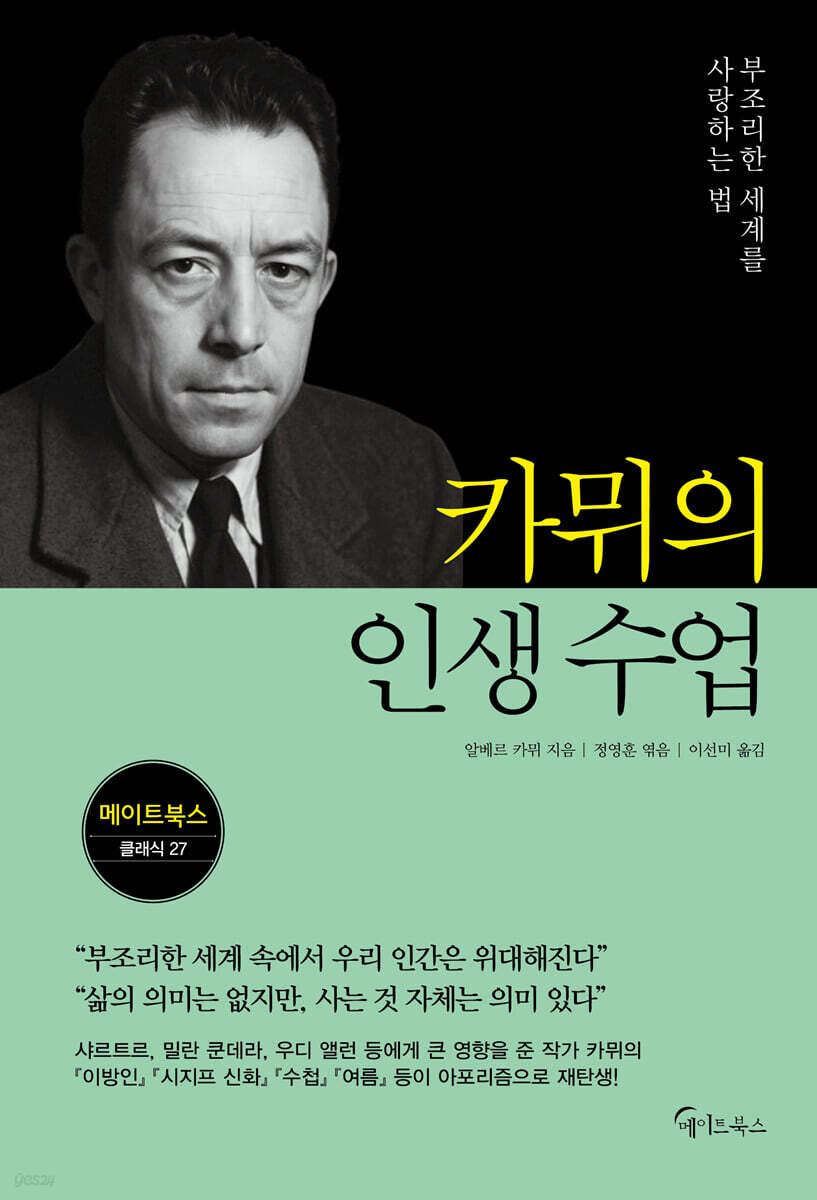 |
Description
Book Introduction
121 short stories and 6 stage narrative
Become friends with Camus!
Albert Camus's thoughts are reborn as 121 clear, lucid thoughts.
"Camus's Life Lessons" is the first attempt in Korea to reconstruct only the "most essential sentences for modern people" from his extensive works, including novels, essays, and notebooks.
Camus's existential philosophy, famously difficult to understand, is compressed into a complete aphorism of about 100 to 150 characters, completely breaking down the barrier to entry for readers.
These dense sentences are not mere excerpts, but the essence of Camus's philosophy, which spoke the truth in living human language.
Each sentence has its own independent completeness, allowing readers to intuitively acquire Camus' wisdom with each page turn.
This format simultaneously satisfies both deep thought and clear readability, opening up new horizons for aphorism collections.
This book is the result of a combination of the most profound philosophical analysis and the most sophisticated editorial planning.
The most special strength of this book is that it perfectly reorganizes Camus' entire philosophy into a logical system called the 'Six Stages of Life Narrative'.
Camus's sentences were scattered fragmentarily across numerous works, making it difficult for readers to grasp the vast flow of his ideas at a glance.
This translation uses the clear logical progression of 'recognition of absurdity → achievement of existential freedom → solitude and rebellion → solidarity and love' as the framework for the entire book.
Columns from different sources were integrated and compressed through highly specialized editing to eliminate duplication and clarify logical connections.
Readers acquire the ideas by following them in order, like a well-built building, rather than having to reassemble them themselves like a 'puzzle puzzle.'
This attempt to reorganize Camus's profound philosophy in such a dense structure is the result of a project with no precedent.
For modern people navigating a complex world, this journey will serve as a much-needed life map.
Become friends with Camus!
Albert Camus's thoughts are reborn as 121 clear, lucid thoughts.
"Camus's Life Lessons" is the first attempt in Korea to reconstruct only the "most essential sentences for modern people" from his extensive works, including novels, essays, and notebooks.
Camus's existential philosophy, famously difficult to understand, is compressed into a complete aphorism of about 100 to 150 characters, completely breaking down the barrier to entry for readers.
These dense sentences are not mere excerpts, but the essence of Camus's philosophy, which spoke the truth in living human language.
Each sentence has its own independent completeness, allowing readers to intuitively acquire Camus' wisdom with each page turn.
This format simultaneously satisfies both deep thought and clear readability, opening up new horizons for aphorism collections.
This book is the result of a combination of the most profound philosophical analysis and the most sophisticated editorial planning.
The most special strength of this book is that it perfectly reorganizes Camus' entire philosophy into a logical system called the 'Six Stages of Life Narrative'.
Camus's sentences were scattered fragmentarily across numerous works, making it difficult for readers to grasp the vast flow of his ideas at a glance.
This translation uses the clear logical progression of 'recognition of absurdity → achievement of existential freedom → solitude and rebellion → solidarity and love' as the framework for the entire book.
Columns from different sources were integrated and compressed through highly specialized editing to eliminate duplication and clarify logical connections.
Readers acquire the ideas by following them in order, like a well-built building, rather than having to reassemble them themselves like a 'puzzle puzzle.'
This attempt to reorganize Camus's profound philosophy in such a dense structure is the result of a project with no precedent.
For modern people navigating a complex world, this journey will serve as a much-needed life map.
index
Editor's Note: Camus's comfort to us living in an age of anxiety.
To the readers of this book: 11 Keys to Camus's Philosophy
Chapter 1: The first thing you must realize is that life is absurd.
The question, "Who am I?" is the driving force of life.
We must ask ourselves whether life is worth living.
We want clarity, but the world responds with silence.
The gap between human beings and life is the feeling of absurdity.
The gaze of others makes me an outsider.
Life has no meaning, but living itself is meaningful.
Realizing that life is meaningless is the beginning.
Death, the face of absurdity, creates the urgency of life.
A prison without walls for the hopeless
The most dangerous thing is the illusion of eternal life.
Only deep silence answers everything.
The courage to act knowing the emptiness behind the role
Condensing eternity in fleeting moments
Don't hold on to anything, including love.
The truth lies in the uncertain exploration, not in the answers.
Only when we acknowledge our pain does reasoning begin.
Recognizing the absurd is the beginning of liberation.
After the curtain falls on the stage, only empty seats remain.
The struggle toward normalcy is the greatness of our lives.
The fate of man is disconnection, and my life is a flame.
Chapter 2: Embrace the Absurd Fully and Achieve Existential Freedom
The absurdity of fate is not despair, but a passion for liberation.
Clarity in life gives me a reason to live.
Absurdity should not be eliminated, but endured and lived with.
A human being is truly faithful only when he loves without understanding.
Don't try to conquer the world, just accept it.
There is no 'why' in life, so just being alive is enough.
Philosophical suicide is a refusal to accept the absurd to the end.
The power taken away by God must be returned to humanity.
Recognizing the absurd is the freedom to reject false hope and move forward.
A life without appeal is the only worthwhile rebellion.
Absurd freedom is not nihilism, but a life-affirming fullness.
Freedom is a way of life that involves risk and responsibility.
The greatest feat of man is to have the maximum of experience.
Happiness is opening the door to the present.
Every day here and now is a complete life.
The courage to accept myself as I am is happiness.
The world is meaningless, but it is still beautiful.
It's a shame not to share happiness.
If there is no despair about life, there is no love of life.
Hope is a necessary illusion that enables us to endure reality.
Chapter 3: Endure Pain and Death and Find Dignity
The most fundamental question is, "Is life worth living?"
Suicide, which destroys the question itself, cannot be the answer.
Maintain a sense of uncompromising consciousness without surrendering to life.
Rebellion against the meaninglessness of life is the only courage.
Killing false hopes is true freedom.
Move toward the impossible and conquer tension, not habit.
To look upon death is to love life.
Each day is a fading light, so don't run away to eternity.
Those who seek immortality forget to live.
Pour everything out here and now, because death is the final appeal.
Your choice is stronger than fate, and death becomes your final freedom.
Despair and love together, this is the only wisdom.
Find clarity in the pain of dispelling false hopes.
Sisyphus can smile because I am stronger than fate.
It doesn't have to last long, what matters is the burning life.
Old age, which time cannot take away, is a record of rebellion.
Maturity is standing in uncertainty without a stable answer.
Abandon useless desires and achieve nobility through moderation.
We must confront the meaninglessness of life without empty promises and false comforts.
There is true clarity in the deprivation that poverty presents.
When we transcend ourselves and connect with the Source, we achieve complete perfection.
Chapter 4: Stand Alone in Solitude and Begin a Rebellion of Your Own Independence
True freedom begins in the solitude of the witnessless.
I am who others see me as, but I must become who I choose to be.
We must endure the emptiness and endure without appeal.
Freedom is not a right, it is a struggle to be won.
Silence gathers existence, and the power of creation comes from there.
Only after a long silence can honest and strong words emerge.
Abandon the comfort of the system and face the world's indifference.
We must remain faithful to the pure present with an attitude of awe.
Recognizing the absurd breeds rebellion, freedom, and passion.
Reject both despair and hope, and choose courage in the face of nothingness.
The only thing stronger than life is dignity preserved through attitude.
Meaning is not given, life is justified by creation.
Truth is something to be conquered and is only achieved through struggle.
Not lying is our true freedom.
All thoughts without action are ultimately just empty dreams.
Effort, not success, holds immortality.
The power of solidarity in trials keeps us oriented even in the storm.
Pour passionate fidelity into your one finite life.
Let go of vain longing and yearning, and find creative power in solitude.
Creating value through rebellion on the bare truth
Chapter 5: Be Positive in Every Moment of Life, Like the Sun and the Wind
He who loves the moment loves life itself.
Let us devote ourselves to the fleeting truths of today's sunshine and wind.
Eternity is not out there, it's in the moment.
Summer teaches us the duality of solitude and joy.
Humbly face finitude in the great cycle of nature.
Rebellious harmony begins when you realize that life is a circle, not a straight line.
The invincible summer is a rebellion against fate.
The sun teaches us to love even the pain of life.
Only in clear clarity can one practice free rebellion.
We must live gently in the light without appeal.
The sun teaches clarity, illusion does not.
Solitude is a fulfilling time to find inner strength.
The sea is a rebellious choice that fights for freedom.
The sea teaches humans patience to face fate.
Nature shows us both rebellion and humility.
Humans must first and foremost be faithful to the earth.
The earth entrusts humans with the task of creating value.
Stepping on the earth is an existential rebirth.
The full power to give everything to life here and now
Every morning light is the final victory over absurdity.
Chapter 6: Go beyond personal rebellion and love others in solidarity.
I rebel, therefore we exist.
In an absurd world, rebellion soon becomes solidarity.
True rebellion is the affirmation of life, not its denial.
True solidarity is an ethical decision to share suffering.
Justice lies within humanity and comes from solidarity.
True shame is not silence, but the protection of others.
Enduring disaster together is the only dignity
Rebellion, when it forgets its limits, becomes oppression, so we reject tyranny.
To love the imperfections of this world, that is the only wisdom.
Love is not about possessing, it is about freeing others.
Love is existence, and together they give meaning to meaninglessness.
Courageous love embraces even the anxiety of loss.
Love is losing myself in countless beings, not just one.
Kindness is a rebellion that preserves human limitations in the face of disaster.
Community is not about fusion, but about solidarity that respects solitary existence.
Forgiveness is the act of freeing yourself from past grudges.
Art does not save, it only testifies.
Even if life is a tragedy, you must love it.
Marriage is not just a bond between people; it is a bond between humans and the earth.
The world is beautiful, and there is no salvation outside the world.
To the readers of this book: 11 Keys to Camus's Philosophy
Chapter 1: The first thing you must realize is that life is absurd.
The question, "Who am I?" is the driving force of life.
We must ask ourselves whether life is worth living.
We want clarity, but the world responds with silence.
The gap between human beings and life is the feeling of absurdity.
The gaze of others makes me an outsider.
Life has no meaning, but living itself is meaningful.
Realizing that life is meaningless is the beginning.
Death, the face of absurdity, creates the urgency of life.
A prison without walls for the hopeless
The most dangerous thing is the illusion of eternal life.
Only deep silence answers everything.
The courage to act knowing the emptiness behind the role
Condensing eternity in fleeting moments
Don't hold on to anything, including love.
The truth lies in the uncertain exploration, not in the answers.
Only when we acknowledge our pain does reasoning begin.
Recognizing the absurd is the beginning of liberation.
After the curtain falls on the stage, only empty seats remain.
The struggle toward normalcy is the greatness of our lives.
The fate of man is disconnection, and my life is a flame.
Chapter 2: Embrace the Absurd Fully and Achieve Existential Freedom
The absurdity of fate is not despair, but a passion for liberation.
Clarity in life gives me a reason to live.
Absurdity should not be eliminated, but endured and lived with.
A human being is truly faithful only when he loves without understanding.
Don't try to conquer the world, just accept it.
There is no 'why' in life, so just being alive is enough.
Philosophical suicide is a refusal to accept the absurd to the end.
The power taken away by God must be returned to humanity.
Recognizing the absurd is the freedom to reject false hope and move forward.
A life without appeal is the only worthwhile rebellion.
Absurd freedom is not nihilism, but a life-affirming fullness.
Freedom is a way of life that involves risk and responsibility.
The greatest feat of man is to have the maximum of experience.
Happiness is opening the door to the present.
Every day here and now is a complete life.
The courage to accept myself as I am is happiness.
The world is meaningless, but it is still beautiful.
It's a shame not to share happiness.
If there is no despair about life, there is no love of life.
Hope is a necessary illusion that enables us to endure reality.
Chapter 3: Endure Pain and Death and Find Dignity
The most fundamental question is, "Is life worth living?"
Suicide, which destroys the question itself, cannot be the answer.
Maintain a sense of uncompromising consciousness without surrendering to life.
Rebellion against the meaninglessness of life is the only courage.
Killing false hopes is true freedom.
Move toward the impossible and conquer tension, not habit.
To look upon death is to love life.
Each day is a fading light, so don't run away to eternity.
Those who seek immortality forget to live.
Pour everything out here and now, because death is the final appeal.
Your choice is stronger than fate, and death becomes your final freedom.
Despair and love together, this is the only wisdom.
Find clarity in the pain of dispelling false hopes.
Sisyphus can smile because I am stronger than fate.
It doesn't have to last long, what matters is the burning life.
Old age, which time cannot take away, is a record of rebellion.
Maturity is standing in uncertainty without a stable answer.
Abandon useless desires and achieve nobility through moderation.
We must confront the meaninglessness of life without empty promises and false comforts.
There is true clarity in the deprivation that poverty presents.
When we transcend ourselves and connect with the Source, we achieve complete perfection.
Chapter 4: Stand Alone in Solitude and Begin a Rebellion of Your Own Independence
True freedom begins in the solitude of the witnessless.
I am who others see me as, but I must become who I choose to be.
We must endure the emptiness and endure without appeal.
Freedom is not a right, it is a struggle to be won.
Silence gathers existence, and the power of creation comes from there.
Only after a long silence can honest and strong words emerge.
Abandon the comfort of the system and face the world's indifference.
We must remain faithful to the pure present with an attitude of awe.
Recognizing the absurd breeds rebellion, freedom, and passion.
Reject both despair and hope, and choose courage in the face of nothingness.
The only thing stronger than life is dignity preserved through attitude.
Meaning is not given, life is justified by creation.
Truth is something to be conquered and is only achieved through struggle.
Not lying is our true freedom.
All thoughts without action are ultimately just empty dreams.
Effort, not success, holds immortality.
The power of solidarity in trials keeps us oriented even in the storm.
Pour passionate fidelity into your one finite life.
Let go of vain longing and yearning, and find creative power in solitude.
Creating value through rebellion on the bare truth
Chapter 5: Be Positive in Every Moment of Life, Like the Sun and the Wind
He who loves the moment loves life itself.
Let us devote ourselves to the fleeting truths of today's sunshine and wind.
Eternity is not out there, it's in the moment.
Summer teaches us the duality of solitude and joy.
Humbly face finitude in the great cycle of nature.
Rebellious harmony begins when you realize that life is a circle, not a straight line.
The invincible summer is a rebellion against fate.
The sun teaches us to love even the pain of life.
Only in clear clarity can one practice free rebellion.
We must live gently in the light without appeal.
The sun teaches clarity, illusion does not.
Solitude is a fulfilling time to find inner strength.
The sea is a rebellious choice that fights for freedom.
The sea teaches humans patience to face fate.
Nature shows us both rebellion and humility.
Humans must first and foremost be faithful to the earth.
The earth entrusts humans with the task of creating value.
Stepping on the earth is an existential rebirth.
The full power to give everything to life here and now
Every morning light is the final victory over absurdity.
Chapter 6: Go beyond personal rebellion and love others in solidarity.
I rebel, therefore we exist.
In an absurd world, rebellion soon becomes solidarity.
True rebellion is the affirmation of life, not its denial.
True solidarity is an ethical decision to share suffering.
Justice lies within humanity and comes from solidarity.
True shame is not silence, but the protection of others.
Enduring disaster together is the only dignity
Rebellion, when it forgets its limits, becomes oppression, so we reject tyranny.
To love the imperfections of this world, that is the only wisdom.
Love is not about possessing, it is about freeing others.
Love is existence, and together they give meaning to meaninglessness.
Courageous love embraces even the anxiety of loss.
Love is losing myself in countless beings, not just one.
Kindness is a rebellion that preserves human limitations in the face of disaster.
Community is not about fusion, but about solidarity that respects solitary existence.
Forgiveness is the act of freeing yourself from past grudges.
Art does not save, it only testifies.
Even if life is a tragedy, you must love it.
Marriage is not just a bond between people; it is a bond between humans and the earth.
The world is beautiful, and there is no salvation outside the world.
Detailed image

Into the book
Determining whether life is worth living is answering a fundamental question of philosophy.
All other questions, such as whether the world has three dimensions or whether the mind has nine or twelve categories, are secondary.
We must first ask this question:
This question lies at the heart of existence, at the heart of passion and suffering.
This question arises the moment we move beyond the realm of 'habits' that we unconsciously perform every day and face life 'consciously'.
On our morning commute, in a phone call, amidst the cracks in our familiarity, this fundamental question invades us.
Humans wish to live forever, but they move towards death.
Absurdity is not something to be avoided, but rather accepted.
Humans are living contradictions.
Life has no meaning, but living itself has meaning.
Nothing has any meaning other than living.
The moment we realize the meaninglessness of life, instead of realizing that life has no value, we realize that the very existence of life is equal to the sum of all reasons.
Therefore, we must live without leaving anything behind.
The only truth is life itself.
We need not judge or explain life, but only stand before it in awe, fully experiencing its depth and breadth.
--- From "Chapter 1: The First Thing You Must Realize is That Life is Absurd"
To live is to live the absurd.
To live in absurdity is first to look at it.
The absurd man does not explain.
He describes and continues to live.
He simply knows that in the face of absurdity, what matters is life, not the illusion of life.
Absurdity is not something to be eliminated, but rather something to be endured.
The world is not limited to our categories.
Absurdity arises when human appeals confront the world's unreasonable silence.
The only way to live is to live without denying the absurd.
The world does not respond to the question 'why' that humans ask.
We must honestly face this silence.
Only when we clearly see that there is no reason for life do we realize that the simple and fleeting presence of being alive is the only absolute value.
This 'no reason' is the basis of freedom that makes everything possible.
This freedom gives rise to a 'fidelity of experience' in which all passion is invested solely in the present moment.
Freedom is not the absence of limits, but the acceptance of them.
To wish to become a god is to destroy humanity.
True freedom is choosing within constraints.
Freedom is never something to be acquired, it is something to be lived.
Freedom without responsibility is a lie.
To be free is to be responsible for yourself at every moment.
Freedom does not exist without anxiety.
Choice always means losing something.
Accepting the anxiety of choice is the path to freedom.
--- From "Chapter 2: Fully Embrace Absurdity and Achieve Existential Freedom"
Suicide is essentially an act that destroys one side of the absurdity.
Absurdity is made up of two elements: human longing and the silence of the world, and suicide severs the relationship by eliminating the longing human.
This is merely an avoidance of absurdity, not a ‘rebellion’, which is the only decision to confront absurdity head-on.
We must not eliminate absurdity, but rather maintain it and live within it with a clear consciousness.
Suicide is a deceptive act that denies the absurdity of life itself, the only truth given to us.
Since the absurd man rejects vain hopes for the future, his only true possession is the experience accumulated in the past.
The depth of this memory is not simply a reflection of time that has passed, but a testament and trace of the freedom we have gained through our rebellion.
Even though time may take our lives away, the richness of every moment we have experienced and loved remains within us, undiminished, and becomes a force that continually enriches the present.
Therefore, aging is not a simple extinction, but a process in which a record of conscious rebellion accumulates.
--- From “Chapter 3: Endure Pain and Death and Discover Dignity”
Solitude is a secret homeland.
Every human being carries a part of darkness within them.
This darkness is the truth of our selves, hidden within our social roles and collective hypocrisy.
We lose ourselves in the false life created by the gaze of others, but solitude frees us from this deceptive role-play.
Those who honestly face the absurd can embrace the truth within themselves and the irrationality of existence without relying on the judgment of others.
I am who others see me as, but I must become who I choose to be.
The gaze of others binds us.
Silence is not absence, it is presence.
Words scatter, silence gathers.
Everything worth thinking about comes from silence.
A person who has faced the absurdity of life does not depend on social noise and the fleeting opinions of the crowd.
Words are often used as tools to conform to others or to avoid the truth, but silence forces us to confront the core of our own being and the fundamental indifference of the world.
Any thought that does not lead to action is just an empty dream.
We are judged by our actions, not our intentions.
Knowing fate and meaninglessness, yet not conforming to those conditions and making courageous choices here and now—this is the absolute ethics by which humans prove the value of life for themselves.
One act of courage erases a hundred acts of cowardice.
There is no love without courage.
--- From "Chapter 4: Stand Alone in Solitude and Begin a Rebellion of Your Own Initiative"
The sun is not an object to be worshipped, but an object to be shared.
The sun teaches clarity, illusion does not.
The light of the sun erases all rebellion.
The sun casts shadows, but shadows are also evidence of light.
Summer teaches us the simplicity of the world.
The world is full of suffering.
Summer speaks.
Accept it.
To rebel is to love the world.
The sun does not erase pain.
But it gives clarity to it.
Rebellion is loyalty to the world.
The sea always teaches us the same thing.
Start over.
An absurd life is like a challenge that can never be conquered.
Therefore, we must not stop trying in the hope of finding a transcendental answer.
Like the waves of the sea, humans must renew their rebellion against their meaningless fate with renewed will at every moment.
The sea is proof that everything always begins again.
The sea, which always starts over again, teaches us patience and consistency.
--- From “Chapter 5: Affirm every moment of life like the sun and the wind”
Rebellion is, in a sense, a conviction of the common nature of all human beings.
Because the person who rebels speaks for everyone by saying 'no'.
He realizes that he is not alone, and that what he protects for himself, he must also protect for others.
In this absurd world, all humans share the common condition of a 'finite fate.'
When we become aware of this common destiny, rebellion becomes communication, not isolation.
To rebel is to unite.
A world where people die for words they didn't say is a world where people die without meaning.
'The unsaid words' refer to an ethical voice that must rebel and testify against the suffering and oppression of others.
The fact that the world is meaningless does not justify this ethical silence.
Rather, silence is shameful because it surrenders to absurdity and turns a blind eye to the dignity of others, deepening the meaninglessness of the world.
Affection is the secret weapon of a strong person.
Kindness and clarity do not exist without greatness.
Kindness is stronger than violence.
To face disaster with clarity and yet maintain compassion for others—this is the most powerful rebellion, the one that shares suffering and preserves human limitations.
There is nothing more contemptible than respect based on fear.
True respect is born from the tenderness of solidarity.
All other questions, such as whether the world has three dimensions or whether the mind has nine or twelve categories, are secondary.
We must first ask this question:
This question lies at the heart of existence, at the heart of passion and suffering.
This question arises the moment we move beyond the realm of 'habits' that we unconsciously perform every day and face life 'consciously'.
On our morning commute, in a phone call, amidst the cracks in our familiarity, this fundamental question invades us.
Humans wish to live forever, but they move towards death.
Absurdity is not something to be avoided, but rather accepted.
Humans are living contradictions.
Life has no meaning, but living itself has meaning.
Nothing has any meaning other than living.
The moment we realize the meaninglessness of life, instead of realizing that life has no value, we realize that the very existence of life is equal to the sum of all reasons.
Therefore, we must live without leaving anything behind.
The only truth is life itself.
We need not judge or explain life, but only stand before it in awe, fully experiencing its depth and breadth.
--- From "Chapter 1: The First Thing You Must Realize is That Life is Absurd"
To live is to live the absurd.
To live in absurdity is first to look at it.
The absurd man does not explain.
He describes and continues to live.
He simply knows that in the face of absurdity, what matters is life, not the illusion of life.
Absurdity is not something to be eliminated, but rather something to be endured.
The world is not limited to our categories.
Absurdity arises when human appeals confront the world's unreasonable silence.
The only way to live is to live without denying the absurd.
The world does not respond to the question 'why' that humans ask.
We must honestly face this silence.
Only when we clearly see that there is no reason for life do we realize that the simple and fleeting presence of being alive is the only absolute value.
This 'no reason' is the basis of freedom that makes everything possible.
This freedom gives rise to a 'fidelity of experience' in which all passion is invested solely in the present moment.
Freedom is not the absence of limits, but the acceptance of them.
To wish to become a god is to destroy humanity.
True freedom is choosing within constraints.
Freedom is never something to be acquired, it is something to be lived.
Freedom without responsibility is a lie.
To be free is to be responsible for yourself at every moment.
Freedom does not exist without anxiety.
Choice always means losing something.
Accepting the anxiety of choice is the path to freedom.
--- From "Chapter 2: Fully Embrace Absurdity and Achieve Existential Freedom"
Suicide is essentially an act that destroys one side of the absurdity.
Absurdity is made up of two elements: human longing and the silence of the world, and suicide severs the relationship by eliminating the longing human.
This is merely an avoidance of absurdity, not a ‘rebellion’, which is the only decision to confront absurdity head-on.
We must not eliminate absurdity, but rather maintain it and live within it with a clear consciousness.
Suicide is a deceptive act that denies the absurdity of life itself, the only truth given to us.
Since the absurd man rejects vain hopes for the future, his only true possession is the experience accumulated in the past.
The depth of this memory is not simply a reflection of time that has passed, but a testament and trace of the freedom we have gained through our rebellion.
Even though time may take our lives away, the richness of every moment we have experienced and loved remains within us, undiminished, and becomes a force that continually enriches the present.
Therefore, aging is not a simple extinction, but a process in which a record of conscious rebellion accumulates.
--- From “Chapter 3: Endure Pain and Death and Discover Dignity”
Solitude is a secret homeland.
Every human being carries a part of darkness within them.
This darkness is the truth of our selves, hidden within our social roles and collective hypocrisy.
We lose ourselves in the false life created by the gaze of others, but solitude frees us from this deceptive role-play.
Those who honestly face the absurd can embrace the truth within themselves and the irrationality of existence without relying on the judgment of others.
I am who others see me as, but I must become who I choose to be.
The gaze of others binds us.
Silence is not absence, it is presence.
Words scatter, silence gathers.
Everything worth thinking about comes from silence.
A person who has faced the absurdity of life does not depend on social noise and the fleeting opinions of the crowd.
Words are often used as tools to conform to others or to avoid the truth, but silence forces us to confront the core of our own being and the fundamental indifference of the world.
Any thought that does not lead to action is just an empty dream.
We are judged by our actions, not our intentions.
Knowing fate and meaninglessness, yet not conforming to those conditions and making courageous choices here and now—this is the absolute ethics by which humans prove the value of life for themselves.
One act of courage erases a hundred acts of cowardice.
There is no love without courage.
--- From "Chapter 4: Stand Alone in Solitude and Begin a Rebellion of Your Own Initiative"
The sun is not an object to be worshipped, but an object to be shared.
The sun teaches clarity, illusion does not.
The light of the sun erases all rebellion.
The sun casts shadows, but shadows are also evidence of light.
Summer teaches us the simplicity of the world.
The world is full of suffering.
Summer speaks.
Accept it.
To rebel is to love the world.
The sun does not erase pain.
But it gives clarity to it.
Rebellion is loyalty to the world.
The sea always teaches us the same thing.
Start over.
An absurd life is like a challenge that can never be conquered.
Therefore, we must not stop trying in the hope of finding a transcendental answer.
Like the waves of the sea, humans must renew their rebellion against their meaningless fate with renewed will at every moment.
The sea is proof that everything always begins again.
The sea, which always starts over again, teaches us patience and consistency.
--- From “Chapter 5: Affirm every moment of life like the sun and the wind”
Rebellion is, in a sense, a conviction of the common nature of all human beings.
Because the person who rebels speaks for everyone by saying 'no'.
He realizes that he is not alone, and that what he protects for himself, he must also protect for others.
In this absurd world, all humans share the common condition of a 'finite fate.'
When we become aware of this common destiny, rebellion becomes communication, not isolation.
To rebel is to unite.
A world where people die for words they didn't say is a world where people die without meaning.
'The unsaid words' refer to an ethical voice that must rebel and testify against the suffering and oppression of others.
The fact that the world is meaningless does not justify this ethical silence.
Rather, silence is shameful because it surrenders to absurdity and turns a blind eye to the dignity of others, deepening the meaninglessness of the world.
Affection is the secret weapon of a strong person.
Kindness and clarity do not exist without greatness.
Kindness is stronger than violence.
To face disaster with clarity and yet maintain compassion for others—this is the most powerful rebellion, the one that shares suffering and preserves human limitations.
There is nothing more contemptible than respect based on fear.
True respect is born from the tenderness of solidarity.
--- From “Chapter 6: Go Beyond Personal Rebellion and Love in Solidarity with Others”
Publisher's Review
To us who are anxious
Camus's comforting philosophy
Albert Camus lived through the turbulent times of the 20th century, but his words still reach us today as living wisdom.
Camus honestly answered fundamental human questions such as why the world seems meaningless and how we should accept suffering and death.
His philosophy is an existential text that must be felt with the heart and experienced in life, not understood with the head.
The charm of Camus's philosophy lies in the paradox that he speaks of despair while not leaving the reader trapped in despair.
He declared that humans can become stronger when they face absurdity head-on rather than avoid or transcend it.
Because he faced death without fear, he was able to love life 'here and now' with more passion.
Instead of complex theories, this book clearly conveys Camus' most practical answers to the question, "How should we live?"
Ultimately, Camus's thinking extends beyond the solitary rebellion of an individual to solidarity and love with others.
All humans who recognize the absurdity are 'comrades' living under the same conditions, and this awareness leads to ethical empathy for the suffering of others.
"Camus's Life Lessons" conveys the message that dignity can be found within life's unavoidable limitations, and that a truly human life can only be realized through solidarity with others.
Camus's philosophy is a record of the struggle to preserve human dignity, and his voice is even more urgent in times of war, inequality, and crisis.
His attitude of not turning away from life and not losing sight of the light even in suffering still points to the most humane path we must take.
This book will be a profound comfort to readers, empowering them to see life more clearly through Camus's words.
Furthermore, it will serve as the most honest guide for those who do not want to lose themselves in an absurd world.
Camus's comforting philosophy
Albert Camus lived through the turbulent times of the 20th century, but his words still reach us today as living wisdom.
Camus honestly answered fundamental human questions such as why the world seems meaningless and how we should accept suffering and death.
His philosophy is an existential text that must be felt with the heart and experienced in life, not understood with the head.
The charm of Camus's philosophy lies in the paradox that he speaks of despair while not leaving the reader trapped in despair.
He declared that humans can become stronger when they face absurdity head-on rather than avoid or transcend it.
Because he faced death without fear, he was able to love life 'here and now' with more passion.
Instead of complex theories, this book clearly conveys Camus' most practical answers to the question, "How should we live?"
Ultimately, Camus's thinking extends beyond the solitary rebellion of an individual to solidarity and love with others.
All humans who recognize the absurdity are 'comrades' living under the same conditions, and this awareness leads to ethical empathy for the suffering of others.
"Camus's Life Lessons" conveys the message that dignity can be found within life's unavoidable limitations, and that a truly human life can only be realized through solidarity with others.
Camus's philosophy is a record of the struggle to preserve human dignity, and his voice is even more urgent in times of war, inequality, and crisis.
His attitude of not turning away from life and not losing sight of the light even in suffering still points to the most humane path we must take.
This book will be a profound comfort to readers, empowering them to see life more clearly through Camus's words.
Furthermore, it will serve as the most honest guide for those who do not want to lose themselves in an absurd world.
GOODS SPECIFICS
- Date of issue: December 10, 2025
- Page count, weight, size: 184 pages | 143*210*20mm
- ISBN13: 9791160029765
- ISBN10: 1160029768
You may also like
카테고리
korean


korean

![GQ KOREA Mark (Monthly): December [2025]](http://librairie.coreenne.fr/cdn/shop/files/8ef265dbbfbf186523ed75ba7319009d.jpg?v=1765340328&width=3840)


