

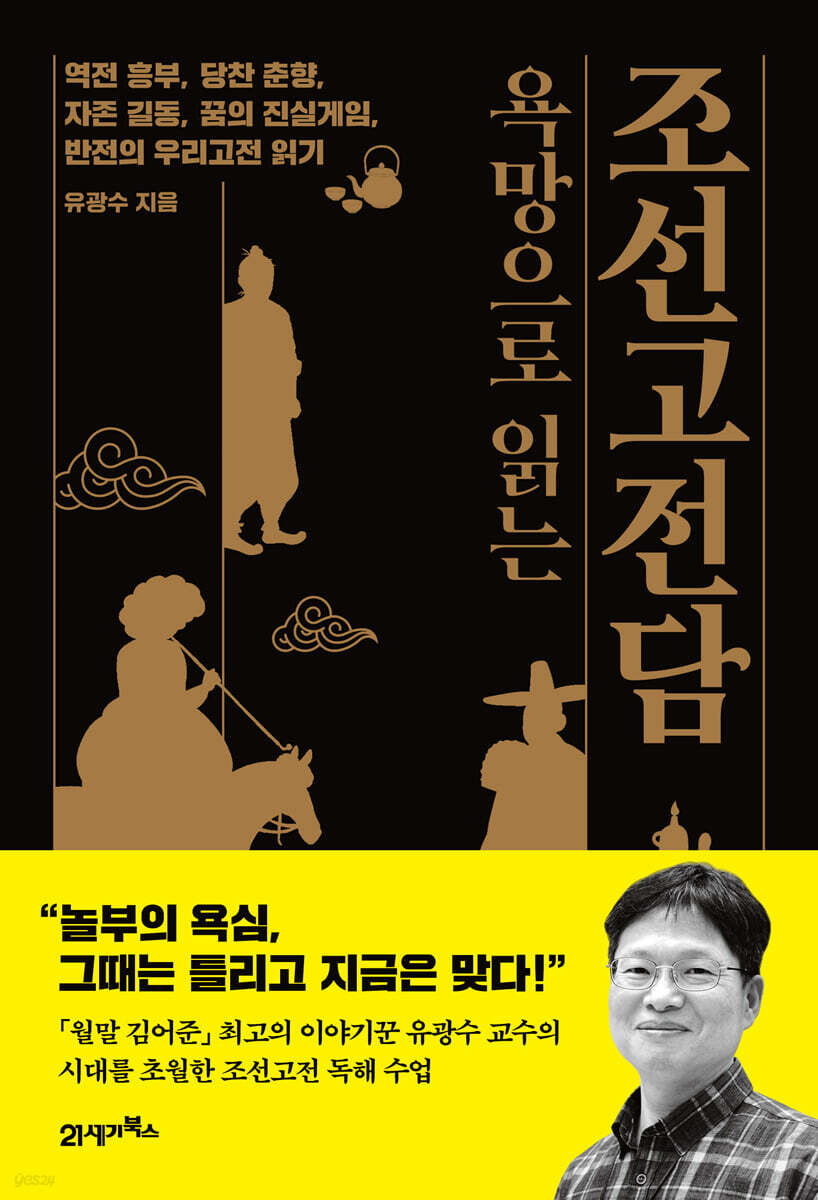
Reading Joseon Classics with Desire
 |
Description
Book Introduction
A time to add wisdom to my life, 'Life's Great River'
Free from the existing classics that are trapped in lessons
Time for active thinking!
All the essential knowledge you need for life is gathered together! The 22nd book in the "Life Lectures" series, a fascinating knowledge experience presented by Korea's leading professors, has been published.
The Life Lectures series, which transcribes the lectures of the best professors in various fields from universities across the country, including history, philosophy, science, medicine, and art, into books, provides readers with useful knowledge to live today and insight to look forward to tomorrow.
It is a knowledge and culture brand that allows you to encounter the best knowledge content in everyday life through not only books but also online lectures, YouTube, and podcasts.
『Reading Joseon Classics with Desire』 is a classic education book full of twists and subversions in which Professor Yoo Gwang-su, a professional storyteller in the world of classical literature, gives a new and twisted interpretation to representative works of our classics, such as 『The Tale of Heungbu and Nolbu』, 『The Tale of Chunhyang』, 『The Tale of Hong Gildong』, and 『The Dream of the Nine Clouds』.
Professor Yoo Gwang-su has restored the original, cheerful and revolutionary nature of our classics to this book, allowing readers to naturally understand the nature of humanity while reflecting on their lives here and now.
From the binary opposition between good and evil represented by Heungbu and Nolbu, to Chunhyang's struggle for self-determination and revolutionary spirit, to the paradox of fulfilling desires as a created hero, Hong Gildong, and the game of truth through Seongjin and Yang Soyu's dreams, you can encounter four exciting and captivating episodes that will remind you of the fun of classics.
Through this book, you will be able to free yourself from the trappings of conventional wisdom and stereotypes and learn what it means to live a more active and subjective life.
Free from the existing classics that are trapped in lessons
Time for active thinking!
All the essential knowledge you need for life is gathered together! The 22nd book in the "Life Lectures" series, a fascinating knowledge experience presented by Korea's leading professors, has been published.
The Life Lectures series, which transcribes the lectures of the best professors in various fields from universities across the country, including history, philosophy, science, medicine, and art, into books, provides readers with useful knowledge to live today and insight to look forward to tomorrow.
It is a knowledge and culture brand that allows you to encounter the best knowledge content in everyday life through not only books but also online lectures, YouTube, and podcasts.
『Reading Joseon Classics with Desire』 is a classic education book full of twists and subversions in which Professor Yoo Gwang-su, a professional storyteller in the world of classical literature, gives a new and twisted interpretation to representative works of our classics, such as 『The Tale of Heungbu and Nolbu』, 『The Tale of Chunhyang』, 『The Tale of Hong Gildong』, and 『The Dream of the Nine Clouds』.
Professor Yoo Gwang-su has restored the original, cheerful and revolutionary nature of our classics to this book, allowing readers to naturally understand the nature of humanity while reflecting on their lives here and now.
From the binary opposition between good and evil represented by Heungbu and Nolbu, to Chunhyang's struggle for self-determination and revolutionary spirit, to the paradox of fulfilling desires as a created hero, Hong Gildong, and the game of truth through Seongjin and Yang Soyu's dreams, you can encounter four exciting and captivating episodes that will remind you of the fun of classics.
Through this book, you will be able to free yourself from the trappings of conventional wisdom and stereotypes and learn what it means to live a more active and subjective life.
- You can preview some of the book's contents.
Preview
index
prolog
Part 1: The Tale of Heungbu and Nolbu
Beyond the binary opposition between Nolbu, who wants to become richer, and Heungbu, who doesn't work
Chapter 1: Three Questions Surrounding the Story of Heungbu and Nolbu
Did Nolbu really share his wealth with Heungbu?
Why didn't Heungbu work?
What did Heungbu's children do?
Chapter 2: "The Tale of Heungbu and Nolbu" is not a story of friendship.
Is Nolbu's greed always bad?
A flower garden of desire and greed
Heungbu was also greedy
Chapter 3: Changes in the Late Joseon Dynasty's Economic Structure Revealed in "The Tale of Heungbu and Nolbu"
A society that is groundbreakingly fair
During the Joseon Dynasty, marriage was basically living with the wife's family.
The true leader of a family is the eldest daughter-in-law of the main family.
Chapter 4: Heungbu and Nolbu's Response to Social Change
Different economic concepts that are too different
Heungbu was the embodiment of desire.
What do the things that came out of the box symbolize?
Part 2: The Tale of Chunhyang
Chunhyang is not a symbol of chastity, but a revolutionary of self-determination.
Chapter 1: Three Misunderstandings About "Chunhyangjeon"
Chunhyang was pretty
Bangja is not a proper noun
Chunhyang is indeed a gisaeng
Chapter 2: Byun Hak-do is being treated unfairly.
Was Byun Hak-do a corrupt and lecherous official?
A courtesan must listen to the request.
Secret royal inspector Lee Mong-ryong only saved Chunhyang.
Chapter 3: The People's Aspirations and Revolutionary Spirit in "Chunhyangjeon"
"Chunhyangjeon" is not "Lee Mong-ryongjeon."
Did Chunhyang believe that Mongryong Lee would return?
Chunhyang is not the embodiment of chastity.
The protagonist who embodies everyone's aspirations
Part 3: The Tale of Hong Gildong
How did the weakest man, Hong Gil-dong, become a "manufactured hero"?
Chapter 1: Is The Story of Hong Gildong the first Korean novel written by Heo Gyun?
Become a classic stuffed animal
Is this really our country's first novel written in Korean?
What was the basis for saying it was a Korean novel?
Is this really Heo Gyun's work?
Chapter 2: Is Hong Gil-dong's Birth the Prelude to the Birth of a Hero?
Inconsistency between the first and second half
The mistake is the perspective we created.
Was Hong Gil-dong born a hero?
Chapter 3: Awareness of One's Existence and Realization of Desires
Why did Hong Gildong run away from home?
Hwalbindang as proof of self-existence
Hong Gil-dong was a politician and a conqueror.
Chapter 4: Uncomfortable Views and Hopes Surrounding The Story of Hong Gildong
Uncomfortable gaze and distortion
What does The Tale of Hong Gildong mean to us?
Part 4: The Nine Cloud Dreams
The endless cycle of human desire and the story of true enlightenment.
Chapter 1: Why did intellectual Kim Man-jung write "The Nine Cloud Dreams"?
Who is Kim Man-jung?
You said that life is fleeting to comfort your mother?
Chapter 2: The Endless Cycle of Two Desires
The dreamlike story of Seongjin and Palseonnyeo
The Buddhist disciple Seongjin desires the life of a Confucian scholar.
Prime Minister Yang So-yu desires an unshakable life.
The six ambassadors said to wake up from the dream.
Chapter 3: What is a dream and what is not a dream
The fractal structure of deception and deception
Public thought and the dream of a tiger
The cycle of self-memory and self-forgetting
A story of true enlightenment
Main keywords
References
Part 1: The Tale of Heungbu and Nolbu
Beyond the binary opposition between Nolbu, who wants to become richer, and Heungbu, who doesn't work
Chapter 1: Three Questions Surrounding the Story of Heungbu and Nolbu
Did Nolbu really share his wealth with Heungbu?
Why didn't Heungbu work?
What did Heungbu's children do?
Chapter 2: "The Tale of Heungbu and Nolbu" is not a story of friendship.
Is Nolbu's greed always bad?
A flower garden of desire and greed
Heungbu was also greedy
Chapter 3: Changes in the Late Joseon Dynasty's Economic Structure Revealed in "The Tale of Heungbu and Nolbu"
A society that is groundbreakingly fair
During the Joseon Dynasty, marriage was basically living with the wife's family.
The true leader of a family is the eldest daughter-in-law of the main family.
Chapter 4: Heungbu and Nolbu's Response to Social Change
Different economic concepts that are too different
Heungbu was the embodiment of desire.
What do the things that came out of the box symbolize?
Part 2: The Tale of Chunhyang
Chunhyang is not a symbol of chastity, but a revolutionary of self-determination.
Chapter 1: Three Misunderstandings About "Chunhyangjeon"
Chunhyang was pretty
Bangja is not a proper noun
Chunhyang is indeed a gisaeng
Chapter 2: Byun Hak-do is being treated unfairly.
Was Byun Hak-do a corrupt and lecherous official?
A courtesan must listen to the request.
Secret royal inspector Lee Mong-ryong only saved Chunhyang.
Chapter 3: The People's Aspirations and Revolutionary Spirit in "Chunhyangjeon"
"Chunhyangjeon" is not "Lee Mong-ryongjeon."
Did Chunhyang believe that Mongryong Lee would return?
Chunhyang is not the embodiment of chastity.
The protagonist who embodies everyone's aspirations
Part 3: The Tale of Hong Gildong
How did the weakest man, Hong Gil-dong, become a "manufactured hero"?
Chapter 1: Is The Story of Hong Gildong the first Korean novel written by Heo Gyun?
Become a classic stuffed animal
Is this really our country's first novel written in Korean?
What was the basis for saying it was a Korean novel?
Is this really Heo Gyun's work?
Chapter 2: Is Hong Gil-dong's Birth the Prelude to the Birth of a Hero?
Inconsistency between the first and second half
The mistake is the perspective we created.
Was Hong Gil-dong born a hero?
Chapter 3: Awareness of One's Existence and Realization of Desires
Why did Hong Gildong run away from home?
Hwalbindang as proof of self-existence
Hong Gil-dong was a politician and a conqueror.
Chapter 4: Uncomfortable Views and Hopes Surrounding The Story of Hong Gildong
Uncomfortable gaze and distortion
What does The Tale of Hong Gildong mean to us?
Part 4: The Nine Cloud Dreams
The endless cycle of human desire and the story of true enlightenment.
Chapter 1: Why did intellectual Kim Man-jung write "The Nine Cloud Dreams"?
Who is Kim Man-jung?
You said that life is fleeting to comfort your mother?
Chapter 2: The Endless Cycle of Two Desires
The dreamlike story of Seongjin and Palseonnyeo
The Buddhist disciple Seongjin desires the life of a Confucian scholar.
Prime Minister Yang So-yu desires an unshakable life.
The six ambassadors said to wake up from the dream.
Chapter 3: What is a dream and what is not a dream
The fractal structure of deception and deception
Public thought and the dream of a tiger
The cycle of self-memory and self-forgetting
A story of true enlightenment
Main keywords
References
Detailed image

Into the book
It might be very different from what you learned in school.
You may be surprised to learn that "Heungbu and Nolbu" is not a story about friendship, and "Chunhyangjeon" is not a story about a chaste woman.
It is also worth considering whether the author of "The Story of Hong Gildong" was Heo Gyun, and it may be embarrassing to discover that Hong Gildong did something completely different from what we thought.
Moreover, you may feel complicated by the fact that 『Guunmong』 is not a story of a fleeting spring dream.
The culprit that made us think of classics as boring is the indifference and abetment that we just pass them off as 'good, good, good stories.'
By arbitrarily calling up classics to suit our tastes and needs according to the demands of the times and making them into stuffed animals, our classics have been reduced to difficult, boring, and tiring burdens.
However, classics are not a burden to be carried, nor are they meant to be difficult to include in exam questions.
Classics have their own classic quality.
I plan to properly unravel the classics one by one through this book.
--- p.10~11
"Heungbu and Nolbu" is not a game where you have to choose between two people, nor is it a lesson book that tells you to live like one of the two people.
Through the actions of Nolbu and Heungbu, the story of Heungbu goes beyond simple judgments of good and evil and sharply points out that two extremes of life, behavior, thought, and value are equally problematic.
And it eloquently states that the world is a spectrum of countless images spread out between these two extremes, and that our lives lie somewhere in between.
Heungbu and Nolbu are us, and their lives are our lives.
If Heungbu is standing over there with that exact look, Nolbu is standing over here with that exact look.
The two are together.
Of course.
Because they are brothers.
So we stood together and lived together.
Our people read it, saw it, felt it, and enjoyed it.
Because they are people who are just like them.
--- p.92~93
Chunhyang is a protagonist who demonstrates true femininity.
Female hero novels portray women as heroes, but ultimately end up settling within that confines by marrying a man.
However, Chunhyang shows an incredible revolutionary spirit that far surpasses that of female heroes.
I didn't win a war for my country, nor did I pass the civil service exam.
Although she was a mere courtesan who was looked down upon and was nothing, she challenged the problems of her time proactively and with true femininity, and spoke powerfully about what it means to be human.
The people who found out about it were enthusiastic about Chunhyangjeon.
And, of course, it was made into a 'Chunhyangjeon' with 'Chunhyang' as the main character, not Lee Mong-ryong or Byeon Hak-do.
The fact that the protagonist is the most lowly, pitiful, and unreasonable woman of her time, who could be treated with impunity, is one aspect of the revolutionary nature of "Chunhyangjeon."
--- p.136~137
The story of 『The Story of Hong Gildong』 was not strange at all, not offensive at all, and not at all incomprehensible to the common people of the Joseon Dynasty.
It was their story, and I wanted it to be their story.
Hong Gildong was hope.
He was a true hero who reflected the hearts of the ordinary people of his time.
It is not simply because they provided relief, punished corrupt officials, and defeated evildoers, but because they understood their hearts and expressed their true desires through tremendous efforts.
People saw it in Hong Gil-dong.
Their hopes.
The only ones who haven't seen it are foreigners like Allen, later generations who have lived a little, and us who don't want to see the truth.
Let's not make excuses that someone covered up the truth.
Even Hong Pan-seo made excuses about his dream of a dragon.
The truth is sometimes uncomfortable and sometimes painful, but it ultimately triumphs.
Because it's true.
--- p.222
The important thing is not that Seongjin dreamed of becoming a sheep, but that Seongjin dreamed of being reincarnated as a sheep.
That is, the moment when the 'past life-present life-next life' of an existence that cannot be connected to each other is visualized through the device of a dream, that is, the moment when the surprising event of waking up from the dream occurs, we come to know that the essence of existence is connected.
And then you realize the surprising truth that nothing is true, it's just a dream, an illusion.
So, we must understand the endless cycle of reincarnation as if it were a four-verse verse that says, “We must look upon it as a dream, an illusion, a bubble.”
『The Nine Clouds』 is a surprising and fantastic story that embodies the theme throughout the work.
You may be surprised to learn that "Heungbu and Nolbu" is not a story about friendship, and "Chunhyangjeon" is not a story about a chaste woman.
It is also worth considering whether the author of "The Story of Hong Gildong" was Heo Gyun, and it may be embarrassing to discover that Hong Gildong did something completely different from what we thought.
Moreover, you may feel complicated by the fact that 『Guunmong』 is not a story of a fleeting spring dream.
The culprit that made us think of classics as boring is the indifference and abetment that we just pass them off as 'good, good, good stories.'
By arbitrarily calling up classics to suit our tastes and needs according to the demands of the times and making them into stuffed animals, our classics have been reduced to difficult, boring, and tiring burdens.
However, classics are not a burden to be carried, nor are they meant to be difficult to include in exam questions.
Classics have their own classic quality.
I plan to properly unravel the classics one by one through this book.
--- p.10~11
"Heungbu and Nolbu" is not a game where you have to choose between two people, nor is it a lesson book that tells you to live like one of the two people.
Through the actions of Nolbu and Heungbu, the story of Heungbu goes beyond simple judgments of good and evil and sharply points out that two extremes of life, behavior, thought, and value are equally problematic.
And it eloquently states that the world is a spectrum of countless images spread out between these two extremes, and that our lives lie somewhere in between.
Heungbu and Nolbu are us, and their lives are our lives.
If Heungbu is standing over there with that exact look, Nolbu is standing over here with that exact look.
The two are together.
Of course.
Because they are brothers.
So we stood together and lived together.
Our people read it, saw it, felt it, and enjoyed it.
Because they are people who are just like them.
--- p.92~93
Chunhyang is a protagonist who demonstrates true femininity.
Female hero novels portray women as heroes, but ultimately end up settling within that confines by marrying a man.
However, Chunhyang shows an incredible revolutionary spirit that far surpasses that of female heroes.
I didn't win a war for my country, nor did I pass the civil service exam.
Although she was a mere courtesan who was looked down upon and was nothing, she challenged the problems of her time proactively and with true femininity, and spoke powerfully about what it means to be human.
The people who found out about it were enthusiastic about Chunhyangjeon.
And, of course, it was made into a 'Chunhyangjeon' with 'Chunhyang' as the main character, not Lee Mong-ryong or Byeon Hak-do.
The fact that the protagonist is the most lowly, pitiful, and unreasonable woman of her time, who could be treated with impunity, is one aspect of the revolutionary nature of "Chunhyangjeon."
--- p.136~137
The story of 『The Story of Hong Gildong』 was not strange at all, not offensive at all, and not at all incomprehensible to the common people of the Joseon Dynasty.
It was their story, and I wanted it to be their story.
Hong Gildong was hope.
He was a true hero who reflected the hearts of the ordinary people of his time.
It is not simply because they provided relief, punished corrupt officials, and defeated evildoers, but because they understood their hearts and expressed their true desires through tremendous efforts.
People saw it in Hong Gil-dong.
Their hopes.
The only ones who haven't seen it are foreigners like Allen, later generations who have lived a little, and us who don't want to see the truth.
Let's not make excuses that someone covered up the truth.
Even Hong Pan-seo made excuses about his dream of a dragon.
The truth is sometimes uncomfortable and sometimes painful, but it ultimately triumphs.
Because it's true.
--- p.222
The important thing is not that Seongjin dreamed of becoming a sheep, but that Seongjin dreamed of being reincarnated as a sheep.
That is, the moment when the 'past life-present life-next life' of an existence that cannot be connected to each other is visualized through the device of a dream, that is, the moment when the surprising event of waking up from the dream occurs, we come to know that the essence of existence is connected.
And then you realize the surprising truth that nothing is true, it's just a dream, an illusion.
So, we must understand the endless cycle of reincarnation as if it were a four-verse verse that says, “We must look upon it as a dream, an illusion, a bubble.”
『The Nine Clouds』 is a surprising and fantastic story that embodies the theme throughout the work.
--- p.280
Publisher's Review
Heungbu was actually just as greedy as Nolbu?
A Guide to Reading Classics for Those Who Find Classics Boring
We live in an age where we can access all the 'stories' in the world with just a touch of a finger.
As the culture of consuming stimulating content that shouts "dopamine explosion" becomes mainstream, classics have become boring, like homework, for modern people.
Professor Yoo Gwang-su, a professional storyteller who interprets classical literature in light of our current lives, presents a new perspective through "Reading Classical Tales with Desire," freeing us from the tedious notion that classics must always contain lessons.
He says that one might be surprised to learn that "Heungbu and Nolbu" is not a story about friendship, and "Chunhyangjeon" is not a story about a chaste woman.
It is said that Hong Gil-dong in 『The Story of Hong Gil-dong』 may be embarrassed by doing something completely different from what we expected, and that we may be surprised that 『The Nine Cloud Dreams』 is not a story about a fleeting spring dream.
When we read a classic work, we must not simply understand the plot; we must understand the context and culture of the era in which it was written, and reflect on it in relation to our own lives today.
Classics are not to be revered as scriptures, but rather to be read and enjoyed without burden and to be utilized well in our lives.
I hope that by reading this book and following the fascinating classic stories told by Professor Yoo Gwang-su, you will not only broaden your thinking but also experience the joy of reading classics.
The reversal of Heungbu, the bold Chunhyang, the self-respecting Gildong, and the dream truth game Seongjin
A lecture on rereading Korean classics with four keywords: reversal and subversion.
This book provides a fresh explanation of four representative classical works from the Joseon Dynasty, well known to everyone, through the keyword of "desire," a universal human emotion.
In Chapter 1, the author points out that "The Tale of Heungbu" is a story about greed, and that Heungbu was in fact just as greedy as Nolbu.
It contains a story that interprets not only Nolbu's greed, which is excessive in pursuing wealth and harming others, but also Heungbu's greed, which is excessive and harms himself and ultimately ruins those around him, as problematic.
Chapter 2 deals with the ideology of the chaste woman in Chunhyangjeon.
Chunhyang's refusal of the magistrate's request was for her own sake, regardless of Mongryong Lee's, and it was a declaration that "my body is mine, so I can do whatever I want with it," showing her desire to fight against the ideas of the time and struggle against society.
Chapter 3 focuses on the debate over whether The Story of Hong Gildong is truly the first Korean novel and on the questions surrounding Hong Gildong's conquest of Yuldo.
Why did Hong Gildong, a righteous man in the first half, conquer Yuldo Kingdom, which was enjoying a period of peace in the second half? The author emphasizes that the discrepancy between the first and second half stems from his desire to demonstrate to Joseon society what he could achieve despite being discriminated against as an illegitimate child—in other words, his desire to prove his own worth.
Chapter 4 tells us that we must break the distinction between “real” and “fake” through “Nine Cloud Dreams,” which tells the story of Seongjin, a Buddhist disciple, who harbors a desire for the secular world and dreams of being reborn as a Yang Soyu to achieve wealth and fame.
Through this, we gain insight into the idea of emptiness, which states that even the idea that 'everything in the world is meaningless' is meaningless.
"Reading Classic Tales with Desire" restores our classics, which have been stuffed with boring interpretations and lessons under the pretext of meeting the demands of the times, to their original form, allowing them to live and breathe in our hearts.
Shaking off the dust of existing stereotypes and actively changing our perceptions is the way to truly enjoy classics as classics.
"Life's Great Lectures," a knowledge-sharing project by Korea's top professors.
Life Lectures is a series that compiles lectures by renowned professors from universities across the country, and is a sister brand of 'Seogamyeonggang (famous lectures you can listen to without going to Seoul National University),' which compiles lectures by Seoul National University professors.
Lectures by Korea's leading scholars have been reconstructed into useful knowledge content for our lives, making them readily available not only through books but also through online lectures, YouTube, podcasts, and Instagram.
This course provides an opportunity for professionals seeking wisdom in their work, at home, and in interpersonal relationships, young people contemplating their career path, and everyone in need of solutions at every critical juncture in life to easily watch, listen to, and learn from renowned lectures delivered by leading experts in their respective fields.
A Guide to Reading Classics for Those Who Find Classics Boring
We live in an age where we can access all the 'stories' in the world with just a touch of a finger.
As the culture of consuming stimulating content that shouts "dopamine explosion" becomes mainstream, classics have become boring, like homework, for modern people.
Professor Yoo Gwang-su, a professional storyteller who interprets classical literature in light of our current lives, presents a new perspective through "Reading Classical Tales with Desire," freeing us from the tedious notion that classics must always contain lessons.
He says that one might be surprised to learn that "Heungbu and Nolbu" is not a story about friendship, and "Chunhyangjeon" is not a story about a chaste woman.
It is said that Hong Gil-dong in 『The Story of Hong Gil-dong』 may be embarrassed by doing something completely different from what we expected, and that we may be surprised that 『The Nine Cloud Dreams』 is not a story about a fleeting spring dream.
When we read a classic work, we must not simply understand the plot; we must understand the context and culture of the era in which it was written, and reflect on it in relation to our own lives today.
Classics are not to be revered as scriptures, but rather to be read and enjoyed without burden and to be utilized well in our lives.
I hope that by reading this book and following the fascinating classic stories told by Professor Yoo Gwang-su, you will not only broaden your thinking but also experience the joy of reading classics.
The reversal of Heungbu, the bold Chunhyang, the self-respecting Gildong, and the dream truth game Seongjin
A lecture on rereading Korean classics with four keywords: reversal and subversion.
This book provides a fresh explanation of four representative classical works from the Joseon Dynasty, well known to everyone, through the keyword of "desire," a universal human emotion.
In Chapter 1, the author points out that "The Tale of Heungbu" is a story about greed, and that Heungbu was in fact just as greedy as Nolbu.
It contains a story that interprets not only Nolbu's greed, which is excessive in pursuing wealth and harming others, but also Heungbu's greed, which is excessive and harms himself and ultimately ruins those around him, as problematic.
Chapter 2 deals with the ideology of the chaste woman in Chunhyangjeon.
Chunhyang's refusal of the magistrate's request was for her own sake, regardless of Mongryong Lee's, and it was a declaration that "my body is mine, so I can do whatever I want with it," showing her desire to fight against the ideas of the time and struggle against society.
Chapter 3 focuses on the debate over whether The Story of Hong Gildong is truly the first Korean novel and on the questions surrounding Hong Gildong's conquest of Yuldo.
Why did Hong Gildong, a righteous man in the first half, conquer Yuldo Kingdom, which was enjoying a period of peace in the second half? The author emphasizes that the discrepancy between the first and second half stems from his desire to demonstrate to Joseon society what he could achieve despite being discriminated against as an illegitimate child—in other words, his desire to prove his own worth.
Chapter 4 tells us that we must break the distinction between “real” and “fake” through “Nine Cloud Dreams,” which tells the story of Seongjin, a Buddhist disciple, who harbors a desire for the secular world and dreams of being reborn as a Yang Soyu to achieve wealth and fame.
Through this, we gain insight into the idea of emptiness, which states that even the idea that 'everything in the world is meaningless' is meaningless.
"Reading Classic Tales with Desire" restores our classics, which have been stuffed with boring interpretations and lessons under the pretext of meeting the demands of the times, to their original form, allowing them to live and breathe in our hearts.
Shaking off the dust of existing stereotypes and actively changing our perceptions is the way to truly enjoy classics as classics.
"Life's Great Lectures," a knowledge-sharing project by Korea's top professors.
Life Lectures is a series that compiles lectures by renowned professors from universities across the country, and is a sister brand of 'Seogamyeonggang (famous lectures you can listen to without going to Seoul National University),' which compiles lectures by Seoul National University professors.
Lectures by Korea's leading scholars have been reconstructed into useful knowledge content for our lives, making them readily available not only through books but also through online lectures, YouTube, podcasts, and Instagram.
This course provides an opportunity for professionals seeking wisdom in their work, at home, and in interpersonal relationships, young people contemplating their career path, and everyone in need of solutions at every critical juncture in life to easily watch, listen to, and learn from renowned lectures delivered by leading experts in their respective fields.
GOODS SPECIFICS
- Date of issue: March 15, 2024
- Page count, weight, size: 288 pages | 316g | 128*188*20mm
- ISBN13: 9791171174683
- ISBN10: 1171174683
You may also like
카테고리
korean


korean

![GQ KOREA Mark (Monthly): December [2025]](http://librairie.coreenne.fr/cdn/shop/files/8ef265dbbfbf186523ed75ba7319009d.jpg?v=1765340328&width=3840)


