

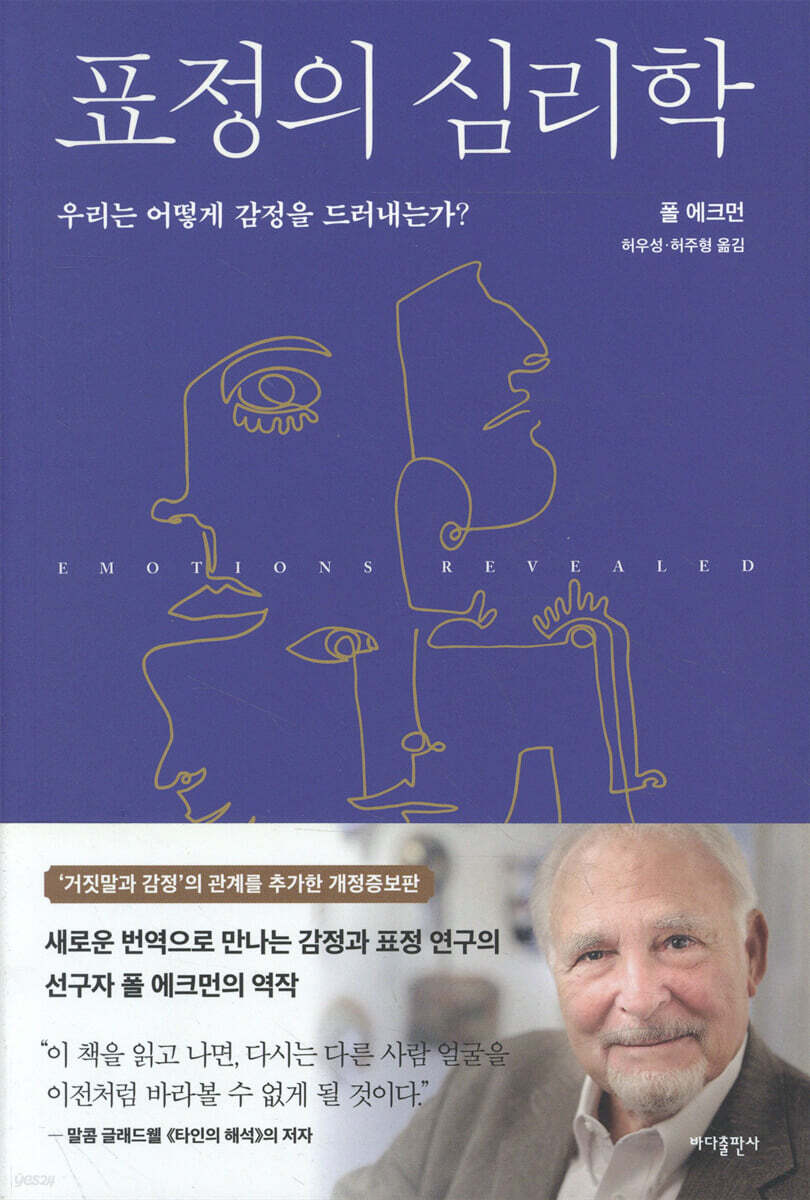
Psychology of facial expressions
 |
Description
Book Introduction
Revised and expanded edition with new translations and additions to "Lies and Emotions"
A masterpiece by Paul Ekman, a master of emotion and facial expression research
"The Psychology of Facial Expressions" is a masterpiece by Paul Ekman, who revolutionized the scientific understanding of facial expressions and emotions. It reveals the process of his 40-year research on facial expressions and reports on the results.
In this book, based on ten years of field research, he answers important questions about emotions and facial expressions, such as, "How are emotions expressed in facial expressions, and what emotional signals do specific facial expressions convey?" and "What triggers emotions, and can we control them?"
Through cross-cultural research, he demonstrates that the relationship between emotions and facial expressions is universal, and explains the characteristics of representative emotions and their facial expressions based on research on the Facial Expression Coding System (FACS). In the final chapter, he discusses how to recognize changes in facial expressions that occur when someone lies.
A masterpiece by Paul Ekman, a master of emotion and facial expression research
"The Psychology of Facial Expressions" is a masterpiece by Paul Ekman, who revolutionized the scientific understanding of facial expressions and emotions. It reveals the process of his 40-year research on facial expressions and reports on the results.
In this book, based on ten years of field research, he answers important questions about emotions and facial expressions, such as, "How are emotions expressed in facial expressions, and what emotional signals do specific facial expressions convey?" and "What triggers emotions, and can we control them?"
Through cross-cultural research, he demonstrates that the relationship between emotions and facial expressions is universal, and explains the characteristics of representative emotions and their facial expressions based on research on the Facial Expression Coding System (FACS). In the final chapter, he discusses how to recognize changes in facial expressions that occur when someone lies.
- You can preview some of the book's contents.
Preview
index
Preface to the Revised Edition
preface
1. Emotions that transcend culture
2 When do we become emotional?
3 How can I avoid becoming emotional?
4. Managing Emotional Behavior
5 Sorrow and Pain
6 Anger
7 Surprise and fear
8 Disgust and Contempt
9 Happy Emotions
10 Lies and Emotions
Conclusion: Living with Emotions
Reviews
Appendix: Facial Expression Reading Test
Acknowledgements
Translator's Note
main
Search
preface
1. Emotions that transcend culture
2 When do we become emotional?
3 How can I avoid becoming emotional?
4. Managing Emotional Behavior
5 Sorrow and Pain
6 Anger
7 Surprise and fear
8 Disgust and Contempt
9 Happy Emotions
10 Lies and Emotions
Conclusion: Living with Emotions
Reviews
Appendix: Facial Expression Reading Test
Acknowledgements
Translator's Note
main
Search
Detailed image

Publisher's Review
Revised and expanded edition with new translations and additions to "Lies and Emotions"
A masterpiece by Paul Ekman, a master of emotion and facial expression research
《The Psychology of Facial Expressions》 is a masterpiece by Paul Ekman, who revolutionized the scientific understanding of facial expressions and emotions. It is a book that reveals the process of his 40 years of research on facial expressions and reports the results.
In this book, based on ten years of field research, he answers important questions about emotions and facial expressions, such as, "How are emotions expressed in facial expressions, and what emotional signals do specific facial expressions convey?" and "What triggers emotions, and can we control them?"
Through cross-cultural research, he demonstrates that the relationship between emotions and facial expressions is universal, and explains the characteristics of representative emotions and their facial expressions based on research on the Facial Expression Coding System (FACS). In the final chapter, he discusses how to recognize changes in facial expressions that occur when someone lies.
This revised and expanded edition (formerly titled "The Psychology of the Face"), featuring a new chapter titled "Lies and Emotions," a revised preface, and revised concluding remarks and afterwords, will deepen readers' understanding of facial expressions and emotions with a more accurate and user-friendly new translation.
Paul Ekman, a pioneer in tracking the relationship between emotions and facial expressions
《The Psychology of Expression》 is the representative work of American psychologist Paul Ekman, a leading expert in the study of emotions and facial expressions.
Ekman, who first developed a method to objectively measure facial expressions by analyzing over 10,000 facial movements and developed lie detection techniques by analyzing “non-expressions” that momentarily reveal hidden emotions beneath fake facial expressions, is one of the most influential psychologists today.
This revised and expanded edition, which includes a new chapter on the relationship between 'Lies and Emotions,' provides a practical and useful guide to reading emotions in ourselves and others, from the typical facial expressions of representative emotions (sadness and pain, anger, surprise and fear, disgust and contempt, joy) to the subtle expressions when we begin to feel each emotion or suppress it, through abundant photographs and examples.
Are facial expressions innate or learned?
In the late 1950s, when Paul Ekman began studying facial expressions, the academic world, where cultural anthropology was at its peak of influence, was dominated by the view that 'facial expressions are socially learned and vary across cultures.'
Ekman showed the same photographs to people from different cultures, including Chile, Argentina, Brazil, Japan, and the United States, and asked them to rate the emotions they felt.
The majority gave the same verdict, suggesting that the expression may be universal across humanity.
However, it is also possible that the subjects learned the meaning of Western facial expressions and emotions through TV and movies.
So he tried the same experiment on people from a culture that was completely isolated from the outside world, with no TV or magazines.
His two experiments with the Fore people of the highlands of Papua New Guinea in 1967 and 1968 supported Darwin's claim that facial expressions are universal.
If facial expressions need to be learned, then congenitally blind people would make different facial expressions than sighted people.
But they also make the same facial expressions when they experience the same emotions.
Ekman explained the counterexample found by many anthropologists (“People in many cultures laugh when they are unhappy”) with the concept of “display rules.”
That is, while emotions and facial expressions are universal, the rules for managing facial expressions are socially learned and vary across cultures.
So when you're alone, your natural expressions may appear, but when you're around other people, you may show a managed expression.
Objectively measure facial expressions
Having confirmed the universality of emotions and facial expressions, Ekman began to study tools for measuring facial expressions in earnest in the 1970s.
In the process, he inserted needles into his own face and applied electrical stimulation to contract the muscles, and in doing so, he developed a method to identify more than 10,000 facial expressions and anatomically measure facial movements.
Using the FACS he announced in 1978, computer scientists around the world are today creating automated emotion recognition programs using artificial intelligence.
This book covers facial expressions of sadness, pain, anger, surprise, fear, disgust, contempt, and joy.
At one time, Ekman called these emotions "basic emotions," but in this book he no longer insists on that term.
Ekman does not deny that there are other emotions, such as guilt, shame, embarrassment, and envy, but he does not discuss them in this book because they do not have distinctive facial expressions that can distinguish them from each other.
Ekman also argues against the tendency to unconditionally eliminate things like sadness, anger, and fear, which he calls "negative emotions."
This attitude ignores the differences between emotions, as negative emotions are not necessarily perceived as unpleasant.
On the contrary, many people enjoy angry arguments, horror movies, and sad stories.
The 2015 Pixar animation Inside Out, for which Ekman served as scientific advisor, personifies the main emotions covered in the book as Joy (joy), Sadness (sadness and pain), Anger (anger), Disgust (disgust and contempt), and Fear (surprise and fear), movingly conveying the message that we can become emotionally mature by embracing negative emotions like sadness rather than trying to block them out.
How to identify representative emotions
Ekman covers one emotion in each chapter, describing its characteristics and typical facial expressions, offering exercises to help you experience that emotion yourself, and analyzing the subtle features that can be observed in the eyes, eyelids, eyebrows, mouth, lips, chin, and cheeks when they appear on other people's faces, along with photographs of his daughter Eve's facial expressions.
Although these expressions are so familiar to us, it is often difficult to determine what emotions they represent, because they are not typical (complete) expressions, but rather 'partial expressions' or 'weak expressions'.
That is, when emotions are just beginning, weak, or suppressed.
Ekman calls these three expressions, including the 'non-expression', 'subtle expressions' and provides SETT (Subtle Expression Training Tool) on his website (www.paulekman.com) so that anyone can easily practice them.
Ekman talks about happy feelings and cites 'fiero', 'naches', and 'schadenfreude' as examples. Fiero is an Italian word that refers to the pride one feels in one's own accomplishments, naches is a Yiddish word that refers to the joy or pride one feels in one's children, and schadenfreude is a German word that refers to the feeling of rejoicing at the misfortune of others.
Ekman argues that emotions are universal, but that there may not always be an optimal word for them in a particular language, and he refutes the narrow view that if a language does not have a word for something, it cannot be an emotion.
Words are not feelings, they are merely tools for expressing feelings.
How to Respond to Other People's Emotions
Ekman shares a striking anecdote from his time living with the indigenous people of Papua New Guinea.
One day, a native woman came to the city hospital with her sick baby, but unfortunately the baby died.
The doctor and Ekman drove her to the native village.
The woman who had been sitting quietly and expressionlessly in the back seat holding her baby the entire time burst into tears and anguish as soon as she arrived in the village and saw her relatives and friends.
The doctor said she was hypocritical because she showed no emotion in the car but showed ritualistic sadness when she met the villagers.
But Ekman thinks differently.
She lost her baby in a surreal, UFO-like space called a Western-style hospital.
And all the way back I was surrounded by strange white men.
For her, returning to the village was like returning to Earth from Mars, and only when she saw familiar faces did the emotions she had been suppressing explode.
“What the doctor didn’t know was that if we don’t have someone to share our loss with, we may not be able to experience true pain.”
Ekman teaches us not only to recognize the subtle expressions of sadness, anger, fear, disgust, and contempt in others, but also to respond to them and use that information.
The most important thing to keep in mind is not to show it carelessly.
There is no more foolish response than reading a person's anger and then asking them directly, "Why are you angry?"
We don't want our feelings to be revealed as much as we want them to be empathized with.
Above all, it is easy to commit the 'Othello Fallacy'.
When Othello suspects and interrogates her of infidelity, Desdemona feels sadness and fear.
Othello assumes that his wife is grieving the death of her lover Cassio and fearing that her betrayal will be discovered, but in reality her fear is that her jealous husband will try to kill her, and her sadness is despair that with Cassio dead, there is no way to prove her innocence.
We must always keep in mind that other people's emotions may have other causes that we are not aware of, and we must be wary of making hasty judgments.
Lies and expressionless faces
While developing FACS, Ekman heard a case of a depressed patient lying.
The patient gave a bright interview before being discharged, saying that he was completely cured, but in fact, he was thinking of going home and committing suicide.
Ekman carefully examined the patient's interview footage frame by frame, and noticed that when the doctor asked about his future plans, the patient paused for a moment, and a look of intense pain flashed across his face.
Ekman calls these very quick, fleeting facial movements that occur between 1/25th and 1/5th of a second when lying "microexpressions," and argues that they are crucial evidence that "leaks" repressed or suppressed emotions.
In a new chapter in this revised and expanded edition, "Lies and Emotions," Ekman introduces various techniques for detecting concealed emotions and fabricated expressions, such as unnatural facial asymmetry and the absence of involuntary muscle movements.
A famous example of the latter is the 'Duchenne laugh' (discovered over 100 years ago by the French neurologist Duchenne de Boulogne).
When we laugh with genuine joy, the outer part of the orbicularis oculi muscle moves (thus creating crow's feet, narrowing the eyes, and raising the cheeks), but in fake laughter, the subtle movements of the eyebrows and brows, such as pulling down, do not occur.
Since then, Ekman has focused on ways to utilize the results of his research on expressionless objects for national security, and the "Truth Assessment Training Program" he developed is being used in practice by various law enforcement agencies, including the FBI and CIA.
Representative examples include training for staff at the U.S. Department of State's Foreign Service Inspectorate (FSI), which handles visa interviews for travelers coming to the U.S. from around the world, and the Transportation Security Administration's (TSA) "Passenger Screening by Observation Technology (SPOT)" program, which identifies illegal immigrants, smugglers, and terrorists simply by observing suspicious behavior in airport waiting lines.
As his reputation as an expert in lie detection through facial expressions grew, a drama based on him, "Lie To Me," was produced and became very popular.
Emotional mechanisms and attention
According to Ekman, emotions are an "automatic evaluation mechanism" that detects situations that threaten our well-being 24 hours a day, allowing us to quickly prepare for critical situations that could put our lives at risk, such as a sudden car accident.
This automatic evaluation mechanism is wary of two types of emotional triggers: universal "themes" imprinted by evolution and specific "variations" resulting from acquired learning.
(For example, feeling fear of a threat is a 'theme', while feeling fear of a New Guinean native being attacked by a wild boar or a modern city dweller being attacked by a robber is a 'variant'.) The further the variation is from the theme, the more we spend time reflecting on what has happened.
When we consciously become aware of the evaluation process in this way, it is called ‘reflective evaluation.’
Everyone has probably had the experience of acting out of emotion and then regretting it.
How can such emotional behavior be moderated or controlled? Ekman says he gained significant insight from a discussion about emotions with the Dalai Lama in 2000.
Buddhist practice seeks to replace automatic evaluation with reflective evaluation in order to free oneself from destructive emotions.
To do that, you must first become aware of the moment when automatic evaluation occurs, which in Buddhism is called ‘mindfulness.’
In contrast to this awareness, which can only be achieved through long-term meditative practice, Ekman suggests a method that even ordinary people can achieve: 'attentiveness,' a kind of meta-consciousness that makes one aware that one is feeling an emotion.
That is, immediately after an emotion arises, you become aware that you are emotional and re-evaluate the event and your reaction.
He says that if you familiarize yourself with the various emotional triggers presented in this book and carefully observe the representative signals displayed on other people's facial expressions, this kind of focused attention, although not easy, is not impossible.
A masterpiece by Paul Ekman, a master of emotion and facial expression research
《The Psychology of Facial Expressions》 is a masterpiece by Paul Ekman, who revolutionized the scientific understanding of facial expressions and emotions. It is a book that reveals the process of his 40 years of research on facial expressions and reports the results.
In this book, based on ten years of field research, he answers important questions about emotions and facial expressions, such as, "How are emotions expressed in facial expressions, and what emotional signals do specific facial expressions convey?" and "What triggers emotions, and can we control them?"
Through cross-cultural research, he demonstrates that the relationship between emotions and facial expressions is universal, and explains the characteristics of representative emotions and their facial expressions based on research on the Facial Expression Coding System (FACS). In the final chapter, he discusses how to recognize changes in facial expressions that occur when someone lies.
This revised and expanded edition (formerly titled "The Psychology of the Face"), featuring a new chapter titled "Lies and Emotions," a revised preface, and revised concluding remarks and afterwords, will deepen readers' understanding of facial expressions and emotions with a more accurate and user-friendly new translation.
Paul Ekman, a pioneer in tracking the relationship between emotions and facial expressions
《The Psychology of Expression》 is the representative work of American psychologist Paul Ekman, a leading expert in the study of emotions and facial expressions.
Ekman, who first developed a method to objectively measure facial expressions by analyzing over 10,000 facial movements and developed lie detection techniques by analyzing “non-expressions” that momentarily reveal hidden emotions beneath fake facial expressions, is one of the most influential psychologists today.
This revised and expanded edition, which includes a new chapter on the relationship between 'Lies and Emotions,' provides a practical and useful guide to reading emotions in ourselves and others, from the typical facial expressions of representative emotions (sadness and pain, anger, surprise and fear, disgust and contempt, joy) to the subtle expressions when we begin to feel each emotion or suppress it, through abundant photographs and examples.
Are facial expressions innate or learned?
In the late 1950s, when Paul Ekman began studying facial expressions, the academic world, where cultural anthropology was at its peak of influence, was dominated by the view that 'facial expressions are socially learned and vary across cultures.'
Ekman showed the same photographs to people from different cultures, including Chile, Argentina, Brazil, Japan, and the United States, and asked them to rate the emotions they felt.
The majority gave the same verdict, suggesting that the expression may be universal across humanity.
However, it is also possible that the subjects learned the meaning of Western facial expressions and emotions through TV and movies.
So he tried the same experiment on people from a culture that was completely isolated from the outside world, with no TV or magazines.
His two experiments with the Fore people of the highlands of Papua New Guinea in 1967 and 1968 supported Darwin's claim that facial expressions are universal.
If facial expressions need to be learned, then congenitally blind people would make different facial expressions than sighted people.
But they also make the same facial expressions when they experience the same emotions.
Ekman explained the counterexample found by many anthropologists (“People in many cultures laugh when they are unhappy”) with the concept of “display rules.”
That is, while emotions and facial expressions are universal, the rules for managing facial expressions are socially learned and vary across cultures.
So when you're alone, your natural expressions may appear, but when you're around other people, you may show a managed expression.
Objectively measure facial expressions
Having confirmed the universality of emotions and facial expressions, Ekman began to study tools for measuring facial expressions in earnest in the 1970s.
In the process, he inserted needles into his own face and applied electrical stimulation to contract the muscles, and in doing so, he developed a method to identify more than 10,000 facial expressions and anatomically measure facial movements.
Using the FACS he announced in 1978, computer scientists around the world are today creating automated emotion recognition programs using artificial intelligence.
This book covers facial expressions of sadness, pain, anger, surprise, fear, disgust, contempt, and joy.
At one time, Ekman called these emotions "basic emotions," but in this book he no longer insists on that term.
Ekman does not deny that there are other emotions, such as guilt, shame, embarrassment, and envy, but he does not discuss them in this book because they do not have distinctive facial expressions that can distinguish them from each other.
Ekman also argues against the tendency to unconditionally eliminate things like sadness, anger, and fear, which he calls "negative emotions."
This attitude ignores the differences between emotions, as negative emotions are not necessarily perceived as unpleasant.
On the contrary, many people enjoy angry arguments, horror movies, and sad stories.
The 2015 Pixar animation Inside Out, for which Ekman served as scientific advisor, personifies the main emotions covered in the book as Joy (joy), Sadness (sadness and pain), Anger (anger), Disgust (disgust and contempt), and Fear (surprise and fear), movingly conveying the message that we can become emotionally mature by embracing negative emotions like sadness rather than trying to block them out.
How to identify representative emotions
Ekman covers one emotion in each chapter, describing its characteristics and typical facial expressions, offering exercises to help you experience that emotion yourself, and analyzing the subtle features that can be observed in the eyes, eyelids, eyebrows, mouth, lips, chin, and cheeks when they appear on other people's faces, along with photographs of his daughter Eve's facial expressions.
Although these expressions are so familiar to us, it is often difficult to determine what emotions they represent, because they are not typical (complete) expressions, but rather 'partial expressions' or 'weak expressions'.
That is, when emotions are just beginning, weak, or suppressed.
Ekman calls these three expressions, including the 'non-expression', 'subtle expressions' and provides SETT (Subtle Expression Training Tool) on his website (www.paulekman.com) so that anyone can easily practice them.
Ekman talks about happy feelings and cites 'fiero', 'naches', and 'schadenfreude' as examples. Fiero is an Italian word that refers to the pride one feels in one's own accomplishments, naches is a Yiddish word that refers to the joy or pride one feels in one's children, and schadenfreude is a German word that refers to the feeling of rejoicing at the misfortune of others.
Ekman argues that emotions are universal, but that there may not always be an optimal word for them in a particular language, and he refutes the narrow view that if a language does not have a word for something, it cannot be an emotion.
Words are not feelings, they are merely tools for expressing feelings.
How to Respond to Other People's Emotions
Ekman shares a striking anecdote from his time living with the indigenous people of Papua New Guinea.
One day, a native woman came to the city hospital with her sick baby, but unfortunately the baby died.
The doctor and Ekman drove her to the native village.
The woman who had been sitting quietly and expressionlessly in the back seat holding her baby the entire time burst into tears and anguish as soon as she arrived in the village and saw her relatives and friends.
The doctor said she was hypocritical because she showed no emotion in the car but showed ritualistic sadness when she met the villagers.
But Ekman thinks differently.
She lost her baby in a surreal, UFO-like space called a Western-style hospital.
And all the way back I was surrounded by strange white men.
For her, returning to the village was like returning to Earth from Mars, and only when she saw familiar faces did the emotions she had been suppressing explode.
“What the doctor didn’t know was that if we don’t have someone to share our loss with, we may not be able to experience true pain.”
Ekman teaches us not only to recognize the subtle expressions of sadness, anger, fear, disgust, and contempt in others, but also to respond to them and use that information.
The most important thing to keep in mind is not to show it carelessly.
There is no more foolish response than reading a person's anger and then asking them directly, "Why are you angry?"
We don't want our feelings to be revealed as much as we want them to be empathized with.
Above all, it is easy to commit the 'Othello Fallacy'.
When Othello suspects and interrogates her of infidelity, Desdemona feels sadness and fear.
Othello assumes that his wife is grieving the death of her lover Cassio and fearing that her betrayal will be discovered, but in reality her fear is that her jealous husband will try to kill her, and her sadness is despair that with Cassio dead, there is no way to prove her innocence.
We must always keep in mind that other people's emotions may have other causes that we are not aware of, and we must be wary of making hasty judgments.
Lies and expressionless faces
While developing FACS, Ekman heard a case of a depressed patient lying.
The patient gave a bright interview before being discharged, saying that he was completely cured, but in fact, he was thinking of going home and committing suicide.
Ekman carefully examined the patient's interview footage frame by frame, and noticed that when the doctor asked about his future plans, the patient paused for a moment, and a look of intense pain flashed across his face.
Ekman calls these very quick, fleeting facial movements that occur between 1/25th and 1/5th of a second when lying "microexpressions," and argues that they are crucial evidence that "leaks" repressed or suppressed emotions.
In a new chapter in this revised and expanded edition, "Lies and Emotions," Ekman introduces various techniques for detecting concealed emotions and fabricated expressions, such as unnatural facial asymmetry and the absence of involuntary muscle movements.
A famous example of the latter is the 'Duchenne laugh' (discovered over 100 years ago by the French neurologist Duchenne de Boulogne).
When we laugh with genuine joy, the outer part of the orbicularis oculi muscle moves (thus creating crow's feet, narrowing the eyes, and raising the cheeks), but in fake laughter, the subtle movements of the eyebrows and brows, such as pulling down, do not occur.
Since then, Ekman has focused on ways to utilize the results of his research on expressionless objects for national security, and the "Truth Assessment Training Program" he developed is being used in practice by various law enforcement agencies, including the FBI and CIA.
Representative examples include training for staff at the U.S. Department of State's Foreign Service Inspectorate (FSI), which handles visa interviews for travelers coming to the U.S. from around the world, and the Transportation Security Administration's (TSA) "Passenger Screening by Observation Technology (SPOT)" program, which identifies illegal immigrants, smugglers, and terrorists simply by observing suspicious behavior in airport waiting lines.
As his reputation as an expert in lie detection through facial expressions grew, a drama based on him, "Lie To Me," was produced and became very popular.
Emotional mechanisms and attention
According to Ekman, emotions are an "automatic evaluation mechanism" that detects situations that threaten our well-being 24 hours a day, allowing us to quickly prepare for critical situations that could put our lives at risk, such as a sudden car accident.
This automatic evaluation mechanism is wary of two types of emotional triggers: universal "themes" imprinted by evolution and specific "variations" resulting from acquired learning.
(For example, feeling fear of a threat is a 'theme', while feeling fear of a New Guinean native being attacked by a wild boar or a modern city dweller being attacked by a robber is a 'variant'.) The further the variation is from the theme, the more we spend time reflecting on what has happened.
When we consciously become aware of the evaluation process in this way, it is called ‘reflective evaluation.’
Everyone has probably had the experience of acting out of emotion and then regretting it.
How can such emotional behavior be moderated or controlled? Ekman says he gained significant insight from a discussion about emotions with the Dalai Lama in 2000.
Buddhist practice seeks to replace automatic evaluation with reflective evaluation in order to free oneself from destructive emotions.
To do that, you must first become aware of the moment when automatic evaluation occurs, which in Buddhism is called ‘mindfulness.’
In contrast to this awareness, which can only be achieved through long-term meditative practice, Ekman suggests a method that even ordinary people can achieve: 'attentiveness,' a kind of meta-consciousness that makes one aware that one is feeling an emotion.
That is, immediately after an emotion arises, you become aware that you are emotional and re-evaluate the event and your reaction.
He says that if you familiarize yourself with the various emotional triggers presented in this book and carefully observe the representative signals displayed on other people's facial expressions, this kind of focused attention, although not easy, is not impossible.
GOODS SPECIFICS
- Date of issue: September 11, 2020
- Page count, weight, size: 452 pages | 668g | 152*223*30mm
- ISBN13: 9791189932732
- ISBN10: 1189932733
You may also like
카테고리
korean


korean

![GQ KOREA Mark (Monthly): December [2025]](http://librairie.coreenne.fr/cdn/shop/files/8ef265dbbfbf186523ed75ba7319009d.jpg?v=1765340328&width=3840)


